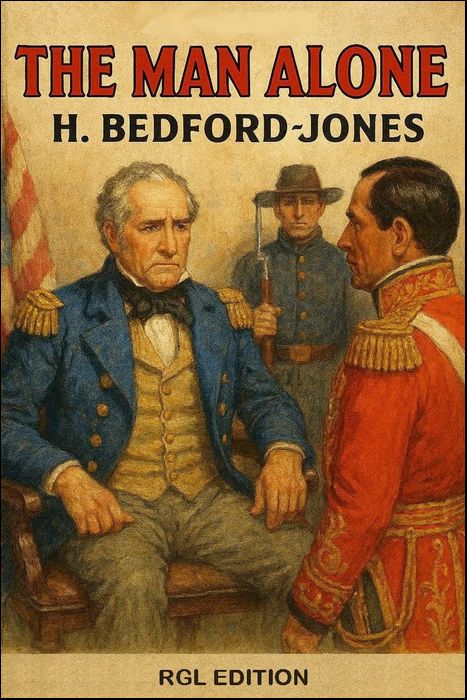
RGL e-Book Cover
Based on an image created with Microsoft Bing software
Roy Glashan's Library
Non sibi sed omnibus
Go to Home Page
This work is out of copyright in countries with a copyright
period of 70 years or less, after the year of the author's death.
If it is under copyright in your country of residence,
do not download or redistribute this file.
Original content added by RGL (e.g., introductions, notes,
RGL covers) is proprietary and protected by copyright.
RGL e-Book Cover
Based on an image created with Microsoft Bing software
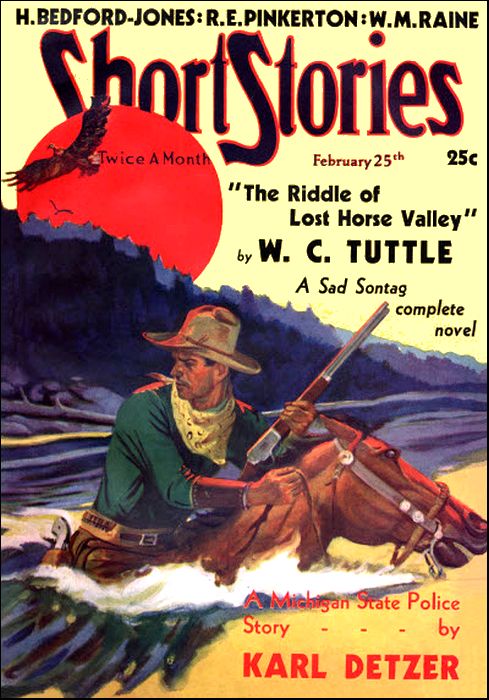
Short Stories, 25 February 1936, with "The Man Alone"
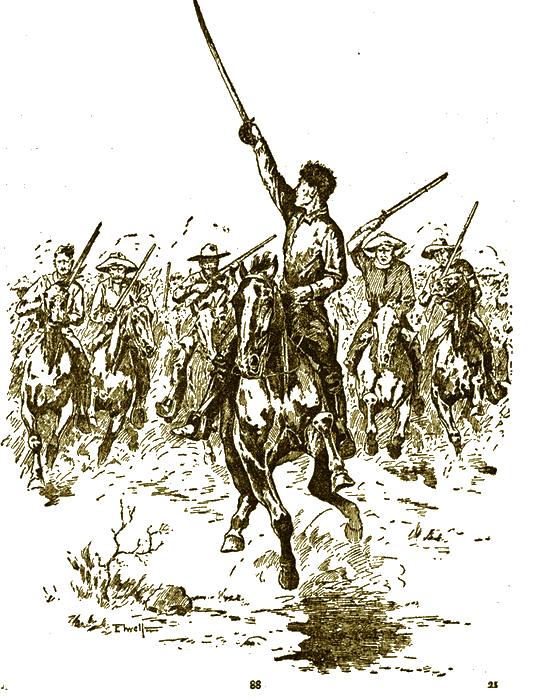
I REACHED the old battlefield of San Jacinto about noon. The Texas sun was hot, a hot breeze swept up from the Gulf; just as on that day a hundred years ago when Sam Houston gave the word to charge. The scene fascinated me, not so much for what had happened here, but for what lay behind it. One man, who had prepared against what never came, and who suddenly seized the fleeting moment and grasped immortality. As I stared across the scene, a lilt of song came to me; it waved in the whispering of the grass and trees, it drifted down the hot sunlight. A man's rough, hoarse voice singing, as though to himself, in throaty exultation:
"We had to win or go under. We fought for a living Cause,
Not for a passel of statesmen working their slobbering jaws;
We planted with powder and bullet, we made a republic grow—
For by God, sir! We founded Texas a hundred years ago!"
I blinked around. Nothing in sight. No one was here. Yet a sudden thin burst of sound lifted, like the thin and distant voices of men in unison roaring forth a wild and hearty yell:
"Here's to you, Gin'ral Houston, damn your eyes!"
Sheer fancy, of course. And yet this ground had been stained deep with the blood of men; yonder river had run scarlet with death, a hundred years ago—
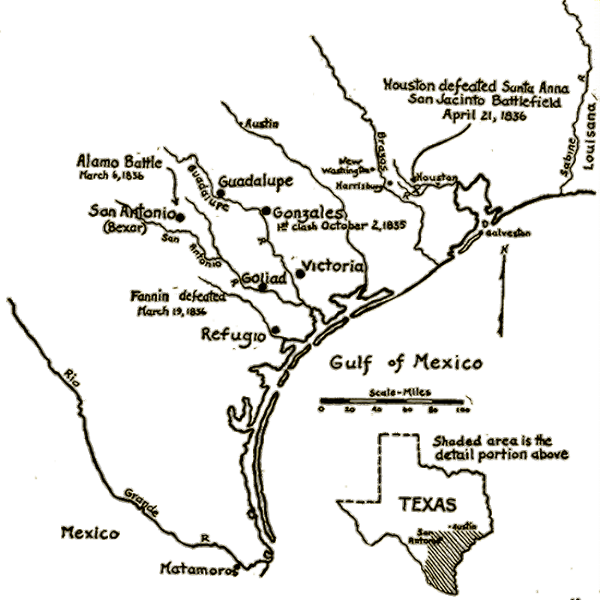
GONZALES, which had witnessed the first shot fired for Texas liberty, was now witnessing a very different scene. Sam Houston and his hastily gathered force, marching to the relief of the Alamo, had halted here. And here the news had reached them.
Consternation, grief, filled the town and camp. Scouts were hurriedly sent forth toward Bexar; a pall of mourning lay over the place. Scarcely a person had not lost friends or relatives in the Alamo. Houston sat with Colonel Sherman, the brave Kentuckian who had come to fight for Texas, and despondency mastered him.
A gaunt man, Houston, massive, powerful, blunt. His deep-set, patient eyes were pools of gray light, deepened by suffering both physical and mental. His gigantic frame wore no uniform, but shabby, baggy, dirty garments. They, like himself, were worn to shreds by what he had endured and spent in the cause of Texas.
"Travis and the rest—all dead!" he growled. "It may not be true. Those two Mexicans who brought the news may have been wrong. We'll hear from Deaf Smith or Karnes or other scouts pretty quick now."
"What'll you do then, Sam?" queried Sherman. He had borne from Kentucky the flag under which the army of Texas marched—a figure of Liberty on a white ground, heavy gold fringe surrounding it.
"God knows!" said Houston. "We've got four hundred men here. I've ordered Fannin to abandon Goliad and fall back to the Guadeloupe. That'll give us four hundred more and some cannon, if he can bring his artillery away. We've got to stop any panic breaking out, or we're done for."
"No panic," said Sherman coolly. "The die is cast now. The Convention has declared for Liberty. We're fighting for freedom, not to keep Texas in the Mexican union. And you're the commander in chief, Sam. They had to come to you at last!"
NO exultation touched the grim bronzed mask of Houston. At last, yes!
All these weary months he had ridden up and down the settlements, preaching liberty, orating, raising men and money. He had been appointed general before, and the politicians gathered at San Felipe had deposed him. They had been fighting among themselves for months in bitter rancor. Mainly, they had been fighting him. They feared his blunt tongue, his vision, his honesty. He was the most powerful man in all Texas, and well they knew it, so the story spread that he wanted to become dictator. He, who had not a dollar nor a home to his name!
Bitterness deepened in his eyes. Two days more, and he would have been in Bexar—but now the Alamo had fallen.
He had four hundred men in his army. How many had come out of Mexico with Santa Anna, no one knew as yet. His army was a pack of volunteers, without discipline. He could give no orders, but only requests. He could punish none. They laughed at any idea of training or order. But they were not laughing tonight, nor was he.
"Sherman, tell me the truth." He lifted the deep gray eyes in a tragic look. "How far can I count on the boys? What do they say about me? I know all that's said of me in San Felipe and so on—but what about the army?"
"They're for you, Sam," said the Kentuckian simply. "They want to fight, and you're the man to lead 'em. All they ask is to meet the Mexicans face to face."
"Yes." The tragic look deepened. Houston's heart sank. "Meet cannon, lancers, trained regiments face to face—with what? Do you know how much artillery, powder and supplies the army has?"
"No," said Sherman in surprise. "Artillery's coming from New Orleans, of course, and I understand there's no lack of transport."
"No lack," said Houston, with a grim smile. "Right now we haven't a cannon. The transport consists of two yoke of oxen, two wagons, and a dozen horses. The equipment of the men is about as good, except for your company of Kentuckians. Chew on that for a spell, and gimme a drink."
Sherman passed over the jug, and Houston lifted it. Suddenly he set it down and leaped to his feet. Shouts were rising through the town and camp. A galloping horse came to a halt outside. Into the headquarters tent burst the scout Karnes, waving a paper. Colonel Austin and other officers followed him in.
"We met up with Mrs. Dickinson twenty mile out," panted Karnes. "Her and a couple negroes—all that's alive out'n the Alamo. Cap'n Dickinson and the kid were killed. Deef Smith stayed to fetch her along in. I come with the news, and this. She got it from General Sesma as she was leaving Bexar—"
HOUSTON seized the paper—a boasting proclamation signed by Santa Anna and ordering death and no quarter to all rebels.
"Well, Karnes? What news?"
"It's all true," groaned the scout. "Every last one dead. Nobody surrendered. And Santy Anny's got thousands and thousands of men, she says. He didn't even bury the bodies, but burned 'em. And he's got another army as big under Gin'ral Urrea who's grabbed Fannin and Goliad by this time. He's a-sweeping all Texas, and she heard some talk that he's a-going right on into the States as well."
So the news of the Alamo was poured forth, while Houston stood with shaggy brows knit and resolve hardening within him. A few hundred men should have gathered at San Felipe by this time, with provisions, powder and stores. He beckoned his aid, Colonel Austin, aside.
"Ride like hell for San Felipe, Bill. I got to stick right here and—what's that, Karnes? What was that last?"
"She says Santy Anny's coming right on, may be here any time," said Karnes. "He aims to burn every house and kill every settler that ain't Mexican by birth. And he's on the way."
"Well, shut your damned mouth about it," snapped Houston, but it was too late now. With an oath, he turned back to Austin. "You see? Now I got to bring off all these here settlers and fight off the Mexicans, if they're coming. Get to San Felipe. Raise every man you can, get powder and transport and cannon somehow! Drill those men if you get a chance. For God's sake check any panic, Bill!"
Austin nodded and departed.
Later, Mrs. Dickinson and the two negroes were brought in. Deaf Smith, the famous scout, came straight to Houston with one of the negroes, who had been the slave of Travis. Houston learned the details, then asked after Mrs. Dickinson.
"Some o' them women are takin' care of her," said Smith. "She's goin' to have a baby pretty soon and she's downright hysterical. She'll raise hell, lemme tell you, Sam."
And she did, poor soul. True, General Sesma was coming with a mere seven hundred dragoons; but Mrs. Dickinson's nerve-shattered fears magnified this into thousands. Neither Houston nor anyone else had definite information on the numbers of Santa Anna's army. It was certainly composed of two or three columns aiming to sweep all Texas, and it was most assuredly some thousands strong, with artillery, lancers and dragoons.
PANIC seized upon Gonzales and upon the army here. The one thought was of flight, and Houston could barely impose some semblance of order on that flight. His own men were deserting hourly, rushing away to get their families and friends out of the tornado's path. These deserters, galloping from town to town, spread wild stories, which grew more wild as they were handed on. Throughout eastern Texas the panic became universal. Every man's intent was now to get his own family to safety, regardless. Every community had but the one thought—to protect its own women and children. Consequently, all thought of joining the army was abandoned. Let others do that! And none did.
Gonzales was abandoned and burned. Slowly, Houston retreated, gathering in all the settlers as he went, protecting the flood of refugees that poured across the wide plains. He sent out frantically for reinforcements and aid. The men from San Felipe joined him and raised his force to six hundred in all. Two cannon were promised, but came not.
So at last he came to the Colorado River of Texas, crossed it, and halted. Various skirmishes had temporarily checked the Mexicans, who were now awaiting their main columns. They were across the river, almost within sight. And here began Sam Houston's weeks of agony, as he devoted himself to drilling his men and keeping them in hand, hoping against hope that Fannin might yet join him.
The few hundred men under his command were the whole hope of Texas. What these men wanted was to fight—and do it now.
Harsh, uncompromising, blunt as ever, he refused flatly to jeopardize Texas until he got artillery, powder, men and food. Rations were scant. Daily Houston looked for word of relief, but his emissaries returned empty-handed. And Santa Anna was advancing, with artillery.
Houston's men jeered at him to his face, hotly telling him that rifles alone would send the Mexicans flying. They begged with him, pleaded with him, swore at him; he remained adamant. President Burnet and the new government, at San Felipe, were moving heaven and earth to raise men and money and guns. Food was coming; let the army wait until it came, with the cannon.
No use. They wore him down, actual mutiny threatened, his authority evaporated. Six hundred men could whip all Mexico! Sherman told him frankly that the men could no longer be controlled, and for his own sake he must yield. So, bitter-hearted, he yielded. It was arranged that on the following morning, the army should cross the river and attack the Mexican camp hand to hand. Details were set forth—and then, suddenly, a scout came in with news.
Johnson's force had been destroyed. Ward had capitulated. Fannin's entire force was captured and massacred—the first definite news of this. And columns of the enemy were pouring forward in overwhelming numbers.
The army was stunned, paralyzed. All thought of attack was given over. Vainly did Houston pronounce the news false—men knew better. The delusion that Texians could not be defeated was gone. Suddenly all the army realized its own weakness.
Next day came further news, and the darkness began indeed to clamp down on Sam Houston. The cabinet, the whole Texan government, was in flight. San Felipe was being abandoned; New Washington, named as the capital, was being abandoned. East to Harrisburg for the government of republican Texas! Harrisburg and safety!
Sam Houston swore heartily and sat him down to write his steadfast friend Rusk, the secretary of war:
"You know I am not easily depressed, but before God I swear that since we parted I have found the darkest hours of my life. For two days and nights I have not eaten an ounce of anything, or slept for a moment...."
RETREAT now, retreat once more. Another flood of frightened settlers to be moved back eastward. Back to San Felipe on the Brazos River—a nightmare march with pitiless cold and rain, with the Mexican dragoons pressing close behind, and a flooded river ahead to cross. It was crossed at last and the bridge destroyed. Another respite now, a chance to hope and breathe.
Vituperation poured upon Houston from every side. What! Run away from these Mexicans? Let them burn and slay on every side without hindrance? Sam Houston was only a lawyer after all. He knew nothing about fighting. He was ruining Texas.
The army murmured. Houston was drilling them day and night, preparing them to meet artillery, cavalry, trained infantry; teaching them to obey orders. Who was he to give them orders anyhow? By God, they were just as good as Sam Houston any day! And they'd prove it. They'd elect another general. Why, he didn't even consult with them or with the officers about what to do! True enough.
"I hold no councils of war," Houston wrote the government. "If I err, the blame is mine."
He drilled them himself, and they hated him for it; but they dared not defy him to his face. The power was there, in those deep gray eyes; the spirit was there, the courage of endurance, the domination that comes from suffering and patience. The one man on whom he could rely utterly was Deaf Smith, the scout, who came and went. Santa Anna was at San Felipe now. If he crossed the Brazos, all was lost. Captain Baker with a handful of men was holding the ford there against him.
One night, without warning, Deaf Smith showed up.
"Fighting," he reported curtly. "Baker's held the ford two days and repulsed Santy Anny, Gin'ral."
"Thank God," breathed Houston. "Sure of it, Deef?"
"Yeah, but that ain't all, Sam. He's got acrost at Thompson's Ferry and is heading for Harrisburg with the hull damned army after him."
"What!" Houston leaped up. "For Harrisburg? But—"
"Ain't no buts, Sam. The president and the cabinet's done skipped out for Galveston. I met up with Rusk, the sec'etery of war, down the road; he's headin' to join up with you. Got a few fellers with him."
Houston sank down on his camp stool, and swallowed hard. "I suppose you don't know anything about how many men Santa Anna has? Or if he's heading down the Brazos—why, he'd have to do that, to reach Harrisburg!"
"He sure is. Got about a thousand men with him. The rest of his army is in two other columns. Sam, one north, one south—hey! What's up?"
For, with one bound, Houston was out of his seat, a flame in his gray eyes.
"Are you sure? Sure? Careful now, Deef! Sure of those numbers?"
"Yeah. We done caught a feller from his column."
"Thank God; oh, thank God!" cried Houston, and grabbed his hat. "Go get some sleep, Deef. We're marching in the morning. See you later."
NO sleep for Sam Houston this night. When Rusk showed up, Houston grappled him in a bearlike embrace. A courier came dashing in, as the army was turning out hastily, with a letter from the acting secretary, who had taken the place of Rusk. A letter of bitter vituperation, demanding action from Houston; a frightened, panicky letter. And the government had fled to Galveston! Houston grinned and tucked the script away.
"We're marching in the morning, boys. Get ready," boomed out Houston's voice as the torches flung red radiance on his bronzed features, no longer weary. "Five hundred and twenty-five men, huh? That's enough, I reckon. You'll get your bellies full o' fight this trip, boys! Dismissed."
Yells of glee, sudden vociferous shouts for Sam Houston. New shouts rang forth, new yells pealed up. Into camp past the sentries slogged a wagon, then another. Two six-pounders, sent by friends of Texas from Cincinnati—here in the nick of time! The packing cases still unopened.
Houston detailed artillery men to get the guns assembled, saw to every detail of preparation himself, came back to headquarters dead tired. There he found Deaf Smith.
"I got me enough sleep, Sam," said the scout. "Let's get busy. Need me?"
"We sure do, Deef. Take all the scouts you can find, and trail Santa Anna's column. If he's heading for Harrisburg, he's bound to cross the river at the Lynchburg ferry. I'll get there first—and if I do, we've got him where we want him! Have word for me sure. We'll set out at daylight, and by next morning ought to be there."
"Got you. Good luck, Sam," and Deaf Smith was gone.
Dead tired as he was, Sam Houston sat gazing into the flame of his candle for a long while before turning in. Suddenly, unexpectedly, he saw the one thing he had prayed heaven to grant him coming true—a chance to smash at the head and center of the whole Mexican army. A thousand men; no more than two to his one. And two cannon had come. It was his hour, his hour, and the hour of Texas!
No haphazard. No mere chance. He saw the thing clearly. From this moment he planned the event. Nothing should spoil his stroke now; whatever happened, he must go through with it as he saw it.
That resolve was to be tested sorely.
Santa Anna would reach Harrisburg, yes; but coming back, he must cross by Lynch's Ferry. Santa Anna, with a thousand men, away from the main body of his army which was sweeping over the whole country! Sam Houston went to bed with ringing thoughts.
Daybreak found him up and off—the last march.
SANTA ANNA not only reached Harrisburg, but burned it. He tried to catch the Texas government, and was within five minutes of bagging the whole crowd from the president down. He took New Washington unhindered, then turned from Galveston Bay and headed through the oaks and brush for Lynch's Ferry. He had no suspicion that Sam Houston was ahead of him.
Ahead of him, yes; and Deaf Smith was on the job. After that long and weary march, the Texas army was worn out. The Mexican vanguard came up. Houston steadily declined battle, ordered his men to eat and sleep. The Cincinnati cannon, the "Twin Sisters," were in battery. The camp was fortified.
Santa Anna described the little camp, with its gaily waving flag bearing the figure of Liberty, and laughed. Grimly calm as any Indian, Sam Houston watched the Mexican forces encamp. He had chosen the position to suit himself, and he meant to choose the time to suit himself also—that was part of his plan. He did not intend to throw his men into battle directly after a march.
When the Mexican cannon opened, however, and their skirmishers, that afternoon, crept forward under cover, he had them cleared out in short order. The "Twin Sisters" opened fire, his horsemen charged, and the skirmish was over. Late that night, Deaf Smith came into Houston's tent and wakened him.
"Hey, Sam! I didn't want to blurt it out afore anybody, but there's a hell of a lot o' Mexicans on the way. They ain't far, neither. Gin'ral Cos and his dragoons."
Houston caught his breath, then assented calmly.
"Thanks, Deef. You stick around; be here at daylight sure. I got work for you."
No more sleep that night. General Cos and more dragoons! How many? Hard to say. Yet the plan must hold at all costs. Regardless of odds. So Santa Anna did not attack because he was waiting for Cos, eh? Sly fellow, that El Presidente!
Daylight. Houston took Deaf Smith into his tent and showed him a number of axes.
"Deef, pick your own men and get to work. Suppose anything happened so's those Mexicans wanted to get away from here in a hurry. How'd they get over the San Jacinto?"
"They might swim," said Deaf Smith, with a grin. "Or they might cross by Vince's bridge, down the stream a ways. That's how they got here."
"You go cut away Vince's bridge, then," said Houston. "And get back here in a hurry if you want to see the fun."
No mean job, this; several miles of woods to cross, and a bridge to cut, while the Mexicans were all about. Deaf Smith set forth with his party, but on learning their objective they balked flatly. Moses Lapham alone went on with him, and Vince's bridge was destroyed—not before General Cos and five hundred men rode over it, however.
MORNING passed. Toward noon, Cos and the dragoons were espied, riding in to swell the force of Santa Anna. Houston roared as his men pointed them out, roared with laughter.
"Why, you fools, Santa Anna's marching some of his men out, around a swell of the prairie, and back in sight of us—to make us think he's getting reinforcements."
None the less, uneasiness reigned through the camp. Houston had his scouts out, obtained precise and rapid reports, knew exactly what he was doing. Halfway between the two camps was a large grove of timber—and upon this point, Sam Houston was preparing his whole stroke.
Noon came. By this time, the certain news that General Cos had arrived could no longer be disguised. What with one party and another coming in, Houston now had seven hundred men. He knew very well that Santa Anna had twice his number. And now, almost at the last moment, a new disaster threatened his whole plan.
His officers, backed by their men, demanded that he hold a council of war.
"All right, boys," and Houston chuckled. "Come right ahead and we'll hold it. But remember one thing! I'm giving the orders here, and by God, I'll shoot the first man who doesn't obey them—no matter who he is. Come along, all hands!"
The senior officers gathered. Faint heart was ruling again; the army was strongly posted, came the argument, and Santa Anna should be made to attack. That way, the great disparity in numbers would be discounted. Sam Houston said nothing at all, but listened in grim silence. Two officers were for attack. The rest voted them down.
"All right, boys; much obliged," said Houston. "I ain't ready to give any orders yet, so I vote we all have a drink around."
No word yet from Deaf Smith. The afternoon wore on. Three o'clock came and passed. The scouts reported that the Mexican cavalry horses were being watered, that all the army, and the dragoons who had arrived that morning, were taking the usual siesta. Then Deaf Smith slipped into camp. He nodded to Houston. The latter swung around to his officers.
"All right, boys. Let's lick Santa Anna before he gets his boots on. Sherman! Burleson! Millard!"
He gave the orders rapidly. One startled gasp, and they obeyed. The men obeyed. The cavalry under Millard mounted and rode forth, sweeping around openly to the attack of the Mexican left. Meantime, the Texians were massing forward, covered by the heavy timber from sight of the Mexican sentinels.
They burst forth. The Twin Sisters vomited grape into the camp ahead. Houston was with the charge. His voice rang out and led the rippling yell.
"Remember the Alamo! Remember Goliad!"
In wild, hasty alarm, the Mexicans attempted some formation. A ragged fire was opened. Not until the charging Texians were close, did their rifles answer the musketry—then death hailed into the ranks ahead. The dragoons broke and fled. The Mexican muskets were still stacked, to a large extent; the surprise of the moment was complete.
Houston's horse was shot under him. He mounted another, followed his yelling line of men over the breastworks and into the Mexican camp. Here a desperate defense was attempted, but it was crushed almost at once. A sudden agonizing pain, and Houston felt himself going down—ankle smashed and horse killed with the same ball.
Someone lent him a hand. He sat down and surveyed the frightful, incredible scene before him.
IT was no longer a battle, but a massacre. The Mexican cavalry had attempted to cross the bayou directly behind the camp, only to find it a hopeless morass; men and horses lay strewn everywhere, forming a causeway over which the Texians advanced in further pursuit. No rifles now. Bayonets and bowie knives alone were doing the work. A horrible wailing sound, the sound of men screaming in death, rose over the field. The Mexican infantry were in panic-stricken flight.
The Texians caught dragoon horses and went in pursuit. Such of the Mexican lancers as could, headed the wild flight for Vince's bridge. The pursuing avengers were close behind them—and there was no bridge. A few swam their horses across the stream, but more died there.
Far and wide, by bayou and prairie and oak-grove, the slaughter spread. No orders could check it; Texas had it coming. It was April 21st. Six weeks before, the Alamo had fallen. A month before, the Goliad butchery had taken place. Here were the men who had done those things, some of them, and the army went mad.
Sam Houston was carried back to his own camp. His wound was excessively painful, but exultation conquered pain. As the afternoon hours passed, his orders began to take effect. The lust of killing passed away, and prisoners dribbled in. By evening, six hundred were gathered together and guards posted.
Jubilation reigned supreme. Discipline was lost; the impossible had been accomplished, and now was the time to celebrate. From Santa Anna's private supplies came wine, champagne, delicacies of all kinds. His private effects were looted. His treasure chest was brought in, with ten thousand dollars in coin, and Sam Houston grinned, when they asked him what to do with it.
"Well, boys, I reckon you-all have earned it! And you ain't had no pay, so—"
Wild whoops went up. Food, liquor, victory! Mexican powder lighted the woods in boyish explosions. Songs were chorused up to the stars. With midnight, order was coming back, and things were got in hand.
MORNING found Sam Houston, at least, clear-headed. Despatches to write, couriers to get off, a million and one arrangements to make, plunder to be gathered—everything to be done, and his ankle smashed. Detachments were sent out to bring in all the prisoners possible. No sign of Santa Anna anywhere among the dead, nor among the captives. Part of the army went off to hunt, for deer were plentiful hereabouts.
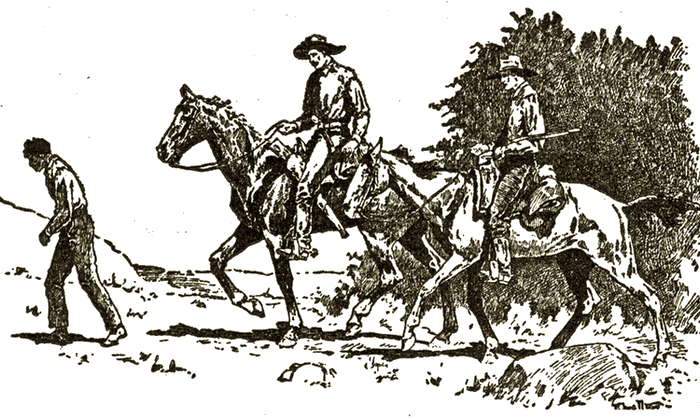
The day passed. Toward dusk, two men came riding in with a shabby little fellow they had picked up down the bayou, scared to death and shedding tears. They started to turn him in among the prisoners, and a murmur arose.
"El Presidente! El Presidente!"
Better look into this, said somebody. Might be Santa Anna, even if he does deny it. Take him to the gin'ral.
Sam Houston, snatching brief reprieve from the consuming pain of his smashed ankle, was asleep. When they woke him and told him that Santa Anna had been brought in—well, there is more than one story to that. Whether rough old Sam uttered the famous "mot" of General Cambronne at Waterloo, or whether he made the polite and polished bit of oratory that later history puts into his mouth, may be conjectured.
At all events, when he found that he really had the top prize in his hand, he was wide awake enough. For he, and no one else, realized what this prize could and would mean to Texas—and the utter mad folly that would lie in executing the murderer of Alamo and Goliad.
He sat late into the night, aflame with his vision. He still had seven hundred men, or a few less; and there were still Mexican generals galore, with thousands of picked men and artillery to north and south. There was one man those Mexicans would obey, and one only—the dictator, the President of all Mexico.
"Sit down and write," he muttered. "Sit down and write, El Presidente. Send the message to your generals. Tell them to evacuate Texas, and do it now. The alternative will not be pleasant matter for you to face, after Goliad—"
A greater victory there than any battle, if he could pull it off. This one little opium-sodden bit of flesh, whom he could strike out of existence with one hand—and with joy—could mean more to Texas in his abject cowardice than ten thousand men. So Sam Houston sat and dreamed into the night hours.
And his dreams came true.
Roy Glashan's Library
Non sibi sed omnibus
Go to Home Page
This work is out of copyright in countries with a copyright
period of 70 years or less, after the year of the author's death.
If it is under copyright in your country of residence,
do not download or redistribute this file.
Original content added by RGL (e.g., introductions, notes,
RGL covers) is proprietary and protected by copyright.