RGL e-Book Cover
Based on an image created with Microsoft Bing software
Roy Glashan's Library
Non sibi sed omnibus
Go to Home Page
This work is out of copyright in countries with a copyright
period of 70 years or less, after the year of the author's death.
If it is under copyright in your country of residence,
do not download or redistribute this file.
Original content added by RGL (e.g., introductions, notes,
RGL covers) is proprietary and protected by copyright.
RGL e-Book Cover
Based on an image created with Microsoft Bing software

Short Stories, 25 September 1935, with "The Jailbird"
UPON a gray December dawn, I crossed one of the river-bridges in San Antonio and came to a halt beside an ugly modern store-front. Here had stood the old Veramendi mansion with its gardens—gone now. The street lights glimmered fitfully. A thread of mist rose from the river.
Somewhere a voice lifted. Some homeward-bound drunk, I thought; but no! It was a gay voice, ringing and vibrant and clear, a voice to stir the blood. The words actually echoed from the store-front nearby, and reached me, distinctly. The lilt of song came clear:
"We didn't have much book-learning, we knew the feel of dirt,
Some of us had fine manners, and some of us lacked a shirt;
We could shoot or swing a broadaxe, handle a pick or hoe—
And by God, sir! We fought for Texas, a hundred years ago!"
Thin and far, a burst of raucous laughter and wild cheering seemed to float from the moonstruck clouds overhead. Voices broke forth in unison:
"Here's to you, Old Ben Milam, damn your eyes!"
No one. Nothing in sight; the street was empty. Imagination? Yet on this very spot, a hundred years ago almost to a day, a man had died. That old Veramendi mansion had witnessed strange scenes, a corpse laid to rest at low twelve with Masonic ritual while bullets shrieked around....
TWO men paused at the entry to a trench running across the street, running across to the Veramendi gardens.
Rifles were cracking, musketry was ringing out in continuous uproar, cannon were smashing away at every moment. Down the street, over the barricade of the trench, bullets were hailing. Dirt was flying. Discharges of grape went screaming in ricochet from the stones, threw earth and splinters everywhere.
"Down, Ben! Down!" exclaimed one of the two men. "Stoop as you go across!"
"Be damned if I will," and the other man laughed gaily—a deep, vibrant laugh. "I'll stoop for no Mexican! Those fellows can't shoot, anyhow. Come on!"
He started across. What thoughts were in his mind, what retrospect of life past, of glorious adventure, came to Old Ben Milam in this moment? He was barely forty-five as he strode along, head high, a gay smile on his lips.
HIS thoughts went back to Monterey. There, the previous fall, he broke jail. Alone, empty-handed with a stolen horse, he set out to cross seven hundred miles of savage trackless desert. He was being hunted near and far.
Weeks later, starving, haggard, worn to the bone, he prowled about the wretched collection of adobe huts by the Rio Grande which was named Laredo. He was waiting his chance to steal a chicken or anything else eatable, and get along. Voices reached him as he crouched in the brush.
"Keep an eye out, Manuel. The others are to keep a sharp watch for that mad Americano who escaped from Monterey. El Coronel Milam."
"Colonel Milam?" echoed another voice in surprise. "But I know him well. He is no Americano; he is of Mexico, señor! I have served in his regiment. He is one of the legislature from the state of Texas—"
"No matter. He's a rebel, to be shot on sight."
Milam grinned to himself as he listened.
ALL his life had been a record of wild adventure. In the War of 1812 he distinguished himself. A Kentuckian of little education, he had something better—ability to win men's affection, to make them follow him.
He plunged into filibustering, joined Lafitte the pirate, came to Mexico as an adventurer. Since then he had been, as they said, in every Mexican jail. He helped Mexico win independence. When Iturbide seized power as emperor, Milam held out for freedom—and went to prison. He escaped, went on fighting; was given a million acres of land and became affluent. He went down to Coahuila as a member of the legislature from Texas.
Then Santa Anna struck, overthrowing the Mexican constitution and proclaiming himself dictator. Ben Milam, like other Americans caught in the net, went into jail; but jails did not hold him long. He got out, got a horse—and here he was.
Such was the man who crouched there, biding his time.
Presently the time came. He darted in upon the empty hut, made away with a little corn and a fowl, and with darkness to aid him, regained his skeleton horse. That night he swam the Rio Grande.
More desert ahead, empty Texan plains, and he had to keep far from roads, pushing on by star and sun, living on berries and nuts and grass and cactus-pears. No safety for him until he reached the American settlements to the north of Bexar.
Weeks later, his horse a staggering ruin, he himself was at the last gasp and worn to a shadow. His clothes were rags. Shaggy beard and hair uncut, he looked like nothing human. And then, one afternoon, he looked down the blinding sunset lane of light, and saw three horsemen making for him. He was caught.
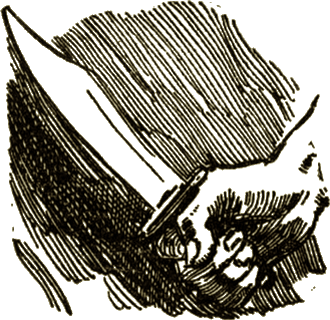
Ben Milam had no intention of going back to jail, however. Desperate, he sent its poor beast toward a clump of trees, gained the cover, and slid to earth. Where he was, he had not the least idea. A good hundred miles from safety, at least; he had covered six hundred or so, by his figures. He whipped out his knife, got his back against a tree, and blinked at the three riders who came spurring in at him.
"Hey, Bill!" broke out one of the three, in astonishment at close view of this gaunt scarecrow. "He don't look like no Mexican!"
A gasp broke from Milam. Then a cry.
"Hey! Are you fellers Americans?"
"You're durned right we are," came the response. "Took you to be a Mexican. Who are you?"
Milam dropped his knife and reeled forward.
"Ben Milam. For God's sake give me a bite to eat—"
MILAM! With whoops of joy, the three surrounded him. They shared their clothes with him, plied him with food and water. Suddenly, at their words, he jerked up his head and stared.
"What's that? Looking for Mexicans? What d'you mean?"
"Ain't many left loose," and one man grinned. "Didn't you hear about the fight up to Gonzales?"
"Fight?" Ben Milam's eyes flashed. "Good Lord! You don't mean Texas is fighting? And me in jail down there! Is it true?"
"You bet. We got forty-odd men down the river with Cap Collingsworth. We're aiming to jump Goliad tonight. Jim Bowie's got another crowd a-coming but we sort o' lost ourselves."
"Hurray! Count me in!" cried Milam eagerly. "All I want is to get a good whack at those Mexicans! And you've actually had fighting?"
"Sure thing. We've done kicked the Mexicans out of Anahuac and all the other places down to the Gulf, except Goliad and Bexar. And there's an army coming to kick 'em out o' Bexar likewise. We got one hell of an army, lemme tell you—"
Texas was up and fighting, then! On the moment, Ben Milam was like a new man, alive with fire and energy. None the less, that horrible march north had grayed his hair and beard. He was Old Man Milam now, to everyone.
But he was safe at last; and that night, in the camp down the river, his arrival electrified Captain Collingsworth's little band of settlers. He had been given up for dead; but now the name of Milam was a thing to conjure with. His gay, eager spirit, his fiery energy, had made him one of the most popular men in Texas.
Despite his military training, his rank in the Mexican army, he refused bluntly to be elected as an officer. He insisted on joining up as a volunteer private. Texas in revolt! The dream of his life had come true.
The gray light of dawn; and before them lay the town of Goliad, with its stores, its arms, its ammunition. Here was the only fortified place in Texas, outside Bexar itself, with a hundred men in garrison.
The forty-eight men crept forward in the obscurity. A sentinel challenged them, yelled in alarm, fired. Rifle-bullets cut him down. Men armed with axes smashed at the gates. The quarters of the commandant were stormed.
In ten minutes Goliad was taken, its garrison were prisoners or fugitives, and Old Ben Milam had struck his first blow for Texas.
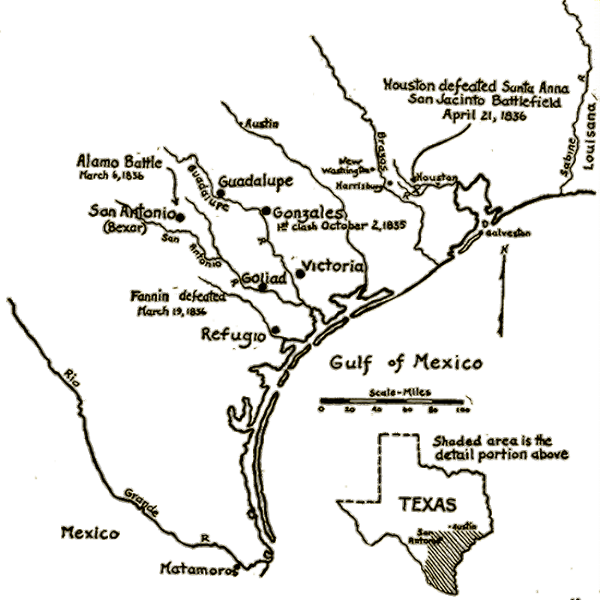
NOW from east and north a storm of men concentrated upon San Antonio, then known to one and all as Bexar. The so-called army of Texas marched from Gonzales; men came from the Border villages, from the Gulf coast, outlaws and men proscribed. Adventurers from Mississippi and Louisiana, in full company and gay uniform. They came gaily on, convinced that one Texian could put to flight a hundred Mexicans, cocksure in the belief that General Cos would surrender abjectly at the first summons. They recked nothing of his fifteen hundred regulars, his score of cannon and his ample fortifications.
All of them knew Ben Milam or had heard of him. He attached himself to Jim Bowie and the impetuous Fannin—hard-fighting, hard-living Jim Bowie, who had a force of guerrilla riders. They came pouring down to Bexar, men without discipline, order or artillery, burning to be at Mexican throats, fighting among themselves—eager to fight for the status of Texas as part of the Mexican federation. Few of them talked of liberty, of cutting the state from the union. They knew not whom they obeyed, were careless of authority, laughed at orders.
Suddenly came the fight at Concepcion Mission, outside the town, when Bowie and Fannin, with ninety men, whipped the four hundred. There came the "grass fight," when Mexican foraging parties were driven madly in upon their fortifications by Bowie and Ben Milam. These encounters gave the enemy abrupt pause.
These Americanos were not men, but devils. To fight them openly were utter folly. And the fortifications, the artillery, the unexpected odds against them, gave most of the Texians even more abrupt pause.
Who held Bexar, held Texas—and General Cos meant to hold Bexar. He said as much, with his calm, disdainful smile, when he was summoned to hand over the town. Mexico would not treat with rebels, except at the point of the bayonet. There was a price on the head of their leaders; let them disperse! All American traders inside Bexar were clapped into jail. Over the Alamo was hoisted the scarlet flag—no quarter to rebels!
Rebels? Jim Bowie, Milam and a third of the army hooted at the word. The other two-thirds, including the leaders, thought twice. Actual rebellion meant loss of lands, position, estate. Many in the army were Mexicans who had joined the Texan cause, but not to cut loose from Mexico. Indecision arose, for here faint hearts held the reins. Steve Austin departed to raise more men and money, and General Burleson took over the army.
Deaf Smith, the scout, got news in plenty out of the town, and no happy news, either. Even Ben Milam, who was all for a headlong smash, paused and blinked when he heard about it.
HALF a mile outside town, the army encamped and pondered sadly. Weeks passed, nothing was done; General Burleson took command, and he was a cautious gentleman. Old Ben Milam raged and ranted and drank, and nothing was done. General Cos was afraid to come out, and Burleson was afraid to go in—and well he might be. The settlers began to drift away, back to their farms and families. Food and ammunition were low. Within the ranks, dissension, quarrels, sectional differences, arose.
Most of the army wanted nothing more than to keep Texas in the Mexican federation. A few wild, bold spirits, like Sam Houston, Bowie, and Ben Milam, were for independence.
And there lay Bexar, with General Cos laughing up his sleeve and waiting for them to come into his trap. A strong trap. The houses were nearly all of solid stone, and had been converted into loopholed forts. The streets were entrenched and barricaded.
Artillery commanded every approach. The old mission outside town, known as the Alamo, had been converted into a stout fort, armed with cannon on roof and wall, with outer breastworks and batteries ready. Every street, every entry, each of the two plazas, could be swept with bullets. To attack, without artillery preparation, would be slaughter.
So said General Burleson. So said all cautious spirits. Colonel Ben Milam fumed, and plenty of others with him. Ill feeling grew and became violent. November had passed. The bleak winter season was at hand, and nothing done, nothing attempted. Came the fourth of December.
Old Ben Milam and a riotous, unruly throng were gathered in the officers' quarters. A Mexican deserter had come in with word that there was disaffection among the Mexican troops, that the defenses were not so strong after all. As Milam and the others once again canvassed the situation, the bombshell broke. One of the New Orleans Grays came running in.
"All over, boys!" he panted. "Orders just been given out from headquarters. We're marching tonight."
"What?" yelled Milam in delight. "Attack?"
"Hell, no," was the disgusted response. "March begins at seven o'clock. The siege is done with. We're going into winter quarters down by Goliad."
There was one blank moment of incredulity. Then followed a storm of oaths. Milam was the first man outside and heading on a run for Burleson's headquarters.
True? The news was only too true. The orders were posted. The Texan "army" was to march away at seven that night.
"Like hell it will!" said Milam, white with shame and rage. "I came here to fight, not to sit on my heels all winter. By the Eternal, I'm going into Bexar if no body else goes!" He lifted his voice. Like a bugle-note, that blaring shout of his lifted over the tumult and quelled it, with words that were to ring down in history.
"Who'll go into Bexar with Old Ben Milam?"
THERE was a frenzied chorus of yells. A Border hunter yelled out something about "bear" and "Bexar"—both words being alike on American tongues. Word was flashed through the camp. More men came on the run. The crowd grew by leaps and bounds, literally.
"Old Ben Milam's going into Bexar, boys! Come on!"
General Burleson appeared, furious. He attempted to quell the tumult, to enforce discipline, commanding Milam and the others to disperse and give up their mad purpose. He was hooted down, jeered down; discipline, so far as he was concerned, was at an end.
Of the eight hundred men in camp there, three hundred and one threw in their lot with insanity. On the spot, Milam was elected to command the attack. He ordered the volunteers to disperse, and meet him at seven that night by the old mill on the river.
There, with torches flaring, Milam gave his orders. The three hundred were to attack at dawn—he himself by Acequia Street, Colonel Johnson with the second column by Soledad Street, the two avenues leading into the heart of the town. A deputation waited on the general, requesting him to postpone his runaway march until the result of the insanity was known; which, as one chronicler says, Burleson "very cheerfully" agreed to do. He even agreed to send some of his five hundred regulars to make a feigned attack on the Alamo, on the other side of town, while Milam attacked. And this was all he did do.
Daylight approached. The feigned attack on the Alamo began, completely holding the attention of the garrison—and as soon as Milam's rifles were heard, the "regulars" calmly marched back to Burleson's camp, leaving Milam to his fate.
These two streets were completely commanded by fortifications and batteries. Milam, with Deaf Smith scouting in the van, led his column straight ahead. A sentry fired, and Deaf Smith's bullet killed him. Five minutes later, Johnson's column was in control of the Veramendi mansion and gardens, while Milam and his men occupied the De la Garza house. These two houses were opposite each other, but there was no communication between them; each of the two converging streets entered the main plaza a hundred yards away. That hundred yards was composed of fortified houses, breastworks, batteries.
A tremendous fire was opened upon the two positions. All day long, grape and musketry poured forth, while Milam and Johnson consolidated their gains and dug in. With night, they fell to work opening a trench communication between the two houses, and by dawn, accomplished this. Throughout the night, the cannon never ceased to thunder.
Morning of the 6th found Milam's force in desperate position. Despite the trench, communication was risky, for it was under constant fire. Mexican sharpshooters had spread out on all sides, along the river and on housetops, and the cannon of the Alamo maintained a galling fire of grape. Milam's men, however, had brought up a small cannon, and opened a return fire with this. His riflemen began to work out, and pick off the enemy.
"Nothing for it but to go ahead," said he. "Let's go!"
WITH the 7th, Milam was more stubborn than ever. One house, surrounded by an open space, lay between him and the buildings on the plaza. He ordered every man out with a rifle, and this tremendous and deadly fire swept the Mexican trenches clear, silenced the batteries temporarily, and cleared the sharpshooters from the housetops. In the lull, one Henry Karnes, an enthusiastic adherent of Old Ben Milam, grabbed a crowbar and ran for the house across the open. Muskets rained bullets, but he made the house in safety, and by the time a flood of men had followed him, smashed a way in. The house was captured. Milam was almost to the plaza now—but Johnson was still blocked from any advance.
Maverick, a trader who took an active part in the assault, attempted that afternoon to map out some course of action with Ben Milam. They inspected the newly captured house, which drove like a wedge at the buildings around the plaza.
"Can't get there by the streets," said Milam, as a hurtling storm of grape whistled overhead from the battery fifty yards away. "But we might smash into one of those houses and get a footing on the plaza itself."
"The men are staggering on their feet, Ben," said Maverick. "So are we. No sleep, mighty little grub, no rest. The church roof, the house roofs, are crowded with men ready to open fire on any advance. And their artillery—whew! Listen to it!"
As afternoon waned, indeed, the cannon from the Alamo had gradually opened up a regular and sustained fire, so well-directed that any communication, even by the trench, was hazardous in the extreme. Milam cursed the squatting camp outside town.
"Five hundred fresh men out there, and nary a one of them lending a hand!" he said. "Well, I'll skip over to the Veramendi house, see Johnson, and arrange with him to make a joint attack at midnight."
"Don't do that," said Maverick in alarm. "Man, it'd be madness! At least, send word over. I'll take the message."
"Send anybody where I wouldn't go myself?" snorted Milam. "Not by a damned sight. I'm going over."
"Then I'll go along," the other rejoined. "Watch out, though. They've got sharpshooters in the trees along the river. Spreading out everywhere."
The two made their way back to where the communicating trenches began. At the gay smile, the hearty words of Milam, the weary, wounded, haggard men, resting and fighting by shifts, raised a feeble cheer. Milam conferred with his officers.
"We're going to rush 'em, boys," he said. "If we can drive 'em out of the Navarro house, we'll get into Zambrano Row through the walls—and we'll have a wedge driven in that'll split the log sure! Well, Sam, let's go."
THEY stepped down into the trench and made their way along. They came to the street, with the Veramendi house opposite. Musket-balls spattered the dirt, grape shrieked and whistled. Milam started across, laughing.
"Down, Ben, down!" cried Maverick. "Stoop as you go across—"
"Be damned if I will!" returned Milam. "I'll stoop for no Mexican. Those fellows can't shoot, anyhow. Come on—it's safe enough."
A group of men were waiting at the end of the trench. Milam waved his hand to them. Across the street now, and stepping out of the trench—
Milam staggered. Then he collapsed, and Sam Maverick caught him as he fell. The rifle-crack came from a cypress tree along the river.
He was shot through the brain.
They could not believe it for a moment. They looked down at him, stared one at another, as the dismayed word was passed along. Old Ben Milam—dead!
Darkness descended. The red flashes, the thunders of cannon, never ceased. Colonel Johnson called his officers and those of Milam together. Grim men, powder-smeared, unshaven, in no better case than the men they commanded. A brief colloquy, then Johnson was elected to the supreme command.
"All right, boys," he said. "Cannon or no cannon—let's go get that Navarro house right now. Make 'em pay for Ben Milam."
"Make 'em pay for Ben Milam!" The phrase flashed on, was caught up and repeated. Weariness was forgotten. If the Alamo flew the red flag of "no quarter"— then the Mexicans would get no quarter. "Make 'em pay for Ben Milam!"
They went rushing forth. They swooped down on the Navarro house, hammered a way in, fought from room to room. Even from the roof, the Mexicans resisted, firing down through holes cut—until they were cleared from here, also. The house was taken at last. Adjoining it was Zambrano Row, a long barracks-like series of rooms. Men fell savagely to work, attacking the walls between with pick and axe. A long job.
Midnight saw Ben Milam laid to rest, with balls whistling around, with grape hurtling through the trees; laid to rest while heads were bared in the darkness, lest lights give away the party, and while the words of the Masonic ritual were punctured by the blasts of cannon. And those who did not hold with Masonry, saluted Ben Milam in the fraternity of patriotism and a cause common to all. There were tears on bronzed haggard cheeks, and choked voices. Ben Milam was gone, but his memory would not be stilled.
The word went on. "Make 'em pay for Ben Milam, boys!"
Hour after hour. Rain damped the powder; the morning broke cold. Into the Navarro house came the Grays, fresh and vigorous. The breach went forward in the walls; at last they were through, pouring into Zambrano Row under a hail of bullets.
Through—and now it was hand to hand, savage, a struggle of ferocity on both sides, no quarter asked or given. Bowie knife met bayonet, rifle met musket. As each room was cleared, the thick partition walls had to be breached into the next.
IN the midst of this, a ragged cheer went up. Exhausted, grimly fighting on with faces like corpses for want of sleep, men looked one at another. The ragged cheer echoed again. Laughter took it up, hysterical laughter. Reinforcements at last—a lieutenant and a few men from Burleson's camp. But others were coming. Shame had done its work at last. News of Ben Milam's death had put fire to the powder-train.
They came, indeed, with evening—men trooping along, fresh and eager, hurling themselves into the struggle, giving the exhausted volunteers a chance to drop and rest. But the Grays refused to yield the van to these late-comers. Zambrano Row was cleared now, and the wedge driven home that would split the log.
Before midnight, the Grays struck. A strong walled house that would command the main plaza, lay directly ahead; it was heavily occupied. The Grays struck it like a thunderbolt, breached the wall, poured in a withering fire, reached the house beyond and stormed it. Then they began to cut loopholes.
Cannon and musketry opened up. Hour after hour, until daylight, the Mexican batteries sent balls and grape smashing in. Daylight came, and the rifles began to answer back with deadly effect. The plaza was under their fire. Reinforcements streamed up; more rifles went into play. Johnson and his men were gathering for the assault on the houses beyond, when suddenly the cannon fire slackened, and halted. The din of musketry died out. There was a silence in the sunrise.
A white flag came into sight, borne by a number of officers coming from the Alamo. General Cos and his fifteen hundred had had enough.
Then, indeed, General Burleson and his staff marched into Bexar, captured by no fault or deed of his; and the spirit of Ben Milam must have roared with ironic laughter to hear the stately phrases of surrender dictated by the "regulars," while those who had followed Old Ben into Bexar licked their wounds and mourned their dead.
Five days later, all were gone. Cos and his Mexicans, dragoons and foot—a third of them chose to remain as Texians—marched out and away toward the Rio Grande. The last Mexican was gone from the soil of Texas. Burleson was gone, too, with his "regulars" and his staff. The army was gone, dispersed again to the settlements.
Colonel Johnson remained to hold the town he had won. And one other remained, deathless in death, the silver cord loosed and the golden bowl broken; he, the homeless, gone to his long home where he bides today under a slab of stone, a great rough ashlar like himself, that bears but the one word
M I L A M
Roy Glashan's Library
Non sibi sed omnibus
Go to Home Page
This work is out of copyright in countries with a copyright
period of 70 years or less, after the year of the author's death.
If it is under copyright in your country of residence,
do not download or redistribute this file.
Original content added by RGL (e.g., introductions, notes,
RGL covers) is proprietary and protected by copyright.