RGL e-Book Cover
Based on an image created with Microsoft Bing software
Roy Glashan's Library
Non sibi sed omnibus
Go to Home Page
This work is out of copyright in countries with a copyright
period of 70 years or less, after the year of the author's death.
If it is under copyright in your country of residence,
do not download or redistribute this file.
Original content added by RGL (e.g., introductions, notes,
RGL covers) is proprietary and protected by copyright.
RGL e-Book Cover
Based on an image created with Microsoft Bing software

Short Stories, 10 August 1935, with "The Buffalo Hunter"
A COLD, blowing night in Texas, near the Guadeloupe River. Dawn was threatening the pale stars. A strange singing sound reached me, yet for miles around was no human presence. Startled, incredulous, I listened.
Again and again, now fainter, now clearer, drifted the sound of voices. It came from nowhere, from everywhere; from the thin clouds, from the chaparral, from the very ground. Then suddenly the lilt grew upon me, the words became distinct, as though the singer were passing close by me but invisible:
"We were hunters and politicians, soldiers, half-breeds and scouts,
Preachers and clerks and gentry, gamblers and country louts,
Lawyers and ciboleros, wandering to and fro—
And by God, sir, we fought for Texas a hundred years ago!"
And then—I could have sworn to it—through the darkness from nowhere came a burst of rough, ribald, bawdy voices swelling and dying away again down the night upon a rush of ghostly hoof beats:
"Here's to you, Cibolero, damn your eyes!"
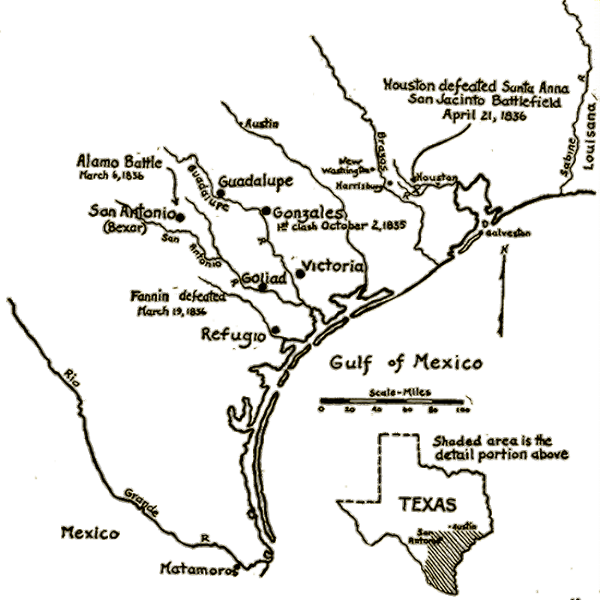
Cibolero? The swing of the word fascinated me. What did it mean? What were these voices from the prairie? True, the Texan war for freedom had started close by here at Gonzales, in 1835, a hundred years ago.
THE Cibolero reined in his shaggy horse, alert for a repetition of the laugh. He was a rangy, thin-faced, bearded man, very brown, clad in ragged buckskin. His Comanche moccasins rasped in the wooden clogs of his Spanish stirrups. He held a long rifle poised across his saddlehorn, poised and cocked, ready.
The harsh laugh came again. Then a hideous, unspeakable scream that drove across the sunlight to chill the very blood.
Somewhere below lay the waterhole, invisible. Here the naked rocks blazed with heat. The entire Puercos Valley shimmered and danced with heat waves, clear to the hot blue mountains. The downpour of sunlight was parching, furious, intolerable.
"All right, stranger!" rose a voice. "Water up and welcome, but keep that rifle low. You're covered."
The Cibolero let his eager horse go on down the steep descent. The trail turned very sharply. The waterhole came into sight, twenty feet distant. The Cibolero halted dead, as another harsh laugh greeted him, and the scene.
"Bet ye never heard a 'Pache holler afore! Well, this 'un did."
The Cibolero stared at a short, squat man of forty, wearing stained buckskin and an enormous sombrero wound with tarnished silver braid. Muttonchop whiskers, Mexican style, and small shrewd eyes flanked a huge hooked nose.
At this man's feet lay a bound and naked Indian, still quivering, as a snake quivers long after life is extinct. At one side were two dead horses and an old, rickety wagon, and against the wheels lay four dead bodies—Mexicans, perhaps pulque hunters. Two men, a woman, a young girl, all naked and dead. The men were much cut up; Apache raiders believed in removing the source of future generations.
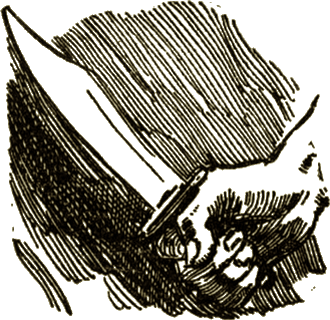
The squat white man obviously cherished the same belief. As he held up his red knife and chuckled, the Cibolero felt a little sick.
"Yeah, he hollered when I give him his own med'cine. This was the only one of the three we didn't down first crack; we let him set for a spell, and by gosh, it got his nerve! Ye see, three 'Paches had jumped these here folks, then we jumped the 'Paches. Well, stranger, light and water up. Seen you coming for quite a spell, and Red Sky figured you for a white man. Kirker is the name, Jim Kirker."
The Cibolero dismounted and gave his name.
"Nathan Jackson?" Kirker repeated. "Why, say! You're the feller they call the Cibolero—the buffler hunter! Proud to grip your claw. Come on out, Red Sky; no need to worry about him. The Cibolero, huh? Thought you was up around Santy Fé?
WITH a nod, the Cibolero followed his horse to the water, and after a drink made unhurried response.
"Yeah. I'm headin' down into Texas to see some friends o' mine."
"Just come from Bexar myself. There's hell to pay in them parts." Kirker stooped and deftly removed the scalp of the dead Apache. Another figure emerged from among the rocks; it was that of a lithe, pock-marked Indian, to whom Kirker jerked his thumb.
"Say, Cibolero, shake hands with Red Sky. Delaware from York State. Him and me are in business. If it goes good, we'll ketch in more of his folks."
"Business?" the Cibolero repeated, puzzled. Kirker nodded, and going to one of the dead Mexicans, removed the scalp and regarded it critically. Then he grinned.
"This ain't so bad; can't tell it from 'Pache hair noways, if ye lift it right. I dunno about the gal, there; the hair's too soft, maybe. Red Sky, trim up the woman's pelt a bit, and mind your eye."
"What in the devil's name are you about?" the Cibolero demanded.
"Making money. I seen Gin'ral Cos down to Bexar; him and me are friendly. I'll get a reg'lar contract out of Santy Anny for 'Pache scalps—hundred dollars per each. The joke of it is," and Kirker grinned, "they can't tell Mexican from 'Pache scalps! So me and Red Sky will profit. Ye see, I got in trouble over to Chihuahua; the governor there put a bounty of nine thousand dollars on my head. Ain't that a brag? Well, Cos has fixed things up. I ain't a outlaw no more and everything's fine. Where you heading for?"
"Gonzales."
"Huh! I reckon you know them Texians are out to raise Cain?"
The Cibolero shook his head. From his pouch he took a strip of jerked meat and began to chew at it.
"Nope. Santa Fé is a long ways from San Antonio."
"Bexar, you mean. The mission's San Antonio, and the town is Bexar. Ain't you heard that Santy Anny is military dictator of Mexico?"
"Yes. That's no news."
The two men fell into talk, and the Cibolero, for the first time, began to comprehend what sort of trouble was going on here in the State of Texas, which was now largely settled by Americans, frontiersmen who lived by the rifle. Entire colonies had come in, formed by Austin and others, to take up Texas land. Texas was now a state, governed by its own representatives down at Coahuila—or had been until Santa Anna became dictator.
Santa Anna had abolished the state legislatures and the constitution of republican Mexico; as dictator, he was supreme. He had crushed all opposition with savage hand. The Texians alone were in resistance, which thus far had been passive, to his program. And the attention of Santa Anna was now turned to them.
His brother-in-law, General Cos, had come to San Antonio with strong forces and was proceeding to disarm all citizens in Texas. The representatives at Coahuila had been flung into prison, such of them as did not escape. Delegates from all over Texas had met at San Felipe to form a new state constitution, within the republic of Mexico, demanding that Santa Anna recognize it. His reply was to jail those who brought him the message, and to issue imperative orders to General Cos.
"And them Texians," observed Kirker, "they holler that they ain't going to be disarmed, and they mean it. Likewise, them greasers mean business."
THIS was the most ominous thing; the Mexicans did mean business. Their troops and artillery held Texas powerless. Their possession of San Antonio de Bexar, the one large city in the state, gave them a base of action. The half-organized settlers had no troops and no money. Some, like Sam Houston, were all for cutting loose from Mexico and forming their own republic, but the masses were awed by the idea of fighting a disciplined power, as well they might be.
"They sure are a-getting their mad up, though," said Kirker, chuckling. "Dragoons are being sent out all over the country, gathering in rifles and so forth, and having trouble doing it. I hear that land is being grabbed, too, which looks bad. If there's any real war started, these here Texians get wiped clean, right down to the cradle. Santy Anny aims to kill off all foreigners that disagree with him. So steer clear of sojers."
"I'm not looking for trouble," the Cibolero said. "I want to find some folks I know. You don't reckon any real war will start?"
"Sure to start. Me, I ain't no Texian. It's no skin off my nose if them settlers gets too brash and are wiped out. I got my own affairs and stick to 'em."
"Hm! I guess that's sensible. Did you happen to hear anything about a family named Sisson? From Pike County, Missouri? Last I heard, they were heading for Gonzales to take up land near there."
"Nope. There's a sight o' folks in Texas, and I ain't met only half. What about a horn of liquor? I got a jug of prime stuff cached with our horses."
"No, thanks; I must move on." The Cibolero drank again, filled his water bottle, and gave his horse a last short drink. After all, he reflected aloud, the settlers would have too much sense to provoke the wrath of Mexico. With this, Kirker disagreed.
"Seems like they're all politicians, Cibolero, on one side; and on t'other, crazy galoots spoiling for a fight. Like that feller Jim Bowie. I tell you, them Texians are right quick to take up a' scrap, somehow! Them that ain't politicians, of course. Well, luck to you! And mind your step, too, if you meet any sojers."
The Cibolero nodded and mounted. As he rode off, he turned for a last look at the waterhole. The two men there were spreading their trophies in the sun to dry.
HEADING straight for Gonzales through the wilderness, the Cibolero rode on, day after day, keeping well to the north of Bexar, as San Antonio was generally known. Gradually the desert and mountains and naked rocks fell beyond the horizon; slowly the lush river country of grazing herds and settlements opened ahead. But as he rode, the Cibolero grew more and more uneasy.
He did not like the new day that had come to Mexico with Santa Anna; a hard, ruthless, lecherous man who had done great things for himself. Gone were the old courtly Spanish customs, the friendly intercourse with Yankees; a new breed had come into power. And thinking of Jenny Sisson as he rode, now and again fumbling at the paper packet sewn inside his buckskin shirt, the Cibolero frowned and worried.
On a day, he came out abruptly upon a new settlement north of Gonzales, a cluster of cabins whose bark was still green. A lean brown hunter, in tattered clothes and coonskin cap, was perched on a stump, waving his arms and yelling excitedly, while a whiskey jug went around the circle of listeners. The Cibolero could hear his voice from afar.
"What's it mean? No gov'ment without representation, I tell ye! Us Texians has got to stand up for our rights! Us Texians—"
"Hey, Dick!" shouted someone. "Since when was you a Texian, you N'awleens 'gator?"
The brown man whirled savagely. "Since when? Since I seen them two Brown boys shot down, over ort the Nueces River—shot and then ripped with lances. And for why? Wouldn't give up their rifles, that's why! And if you'd heerd the gal screaming from the cabin, too, it'd ha' been enough. Right then, by God, I become a Texian and I stays a Texian! And if you boys don't tote your guns down to Gonzales—"
He broke off suddenly, as the Cibolero came riding up. The voices ceased. Men turned and stared; women peered from cabin doorways. Eyes and faces were suspicious, questioning, alert. One could never be sure nowadays. The Cibolero drew rein.
"Howdy, folks." At the homely words, all tension relaxed. The Cibolero swung out of the saddle, leaned his rifle against a stump, and stretched. "By gosh, I come all the way from Santa Fé, boys. Got a drink to spare?"
Already they were surrounding him eagerly, aflame with curiosity. From Santa Fé, that unknown, distant city of song and story! The Cibolero expertly swung the jug on his elbow and lifted it to his lips. Presently he handed it back.
"Prime stuff; obliged to you. What's all this talk about trouble?"
A MOMENTARY silence. Then the agitator spoke up.
"What? You mean to say as you don't know about it?"
"Santa Fé is a long ways," and the Cibolero smiled. "I reckon I'm a lot ignorant, folks. Say, did any of you ever meet up with some Pike County settlers by the name of Sisson? Last I heard they were headed for Gonzales—"
"What?" broke in the speaker eagerly. "Pete Sisson and his old woman, and the two gals? Why, I stayed two days with them folks! They're a spell out of Gonzales on the crick road. Sisson, he's got the rheumatiz bad; he's all crippled up. And that oldest gal, Jenny—maybe you're the feller she was allus talking about? The buffler hunter?"
"Reckon I am, mister; I usually go by the name of the Cibolero. I've come a right smart ways to see them folks, too."
"Hurray! That gal allowed you'd join up, if you was here!" The agitator was upon him, breathless, pouring forth excited words. "Listen here! That goddam Gin'ral Cos, he's a-sending sojers, a hull passel of 'em, up to Gonzales. They figure to grab everybody's rifles, and the old brass cannon they've got at Gonzales too—"
"Hold on, this is all new to me," exclaimed the Cibolero. "What for are the guns being grabbed?"
"What for? Tyranny, by God!" With a scream, the brown man leaped back to his stump. "That's what I'm a-telling you folks—tyranny! We got a right to bear arms. It's in the Constitution back home. Us Texians have got it in our state constitution here, but now that's all smashed to hell. There ain't no more state gov'ment, hear me? Just Santy Anny. They're taking our guns everywhere. They put Steve Austin in jail—yeah, Austin hisself! They got us Texians in jail all over, they're a-grabbing farms and saying land titles ain't no good, and we got to fight!"
"We can handle any greasers that come this way," said a skeptical settler.
"Yah! You boys set on your hunkers and say it ain't your business," yelled the brown man. "By God, it'll be your business when them lancers come this way, you bet; first you know, you got a lance in your belly! And you women folks in there, you'd better light a shuck for the woods when them dragoons show up—by God, you had! None of your business, huh? None of Davy Crockett's business, neither, but he's on the way—"
"What's that?" shouted somebody "Colonel Crockett from Tennessee?"
"Himself, and a many more like him. I tell you, hell's blazing down to Gonzales! There's a new gov'ment being set up to San Felipe, and we got powder and guns coming in from N'awleens—"
The uproar rose again. The Cibolero went to one of the cabins, obtained a cornpone and a strip of side meat from a woman, and listened while he ate, with a mental shrug. It was none of his business, as a matter of fact. He was not a Texian. The names spouted by this agitator meant nothing to him. Jim Bowie, Travis, Austin—these men, proscribed by the new Mexican government, were unknown to him. His only Texas interest was the girl Jenny from Pike County. At thought of her, he touched the packet under his shirt, and a smile crept into his eyes.
He had nothing against the Mexicans; up in Santa Fé, he had many friends among them. Not that he blamed these excited, blaring Texians for sticking by their guns and resenting oppression; but he was like Jim Kirker. It was no skin off his nose what happened in these parts. These fellows had settled in Mexico with their eyes open. So many of them had settled here in Texas, indeed, that they had pretty well crowded out the Mexicans.
As to atrocities, he judged that the stump orator was full of whiskey and exaggeration. "See you in Gonzales!" he sang out, when he mounted and rode on. A chorus of voices made response, and rifles were brandished; they were getting worked up, all right.
THAT night he ran into a one-man camp. A traveler was roasting a wild turkey over a tiny fire, and hailed the Cibolero delightedly. A wandering preacher, this, who had left his Bible in Nacogdoches and was carrying powder—in his saddlebags, his pockets, hung to his belt, stuffed everywhere.
"So you never heard o' Sam Houston?" observed the preacher, as they talked. "Well, just wait! Down to San Felipe, where them aristocrats are settled, they got a gov'ment all ready. Houston, he writ the constitution; he's all for secession from Mexico, but that's too much for most folks to swallow. Now that they're calling it treason to have rifles, I dunno. I hear the Mexicans are grabbing farms and land, too."
He shook his head at the Cibolero's frowning question.
"Killing? I dunno. I'm a-heading for Gonzales. I hear Gin'ral Cos has sent an army to disarm the folks there. They got an old brass cannon, a four-pounder, to use against the Comanches, and Cos aims to get it. Texian? You bet I'm a Texian. Come from Kaintuck three months ago. Ain't you waiting the night?"
The Cibolero was not waiting. After an hour's sleep he mounted and rode on; he was growing more uneasy about Jenny and her folks. It did look as though some fire underlay all this smoke. A preacher toting powder—that was funny. Talk about conventions and politics meant little to him; it looked like these settlers had all gone crazy.
He rode hard, careless now whether his horse lasted or not. He came into Gonzales of an evening, worn out, starving, his horse exhausted. To his amazement he found the little town of straggling log cabins and adobe huts in a blaze of light from bonfires, aflame with voices and excitement. He had anticipated seeing hundreds of settlers gathered here, but he found only a few dozen.
Someone caught him as he half fell from his horse. It was Deaf Smith, a scout whom he had met in the Western country, and who greeted him vociferously.
"Hey, Cibolero! Here's a jug; drink hearty. Just in time, you old grizzly! Them sojers is camped acrost the crick. Hey, everybody! Here's a Texian for you—come all the way from Santy Fé to get in the scrap!"
Men gathered excitedly. The Cibolero drank, and the liquor set him on fire. War? Yes; the brass cannon was ready, the Mexican soldiers were here, the morrow would see fighting! Voices roared on every side. Beneath the wild exuberance lay a deeper note; these men were scouts, settlers, Indian fighters, not mere talkers. Their excitement was backed by a grim purpose. Disarm? Not a bit of it!
More drinks, and a bite to eat. The Cibolero felt himself swept along with the tumultuous stream; he was amazed to hear of what had happened in Texas lately, of how the whole people were taking arms. War? It was a certainty. None the less, he pursued inquiries about the Sisson family and found several who knew them well.
Yes, old Pete Sisson was bedridden. He and his folks had not come into town. He was friendly with the greasers anyhow. The Cibolero got a description of their place and the way thither well fixed in his mind, then let it all wait. He was done up, the liquor was good, the Sissons were safe—and here was fighting on the morrow. He must stay and see what happened. Mexican faces, too. He was newly astonished at how many Mexicans sided with the Texians. It was all a muddle to him. By midnight, however, human endurance had reached its end. He was snoring fast and hard, the world forgotten.
SUNLIGHT wakened him, and a wild outburst of voices. He sat up, reached for his rifle.
"Pile out, pile out, everybody!" came the shouts. "River road, all hands! Hurry!"
The Cibolero staggered out into the sunlight. Dust was rising in clouds, men were riding furiously. No time to seek his own horse; he caught the first saddled beast in sight, swung up, and pounded off in the wake of the straggling riders.
There was the river. Across the stream, on an eminence, the Mexicans were camped. The horses splashed through at the ford. Voices rose; a parley had taken place. A screen of oak trees shut off everything ahead. Now Deaf Smith appeared, shouting at the men. Some dismounted and went crashing ahead on foot to where the little brass cannon was placed. The Cibolero found himself turned to the left, with a number of other mounted men.
The open ground came suddenly in sight, and sudden startled silence fell. The breeze blew the dust away. A bugle was shrilling, the enemy were in sight; lines of cavalry drawn up, lance-points a-glitter in the sun, blue and red uniforms, brass dragoon helmets, gold-laced officers. Carbines, discipline, against a ragged line of riflemen.
Deliberately, the Cibolero left his weapon unloaded. It was not his fight; he was here to look on. He heard voices all around; treason, no quarter promised, the cannon was ready. Everything was a muddle to the Cibolero. He stared, realized suddenly that the lines of cavalry were wheeling to bugle calls, were on the point of charging.
Then—crash! The brass cannon roared out. A wild yell rang down the Texian line. Men leaped from cover and started across the open, madly charging the lines of cavalry. Rifles began to speak, the explosions running to right and left. Powder smoke hid everything. The bewildered Cibolero could see little until the dust and smoke thinned. Then amazement seized him. Wild yells pealed up, yells of triumph, of ferocity, of exultation.
Those disciplined ranks were gone, shattered, blown like leaves on the wind. Men and horses lay rolling or kicking. The officers had turned tail, the dispersed dragoons were in wild flight. With sudden relief from their tremendous tension, the Texians burst into cheers, oaths, hysterical laughter. Somebody pounded the Cibolero on the back.
"Licked 'em! What'd I tell you? One Texian can lick ten yeller-bellies any day! Smashed 'em with one volley—look at 'em run!"
Someone yelled something about Lexington; others took up the word, for these men had not forgotten the Revolution. Licked them! Texians could stand up to the boasted cavalry of Mexico and lick them all at one volley! The thing was proven at last.
CONFUSED, the Cibolero finally found his way out of the frenzied scene. There would be no more fighting; the fun was over. The Cibolero climbed aboard the first horse he saw and went riding away. It was all over now; he could go and find Jenny at last. He was so filled with this thought, that he paid little heed to the horse, until he realized with many a curse that it was an old, slow, jaded beast. However, no matter! A new eagerness had replaced the thrill and quick excitement of the battle in his heart, and his eyes were alight.
Jenny and her younger sister, their ma, old Pete Sisson, all waiting for him! He had a present for Jenny safely sewed inside his shirt, and his fingers sought it anew. A lace scarf that had come from Mexico City. No doubt stained with sweat and dirt by this time, but it would wash. And how her pretty face would beam at sight of it! Almost seventeen was Jenny, and high time she was married.
"And she will be now, quick enough!" muttered the Cibolero happily. "I'll jerk her out of all this mess. No Texas for me! Just because a bunch o' cavalry gets licked, these Texians think all Mexico is their meat. They ain't got sense enough to know that Santa Anna can throw twenty thousand prime troops at 'em, with cannon to boot. And he'll do it, too. Just like Jim Kirker said. He'll wipe 'em clean."
The sun rose higher, and the skinny old horse shuffled along. The Cibolero, remembering the landmarks given him, made no mistake. After a long time he came into a trail, and saw a lance lying in the dust. An eight-foot lance, the shaft two inches thick, the razor-keen head three inches across. He frowned; riders had come this way, Mexicans! Just as well that he had not fired his rifle. Might have need of it yet.
They'd learn something if they monkeyed with him. A harsh laugh came to his lips. A new contempt for Mexicans had arisen within him; more correctly, a contempt for their fighting ability. There were good fighters in Mexico, yes, but not among these soldiers, the scum of the cities, many of them convicts. Such men disarm the Texians? Not likely. Well, it was not his business. He was no Texian.
A DISTANT patch of green, a line of thick trees; there was the creek. A trickle of smoke was lifting, and he sighed in happy relief. That was the place, all right, and everything was quiet. Cooking dinner, most likely. Jennie's hot-bread would sure be welcome, and a horn of liquor as well. The Cibolero realized all of a sudden how thirsty and hungry he was. Until this moment, he had been too excited and eager to think of it.
Gradually the trees grew nearer. The thicker, denser clump forming a windbreak about the cabin took shape, as the Cibolero rode among the outlying oaks and nut trees. He drew rein, suddenly; he sat listening, wondering. Then he swung to the ground and turned in among the trees, and halted.
What was it, off there to the left? A man's voice, assuredly, cursing and laughing; then came a queer choked, panting gasp. Something was moving over there, crashing among the berry vines.
"Hi!" called the Cibolero gaily. "Hi, Jenny! That you hunting bear—"
A wild, wailing cry came to him in response. A cry that actually froze something within him. From that instant he was a changed man.
A figure came plunging forward, the figure of a girl; no, not Jenny at all, but her sister. Running, mouth wide open for breath, hardly a rag on her body; and behind, thrashing along and swooping to clutch her, a soldier. A Mexican. Now he had caught up with her, and one swiftly choked scream burst from the girl.
The Cibolero had been momentarily paralyzed by all this. He wakened abruptly, let his rifle fall, and forgot it as he flung himself in among the vines. Not until this instant did the other man realize his presence, but it was too late for defense. The Cibolero saw that there was fresh blood on the uniform tunic. He saw nothing else, heard nothing at all, until he found himself standing in the drifted sunlight beneath the trees, with what was left of a man hanging in his hands.
He wakened. He was dimly aware of a thin screaming that had now ceased; this soldier had been crying out. He let the limp thing fall, and his eyes went to the girl, widening in horror. She lay there unconscious on her back, her small breasts heaving above her panting lungs. Upon her face was a smear of blood, though she seemed unhurt.
"Hola, Ramon!" A voice came to him as he stood, a distant laughing voice in Spanish. "Fetch the little one in, hombre! Share and share alike, comrade—"
A shiver seized upon the Cibolero. He swallowed hard, stared down for a moment at the unconscious girl, then his head came up. He turned and strode back to the trail, where he picked up his rifle and primed it. An old Kentucky rifle, this, long and heavy and beautiful; it had been the pride of his life, until now.
FORGETTING his jaded horse, the Cibolero struck off along the trail, on foot. He made no effort to hide. The very heart and soul was frozen fast within him, yet his eyes were burning as he strode. Jenny, Jenny! Nothing else mattered.
The clearing grew and fell open before him; in the midst of it was set the log cabin. At one side grazed horses, saddled cavalry horses. Six men were gathered, eating and drinking, at a table under the umbrella tree in front of the cabin. Ma Sisson had always wanted a table under a tree, he remembered.
She would want it no more; that, nor anything else.
A glance showed him everything as he advanced. She lay just outside the doorway, one arm over the breast of Pete Sisson. He had fallen on the threshold, a rifle still clutched in his hand. She must have been cut down as she caught him; a saber must have done that frightful thing. Only an axe or a saber—
And Jenny, Jenny!
The Cibolero halted, and the breath came from his nostrils in a low whistling groan. He saw her white body for the first time in his life; all her sweet body, stretched there at one side, but not all white now. She was limp and dead. He knew the sight of death instantly.
"Madre de Dios!" A voice jerked out the startled words as one of the men about the table caught sight of him.
They saw him, all of them, saw him and leaped up; they were crying out, clutching at weapons. The Cibolero's eyes cleared. He said nothing, but lifted the rifle and slowly pressed the trigger. The white smoke spurted.
The Cibolero reversed the rifle and swung it up, as the other five came running at him. No matter if the hot barrel burned his hands; there was a worse burning in his brain. The foremost soldier pitched down to the blow, and the walnut stock of the rifle snapped off short. The Cibolero remembered that a Kentucky rifle always acted this way if clubbed; somebody had told him as much. No matter. He had no more need of it.
The remaining four were upon him. His forgotten knife came out. There was a flash, a play of glittering steel in the sifted sunlight. Under their combined rush, the Cibolero tottered and lost balance, and was borne backward.
But as he fell, his free hand gripped one of those men close and hard.
The dust swirled. A wild sound rose out of the dust, a bubbling scream, as a man flung himself frantically aside. He got to his feet and ran toward the horses; his whole face was split by a slash across the cheeks, and blood dribbled down over his tunic. He got to a horse and after a while clawed his way into the saddle. The other horses followed as he rode away and there was none to stay them.
The other three soldiers lay on the ground with the Cibolero, and tried vainly to flail clear of him. He had flung his long arms about all three, gripping them very tight, and in one body his knife was buried to the hilt; this man did not thrash about for long.
The Cibolero glared into their sweating, pallid features, their bulging eyes. Two of them; no more. He knew that the wounded man had ridden away; he realized it clearly, and was unworried. There was no haste. He would get that man later. Now he was gripping the two living men and the dead man very close, so close they could not use their weapons. Not that he cared a snap about their knives. He felt nothing. He was no longer capable of any bodily feeling. Desperate, they made frantic efforts to get clear of his grip, and could not.
Of a sudden, the Cibolero shifted himself. He moved his body, and flung their whole weight sideways, rolled them over. Swift and agile as a panther, he unexpectedly loosened his hold on them. He got clear, gained his feet on the instant, and was reaching for them as they scrambled up.
From the two men burst hoarse panting words, incoherent oaths, appeals, frenzied cries. They still had their knives.
THE Cibolero caught hold of them as they came up, one hand to each slim brown throat, and his fingers sank into the flesh. The third soldier, with the knife still buried in his back, slid away and lay quietly in the dust. The Cibolero stood up to his full height, dragging those two with him, holding each of them by the throat.
They used their knives, but he felt nothing at all. Every sense was dead within him, everything except the one driving urge. His long arms swung the two heads together with a crunch.
One of the soldiers wailed out terribly, though his voice soon died. Again and again the long arms moved them apart and brought them together. Presently, however, the Cibolero realized that they were like limp dolls in his grip. He looked down, his brain cleared, and he let them fall. They sprawled in the dust like two heaps of old reddened rage.
One had got away. He remembered this with a stab of hurt in his brain, and swung around. Once more he caught sight of the white, twisted dead body of Jenny.
The Cibolero put one hand inside his shirt and tore at the stout paper packet sewn there. He ripped it out. The paper came forth red, and so did his hand. With fumbling fingers he rent aside the paper and opened the delicate little scarf of lace from the Ciudad Mexico. He dropped it over the poor twisted figure, then looked about. The horses were all gone. No matter. He would follow.
Sweat and bloody dust filled his eyes. He wiped them clear, expelled a deep breath, and strode away along the trail. He did not look back at the clearing. Now he had only one thought, remembered but one thing, one man.
AS he came into the outer trail, he paused for a moment, stepped uncertainly, and put out his hand to a tree for support. Again he wiped his eyes, straightened up, and went on afresh, on out toward the hot sunlight beyond the trees.
Now it must be told of a man who was riding, alone, toward Gonzales with curious work to do there. A big man, carelessly dressed, with a bold, handsome face and very bright hot eyes. He came to an oak tree and saw a man sitting against it, leaning back against the tree, with eyes closed. He dismounted hastily and went to the man.
The Cibolero opened his eyes and looked up, dazedly.
"Here, what's happened?" demanded the stranger. "Looks like you been in a fight."
"Howdy," murmured the Cibolero. The stranger held a flask to his lips, aided him to swallow, then touched his ripped, stained buckskin shirt.
"Good God, man! You're all cut up!"
"Don't matter," said the Cibolero, heartened by the fiery drink. "One of 'em got away. I got to be after him—"
"What? Say, you don't mean a Mex soldier with his jaw 'most cut off? I found him laying dead in the road. Say, who in hell are you?"
The Cibolero suddenly smiled, and relaxed.
"A Texian, by God!" he said, and laughed faintly, although his eyes were blazing. "I tell you, one Texian is good for any ten of them yeller-bellies! Yeah; I'm a Texian, by God, from now on—on—"
His jaw fell, and his head lolled forward. The other man looked swiftly at his hurts, perceived that life was extinct, then straightened up.
"Texian, huh?" he murmured. "There's the answer to all these politicians. By godfrey, I'll be a Texian myself, and nothing else! Old Sam Houston's right. No more Americans, no more Mexican citizens—just Texians. Yes, sir, sure as my name's Jim Bowie, that's the answer! Shake, pardner. From now on, says you; and that goes double."
And leaning forward, Jim Bowie gravely shook the dead hand of the Cibolero.
Roy Glashan's Library
Non sibi sed omnibus
Go to Home Page
This work is out of copyright in countries with a copyright
period of 70 years or less, after the year of the author's death.
If it is under copyright in your country of residence,
do not download or redistribute this file.
Original content added by RGL (e.g., introductions, notes,
RGL covers) is proprietary and protected by copyright.