RGL e-Book Cover
Based on an image created with Microsoft Bing software
Roy Glashan's Library
Non sibi sed omnibus
Go to Home Page
This work is out of copyright in countries with a copyright
period of 70 years or less, after the year of the author's death.
If it is under copyright in your country of residence,
do not download or redistribute this file.
Original content added by RGL (e.g., introductions, notes,
RGL covers) is proprietary and protected by copyright.
RGL e-Book Cover
Based on an image created with Microsoft Bing software

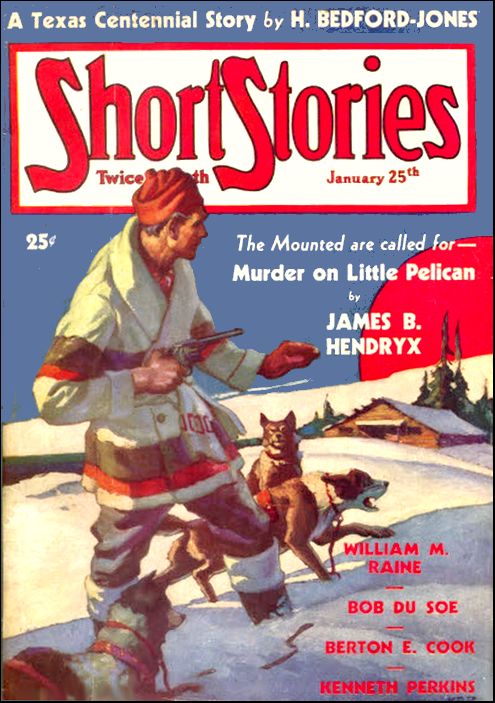
Short Stories, 25 January 1935, with "Loser Pays"
ONE bitter cold, dark night my car broke down, just outside Goliad. Storm, rain and sweeping wind. A passing motorist agreed to send help. I waited, and while the wind howled, I thought of the day, a hundred years ago, when three brush fires had crackled close by here. A distant shouting came down the wind—the voices of many men—yet no one was in sight. The voices died out, and then the slow but indescribably dignified voice of one man singing reached me. A gallant, rich voice, and the words came clearer and clearer:
"We asked and we gave no quarter. When we shot, we shot to kill.
And never a one of us whimpered when we had to foot the bill.
From Trinity to Laredo, by prairie and Alamo
We paid with our lives for Texas, a hundred years ago."
A burst of thin and distant yells swooped down with the wind, and after it a quick, fierce shout in unison:
"Here's to you, Colonel Fannin, damn your eyes!"
Was it real? I blinked around, shivered, found and saw nothing; yet it seemed that there came another burst of yells, and the rushing tumult of hoofbeats passing overhead. Here by the Coleto river men had fought like heroes, had died like heroes for the sake of other men—
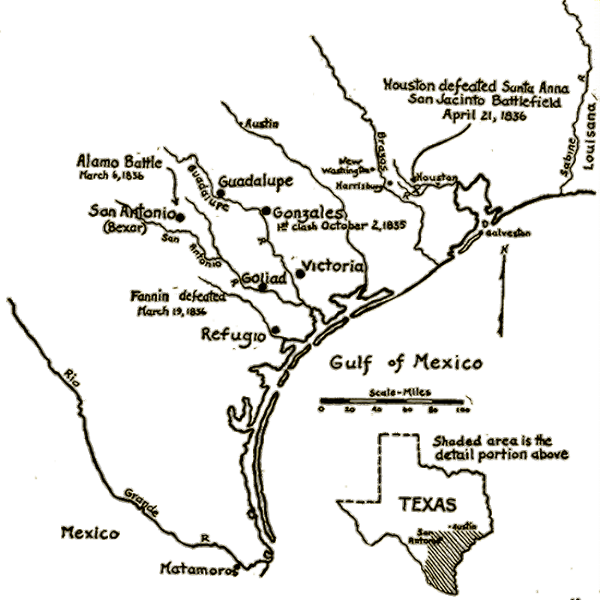
IMPETUOUS, ardent, chivalric, the young Georgian leaped to his feet. The others looked at him expectantly. He had already won a dashing repute, had Fannin. He had fought beside Jim Bowie, had proved his ability to lead men. In this new year of 1835, great things were expected from him.
"If Santa Anna is really coming with the whole army of Mexico," he cried, "then don't let him set foot on Texan soil! Strike ahead of him. Straight across the hundred and fifty miles of desert lies Matamoras. Strike there! An expedition can take and hold it. Santa Anna will be cut off from the sea. He'll have deserts behind him. Carry the war into Mexico, and save Texas!"
San Felipe went wild with delight.
For, at San Felipe was assembled the convention of Texas, now in rebellion. It was no secret that Santa Anna, the dictator, was somewhere on the march north with the overwhelming forces of Mexico. Carry the war into Mexico! Capture Matamoras!
Colonel Fannin was, on the instant, given unexampled powers. Although Houston was the general, Fannin was made practically independent. He was sent hot-foot to take command of Goliad, raise men and supplies, and then march on Matamoras. Colonel Johnson and Doctor Grant were to take post at San Patricio, gather horses, and then unite with Fannin in his march. All this by the council. And nothing doubting, Fannin departed, eager and ardent.
But at San Felipe reigned dissension.
Governor Smith—for as yet Texas had no thought of seceding from Mexico—had been elected to office; and in no time he was at open war with the council. Sam Houston was appointed general, deposed, appointed again. He stuck with the governor, the mainspring of authority. Colonel Travis was sent to command at Bexar, or San Antonio, with a small force. Fannin, at Goliad, had four hundred men. Johnson and Grant had another hundred.
Although none of them knew it, Santa Anna was even then almost upon them.
In San Felipe, matters went from bad to worse. The governor accused the council of graft and playing politics; the council went to work to depose him, and eventually did it. But first—who was to be obeyed? Houston ordered Travis to abandon Bexar, blow up the Alamo, and fall back to a prepared line of defence. The council sent post-haste orders to do no such thing but hold the Alamo.
And Fannin was at Goliad, preparing for the march on Matamoras. Suddenly the council revoked all orders to him. He was left to his own resources. And like a whirlwind, Santa Anna came when least expected. A new convention was meeting, Houston was at last in supreme command—too late. The agony of Goliad had begun. News was slow to travel in that day.
FEBRUARY drew on apace. With Fannin was Major William Ward and his Georgia Battalion—a hundred volunteers who had come West to free Texas, only to find that so far Texas did not want to be freed. They had hailed Fannin jubilantly, they obeyed him with fanatic devotion.
"Ward, we're up a stump," said Fannin despondently, huddling one evening over a fire with his friend. It was the 25th of February. "No word from San Patricio, and if Johnson and Grant don't find horses for us, we can't strike at Matamoras. Where Santa Anna is, nobody knows. Who's in command, nobody knows."
"It's a sweet mess," commented Ward. "Looks like all we can do is hang on and see what turns up. Queer we don't get some news from San Patricio."
Fannin nodded. "I feel incompetent, and that's the truth. I've asked the council to relieve me of command; I'm no soldier, and know it. Houston is the man of the hour, whether I like him or not. But, damn it, what can I do? They order me not to retreat. Houston has sent no orders at all. The governor has forbidden the Matamoras expedition, the council says to go ahead. I'm just no soldier, that's all. I can command a company, but I'm not the man to hold a chief command—"
"Good God, man! Nobody could, under such circumstances!" exploded Ward. "Why, the situation is utterly insane! Suppose Santa Anna should show up now?"
A sharp rap at the door. An orderly entered. Outside was a rising buzz of voices.
"Courier from Bexar, Colonel."
An exhausted, excited man stumbled into the room, thrusting out a letter. Fannin leaped up at sight of his face.
"What is it? What's happened?"
"Santy Anny—him and the hull damned Mexican army! Thousands of 'em. Travis has took to the Alamo, wants you to come a-running."
Fannin tore at the letter. He heard one low-voiced, tragic oath from Ward, as they were alone again. Then he extended the letter in silent dismay. Ward read it and looked up. Their eyes met for a moment in mutual comprehension.
"Well, it's come." Fannin squared his shoulders. "Half our men here are out foraging for food. We've no horses, only a few oxen for the wagons and artillery. We've one tierce of beef—and nothing else. Travis wants us to bring our artillery and ammunition and come to lend a hand."
"It's impossible!" said Ward. "And Matamoras—"
"Matamoras be damned—that's all washed up now. I'll send Johnson word to fall back here and join us. Get a courier ready while I write the letter, will you? Then we'll have to round up our men and try to get some transport."
Travis—holding the Alamo to death! The thought burned.
And yet, despite every effort, Fannin could not get off until three days later; then his transport broke down within a quarter-mile. To move the ammunition and cannon was impossible. His scouts brought in word of Mexican dragoons. To reach Bexar, a hundred miles away, was simply an impossibility. Travis had been ordered by Houston to blow up the Alamo and fall back; the council had sternly countermanded this order. To know what was going on, was out of the question. Fannin returned to Goliad and fell to work at his defences. His men were ragged, barefoot, starving. He wrote the council in words of desperate gallantry:
"I again repeat that I consider myself bound to await your orders, I have orders from you to await reinforcements. I am desirous to be erased from the list of officers and have leave to bring off my brave volunteers in the best manner I may be able."
THEN, like a thunderbolt, came the news that General Urrea had destroyed the force at San Patricio. Johnson and four of his men alone escaped; the others were butchered. They had refused to obey the order to join Fannin, and paid the price.
Settlers at the Refugio Mission sent in an appeal for help. Fannin despatched Captain King and a few men to the mission, thirty miles distant, to escort in the settlers. And all this while Travis was holding the Alamo—or was he? A second courier had come in with another urgent request for men and ammunition.
"I can't stand it!" cried Fannin to his friend, striding up and down the room, his features agonized. "To think of Travis and the others there, desperate—and we sit here helpless to lend a hand, helpless to join him! Evidently, Urrea commands a second army of Mexicans pushing up at us. And no orders—nothing! No horses, no reinforcements. I'm sending out parties tomorrow to scour the farms for wagons and oxen. We may pick up a few."
"Hang on," advised Ward grimly. "You've got four hundred men to think about, old chap. Funny we don't get any word from King."
Fannin snorted. "He should have been back with those settlers ere this. I told him to get back instantly. Hang on? Yes, that's all we can do, damn it!"
News burst suddenly. A courier came in with word that the frightened convention had once more placed Sam Houston in command of all Texas forces. Relief would be sent to Travis at once. Orders might be expected by Fannin at once.
None came. Instead, a messenger from King at Refugio begged for help. He had fought off a detachment of Mexican lancers but the mission was surrounded.
"Let me go and bring him in," said Ward. "These boys of mine are itching for a scrap anyhow."
"Go ahead, and God keep you!" said Fannin simply.
The Georgia Battalion, with yelps of delight, fell in. Then eyes went upward; a murmur grew and grew. "The flag! Ain't we taking it?"
Their flag had been raised above the mission—a white flag bearing a blue star and the legend "Liberty Or Death." A flag of silk, presented to the Battalion back in Georgia by a Miss Troutman. Colonel Ward looked up at it, and saluted it gallantly.
"Leave it for luck, boys!" he cried. "We don't need it; and maybe it'll be safer here. Attention!"
Fannin sat tight, perforce, and looked to his defenses. The Alamo had already fallen, but he would be slow to learn of it. Sam Houston, with a relieving force, had been two days too late.
WARD and his Georgia boys marched the thirty miles to Refugio in rollicking gaity, reached there late on the 13th, and found all well. King had beaten off an attack and the Mexicans had apparently dispersed. Ward now had a hundred and forty men all told.
Next morning, preparing for the return march, his scouts dashed in. Mexicans at hand, and plenty of 'em! Dragoons and lancers on the run!
And on the run they came, a thousand strong, pennons flying and bugles blowing. When they got under the very walls of the mission. Ward's men opened fire. The ranks were shattered and broken. The Mexicans wheeled and departed, only to reform again and again.
Until four in the afternoon, the attacks continued. Then, leaving a couple of hundred dead, the enemy rode off for good. And not one of Ward's command was killed.
That night came in a frantic message from Fannin. Orders at last from Houston; he was to abandon Goliad and retreat, joining Houston on the Guadeloupe. Ward must come in at once with his command. Head for Victoria on the Guadeloupe.
Ward lost not a moment. At midnight he marched out with his Georgia boys, flushed with victory. Mexican cavalry picked them up with morning, but Ward headed through woods and swamps for the Guadeloupe and threw off the pursuit. Day after day they struggled on. Came the 19th, and the sounds of cannonading from Goliad.
Ward pressed onward, obeying orders. Victoria at last—and Mexican troops there! Cavalry all about him. Urrea's whole army was about him. He was caught.
He went to Urrea's camp. Urrea offered him free passage to New Orleans if he would surrender. Ward took back the word to the Georgia boys and advised against it. Fight to the last ditch! But the dragoons, the lancers, the infantry, the artillery—the Georgia boys lost heart. They voted for surrender. Fannin had been destroyed. They had no hope of fighting through.
They surrendered, and were marched to Goliad.
What of Fannin, meantime—Fannin, undergoing his agony of glorious failure?
On the 14th, an express reached him from Houston, with definite orders to bring off what cannon he could, abandon Goliad, and fall back to the Guadeloupe. He sent messengers to Ward, and had no word back. He buried some of his guns, hastily set about collecting wagons and transport, and waited until the 18th for Ward, in vain.
This day, his scouts brought in word of increasing numbers of Mexican cavalry.
Next morning he marched out, with three hundred men, setting fire to the wooden buildings, with what ammunition he could not take. He had no fear of the Mexicans; with his officers, he laughed at them, for fighting with Bowie had imbued him with the idea that one Texian could disperse a dozen dragoons.
They set forth gaily, then, to join Houston and seek the war. Free Texas! The convention had declared for liberty. The die was cast. To the ardent Fannin, the days of 1776 were come again. He led his men out with cheers. Not a Mexican in sight as they crossed the river at the ford, got the light artillery and the wagons over, and headed across the prairie for Coleto Creek, ten miles away.
No danger anywhere. Eight miles were covered, when it became necessary to rearrange the hasty loads and teams. Two miles distant lay the creek, thickly wooded. The scouts urged Fannin to make his halt there, but he shrugged and gave the orders. Camp was made, the oxen were unyoked from the guns and wagons, were allowed to graze. His little force of mounted men was sent out to scout; that was the last heard from them.
SUDDENLY a yell arose. Fannin leaped to a wagon and looked forth; a shout broke from him, a shout of eagerness, of delight. Mexicans! A few troops of lancers breaking from cover of the trees—only a few troops. And they meant to attack. Good!
The last chance to make the timber was lost.
Swiftly, Fannin drew up his men in hollow square, three rifles deep, the cannon at the four corners. He asked nothing better than a cavalry charge; and he got it. He got more than he bargained for. The lancers deployed, and he eagerly opened on them with his cannon.
Then more lancers appeared. Helmets glittered and drew into sight from the brush. Dragoons! Company on company of them. A wild burst of yells lifted—a company of Indian scouts, sharpshooters, scattering out. A column of infantry advanced.
And suddenly Fannin knew he was caught, there in the open, by Urrea's whole army. Caught and surrounded.
"That's no convict infantry," spoke up a scout. "That's the Tampico regiment, Cunnel—the crack outfit of the hull Mexican force."
"So much the better!" Fannin's gay, wild laugh rang out. If a cold hand laid grip on his heart, none suspected it. "So much the better. Give 'em hell, boys!"
A ragged cheer went up, gained volume, became a bedlam of voices. No surrender!
The cheering died. The dragoons and lancers were spreading out, coming in on three sides, quickening pace. Hands gripped on rifles; the artillerymen hastily loaded with grape and canister. The squadrons were trotting now, pennons flying, lances glittering, escopetas ready for firing. Suddenly a trumpet outblew, then another, and the horses leaped to a gallop. Down came the lances. The charge thundered in upon three sides, brown faces alight with battle-lust, yells rising high.
Then the rifles began to crack. The light cannon crashed out. Horrible lanes of death were opened in those advancing ranks, but they came on. Horses went down, men went down, but the others came on. On and on, until the third and reserve rank of men loosed their fire and vomited death into the broken squadrons. They wheeled and went galloping away, leaving dead and wounded men and horses strewn on the prairie.
They reformed, while the exultant lines of Texians yelled themselves hoarse. Formed up again on three sides. The regiment of Tampico was advancing on the left flank, twelve hundred strong, bayonets glittering, lines dressed as though on parade.
Again the trumpets lifted silvery voices. The squadrons came on at the gallop, the Tampico regiment charged in with the cold steel. Bullets smashed into them. Their ranks were broken, faltered, shaken. They dispersed and flung themselves into the long grass. The cavalry squadrons were shattered anew by that deadly fire. They swerved and galloped away.
Yells redoubled. Fannin, despite that cold grip clutching his heart, despite the blood pouring down from his thigh, yelled with the rest. Then he was forced from his feet and submitted to being bandaged. A severe wound enough, though the bone was not broken. Bandaged, he came up again, leaning on a rifle. They greeted him with cheers and yells of delight.
Another charge. The Tampico regiment in the grass was joined by the Indian sharpshooters. No more charges for them; but as the cavalry swept in, their bullets hailed into the hollow square of riflemen.
Then, with men dying and wounded, the rifles turned to the grass fighters. Grape searched them out, deadly bullets found them. A few of the Indian scouts remained, but the rest broke and fled. Evening was coming down, and the battle of the Coleto was won for Texas.
IN the dusk, Fannin assembled the men around him. Exultation had gone. He faced them level-eyed, white-lipped, calmly. That cold clutch had fastened tight upon his heart now, but his voice was gay and ringing as ever.
"Boys, the decision is up to you now," he declared. "We've licked them. Maybe we can lick them again. We've got a right smart of wounded men to think about, and mighty little water in camp. We can't hope for any reinforcements—what's become of Ward and the Georgia boys, nobody knows. More than likely, there'll be fresh Mexican troops here by morning."
The sober, deadly words drove into them. The men listened, staring at him as he leaned on his rifle-crutch in the gathering dusk.
"Face the facts," he went on. "Our wagons have broken down. We've no way to carry off any wounded men. If we leave them here, they'll be butchered. You heard the yells of no quarter! Now, we've got to make our choice and make it quick. We can abandon the wounded, the artillery, the baggage, and break through them for the Guadeloupe. We can do it with one smash; we've licked them already. Or else we can throw up entrenchments and lick them again if we have to do it. We've mighty little water, remember. The powder has run out. We've got about two charges for each cannon left."
He paused, compressed his lips for a moment, then went on.
"I'm giving no orders," came his voice, slowly. "I'll do whatever the majority decides is best. If you so decide, I'll stay with the other wounded men and order you on. I'll say frankly that by morning we'll probably find twice as many Mexicans here, and your one chance is to break 'em now and—"
"To hell with 'em!" yelled a frontiersman suddenly. "Hey, Cunnel! You mean to say we got to leave the wounded here to be butchered?"
"There's nothing else for it," Fannin rejoined. "It's better that a few should die, than that all hands should take the risk."
"Be damned if we do!" rose the shrill yell of indignation. It was echoed and reechoed by the thronged circle of men. "We stay right here!"
Fannin put it to the vote. Not one dissenting voice was raised.
"I'm proud of you, boys'." rang out his clarion words. "Then get to work and throw up trenches and let 'em come and be damned!" With a burst of cheers, the wearied men fell to work with new enthusiasm. But the wounded men cried for water.
FANNIN lay blanket-wrapped in the darkness; no fires, for the Indian snipers were still at work. His wound stiffened. Worse than his wound, was the agony of his soul. He had done what he could; all that any man can do. Circumstances had hemmed him in, beaten him back, crushed him down. Victorious, he looked failure in the face and recognized it. He knew what the morrow must bring forth, and trembled; not for himself, but for these three hundred men around him.
This night, he aged twenty years. As the hours crept toward dawn, he knew the worst. The rumble of artillery lifted along the ground, the measured tread of fresh cavalry squadrons shook the long quivering grass; but they were not coming to his help. The water had given out ere midnight. The feverish cries of the wounded rang in the darkness, pitifully.
Slowly the dawn broke. A rifle cracked, then another. Silence again, and men were roused from sleep. Fannin stood clutching his rifle-crutch, peering out at the higher ground all about, as the slow day broke. Colder and grimmer grew the grip on his heart. There on the eminence, the hillock he should have seized, rose a gay cluster of horsemen. Officers, a flag. Epaulets, the gay glimmer of uniforms in the sunrise. General Urrea in person and his staff.
Artillery posted now; a battery within six hundred yards of the camp. Fresh squadrons wheeling about, preparing to attack. One of the Mexican guns suddenly belched smoke, and into the camp rained grape.
"Hold your fire," Fannin cautioned his men. "No reply. Save the last powder-charges for their attack."
The Mexican guns crashed and crashed again. Suddenly their fire ceased. An officer and a man with a white flag appeared, riding in. Fannin sent Major Wallace out to meet them. Terms were offered; surrender at discretion. Major Wallace laughed.
"Before we'll yield on such terms," rang out his voice, "we'll fight as long as there's a man left to fire a gun!"
The officer went galloping toward the hillock. The squadrons formed up for attack, with trumpets shrilling. Then, abruptly, General Urrea himself with his staff came riding toward the camp, white flag displayed.
"Come on, Wallace," said Fannin. "Give me a hand and we'll say howdy to him."
He struggled out into the open. Urrea dismounted, greeted him with gallant words.
"There has been enough bloodshed, Colonel Fannin. Surrender, and I'll grant you honorable terms. Your freedom on parole, if you like."
SUDDEN relief flooded into Fannin. Urrea was afraid to face those rifles again; the pompous boast of "no quarter to rebels!" was a thing of the past. They were saved, all of them.
"Will you come into our camp?" he asked. "It is difficult for me to stand. We may then reduce the terms to writing, if my men accept."
Urrea assented, called his secretary, and both of them walked into the camp with Fannin and Wallace.
The riflemen stared. For the first time, they saw a Mexican general at close quarters; gold-laced uniform, high collar, clanking sabre. Then word spread of the proffered terms. Their lives and freedom, on parole. They would be sent back to New Orleans. A cheer arose, and swept along the lines.
The terms were put into writing, both Spanish and English. Fannin read the latter to his men; they approved with a shout. Arms were stacked, water was fetched from the river for the wounded. The Mexicans had horses in plenty; these were hitched to the wagons in which the wounded lay, and with an escort of dragoons, Fannin and his men were marched back to Goliad.
As they went, they saw a courier go streaking off for Bexar. They already had heard from the Mexicans that the Alamo had fallen, and Santa Anna was in command of the town. At the moment, this meant nothing to Fannin. Tortured by his wound, yet immeasurably relieved that the stress was over and his men safe, he thought of nothing else. He could relax at last.
With evening, he and his men were back in the quarters they had abandoned; but now as prisoners, confined and guarded.
NEXT day arrived a weary, gaping train of prisoners. A Major Miller and eighty men, volunteers from New Orleans to help free Texas; they had come by sea, and landed at Copano to find themselves Mexican prisoners. They were marched in and mingled with Fannin's men. Next morning, however, they were assigned quarters to themselves, and each man of them was bound about the left arm with a white cloth.
"Why?" demanded Fannin, when Major Wallace told him of this.
"Some whim of the Mexicans," and Wallace shrugged. "This Colonel Portilla, who's in command here, is a brute. By the way, I've news of Ward. He'll be here tomorrow."
"Ward! Here?" Fannin raised up on one elbow, then fell back. "Oh, I see. How many of the Georgia boys are left?"
"Most of them, thank heaven! They got the same terms we did. But our men have all been moved into the old church; they're crowded in and given mighty poor food."
Fannin protested to the commandant, without avail.
Ward, and his weary, despondent men came in next day under guard. Three hundred and fifty prisoners crowded into the old church walls now, poorly fed, yet overjoyed with everything. They had come through victorious, and now they were heading back for New Orleans. Nothing else mattered! And the Mexicans were, in general, friendly enough. Good fellows, after their own fashion.
CAME Saturday night, and Fannin had his cot carried into the church among his men. There was singing and high jubilation all around. A ship was already at Copano to take them away, spread the rumor. Then, as Fannin was carried back again to his own quarters, there was a rush of hoof beats outside the gates, the challenge of a sentinel, the sharp response.
"Courier from El Presidente!"
Orders from Santa Anna had arrived, detailed, precise orders from the conqueror of the Alamo. Colonel Portilla had but to obey.
Palm Sunday, the 27th of March. The Mexican forces had swept lower Texas clear of rebels. Santa Anna himself was now pressing on from Bexar, with nothing to stop him but a contemptible, hastily raised little army commanded by Houston, who was in full retreat. The convention, the politicians, the lawyers, the whole government, were in hasty flight for Louisiana and safety.
The men crowded in the church were wakened and ordered out. Squads of them were marched away in three directions as workmen. Three columns were made up. One was marched out under heavy escort on the Bexar road.
"Going to slaughter beeves, señores," said one of the Mexican officers. "Plenty to eat for all today!"
Another column of a hundred on the Copano road; a ship was there, and they were to be started for New Orleans at once. The third column, south across the prairie—Santa Anna was coming to occupy Goliad and a new camp had to be formed. So they were told. All the officers were here save Fannin. Three hundred and fifty men.
All three columns sighted huge piles of brush being gathered by the working squads.
Coming to the brush piles, each column was formed in a double rank and ordered to sit down on the ground. The men obeyed, in no little wonder at the whole thing. One of them looked around. Suddenly he knew, they all knew, why Miller's men, who were not with them, wore the white arm-bands.
"By God, boys, they're killing us!" rang out the shout.
The muskets began to crash in volleys.
MANY of the victims survived that first hail of lead in the back. Some tried to fight. Some broke away, and were run down and spitted on cavalry lances. A few gained the shelter of brush and eventually escaped—a scant few. Bullet and lance did their work, and then the bodies were gathered and flung into the gathered brush.
The troops marched back. Now the wounded were dragged forth, and butchered with short shrift. And all the while, Fannin, alone, waited for the death that his guard informed him was coming. Alone—in a sudden horrible burst of realization that would have shaken the sanity of most men.
They aided him out to the square. He hobbled to a bench as ordered, and sat there, and looked up with cool, brave eyes at the officer who brought a white bandage for his eyes.
"Here, Señor Capitan," and he produced his gold watch, "is my watch. As a favor from one soldier to another, will you see that it reaches my wife?"
"But yes, my Coronel," and the officer caught the watch avidly. Fannin reached up and took the bandage.
"I'll put this on myself. Will you see that I'm shot in the heart and not in the head?"
Glib promises. The firing squad stood ready. Fannin's gaze drifted around in the sunlight for one moment; then he reached up and tied the bandage.
"Fire!"
The volley was directed at his head. He was killed instantly, and his body flung into an arroyo outside the fort.
Torches were set to the three piles of brush outside town, after the bodies had been plundered and stripped. Three columns of smoke and crackling flame, that only half did their appointed work. Weeks afterward, when vengeance had run its course and Houston's men had done their work, fragments of charred flesh and bones were picked up near and far—such as the dogs and vultures had left for the finding.
The Alamo had sent up its smoking pyre. Goliad sent up its three trails of smoke. The losers had paid.
But the game was not yet finished.
Roy Glashan's Library
Non sibi sed omnibus
Go to Home Page
This work is out of copyright in countries with a copyright
period of 70 years or less, after the year of the author's death.
If it is under copyright in your country of residence,
do not download or redistribute this file.
Original content added by RGL (e.g., introductions, notes,
RGL covers) is proprietary and protected by copyright.