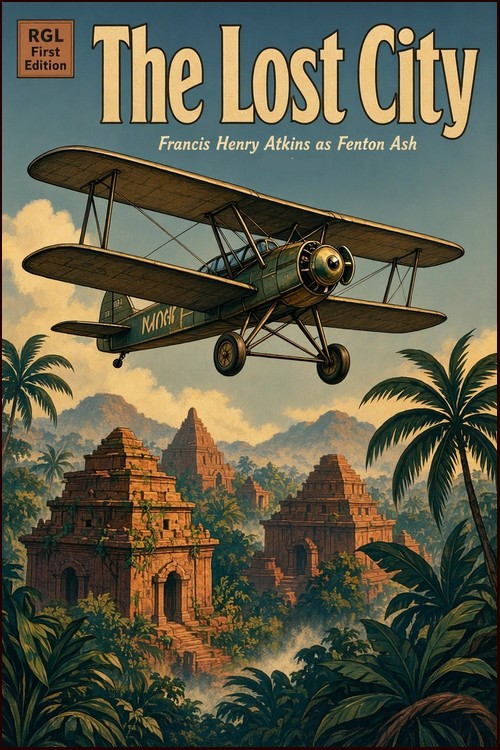
RGL e-Book Cover
Based on an image created with Microsoft Bing software
Roy Glashan's Library
Non sibi sed omnibus
Go to Home Page
RGL e-Book Cover
Based on an image created with Microsoft Bing software


In the blistering heart of an African jungle, where crocodiles slide through slime and lions roar from the shadows, an impossible apparition descends from the sky—an aeroplane mistaken for a monstrous bird by a terrified village. Its arrival entangles young hunter Stanley Morton and his loyal companion Mike in the schemes of Cagga, a ruthless slave-dealer whose cruelty masks a deeper secret: the whispered existence of a hidden white civilization and a stolen princess whose fate could change everything. From jungle death traps to aerial rescues, from menageries of savage beasts to the first hints of a legendary city lost for centuries, "The Lost City" plunges readers into a breathless serial adventure where every chapter heightens the danger and every revelation deepens the mystery.
This RGL first edition is a novelisation of the 15-episode American silent film serial The Lost City released by Warner Brothers in 1920.
It was written by the British author Francis Henry Atkins under the byline "Fenton Ash" for the English weekly newspaper The People (Odhams Press London), where it was published in 15 installments, beginning on 6 September 1920.
The film serial was directed by E.A. Martin and featured:
Juanita Hansen as Zoolah/Princess Elyata of Tarik
George Chesebro as Stanley Morton
Frank Clark as Michael Donovan
Irene Wallace
Hector Dion as Cagga
The chapter titles, which, to some extent, differ from those in the novelisation, were:
01. The Lost Princess
02. The City of Hanging Gourds
03. The Flaming Tower
04. Jungle Death
05. The Puma's Victim
06. The Man-Eater's Prey
07. The Bride of Death
08. A Tragedy in the Sky
09. In the Palace of Black Walls
10. The Tug of War
11. In the Lion's Jaw
12. The Jungle Fire
13. In the Cave of Eternal Fire
14. Eagle's Nest
15. The Lost City
IN a clearing in the recesses of a vast African jungle a native village lay sweltering in the noontide heat. The burning sun poured its almost vertical rays upon the low huts, upon soaring forest trees on one side, on creek and swamp on the other. Great lizards flattened themselves out upon rocky ledges as though greedily drinking in the baking sunshine; humming birds were hovering like diving, flashing jewels, above gorgeous flowers, dragon flies darted to and fro in the shimmering haze. Otherwise there were few signs or sounds of life for the inhabitants of the village were asleep within their habitations, and the forest lay in hushed silence.
Once or twice there came a muffled splash, and a deep, sullen plunge, as some monster crocodile in the distance slid down the mud-banks of the creek into its turgid, slimy waters. Or a quiet little splash might be heard as a stork that had been standing like a figure carved in stone, suddenly shot out its long neck and seized a struggling fish. A monkey on a branch overhead crept further along it into the shadow of the foliage, chattering sleepily as if saying to itself. "How hot it is; oh, how hot it is!"
Suddenly, there came the sound of a running native, rushing and tearing towards the village at his utmost speed, uttering as he ran exclamations of fright and terror. A fine figure of a man, with picturesque head-dress, and armed with spear and shield. He was a native warrior chosen for his known courage and trustworthiness, to mount guard as watchman and scout on a neighbouring eminence while the people of the village were enjoying their siesta. Most certainly not a man easily scared, or one likely to lose his head in face of any ordinary danger that might threaten. What, then, could be the meaning of this frantic, head-long panic? This was the question which everyone was asking a minute or two later, when the great village gong sent forth its booming summons in a manner which told that something more than usually momentous was afoot.
Almost instantly, as if by magic, the silent, seemingly deserted village became alive with people. Men, warriors and children, dusky, armed warriors, and trained men, rushed about in aimless confusion, like an ant heap which has been disturbed by some one poking a stick into it. Then, with one accord, they bowed very low, three times, and immediately threw themselves flat on their faces on the ground of the clearing. For they had seen what the panic-stricken scout had pointed out—a terrible apparition in the sky.
An awful thing, a flying something of uncouth shape, with outspread wings of a size such as no bird that they were acquainted with ever attained to. Sinbad the Sailor's Roc would have been but as a mere sparrow by the side of this monster, Though it was then scarcely more then a speck in the sky, these children of the wilds could calculate its distance, and somewhere near what its real size must be, at a glance, and indeed their worst fears were confirmed by the prodigious rate at which, each second, it increased in size.
Larger and larger it grew. Evidently it was coming straight at them; and lower and lower fell the courage, higher mounted the fears of the prostrate community, as first one of them and then another ventured to raise his or her head to take a peep, and banged it down again on catching another view of the awful thing swooping down on them. Exactly what would have happened had matters continued thus cannot be told—probably some would have died of sheer fright—for at this point there came an unexpected diversion.
From somewhere at the back—from a dwelling almost hidden in the shadows under the giant trees—a man came forth—a white man, clad in white raiment and sun helmet, a man with a hard, sensual, cruel face. Taking in the situation almost at a glance, he proceeded in a manner of his own to restore order among the prostrate crowd, and, as he termed it, "bring them to their senses."
He was a slave dealer—one of those pests who are the curse of the "Dark Continent," detestable miscreants whom men like Livingstone, Gordon Baker and others exposed, and tried so hard to hound down and drive out off the land. His name was Cagga, and he had a bad reputation even among the Arab slave traders for treachery and unscrupulousness. With him came his principal lieutenant, a big native warrior with shield and spear. In one hand Cagga carried a whip with a long, wicked looking thong, with the other he matched the spear from his man's hand and then went about among prostrate crowd, prodding and lashing right and left till he had prodded and lashed them to their feet.
Meantime, the approach of the flying apparition had been the cause of another and most curious demonstration of quite a different kind. It had begun with a few low growls from some unseen but evidently large and savage animals. These increased in number and volume, as others joined in until the whole forest resounded and echoed with a deafening chorus, amongst which could plainly be heard the mighty roar of lions and trumpeting elephants. It was as though the forest had been alive with great beasts, which had either seen the apparition in the sky, and were roaring defiance to it, or had been excited for the unusual and increasing noise it sent forth as it drew nearer. The sounds of the roars and snarls and trumpeting came up through the heated air to the two men in the aeroplane—for that was the "monster" that had caused so much commotion—and surprised and perplexed them not a little.
"Holy Moses" exclaimed one of them, a big, muscular Irishman. "Phwat sort av a place is this we've got to? Arrah now, Stanley! Ye're not goin' t' land in a den av lions like this?"
"We'll have to land and risk it, Mike," returned the young fellow, who was evidently his leader. "It's no use going further without verifying our position. I can see a lot of people below—a native village, I guess—and a white man among them—and a roomy clearing to effect a landing in, so we ought to be all right. And as to the lions—I guess the white man's a hunter, or perhaps a dealer in animals, and he's got a collection together here."
Now in this Stanley Morton—such was the young fellow's name—had made a shrewd guess; for Cagga added dealings in animals and hunting for ivory to his other business; and he had, just then, quite a large menagerie gathered together at the chief village of the native tribe which he "bossed."
As the aeroplane settled to rest on the ground, the uproar from the wild animals, which had risen to a pandemonium, died down. Cagga, who had been watching the aviators' manoeuvre from a distance through binoculars, uttered an exclamation.
"Why, it's that young game hunter," he growled with an oath. "Now, what ill wind can have sent him my way just now, I'd like to know? However, I must dissemble, as they say on the stage. It wouldn't be wise to do anything to raise his suspicions. Perhaps he only wants to ask his way to some place, and then he'll go on.
Cagga, like most of his tribe, had many black marks against his name. He was, in fact, "wanted" by the frontier police, and had good, reason, therefore, for not wishing to have visitors. He had seen Stanley Morton some time before on one of his secret trips to the coast. He had been pointed out to him as a young millionaire who was an enthusiastic big game hunter. As the good-looking, athletic young fellow came towards the village, Cagga went forward to meet him, bowed deferentially, and said, "You are welcome, sir, to the shelter of my humble abode while you care to stay here."
him cordially. Then began a conversation between the two on the pleasures and delights of big game hunting, with a few inquiries, on Stanley's part, as to the direction he ought to take in order to get a good "bag."
"And by the by," he added, as if casually, "could you tell me—I suppose there's really no truth in the stories I have heard about some city hidden in the midst of this wilderness of forest and jungle and swamp—a city that has been lost sight of for countless years, yet still survives?"
Cagga started, then controlled himself. A crafty gleam came into his face that would have put on his guard any man of more suspicious temperament than Stanley Morton. "Where did you hear that—that—foolishness, sir?" he asked cautiously.
"Oh,—well—I heard something about it from two or three old hunting chaps I came across. They said that many strange reports have been brought back by explorers who have ventured out here. But they all admitted they did not believe in the tales themselves."
No, I should think not. Old wives' tales, as they say; that's all you can say about them."
Here there came another diversion. A number of men of the tribe were seen approaching from a different direction. They were a party who had been out on a slave-hunting—or slave buying—expedition, and were returning with a batch of wretched-looking captives. As they passed by towards the village Stanley, who was looking at them with mixed feelings, saw a man in charge behaving with brutality towards one of the females, and he felt indignant. He seized the fellow and handled him pretty roughly, when Cagga interfered. Inwardly seething with rage, he took his man's part, while affecting extreme politeness.
"I humbly beg pardon," he said to Stanley, "but these people must be handled, with firmness."
As he turned to follow the party's march to the village, he said to the big warrior from whom he had taken the spear, speaking in the native tongue, "Akrala! Watch these strangers! They may be spies and enemies who may bring the soldiers from the coast upon us."
Stanley, strolling behind with his faithful assistant, Michael Donovan, said to him thoughtfully, "That poor slave girl has the features of a white girl, Mike."
Mike looked at him quizzically. "Shure, it's funny phahncies ye have at toimes, Stanley. Phwat next, Oi whonder?"
But Stanley remained very grave. He was recalling several curious things that had struck him about the girl in question. Not only had she a face quite different from all the others, not only did it seem to him—black though it was—to be like a white girl's, but it was, he thought he could see, a very pretty, charming face. Nor was that all. Though she seemed to be but a black slave girl chained to the other helpless captives her behaviour, her pose, her manner, were all totally different. In place of their loose, careless, slip-shod bearing, this particular girl carried herself with a certain haughty pride which, while many would have laughed at in a slave girl appealed to Stanley in a manner he could not shake off.
He made up his mind to enquire further into this, and later on, when an opportunity offered, he, aided by Mike, bribed the guard to set her free for a few minutes, when he beckoned her to follow him to a secluded spot among the trees. There the two had quite a long talk. Then she went back to her place with the other slaves, while he returned, with shining eyes, to Mike to tell him what had taken place.
Mike had some news for him, too. He had not been idle in the interval. "Listen t' me, sonny!" said he. "Ye remimber I told ye Oi had been animal tamer wid a circus out here? An' that Oi taught one av the elephants t' dance whin I played a certain tune on me mouth organ?"
"Yes, Mike, I remember that. But what of it? I have wonderful news for you, Mike! That pretty slave girl—"
"An' Oi have wonderful news for you. That elephant's here. They're got several, an' Momba—ye remember Oi told ye the baste's name was Momba—is amongst thim!"
"Ah! Very interesting, Mike! Very interesting! But now listen to what I have discovered! You recollect what brought me out here—the tales I had heard about there being a lost city buried somewhere in the midst of this vast wilderness?"
"Why, av course. What thin?"
Stanley seized Mike's arm to fix his attention. "It's all true, Mike! There's a lost city somewhere in these wilds! It exists to-day, and it is inhabited by a race of white men, and that slave girl comes from it! She is a Princess, Mike. Her name is Elyata—Princess Elyata! She speaks a sort of Spanish dialect—something between Spanish and Portuguese—and we could understand one another! Her father is a King—a white man—and reigns over the wonderful 'Lost City' which is inhabited by a white race!"
Mike stared at him as though he thought Stanley was mad—in fact he did think so. Then he turned away, that he (Stanley) should not see the pained expression in his face. "Shure, the lad's mad—stark, staring mad!" he muttered aloud. "The heat it is that has done it! Poor lad! How'll Oi iver got him safe home again?"
But Stanley only laughed, and started off to find Cagga.
"I want to buy one of your slave girls," he said, with a light laugh, and he pointed to the one he had in his mind.
"Very well," said Cagga. "But the price will be high." Then turning to one of his people, he said, carelessly, "You'd better take the girl to the women, and tell them to give her a bath and a good wash, and dress her up a bit, as she's going to leave us."
Stanley, well pleased, strolled away, with Mike, and then appeared Cagga's black lieutenant. He walked quietly up to his master, and began to talk in a low tone. Acting on his master's orders to keep the strangers under observation, he had watched Stanley, had seen him bribe the guard and walk away with the girl, and had followed, secreted himself among the bushes and listened. And now he repeated to Cagga what the girl had said, which agreed with what Stanley had told Mike.
A great change came over Cagga's face. He sat for quite a long time absorbed in thought, muttering to himself at intervals. And this is somewhat how his mutterings ran:—"So! Then it is all true—what I had heard, and what I was going to seek after! The lost City of Tarik! And she—she claims to be a white girl and a Princess, daughter of the King of Tarik! What a discovery! What a future it opens up for me! She has been stolen and carried off, her skin artificially darkened and then sold as a slave! What luck that she should fall into my hands! Of course I shall not now think of selling her! I shall marry her myself, and take her back to her home—where I shall have a fine position with a King for a father-in-law!"
When later, Stanley came back to pay for his slave girl and take her away, he was astounded at the vision of loveliness which met his view. Though dressed up in somewhat bizarre fashion—doubtless the best the village wardrobe could provide—she looked a different being. Her skin was as white, her hair as fair as any European's. And her face was more beautiful, more charming even than Stanley had believed it would turn out to be.
Then he received a terrible shock. When he asked the price he had to pay, Cagga shook his head. "I have changed my mind," said he, insolently," The slave is not for sale!"
THE next two or three days were momentous ones for the two travellers, who found they had fallen into a veritable hornet's nest. Stanley, after parting with Elyata, planned, with Mike's aid, to run off with her. But they were followed and recaptured; and Cagga, in mad revenge, ordered the two men to be bundled into a pit, at one end of which were a number of lions. These were shut off by bars in which, however, was a sliding door worked from above.
"It's done for, we are," Mike lamented. "Whin they hoist up that door the critters will—! Oi whonder if a little music wud charm thim, now? Oi'll try it, an' hope for the best."
Mike pulled from his pocket the little mouth-organ to which reference has already been made—he was never without it wherever he went—and with a doubtful shake of his head, he commenced playing away for all he was worth, it seemed a forlorn hope indeed; and so far as the lions were concerned it was a dismal failure. It only seemed to excite them, and they soon drowned the sounds in a burst of earth-shaking roars.
But the unexpected happened. Over the side of the pit came something like a great snake, swinging and jerking about as if in tune to the music. It was Momba's trunk. Momba had heard! And she had responded to the summons! To her it always meant an "invitation to the dance," and as she was a bit of a jazzing enthusiast, she had come dancing along, in her odd, quaint fashion, till she had reached the edge of the pit.
Mike was prompt to seize her by the trunk, and the friendly elephant assisted him to climb up to her head. Then, under his direction, she helped Stanley to follow his example. It took only a few minutes to set them free.
But, meantime, things were going badly with Elyata. She had been kept prisoner in Cagga's house, where he made her life a misery with his hateful attentions. Seizing an opportunity to creep away, she made another attempt to escape, which, alas! ended disastrously for the persecuted girl. Not knowing her way about the place, she followed a passage which led to the very place the two friends had escaped from a little while before—the lion pit. A trap door, concealed with diabolical cunning, opened under her feet, and with a scream of terror, she fell into the terrible den. Her cry was heard by Stanley and Mike, and they rushed to the pit and looked down. Then Mike looked round for Momba, once again setting the mouth-organ to his lips. But Momba had gone off into the forest!
STANLEY MORTON started forward towards the edge of the pit where Elyata was standing as though fascinated with terror. The lions, on the other side of the iron bars which shut them off, were roaring and rushing to and fro anxious to get at their prey. So for they were kept back by a sliding door which, however, might be drawn up at any moment. Mike laid hold on the young man just in time to prevent him from throwing himself into the pit; and there was a brief but sharp struggle between the two.
"Keep off! Let me go to help her!" gasped Stanley, as he struggled furiously in the powerful but kindly grasp of his friend.
"It's mad ye arre t' thry that way!" Mike remonstrated. "There's onnly one way to save her—the aeroplane. Arrah now, be sinsible an' come wid me!"
Stanley suddenly gave way. "You're right, Mike, my lad!" he agreed. "Come away then, and pray Heaven we may be in time!"
The two started off at top speed for where the aeroplane lay. It was a hot run in the broiling sun, but neither of them felt anything of it just then. As they neared the machine they were seen, and a crowd of Cagga's men came after them. But they were too late. The aeroplane had started ere they could reach it, and with a great whirr it rose into the air and sailed off. But not very far. The crowd who were standing staring at it, open mouthed and furious, were surprised to see it circle round and head back towards the village. Afraid that there was some sinister intention in this, they were seized with panic, and uttering loud cries of fear, ran about hither and thither seeking for cover.
The cries and shouts were heard by those within the village and communicated the panic to them. This was a very fortunate thing, and it probably saved Elyata's life. For when the plane passed over the lion pit she was still there in the same place, and the sliding door had not yet been opened. At that very moment, however, it began to rise. Probably the guards who had been charged with the duty had been too startled by the clamour outside to act sooner. The lions were now excitedly pawing at the space at the bottom of the door which was growing wider every second, and tumbling over one another in their eagerness to get at the poor girl. All the time they were sending forth a most blood-curdling chorus of growls, snarls, impatient whimpers, and resounding roars. Overhead, Mike was leaning over trying so to manoeuvre a long rope as to swing it within the girl's reach.
Suddenly it seemed to leap at her. She caught it, and pulled. Mike let out a little more, to enable her to get a good hold, then gave a great haul. The barred door slid up, and the lions rushed out, some leaping high, others standing on their hind legs, clawing wildly at the empty air.
But they were too late! Elyata was by that time swinging easily and safely at the end of the rope well beyond their reach. With the agility of an acrobat she climbed higher and higher until she reached the aeroplane, which then sailed rapidly away out of sight. Cagga, who had roused up and come out to inquire what all the noise was about, stood watching it, shaking his fists at it as long as he could see it, his face a picture of helpless rage.
"Wait a bit, wait a bit! You haven't done with me yet!" he snarled. "You can't keep up in the air all the time! I shall follow you, and I will run you down! And when I catch you—it will be my turn again!"
CARING nothing for Cagga and his threats—which of course they could not hear—the three on the aeroplane sailed gaily onwards. They were a happy, laughing little party just then. Elyata was delighted with this, her first experience of flying. She kept looking down, marking how different things that had been familiar all her life on the ground, looked from above; at first she would be puzzled, then, when she recognised them, she would clap her hands like a delighted child. Stanley found sufficient pleasure in watching her and admiring her grace and beauty, while Mike had plenty to occupy him in managing the machine.
Over forest and swamp they glided; over river and lake, and jungle, as though in a dream, until—they were pulled up and brought back to other realities, as it were, with unpleasant suddenness. The petrol had run out! Stanley and Mike looked at each other in surprise and dismay. An examination revealed the fact that the petrol had been quietly but steadily leaking away for some time.
"May the devil fly wid 'em!" muttered Mike between his teeth. "It's monkeying with the petrol tank they've bin!"
Stanley only nodded moodily. He understood. They ought to have taken precautions against anything of that sort. But it was too late now, and raging against Fate wouldn't alter matters. The situation was too tragic; too heart-breaking for mere words. Obviously there was only one thing to be done—to land at the first likely-looking place, and pursue their journey on foot, in the hope of reaching some native village where the villagers might be friendly, or might be bribed to aid them. And this, in effect, is what they managed to do and a very queer, quaint sort of "village" it was that they came to.
"The Village of Hanging Gourds," Elyata called it when she saw it. She had passed it, it seemed, on her way to Cagga's place. Instead of being on the ground the huts were suspended high in the air amongst the trees, and the inhabitants went up and down by means of swing "rope" ladders, made from the tough fibre of creepers.
There there came a surprise. The chief turned out to be a native who had acted as guide to Stanley in a previous hunting expedition, and he welcomed him and his companions cordially. "You are welcome to stay as long as you like," said he.
THE three travellers stayed a week as the guests of the tribe, during which time Stanley and Elyata fell more and more deeply in love with one another. To her the quaint village seemed not merely a haven of rest, but a veritable paradise, after the hardships, the sufferings and the humiliations she had endured. Stanley's chivalrous behaviour and manly, upright nature, appealed to her as something entirely different from anything she had known before.
The two had many long talks together during this period, so that Stanley learned more and more of her history from day to day. And the more he heard, the greater became his pity for her in all she had gone through, and his admiration of her high-spirited courage, and her loyal trustfulness. He showed her some cuttings he had brought with him, taken from a publication wherein reference had been made to "Travellers' Tales," and various reports about the supposed existence of a lost city in that part of Africa. He read one of them to her which ran thus:—
". . . This vast and seemingly trackless wilderness, now given over to wild, savage animals and reptiles (and races of men even more fierce and dangerous) is yet a land of mystery, of weird legends, and strange traditions amongst the natives. These tell of a wonderful past, of a time when the whole region was thickly populated; when great cities, inhabited by a flourishing white race, rose in stately splendour where to-day, there seems naught but jungle. Nay, amongst those tribes nearest to the mysterious region, there is a belief that one at least (if not two) of these cities survives even to this day, completely isolated—like the palace of the Sleeping Beauty in the ancient fairy tale—by the thick forest and jungle that have grown up around it."
"There!" said Stanley, when he had finished the reading. "That's really what brought me out here! That was the lure that led me on! And to think that it is all true—that the Lost City veritably exists, as in the fairy tale—"
"Wid its Beauty," put in Mike, who was sitting beside them, quietly smoking his pipe. "Not aslape, though, bedad, at all, but very much awake!"
Elyata laughed at this; then her face became sad, and tears came into her beautiful eyes.
"Yes," she said softly. "It exists, as I can testify, for it is my home! But shall I ever see it again? I shall try to lead you there—and if we ever arrive, I can promise that you will have such a welcome, such a reception, from the King my Father, and from all our people, and such rewards, as will make up for all the—danger and the cost!"
"Well, we are going to do our best, Stanley assured her cheerfully. "But as for reward—I want no greater reward than a smile from your lips and the assurance of your love."
Stanley and Mike would have liked to do a little hunting during their stay, but their host, the friendly chief, warned them that it would be dangerous for them to venture far into the surrounding forest.
"There are the crocodiles that live in the swamp," he warned them. "They may come forth at any time, and cut off your way back. And in the jungle beyond are lots of lions and leopards, elephants and other such like creatures, besides some terrible beasts new to us here. Where they have come from we know not, but my hunting men are very much afraid of them. To some extent they are shaped like lions without manes; but they are also striped—like zebras."
"Striped!" Stanley repeated. "Why—surely—they can't be tigers?" Now Elyata had already told him of a great collection of wild animals in her city, "brought, hundreds of years ago, from all parts of the world, and kept up ever since," some of which at times broke loose and escaped into the surrounding forest.
Stanley, therefore, now looked at Elyata inquiringly, and she nodded her head. "Yes, yes, we have some beasts like that—like striped lions," she said. "But we call them by a different name,"
As to the crocodiles, the reality of the danger was vividly brought home to them a day or two later. Elyata, forgetting the chief's warning, had wandered off a little distance to a large and rather pretty pool, where was a rock upon which one could sit, and listen to the murmuring of a small stream that fell into the pool. There, rendered drowsy by the heat, she was soothed to sleep by the lullaby of the little trickling streamlet as it fell plashing from the rock. Thus she failed to hear the gongs which were sounded by he villagers as a signal for all who were below to mount up quickly, by the hanging ladders, to places of safety amongst the trees.
She woke up suddenly, from a pleasant dream, and uttered a startled cry, as she saw on the bank but a short distance away two enormous open jaws, armed with awful rows of great teeth. They closed with a nighty snap, and she saw the head and green eyes and the scaly body and tail of a great crocodile.
Starting up to flee, she was horrified to see that this was only one of a number of these reptiles, of various sizes, that were gradually surrounding her on all sides, save at her back, where was the rock she had been leaning against, and which it was impossible to climb. The frightful monsters had evidently seen her, and were now making for her—some being already in the water, while others were waddling down the banks of the pool.
In vain the horrified girl looked round for some avenue of escape. None was open to her, and, as one of the monsters came swimming towards her, with just its great snout and beady, cruel-looking eyes above the water, she gave herself up for lost. When something come hurtling down from above.
It was one of the "rope" ladders, thrown down to her from the top of the rock by Stanley, who had fortunately seen her danger. And Elyata climbed up just in time to escape the snap of the nearest crocodile's teeth.
But a greater danger than the crocodile's teeth was even then on its way to them, and day by day was creeping nearer. When the ugly reptiles had cleared off, and the native scout's and hunting men went forth, the first news they brought in the evening was that a white man, with a large party and many elephants, had arrived in the vicinity, and they were camping out for the night not far away.
It was Cagga and his men! He had kept to his resolve to follow up the fugitives!
"We shall have to move on, that is certain," said Stanley. "Whatever dangers may lie before us in the forest, they can be no worse than what threatens us if we remain here!
"Many elephants they said," muttered Mike, musingly. "Oi whonder, now, if Momba is among thim!"
He decided that he would go out and ascertain. After dark, therefore, with one of the blacks as a guide, he crept out to the enemy's camp, taking with him his beloved mouth-organ. A couple of hours later he returned in triumph, riding Momba! She had been one of the troop, and had responded to his call; Then, in the darkness of the night, the three refugees mounted the great beast and, with a couple of natives lent by the friendly chief, as guides, they stole off to seek fortune and safety further afield.
During that night and the next day all went well. They kept ahead of their pursuers, following a track, which, their guides informed them, would take them soon to the village of a tribe known as the Brown Men, who might perhaps give them asylum. But misfortune befell them. When they woke up the next morning, after a night's sleep in the open, Momba was nowhere to be seen. She had gone off and deserted them!
While disconsolately eating some of the food they had brought with them, they heard the distant roar of a lion. It was repeated at intervals, sounding each time nearer. And then came to their ears, also, the call of its mate. Stanley and Mike had jumped up in haste at the first sound, and gone off a little way in search of better shelter. They now returned saying they had discovered a cave. To this they led Elyata; and then went out again to reconnoitre.
At the edge of an extensive clearing, they paused as the lion's roar came again to their ears, and gazing across the open space, they saw a terrible sight. A native—probably one of the Brown Men their guides had spoken of—running hard, pursued by a big, maned lion. Even as they looked the savage animal overtook the poor fellow, and pounced upon him. Ere they could make any attempt to aid him they were called back to the cave by a scream from Elyata, and rushed there to find her face to face with a leopard, which no doubt lived in the cave and resented their intrusion. It was creeping stealthily towards the helpless girl, and crouching for its spring.
STANLEY, recalled to the cave by the piercing cry uttered by Elyata, arrived on the scene only just in time. He saw her standing as though spell-bound with horror; she was staring, with starting eyes, at the crouching form of a big leopard, which was slowly wriggling its sinuous way towards her, preparatory to its final spring. She had her back to the rocky wall at one side of the cave. The animal was approaching from the opposite side, at such an angle as to cut her off from all possibility of escape through the entrance, even had she attempted to run. Stanley took all this in as he stood for a second at the entrance peering into the semi-darkness beyond.
Then the beast leaped. Like a great missile from some unseen but mighty spring, it launched itself at the girl. But quick as it was, something went whizzing just a shade in front of it in mid air. It was a lasso, which Stanley had loosened and got ready as by instinct, while running back to the cave. The whirling noose coiled itself like a writhing serpent around the animal; and Stanley drew it tight and dragged at it with his whole strength, thus so directing the leopard's course that it failed in its spring, fell to the ground on one side, and rolled over.
Ere it could recover its feet, Stanley had wound his end of the rope round and round a rock and made it fast. Then he made a dash for the girl, and half led half carried her out into the open air, where they ran against Mike.
"Glory be, ye was in toime, thin!" he cried fervently. "Phwat was the baste? I heard its voice—an' where is it?"
"Tied up, Mike," Stanley told him tersely. "'Twas a leopard, and it's tied up in such a way that it'll take it all its time to get loose again—but—I've lost my lasso—the only one we had left between us."
Mike nodded his head, sagely. "It's a good exchange it is—a lasso for a princess," said he. "But where will we go now? There's a leopard inside the cave—he's tied up, ye say, tight enough. But outside there's a man-eating lion, an' not so much as a lasso left t' tie the baste up wid! An' the food's all gone! So phwat will we do?"
That was a question more easily asked than answered. For the moment, Stanley had forgotten the predicament in which they were placed. The recollection of the peril Elyata had been in, and his great relief at her escape, had taken up all his thoughts. Now, however, it became clear that they must come to some decision as to their next move. The lion had gone out of sight; but in the distance they could still hear the call of its mate. So there were evidently two of them about.
Elyata shuddered at the ominous sound; and Stanley put his hand on hers to reassure her. Then, suddenly, all their cogitations were blown to the winds, and the problem of what they were to do next was solved for them in a manner they little expected. There was an outburst of trumpeting—the sound of approaching elephants. Then a great shouting of native voices, and from out of the forest, on the other side of the clearing, there swung into view several elephants, on which were mounted Cagga and his followers! Before the luckless fugitives had well realised what had happened, they were surrounded by Cagga's warriors; and once more they became his prisoners.
Not, however, without a manful resistance; in which Mike, who had once been renowned in the ring, proved that he had not forgotten his old-time skill with his fists. Three men went down under his sledge hammer blows; which so exasperated his foes that they would have made an end of him with their spears, but that Cagga intervened in time. Not from any feeling of humanity or friendliness, but for ulterior motives of his own. He did not want either of his prisoners killed off just then. Elyata and Stanley made a spirited fight of it, too, in their own fashion; but, with so many enemies against them there could, of course, be but one end to it; and, as stated, they were all made captive.
The two men were bound and hoisted to one of the elephants as unceremoniously as if they had been bundles of merchandise. Elyata—as Cagga's bride-to-be—was lifted on to his own elephant and placed at his side. Thus they journeyed for two or three hours, and finally reached the outskirts of an extensive village inhabited by the tribe known as the Brown men. Here they were met by a miscellaneous crowd of men, women and children, who rushed towards them, pell mell, all shouting, yelling, and calling out at the tops of their voices.
It looked at first as though they had turned out "en masse" with hostile intent; and Stanley even had a hope that it might end in an attack on Cagga, and the opportunity of escape from him for himself and his two companions. But he was quickly undeceived. As a matter of fact, Cagga was on the friendliest terms with Lobo, the Brown Men's chief, who now appeared in the midst of them. He was a great, fat, hulking savage of the worst type, with a big, sensuous mouth, and cruel-looking eyes, and Stanley's heart fell as he looked at him, and observed the way in which he welcomed the white slave-trader. Stanley knew enough of the native dialect, too, to enable him to begin now to understand the cause of the excitement.
"There's a mad elephant about, on the rampage," he told Mike, in a low tone. "It's evidently been running amok, knocking over their flimsy huts and killing several natives, besides, no doubt, doing no end of damage. For the moment, apparently, it's gone off in another direction, but if may come back and begin all over again. They want to know whether Cagga, with his fighting men and his tame elephants, will help them to hunt it down and kill it."
"An' Cagga don't half loike the job," quoth Mike. "It's aisy t' see that same. He can foight agen you an' me when it manes settin' his men on to us fifty t' wan; but he's no foighter himself, the cowardly varmint!"
As they drew nearer, and presently entered the village, signs of the damage that had been done were seen in every direction. Huts had been unroofed, smashed in, or bodily knocked over. The place looked as if it had been visited by a tornado. However, the chief's residence—the best and strongest building in the village—had escaped; and here Cagga was received as an honoured guest. Elyata went with him. As for Stanley and Mike they were fastened up to a great stake, and made secure with padlocks. Then, for the time, they were left to themselves.
"H'm!" remarked Mike. "Oi guess, this is where Cagga intends to wind up our affairs in quick order. Stanley, darlint, we're in a toight corner me bhoy!"
Stanley made no reply, his state of feeling was beyond mere words; and Mike, comprehending, relapsed into silence, too. He looked round and about in a listless sort of way, and his thoughts reverted to Momba. He had seen her with Cagga's elephants, and he sighed as he remembered the way in which she had deserted them. What a lot of difference it might have made if she had not gone off!
The thought of Momba naturally made him think of his favourite solace when in trouble—his mouth organ. Mechanically he took it from his pocket, and putting it to his lips, began to play it softly. He was afraid to play loudly, lest it should attract attention which, in turn, might result in his being robbed of it. Lightly as he breathed into it, however, the notes, floating softly through the air, reached the ears of a maiden, a dusky, dark-eyed beauty, who chanced to be passing near. She halted, listened, then turned and crept, slowly, hesitatingly, towards where the music came from; as though yielding, in spite of herself, to the compelling spell of some enchanted instrument. On tip-toe she came, stepping lightly, careful to make no sound that might interfere with that alluring melody.
Stanley, plunged info a profound reverie that had rendered him oblivious of everything around him, suddenly roused himself, and, as he did so, realised that Mike was talking, not to him, but to somebody else. He saw the native girl standing gazing at Mike, an expression of wrapt admiration and wonder on her not unpleasing features. No nymph of the sylvan woodlands ever listened more rapturously to the playing of a shepherd upon his pipe. But Mike took it in a very matter of fact fashion:
"It's a phunny sort o' gal ye arre, Topsy, t' sthand there smiling an doin' nothin', whin it's famished Oi am for the want of a little honest food. If you would onnly bring us a dish of ham an' eggs, now, Oi'd give ye a kiss for it! Phwat's that ye say? Talk sinse, Topsy darlint, talk sinse! Stanley, me bhoy, wake up—"
"I'm awake, Mike," the young man answered.
"Well, here's a chance for a frind in camp. Topsy is flirting with me: but divil a word can I undherstand."
"She says her name's Yudrah," Stanley laughingly explained. "And she declares she is your friend, and means to try and help you."
"Now the saints in Hivin be praised!" cried Mike. "Sure, we niver wanted a friend more! If onnly she'll bring us that ham an'—"
"No, no, sonny. They've got nothing of that sort here. But she says she'll bring us some food and fruit, and something to drink."
"Well," said Mike resignedly, "let's have that thin, if there's nothin' else on the menu."
Stanley translated, and Yudrah smiled, nodded her head, and started off like the wind. Within a few minutes she returned, carrying some luscious fruit, besides more solid food; and a gourd containing what proved to be a most refreshing drink. This time she had with her a companion—a very odd-looking companion indeed. It was a monkey—a spider-monkey, one of those grotesque creatures all arms and legs and tail, especially tail, which seems able to hang on to anything anywhere, at any conceivable angle. Indeed the animal looked as though it might be quite capable of the fabled feat of hanging on also by its eyebrows, so thick and bushy were they.
Mike eyed the monkey doubtfully. "Ugh! Phwat's she bringing that ugly brute here for?" he wanted to know. However, he started on the food and drink, which he found so much to his liking that he became even friendly with "Rollo," as the girl called her pet. Stanley laughed as he saw the two hob-nobbing together "like brothers," as he expressed it. The monkey was picking out bits here and there and giving them to Mike, who ate them appreciatively.
"Sure thin it's a most intelligent baste, it is," Mike now admitted. "It knows jest the bits Oi loike best; an' its handing thim to me loike anny Christian. Long loife to ye, Rollo, me bhoy!" he cried, nodding to it before taking a drink from the gourd. "But ye should get your eyebrows cut."
But Rollo, as it turned out later, was to prove a better friend still; and was destined to do a greater service for them than merely indicating the best tit-bits amongst the food.
"It's a lovely dhrink!" Mike declared, after another long draught. "Begorra! Oi niver sampled any champagne as tasted bether! Phwat's your opinion, Stanley, darlint?"
"Well—so far as you have allowed me to try it," remarked Stanley, as he peered into the now empty gourd, "it's a wonderfully refreshing beverage. Eh? what did you say, Yudrah?"
The last words had been spoken to the girl in reply to something she had said. Yudrah did not repeat her words, but laughed and nodded her head; and then gave practical evidence of her meaning by producing a bunch of keys, with one of which she unfastened the padlocks, thus setting the two free.
They rose to their feet at once; and Mike indulged in some extravagant antics, intended to convey to their deliverer his gratitude and delight. But his joy was short-lived. Akrala, Cagga's head man, who had played the spy on them before, had been acting the same role here. And he now brought on the scene Yudrah's father—Lobo's headman and chief gaoler—who burst upon them in a fury. With savage violence he secured the two prisoners again; and then carried off his daughter, opened the locked gate of a sort of stockaded enclosure, pushed her roughly into it, fastened the gate behind her, and went off to report the matter to his chief.
This enclosure was situated quite close to the chief's house, where Lobo and Cagga were sitting together carousing; the black chief making the meeting an excuse for gorging himself without stint.
Now Elyata had been already put into the enclosure, as a prison-place where she would be secure until Cagga should be ready to resume his journey. And the two brutal bullies now went thither, partly to make sure that she was still safe, and partly to mock her in her distress. There were the two maidens—Yudrah and Elyata—together, both prisoners and companions in misfortune. After their captors had made themselves disagreeable for a while, in their own peculiar fashion, they ordered Yudrah's father to keep watch outside the stockade, and not to leave his post on any pretext whatever. Then they went back to their carousing, and the gaoler sat down inside the veranda opposite the stockade. It was near the time of the daily siesta; and soon he became drowsy, and nodded, and finally went off to sleep.
Meanwhile, Yudrah was making friends with Elyata; and to the great joy of the latter, silently made known to her that she was going to set her and her two friends outside free. But how was it to be done? Elyata wondered. The gaoler sleeping outside had the key of the gate in his pocket—Elyata had seen him place his bunch of keys there after locking the gate on Yudrah.
This was where Rollo, the monkey, came in. He had been left outside at first; but had had no difficulty in scaling the stockade, as soon as the coast was clear, to join his mistress. Yudrah now made signs to it which it obeyed as readily, and as intelligently, as a well-trained sheep dog which understands and obeys every silent sign of the shepherd. It climbed back over the stockade posts, and made its way—Yudrah watching, and directing it all the time through, the posts—to the sleeping guard. There it cleverly picked the man's pocket, softly taking from it his bunch of keys, with which it returned in triumph to its mistress.
Then Yudrah noiselessly unlocked the gate, and led Elyata to where Stanley and Mike were fastened to the stake. She unlocked the padlocks, set them free, and led them all three out of the sleeping village by a side path; and there said good-bye.
The fugitives, elated and encouraged at their unexpected escape, followed a jungle path pointed out to them by their dusky friend, which, she had said, would lead them to another village of the Brown Men, where were friends of hers who liked not Lobo, and would hide them. But ere they reached it, new troubles befell them. The mad elephant came back in their direction, attacking and destroying almost everything in its way. And in its track followed a troop of lions.
The fugitives sought a temporary refuge on some high ground amongst a lot of rocks and boulders. But the savage beasts saw them, and came after them on several sides, cutting them off from all apparent chance of escape.
The situation of the unfortunate fugitives looked hopeless indeed. The ferocious beasts came gradually nearer, in their own peculiar manner. They did not dart straight upon them, but rushed about to and fro restlessly, in a rough semi-circle, crossing and recrossing often leaping lightly one over the other where two happened to meet. But ever narrowing the space that divided them from their prey.
And as this space diminished, so the three squeezed back closer and closer against the rocky wall which they could not climb. Stanley had his arm round Elyata, partly to support and partly to protect her, so far as he could, to the very last; while all three gazed, with staring eyes, in the fascination of a gathering horror.
For a space comparative silence reigned. Then was heard another sound echoing through the forest. Low and uncertain at first, it quickly grew louder, coming in sharp staccato bursts, and, as it came nearer, revolved itself into the unmistakable trumpeting of the mad elephant!
This was a climax indeed! The unhappy three knew not what to make of it or how to regard it. If the elephant, in its mad, raging career, should make for them, all would be so much the more quickly over!
But if it fell foul of the beasts that were besieging and threatening the fugitives, well, then, possibly, it might drive them off.
The latter was, in a way, what happened. The lions seemed inclined to turn tail—lions are not always so courageous as is popularly supposed. Tigers are often more determined fighters than lions, and so it proved here.
It was the tiger which, eventually, turned to oppose the raging elephant when it drew near. And, curiously enough, its actions put heart into the others, and induced them to stay their flight.
Instead of fleeing, therefore, they, too, turned upon the intruder, the tiger leading the attack; and a terrific battle ensued.
"Look, look! The tiger's on the mad divil's back!"
Sure enough it was. The tiger had either leaped or climbed its way there, it was hard to say which, it had happened so quickly; and it was to be seen plainly now, mounted on high. It was holding on with the claws of all four feet, while the lions leaped and danced and clawed at the elephant on all sides at once.
And then came a curious development. The elephant had, of course, come rushing amongst the crowd with trunk lifted and thrown back, to keep it out of the reach of its enemies.
Following this instinct, then, the mad elephant, thinking perhaps only of the foes it could see around it, and forgetful of the enemy on its back, put its trunk so far backwards that the tiger rose up, clawed at it, and held on.
That was the finishing touch, so to speak with the elephant. The fear of deadly injury to its trunk overpowered all other feelings; and with a great, far-reaching scream of mingled rage and terror, it rushed off in headlong flight, carrying the tiger with it and followed by the lions like a pack of big, yelling, roaring hounds.
In the space of two or three minutes all the crowd had disappeared into the forest, leaving the three fugitives to stare at one another with great gasps of relief.
"Shure it wor an iligant foight," breathed Mike, reminiscently. "A grand foight! Ye doan't see a foight loike that ivery day!"
"No! I should hope not!" cried Stanley. "I never want to see another!"
"Now which d'ye think'll get the best av it?" Mike queried, with great interest. "First, there's the tiger."
"I don't know and I don't care!" Stanley interrupted testily. "I only want to get away from this neighbourhood. Can't you see that they might come back here—the whole fighting, clawing, howling, roaring, snarling lot?"
"So they moight, Stanley darlin', Oi niver looked at it that way! Be the Powers! it's makin' tracks we'll have t' be! Now which way will we be goin'?"
That was a question more easily asked than answered.
The elephant had departed along the very track the fugitives had intended to follow, the one leading to the Brown Men's other village, which Yudrah, the native girl who had befriended them, had indicated.
There, she had said, they would find some of her own friends who, for her sake, would hide them.
"It's useless to think of going in that direction now!" Stanley pointed out, desperately. "We shall be rushing upon certain death. We'd better look about for some other trail, and try our luck with that!"
But they could not find anything of the kind. The only sort of path or track was the one that was now barred to them.
"Shure," he said, "that elephant's made a path the way he came! An' a most iligant path it is! It must lead somewhere! P'raps the baste came through some village."
"You're right, Mike," exclaimed Stanley. "'Tis a good idea! At any rate it's the best imitation of a path we are likely to meet with! We'll follow it, and trust to luck!"
It did not seem to bring them luck, however; for they followed it for a long time without coming to anything in the shape of a village.
Tired out, hungry and dispirited they halted, and beneath the shade of some thick trees, Elyata was glad to rest from the glare of the sunlight. And Stanley remained with her.
Mike, however, feeling sure they would be pursued, was too uneasy to give himself up to resting; and he retraced his steps, on the alert for any sound or sign of the approach of Cagga or any of his people.
It was not long before his caution was justified. Just before rounding a bend he heard unmistakable sounds of an elephant coming that way. Creeping forward to the corner he climbed a tree, partly for concealment, and partly to get a better view; and there he saw, not very far away, Cagga, alone, mounted on Momba.
Evidently, impatient to recapture his prisoners, he had hurried on in advance of his followers; and this gave Mike a chance of which he promptly availed himself.
Pulling out his mouth organ he began to play on it, and soon perceived that his elephantine friend heard and remembered.
Mike saw her usual solemn, swinging gait change. Her footsteps grew shorter and more jerky, as though she felt undecided.
Then Mike altered the tune. He played an air so lively, so inspiriting, that Momba's foot itched to dance to it.
She threw aside all ideas of decorum or dignity, and danced along towards the tree, picking up her feet more and more quickly as the music grew faster and faster.
Rolling about, swaying like a ship at sea, she advanced in a series of half turns. She would turn to the right and swing her trunk in that direction, as though to salute an imaginary partner.
Then whiz round to the left, with a coquettish curtsey, and a swing of the trunk towards another imaginary partner on that side.
And so, dancing, prancing, whirling this way and twisting that, she gradually "jazzed" her way, till she arrived beneath the invisible musician whose spell had entranced her. And there the music stopped, and she halted.
As to Cagga, he had been rolled about, and jumped and bumped, and pitched and tossed, and jerked and jarred, till he felt sore and bruised all over.
Whether it was an earthquake from below or a bombshell from above, that came next, he had at first no idea. But something awful and unnatural happened; something worse oven than Momba's Terpsichorean madness, for this time he was shot clean off on to the ground.
There he found himself rolling over, fighting and struggling with an unknown foe, who had descended on him, from somewhere, like a thunderbolt.
It was Mike, who had dropped, from a branch above, on to the slaver's shoulders, with such force that they both shot off the elephant's back together.
On the ground the battle waged furiously, but not for long. Cagga, though a scoundrel, was not a coward physically, and he could put up a good fight when hard pressed. But he had had such a doing during Momba's jazzing antics, that he soon lost what breath he had left, and gave in.
Then the victorious Irishman mounted Momba, went back to where he had left Stanley and Elyata, took them on board, and off they went.
And a very merry party they were, as Mike related all that had occurred; sending his companions into roars of laughter by his imitations of what Cagga had looked like while Momba was dancing.
THE infuriated Cagga had to wait with what patience he could till his head man came up with his followers and more animals. He passed the time, not in chewing the end of moral reflection, but in spitting out oaths and curses, for which he had rather a name among the slavers who knew him.
One of these was named Ramo, who ruled over a native settlement, much as Cagga did at his own headquarters. This Ramo was partly dependent upon Cagga's goodwill for the carrying on of his disreputable trade; and Cagga bethought him of that fact.
"Now that they've taken my elephant," said Cagga, to Akrala, referring to Elyata and her companions, "and have got such a long start, we can't catch up with them before they reach Ramo's territory. We'd better cut across a near way, and see Ramo first. I will arrange with him to help us hunt them down."
This programme was carried out. Cagga interviewed Ramo and came to terms with him. He offered a dozen slaves as the price for effecting the capture of the fugitives. The offer was accepted; and half an hour later a party of Ramos hunters set out on their errand.
They came upon Stanley and Elyata, waiting the return of Mike who had gone in search of Momba. That creature of many moods, with typical feminine waywardness, had wandered away when the party had dismounted to pick wild fruits for food, leaving them very much in the lurch.
Stanley made a stout resistance, but he was overborne by numbers; and the two were carried captive to Romo's residence. There, to their chagrin, they found Cagga already arrived, and evidently on friendly terms with Ramo.
They were brought before the two slave traders, who were hob-nobbing amicably together, and their hearts fell as they realised the position.
"There was another white man, and my elephant! Where are they? Why are they not here?" Cagga demanded, angrily. "Did you not look for them?"
"Truly we searched for them, and we traced the man, Most Illustrious," replied the head man of the hunters, "But the man had already become entangled in the grip of the 'Boa Vines,' from which he cannot escape. So we left him to die. As for the elephant, we could not find it. No doubt it has gone back to its home!"
Elyata and Stanley glanced at each other in horror and dismay. This callous statement of the fate that had befallen the faithful, cheery Mike added heavily to the depression that had seized upon them both since their capture.
Cagga laughed with cruel satisfaction at having got rid of the Irishman; and Ramo joined in, and then, desiring still further to curry favour with his visitor, said:
"I have a fine prison house in which I can put this other man" pointing at Stanley. "It has a strong tower. I will put him in the top of it, where he will be quite safe. It was built specially strong to serve as a magazine for my explosives; and also I keep a lot of leopards and other wild animals there in cages."
"Yes," said Cagga, thoughtfully, "if he should try to escape down below, your leopards, I suppose, would get him. And if he doesn't," he added to himself, "I could blow him up by fixing a fuse amongst the explosives. That seems a good plan! I'll think about it!" And he chuckled mightily at the idea.
Stanley was taken away, Elyata was released, and Cagga looked at her, and from her to Ramo, with a leer. "The one I told you about; my wife that is to be," he said.
Ramo nodded. "Why not get married at once?" he suggested. "Make the price double, and I will conduct you to a priest—one who would be recognised by the King, her father, and he will marry you straight away."
"Done!" exclaimed Cagga, eagerly. "Send word to your priest that we are coming." But he hesitated, "what about the wedding garments?"
"I will see to that. I have some by me, and my women will dress her in them."
Thereupon he gave his orders, and the unfortunate Elyata was whisked away, and a few minutes later was being dressed up for her "wedding!" Outside, some handsome horses, gaily caparisoned, were brought round and kept waiting in readiness for the wedding journey.
Then, all suddenly, a great commotion arose. It spread quickly, and soon the whole population seemed to be in an uproar. There were weeping and wailing, cries of fear, of horror and distress, and headlong panic.
A native had come rushing to the Chief's home with the news that the "Black Death" or "Jungle Death" had broken out, and the appalling message had spread like magic. For everyone knew what would happen: the village and all buildings would be fired, and burnt completely out. That was the Law—Jungle Law!
Cagga ordered his followers to prepare for a hasty departure, saying he would return and be ready to start in a few minutes. Then he went out of the house.
Confusion reigned here as elsewhere; and Elyata, being left to herself for a few minutes, took advantage of it.
She ran out, freed the two horses standing waiting for her and the intended bridegroom, and mounting one of these, rode off on it, leading the other by the bridle.
But Cagga had gone to the tower to carry out his fell purpose of firing it, and so blowing it up, with all it contained—including the prisoner shut up in it—Stanley Morton.
STANLEY, alone in the tower to which he had been taken, bound, had managed to free himself from his bonds. But beyond that he could do nothing; and he had been passing most of the time either pacing restlessly to and fro in his prison, or sitting moodily on a stool gazing into vacancy.
It was beginning to get dark when, from below, there came to his ears sounds of commotion and panic. Rushing to the window and looking out, he could see people running about with torches, and it looked to him as though they were setting fire to the huts and other buildings.
There was no doubt about this a little later, when fires began to break out in all directions.
Stanley stared in a wonder which gradually turned to a dull despair as the number of fires increased, and it became evident to him that it would be only a question of time before the whole village would be burnt out. Including, of course, the place he himself was in—and he a prisoner!
Then he remembered what Ramo had said—about the lower part of the budding being used for the storing of explosives!
Had he known that the murderously minded Cagga was even then stealing along down below, bent on firing those explosives, he would have felt his case to be hopeless indeed. As it was, he began working feverishly at the bars of the window, in the desperate hope that he might be able to loosen one or two and so get a chance of escape.
He had been trying the same thing at intervals during the day without success; but now he applied himself to the task with redoubled energy and determination.
And, in effect, to his great joy, he found that one of the bars was yielding! Yes! It was certainly getting loose! He wrenched, and shook it, and struggled with it, till the perspiration poured down his face, and at last the lower end of the bar gave way.
He pushed it outwards—there was no glass to the window—and put his head out to see what his chances of climbing down might be, when a voice came up from below:
"Shure, that's a moighty brave shove ye gave just thin, Stanley darlint! It helped me a lot, it did, that toime!"
Stanley started back, in amaze at this voice that came up to him from the darkness; for it was the voice of Mike whom he had been picturing as having died of a dreadful death alone in the sombre forest! A horrible death of slow suffocation in the fatal grip of the "Boa Vines," which, it is said, never let go their strangling hold once they had seized upon a struggling victim!
Had Mike, then, escaped? It did not seem possible in view of what he had heard the native hunters say, after having seen him vainly fighting against a dreadful fate.
Or was he dead, and had his spirit, as faithful in death as the fellow had been in life, come to aid him—!
"Oh! What am I thinking about!" Stanley groaned, in his despair. "What nonsense! My brain must be giving way—in my feverish anxiety I must have fancied—!"
"Arrah now! Could ye squeeze through, d'ye think—or should Oi loosen another av these blessed bars for yez?" Thus spoke the voice again.
An idea came to Stanley: "Mike!" he said, in a low whisper, "is that you? Do you mean that you loosened that bar I've been tugging at?"
"Whoy, who else should it be?" the voice responded. "Be aisy, now! It's me—an' not me sperrit—if that's phwat ye're thinkin'! Oi aint dead yit—an' ain't going t' be, spite of that miserable divil Cagga, who—"
"Where are you, Mike? I can't see you! How is it you're close up here, and yet I can't see you?"
"Shure, that's aisy t' onnersthand. Oi'm perched on the bough av a tree. A foine, big tree, as I saw reached up nearly t' where ye be. Oi found out where they'd put ye, an' Oi climbed up here, an' 've bin thryin t' loosen that bar for yez, but it were a bit awkward, an' ye helped me jest at the right moment. An' now, if ye can squaze through, come out as quick as ye can, an' let us be goin'; for there's no sayin' phwat divilment these spalpeens may get up to next"
Which was very wise advice on Mike's part, and Stanley promptly acted upon it. Well it was for them both that he did. For they had scarcely got a hundred yards from the building—after he had "squazed through," joined Mike, and slipped down the tree—when the whole affair blew up.
Cagga had carried out his diabolical plan; but thanks to Providence and faithful, resourceful Mike—just three minutes too late to effect his fell purpose.
"Holy Moses!" exclaimed Mike, as the sound of the explosion died down. "That was a narrow squake for us! Oi wonder, now, if that divil Cagga had any hand in it?"
Which observation was one more proof that Mike was a pretty shrewd hand at putting two and two together.
Stanley would have liked to inquire what all the uproar, and the various fires meant; but Mike hurried him along. From the scene of the explosion a great glare had now gone up into the sky: and this, added to the glare from the other fires, rendered the two unpleasantly conspicuous.
"We're too much in the limelight here, Stanley, darlint!" Mike warned him. "We'll have t' get out av it into the darkness."
At any moment they might he pounced upon. That they had not been noticed, and pounced upon already, had only been due to the fact that everybody around was in such a state of panic.
Suddenly they saw appear, just ahead of them, three splendid-looking piebald horses, two of which were being led by the rider of the other, who appeared to be a woman.
She was dressed in what was evidently very rich, costly raiment; the horses had particularly handsome saddles and bridles; and the rider was unusually skilful in handling the high-spirited creatures, rendered restive by what was going on around them.
They had come into view, as stated, suddenly, through a cloud of smoke; and now came prancing and clattering along at such a pace, that the two had to dart aside to avoid being knocked down.
Then, to Stanley's astonishment, Mike made a dart and seized the bridle of one of the horses, and hung on to it.
"By the powers, it's the Princess! Can't ye see?" he called out to Stanley; and Stanley roused up, and became alive to the fact in a flash.
Elyata it was. Elyata dressed up in the fine wedding clothes they had put upon her, which had so altered her appearance that Stanley had not recognised her, and she would have passed them unnoticed, if Mike's sharp eyes had not penetrated her disguise, so to speak.
Elyata was on her way, before setting out on her flight, to the tower, in a forlorn hope of being able to rescue Stanley and take him with her. That was her idea in taking spare horses with her.
As matters had turned out, she was able to carry it out in full, and provide mounts for both Stanley and Mike.
Thus did the three friends escape together from their enemies, and from the burning village.
BUT they presently came to realise that their situation was not one to be envied.
They had left Cagga behind them, it was true; but to be out in the forest at night, with fierce, wild animals on the prowl, meant that they were in constant personal danger.
They dared not halt and camp out, for it was certain they would be followed. It was absolutely necessary, therefore, that they should travel on through the night, and put as great a distance as possible between themselves and their enemies before the morning light.
How they got through that night without mishap they could never afterwards tell. But the morning found them none the worse, save that they were hungry and tired.
So tired, indeed, was Elyata, that when, after dawn, they come upon an old ruined temple, it was decided to dismount and take a rest—and, incidentally, try to get something to eat.
The ruin formed a welcome camping place, with a raised floor below, and overhead, remains of a roof sufficient to afford shade from the sun. It was situated on one side of a clearing, and opposite to it was a cluster of thick evergreen trees which, Mike pointed out, offered a first-rate shelter for the horses.
Before leading them across there to tether them, however, the travellers took stock of what they were carrying.
"Why—this is capital!" exclaimed Stanley. "Really, I'd no idea we were so well fitted out! I couldn't see in the dark, you know. Rifles—I spotted them—ammunition, skin bottles (empty though), some camp cooking things, some useful long pieces of strong rope—and—yes—here's some biscuits! Come! We only want some water, and then we could have a little preliminary refreshment, before I start off to look around and shoot a deer or a wild pig to give us a more substantial meal.
"Why you were well fitted out, Elyata!"
"You forget," she returned, in low tones, that were full of bitterness, "it was to have been my wedding journey. That's why!"
Stanley said no more; and there was an awkward silence. Then Mike, to turn the subject, volunteered to trot round a bit and try to find some water.
"Oi'll put these pretty critters up," he said, alluding to the horses, "an' take two or three av these bottles, an' I dare say Oi'll soon be back wid thim full. Thin Oi'll join ye in yer banquet av bread an' water."
"I shan't wait for that," said Stanley. "I'm off now to find some game. And he took up a rifle and some cartridges, and strode off one way, whilst Mike went another with the bottles.
Mike was not long in discovering a spring which afforded an ample supply of delicious, cool, fresh water. But when he returned with some to the "camp," Elyata was nowhere to be seen!
During Mike's short absence, a lion, hunting around in the neighbourhood, had scented the horses; and had begun to crawl stealthily towards the place where they were tethered, when it was seen by Elyata.
She, in affright, tried to steal off before the beast should see her, but unfortunately this step had the opposite effect from that which she had hoped for.
The lion saw her in flight, and the sight drew his attention to her, and away from the horses, so that he gave chase to her instead.
Elyata, seeing it was hopeless to hope to out-distance such an enemy, had the presence of mind to scramble up a tree. She managed this barely in time to escape the furious creature's claws, as it stood on its hind legs and tried to seize her.
Then she heard a shot—followed by others. The lion first sprang into the air, next made a rush in the direction of the sound, when another bullet came that bowled it over; and yet another followed which finished it.
Then Stanley appeared, and after going to the fallen foe to make sure it was really dead, he hastened to Elyata to reassure her, and assist her to get out of the tree she had ascended in such haste.
They returned together to the camp only to find it was deserted. It was now Mike who was missing. He had gone forth in search of Elyata. She, however, conjectured that he had gone back to the spring to fetch more water.
She said so to Stanley, who nodded his head absent-mindedly.
"That's all right," he said, "only I wish he had waited till we came back. I want him to give me a hand with that lion. Is lion good to eat, by the way?"
Elyata, a little surprised by the question, frankly admitted she didn't know. She had never tried it.
"That's just the case with me," Stanley returned in a perplexed tone. "I don't know what to do. I didn't see a single thing that seemed worth shooting. I'm getting awfully hungry—I don't know how you are—and this wretched lion is the only thing, apparently, we can get in the eating line. I do wish Mike were here. I think he knows. I heard him say once that he had tried eating all sorts of food—even crocodile. He didn't like crocodile, I remember—said it had a nasty, fishy taste. But I have an idea that he rather liked lion. Anyway, I shall go on skinning this one."
"While you're doing that I'll fetch Mike back," Elyata volunteered. "If he's gone for water he isn't far away. He returned quickly before, and I noticed the way he went."
And Elyata tripped off gaily in the direction she supposed Mike must have gone.
She found the spring easily enough, but of Mike himself there was no trace. She was surprised; and feeling convinced that he could not be far away she began calling his name.
Then—still under the impression that he could not be far off—she did a foolish thing; she ventured in amongst the trees to look for him—and very quickly lost her way.
She lost her head a little, too; for instead of remaining still, and calling for Stanley—who would be sure to have come to look for her before very long—she rushed about in alarm. And then, as so often happens in such cases. she wandered farther and farther into the depths of the trackless forests.
There are places in those gloomy recesses where things of evil repute live and flourish. One of these is called the huna flower, a large, lily-like blossom, with a delicious, seductive scent, which, the natives say, has a horrible effect upon those who inhale it—it causes temporary madness.
It was so here, at any rate. Elyata, surprised and delighted at the beauty of the blossoms and the richness of the perfume, picked a flower and smelt it with intense delight—at first; but with disastrous after effects.
A little while later she was rushing aimlessly about like a mad creature, singing, laughing, crying by turns, and utterly oblivious alike of her surroundings and of the friends she had left.
In her aimless progress she passed near a cave that happened to be the residence of a great black puma, which, hearing her voice, crept forth wondering what it meant.
At first, coming out of the darkness of its den into the blazing sunlight slanting down between the great forest trees, it seemed half dazed, and sat on its haunches blinking its eyes and staring vacantly.
But as it grew accustomed to the light, it pricked up its ears, and its whole body quivered. It began to crawl along with its belly close to the ground—the attitude all creatures of the cat tribe assume when they see or scent their prey.
It sniffed the air, and, opening its mouth, sent forth that long, wailing cry such as pumas are wont to utter, which has been compared to the cry of a child in pain.
So closely does it resemble that sound, indeed, that it is a known fact it often deceives even dwellers in the wilds. These people have frequently been induced to leave their log cabins at night, to go out into the darkness with lanterns, to search for the child which, they suppose, must have lost itself in the woods.
In the present case this was illustrated in a remarkable way.
Elyata heard the cry, and, even in her madness, it appealed to those feelings of pity which are natural instincts with natures like hers. At the same time her madness had taken away all sense of fear. For the time, she was like a child too ignorant of the world to be afraid of anything around her. And as little children in similar case, when by chance alone in the woods, have been known to make friends with the most unlikely creatures—including even snakes—so Elyata, instead of fleeing from the puma, turned towards it, and with child-like innocence offered it the flower to smell! For she was still carrying in her hand the large, beautiful but deceptive blossom that had caused her madness.
But strange to say, the puma turned away with a whining snarl, and crept into the undergrowth.
Child-like she, too, turned away, with a disappointed air; and went on wandering about, at times skipping and dancing, shouting and laughing, at others gravely examining anything that seemed a little out of the common and happened to attract her attention.
And then came the strangest thing of all in this remarkable experience. As she pushed her way through some bushes, and stepped out into a clearing, she came face to face with a full grown tiger!
Still under the spell of the flower, she offered it to the tiger to smell, but the animal retreated from it, stepping backwards.* (* The above curious incident is shown very clearly in the representation of this episode on the screen. The tiger does not turn tail, or creep away, but walks backward—a very unusual thing.)
As in the case of the puma, it evidently had an instinctive dread of the flower, and was afraid to molest the one who possessed it.
Again Elyata went away with a disappointed air, and wandered back into the trackless forest.
MEANWHILE, Stanley waited impatiently but vainly for his missing friends. Neither Elyata nor Mike returned.
Afraid himself to venture far, he made little excursions, so to speak, into the forest surrounding the ruin, calling out, whistling, once or twice even venturing to discharge his gun, hoping the sound might act as a guide to the wanderers.
Every now and then he returned to the ruin, hoping that one, if not both of them, had come back; but only to find the place still deserted.
At least, he found it so many times; but at last one was there whom he had not been looking fur. It was Cagga himself.
Cagga alone, as it happened. He had left his followers behind and hastened on ahead, hoping to catch up the runaways—and now, lo and behold! he had come upon one of them! And a moment later he wished he hadn't.
For Stanley was in an ugly mood. He had been suffering great agony of mind on Elyata's account. He knew not what had happened to her, but his first idea on seeing Cagga was that he had captured the princess and come there to capture her companions.
With the thought that the poor girl was probably again in Cagga's power, came rushing a great flood of anger and indignation against the man for his persecution of her; and the young fellow flew at him like a wild cat.
He did not know that Cagga was alone, although the circumstance did not trouble him one way or the other. An overwhelming resolve to inflict punishment for all he had done and made his friends and himself to suffer, came upon the young fellow, and seemed to give him the strength of two ordinary men.
The pair clinched in a deadly wrestle, and when they fell over, carried on the struggle on the ground. They rose to their feet, and Cagga, after one look at his adversary's face, would have run off to get back to his followers. But Stanley went at him again, dealing him blow after blow with a quickness and a deadly force that nothing could withstand.
And his last tremendous effort knocked his man out finally. Cagga fell, rolled over, and lay like a log.
Stanley stood over him waiting for him to get up. But as there was evidently no further fight left in the fellow, he began to wonder what he had better do with him. A strong impulse came upon him to kill him, and so end his persecution once for all.
But this impulse the young man sturdily resisted. If Cagga had kept on the fight, it might possibly have come about that Stanley, in the hot temper he was in, might have killed him. But he could not do such a thing with a foe lying unconscious and helpless at his feet.
"Heaven help me! I can't kill him," he muttered, "though I believe, really, that I ought to, and that I shall be sorry later on that I didn't! Still—no! I can't do it!"
"Then I'd better be off before his people come up," he decided. "And I'd better have another try at finding Elyata and Mike!"
With that he turned his back on Cagga, and went off info the wood in the direction Elyata had taken.
And there he fell into a quagmire, which at first only made him more angry and impatient. But later, as he found he could not escape from it as easily as he had expected, he became seriously alarmed.
For now he felt as if he were being sucked down. He could not pull either foot out, and he was sinking deeper and deeper every moment.
WITH Elyata, madness had passed into exhaustion. She had sunk upon the grass, and had fallen into a deep sleep.
A little way off crouched the puma. It was waiting for her to wake. Some instinct told the creature that she would then drop the uncanny flower or throw it away, and would be an easy prey.
MIKE wandering around seeking for Elyata and Stanley, at last came upon the later, when he was fast sinking in the bog hole into which he had stumbled.
The Irishman promptly grasped the situation:
"It's a rope we whant," he cried, "An' Oi know where there's wan. Shure, 'twer hanging from the saddle av the horse the Princess was ridin! Arrah now, he aisy, Stanley while I go an' fetch it."
"Be aisy!" Stanley gasped. "Its easy enough to sink further in—and if you're not pretty quick with that rope—"
Mike, however, had already bounded off in the direction of the camp. He found the horses were all right, though showing signs of becoming fidgety from being left so long to themselves. He unslung the rope, and in a commendably short interval was back to where Stanley was so anxiously expecting him.
Having made a noose at the end of a rope, he threw it to the young fellow, who caught it and put his head and arms through. Then Mike began to pull.
But alas! he had not understood the treacherous nature of the ground. He pulled his hardest, but could only move his unfortunate friend a very little towards him.
Mike took a long breath, stuck his heels in, and gave another tremendous pull.
"Shure, that's bether!" he cried, as he saw Stanley move about another inch. We'll have ye out with toime an' luck," he added confidently, as he saw a very evident expression of disappointment pass over the others face.
And so it went on—for a few minutes, till the disaster came. Mike himself slipped into the bog!
As stated he did not understand the peculiarly treacherous nature of ground of this character. In some places the surface thickens so as to form a sort of crust, which becomes overgrown, and looks like firm turf. It will even bear a man's weight, provided he walks straight across it and does not stay too long in one place. But if one stamps about on it, digs one's heels in, etc., as Mike had been doing—increasing his weight, as it were, by his heavy pulls then the crust gives way and lets the unfortunate through.
That is what had happened there. And now Mike was just as badly off as Stanley himself! It looked as if the two were doomed to meet with the same terrible fate.
WHEN Elyata awoke from her deep, trance like sleep, the madness had passed, and she was in her right senses again. But she had hardly opened her eyes before she became spell-bound with horror; for she found herself gazing straight into the green, glaring eyes of the black puma.
There it crouched, gazing steadily at her motionless save for the switching tail—in itself a sign that it was about to spring.
Elyata gave herself up for lost, but she uttered no cry; she was too terror-stricken to make any sound. And it was as well perhaps that it was so; for it would in all probability have been the signal for the beast to launch itself upon her.
It was at that critical moment that loud rustling was heard behind her. It attracted the puma's attention. The rustling increased, and now it sounded like some one forcing his way through the undergrowth.
The puma stood up on all fours, gave a half-frightened, half defiant, growling snarl, and then turned tail. With a bound it went off into the forest.
Elyata turned now to look round. She was hoping to see Stanley or Mike, but she saw, instead—a great ape!
It came on, forcing its way through bushes and branches and reeds, till it came out into the clearing where the young girl had been sleeping. And now she felt as frightened as before, as she gazed upon its ugly form.
But it took no notice of her; or, if it saw her, only hurried on its way the faster; and the crashing sound in the forest continued and became louder and louder.
Something heavier and bigger than the ape itself had evidently been behind it, and had probably been the real reason for the flight of both puma and ape, and of the latter's taking no notice of the girl. For the newcomer was an elephant. And Elyata, with joy and delight, recognised Momba!
Yes, Momba it was; but Momba in a bad temper! Momba in a petulant, wayward mood, wherein she was out of sorts with all the world—friend and foe alike.
"Momba, dear Momba!" cried Elyata. But Momba passed by, swinging her trunk so carelessly that she struck Elyata, and all but knocked her down.
"Momba! Oh Momba!" the girl exclaimed, in surprise and pained reproach. "Momba! How can you treat me like this?" And her voice was almost tearful.
Momba did not trouble, however. She strode along, swaying from side to side, with a curious, "I'm-in-a-bad-humour-and-don't-care" sort of expression.
Elyata ran after her desperately. She (Elyata) was lost in the forest, unable to find her way out. And now, just when one she thought would be a true friend, opportunely appeared, she was to be abandoned—left in the lurch, all because that friend happened, perhaps, to have had a tiff with somebody else!
Momba had roughly pushed her aside. Was she—the Princess Elyata—going to allow herself to be pushed aside in that contemptuous fashion? Not if she knew it!
So she ran after the fickle-minded friend, trotting beside her trying to keep up with her long swinging stops; and talked to her, by turns appealing, complaining, scolding, flattering, reproaching and even threatening. But it was all one. Momba's mind seemed like her own thick skin—impervious to everything; and Elyata grew tired of trying to keep up with her.
An elephant does not seem to go very fast when it walks. But its long steps take it over the ground so fast as to make it difficult to keep up with. Try it, and you will find out.
Elyata, at any rate, grew tired of the exercise, and felt ready to cry with vexation. Was it possible that Momba, the one who had befriended her so often, and always just at the critical moment, meant to go off now in a silly pet, and leave her to die in that gloomy forest?
Just as, in despair, she was watching this inconstant acquaintance striding away in the distance, Elyata heard shouts.
Someone was calling "Momba, Momba" with all their might; and then, intermingled, came cries of "Elyata! Princess! This way! Come to us!"
Elyata, summoning up all her strength, began to run her hardest in the direction of the cries; for she had recognised the voices of Stanley and Mike!
At first she could not see anything of them. Later she caught sight of them apparently sitting or lying on the ground, and wondered; then began to sense that something must be the matter.
Momba went swinging past them without taking any notice, save to twist her trunk in their direction and give an indifferent sniff; and Elyata, following behind, heard Mike calling bad names after her for deserting them.
"What's the matter? Why are you—?" Elyata began, as she drew near. Then she stopped as both Stanley and Mike warned her not to come any closer. And, indeed, by that time she could see for herself how matters stood.
"Oh Heaven! What's to be done?" she exclaimed, horrified. And catching sight of the rope she caught it up and began to pull and tug at it.
"That's no good, Princess! 'Tis Momba we want t' pull us out! Whoy wouldn't she stop?" Mike asked.
"I don't know! Something has upset her, I suppose," Elyata answered, desperately. "What can we do, oh! what can we do?"
Then a thought came to her. "Mike, Mike! the music—quick! There is not a moment to be lost! She will be gone before I can make her hear!"
Mike nodded, and with some difficulty managed to get his mouth-organ out of a pocket and throw it within her reach. Elyata pounced on it and went off after the elephant, playing frantically, as she ran, the best music she could think of.
But Elyata was not a practised performer with the instrument, as Mike was. She had borrowed it, at times, from him and tried to learn some tunes under his instruction, but the result had not been a conspicuous success. For she had been brought up in a country where mouth-organs were unknown; and, naturally, the same remark applied to the tunes he played. They were strange to her.
She wished now, as she ran after Momba, blowing her utmost and getting red in the face and very much out of breath, that she had been more diligent in her musical studies with Mike, when she had had the chance.
For the charm did not work as she had hoped and expected. Momba's big ears flapped to and fro rather restlessly, and her trunk came round as if sniffing to find out what was going on behind her. But she did not stop, or even slow down. And Elyata was soon almost out of hope, as well as out of breath.
"If only I knew the right tune!" she panted, as she paused to take breath. "What was it like? How did it go, I wonder? It seemed so easy to Mike—and I believe I'm doing it right, only Momba is in such a horrible temper that—! Ah! Thank goodness she's stopping!"
Yes, Momba had stopped at last, and turned half-way round. Then, however, she turned to go on again; but Elyata started afresh with a new burst of melody, and was almost frantic with delight as she saw that the elephant was once more affected by it.
Finally the great animal stopped, turned, and began slowly to retrace her stops. Elyata ran to meet her, and, in her great joy and relief, threw her arms round her trunk and kissed it.
And Momba seemed to understand and to be sorry; for she walked back with Elyata without the necessity for any more playing, and proved herself once more docile and obedient.
Under Elyata's direction she soon drew the two out of the quagmire, by pulling at the rope—taking precious good care all the while not to go too near herself. She had the instinctive fear of such death-traps which seems to be natural to all elephants in the wild state.
When, presently, the two were on safe ground once more, and Mike had told his story, Elyata asked him why, when he had gone for the rope, he had not brought one of the horses along. "It would have got Stanley out at once," she pointed out.
"Begorra! ye're roight, Princess!" he exclaimed, "Oi niver thought av that! Phwat a fool Oi am!"
"There's another thing," Elyata said, thoughtfully. "Momba, must have broken away from Cagga's lot—which shows he's not far away! So we'd better hurry, or he'll catch us up.
"And I wonder who it was," she went on with a smile, "upset Momba this morning! Some one must have done something that put her ladyship out! Whoever it was, did us a good turn!"
IN a spacious clearing in the great forest, resided an Arab community whose Chief was named Hakar.
It was a settlement half village half the people living in rude huts. The Chief himself, however, and his wife and principal followers, lived in large tents, gaily decked out with many colours, and shady awnings, under which, when outside, they could shelter from the sun.
Hakar had a wife named Mitza, who, past her first beauty herself, was jealous of any other woman who came near her husband.
Thus, when Stanley and his two companions, found their way, hungry, travel-stained and weary, to Hakar's abode and were at first received hospitably. Mitza at once became watchfully hostile.
Elyata's beauty raised her fears; especially when she thought she could perceive that her husband was impressed by it.
He ordered his wife to put her up in their own residence, while Stanley and Mike were given a tent to themselves.
Then, however, Cagga arrived, and a change immediately came over Hakar's behaviour.
Stanley came into the tent where Mike was sitting quietly smoking, and gave him the bad news.
"Cagga is here," he cried, "and, as usual, he is bribing the people to take part against us. He has won Hakar over, and we shall have to look out!"
"Phwat will we be afther doing?" Mike inquired.
"We'll have to get Elyata, and fight our way out."
Mike, as an old prize fighter, was always ready to welcome a good scrap. "Faith!" said he, "Oi'm wid ye there. Say the wurd, show me yer plan, on' Oi'm yer man. When is it t' be?"
"Now. Elyata is in the front apartment, with only one attendant—a woman. Cagga and Hakar are talking, and I expect bargaining, elsewhere. Now, therefore, is our chance! You seize the woman, and keep her quiet, while I carry off the Princess."
This programme was actually carried out. Mike stole into the place where Elyata was, and stealing up behind the woman in charge of her, seized and bound and gagged her before she could so much as cry out.
Stanley, who was close behind him, ran across to Elyata, who was reclining on a couch, and explained their plan. Joyously she joined in, and the three stole out, and got round to where Momba was tied up, without being observed. For it was the hour of the siesta, and nearly everyone in the village was asleep.
They set Momba at liberty, she graciously assisted them to mount her, and they had soon left the village behind them.
"They will come after us, I suppose, as a matter of course," said Stanley. "But I think we have a fair chance of reaching another place I was told about. The chief there is an enemy of Hakar's, and is therefore all the more likely to be friendly to us. I have all the directions for finding it."
"But Cagga may catch us before we get there!" Elyata pointed out, and she shuddered at the thought. She had come to loathe the very name of the man who was so determined to marry her.
"We have got these to play with," Stanley answered, indicating some rifles and ammunition they had brought with them. "If Cagga comes with his men and his elephants, I don't see why we should not be able to keep ahead of him. And if he comes on horseback, then there won't be so many followers with him, and—we'll fight 'em!"
"We will that," Mike agreed "Shure, we've got two guns apiece—an' if ye can load for us, Princess, we can make an iligant foight av it."
"Yes," Stanley added, gritting his teeth; "and if I shoot at Cagga again, I'll shot to kill! I've had enough of acting leniently towards that murdering scoundrel!"
"Oh, dear! More fighting in prospect," Elyata lamented. "Shall I never come to the end of it all and get back to my own home and peace again!"
"Oi whonder, now, Princess," Mike put in, "how fur off your home moight be? Ye can't give a guess Oi suppose?"
"Ah, Mike, my dear friend, how I wish I knew! I know by the sun that we are travelling the right way all the time. We are going towards the rising sun, and that is the way to my home. But how far it is—that I cannot tell!"
Just then an antelope came running towards them; and instead of bounding off in affright when it saw them, it continued on its way, passing quite close to them.
Mike, tempted by the easy shot, was about to fire at it, when Stanley intervened and prevented him.
"Steady Mike!" he said. "What are you thinking of? Do you want to tell Cagga, if he is behind us, exactly where we are?"
"Begorra, but it's roight ye arre, Stanley darlint, an' it's meself as ought t' be shot fur a fool. But that; wor a moighty pretty chance t' get some venison. Ye doan't often get a chance loike that!"
"Well, here comes another, at any rate—and there's another over to the left—and—why the woods here are alive with game!" Stanley exclaimed, as several animals appeared in succession. There were two more antelopes, then a wild boar, then a large deer, and then—!
Then Momba became uneasy and restive, stretching her trunk out and sniffing the air suspiciously.
Elyata turned pale. "I'm afraid it means that there is a fire ahead of us!" she said, in frightened tones. "If so we are in a bad way again. Momba will—!"
She paused, as she noticed some black smoke rising in the air above the tree tops some distance ahead. "Look!" she said. "Look at that!"
The other two looked—and so did Momba, and she came to the conclusion that she did not like the look of things any more than they did—nor the smell, either.
All wild creatures have great dread of tire, and Elephants, perhaps, the most of any.
They could now distinctly smell the fire ahead, and glanced at each other in dismay.
A minute or two later they had to abandon all hope of going on, for Momba became unmanageable, and, turning round, incontinently bolted back by the way they had come!
Mike made great efforts to stay her wild stampede, or at least to coax her into some side track—any direction rather than the one which was leading them straight towards the pursuers who, as they knew, must by this time, have got upon their track.
But Momba, with the "contrariness" which so frequently characterised her moods, seemed now to be desperately resolved upon doing the very things which she ought not to do, and which her riders were anxious she should not do.
In her panic she seemed to go almost mad. If there were trees about with low branches, she would make for them, even if they were not in her line of retreat; and so in regard to rough and uneven ground. She was possessed by a blind desire to rid herself of her burden.
The results were grave discomforts and even danger to her riders, and, eventually, disaster.
One after another their belongings suffered. First the rifles and ammunition were swept or shaken off, then the harness, unable to bear the extra strain, gave way. Finally, the unhappy riders slipped off; and Momba, continuing her headlong career, plunged forward and left them to their fate.
Their "fate" meant being recaptured by Cagga and his allies, and carried back in triumph to Hakar's village.
And then of course, matters took a bad turn and were worse than before their attempt to escape. Stanley and Mike were confined in an isolated building under strict guard, while Elyata went back to Mitza's quarters.
Cagga, meanwhile, discussed the situation with Hakar. "I came here expecting to find a priest who would marry the Princess and myself," he pointed out.
"That can be arranged," Hakar replied, with a smirk, "if you will pay my price."
"Yes, but there is a difficulty. It must be a ceremony which would be binding in the eyes of her father, the King of this mysterious city of Tarik. It is no use to me unless we can be sure as to that."
"True. Well, you know, friend, there is one marriage rite that everyone respects in our land—the Blood Ceremony. I can arrange that for you; only it will cost you a little more."
Thus callously did the two slavers speak of this matter. There was more discussion and haggling, and then at last a bargain was struck.
Now, Mitza had been on the other side of a curtained partition while this talk had been going on, and had heard all that was said.
But she also subsequently overheard part of another talk between Hakar and his head man, according to which it seemed that Hakar had some plan in his mind by which he intended, in the end, to secure Elyata for himself.
And this made Mitza furiously jealous. It started in her bosom a smouldering fire of deadly hatred against this persecuted girl, who deserved the woman's pity for more than either her suspicion or hatred.
But Mitza nursed her jealousy, and spent some time in thinking out a way in which she could avenge herself upon the one whom she now regarded as a dangerous rival in her husband's affection. After a good deal of thought she went to see Elyata alone.
Assuming an air of great sympathy and compassion, she told the young girl what she had heard said between her husband and Cagga.
"They are arranging to marry you to him," she said, "by the Blood Ceremony. You know what that is, I suppose, my dear?"
Elyata shuddered. "Alas, yes," she answered in a low tone. "Oh, cannot you help me? Have none of you any feeling of justice or pity, here?"
"Yes, my dear I have," replied the crafty woman. "That is why I have come, I want to help you! If you will trust me, I will enable you and your friends to escape. Do not undress to-night or go to bed. I will come to you and lead you out by a safe way, so that you can join your two friends, and all go off together!"
And the innocent, unsuspicious girl flung her arms round the woman, and tearfully thanked her, calling down blessings on her head.
Now Mitza had a pet animal—a somewhat strange pet for a woman. It was a tiger; a savage, man-eating brute that had given much trouble before it had been captured. She kept this pretty pet in a compound shut in with barbed wire fencing.
When, that night, she came to Elyata. and pretended to lead her to her friends, she led her, instead, in the dark, to the gateway of this enclosure, and opening the gate, pushed her inside, and shut her up with the tiger.
AS Mitza suddenly shut the gate of the enclosure upon her, Elyata heard a great roar, and she almost dropped upon the ground with the fright it gave her.
Only then did she realise Mitza's treachery. When she had found herself pushed so violently through the gate, the girl's first idea had been that Mitza had heard someone coming, and had pushed her inside to hide her.
Now, however she understood; and her heart and her courage alike failed her. The revelation of such base, almost inconceivable treachery struck upon her with a shock as a heavy physical blow might have done. She felt, for the moment, incapable of either thought or action.
She was recalled to both by a well-known voice that came, in low accents, out of the darkness. It was Stanley who spoke, in an interval between the roars, seemingly from somewhere above.
"We've opened the other gate!" he said, "and I think the tiger will go out. If it does you'd better follow it, and meet me outside. Mitza is still watching at the gate where she pushed you in!"
Elyata could not see much, but she, could just discern something moving at the other end of the compound. It seemed to give a bound, and disappeared in the darkness.
"Quick! Now's your time, before Mitza finds out!" came the voice again; and Elyata tried to nerve herself to act upon the instructions given.
It required no small courage on the young girl's part to follow, in the dark, a raging tiger which she could not even see, and which, at any moment, might come tearing back and seize her. However, there was nothing else to be done; and she went forward, her heart seeming ready to come up into her mouth at every step.
But the ordeal was not a long one. As she drew near enough to the further entrance to be able to make it out dimly and see that it was open, Stanley came to meet her.
"Come along!" he whispered, "Mike is coming to meet us. I couldn't get down to you, or help you up to where I was on account of the barbed wire."
As they hastened along, Elyata asked Stanley how he happened to be there at so opportune a moment.
"Well, it was thanks to Mike," he answered. "He managed to get free to set me free, and then he said he would go out and hang around and see what he could find out about you. And it so fell out that he overheard Mitza talking to one of her women. She boasted to her of what she was going to do; and how, while pretending to help you escape, she intended instead to shut you up with her pet—the man-eating tiger!"
"Oh! How could she he so wicked?" murmured Elyata. "And why should she? What have I done that she should wish to kill me?"
"Nothing, Elyata. You've done nothing. She's jealous—that's all."
"Jealous! What an idea! Jealous of Cagga?"
Stanley gave a short laugh. "No, no; of Hakar—her husband."
"What nonsense," exclaimed Elyata.
"Of course it is, my dear. But that's the real explanation."
"But what about that tiger?" the girl now asked with a shiver. "Where's it gone? It may be lurking about somewhere and spring out on us. And where's Mike? You said we should meet him!"
"Well, so we ought to—by now," Stanley returned, and there was uneasiness in his tones. "He went back to see if he could get at Momba, and induce her to come. Hark!"
Stanley stood still and they both listened together. They could hear a distant outcry; shouts and yells and the beating of tom-toms.
Just then some one came their way, running. The dawn was near and it was just beginning to get light. They saw that the runner was Mike.
"Be the powers it's a narrow squake Oi've had av it!" he said, without stopping. The two understood, and started running, too, beside him.
He spoke jerkily, for he was out of breath.
"Ye managed that thin, Stanley?"
"Yes, Mike—thanks to your help. I should never have done it but for you! But what's up now?"
"Begorra! The divils own rampage! That cat, Mitza, discovered as we'd managed t' get the tiger out, and she ran back an' gave the alarrum. She darted about like a mad thing, jabberin' away, rousin' all the natives an' settin' a mob of 'em t' follow ye up. So Oi had t' scoot! Oi couldn't go afther the elephant, an' I had t' run a long way round t' get clear av thim!"
"I see! It's lucky you contrived to find us at all!"
"It is that, though phwat use it's goin' t' be Oi don't know, for Oi'm blessed if Oi know which way we ought t' go. We shall have a whole crowd av thim at our heels prisintly, loike a pack o' yellin' hounds!"
And this in fact is what came to pass. A wild, excited, yelling mob could be heard drawing nearer and nearer, and the three unfortunate fugitives dived into the thick jungle in a despairing effort to evade capture.
Now how it came about they could never afterwards tell, but the three became somehow separated. Elyata, at any rate, found herself suddenly and unexpectedly alone.
She looked round expecting to see Stanley and Mike, or at least one of them. She had dived into some thick bushes, and had continued her way through dense undergrowth, under the impression that they were both following her. But now no sign of them could she see.
She dared not call out to let them know her whereabouts, for to do so might betray it to some lurking pursuer.
Still she expected that she and they would find one another directly; and it was not till later that the conviction came to her that she had lost her friends.
A cold, helpless, despairing feeling settled down upon her spirit, as her fears grew into a certainty; and then she gave up all further attempt at escape and sat down on a fallen log.
The pursuers seemed, to have passed her by, and to have gone off in a different direction. Their cries and shouts and firing of guns had died away into the distance, so that, for the time, she seemed to be free from them. But of what use was that when she was alone, lost in the jungle, without food, or any idea which way she ought to turn her steps!
Suddenly she sprang to her feet, listened, and then started off at a run in such a panic that she took no heed at all which way she went.
She had heard the roar of the tiger! Yes, the terrible beast, the dreaded man-eater, had come across her trail, and was following it up with the persistence of a bloodhound!
She ran blindly at first; then, however, began to look out for a likely tree, and she came to one in a clearing overlooking a sheet of water.
She scrambled up the tree, and had only just time to settle herself amongst the branches when the tiger arrived, and, standing up on its hind legs, tried to reach her. Finding this was not possible it took up a position below, resolved, apparently, to wait until she should drop into its claw of her own accord.
The fact that it appeared so hopeful that was what would happen made her shudder. It was an ominous sign!
Elyata glanced about to take in her position, so to speak. The tree she was in stood on the top of a rock, which overlooked, as already stated, a stretch of water which might be either a broad, sluggish stream, or merely a pretty large pool. It was so surrounded with trees and bushes and reeds that one could not say how far it extended in any direction.
Almost beneath her, at the foot of the rock—which went sheer down to the margin—she noticed a group of small trees clustered together in such a way as to form an arch over the water. And, looking more carefully, she espied a roughly constructed raft.
Evidently it belonged to some native, who put it away, when not in use, in this useful little hiding place; which, in fact, answered the purpose of a boathouse. And the raft had a pole lying across it wherewith to push it or punt it across the water.
Elyata cast an appreciative eye at this rough contrivance.
She looked round and down at the tiger sitting up near the trunk of the tree, and staring up at her with its great yellow-green, hungry-looking eyes. And as she looked, the horrible beast opened its immense jaws and licked its lips, as if in pleasurable anticipation of the prey it expected to secure later on.
Then her glance roamed back to the raft resting so smugly under its leafy shelter.
"Dear heart alive!" she said to herself, or words to that effect, "if I could only pop down and make off on that raft! Surely that would be a good way of giving the tiger the slip?"
The more she thought about it the more the idea appealed to her. She noticed that a great branch of the tree she was on stretched out at almost right angles, so that it overhung the bank below and the water beyond. Also, there was a lot of creeper—which she knew would be strong enough to bear her weight—tangled round the branch, with some of it hanging down.
Here, then, it seemed to the resourceful young girl, was her chance.
She crept along the branch, and was almost shaken or frightened off it by the sudden, awful roar that the tiger sent forth directly it saw her moving.
However, recovering her presence of mind, she continued her little manoeuvre till she reached the right point. Next she boldly left the branch, and, clinging to the hanging creeper, let herself down, hand over hand, till she was near enough to the bank below to let go.
Then she dropped on to the sward, near the edge of the water, and darted like a flash for the place where the raft was lying.
Her movements were hastened by the frightful roars of rage sent forth by the tiger, as it saw his prey thus escaping from it. The beast seemed beside itself with exasperation, and, if one could believe that such a creature could swear, this one certainly swore then. (We say that a cat swears when excited or enraged—so why not a tiger, on a larger scale?)
Elyata gained the raft, found that it was not fastened up in any way, seized the pole, and began pushing her way out from the bank across the stagnant water.
And then a dreadful thing happened! The tiger followed her!
Yes! It could not leap off the rock after her! but it raced about, first to right and then to left, as would a dog in similar case, till it found a way round. Then it made the detour, and came leaping down across some terraces and broken rocks, till it gained the bank.
There it plunged, splashing into the water, and commenced swimming, vigorously towards her.
The frightened, harassed girl felt almost like fainting when she saw this. She had been congratulating herself so much upon the astuteness with which she had—as she had thought—outwitted the bloodthirsty monster, that this sudden new danger seemed to her a turn of Fate's wheel that was hardly fair.
But she quickly recovered her nerve. She pushed away with the pole as hard as she could, punting the raft across, and making for the bank the other side—which she could now plainly see under the trees with which that side was fringed.
But though she worked bravely, the tiger gained on her. Its great, ugly head and blazing eyes were above the water, leaving a rippling swirl in its wake.
The huge head came nearer and nearer, and the plucky girl, determined to fight it to the last, and fearing it might seize her punting pole in its powerful jaws, drew it in, and took up, instead, a long pointed stake of which there was a small bundle lying on one side of the raft.
And with this she fought her formidable foe literally tooth and nail—for she tried to jab its eyes out with the point, and when it caught it in its teeth and snapped it off, she snatched up another, and still continued the fight.
The tiger put one of its great paws on the raft, causing it to tilt dangerously with the weight, and threatening, indeed, to capsize it altogether.
The girl struck at the big paw, banged and pushed at it, and whacked at it with such force and determination, that the tiger withdrew it, with a savage, snarling roar of pain.
Then there was an interval, during which the savage animal splashed about in the water, swimming to and fro, seeking a point of vantage for another attempt to get on board.
Meanwhile, the raft drifted towards the further shore; and Elyata, with one eye on the bank and the other on the tiger, so to speak, wondered desperately what she should do if it ran aground.
She had not much time for thought, however. The tiger made another effort to climb up, and this time succeeded in getting two paws on the side of the raft, tilting it so much that that side was awash.
The hunted girl saw that in a few seconds more the beast would either be on board or the raft would be upset; and she took a sudden daring resolution. She sprang off herself into the water, on the further side, and began swimming for the shore.
Thus the girl and the tiger were in the water, swimming about at the same time; but the girl had a little the advantage because the raft was between them.
This enabled her to reach the bank first, and she landed and made off into forest, while the tiger followed a little later.
Elyata, running wildly, seeking, but in vain, for some friendly tree with boughs low enough for her to scramble up, heard a shot, followed by a loud roar. The next moment Mike came into view with a rifle in his hand, from which the smoke was still issuing.
"Holy Moses! It's a near squake ye've had, Princess!" he exclaimed. "Lucky ye happened t' come this way!"
"Oh Mike, Mike! How glad I am to see you," Elyata gasped. "Did you hit it? Have you killed it? Look out—be ready—if it is wounded it will be on to us—!"
Mike was standing ready, and was watching the undergrowth in the direction in which he had fired. But the tiger did not show.
"Where's it got to?" she queried.
"Oi think it's slunk off. Oi guess it's bin hunted before, an' knows phwat the sound of a shot manes," said Mike, thoughtfully.
"You mean that you missed it! Perhaps it's as well, Mike," Elyata returned, smiling in spite of herself at the expression on the Irishman's face. "A frightened tiger is better than a wounded tiger, you know."
"Bejabers, ye're roight, Princess." And for a moment Mike's face expanded into a broad grin. Then he shook his head and grew serious again.
"'Twere a bad shot Oi'm afeard, Princess," he confessed; "though it's koind of yez, it is, t' thry t' foind an excuse for it." Then he added to himself, "But Oi do hope the bullet singed the spalpeen's whiskers!"
Elyata sank to the ground and sat on the grass, exhausted by her exertions.
"Where's Stanley," she asked anxiously.
Mike shook his head again. "That's another thing Oi doan't know," he said ruefully. "Whiles Oi were looking fur ye in one direction, he shot off t' foind ye in anither. An' Oi've not set oiyes on him since!"
"Oh, dear! Everything's gone wrong!" sighed Elyata. "It would be some comfort if we only knew where he has got to!"
Poor Elyata had that amount of comfort a little later, when Cagga and Hakar's people, attracted by the sound of the shot, appeared and surrounded them so suddenly that they had no chance to offer resistance.
For Stanley was already with them as a prisoner!
BACK once more in Hakar's residence, Elyata for a time, gave way to despair. Even her high courage failed her in face of this further run of ill fortune.
Everything and everyone around her added to her misery. Cagga's hateful smile of triumph (how she loathed that smile of his!) Hakar's furtive, significant, glances, and—by no means least—the vengeful gleams in Mitza's dark eyes—look which way she would, there seemed nothing but evil on all sides.
Mitza, in particular, made her shiver. Elyata knew her now—this pretended friend—for the treacherous enemy she really was. And from her look the unhappy girl recoiled in horror, as she would from the gaze of a deadly snake.
She threw herself down on a divan, and tried to shut it all out by burying her face in a cushion.
Presently she heard voices raised in fierce anger; then the sound of blows. She looked up quickly, and, for a few moments, utter surprise kept her quiet.
One of Hakar's men—a big, brawny, ruffianly black—was beating Mitza with a whip! She, beaten down and crouching under the savage blows, was sobbing and shrieking, and crying for mercy; while Hakar, her husband, looked on with a callous, mocking smile. Elyata's blood boiled at the sight! Gone at once were all thoughts—all memory—of the wicked trick this woman had played her. She forgot the enmity and the murderous hate she had shown—and remembered only that she was a woman like herself.
With sudden fierce energy, Elyata flew at the man like a wild cat, snatched the whip from the astonished brute's grasp, and laid about him herself with it. And that with such effect that he actually turned and fled!
Never, doubtless, in the fellow's life, had any woman dared to resist him or lift a hand against him. And he must have been as amazed as if Elyata had been some new and terrible apparition.
The indignant girl turned to Hakar.
"Coward!" she cried. "You vile coward! Only a beast would treat a woman like that!"
Hakar, curiously, showed no sign of anger at her interference; but merely laughed and went out, leaving the two together. And Elyata knelt down beside Mitza, who had fallen on the floor, and tended her as solicitously as if she had been her dearest friend. And when Mitza, thus helped and comforted, rose slowly to her feet, all the sombre fire of hatred had gone from her eyes, which now rested on the young girl's face with the mute devotion that a faithful dog shows for its mistress.
Then Elyata saw she had something in her hand. It was a long, sharp, murderous-looking knife! Elyata took it gently away from her with a disapproving shake of the head.
"No, you poor soul!" she said. "Not that way! You mustn't use that! It would only make things worse for you!"
And she took the knife and hid it in her own bosom. But as she did so and turned away, Mitza saw in her face an expression of mingled resolution and despair terrible to look at.
It set Mitza thinking deeply: and made her nod her head, meaningly, behind Elyata's back.
ELYATA was now persecuted by Cagga with attentions, requests, and even threats, having for their object to force her to consent to an immediate marriage.
Obstinately and stubbornly she refused; and in this, strange to say, she was now secretly supported—and in entire good faith—by Mitza, who had repented of the wickedness she had been guilty of towards her.
At last Cagga forced a despairing consent from the distracted girl by hanging up Stanley and Mike with their heads downwards, and then taking her to look at them.
"Say the word," he whispered, "say you will marry me, and I will set them free! I will send them back to the coast!" And what could she do but consent?
But Cagga broke his promise directly afterwards, for he had the two placed, bound and helpless, on the backs of elephants, ready to be driven out into the wilds.
Nevertheless Cagga held Elyata to her promise; and a priest was sent for to carry out the ceremony.
THERE was a pause in the marriage ceremony. Cagga glanced at Elyata with a mocking smile.
"You are looking troubled, my adored one," said he. "You are wondering, perhaps, whether we have kept our promise about your two friends. You shall see, before we go further, that we have. We promised to send them back to the coast. They are just starting on their journey, and you shall have a last peep at them before they leave."
He led her to a position where she could see what was happening outside. There were many natives going to and fro, and a crowd of them had gathered round two elephants, which were standing as though awaiting a signal for departure.
Each one had a man on his back. One was Stanley and the other Mike.
But each was bound, and tied on the elephant!
Thus had Cagga—ever the vile deceiver—pretended to keep the promise he had solemnly made to Elyata to set her friends at liberty and "send them back to the coast," if she would consent to marry him!
Even as the deceived girl looked, there arose a great uproar. There was shouting and yelling, the beating of drums and firing of guns—a pandemonium of noise, created with the object of frightening the elephants. And it had its intended effect! Startled and alarmed, they rushed off like mad things, and disappeared in the distance in the direction of the jungle bearing the two hapless victims on their backs doomed to a horrible fate.
Elyata turned on the perjured perpetrator of this atrocity one disgusted glance of utter scorn; then walked back to take up her former position.
She did not so much as look again at the one who hoped, in a few more minutes, to call her his wife. His jeering, triumphant smiles, and horrible leers were lost upon her; for she stared straight before her and saw them not.
But in the hand that was hidden among the folds of her rich-looking bridal dress, she clutched, with yet firmer grip, the handle of the long, sharp knife she had possessed herself of!
It was not intended for Cagga—though no scoundrel probably ever deserved death more—but for herself!
Elyata had made up her mind. She had promised Cagga to marry him in return for a promise which he had broken. Nevertheless, she would keep her promise.
The marriage ceremony should be carried through; and then he would find—that he had a dead woman for a bride.
She did not tremble, did not flinch, though she was staring death in the face, as it were—for in a few minutes more she would be a corpse.
She had no scruple, no hesitation. Her cup was full; and life no longer had any attraction for her.
Now just when matters were in this position, someone came in with a message which was delivered to Hakar in a low tone. He, in turn, spoke to Cagga and the priest. They conversed together apart for a minute or two, and then the three went out together.
Elyata, glancing involuntarily after them, saw in their place—the dark eyes and dusky face of Mitza. She was smiling—a strange, inscrutable smile!
The young girl turned away wearily. She thought Mitza was smiling at the delay—but to Elyata it was only prolonging her state of tension and misery. She saw no reason for smiling.
But Mitza was not idle. She was nodding her head with evident satisfaction, the while that she busied herself with the large silver cups containing wine, the drinking of which formed part of the ceremony.
She tip-toed across to Elyata, and whispered:
"'Twas I arranged that!" she said, in effect; and when Elyata stared at her wonderingly, she went on, impressively: "Do not drink out of the cup! Only put your lips to it, and pretend to drink!"
Elyata started back horrified:
"Y—you—have—poisoned it?" she gasped.
But Mitza shook her head. "No, no!" she declared. "Not poisoned—only—but you shall see, you shall see! Take heart, little one! I promised you I would befriend you, and I am going to do it—really, this time!"
Elyata was greatly puzzled; but something in Mitza's looks, more perhaps than her words, began to inspire her with a faint glimmering of hope.
She (Mitza) evidently had some idea, some plan in her mind. At first Elyata had thought it must consist in poisoning the drink; but that was denied; and she could not think what other plan there could be likely to prove effectual. However, she could only be patient, and await developments.
But she kept fast hold of the knife she was holding, all the same.
Then Cagga and the others returned, and the ceremony was proceeded with.
In due time the cup was passed round. Elyata pretended to drink, but took not so much as a sip. The three men drank deeply of it, particularly Cagga, who kept holding it aloft and drinking again and again.
Then, almost suddenly, the effect of Mitza's handiwork showed itself. The three sank down, one after the other, in what looked like a drunken stupor.
"Ah! That was well done!" Mitza exclaimed. "Do not fear, Princess!" she went on, as she saw an expression of fear in Elyata's face. "There is no harm done. The effects of the drug will pass off completely and do no harm—but not for 12 hours or more. So you will have that time clear to get away and find your friends, and for all of you to get away together. Come with me!"
Elyata's feeling of relief was so great that she laughed like a child.
"You say come with you—you are not going to pen me in with another of your savage pets, are you?"
But Mitza did not laugh. Instead, she shook her head, and looked very troubled and ashamed.
"Ah! Do not remind me of that!" she entreated. "I shall never forgive myself, Princess! But—" brightening up a little—"I am going to make the best amends I can! And then we part! We say farewell to each other!"
With that she threw a cloak over Elyata, as a partial disguise, and led her out, and around by devious ways, until they entered the woods and came to a small clearing.
There, under the shade of some trees, stood a horse ready saddled. Not only, indeed, was it saddled, but Elyata perceived, when she came to look more closely, that it carried quite a number of things—amongst them bags containing provisions, and even a couple of rifles with ammunition. Those last Elyata regarded with especial delight.
"This is wonderful—and splendid of you!" she cried. Then a shadow crossed her face, and she turned to Mitza:
"It is very, very good of you," she said, taking her hand. "But—my kind friend—it will mean trouble for you! When they find out what you have given me—!"
"Nay, do not hesitate to accept them," Mitza said. "These things are all mine. I can do what I will with them. But those will not be missed. Or, if they should miss them they will think you stole them yourself. They have a great opinion of what you can do in the way of planning escapes, you know," she ended, with a smile.
Elyata laughed. "I'm glad I have a bad character that way," she observed. "I'm proud of it! I wish, though," she went on, "that I knew how to handle those things," pointing to the firearms.
"Your friends know how to use them. They will be very glad of them when you find them."
"Ah! That's just it—when I find them! Shall I find them at all—and will they be unhurt—?"
"You will not have much trouble in following the tracks of the two elephants," Mitza assured her. "Let us hope you will catch them up before any harm has happened. Now, hurry away—and may good fortune attend you!"
Thus did Mitza, who had been so bitter against the young girl, show her appreciation of the kindness and forgiveness Elyata had shown in return for her enmity.
Mitza went back to her tent, and Elyata started off on her lonely and momentous mission, upon the success of which depended the lives of her two friends.
As Mitza had predicted, she had little difficulty in tracking the two elephants. It required, however, some hard riding to overtake them, and she did not come upon both at first, but only one—that with Mike on its back.
The other, which carried Stanley, had forged ahead, and got altogether out of sight.
Mike, as can be understood, was as delighted to see her as he was surprised; and he called out to her some useful advice as to the best way of bringing about his freedom.
The elephant was in a nasty temper—it had not got over the way in which it had been driven out of the village. And every time Elyata tried to ride up beside it, it swung its trunk round, and once or twice swung itself half round, fiercely, in very menacing fashion.
Elyata had therefore to be patient and tactful, talking to it and trying to coax it into a better humour.
Then she remembered the knife she was carrying, and she tried to get near enough to hand it within Mike's reach. Each time she attempted this manoeuvre, however, the elephant would swerve and take up a threatening attitude; but at last she managed it by a sudden rush.
She turned and darted off, only just in time to escape a blow from creature's trunk; and riding round in a circle, followed slowly behind it, ready to give the Irishman further aid, as required.
He, meanwhile, was busy cutting the cords that bound him, a process that took some time, because he was so tied up that he could at first get very little play with the hand holding the knife. Presently he called out:—
"It's ready Oi am, now, Princess! Oi'll come straight to yez—that is, if the baste 'll let me!"
Elyata understood his meaning; and prepared herself and her steed accordingly. A few moments later Mike half-slid half-jumped off the elephant's back, landed safely on his feet, and then darted like a flash to Elyata's side.
She made room for him on the horse, and he leaped up nimbly behind her; and she at once turned the horse and started it off at a gallop, Mike urging it to its utmost speed by kicking his heels against its sides.
It was well that they took these precautionary measures; for the elephant, feeling the man slipping from its back, turned and tried to seize him with its trunk; and, failing in this, even ran after him, and then after the horse for some distance.
Then, tiring of the exertion, it went rampaging off in another direction altogether.
"Faith! That wor a narrow squake, Princess," said Mike. "You managed it all foine! Just roight! Ugh, the brute! If ye'd made a mistake, an' not done jest as Oi said, he'd a' nabbed me!"
"But why?" Elyata asked. "I should have thought it would have been glad to get rid of its burden."
"Yes; so it would a' been, if it wor any dacent sort av a baste. But it's a vicious crayther, it is—I heard thim savin' as it had killed two or three men. That's one rason whoy they made use av it. They wor glad t' git rid av the divil!"
"How will Stanley fare, then?" Elyata asked anxiously. "What can we do about him? We must act at once!"
"Shure, Oi'll go afther him on the horse, whiles ye rest here. He's not far ahead—an' the baste he's on is a betther tempered crayther. Lend me the horse, an' Oi'll foind him and be back in a jiffy!"
To this Elyata at first demurred. She wished to go herself in search of their friend; but she had been through so much that day, that she had to admit she was thoroughly tired.
So, after some friendly argument, she, on Mike's advice, sat down under a tree they selected (into which she could easily climb should the hostile elephant return) and the Irishman rode off on the horse alone to look for Stanley.
It took the worthy Irishman much longer than he expected to track down the other elephant and rescue his friend. He eventually succeeded, however, and the two returned, riding together on the same horse, to where Mike had left Elyata. Then a fresh, a terrible surprise awaited them.
Elyata had disappeared!
An examination of the surroundings showed that there had been a struggle. The ground had been trampled down by a number of horses, and there was no doubt that the young girl had been carried off. But by whom?
Naturally the first idea of the two friends was that it must have been by Cagga and Hakar. But some signs were found which negatived this theory, and pointed to the probability that the offenders were strangers.
"One of those wandering bands of Arab scoundrels!" Stanley decided, anguish and despair in his voice. "We must follow in their tracks and rescue her!"
STANLEY'S guess was correct. An Arab freebooter, named Abou Selim, had come that way with his band of wandering plunderers, had captured Elyata, and carried her off.
He was on his way to the village of Morizo, a black trader, who welcomed him with great glee when he saw the prisoner he brought with him; and offered at once to purchase her.
But they could not agree upon the price; and after a great deal of haggling, it was proposed that they should gamble for her after a fashion often adopted among the people of the country, viz., by the use of "jumping beans."
The method is simple. Each man puts his bean on a table, and the one whose bean jumps off the table first, is the victor.
In this case Morizo proved the winner, and Elyata was put in an apartment in his dwelling—a roomy, log-built bungalow.
Just then a strange event happened, and engaged the attention of her captors. Two men engaged in exploring work with a balloon, having been blown out of their course, came down near the village and sought the hospitality of the chief. Later, having anchored their balloon, they went into the jungle on a little excursion in search of game.
That night proved a terrible one for the unlucky villagers. The place was visited by a number of tigers, which attacked it with ferocious savagery, chasing and killing the inhabitants in all directions.
They even broke into the chief's house, and killed Abou Selim; while Morizo, with a number of his followers, fled into the forest, where they took refuge in trees.
Elyata had a terrible time. She was chased more than once by the crowd of man-eaters, only escaping by a miracle—or rather, what seemed a veritable succession of miracles. Eventually she crept into a "sleeping box" and remained there concealed for the rest of the night.
STANLEY and Mike, after a harassing search of a day and a night, found themselves at early dawn on a hill overlooking Morizo's village.
The first view of the place caused them some surprise and disappointment. There seemed to be no one about. No smoke arose from any habitation—not even the Chief's resilience. Nor was any inhabitant to be seen.
"Looks as if they've given us the slip and have gone off before our arrival!" muttered Stanley, biting his lip with vexation. "Yet," he added taking a second and more extensive glance round, "it's strange there is not someone left. I don't see anyone moving—"
"No—but, be the powers theer be something else moving!" exclaimed Mike. "Look! Phwat's that craping along yonder to the left? An'—yes—there's anither av 'em over there to the roight—an'—Holy Moses! Whoy, Stanley, darlint, the place be aloive wid 'em—wid tigers, begorra! Now, wheer, thin be the Princess?"
They looked at one another in horror and dismay. And now, as they watched, they saw the animals begin to move off. The day had come, and they deemed it time to slink off to their lairs in the surrounding jungle.
"Arrah, now, Stanley—phwat's that big thing out yonder—t' other side the village? It's movin! It's a moighty big crayther, it is—!"
"Why," returned Stanley, after a few moments' puzzled hesitation. "I do believe it must be a balloon! Yes—it is a balloon! Now I wonder how in the world it came here? And where are the people it belongs to? I don't see any sign of them!"
"Shure it's a whonder, so it is, t' see a balloon hereabouts," Mike commented. "But Oi'd rayther see the Princess, an' know she's safe than all the balloons in—whist now! Who's that comin' out o' that house? The Chief's house, Oi guess, by the look av it! Woy—hurrah! Shure! it's the Princess herself, it is!"
Yes! It was Elyata, who had just emerged from the Chief's house. But she was running hurriedly, looking back over her shoulder as she ran. And there, presently, the two horrified spectators saw what it was she was fleeing from.
A large tiger was following her!
Not in haste. It was not bounding along; but following upon her trail in a somewhat leisurely fashion, which seemed to suggest that it had lately had its fill, and was not in any particular hurry about its next meal.
It could afford to take its time. Could afford to follow its intended prey in its quiet, crafty, but deadly manner, knowing it would be able to run it down at any moment it chose.
Stanley and Mike shouted at the top of their voices, partly hoping to frighten the beast away or distract its attention, and partly to let Elyata know that they were near, and cause her to come in their direction.
But the young girl evidently could not hear them. She ran on at first aimlessly—then, catching sight of the balloon, she altered her course and made for it.
She was nearing it now. Another few seconds and she had drawn quite close. But the tiger had increased its pace. Some subtle instinct had, perhaps, warned it that its prey might escape if it dallied too long.
Elyata reached the place where the balloon was tethered, climbed nimbly up a rope ladder hanging down, and so reached the basket car and got into it.
But glancing back, she saw that her foe was now bounding along; and a fear seized her that it would climb into the car after her.
She noticed a rope with a slip-knot arrangement, and saw that the balloon was tethered by it to a tree stump below. Looking over the side, she saw the tiger trying to climb up the rope ladder, and in affright she loosed the slip knot, and cast the rope overboard, thus freeing the balloon; which at once rose in the air and sailed away.
But the tiger had got its paws on the edge of the car, and clung to it as it went aloft!
STANLEY and Mike stood and stared in horror and amazement, as they saw what was happening. For a space, the extraordinary nature of this "tragedy of the skies," which was being enacted before their eyes, held them spellbound.
There was the balloon rising in the air, with the basket-car dependent from it; and inside the car, the girl.
Outside, was the tiger, with his two fore paws on the edge of the car, and his hind paws clinging to the under-part of the basketwork.
The balloon rose very gradually—for the tiger was a big beast, heavy enough to have considerable effect upon the carrying power of the balloon.
Also, it was drifting very slowly laterally. It was fortunate that it was floating across an open space where there were few trees, and those only small ones. For had there been a number of big, forest trees, the machine must have crashed into them, when the gas-bag would almost certainly have been ruptured and then burst.
What wind there was was sending the machine somewhat in the direction of the two breathless spectators. Not quite towards them, but at an angle, as it were. And straight ahead of the course thus set was a lake, which—unless the wind shifted—it would pass over.
Stanley and Mike both noted all these points subconsciously, even while they were standing gazing; with the result that they both, as by one impulse, suddenly began running their hardest towards the lake.
They saw that the water would offer to the girl her only chance—and that was but a slender one. Elyata was a fine swimmer and diver, and her friends knew that she would not hesitate to dive or drop off into the lake if she only had the chance.
But would she get that chance? That was the terribly critical question, the maddening uncertainty, that was troubling the two men as they raced towards the lake.
The exasperating part of it was that could not see what was going on within the car—what the girl was doing or what the tiger was doing or trying to do.
Apparently, it was all the animal could do to hold on; but he was evidently struggling to get into the car. And his struggles were causing the car to sway and swing about, which, in turn, was affecting the balloon.
Could the animal hold on with three paws and strike out with the other at the girl. And what was she doing meantime? Was she crouching inside?
As stated, they could not see her. It was impossible to say what she was doing, or what was happening or might be about to happen.
The balloon was now approaching the lake. A moment or two later it was almost over it—but not quite.
And Stanley and Mike had nearly reached the edge of the lake—but not quite.
Suddenly the tiger made an extra effort and the agonised pair, still running hard, saw it climb right into the car!
At that very moment something flashed through the air, and there was a great splash in the water below—not very far from the bank.
The two runners looked anxiously to see the result. Was the water just there deep or shallow?
Then they broke into cheers and shouts of encouragement as they saw the intrepid girl swimming strongly and heading straight for the shore.
They reached the bank themselves almost at the same time that Elyata gained it, and helped her out of the water.
As to the tiger—well, the balloon rose suddenly higher in consequence of the release of the girl's weight, and sailed away with the brute. And it may be floating about somewhere in the upper air now, for all that is known to the contrary.
The fugitives never saw or heard of it again.
A SHORT time afterwards the three found themselves gazing at a surprising sight. They saw in the distance what was evidently a walled town, with well-built houses, soaring towers and one or two imposing looking buildings.
Stanley and Mike looked at Elyata inquiringly. The same thought occurred to each of them. Mike voiced it:
"Shure!" he cried, ecstatically, "it's comin' t' the end av our journey we arre! That'll be yer own swate home, Princess!"
But to his great disappointment Elyata shook her head rather sadly. But she laughed, too, at the idea.
"Oh. no!" she exclaimed. "Why—our city is a far larger, finer place than this!"
"Phwat place will it be, then?" Mike queried.
"Oh, I expect it's just one of the old Arabian walled cities," Stanley now opined. "There are still some of them scattered about the country, here and there, you know."
"An' how will they recave us, Oi whonder?" Mike pondered seriously.
That was the important question. The three resolved themselves into a council of war—or peace, as the case might be—and discussed the best way of approaching these unknown people.
However discussion did not help them, and they came unanimously to the conclusion that there was only one thing to be done: They must take their chance. They must go boldly ask for hospitality as strangers—and risk the consequences.
They marched, accordingly, up to the gate of the city, which stood beside a high, substantial, square stone watch tower. There was a parley with the guard there, who eventually said they would be conducted to the King's palace.
"So there's a King here!" Stanley commented, in surprise. "I wonder what next!"
They speedily found, as they passed through the streets on their way to the palace, that there were several surprising things that might come under the general heading of "What next?"
The people they saw, for one thing, were strangely and curiously dressed; but this was nothing to the surprise which awaited them when they entered what they were told was "the Palace of Black Walls," and saw the costumes worn by the "persons in authority," who were waiting to receive them.
Stanley and Mike both rubbed their eyes. The former, in particular, thought he must be dreaming. For, lo! they were attired as in a play representing the middle ages. The whole scene—the grave, solemn grandees in rich robes, seated round a long table, the attendants obsequiously waiting on them, and the sombre walls of the apartment itself, might all have been a scene from "Hamlet" or "The Merchant of Venice."
A very dignified individual with a white beard, rose and addressed them:—
"Who are you?" he asked. "And what brings you to our city?"
Stanley felt nonplussed. For a space he could think of nothing to say. No words suitable to such an unexpected occasion, would come to him.
Then he had an inspiration. Once he had acted in private theatricals in some play that came back to his mind, and he uttered now words such as he had learned to speak then:
"Grave and reverend seigneurs," he said, with as much dignity as he could assume, "we are fleeing from the pursuit of cruel enemies of this august lady, who is a Princess of the Royal House of the City of Tarik. We are escorting her back to the King, her father. But we have been beset by the way and plundered. All our wardrobe has been carried off, leaving us only these poor, tattered rags in which we are ashamed to appear before you.
"We crave your indulgence and your kindly hospitality!"
"Alas!" returned the one who had spoken. "We are people of sorrow! Our own King lies, as we fear, at the point of death. We are in sore trouble!"
"If that is the case, then perhaps I can be of service to you," said Stanley boldly, "for I am skilled in medicine. Allow me to see your King, and I will very quickly tell you whether I can do any good."
Now, in saying this the young fellow was making no idle boast. It so happened that his parents had originally intended to bring him up to the medical profession, and he had gone through a course of training with that object in view.
There was a short consultation amongst those seated round the table. Then their leader addressed Stanley again:
"My name is Atalfa," said he. "I am the King's prime minister, and these are members of his council. The King, however, is being cared for by our high Priest, Manoric, who is chief of the Cloud Worshippers. I will send and tell him what you say; and if he is willing, then you shall see the King."
Now just at that time the high priest Manoric was talking to his son Enric. And this was the nature of their conversation:
"You must have patience, my son," he advised. "We must not be too precipitate. The King will not live much longer—then I will put you upon the throne, and you shall reign in his stead!"
At that point, a high official appeared with Atalfa's message.
"We will have no strangers interfering here!" Enric protested hotly. But his father spoke to him apart in a low tone:
"Do not be so headstrong, boy! I do not see that any harm can come of it; and if we refuse it may excite suspicion."
Enric shrugged his shoulders, and turned away sulkily.
"Oh very well—if you look at it that way, then I have no more to say!"
The result was that Stanley was conducted to the King's sleeping chamber, where he examined the sick man, and presently returned to the hall, where Atalfa and his council were waiting his report.
"I have no hesitation in stating that your King has nothing serious the matter with him," Stanley declared. "But—he is being slowly poisoned!"
If he had expected that this allegation would create astonishment or be received with disfavour, he was quickly undeceived. On the contrary, Atalfa sprang to his feet, and looking round at the others, exclaimed:
"What did I say? Here you have confirmation!"
Then, turning to Stanley, he explained:
"We have suspected something of this kind for some time; but we had no proof. Can you give us proof?"
"I can, sir," Stanley affirmed, drawing a small phial from his pocket. "I no sooner looked at your King than I felt pretty certain that he was under the influence of a certain deadly drug, which is being administered to him in small doses. And searching around, I discovered, concealed behind an ornament, this bottle which, I found, contains the very drug I suspected.
"Let your attendant bring me some small animal—a cat, or a dog—or a rat—will do—and a piece of bread or cheese, and I will convince you!"
After a short delay, a servant appeared, with a rat in a cage; and Stanley poured one or two drops from the phial on to a small lump of cheese, and offered it to the rat, which ate it greedily, for it was hungry.
Within a minute the little creature rolled over on its side—dead!
The strangers were then requested to withdraw for a little time, while the council consulted. Presently they were re-admitted:
"We have discussed this grave matter," the Minister informed him, "and we sent for the high priest and questioned him. His answers were not satisfactory, and we have unanimously come to the conclusion that he has been deliberately trying to poison our King. We have therefore condemned him to death! The sentence is that he is to be thrown to the lions!"
"I will tend the King, with your permission," said Stanley. "And you will see that he will soon get well now!"
"If you can do that," said Atalfa, "you will not find us ungrateful. We will be your friends, and will give you what assistance we can in prosecuting your journey to the home of your princess!"
Here Elyata suddenly stepped forward to the council table.
"I think I ought to tell you, sir," she said, in hurried, earnest tones, "that while standing over there, in the background, I accidentally overheard some whispered talk amongst two or three of your people here, which, taken in connection with what you have said, shows that there must be others in this plot, besides the priest you speak of."
Elyata's sudden interposition caused some stir. Those at the table sprang up and looked at her in surprise, while exclamations and murmured comments were heard around.
"Who are they, Princess?" demanded Atalfa, sternly. "Point them out."
But this, unfortunately, Elyata was unable to do. When she looked round, they seemed to have slipped away. At any rate, she was unable to identify the persons she had referred to.
"You see," she explained, "I did not then understand the subject they were referring to, and so did not take particular notice. All the same, I am sure I am not mistaken; and you will do well, sir, to investigate the matter. There may be a conspiracy going deeper and farther than you think!"
Atalfa bowed to her as if to intimate that he would look into it, but desired to say no more about it just then. So Elyata remained silent.
"In the meantime," he went on, "to resume where we left off, I was about to say, Princess, that you and your companions will be our honoured guests. Our servants will conduct you to the bath, where they will supply you with attire befitting your rank."
Some female attendants came forward as he spoke, and bowing before Elyata, escorted her from the hall.
She went with them with ready compliance, turning, ere she reached the door, to wave a hand to Stanley.
Then a short, dapper man dressed very elegantly, came forward with a somewhat mincing gait, and bowed profoundly, first to Stanley and then to Mike.
"This," said Atalfa, "is the King's Chamberlain, into whose care I shall deliver you, with every confidence that he will treat you well. He will conduct you also to baths, where you will find, we trust, all that you require for your comfort, including, of course, clothes, suitable to your rank and station, to replace those you have lost in the course of your arduous journey."
He bowed to intimate that the "audience" was at an end; and Stanley bowed in return. Then the Chamberlain bowed, and made another obeisance to Donovan; who, not to be outdone, stepping back to have more room for his own elaborate flourish, blundered into some people behind him.
These began bowing, in their turn, apologising for having got in the way of so distinguished a visitor; and Mike, of course, had to respond with a whole series of bows; after which he still had to finish up with the Chamberlain.
In fact, there was so much ceremony of this nature to be gone through, that it was quite a long time before they reached the baths. For even the people they passed on the way, seeing them being thus escorted by the King's Chamberlain, made most respectful salutations, every one of which, Mike, like the polite, good-natured soul he was, was careful to acknowledge with still more elaborate flourishes.
However, at last, they reached the baths, which, like the palace itself, were built of black marble. The clear water looked deliciously cool and inviting to the hot, dusty, travel-stained wanderers, Mike, in particular, was loud in his expressions of satisfaction as he stood on the edge of a long swimming bath, with a merry, bubbling fountain splashing and dripping and tinkling musically in the centre. And every gracious expression of approval was received with more bows from the delighted Chamberlain, in which the punctilious Irishman, had, of course, to take his part.
Later on, when the two—having at last been left to themselves—had finished their ablutions, and entered an adjoining apartment they found many suits of beautiful clothes laid out for them to choose from.
Stanley regarded these with a perplexed air; Mike, however, did not hesitate. He pounced at once upon the most gorgeous dress he could see, and selected, to wear with it, the hat with the most plumes.
"Good gracious, Mike!" Stanley exclaimed, "you're never going to wear those things?"
"An' whoy should Oi not, then?" said Mike, bridling. "Shure! Aren't they put here for us?"
"Well, yes," dubiously, "I suppose they are—but—er—we shall look so strange—"
"Not at all at all," Mike returned, with composure. "'Whin at Rome ye must do as Rome does.' An', shure, we shan't seem nearly so strange in these togs t' the people here, as we must have looked in phwat we wor wearing!"
"There's something in that view, no doubt," Stanley admitted, with resignation. "And I suppose, if we declined, we should only hurt their feelings. I've no doubt that our friend the Chamberlain would be disappointed."
"Disappointed!" cried Mike. "Ye can take my wurd for it, Stanley darlint, he'd niver forgive yez—in this wurruld or the next!"
"Very well. I don't wish to incur his eternal hatred, I presume I must e'en consent. But how on earth I'm going to keep my countenance when I look at you before the King and others—and—and—the Princess, you know—!"
"Arrah, now, ye're wrong entoirely, Stanley," Mike affirmed, with conviction. "Ye're wrong all round—and, most of all, about the Princess, Stanley darlint! Ye don't know phwat ye're talkin' about! Ye've niver seen the Princess dressed as site ought t' be—as she's used t' bein' dressed. Oi guess, whin she's at home!"
It turned out that Mike was right. For, later on, in the banqueting hall, their attire was thrown altogether into the shade when Elyata entered. Even Stanley, who was over head and ears in love with her, had been hardly conscious of the full extent of her beauty and grace until this moment, when she came to them apparelled in a dress which seemed as though it might have been specially made to set off her loveliness to the very best advantage.
She came down some stairs, almost like a fairy vision floating through the air, carrying herself with a natural, easy dignity, which caused the admiring Irishman to exclaim, in a low tone to Stanley:
"Shure, she's ivery inch a rale princess. she is! Ye can see it's born in her, bedad!"
BUT Manoric, the condemned high priest, and his son, were not going to give in without a struggle. They had their own circle of friends and supporters, who, when he was thrown into prison, contrived a fiendishly clever plot by which to turn the tables on the cause of their discomfiture.
Stanley, the chief object of their hatred, was drugged, taken away in his sleep, pressed in Manoric's clothes, "made up" to resemble him, and put in the priest's place in the dungeon where he had been confined. And on the morning of the carrying out of the sentence, it was Stanley—so completely drugged as to be helpless, and all but unconscious—who was pushed into the lion pit, and propped against a wall, awaiting the lifting of an iron gate which would let the lions loose upon him.
THE execution of the traitor-priest Manoric, by being given to the lions, was a public affair at which many of the principal people of the city were present.
The King was there in state—he was now well enough to get about—with his prime minister, Atalfa, and his council and other functionaries; not forgetting the High Chamberlain, who had special charge of the personal comfort of the King's guests.
Princess Elyata was one of the spectators, greatly against her wish or inclination. And it cannot be said that Donovan had any great wish to be present either. But they had been told by the Chamberlain that they would seriously offend both the King and the people generally if they refused; so there was no other course open to them.
Mike was there with Elyata for another reason, viz., to watch over her in the unexplained absence of Stanley, who had not put in an appearance. All Mike could offer in the way of explanation was this: He and Stanley had been sleeping in a doubled-bedded room, and that morning, on waking, he (Mike) had found to his surprise, that Stanley had already apparently got up and gone out by himself.
For what reason, Mike had no sort of idea. He had left no message or note, and he seemed to have dressed himself in his usual way, because his clothes had gone too.
It looked as though the young man had been restless, or had had a whim to get up early and go for a morning stroll alone; and not wishing to disturb his companion's deep slumbers, had dressed very quietly and slipped away.
But when, a little later, he had neither returned nor sent any message to explain his absence, Mike had become uneasy, and had gone wandering about looking for him and making inquiries.
Mike had tramped in and out of the palace, to and fro in the courtyard, and outside the walls, and had only given up the search temporarily because he had been recalled by the sound of the trumpets summoning all and sundry to attend the execution.
Then he had hurried back and taken his station near Elyata.
She was greatly disturbed and surprised when she saw Mike come in alone; but nothing could be done then as the ceremonial had begun. After the fanfare of the trumpets Atalfa unfolded a long script, and proceeded to read it. It was a formal account of the trial of Manoric, of the crime of which he had been guilty, the sentence, and so on; and it was interrupted every now and then by more blowing of trumpets.
"Couldn't you find him, Mike?" Elyata whispered. "Whatever can have happened to him? It is most strange! I am becoming more anxious every moment. If it were not that I might offend or scandalise these good people if I made any fuss just now, I would go to the King and tell him how troubled I feel."
"Shure, Oi understhand, Princess," Mike answered. "But it's patient we must be for a little while now, till this onplisint business is over. Thin we'll go and tell him together, if Stanley hasn't turned up before."
Then with more trumpeting, the critical part of the "function" arrived. Inside the bars they were looking through—which ran across a walled-in enclosure—they could see a long grating, on the other side of which several hungry-looking lions were running to and fro, snarling and roaring, evidently impatient for the prey which they instinctively knew would be given to them.
Suddenly an iron door in the well of the enclosure opened, and some attendants pushed in a strange and curious figure—a man, seemingly either rendered nerveless by fear, or half-dazed from some other cause.
He wore the dress—well-known to most of those present—of Manoric, the Chief Priest of the Cloud Worshippers.
But—he was not Manoric! Elyata quickly perceived that something was wrong. At first she looked puzzled. Her eyes opened in wonder. Then into them came a dawning horror.
She uttered a terrible cry as she rose to her feet—a cry which rang out even above the roaring of the lions, and caused every eye to turn in her direction.
"Why," she cried in agonised tones, "that is not Manoric! It is my friend Stanley Morton! Stop! Stop! Stop this awful, wicked thing you are about to do! For pity's sake, oh King, stop it, and bring him out to me!"
Elyata was right! Stanley it was! Stanley, drugged into a state that was so trance-like that, though he might be able to stand up by leaning against the wall, where he had been placed, he seemed to have no power of movement and to be utterly unable to realise or understand the position of peril in which he stood.
At Elyata's appeal, the King gave a signal to stop the proceedings; but it was too late. The big grating was already being raised, and the raging lions were pushing underneath it, trying to get through.
Elyata rushed forward and threw herself on her knees before the King. The tears were streaming down her agonised face. With clasped hands she held out before her, she implored the King to save her friend.
And the King, as soon as he grasped the full meaning of her appeal, had, as stated, ordered the execution to be stayed. But whether by accident, or because something of this kind had been foreseen and provided for by the plotters, there seemed to be some hitch. The grating could not be lowered again.
The King shouted hurried orders, Atalfa and other officials shouted, too. People cried out, giving advice, and suggesting, some one thing and some another.
Then the King's voice was heard above all the others:—
"A reward! A great reward to any one who will save that man from the lions!"
But even this failed. One or two of the lions had already wriggled through, and others were struggling to follow them.
No man there would venture into the enclosure to try to rescue the unfortunate young fellow. It looked as though his fate was sealed.
Elyata glanced round despairingly for Mike; and her heart sank when she could not see him. Her last hope seemed to have failed her.
Suddenly an extraordinary thing happened inside the enclosure.
The whole wall on one side, for the space of some yards, toppled over and fell down with a great, resounding crash. Big stones were thrown about this way and that, in a cloud of dust and splinters.
The deafening noise, not only rose above the roaring of the lions, but, accompanied as it was by the hurtling stones, and the cloud of dust and flying debris, it caused a temporary panic amongst the animals and drove them back.
For the time, they turned tail, like frightened curs, and seemed as anxious to creep back inside the grating as they had been to get out.
Then, in the midst of the dust, several figures were dimly seen rushing through the gap. They were led by a stout, muscular looking man in a hat with three great waving plumes, like Prince of Wales' feathers, whom Elyata, by that sign, knew must be Mike.
She had been almost on the point of fainting from sheer horror, when the roar of the falling wall had startled her failing senses into life again.
Her staring eyes had marked, as in a dream, what had followed—the hurtling stones, the lions driven back, and now the shadowy forms running towards Stanley, where he stood still leaning against a part of the wall left standing, and still looking with vacant, unseeing eyes straight before him.
Elyata saw the dim figure with the enormous plumes seize the dazed young fellow and carry him, as if he had been but a child, back through the gap. The men with him, who were armed with long pikes, were acting as a body-guard, to keep off the lions should they attack the rescuer.
But so quick and unexpected had been Mike's rush, that he succeeded in carrying Stanley away to safety before the animals had recovered from their scare.
He bore his burden into the palace, where he was placed upon a couch, and carefully tended by Elyata and himself. But it was some hours before he recovered sufficiently to be able to give any account of what had happened to him.
Even then he had not much to tell; for his senses had been so dulled by the drug which had been administered—he knew not how—that what had happened appeared only like a confused nightmare.
Mike had more to tell when Elyata asked him how he had managed to effect the rescue.
"It seems like a miracle!" she declared.
And it was certainly a rather wonderful story; though Mike modestly averred that it had been "as simple as swallowing oysters."
Directly he had recognised Stanley he had grasped the fact that there must be a plot. He had no time to say anything to Elyata, but had dashed off to the other side of the door through which the unfortunate young fellow had been pushed into the enclosure.
He found the door guarded by some of the plotters, who had, he could see, been placed there purposely to delay the King's orders being carried out till the lions had reached their prey.
Mike saw it would be of no use to waste time over them; so he raced on round the wall of the enclosure, full now of an extraordinary idea that had come into his fertile brain.
While going about that morning making inquiries about Stanley, he had passed round the wall, and had found that on the outside was a place used as a rest place for some elephants. Here they were tethered and fed—the tethering consisting in being chained to some ponderous iron staples fixed in the wall.
Being fond of animals, and especially elephants, he had lingered and spent a little while making friends with the elephants tied up there, and their keepers. And he noticed, by chance, that the great staples had, through the chafing caused by the constant pulling and tugging of the big beasts at their fetters, so in the course of time worn away the stonework, that the wall at that point had been much weakened. So much so, in fact, that he was rather surprised the elephants had not pulled the staples and the weakened bricks clean out.
Which, Mike had said to himself, would probably mean the collapse of the whole wall at that point.
Naturally, being preoccupied by his wish to find his friend, he had not thought anything further at the time. But now it came back to him; and it was, in effect, the idea that prompted him to race round the wall to the spot.
There they were, the patient elephants, chained to the wall, their lazy attendants, usually sleepy, but on this occasion a little more awake than usual on account of the roaring of the lions, which they could hear, and their knowledge of what was going on on the other side of that wall.
Mike's arrival at a run, his evident excitement, his hurried, gasping explanation of the state of the case and what he wanted, woke them up and gained their sympathy and co-operation. Some seized their pikes to help against the lions, while the others gave their attention to the elephants.
A pull—"a great pull, a pull all together," justified Mike's theory, and showed how shrewd had been his quick deductions.
The "tug-of-war" pulled the great staples clean through the wall, bricks and all, leaving big holes which so weakened the wall that it collapsed in a heap, leaving a wide gap and a cloud of dust.
How the intrepid Mike, backed up by the elephant attendants with their pikes, then rushed boldly in and effected the rescue, has already been told.
"It was splendid, magnificent, of you, Mike!" cried Elyata, with shining eyes. "So clever, so thoughtful! Stanley will thank you himself when he is better!"
"Arrah, arrah, now, go aisy, go aisy, Princess! Whin did Oi or Stanley iver waste our breath thankin' one another? No! It's not thanks Oi'm thinking about—but me foine feathers," he concluded sadly. "Did ye iver see such sights as they arre! An' them the very best an' foinest they had in the place! The Chamberlain tould me so his own self!"
Yes, sad to say, the three great, magnificent plumes Mike had been wearing, of which he had been so proud, which had, so to speak, been his glory as well as his pride, had come to grief during the rescue. The thick dust or something had proved too much for their delicate frames, and they were now mere faded, drooping wrecks.
WHEN Stanley had quite recovered, he sought out the King, thanked him for his hospitality, and said that he and his companions now desired to resume their journey.
But this the King would not hear of. "You must stay with us a few days," he said. "You have need of rest—and you will find much in this ancient city that will interest you. And, apart from that, we cannot let you leave us until we have given you some special mark of our appreciation of the great services you have rendered us.
"You have not only saved me, personally, but have been the means of exposing a wicked conspiracy for over-throwing those in power here, and putting in their places persons like Manoric and his son Enric.
"As to what sort of men they and those associated with them are, you have had practical and unhappy experience. You know how they tried to poison me; and how, when, thanks to you, they failed in that, they invented, by way of revenge, that diabolically ingenious plot against you which very nearly ended in our giving you, our benefactor, to the lions!
"That is sufficient to show you what wicked, unscrupulous persons they are. You can imagine for yourself—as we ourselves do now—what would have been the plight of our people had such men got into power here. And that is the measure of the thanks we feel we owe to you!
"In order to show that we appreciate what you have done for us, we have arranged for a special festival in your honour; and, of course, we must have you there to join us!"
What could Stanley and his companions do, after that, but agree to remain a few days longer, as the King desired? So it was arranged accordingly; though, truth to tell, somewhat against Stanley's wishes.
"I am becoming very anxious to be getting on our way," he said, privately, to Elyata. "I do not suppose for one moment that that scoundrel Cagga has given up his hopes of recapturing you. He'll be on our track again, you may be sure—and the longer we stay here, the easier we are making it for him to catch up with us!"
And Elyata and Mike both agreed with him. The only thing to be said, on the other side, was that the King had promised to send a party of his armed men to accompany them some part of their journey.
But, somehow, Stanley did not take much comfort from this. And the sequel showed that he was right.
Meantime, they found, as the King had said, that there was much to interest them in the place, and to fill up their time during the two or three days before the promised grand entertainment.
One day they were conducted, by their hosts, round the City walls, and were taken up to the top of the high watch tower, where they were shown a remarkable machine which formed an important part in their system of defending themselves from attacks by the wild tribes surrounding them.
It was an ingenious arrangement of huge "burning glasses," i.e., concave mirrors, which could be turned about in any direction. In a country like the part of Africa they were in, with the sun, almost overhead, glaring down with an intensity unknown in other climes, such a contrivance formed a most powerful weapon.
"A heat ray from these glasses, falling upon a human being," their conductors explained, "will burn his eyes out at once; and kill him within a few seconds."
THE entertainment to which the King had referred, proved to be a grand affair indeed. Never—so it was declared—had those ancient walls seen a more magnificent festival. Every effort had been put forth to render it a great success, and thus to pay special honour to the King's guests.
As may be supposed, there were many complimentary speeches, and much drinking of "healths." The Princess Elyata was toasted, as well as her father, the King of "The Lost City," and "all her Royal House."
Stanley and Mike received ovations; and Mike made what was the longest speech of his life, as he beamed on them all (and especially on the Chamberlain), and thanked them, in his own inimitable way, for the nice things they had said about him.
BUT whilst feasting, and merriment, and jollity prevailed at the palace, a very different scene was being enacted in a clearing in the forest just outside the City walls, a scene which proved that Stanley had been right in his judgment.
Manoric the priest, and Enric his son, had fled from the city. But they had not fled very far. In a forest glade they had encountered Cagga, who was journeying, with quite a large following, in search of Elyata.
Now Manoric and Cagga knew one another. And following the old-time saying, "Birds of a feather flock together," they agreed at once to join hands against the Princess Elyata and her companions.
"Revenge us on those men, Stanley and his companion," said Manoric, "and we are ready to join you. We can lead you, by a secret tunnel, into the heart of the city. It has an opening in the great banqueting hall. You can surprise them in the midst of their feasting; and you ought to be able, thanks to the surprise, to carry off the Princess and her two companions before sufficient resistance can be organised! Mind! if you succeed, I demand, as my reward, that the man Stanley be put to death immediately. I have been disappointed once; I will not be baffled again! He escaped the lions—let him now be given to your elephants—to be torn by them, limb from limb!
THIS foul programme was agreed to by Cagga. Manoric led him and his men by the secret tunnel into the City of the Cloud Worshippers, enabling them to burst in upon the banquet and carry off the three they wanted, before the surprised feasters could make any serious defence.
Elyata, Stanley and Mike were seized and carried away to the camp of the slave dealer.
There, Cagga, in compliance with his bargain with his vile allies, prepared to carry out the ferocious vengeance they had demanded.
Two elephants were placed back to back, with Stanley between them. His feet were fastened to the harness of one, and his arms to that of the other.
Manoric, his son Enric. and Cagga looked on with cruel smiles. The debased elephant attendants, as cruel as their diabolical masters only awaited the signal which would start the elephants.
CAGGA delayed to give the signal which would mean for Stanley a horrible death because he wanted to gloat a little longer over the sufferings of his victims—of Elyata and Donovan, as well as the young fellow lying tied up between the two elephants.
He glanced at Elyata with that horrible smile that she now knew so well—and the eyes which always reminded her of the cold, cruel, malignant gleam in the eyes of a puff adder.
But his triumphant look of malice and cruelty was lost upon her just then. She noticed it not; she scarce saw him at all. She was gazing at Stanley, and seemed to be simply frozen with horror.
Manoric and his son stood by with expressions on their faces not less evil than Cagga's—but with more impatience. The former, in particular, was hungry to see carried out this diabolical atrocity that he had planned; while, as to Enric, his feeling were rather mixed.
He had fallen in love with Elyata; and had hoped that he might be able to marry her. But the arrival on the scene of Cagga, who claimed her for himself, had interfered with his dreams in that direction.
So he had no liking for Cagga; and only joined in this atrocity because of their mutual hatred against Stanley.
As for poor Mike, he was seething with helpless, useless rage and indignation. Though he was bound, it was only the fact that he was held back by three or four armed warriors that kept him from throwing himself recklessly upon Cagga, in uncontrollable fury.
Suddenly there came a sound which caused Cagga to look round and stare uneasily at the walls of the city they had left.
The sound was as of voices in the distance. There was confused, muffled shouting; and on the top of the high, square watch tower, could be seen a number of men, evidently busily engaged in some unusual occupation.
The wind was coming from that direction; and now, blowing a little stronger, it brought other sounds besides the shouting—a clanking and creaking, as of the movement of heavy machinery.
Manoric started in alarm, and uttered a cry. Enric started, too, as his gaze rested on the watch tower.
The cry caused Cagga to turn and look sharply at the two, and what he read there—in their faces—had an instantaneous effect upon him. He simply turned tail and ran off, as hard as he could go, into the forest.
He was only just in time. Manoric and his son turned to run, too; but they were too late. A blinding flash of intense light came from the distant watch tower and rested upon the two, as they stood close together, about to flee.
Each one threw up his arms and fell upon the ground, where they remained—dead.
The awful flash swept round just as might a searchlight at night. It rested here and there upon Cagga's followers; and wherever it rested, men threw up their arms, and fell, with terrible cries, dead on the sandy ground.
A panic seized the rest. With wild cries of terror and dismay, they left whatever they were doing, threw down whatever they had in their hands, and rushed off, in a body, into the shelter of the forest.
All, that is, who took alarm in time. Many there were, however, who fell by the way; and those who fell rose no more.
For the first few seconds Elyata and Donovan were too astonished to take any action themselves. Then fear came to them, too, and their first impulse was to rush somewhere out of danger. But, for one thing, they would have been too late, had the fatal light sought them out.
But it did not; and the next moment they were both inspired with the same idea—to rescue Stanley, at no matter what risk to themselves.
First Elyata ran to Mike, who was now standing quite alone, and began to loosen his bonds. She would have urged him to take shelter on the other side of a big tree; but, somehow, she had by then instinctively grasped the idea that they were in no danger where they were. The awful, blinding light was directed and guided with skilful care; and was aimed at their enemies, not at them.
So Elyata set Mike free, and then they turned their attention to Stanley. The elephants had been standing patiently enough during the panic of their masters, but now they were showing signs of restlessness.
"Quick, Mike, quick!" cried the girl. "Quick, quick! Or we may be too late!"
"Whist, now, Princess," he said, putting a hand on her arm to stay her. "Holy Moses! Look at that, now! Doan't ye go near, or ye'll be caught in the light; but run and steady that elephant, an' Oi'll see t' other!"
The great, thick rope with which the unfortunate prisoner had been tied between the elephants was on fire! The light—two beams, one at each end—was steadily burning them through!
It behoved the two would-be rescuers, therefore, to keep well away, and let those on the tower do the work of rescue for them. Meanwhile, as Mike had quickly perceived, they could do their part by attending to the elephants and keeping them quiet.
There followed a brief interval of anxious suspense. Then the ropes parted in both places, and Elyata and Mike, waiting only until the light ray moved away, rushed in to trample out the flames from the still burning ropes, and then to drag Stanley from between the elephants.
They carried him to some turf, put him on the soft grass, and there removed the remainder of the rope with which he had been tied.
Now that the dreadful tension was relaxed Elyata was like an emotional child, between smiles and tears. Then Mike, who had disappeared for a minute, returned with a flask.
"Ye're doin' yer best, Princess, for the bhoy—Oi'll not say but ye arre—but here's something that'll do him more good at the moment—and that's some whisky! Very foine whisky it be, too—Oi've tasted it, an Oi can recommind it!"
Stanley smiled. "Where did you get that, Mike?" he asked. "You're right about its being good," he added, after "sampling" it. "I feel better already."
"O' course ye do! It's put new loife into yez, it has. As t' where it came from, it's some av the spoils av war. There's more spoils about, if ye toike t' look for thim—"
Stanley shook his head. "I don't think we'd better," he said. "Now's the time to get away while we have the chance. If we wait here till the evening, Cagga and all his crowd who have run away will return. They will know they need not fear the light then. We must be far away by that time."
"Shure it's talkin' sinse ye arre. Stanley darlint. But—is it go alone we will—or will we go to the town for the escort they promised us?"
"That's a very difficult question to answer, Mike. There is no doubt what has happened has upset our good friends—one cannot say to what extent. It may be, for instance, that they are not able now, at the moment, to arrange to send a party with us. If not, we'll have to push on alone. It is no use spending time here any longer."
"Suppose," Elyata suggested, "that we make a start, but pass by in sight of the town. They will see us; and if they are able to do anything, they can send someone out to tell us."
"Good idea," Stanley agreed. "Don't you think so, Mike?"
"Be the powers, it's nate, it is! We can foind out that way without losin' toime!" said Mike. "An' Oi, fur wan, am not sorry t' get away from this place."
Elyata's suggestion turned out an opportune one. For they had not gone far after they had got well in sight of the walls, when they saw someone issue from the town gate and come towards them. It turned out to be the Chamberlain. He brought grave news—so grave that he dispensed with the ceremonious flourishes he usually indulged in.
There was trouble in the city, he said. The friends and supporters of Manoric and Enric had broken out, and were endeavouring to obtain control.
"But Manoric and his son are both dead. Your wonderful light ray killed them—and also saved us—for which we have to thank you," Stanley told him. "Cagga managed to run off and take shelter in the forest in time. But the other two were too late. If you go to the place you will be able to see for yourself."
"Why, that is good news," said the Chamberlain, thoughtfully. "It ought to bring our difficulties to an end pretty soon. So if you will return with me, and wait till matters settle down, the King will, I am sure, keep the promise he made you about furnishing you with an escort."
But the three, after a very brief consultation, decided to continue their journey at once and take their chance. The friendly Chamberlain was sorry, but he made no effort to dissuade them.
They charged him with many kind messages to the King, and all those who had shown them friendliness; and he, on his part, warned them to beware of the "barbarians" they would be sure to meet with.
"You will probably come across some people—blacks—whose Chief is known by the curious name of 'Farther'—why, I know not. He thinks a lot of himself and his wife; but they are a most uncivilised lot—savages utter barbarians. Beware of them. Trust them not—they are treacherous and cruel.
They thanked the worthy official for his warning and advice, and hurried on their way. For well they knew that it would not be long before Cagga and his men would be on their track.
But it cannot be said that they set out in very high spirits. With Cagga behind them, and in front a tribe of "black barbarians," the outlook could certainly not be called encouraging.
"Niver moind," said Mike with true Irish hopefulness, "perhaps things won't be as bad as they seem, begorra!"
They travelled onwards all through the rest of the day and most of the following night. At dawn they started on again, weary and hungry, and their plight seemed so bad that they began to ask themselves whether they would not have done better to have accepted the Chamberlain's invitation.
And then they had a curious adventure.
They came to an open space of considerable extent, which dipped down into a hollow, and there they espied a little black child playing with a leopard's cub.
The little boy had no doubt wandered away from a native village, and had chanced upon the cub. And because they were both young and playful they took to one another at once, and became great friends.
That was how the surprised spectators read the matter, and it turned out, afterwards, that they were right. But they guessed the danger the child was in for it was not likely that the old leopards were far away.
For a minute or two they watched the two romping on the grass; then, suddenly Mike gave a warning "Hist!" and pointed to a tree on one side of the clearing.
There the others saw something moving. A moment later they made out the forms of two full-grown leopards.
Now Mike had not neglected altogether the opportunity of possessing himself of some other "spoils of war" besides the whisky flask. He had, for instance, carried off a couple of Cagga's rifles which had been cast away in panic, and some ammunition.
It all came in useful now; for hardly had they espied the leopards, than the female espied the child "interfering" with her cub.
With a ferocious snarl it sprang down the tree and begun to creep towards the little intruder. At the same moment Mike, rifle in hand, stepped out and showed himself and shouted, hoping to frighten the beast away; whereupon it turned its attention to him, and went for him like lightning.
Mike fired and wounded it, but it charged home, and actually struck at him with its claw just as a second shot bowled it over.
Mike's sleeve was torn, and there was a gash on his arm, but he did not heed it till he had captured the little black fellow, and brought him, and the cub together, to where Stanley and Elyata were standing. They had been looking on with eager interest; Stanley, with a rifle, in readiness to back his friend up, or meet the attack of the other leopard, as might be needed.
But the male cleared off, and the travellers, guessing there must be a village near at hand, set out in search of it.
They came upon it in due course, and found that the whole place was in commotion. The little son of the Chief was missing. It was supposed he must have wandered away into the forest; but parties had been sent out in search of him and had returned unsuccessful.
The mother and father were distracted—and were offering tempting rewards for his recovery.
It can be understood therefore how delighted they were when the three white travellers arrived bringing the child safe and unharmed.
The three, on their side, were not a little astonished to find that the Chief who was now welcoming them so cordially. was no other than the one they had been warned against—the "barbarian" named Farther.
A great, burly figure was he, not exactly handsome, but of splendid physique—and his wife was a fit mate for such a man, for she was a big woman, too.
They made much of Mike, who had been wounded in saving their child, and dressed his wound and bound it up. Then they treated all three hospitably and assured them of their friendship.
But Cagga was on their track, and he arrived next day and encamped near the place; and when he found that the three he sought were there, he sent a message demanding their surrender.
Here a strange and most unlooked-for complication entered into the situation. It turned out that the messenger sent in by Cagga, with the insolent message, was no other than Farther's eldest son!
He was a young follow with a splendid figure, and known to have a high reputation as a fighting man. It seemed that he had taken service with Cagga as a warrior, and had just recently come to be his principal guide and lieutenant.
He thought he had only to make his wishes known to have them granted, as a matter of course, by his parents. In fact he had boasted about it to Cagga:
"What!" he had exclaimed. "These three white people have run away from my lord and are resisting his reasonable will! Let my lord's mind be easy! The people with whom they have taken refuge—why, they are my own people! Their chief is my own father! His wife is my mother! All the tribe know me, and will do what I wish, and what I advise them to do! For I am their chief's eldest son!
"Let my lord be at peace; for I will quickly bring to him the three as prisoners, bound and at his disposal!
But in making these boasts he was counting without his host, so to speak.
He marched into the presence of his father and mother, in sight of their people, attended by half-a-dozen followers, like a conquering hero. He came expecting to be received with glowing pride by his parents, and acclamation by the tribe, who had all known him from his boyhood. They would be proud (he reckoned) at the position he had attained to—the trusted, right-hand adviser of Cagga, the powerful white man.
His astonishment and chagrin therefore may be imagined when his request was flatly refused.
At first he had been received exactly as he had pictured things to himself—as he had dreamed of in his ambitious dreams. His father and mother made much of him, members of the tribe crowded round him to shake hands and to admire and congratulate him.
Farther and his wife brought their youngest—the young warrior's little baby brother—the one who had been rescued—for him to see—and he had taken the youngster in his arms, and caressed him.
But when he made known his request—his command, rather, the way he expressed it—a cold chilling silence fell upon everybody there.
His father, the big Chief, took the little baby boy and placed him in the centre of the assemblage and left him there alone.
"Listen. Ledro, my son," said he.
"You see your tiny brother there, standing alone. So he stood alone in a forest clearing when a leopard's cub came along and the two began to play together. There was no one near—but the parent beasts were not far off—you understand?
"Our search parties, sent out in our distress, could not find him. Then the leopard mother looked about and saw. And she crept towards our little one. A minute or two more, and you know what would have happened!
"But just then these three strangers appeared. They also looked out over the scene and they understood. It was a question of moments. They did not send one of their number to interview the leopards and demand that they should retire and remain neutral—they acted.
"In a few moments it was over. The she leopard lay dead, the other ran away, and they brought our little one to us—with the little cub as its playfellow. But one of the strangers was hurt in rescuing our little one, his arm was clawed by the savage mother, for he was a brave man.
"And now you come and ask us to surrender these three strangers to your master who—so report has it—is a hard man.
"Our answer, son, is, No!"
A great silence fell upon the assembly. Then there was low respectful, but very unmistakable applause. The people were evidently sorry to have to take sides against the son whom they so much admired; but—they agreed with their chief. They were not going to surrender the strangers!
And yet these blacks were regarded as barbarians!
"Now tell us, son," the Chief went on. "Tell us what you would do in our case? There is your little brother. Are you not glad he is alive, and has not become the leopard's prey?"
The handsome young savage, drew himself up and said proudly:
"Father, I should do as you are doing. I would not surrender those who saved our little one. Nevertheless Cagga is my master, and he is, as you say, a hard man. I shall bear your message to him and do my best; but it may be a difficult business for me."
With that he went back, sorrowfully, to Cagga, and told him what Farther and his people said.
Cagga swore that he would "wipe them out," lock, stock and barrel. But Farther still defied him, and he and his people retired into a stockade and there awaited the attack.
Cagga lost no time in carrying out his threats, and there was a long and fiercely-contested battle, in which Stanley and Mike of course did their share of fighting. In the course of it Farther's son was stabbed and left for dead by some of Cagga's men, in revenge for the course his father had taken.
In the end, Farther and his fellow "Barbarians" helped the three fugitives to get away through a tunnel, whence they escaped into the forest, and thus once more became wanderers.
By chance they came across a substantial square stone house with barred windows, which had probably been built by hunters; and they gladly took refuge in it
But in the night a lion paid the place a visit, and made a determined effort to get in. Finding its assault on the door useless, it made a desperate attempt to struggle through the bars.
At first, it seemed too big for the aperture, but it persevered with fierce energy, uttering the while the most savage, bloodcurdling roars and growls, as though threatening what it meant to do to those inside when it could get at them.
And they could only huddle together and look on helplessly as the great, powerful beast wriggled and strove, gradually bending the bars farther and farther apart.
Neither Stanley nor Mike had a weapon. They had used up all their ammunition in the battle with Cagga, and even broken their rifles in hand-to-hand fighting.
INSIDE the building Stanley's hand touched something hanging on the door. It was a coil of rope. Very stout, strong, serviceable rope, too. And Mike glanced meaningly at Stanley.
"Shure, this ought t' be useful, Stanley darlint. Oi'm goin' outside t' thry it."
"I'm coining with you, Mike," Stanley returned. "I see your idea; but there isn't a moment to lose!"
They removed the wooden strut with which the door was fastened up inside, and going boldly out, looked round.
The dawn was just breaking, and could see everything pretty clearly.
There was the window, and there the hindquarters of the lion engaged in its tremendous struggle to force the bars apart far enough to enable his big body to pass through. There were its two hind legs, kicking, and struggling, and clawing at the wall, and striving to get a hold with its claws on the window sill.
And there, also, conveniently close, was the upstanding trunk of a strong young tree, with two or three more of like character near at hand.
"Shure, there's our chance!" Mike muttered, pointing to the trees; and Stanley nodded.
Then began a most extraordinary fight between the two men with the rope, and the lion, half imprisoned, in the window.
The "plan of campaign" was firstly to tie one end of the rope tightly and safely round one of the lion's legs—so tightly, that, pull and tug as it might, afterwards, the rope could not, by any possibility, slip off.
Secondly, to pass the rope round the first tree in a certain way, and at a certain height from the ground, and then pass it on to another tree a "safe" distance away.
That arranged, the lion had to be dragged back through the window and then to the tree, before it had time to make a rush. Altogether a rather ticklish thing to accomplish.
But the two men managed it—and did it well. They made an out-and-out good job of it.
They began by calling out to Elyata to come outside and close the door after her. That ruse assisted them to get the lion back out of the window. For no sooner did it see that its intended prey had escaped, and there was nothing before it but an empty room with a closed door, than, naturally, it began trying to back out that it might be free to chase the said prey outside.
Also, the lion, by this time, was very angry and indignant with some unseen foe who was taking great liberties with its off hind leg.
Someone was playing pranks with that leg. Someone had fastened something to it and was pulling and worrying at it, in a way which the lion felt was both insulting and annoying.
It was easy to read its thoughts on the subject. It roared out its sentiments in a fashion that there was no mistaking. "Wait till I get back out of this window, and see what I'll do!" was what Mike said its roars meant. While the snarls and growls in between were evidently leonine curses and oaths.
However, it backed out at last, and bounced round and lifted its great head to see who it was had hold of its leg.
Just then there came a tremendous pull at the leg, and the lion, being unprepared for it, was dragged backwards some distance before it could get purchase enough with its other legs and claws to resist.
There was another strong tug—this time of a different kind, for it lifted the leg in the air and kept it there.
And there was his majesty, the King of the Forest, looking extremely foolish with one hind leg held up in the air, rendering all its mighty struggles futile.
And there the travellers left him. Stanley and Mike spent two or three minutes strengthening the position by passing the rope round other trees; then they all three made their escape.
But Elyata had to be carried. The strain of all they had been through, the fighting, the flight, and now this terribly critical scene with the lion, had been too much for her.
And an aggravation of their troubles and dangers now appeared in the shape of a forest fire.
They learned afterwards that Cagga had carried his revenge against the "barbarian" Chief, Farther, to extremes. He had, in effect, "wiped them out" and had given over their home to fire And the fire had extended to the surrounding forest which was now burning fiercely, and sending out great clouds of suffocating smoke, which was carried by the wind in the direction of the fugitives.
It had this advantage, however—it saved them for the time being from Cagga's pursuit; for he and his followers had enough to do to keep clear of the fire themselves.
Then they came to a stream where they found a large canoe. Stanley placed Elyata in it and then collapsed in it himself, completely overcome by his exertions, and the effects of the heat and smoke.
So it was left to Mike to ferry the canoe across the broad stream to the further bank, where they rested, safe from the danger of the fire, though still followed by the smoke.
And here it was, that, at last, they came into touch with a most welcome link with civilisation.
Into that vast wilderness a missionary had wandered, some years before, had made his home there and devoted himself to the almost hopeless task of teaching Christianity to the benighted inhabitants.
A fine example of his cloth was Jack Horton; a bespectacled, still black-coated, resident of the wilds, with his good-tempered, cheery smile, and his ready sympathy.
Not far from the river bank where the boat was now lying was a trail running parallel with the course of the stream. Along this trail appeared Jack Horton driving a four-horse team, behind which came lumbering and jolting and bumping a large covered waggon—the sort of vehicle that "out west" they would have called a "prairie schooner."
Mike saw him and hailed him. He drew up at once, and got down, with a hearty greeting as the Irishman came towards him.
Mike briefly explained the situation, and had no need to ask twice for aid. Leaving the care of the team to his man, who sat in the front with him, Horton plunged inside, and came out laden with several articles, all useful in cases of emergency.
He accompanied Mike back to the canoe, where he administered restoratives to Stanley and Elyata which quickly brought them round; after which he invited them to his caravan to join him in a meal.
So good-natured, so breezy and so sympathetic did he show himself, that the spirits of the worn-out fugitives rapidly revived, and they became quite cheerful.
After they had eaten their fill of a capital repast, Mike said to their host:
"Ye seem t' have all the comforts av home wid ye, sorr—ye doan't happen, Oi suppose, t' have anny clothes ye could sell to us? Ours have got pretty bad with all we've bin through."
Now honest Mike had really been speaking more in jest than earnest. And his surprise may be imagined when Horton replied, in the most matter of fact way.
"Why, yes, I think I can supply you with something in that way. Not sell you, though; you are welcome to anything I have that is useful to you. I'll inquire of my assistants."
Then the three stranded fugitives had a surprise indeed.
At the missionary's call, there came to the front of the waggon, pushing aside the hanging curtains which had hidden the interior—a number of monkey faces!
Quite large apes they were; and very odd and strange they seemed as they peered out and surveyed the strangers with their restless eyes. But the surprise did not end there.
Mr. Horton had said he would ask his "assistants" what clothes were on board. They evidently understood what he wanted, for they actually began handing out a lot of garments, of various kinds, with a gravity and a business-like air that was irresistibly diverting.
Mike seemed as if he would never leave off laughing. Stanley and Elyata were scarcely less amused, and Jack Horton, the jolly missionary, beamed with pleasure at seeing their amazed interest.
But when one of the apes, apparently taking special interest in Mike, began passing him some of the most gaily coloured clothes, and pressing these upon his acceptance, the warm-hearted Irishman was visibly affected.
"Shure it's a good, kind brute—Oi mean crayther—ye arre," he said, heartily. His memory went back to another monkey he had known, who had also been friendly to him.
"Ye remoind me av another I knew just as civil. He picked out all the best bits for me like anny Christian. I wonder if ye know him? Rollo his name is—he's all legs an' arrmms an' tail an' eyebrows?"
Here the ape, having passed on all it had at hand, took hold of Mike's extended hand and shook it with so tight a grip that Mike winced—for apes are very strong animals.
And Mike was delighted. "Its very friendly, ye arre!" he exclaimed. "Long loife to yez!" and he shook the hairy paw cordially in return—whereupon the monkey leaned over and kissed him!
Mike's astonishment at this sudden caress was so unmistakable, and so comical, that the others laughed all round. Horton, seeing that Mike seemed embarrassed, explained:
"They all do that," he said, "if they like you. It's a trick I've taught them." And calling to another, the animal saluted him in the same way.
A discussion ensued as to their next movements. Stanley and Elyata told the missionary their story, and how that they were journeying to the City of Tarik, whereupon he looked at them—especially at Elyata—with evident curiosity.
"Well, now," he said, "I have been living here some years, and one cannot do that without hearing reports and stories about the City of Tarik—but I've never known whether to believe them or not. I've certainly never seen any direct proof that it exists—but," he went on politely, "I take your word for it, Princess. I know the direction in which it is said to lie, and I happen to be going that way. So, if you will come with me I can help you a little on your road.
This offer was, needless to say, gladly and gratefully accepted. And a little later the "caravan" resumed its interrupted journey, carrying now with it the three fugitives, in addition to its cargo of tame apes.
NOW while all this was happening in one direction, other occurrences were taking place, not very far away, which in their turn, led to developments that had unexpected and far-reaching consequences.
It has been stated that the eldest son of the Chief known as Farther had taken service with Cagga, and that he had been struck down and left for dead by Cagga's men—and, of course by his orders.
He was not dead, however, though it was some time ere he regained his senses and was able to go after Cagga to find out how matters had ended.
Then, to his horror, he learned the full extent of the atrocity of the man whom he had been serving faithfully, even if he had seen done, and had himself been compelled to do, in his employ, things which he himself did not approve of.
Now he looked forth upon a blackened waste where, but a day or two before, his home had stood. Of his father and mother and his little brother, of his other relatives and friends—those who had greeted him with such pride and admiration—not one living soul could he find.
All had gone—burnt together in the firing of the stockade—Cagga's savage act of revenge upon these "barbarians" who had refused to give up their guests, and had dared to defy him.
There—somewhere amongst those ashes—they were lying, all done to death with awful, almost inconceivable cruelty, at the orders of this murderer!
"And this is the man," said Farther's stalwart son to himself, "this is the man who would make the beauteous princess Elyata his bride, in order to become the son-in-law of the King of the City of Tarik, and its future ruler!
"And I—I—in my blindness, have been helping him to that end! I—I have been helping him to that end! I—I have been assisting to hunt down these harmless, helpless travellers, who showed their true characters when they took the trouble to rescue our little one from the leopards and carry it to our home!
"And I—I in my foolishness, agreed to guide this monster to the Lost City, to carry on more wickedness there!"
For he, in his wanderings, had found the Lost City one day, had seen it in its beauty and glory as the sun had shone on its golden towers, and he therefore knew the way to it. And that was why Cagga had engaged him as his guide, and had promoted him to be his lieutenant.
"But I—I will defeat his plans!" he cried. "I will go to that city at once. I will get there before him, and the King there shall know the truth about the man I have served too long.
"Henceforth I am Herso the Avenger," he finished, raising his arms towards the skies. "Hear my vow, my oath, oh my father and mother, and all those who loved me! I will avenge you! Ay, every one of you! Henceforth I am Herso, the man who lives only for vengeance!"
Then, turning away from the scene of awful desolation, from the fires still burning in the woods beyond, he went in search of a riderless horse he had noticed wandering about bewildered.
It had belonged to one of Cagga's men who had been killed in the fighting: and "Herso the Avenger" found it, captured and mounted it, and set out at once for the Lost City, to which he knew the quickest and most direct way.
And he seemed, from that moment, to know neither hunger nor thirst, to heed no danger and require no rest, till he had reached the mysterious City, and craved an audience of the King!
After some parleying he was taken to the palace and an official—the Chamberlain—went in to see the King.
"A strange thing has happened, sire," said he. "One of the outer world barbarians—a black fellow has presented himself at the City gate begging to be allowed to see the King.
He declares that he brings news of the lost Princess Elyata!"
The King started and his whole manner changed. He had become almost resigned to the conviction that
he would never see his lost daughter any move. But now his air of brooding apathy vanished. His eyes, which had been dull, almost vacant, became keen and searching, his face lighted up with sudden fire.
"This is not some ill-timed jest—another of the deceptive fairy tales we have heard before?" he demanded, sternly. "You would not dare to play with me—?"
"May the gods forbid, sire," was the official's answer. "We know too well how deep your grief has been—!"
"Then you have some special reason for thinking this may be true?" cried the King. "Tell me quickly why ye think so. What manner of man is he who comes here with the news?"
"Well, sire, for a barbarian he is as handsome a fellow as I have ever seen! He would make a fine model for a sculptor! And there is that in his mien that leads me to think he must be a young chief, or the son of a chief.
"But there is something about him that I cannot quite fathom. He is like one under the thrall of over-powering emotion. It may be anger, it may be—"
The hope of a big reward, I suppose," remarked the King, with a hard smile.
"No, sire—I would rather say—revenge!"
"Ha!" The King spoke the word with curious significance in his tones. "Bring him before me!"
Now it must be explained that the people of the Lost City were rather a curious race. So far from having degenerated by being so long shut off from what we call "civilisation," it seemed as though, in some matters, they had gone ahead of modern nations.
Or it might be that they had once belonged to a world far wiser and cleverer than our own boasted civilisation, with all its marvels, has to show. From this point of view they might actually have degenerated, and yet still be actually wiser, to-day, in some things, than we "outsiders."
Anyway, in this matter of the stranger who had presented himself at their gates, the Chamberlain had "sized the man up," so to speak, with a correctness which suggested an almost uncanny power of observation.
The King of course knew this, and knew he could trust his councillor's opinion. He was going now to try his own observation. That is why he had asked no more questions, but had said "Bring him before me!"
And Herso was brought before him and stood in the King's presence, neither awed nor defiant, neither obsequious nor arrogant. But standing upright with a strange, unconscious grace, mingling with a subtle suggestion of repressed fierceness.
The King glanced from him to his Chamberlain and nodded. "You were right," he said briefly. Then he addressed the stranger:—
You bring us news, friend, of my long lost daughter," he said. "If your news be good true, and if it will lead to our recovering her, no man could bring more welcome tidings, or will deserve better at our hands.
Herso made a sudden impatient gesture. He raised one arm, that carried a spear, aloft, and again they noticed that his action was eloquent in its natural, unforced sense of dignity.
"I want no reward, lord," he said, "of the kind that men usually ask. I want neither your gold nor the things that gold can buy. I have no one to give such things to. Father mother, brothers, sisters, friends, my tribesmen—all are gone! They lie buried in the ashes of what, but a few days ago, were our homes.
"There are certain men who have committed this deed! They are your enemies as well as mine, for they are enemies of your daughter, and have long followed her with their persecutions.
"Give me but the power to seek out these men and deliver your daughter from them, and bring her to you and I will do it faithfully. The only reward I ask is that you leave me to deal with those men—your enemies and mine—in my own way!
The King looked at him long and steadily. Then he nodded his head.
"Well—we will see," he said quietly. "But first you need refreshment and—rest. You have, I can see, come far. You have not spared yourself. You are hungry and thirsty and have had no sleep. Rest, then, awhile, and eat and drink. And if things are as you say, you shall not find us ungrateful—whatever may be the reward you ask."
Then, to the Chamberlain:
"Take him away. Treat him well—let him rest. And—let Dr. Thorlu see him."
So Herso was led away, and food and drink were given him. Then Dr. Thorlu, the King's physician, came to see him, and—threw him into a deep sleep.
Whilst in this state he was brought under the influence and action of a wonderful photographic machine—a machine that can photograph the human brain. And the photographs that resulted told the King all he wanted to know.
The next morning a troop of horsemen clattered through the city gate and went out into the wilderness beyond. They were known in the Lost City as the Black Riders.
They wore strange, muffled up costumes, with hoods, making an impressive and curious spectacle as they swept out through the gate.
At their head was a rider who wore no costume like the rest. His splendid limbs were free from all covering—he sat his horse superbly—a fine, statuesque figure of a man, in all the pride of youth and strength, but with fierce eyes, and hard, compressed lips.
He went forth with a mandate to search for and find the Princess Elyata, her two friends, Stanley and Donovan, and Cagga the slave dealer and his chief followers, and bring them all before the King of the Lost City.
He—the leader of this troop of Black Riders—was "Herso the Avenger!"
ELYATA and their friends were sorely in need of help just about that time, for the caravan was beset on its way by a number of lions, with a ferocity and persistence such as the missionary had never experienced before.
IT was about the third day after the fugitives' meeting with Mr. Horton, the missionary, that the lions attacked the party with such determined ferocity.
Up to then their journeying had been comparatively uneventful, and, indeed, even pleasant. For their kindly host had a good supply of food; while the tame apes which he had with him were a continuous source of amusement and wonder.
They performed all sorts of little services for their master and his friends. When, for instance, there was a halt for a meal, they laid a cloth on the grass, and set out the articles required, like well-trained servants.
They would take gourds and go to a spring or stream, near, and bring them back full of water for immediate use. Then take the water bottles, and bring them back duly filled, to carry with them, in the same way. And so on, with numberless little duties, as occasion rose. One of these intelligent creatures became so attached to Elyata that it always insisted on kissing her at the finish of a meal.
Horton also had a good stock of rifles, and plenty of ammunition, which was a matter of satisfaction to Stanley and Mike.
If it came to a question of fighting, they would not now be as helpless as in the past.
As they had proceeded, they had noticed an unusual number of wild animals, which had, in two or three cases, threatened to attack them. But a few shots had quickly driven them off.
The missionary remarked that the forest creatures had all been disturbed by the fire; and doubtless numbers of the smaller animals had been destroyed, so that there would be fewer now for the beasts of prey to feed on.
And this was, of course, the case; but even so, he was not prepared for what happened later, when separate groups of animals were driven by their hunger to combine together in large troops, which swept through forest and jungle like a devouring scourge.
It was one of these troops which eventually attacked the party, with most extraordinary daring and ferocity.
One after another of the beasts were shot down, but others came on undismayed. Soon the travellers had many dead or dying on every side of them, but still others came bounding to the attack, till the repeating rifles grew hot, and had to be changed for spare ones.
Matters became desperate, and even the experienced Horton was giving way to despair, when something happened which undoubtedly saved the party.
Suddenly, the whole troop scented other prey, and, as by one accord, turned and made for it. And the astonished travellers witnessed the extraordinary sight of a whole troop of beasts of prey sweeping along a forest glade, and disappearing in the distance, as might a pack of foxhounds in full cry.
What had they seen or scented? What had they gone after? The travellers stared at one another in surprise; but there was no answer at that time to the riddle.
It was not till later that they found out the truth. Then they learned that these savage creatures, after so nearly succeeding in their attack, had done them, in the end, a very great service.
They had scented and had gone off in pursuit of some of Cagga's men who had tracked the caravan, and had intended to attack it. Truly, a remarkable turning of the tables.
The travellers, tired out with their shooting, and all the excitement of this fierce encounter, got down out of the wagon to stretch their limbs and inspect the "bag." One by one the dead brutes were dragged from the places where they had fallen, and were collected together in rows.
And a very fine "bag" they made! Trying, even terrifying, as their experiences had been, the victors felt now a hunter's pride in the array before them.
The apes came to make their inspection, too; and it was interesting as well as amusing to see the mixture of curiosity, awe, and wonder with which they now approached these terrible creatures, from which, previously in their lives, they had always fled in headlong terror.
When they resumed their journey, they came upon traces which enlightened them, in some degree, as to what had happened.
As a matter of fact, Cagga had seen the caravan, and had laid his plans to ambush it. He sent forward some of his band, who crept round and went on a considerable way ahead. Then they had left their horses, and turned back, on foot, to hide beside the track along which they knew the travellers must pass.
They had been thus concealed when the wild animal troop had made their attack, and, for a time, had waited the issue. Then, however, one or two had become alarmed, and had begun to creep off to get back to their horses. Others followed; and panic seizing them, they had acted carelessly, and ended by betraying their presence to some outside member of the troop.
Horton and those with him saw enough to tell them that, though most of the band had probably reached their horses in time, and made good their escape, several had fallen victims to their relentless pursuers.
"Let us be thankful, dear friends," said the missionary devoutly, "for our own escape! It has truly been most Providential!"
They were all deeply impressed with his words, and for some time they journeyed on in silence. Presently Stanley asked where they were to pass the coming night.
"It seems to me," he pointed out, "that there is nothing to prevent these animals from returning to attack us again. And—at night—you know—"
"You may make your mind easy on that score," Horton replied. "At least I hope so. Not very far from where we now are there is a cave—a large cavern—in fact quite a series of caves. It is a very strange place, for inside there is a fire which is always burning, day and night."
"Now how can that be? Phwat's the fire made of—an' who lights it an' keeps it goin'?" Mike wanted to know.
Horton smiled. "It's not that sort of fire," he explained. "It is evidently an outbreak of inflammable gas from some hidden source in the rocks beneath. How it got lighted in the first place, I cannot tell you. All I know is that it is said to have been burning for centuries. The natives call it the 'Cave of Eternal Fire.'
"I have frequently made it my resting place on my journeys; indeed, I visit it pretty often, for it is not very far from the tribes amongst whom I carry on most of my work. We will stay there, and you can have a good rest. You require it, all of you! You can do a little hunting, too, in the neighbourhood, and so have a change of diet."
They reached the strange cave that night; and found it, as Horton had intimated, a truly wonderful place.
The night was just closing in as they came in sight of it, and the missionary pointed out its position up on a rocky hillside in front of them.
A curious, mysterious-looking glow went upwards, illuminating the sky above, like the glow to be seen at night above a distant city.
When they got close to it Horton sent on one of his apes to reconnoitre.
"This place is avoided at night by the natives," said he. "I have never found any one here—still, it is as well to make sure. As to wild beasts—of course, you are quite safe. The fire keeps them away."
"There's Cagga," Stanley reminded him. "He's sure to follow us. We must be on the look out for him."
"Ah! I fear I was forgetting him," Horton agreed, and he sighed. "These slave dealers," he went on, "are the curse of the country! They are far more to be feared than the natives.
"You can generally manage the natives, if you go the right way to work and treat them honestly. But these Arab slavers—so-called white men—are far more to be feared; they are more cruel, more dishonest, and more treacherous."
"Just what we found," Stanley put in. "Take this Cagga, and compare him with these poor blacks, Farther and his tribe. There we found gratitude for a small service we were able to render them, and honesty and loyalty. Now, I could have shot down Cagga several times, if I had chosen—and he knows it well enough. Only I could not shoot a man in cold blood. Yet he has never shown the slightest sense of gratitude for sparing his life! It has only, it seems to me, made him more vindictive."
"Ah, yes, that is their character," Horton confirmed, shaking his head.
The ape had now returned. They had seen it enter the cavern and disappear within. Now that it had come back, its manner evidently conveyed some information to its master, for he said:
"Good! All is clear; there is no one about. We can safely enter and make ourselves comfortable for the night. We had better unharness the horses, and take them inside the outer cave. They will be safer there than outside."
So saying, he led the way, and the three followed him, while his man remained behind to see to the horses and cover up the wagon.
The three strangers glanced round, with great curiosity as they entered the weird-looking caverns. There was an outer one, with a rather low entrance; and then a high passage leading to the interior caverns.
As they wended their way inwards, the dim illumination grew stronger and stronger; and at last, rounding a corner, they came in sight of the "Eternal Fire," a column of bluish yellow flame which rose out of the middle of a sort of altar—a great block of rock, with a flat top and a hole in the centre.
The fire was lambent, ever rising and falling, the flames now reaching out far towards the roof of the cavern—a large, lofty grotto—there sinking low, for a short space, before rising again.
And it was perfectly silent. No crackling, no hissing, no sound of any kind. The three strangers who looked upon it now for the first time, found it all the more uncanny—the more awe-inspiring—for that very reason—that it burned on, flared up, sank down and rose again—everlastingly, it seemed—always in the most absolute silence.
"I wonder," said Elyata, as they all stood gazing at it, "I wonder if you could put it out?"
"I wouldn't care to try," Horton replied. "I have heard strange stories as to that. They may be true, or merely legends; anyhow, it is said that many have tried to put it out by smothering it in various ways, and that they have always lost their lives. The flame has leapt at them and burnt them to death—scorched the life out of them! That is the legend as it has been told to me. Well, now, I think we had better turn in.
"Usually I do not trouble to set a watch—my apes are sufficiently vigilant watchers. But with this man Cagga about—"
"Yes; we must not leave anything to chance," said Stanley. "We must have a watchman—and I am going to take the post to-night."
And Stanley stuck to that; and as soon as the others had found resting places, and made themselves comfortable with cushions and rugs brought from the wagon, he went to the entrance and sat down on a slab of rock to watch through the night.
As he sat thus, the moon rose—a big, full moon, bathing the country around in a flood of soft, silvery light, and Stanley became aware that the cave entrance commanded extensive and very beautiful views.
He looked down upon a far-flung landscape of hill and valley, with streams and lakes, here and there, that reflected the moonbeams.
He could see ridge after ridge, till they seemed all to dissolve into a dim haze in the far distance.
Muffled sounds came to his ears—sounds of the forest and jungle—the roars of lions and other savage creatures amongst them—but they were all far off. As Mr. Horton had said, the cave of the "Eternal Fire" seemed to be avoided by all wild life, whether animal or human.
Now, while he sat thus, entranced with the beauty of the scene, a soft shadow, as it seemed, flitted out from the cave, and took its place beside him.
It was Elyata.
"I was restless, I could not sleep," she whispered. "So I came here to share your watch. You do not mind?"
"Mind? No—if it is your wish."
"What a lovely scene! How softly beautiful it all looks in the moonlight! I wonder," she went on, dreamily, "what our future will be? Shall we go our ways?"
"I know what the future will be, if you will let me shape it for you," said Stanley boldly. "You will be my wife, and we shall share the future together!"
And Elyata was not unwilling. She listened to his pleadings and his vows of love, and did not resist when he drew a ring out and placed it upon her finger.
"It is a quaint, antique relic," he told her. It was my mother's engagement ring; and since she died I have always carried it about with me. I hardly know why, except that it must be because I loved her so. But now it comes in fitly as witness that we have plighted our troth to each other.
"But Elyata, dear," he went on gravely, "what about your father? It's all very well for us to settle matters in this free and easy way—but he may have other views! He is a king, while I—I—"
"You are a dear!" Elyata put in.
Stanley smiled. "He may think me something else—an upstart, a fortune-seeker, a—!"
Here his mouth was closed by a small soft hand.
"Hush, hush! I won't listen to such things!" she cried. "He will think just what I tell him to think! And I shall tell him the truth—that you have shown yourself the bravest, noblest, most honourable, loyal friend and protector—that you have risked your life for me again and again, and that I owe you—and he owes you—more than we can ever repay! And—well, in any event, he loves me too much and will be too delighted to have me back to think any but agreeable things!"
They both laughed at this picture of their future, and of Stanley's father-in-law that was to be, and then fell to chatting of their surroundings and the prospects and possibilities of the next few days.
"Isn't he a fine fellow—Horton!" said Stanley. "Fancy a man coming all the way from our distant country, to bury himself in a wilderness like this, living over in the midst of so many perils and dangers! And all at the call of duty!"
"It is certainly something that I am not able to understand," she confessed. "But I admire him all the same. How kind—how very kind—he has been to us—absolutely strangers though we are!"
"You and I were strangers to each other once," laughed Stanley, "not so long ago, you know."
"And yet," returned Elyata, "it seems now as if I known you for ages!"
Thus did these two confess and vow their love for each other, that night, near the flame of Eternal Fire.
It must have been Fate that arranged it so just then. For the next day was destined to see them parted, to meet no more, till—!
But we must not anticipate.
THE next morning all were astir early. Mr. Horton was busy removing the contents of the caravan into the cave—work in which all hands helped, including, of course, the apes.
For the missionary decided to make the place his headquarters for awhile, from which he could make visits to various tribes in the surrounding districts.
It was astonishing what a collection of things he seemed to have stowed away in his waggon. They came out, boxes, packing cases, crates, one after the other, and Stanley and Elyata laughed as they saw the piles mounting up in the cave.
"I have been on one of my periodical visits, you see," Horton explained. "I only make two a year—and I have to travel such a great distance, that I naturally like to bring all I can while I am about it."
Stanley and Mike set off to do a little hunting. They hoped to bring back some venison and a few birds good for eating.
Elyata went with them a little way, and watched them as they disappeared into the woods in the distance, turning to wave their hands to her at the last moment, and she waved hers in return.
Then she went back to the cave feeling very happy and more than a little sleepy; for had she not been "keeping watch" all night—to say nothing of the way she had run about that morning helping in the unpacking and removal of the missionary's stores.
So sleepy did she feel that she sought the rough couch she had left unoccupied at night while she had been doing "sentry go."
But first she mentioned her intention to Horton, explaining the reason.
"By all means take a rest, my dear young lady," said he. "You all require rest. I have said so. So lie down for as long as you please, and I will see that no one comes to disturb you."
So Elyata went and lay down, and was soon in a deep sleep.
Now, in the course of the morning, it happened that Horton had some visitors—blacks. Somehow, they had heard that he," their friend whom they loved, and held in the greatest, deepest respect, had returned.
It is wonderful how "news" gets transmitted, from tribe to tribe, even in great solitudes like that he was living in, without any visible means of communication. It is a fact well known to travellers in the wilds—and it was so here.
The visitors were the "Princess" of the tribe—so she was called among them—and half a dozen of her attendants. They all knelt down before Horton by way of greeting, so great was their love and affection for him.
He, on his side, received them very cordially; but when they evinced curiosity regarding his newly-arrived stores, he had to keep them from being too inquisitive.
"I have a friend in there—a young visitor—a white girl," he told them—which, however, of course only excited their curiosity all the more. And he had to be very watchful in order to keep them—especially the black "Princess"—from going in and disturbing Elyata.
MEANTIME, Stanley and Mike were having some good sport—at first. They shot several birds, and then stalked some deer grazing near the edge of a clearing.
Stanley killed one, while Mike shot at another and wounded it.
"Oi'll go afther it," said Mike. "It won't get very farre by the looks av it."
"All right, Mike," Stanley replied. "I'll stay here and skin this one and cut it up while you're away." He set to work at once, and Mike went off after the wounded buck.
But the chase proved a longer and more difficult one that the worthy Irishman expected. The animal took to the woods where the ground was marshy, and Mike had to make detours to get round various pools and small streams.
Suddenly he heard firing. He stopped and listened and heard more shots.
"Now may the saints defind us!" cried Mike, in sudden alarm. "It's not Stanley doin' all that shootin'. There's somethin' wrung! Can it be Cagga again?" Even as he spoke he was running his hardest back to the place where he had left his friend.
Cagga, alas! it was—or at least some of his men. They had come across Stanley, who had got thereupon behind a tree and had fought them for a while.
But they had shot him down at last; and had gone on to join up with Cagga, leaving Stanley, as they thought, dead.
He was lying quite insensible when Mike found him; and it was a long time before he could restore him to consciousness. And all the time he was in a terrible fever of anxiety about those at the cave, for he could just catch, now and then, the dim sound of distant shots coming from that direction.
Yet how could he leave Stanley to go to the aid of their friends?
And when Stanley did recover somewhat, it turned out that he had been injured in the head by a bullet, and that the wound had in some way affected his brain and his memory.
Cagga, meantime, with his whole following, had moved on to the cave, determined to capture Elyata.
Horton made a heroic defence; but was mercilessly shot down and killed.
When the faithful Mike, after tremendous exertions, managed to get the sorely wounded Stanley back to the cave, he found it deserted.
The place had been looted. Everything of any value had been carried off, and the wooden boxes and packing cases, after being broken open, had with whatever had been left over, been set on fire and burnt out. And Elyata was missing.
THE next morning Cagga appeared alone near "The Cave of Eternal Fire," approaching it cautiously, looking doubtfully about on all sides, as though expecting an ambush.
Slowly, and evidently on the alert for possible danger, he made his way to the entrance to the cavern, and, after some hesitation and a final look round, he entered.
From the outside the place had appeared much as usual. All had seemed quiet and peaceful. But once inside it could be seen that it was the quiet of death.
The entrance was partially blocked by piles of boxes and packing cases, which had been put there as a barricade by the defenders, and behind which they were now lying—dead.
Cagga looked down on the dead bodies at first with callous indifference, and even with an evil smile. But he starred when the saw that one of the bodies had been burned in the fire of some of the packing cases.
The body was so burned that one could only tell that it was that of a female. The dead body of the heroic missionary, who had died defending his friends against Cagga's murderers, lay close beside it, but it had not been burned.
Then Cagga started again as he heard voices outside. Going back to the entrance and peeping out, he saw some people coming towards the cave. Then, realising that he would not be able to get away without being seen, he withdrew and followed one of the numerous side passages inside, where he could easily hide, and watch what took place, without being seen himself.
Outside he had seen Mike and Stanley. They had been all night in the jungle—for Mike had had to carry his wounded friend at times. Then they had encountered, early that morning, one of the unfortunate missionary's men, who had heard of his arrival, and had come to meet him.
Simpson—that was the man's name had come upon the pair while they were still quite a long way from the cave, and his help had been welcome indeed to the exhausted Irishman.
And as they slowly toiled along, the newcomer had startling news to impart. He had been to and fro outside the cave, looking for signs and tracks, for a long residence amongst the native tribes had made him skilful in such matters. He could "read the signs" almost as well as a native tracker; and this was what he told Mike:
"Things have happened here," he said, "which I cannot wholly understand. I have found tracks of horses—that is, of mounted men—and also of men on foot.
"Men have been shot down outside: but all, whether killed or wounded, have been carried off. Only in the cave itself have any dead bodies been left. There you can see that of my beloved friend and leader, poor Horton; while, beside him, is that of a woman badly charred in the fire!"
"Mercy on us" cried Mike, stopping suddenly and staring at the speaker. His face was pitiful in its look of misery and despair.
"Doan't ye say—oh, doan't ye say, for the love of Heaven, as it is the Princess! Phwat will Oi do if such an awful thing is to be added to this!" indicating Stanley, whose vacant look proclaimed that his brain had not recovered its balance.
"I cannot say," the other returned, "whose body it is." He thought for a moment, then added, "Stay, though! you speak of a princess. Ah! now I understand! On my way here I met two or three men of a tribe I know. They came over here yesterday, they told me, to pay a visit to Mr. Horton having, like myself, heard of his arrival. It was from them that I got the first news of what had happened. How they had escaped I know not, for they were in such a state of panic and terror that I could scarce make out what they said. But they were certainly speaking of a princess who, they said, had been killed!"
This was like a physical blow to poor Mike, and he absolutely seemed to totter under it. Then, recovering himself somewhat, he faltered, "It's a mercy, it is, as he doan't understhand phwat ye're sayin'—fur it would kill him, it would! It would kill him!"
Simpson murmured his sympathy as he glanced at Stanley, who was walking—or rather stumbling—along, helped by the two, like one in a trance. And for a while they went on in silence.
"But what I can't make out," Simpson continued, a little later, "is this matter of mounted and unmounted men. It's a bit of a mystery to me! It almost seems as if there had been two parties fighting one another!"
But Mike was not listening. His whole thoughts were taken up with what had been said about the Princess. Was this indeed to be the terrible end of all they had been through?
He, too, reeled and stumbled, even while he was helping to hold Stanley up; for he felt as if his own brain had become dazed, too.
By this time they had reached the entrance to the cave. They found their way inside, through the charred remains of the fire, and there they found what Simpson had described.
There lay the dead body of the martyred missionary; and, beside him, that of a female, so charred as to be unrecognisable.
But Stanley, with a great cry, threw himself down beside it and lifting up a blackened hand, drew off it the ring he had placed upon Elyata's finger!
INSIDE the cave, a little later, Cagga again stood alone, looking down upon the charred remains. He had seen from his place of concealment, what Mike and his companions had been doing. He had seen Stanley recover the ring—had heard a burst of maniacal laughter from him that had followed—and finally had seen his two friends lead the demented young fellow away.
More than once during their stay in the cave, looking about, those three had been in danger that they little dreamed of, for Cagga had been handling his revolver, and had been in two minds as to shooting them down.
Undoubtedly he would have done so if, in their investigations, they had accidentally wandered too near the place where he was hiding; or perhaps if he had not perceived Stanley's mental condition.
As things had turned out, the three had left the cave without knowing anything of his presence there; and he had satisfied himself that Stanley was now a madman, and therefore was no longer to be feared.
He stayed a while, as they had done looking upon the awful scene; but so far from being shocked, his scheming brain was merely considering how he could turn what had happened to his own advantage.
And he thought out a plan:
"Yes! Good!" he mused, with a cynical smile. "I go on to the Lost City and see the King, and I make known to him the sad news of the unfortunate death of his daughter. I also make known to him that I am her grieving husband—that I had been married to her—and am therefore now his heir. Thus shall I establish my claim to be King after his death!"
Still smiling at this alluring prospect, he left the cave, after assuring himself that the three were, for the time, out of sight; and set out upon his journey to the Lost City.
In due course the three friends also set their faces in the same direction; for Mike decided that that was the proper thing to do. He gave much thought to it; and came to the conclusion that it was his duty to seek out Elyata's father and tell him all that had happened.
Stanley remained in the same condition; and it did not matter to him, poor fellow, where they wandered.
Simpson spoke of some gipsies he knew, who would, he felt sure, receive them hospitably. And he urged Mike to visit them.
"I will take you to them," he said, "and you can stay a while; and, maybe, the rest will do your unfortunate friend good. Moreover, I have heard that the King and Queen of these gipsies came originally from the Lost City; so that they may be able to give you some useful information."
Mike had gladly and gratefully adopted this advice. But first, they had to return to the cave to give reverent burial to the dead there.
And then an unexpected thing occurred. The missionary's four tame apes, which had been hiding somewhere in the interior, showed themselves, and came to join them.
They gathered round the unhappy Stanley just as though they knew of his trouble and wished, in their strange way, to show their sympathy. And their display of friendliness seemed to have a comforting effect upon him.
So it was resolved to take the creatures with them.
IT was some two days later that the strange company, the three men and the four apes, reached the encampment of the gipsies.
There, thanks to Simpson's good services, they were kindly received by Rudo, the gipsy King, and the fair Elna, his beautiful wife.
They sympathised with them when they heard their story, treated Stanley with thoughtful compassion, and even extended a welcome to their queer followers.
"A rest here for a few days will be good for both of you," Rudo said to Mike, "And let us hope it may restore your unhappy friend to his senses."
Mike shook his head dismally. "May Heaven forgive me, sorr," he replied, "but it's myself that is afraid t' wiss for that same. It's bad, indade, t' see him as he is—but shure, he's happy, in his way! But phwat will happen if his sinses come back, an' he knows an' realises the truth, Oi'm froightened even t' think!"
"Ah well, my friend." said Elna, sympathetically, "do not lose heart! There may be hope for him yet." She had been gazing at Stanley very intently. "Yes!" she repeated, "there may be hope for him yet!"
"My wife is by way of being a bit of a thought-reader, you know," Rudo explained to Mike. "They are all clever at thought-reading in the City of Tarik from which she came originally. And she is something: of a fortune-teller as well," he added.
This did not afford much comfort to poor, grieving Mike. It was beyond his powers to imagine what the future could bring that could possibly make up for what they had lost.
However, he set himself to work, with a will, to do the best he could in the circumstances, all round. He tended Stanley and watched over him day and night, save when he and Simpson went out together to do a little hunting. For Mike had stuck, through all that had occurred, to the rifle he had been using at the time of their last unfortunate hunting excursion. And Mike wanted to help in replenishing the larder of these good people who were entertaining them.
The apes, too, made themselves uncommonly useful in many little ways. For one thing, Rudo and his wife had a baby, which usually lay in a little cot, swung, hammock-wise, in a portable iron stand, out in the open, close to their caravan.
The eldest and biggest of the four was a mother ape, and she was the most intelligent of this odd family. So "intelligent," indeed, that she sometimes smoked a pipe. Jack Horton, her lost master, has named her
Fanny. Whatever she did, he had been wont to say, it was "Pretty Fanny's way." Not that she was particularly pretty—but that's neither here nor there.
Fanny, anyway, was good-natured, and affectionate; and she took a great fancy to the little baby in its cot. She danced attendance on it all day long, watched by it while its father and mother were otherwise engaged, rocked it, tirelessly, by the hour together, and grew so fond of the child that she even became jealous of its mother, and was disposed to resent the attentions she paid to it.
Fanny was so trustworthy that she was generally allowed to run about quite loose. Otherwise the four apes were usually chained together with long, light chains, an arrangement which added not a little to their grotesque appearance.
Sometimes they became tangled up in consequence; and then it was highly diverting to observe the grave earnestness with which they would set to work to sort themselves out.
They seemed to have settled it amongst themselves that they belonged now to Mike and Stanley. Mike they regarded as their master; to him they rendered respectful, watchful service; but with Stanley, their manner was quite different.
It was as though they had an instinctive knowledge that he was ill or in trouble of some kind; and they clustered round him in a manner suggesting that they wanted to cheer him up. They put on a kind of "It's not-so-bad-as-you-think-it-you-know-so-cheer-up!" manner, which was inexpressibly quaint.
And Stanley, on his side, poor fellow. might have been a child, so far as his treatment of them went. He never ordered them about, or interfered with them; but always seemed glad of their company.
On the other hand, he never played with them as a child might have done.
It was, alas! as though all cheerfulness or playfulness, all pleasure, even of the most innocent character, had gone out of his life for ever!
Thus many days passed, Mike, ever watchful, hoping against hope that each morning might bring a change in his friend; yet almost dreading if it should happen so.
And all the time, the strangers received the most friendly treatment from their kindly hosts. Mike, indeed, began to feel some embarrassment fearing that he and his companions might be outstaying their welcome. Yet he shrank from travelling onwards with Stanley, and exposing him to the rigours and hardships of the forest and jungle.
Then a day came when he was able to do their hosts a service of a kind so critical, that it went far to balance accounts between them.
Indeed, in their grateful eyes, it far surpassed all they themselves had done or tried to do. And, curious to state, it came about through the apes; or rather one of them, the "Pretty Fanny" aforesaid.
It happened in this way: It was the time of the daily siesta. All in the encampment were asleep or dozing. The baby in its cot was asleep, too; and its nurse had moved a little away from it to get farther into the shade.
In all the camp there was probably only one wide awake watcher, and that was Fanny. She was looking after the baby as it lay in its cot shaded from the sun by a high, perpendicular rock which rose sheer skywards to a great height.
Fanny went silently to and fro, now putting out a hand to rock the cot, now going round to peer into the baby's face and make sure it was all right. Then she would sit down beside it, and solemnly take a pull at her pipe.
High up above was a speck—the merest speck, as it seemed—which appeared to be suspended or to be floating in the azure. It was an eagle, hovering in the upper air. But no one saw it; nor, probably, would anyone have troubled if they had. The sight was too familiar in that country to attract attention.
Suddenly the speck grew larger! Larger and yet larger it seemed to grow! It was the eagle making its swoop! From that tremendous height it had seen the baby, and had marked if for its prey!
It seemed to come down almost like a great stone. Then there was a tremendous swishing of mighty wings, the alarmed Fanny dodged beneath the cot, whilst the huge bird swept past and upwards.
It had come and gone, as it were, almost in a flash.
But the baby had gone, too!
The frightened ape was the only creature who had seen the tragedy, or had heard the rushing wings. But no sooner had the eagle departed on its upward flight, than the faithful guardian sent forth a loud, long booming cry which resounded throughout the whole encampment. it woke everyone up, and brought them running to the place, wondering what had happened.
There they saw Fanny, with her thick, pliant lips opened wide, trumpet fashion, sounding her alarm, and pointing upward to the top of the precipice.
And, following the direction thus indicated, they could just get glimpse of the eagle's nest, and of a white bundle lying in it, with the bird itself standing guard over it.
Hard would it be indeed to describe the agony and despair of the parents or the horrified dismay of their followers.
Mike hastened to the place with the rest, and grasped the position with something like consternation.
Rudo ran up to him, and clutching at his arm with one hand, pointed with the other at the top of the rock.
"Look, my friend, look!" he groaned. "What an awful thing for us! To have to stand here and look on while that bird-fiend devours our helpless little one, and scatters its bones on our heads! Oh! is there no hope? No human being can climb that rock—but—can't you shoot at the feathered monster? You might at least drive it off—and frighten it away—?"
Mike's thoughts were working swiftly. He knew that to fire at the bird could not do any good. The baby might he hit instead, and in any case—"
Just then Mike felt a hairy paw pulling at his hand as if to attract his attention. Looking down he saw Fanny peering up anxiously, her mobile face working, and her quick eyes blinking rapidly, all of which, he knew, betokened excitement.
Fanny, he saw, was trying to make him understand. Her behaviour put him in mind of a dog anxious to be "sent" after something, and waiting with feverish impatience for the order or permission to "go."
And following the direction of the ape's eloquent looks, he glanced towards the great towering rock—and then understanding came to him! The face of it was covered, more or less, with creepers, which hung trailing down in long festoons.
He looked down at the eager working face questioningly, then again at the rock and again at the ape.
"Yer whant to go up?" he murmured, half to himself, half to Fanny. "Ye think ye could climb up yonder, an' get yer little baby friend an' bring it down? Thin off wid ye, ye clever crayther—an' may the saints preserve yez an' the baby!"
The two started off together towards the rock, and so impatient was Fanny that he had to run to keep up with her.
She seemed loath to go without him beside her; but once within reach of the lowest trailing creeper, she sprang at it, caught it, and began climbing up, hand over hand and foot over foot, with an amount of nimble energy, and untiring strength, that amazed the spectators, and roused their excited admiration, anxious and fearful though they were.
Away it went, sometimes hidden from view under masses of creeper, but quickly emerging into sight again, upward and over upward, with muscles that seemed to be of hardened steel, till it reached the top.
There was a bit of a fight with the savage feathered robber, which was not going to surrender its prey without a struggle. But Fanny beat it off and drove it away; and a little later was seen, by the crowd below, now gasping in breathless suspense, coming cautiously down, carrying the baby.
And, in effect, Fanny brought it down in safety and unhurt—and—handed it to the anguished mother?
Well no; not without an effort to keep her prize! Fanny, having rescued the baby, evidently considered it now belonged to her more than to its mother.
So Mike had to interfere; and there was quite an amusing scene ere he finally obtained possession of the child, and gave it into the arms of its delighted parents.
THAT night Elna, the grateful mother, held a fortune-telling seance. After some weird ceremonies, she gazed into a crystal, and finally made this cryptic statement to Mike:—
"Take your friend to the Lost City. We will furnish you with guides. It is there—and there only—as I read it—that he will find love and happiness once more!"
THE next day, Mike and his companions, with their gipsy guides, started on the final stage of their journey; and then, at last, Stanley saw before him the Golden City of his dreams. But he gazed on it now without happiness, and without hope.
AT last the weary travellers stood in sight of the mysterious city which for so long had been their goal. Now, in a little while, they would know how they would be received.
They might be refused admission and turned away. On the other hand, if they were welcomed, then they would learn the truth about all the wonderful legends and stories they had heard; there would doubtless be revealed to them some of the secrets of this marvellous place, that had held itself aloof from the rest of the world for so many centuries.
Under other circumstances this would have been a source of joy and enraptured expectation to them; but now, alas! everything had changed. There was only one left—Donovan—to take any interest in it, for Stanley, poor fellow, no longer counted. And Mike's interest was now very different from the glowing enthusiasm he had formerly felt.
"We have brought you within sight of the gates," said the leader of their gipsy guides, "and here we leave you. We need not linger to see how you are received, for we have faith in the wisdom of Elna our Queen. She bade us bring you here and then leave you; which shows she was sure that you would not require our services any further."
Mike thanked them on Stanley's behalf as well as his own, and then thanked Simpson, who also said he must leave them, as he had other duties calling him away.
Then, alone, with Stanley and the apes, Donovan went forward to the city gates.
Poor Mike was in a most despondent state of mind. He knew not what course he ought to take in view of Stanley's condition. Sometimes he thought one thing and sometimes another. It was only a feeling of duty urging that he ought to see Elyata's father and tell him all that had happened, which had decided him to try to enter the strange city.
But for that he would, no doubt, have set his face towards the coast, where he might hope to meet with some doctor who would advise him what to do for the best with his friend.
Having, however, made his decision, he went through with it. As he approached the gates he was not a little surprised to see a remarkable figure marching solemnly to and fro.
A fine, tall man in a white uniform. He had a sword and a steel helmet with waving white plume—a figure so picturesque, so dignified and so unexpected that Mike felt quite awed.
It was some time before he could make up his mind to address so magnificent a person; but eventually he took his courage in both hands and strode forward:
"The top av the mornin' to yez, sorr," he said, taking off his hat with a sweeping bow. "Shure it's wanderin' travellers we arre, as have come farre t' have a plisant talk with yer people here. It's the King Oi want t' see. Could ye tell me, now, where would Oi foind him?"
Mike spoke in the language Elyata had always used, and he was not a little relieved to find that it was understood.
The imposing-looking being he had addressed stopped in his pacing to and fro and looked at Mike keenly.
"I will ask the King if it is his wish that I should admit you," said he.
"Just so," Mike agreed. "That's just phwat I meant—onnly ye've put it bether for me. Now thin, will ye call out somebody an' sind the message—"
"The King says you may pass into the City," was the answer given very solemnly.
"Did he know? An' how could that be, seein' as ye've not seen him or sint t' him—?"
" The King has said it," was the grave response, spoken with such lofty dignity, that Mike exclaimed: "Thin ye must he the King yerself. Oi moight 've known that, at first, seein' phwat a grand lookin' figure ye arre! Well, thin I whant t' tell yez—"
"These gentlemen are coming from the King to take you to him," said the other, pointing along the apparently deserted roadway inside the gates. And sure enough, even as he spoke, three persons came into view round a bend.
"The one in the middle is the King's Chamberlain," added the guardsman.
This information roused Mike's interest at once. He remembered his friend the chamberlain at the City of the Cloud Worshippers, and glanced with curiosity at the new-comers.
Here was another surprise. In the present case there were no old-fashioned dresses. To his astonishment they were all very much up to date. The three might have stepped out of a London or New York tailor's shop. They were in black and wore frock coats made of good broadcloth.
Mike recovered from this shock just in time to take off his hat and make another sweeping bow, which was punctiliously returned, only the chamberlain, having no hat, could not doff it.
"My friends, you are welcome," said he, with a kindly smile. "Also your companion, who, I am sorry to see, is mentally afflicted—let us hope only temporarily."
This was yet another surprise—that the stranger should be able to read thus, at the first glance, what was the matter with Stanley.
"You have a family of little ones, too, I see," the speaker went on, with a genial laugh. He was referring to the apes, which now gravely advanced and offered their paws.
The other two were equally amused.
"Have you any more, or are these all your domestic circle?" one of them enquired.
Mike grinned. "Faith, sorr, they're not mine at all, at all. It's orphans they arre—but I didn't loike t' lave the little chaps in the wilderness. Will I be wrong, now, in bringing thim? Phwat will the King say?"
"Oh, the King won't mind," laughed the chamberlain. "I dare say we can find room for them."
This cordial reception was a great relief to Mike, and had the effect of putting him quite at his ease. He saw that he had nothing to fear either on his own behalf or on Stanley's, and it took a load off his mind. He had done the right thing after all! This was much better than the alternative course that had suggested itself to him—the journey back to the coast.
It was much the same when he was presented to the King.
He saw a grave, thoughtful-looking man, tall and thin, with a dark moustache and grey hair, dressed quite plainly in a black frock coat, much as the others had been. He was reserved and said little, but had very keen, searching eyes. In manner he was quite unceremonious.
"Well, now," he said, cutting Mike short in the beginning of a hasty and somewhat confused explanation. "We can postpone going into your story for the moment. Indeed I already know a good deal of it. The first thing you need is refreshment—and the second a change of clothes. My chamberlain shall attend to all that. Then I will see you again."
So Mike and Stanley were led away by the genial official and regaled with good cheer. Then they were conducted to an apartment where many suits of clothes were laid out for their selection.
Very different were they from those which had been offered to them in the Palace of Black Walls. Then Mike had had the pick of an assortment that seemed rather fit for a fancy dress ball than for life in the wilderness. Here it was all the other way.
The worthy chamberlain saw Mike's puzzled air and explained:
"Though we keep ourselves so isolated from the outside world," he said, "we are posted up in its doings. Our caravans go secretly to and fro to the coast, and keep us supplied with whatever we require—clothes, for instance, as you see here."
Mike asked no further questions, but was quite content to take what the gods provided. For himself he chose, this time, a suit of flannels with a grey tweed jacket. For Stanley he selected a similar suit, but with a black velvet jacket—as being more suitable to the circumstances.
For the young follow was quite unable to choose for himself.
"Well, now, the King will see you again," said the chamberlain. "Come with me!"
Here came further surprises. In the first place they were conducted, not to a room in the palace, but to beautiful gardens surrounding it. On a lawn of velvety green, they sat down on a seat beneath a shady tree, and the King came and sat down beside them, in the most unconventional fashion.
He took great interest in Stanley, and examined him, gazing very fixedly at him the while. Finally he said to Mike:
"You need have no fear about your friend. He will, I feel sure, in a little while, be quite himself again." And it can be understood what relief and comfort this assurance brought to the faithful Irishman. He began to recover his old spirits and became comparatively cheerful.
And now that he felt more free from anxiety on Stanley's account, he had more thought to give to other matters; and one thing that puzzled him was the King's attitude concerning his daughter. He did not mention her name or ask for particulars about her.
Indeed, once, when Mike was about to relate some details, the King stopped him:
"It is not necessary to tell me," he said, "I know more than you think!"
The next surprise that came to Mike took the shape of a tall black—or nearly black—man, good-looking, and with a splendid figure, who looked strange and unfamiliar in his suit of grey tweed.
Mike stared at him. looked away perplexed, glanced back at him furtively, gazed up at the sky, and then went boldly up to the new arrival.
"It's meself as is badly puzzled, sor, wid yez. I seem t' know yer face—an' yet I can't recall yer name!"
The King laughed. "You ought to know him, friend," said he. "Though I dare say the dress puzzles you. This is Herso, the son of that poor fellow Farther—"
Mike waited to hear no more, but shook him warmly by the hand—though his whole brain felt confused with wondering how on earth he came to be there at all—apart from the dress.
"Ah!" observed the King sympathetically, "Herso could tell you a lot that you don't know yet—but you will hear it in due time."
Suddenly Herso's whole manner changed. His face grew fierce and savage, his eyes seemed to blaze. He was glaring like a ferocious wild beast at something he had caught sight of in the distance.
Mike, amazed at the extraordinary change in the man, followed the direction of his eyes, and then it was his turn to change countenance. He clenched his fists, his good-natured eyes grew hard and steely, his mouth was compressed, and he gritted his teeth.
He saw now what Herso had seen.
It was Cagga—yes, Cagga—dressed in ordinary clothes—much as they themselves now wore—sauntering, nonchalantly, across a corner of the lawn a few hundreds yards away. He disappeared behind some bushes.
The King laid a hand upon Herso to restrain him; for the young "barbarian" looked as though he were about to bound off after the slave dealer, with the intention of tearing him limb from limb.
"Keep yourself quiet, Herso! he said. "Would you destroy all my plans?"
But Mike felt not less upset. "That man!" he exclaimed to the King. "Ye know who he is? Phwat's he doin' here? Your unhappy daughter—the poor Princess—the swate, bonnie young lady—ye can't know, sorr—"
"I say to you, as I said to Herso, leave this matter to me. You must not do anything to interfere with my plans," replied the King sternly. "That man is staying here as you are—and you will leave him alone—both of you! I will see to it that he does not interfere with you!"And with that the King went away.
Poor Mike hardly knew whether he was on his head or his heels, confusing did he find this most unexpected situation. But it was evidently the King's will, and he had no alternative but to submit.
Thus two or three days passed, during which Mike frequently saw Cagga, but he took no notice of him, and Cagga, on his part, made no attempt to interfere with either Mike or Stanley.
MEANTIME, great, preparations were going on for what Mike was told was a sort of yearly fête.
"This year," the Chamberlain confided to him, "the King is going to name his successor to the throne. That fact makes our fête this year of greater importance than usual."
Mike was more mystified than ever. It seemed to him a strange time to hold a fête—just after the terribly tragic death of the unfortunate Elyata. But by this time he had learned to recognise that he was amongst strange people, where the unexpected and all sorts of surprises might crop up at any moment.
THE day of the fête arrived, and there were strange doings indeed.
Wonderful processions passed before the King, sitting in state under a canopy, surrounded by his courtiers and councillors and others, including bevies of richly dressed ladies.
All this was followed by a brilliant festival in the evening, at which Cagga was present in evening dress. It was whispered that he expected to be named by the King as his successor to the throne.
Somehow, Stanley, though he did not understand what was going on, seemed more melancholy than usual; and Mike was certainly not in festive spirits, for to him the whole affair seemed a bitter mockery.
Suddenly some heavy curtains which hail hidden one end of the room, were drawn aside. There was a great blare of trumpets, followed by an outburst of thunderous shouts and ringing cheers.
And no wonder; for this is what the drawing back of the curtains had revealed:
On either side ranks of ladies—at the end of all a young girl in a glorious costume looking on the whole scene with radiant face and shining eyes.
It was the Princess Elyata; and the others were her ladies-in-waiting!
Her father then appeared beside her; and he led her forward between the ranks of bowing and curtseying courtiers to where Stanley and Mike were standing staring with all their eyes—for one glance had been enough for Stanley. In that one moment his lost senses had come back to him.
The King delivered his smiling, blushing daughter into the arms that Stanley opened to receive her.
Then how much they had to say to each other! What a lot there was to explain! Elyata and her father explained it between them, alike to Stanley and Mike, and to the wondering assembly.
The solution of the seeming miracle was in this wise.
The "Princess" whose half-charred body had been found in the "Cave of Eternal Fire" was the black "princess" who had come over to see the missionary. It will be remembered that he had said he had a white girl asleep in the cave, and that she was not to be disturbed. This naturally excited the curiosity of the visitor, and while Morton's back was turned, she crept inside to see for herself what the "white girl" was like.
She saw Elyata lying in a deep sleep; she also saw the ring on her finger and she coveted it; so she softly drew it off and put it on her own finger. Hence the mistake made by both Mike and Cagga in supposing that Elyata was dead.
She had, in fact, been found, a little later, by Herso and his troop of black Riders, who had fought and driven off Cagga's men, but arrived too late to save either the missionary or his black companion. Elyata herself had been unconscious from the effects of the smoke when Herso discovered her, but had revived when carried into the open air.
Simpson, therefore, had been right when he had said he believed there had been a fight between two parties of men, one party mounted and the others on foot.
And the reason that Cagga had been deceived was that he had not been present at the actual fighting, but had played a coward's part and run away.
He had seen, from a post of vantage, the arrival, in the distance, of the Black Riders, and had gone off in a panic, leaving his followers to do the best they could for themselves.
It has been told how he crept back, the next morning, to the "Cave of Eternal Fire." His band had been driven off in one direction and had scattered, in their fear, each man for himself. Cagga had run off and hidden himself in another direction, and thus had lost touch with his beaten and frightened band, so that he knew not what had happened.
In such fear was he that he would not have ventured near the cave again at all, but for his curiosity as to what had become of Elyata. For all he knew, the Black Riders might be lying in wait there, hoping to ambush him—and that was why he had approached the place with such furtive caution.
But he found no one there save Mike and his companion, whom he had watched, as previously told. He concluded, as they did, that Elyata was dead; and then had occurred to him the cunning idea of going boldly to the City of Tarik, claiming to be her husband.
All this was not told to Stanley and Mike at once. The King led them into a private chamber after telling the assembled guests that he would not be long absent, and that they were, meanwhile, to continue the festivities.
"You are wondering," the King said to Stanley, "why I have kept silence about Elyata. It has been done for several reasons. First, to put you to the test that I might have time and opportunity to form my own opinion about you, before giving my assent, to what Elyata confessed to me were her wishes.
Second, to enable Herso to capture Cagga and his band of desperadoes. As to Cagga, he saved us trouble by coming here himself; and I have allowed him to remain here for a while under the delusion that I believed his tale, in order that his disappointment might be the greater when he learned the truth—which he now knows. As regards his murderous following, every one has been killed or captured, brought here secretly, and put under lock and key.
"And Herso, while doing this, has looked after you—"
Stanley and Mike both started. "Now, how can that be, sorr?" Mike asked. "Shure, Oi niver saw annything av the good chap—"
"No; but he was never far off, and he guarded you from being followed and attacked by Cagga's men. Also he kept in touch with you through Simpson—"
"Simpson!" exclaimed Mike. "Phwat had Herso to do wid him?"
The King smiled. "Simpson," said he, "is one of my people. You will see him here presently, now there is no longer any need for secrecy. When Herso had rescued Elyata, he did not leave you two to the chances of being killed by Cagga, or of dying of starvation, or by wild beasts in the jungle. He left my agent—(his real name, by the by, is not Simpson, but that doesn't matter) to look after you. He led you to our friends the gypsies that you might have a little peace and rest before undertaking the last stage of your journey. He saw Herso frequently at night, and gave us news of you for Elyata—for," the King declared with a laugh, "that was the only way I could keep her quiet and prevent her from blowing up all my plans sky high!"
"Ah, but it was not a laughing matter for us, then, Stanley," Elyata put in, "when we learned the state you were in—"
"There, there! All's well that ends well, my child," said her father.
"It's all like a dream to me!" Stanley told her. "I have but a confused recollection of what happened after the last time I saw you. Ah!" he cried, suddenly. "That reminds me—do you remember my giving you a ring—my mother's ring?"
"Of course I do, Stanley! Could I forget?"
"Here it is!" he returned, drawing it out of a pocket. "See! Through all my mind-wandering, some secret instinct bade me treasure it!
"Yes, Princess," said Mike, "an', it's so jealous av it he was, that he was ready t' foight me once for it, whin Oi thried t' take it from him, for fear he should lose it!"
The King took Mike's hand. "That's only one little example of the way you've watched over him, faithful friend!" said he.
"I've heard all about it from 'Simpson' and Herso—and I thank you!"
"And I heard about it, too," said Elyata with emotion, "and want to add my thanks to my father's. Indeed it was only the knowledge that he was in your care that prevented me from disobeying my father and coming to look after him myself!"
"Well, well! It's all muddled Oi ahm," the confused Mike declared, and he held his head with both hands to emphasise his feelings. "Stanley says it was loike a drame to him. But Oi think this must be all part av his drame, an' that Oi've not woke up yit!"
THEN they all returned to the scenes of festivity, where the King left them with the revellers and merrymakers, for he had a grim duty yet to perform,
He had to keep a promise made to Herso as his reward for finding Elyata and bringing her safely home to him.
Cagga was sulking in a corner, scowling and biting his nails and gnashing his teeth. Well was it that care had been taken to deprive him of all weapons, or he might have run amok and tried to kill Stanley then.
The King found him and said quietly, "Cagga, come with me!" and Cagga went, much against his will; but he seemed to be controlled by a stronger will than his own.
The King opened a door, and saying, "As ye sow, so ye shall reap!" pushed him into a bare room, and closed the door upon him.
There Cagga came face to face with Herso, his former lieutenant, no longer clothed in the garments of civilisation, but as he had been wont to go about in the forest and jungle.
In his eyes glowed a hate which nothing could subdue. His great muscles stood out taut and hard as steel, as he sprang upon his enemy, and they wrestled together in a death grip.
From that chamber Herso came forth alone. His face was calm and satisfied, as he passed on his way to the gates of the city, speaking to none.
Without a word, or a gesture of farewell, he went out into the wilderness, and was never seen again.
A FEW weeks later there was another fête. This time it was for a wedding, when Stanley became the King's son-in-law, and the declared heir to the throne of "The Lost City!"
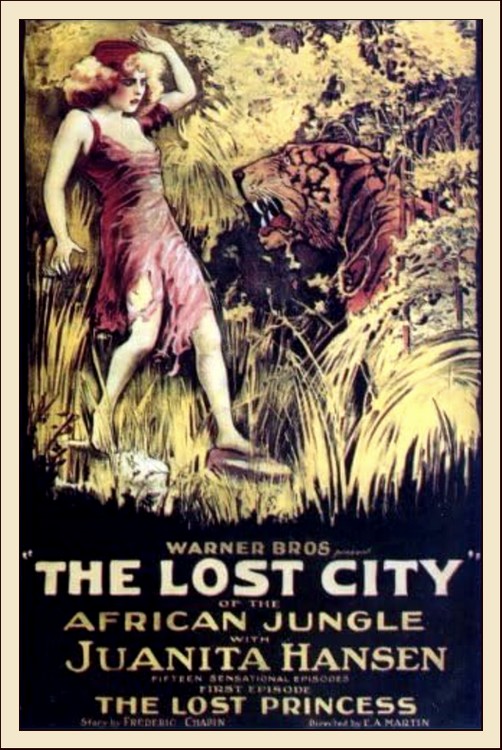
Film Poster, 1920
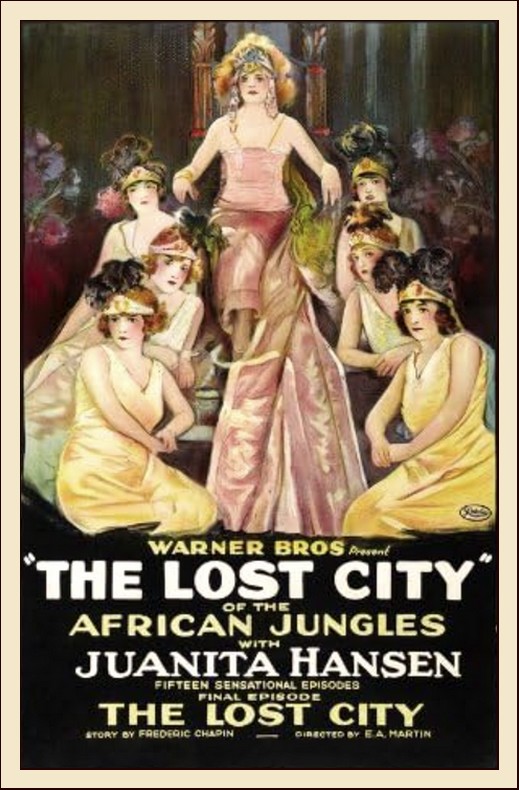
Film Poster, 1920
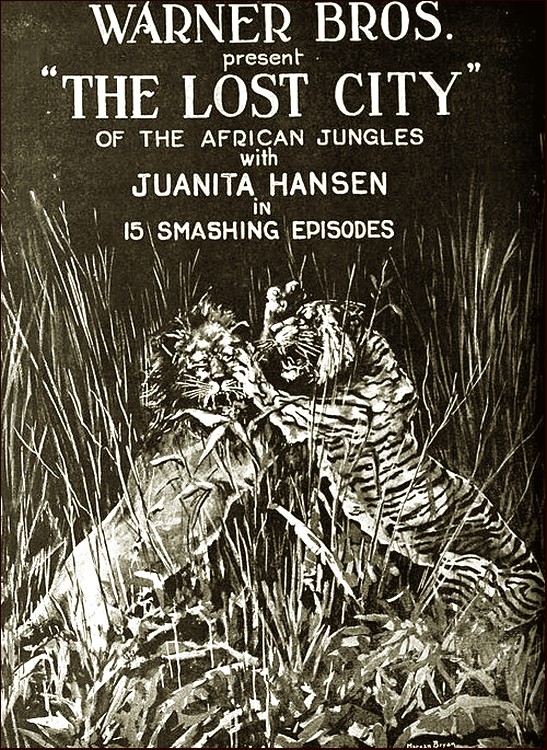
Advertisement for "The Lost City," 1920
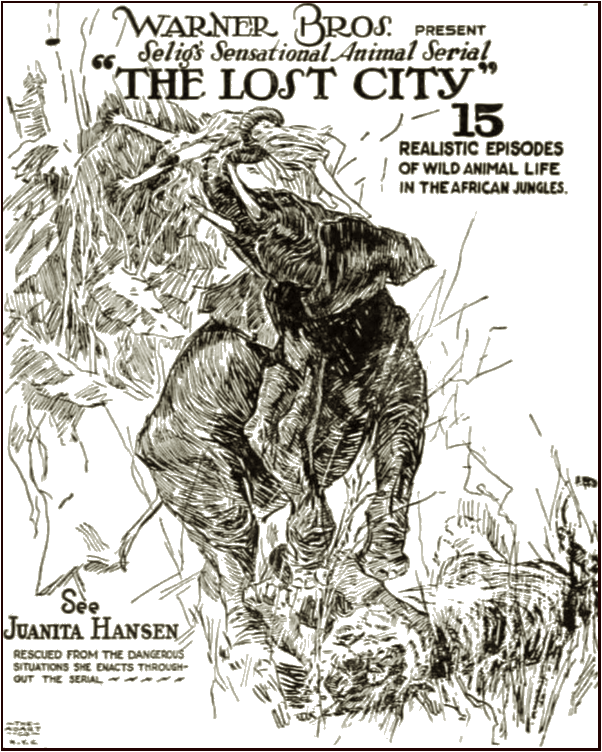
Advertisement for "The Lost City," 1920
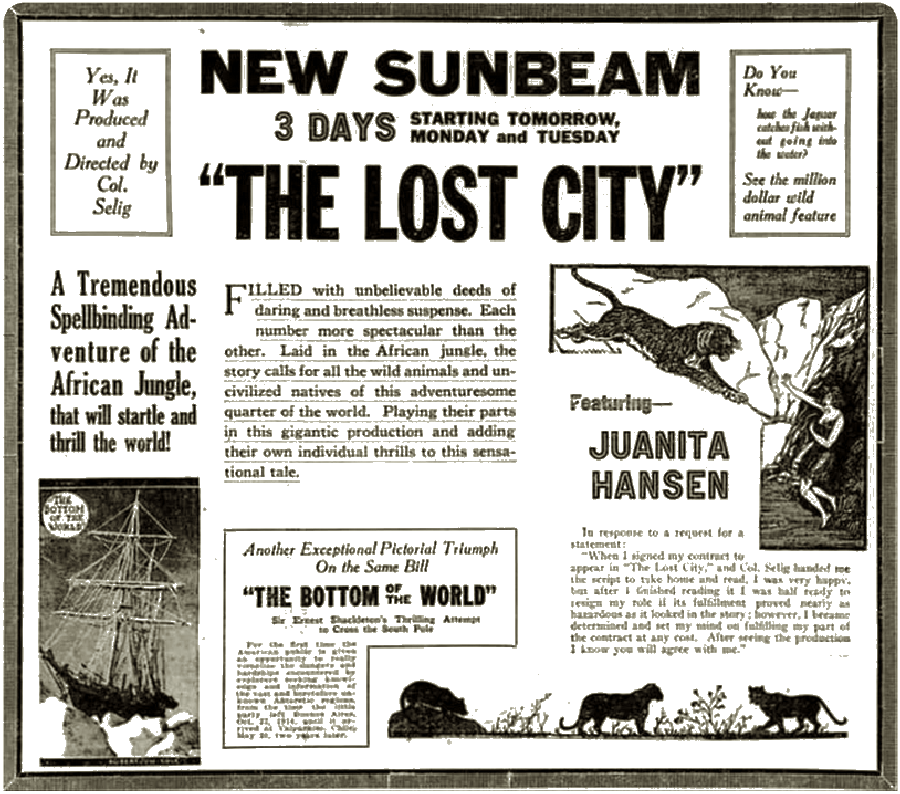
Advertisement for "The Lost City," 1920
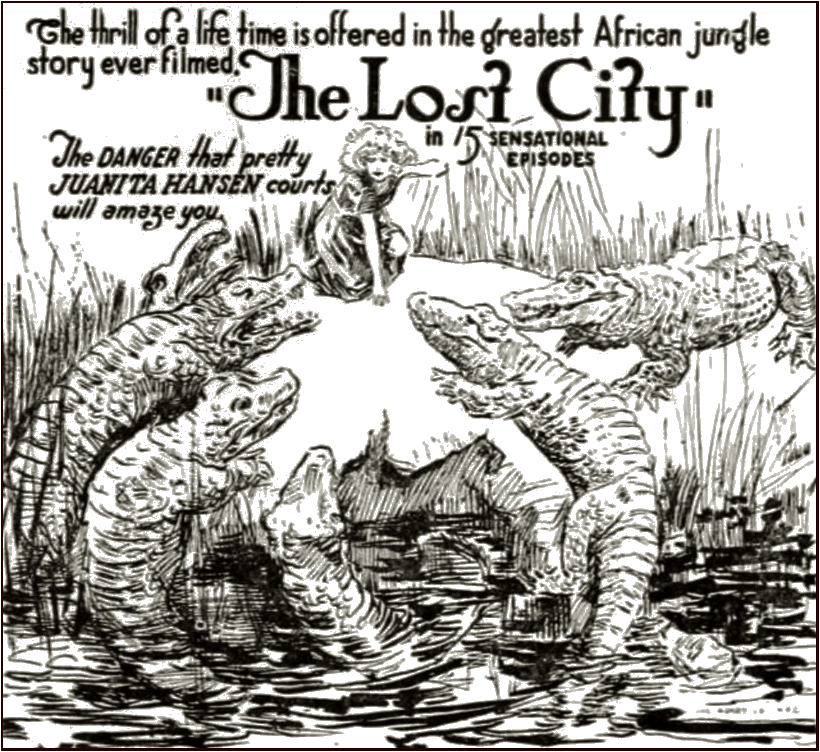
Advertisement for "The Lost City," 1920
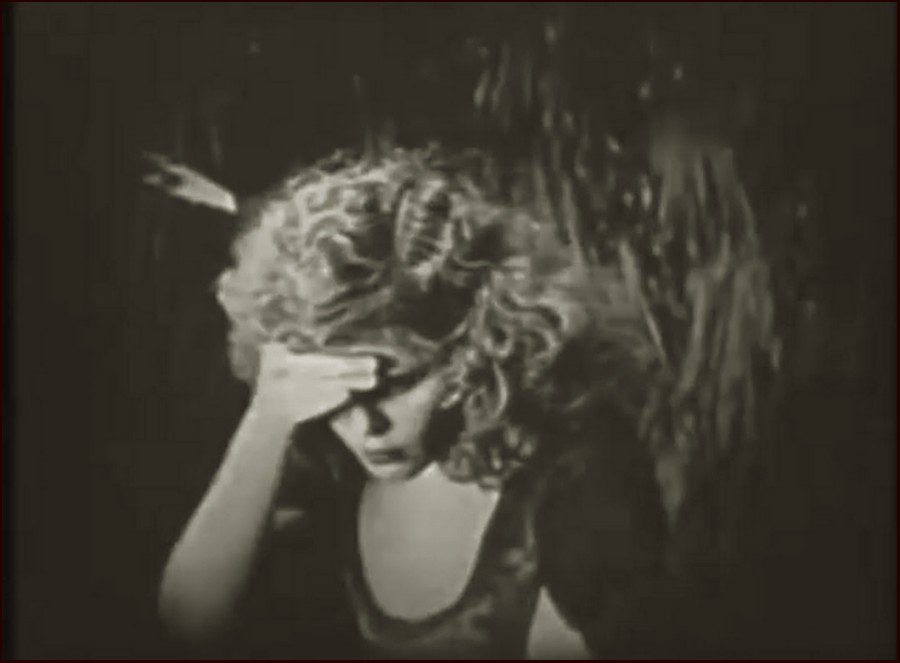
Juanita Hansen
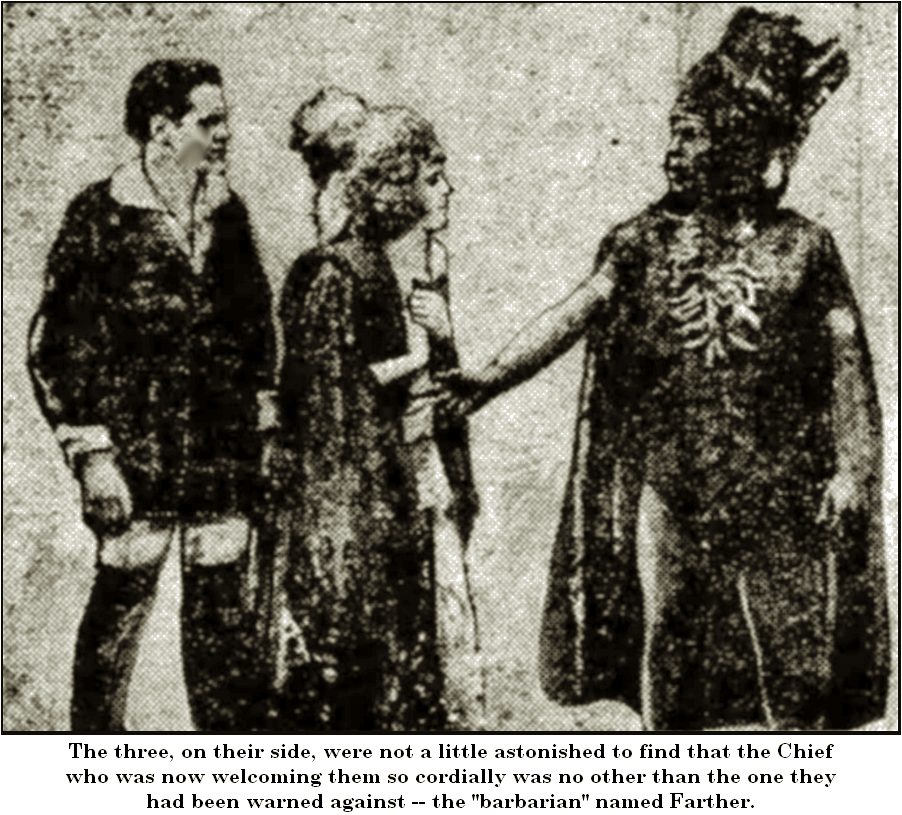
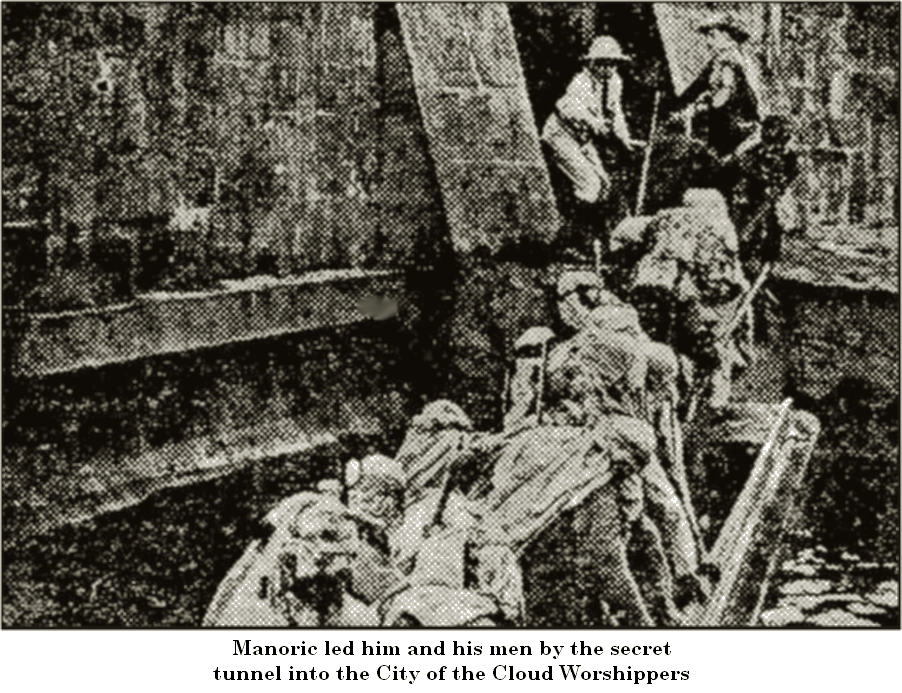
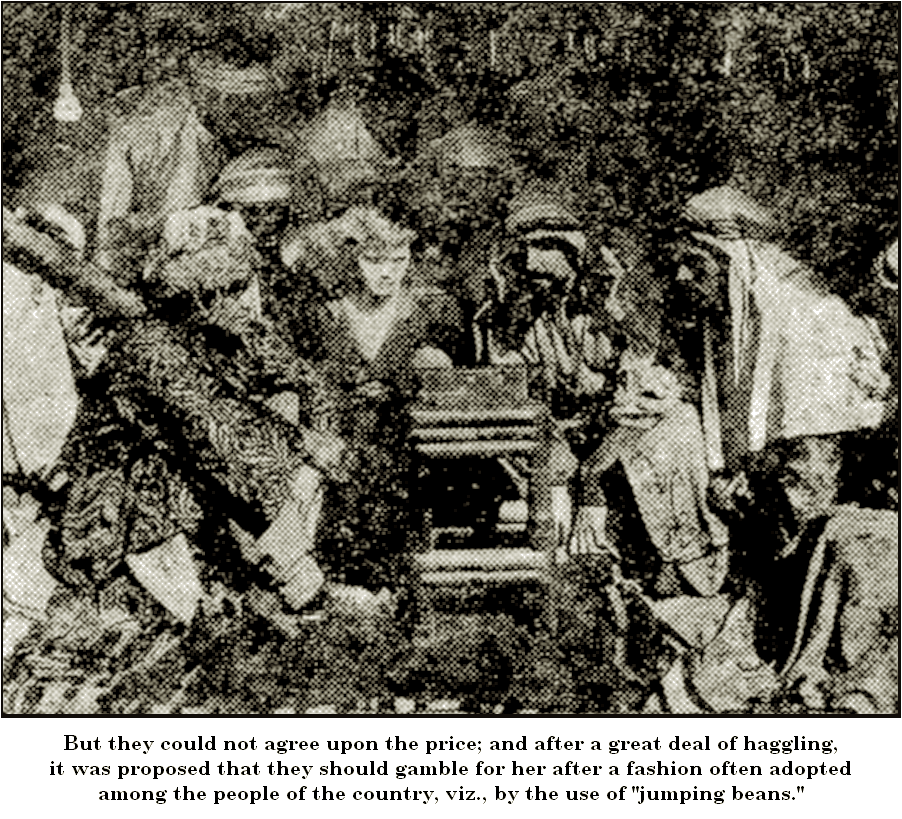
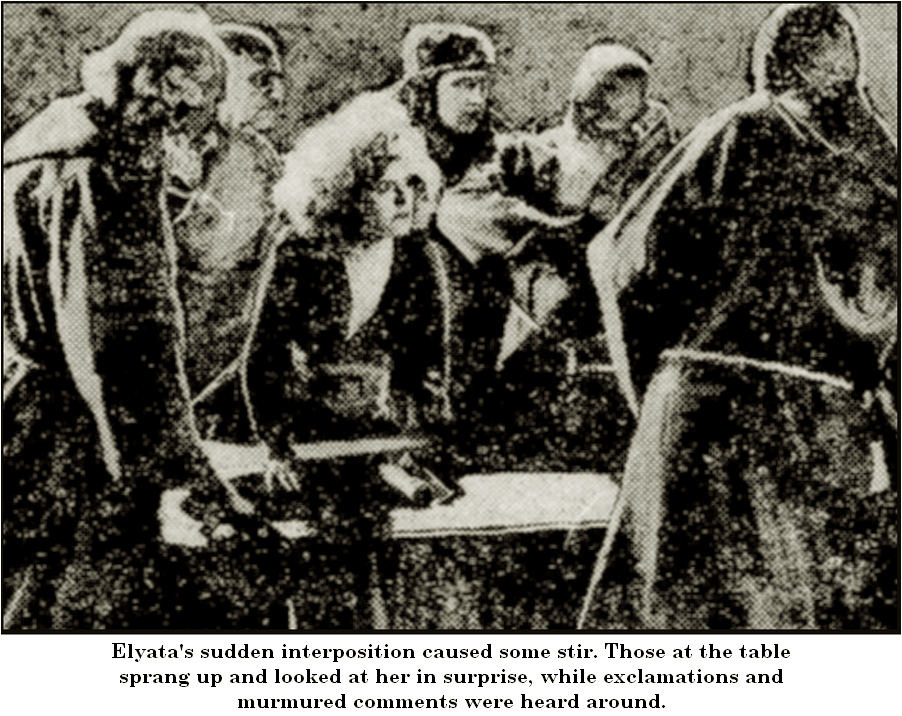
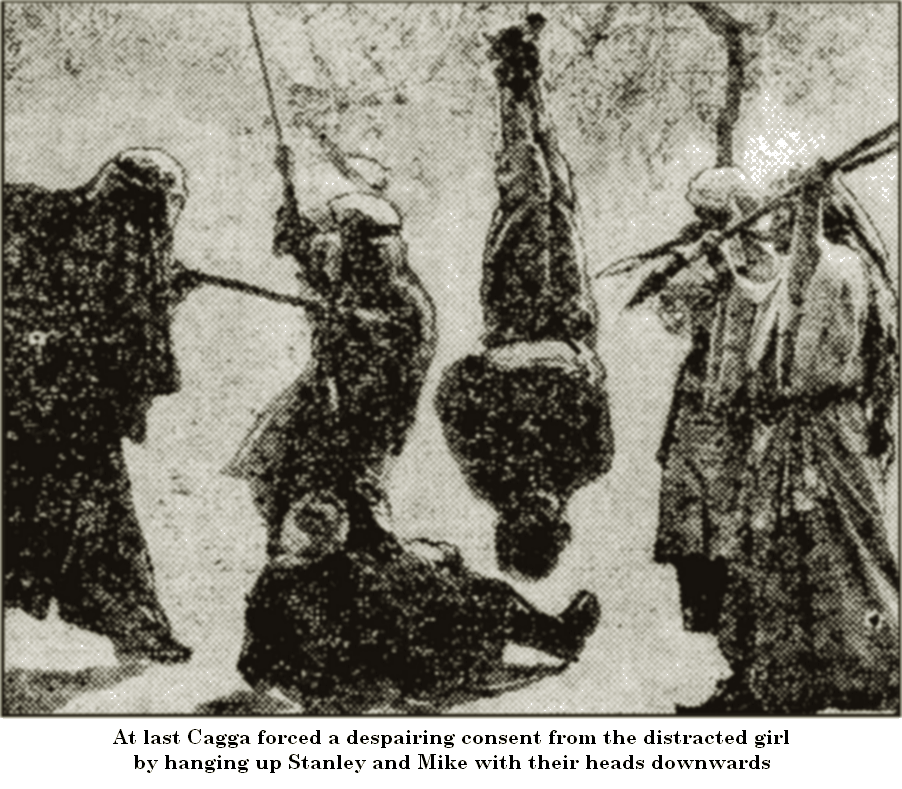
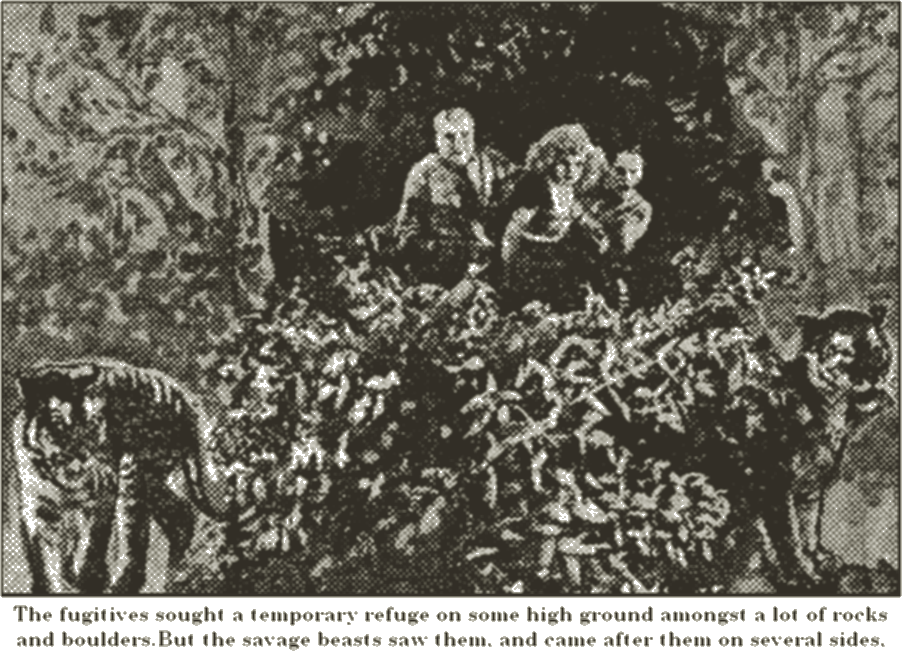
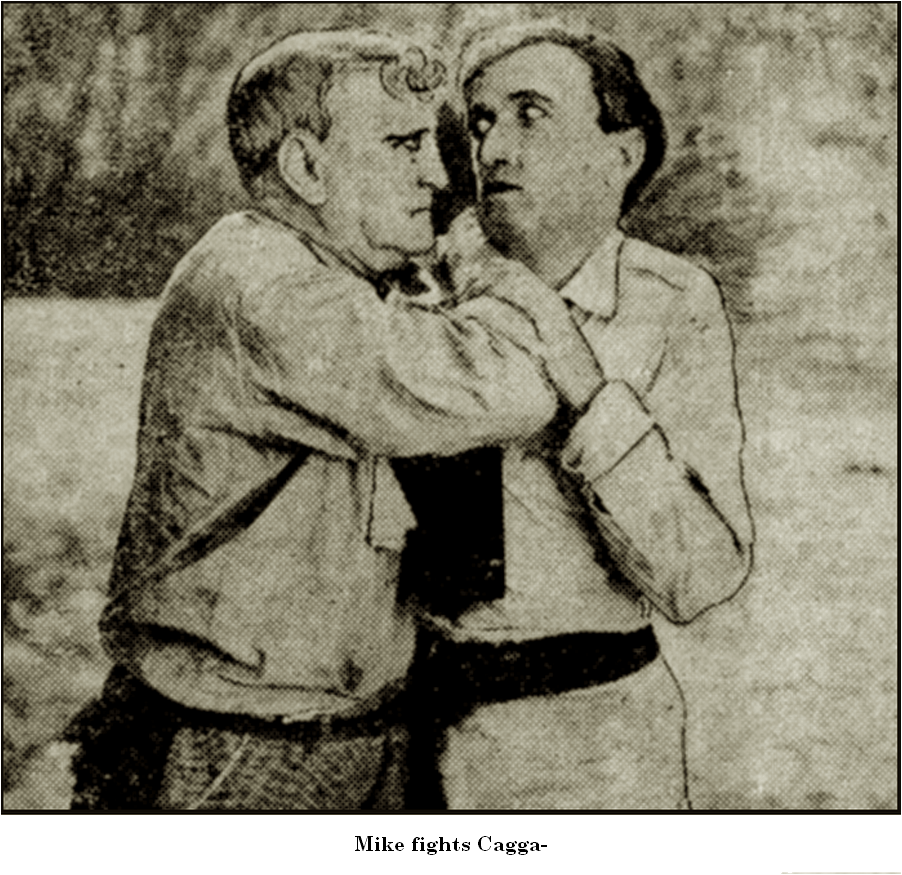
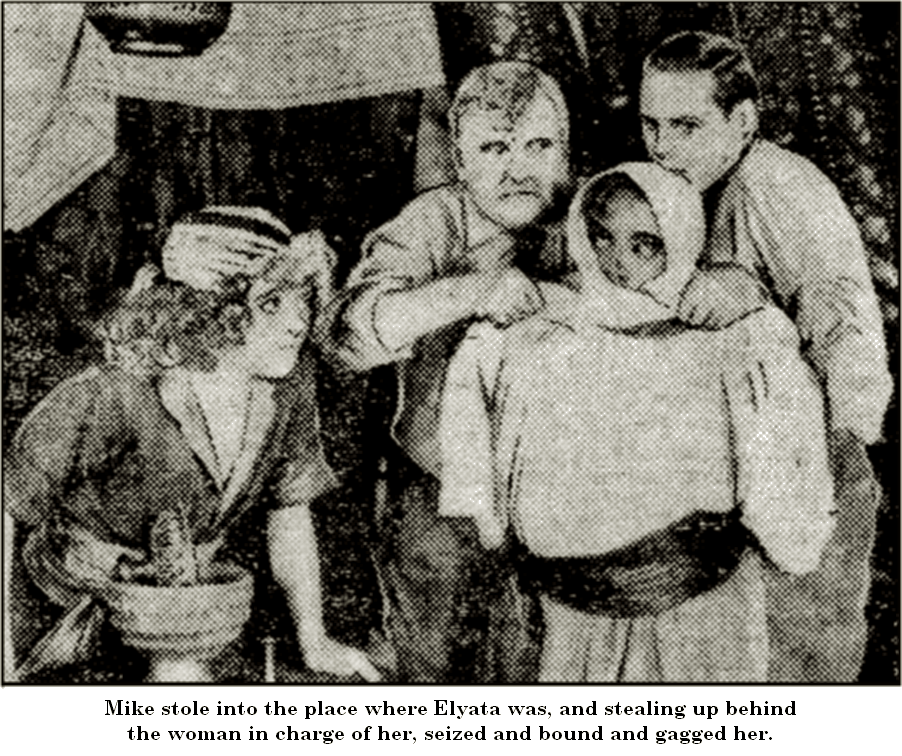
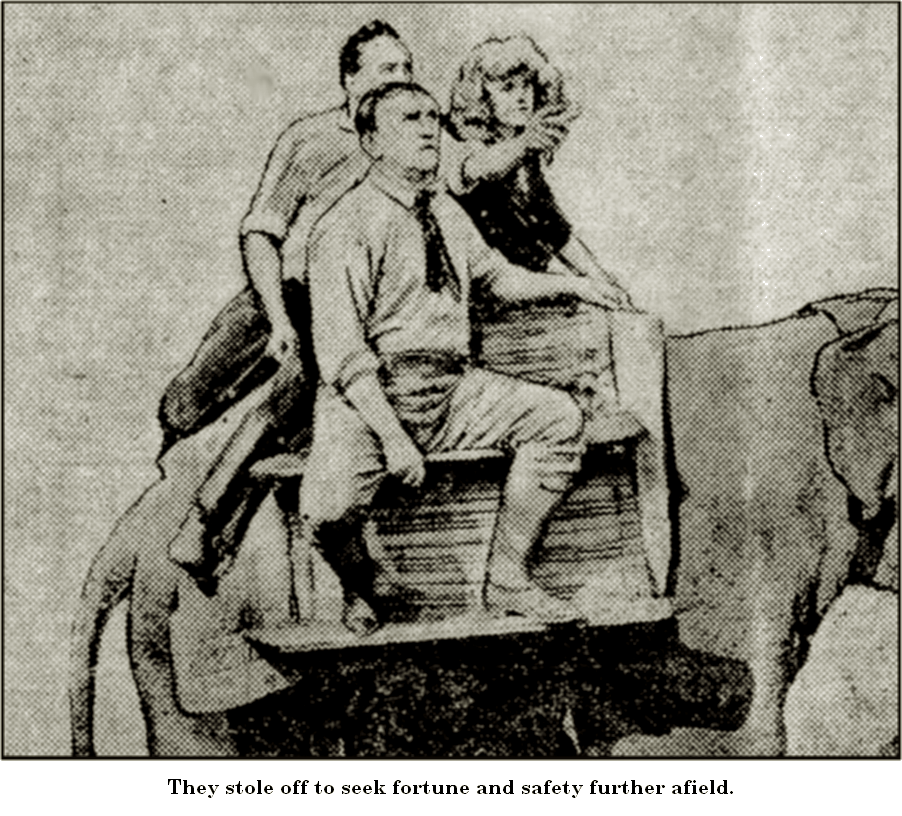
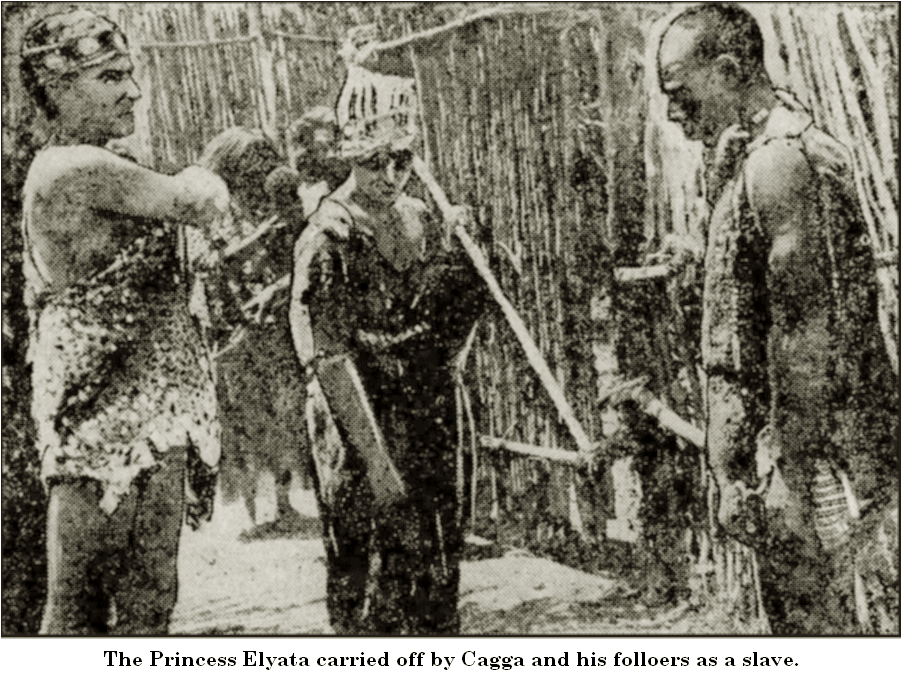
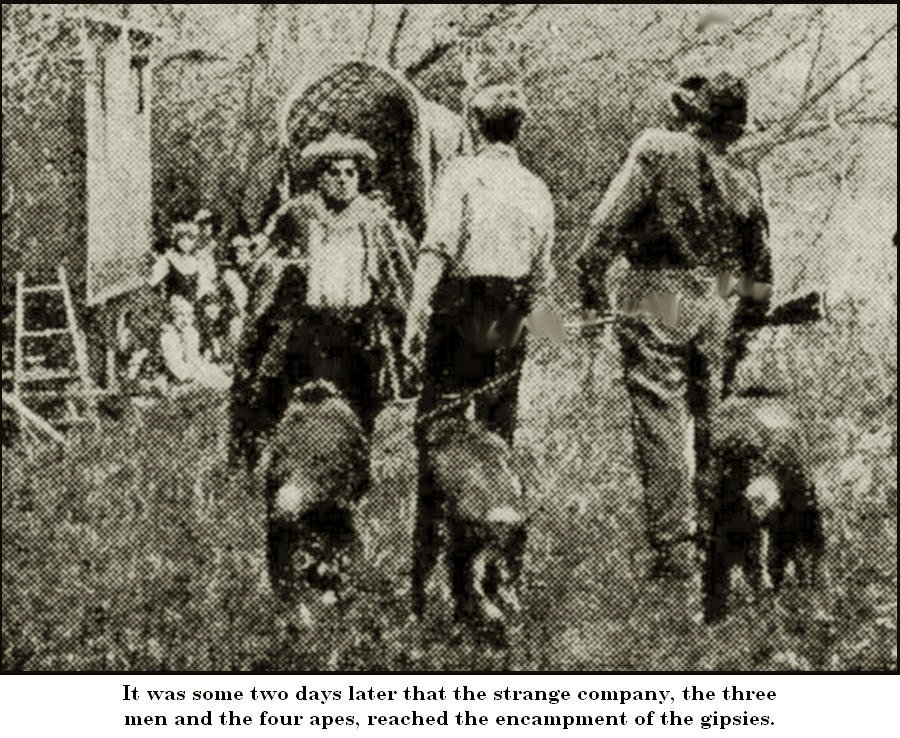
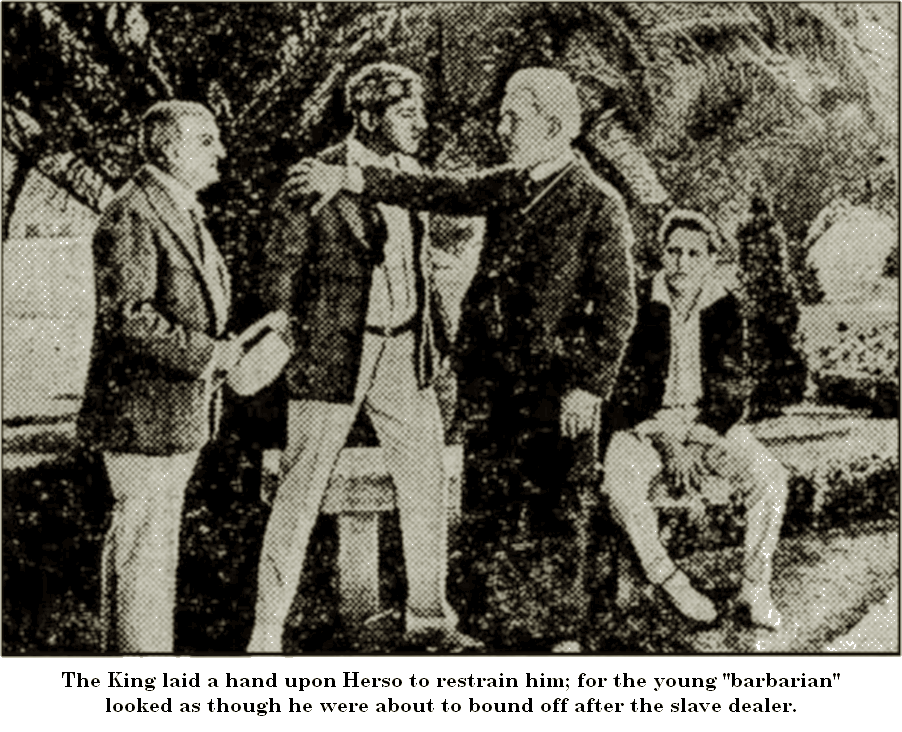
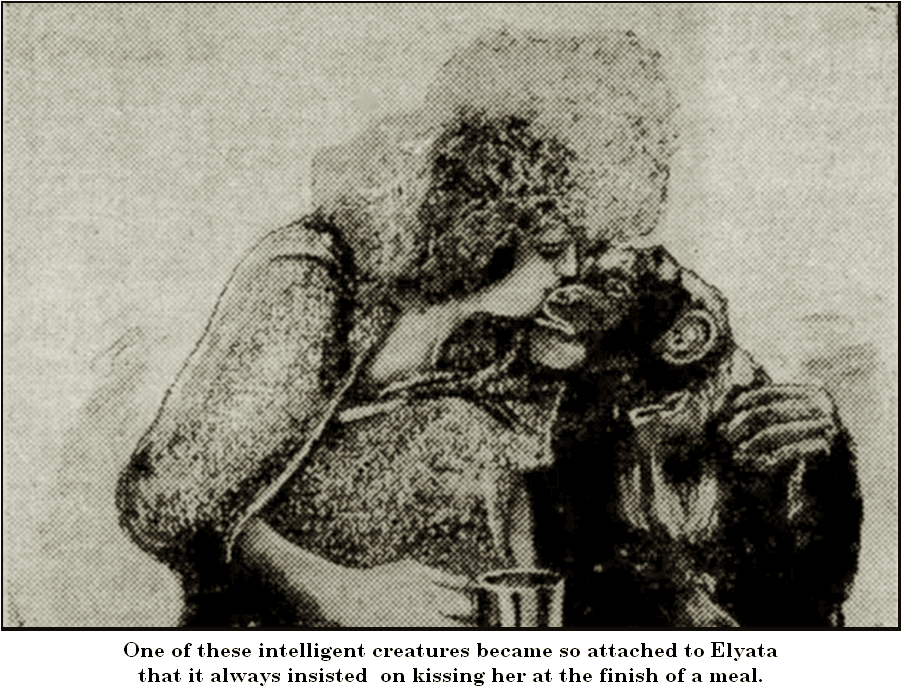
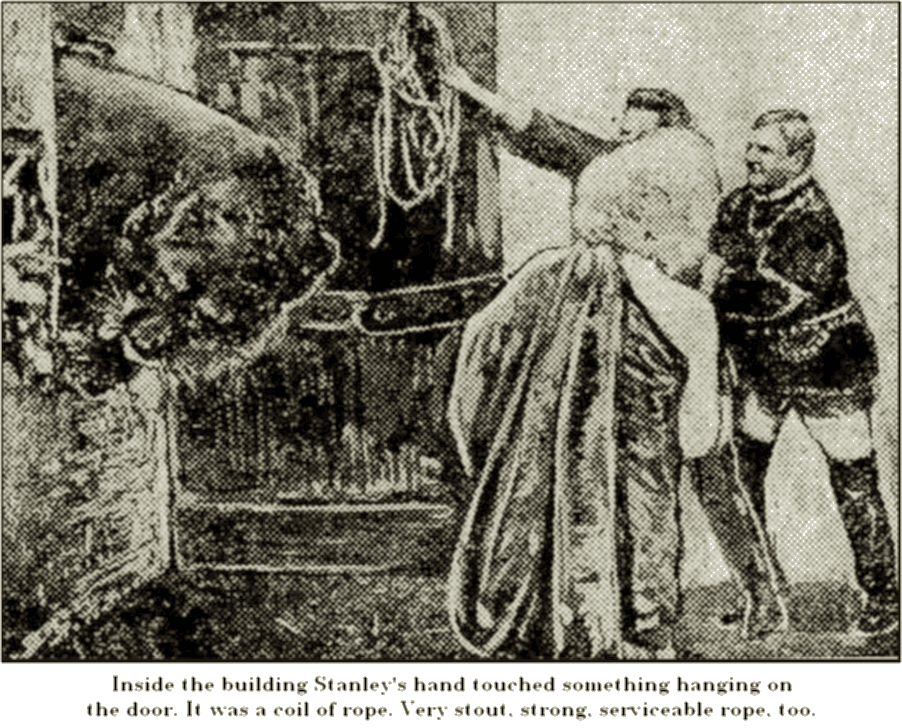
Roy Glashan's Library
Non sibi sed omnibus
Go to Home Page