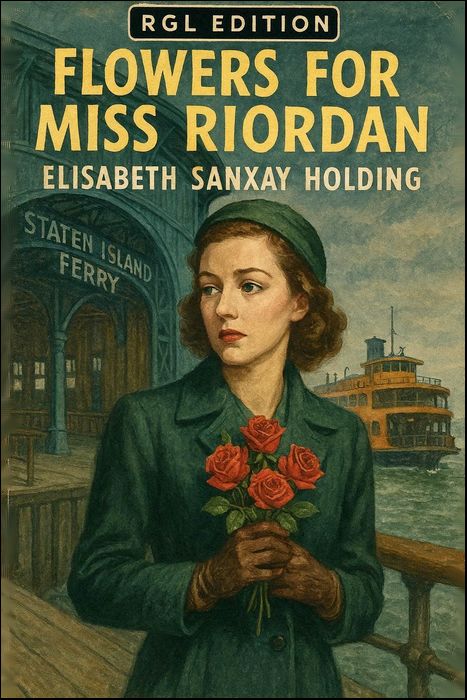
RGL e-Book Cover
Based on an image created with Microsoft Bing software
Roy Glashan's Library
Non sibi sed omnibus
Go to Home Page
This work is out of copyright in countries with a copyright
period of 70 years or less, after the year of the author's death.
If it is under copyright in your country of residence,
do not download or redistribute this file.
Original content added by RGL (e.g., introductions, notes,
RGL covers) is proprietary and protected by copyright.
RGL e-Book Cover
Based on an image created with Microsoft Bing software


The Munsey Magazine, May 1925, with "Flowers for Miss Riordan"
THE gates were opened, and the crowd went shuffling and pushing out of the dim ferry house. Fleet and glittering motor cars shot by, and after them came thundering trucks, and great dray horses with earth-shaking tramp—the whole world going by on parade, until it seemed that only an enchanted ship could hold all of it. Then bells clanged and winches rattled, the gates shut before Miss Riordan's nose, and off went the boat, with the world aboard, leaving in its wake a strip of foaming water that after a while grew tranquil and a lucent green.
Miss Riordan turned back and began to saunter up and down the ferry house. She wore an annoyed expression. She was a cruel lady, frowning upon the tardiness of her cavalier, who was doubtless rushing to her from somewhere, breathless and humbly apologetic.
"I am here," she said in effect, "and I may as well wait, but it shall never happen again—never!"
Two boats gone! That meant forty minutes.
"Well, of course, I came too early," she reflected. "That makes it seem longer; but I just won't wait after the next one."
She knew she would, though. He knew it, too—knew he would find her there. He would come when it suited him, and there she would be, waiting for him.
"He makes me sick!" she said to herself, with a sudden rush of tears. "Who does he think he is, anyway? I bet, if everything was known—"
But she hoped the time would never come when everything was known, even if it should effect the well deserved humiliation of Mr. Louis Pirini.
On the Day of Judgment there would be an angel with an immense book. He would ask you questions, and write down your answers in letters of fire; but he would know the right answers beforehand, or have them on file somewhere, so you'd have to be careful what you said. It was a comfort to think, though, that if that time came, you would be purely a soul, without bodily contours, and certainly without age. Miss Riordan was not very clear in mind about her sins, but she knew well enough which were the things that filled her with the greatest shame and guilt—her age and her physical luxuriance.
"Well, anyhow, I don't look it!" she said forlornly to herself. "He don't really know. He just tries to tease me—but I don't care!"
The energy she was obliged to expend in not caring for the humorous remarks of Mr. Louis Pirini was, however, a considerable drain upon her nervous system. Usually she was able to laugh when he did; but sometimes he was too mean, and then she cried—a weakness she dreaded beyond measure. Always, whether she laughed or cried, when he was with her and when he was absent, she was filled with a passionate resentment against him.
Her grievances had grown monstrous; her heart was bursting with them. Sometimes, when she lay awake at night, she thought that the only good thing in the world would be to "get even" with him.
But Mr. Pirini was safe as an immortal god from her vengeance. There was no conceivable way in which she could hurt him. She couldn't retaliate by making unpleasant remarks about his personal appearance, because they both knew that he was superb. She could not shame him by reminding him of all she had done for him—she had tried that once. She couldn't even tell any one of her own generosity and his vile ingratitude. On the contrary, she felt obliged to lie quite wildly. When she bought anything new, she pretended that Louis had given it to her. When they went out together, she pretended that it was his treat.
"And he just stands there grinning!" she thought. "All I've done for him, and look how he acts! Look at last Sunday, down to Coney, when we met Sadie. She's seen me and Louis going together nearly a year. It was perfectly natural for her to say was him and me going to get married; and what did he up and say, after all I've done for him? 'Sure we are,' he says, 'when hell freezes over!' I'd just like to have told Sadie a thing or two about him!"
Unattainable consolation! She couldn't ever tell any one, for nobody would understand. She did not even care to bring the matter to the attention of God prematurely, for she feared He would not consider all the evidence, but would give a judgment based upon one or two salient facts; and the facts were somehow so insignificant, compared with her feelings.
Twelve minutes, now, before the next boat. A sort of panic seized her. He mustn't come and discover her walking up and down like this, as if she were impatient, as if she were eagerly waiting for him. No—she would be found reading something with profound interest, unconscious of the passing of time, of the waste of this Saturday afternoon, so precious to her after a week's work in the factory.
She sauntered up to the news stand and fluttered over the pages of a magazine. She thought it was "high-class," and yet it was full of pictures. She paid for it, and sat down on a bench.
"Well, I read a lot of good things in school," she reflected, always on the defensive. "'Hiawatha,' and all that. I was real good in English."
She turned to an article on Turkey, a country which she thought immoral and interesting, but it was difficult to divert her attention from her feet. Funny, the way they hurt more when you were sitting down than when you were walking!
"Maybe I might have took a half a size longer," she reflected. "Well, anyways! This shiny paper kind of hurts my eyes. It's an awful foolish thing to wear glasses—makes you look so much older; only they do say it gives you wrinkles to squint."
Wistfully she looked at the photograph of a group of Turkish beauties. Certainly they were all stout, but somehow it was a different sort of stoutness; and their eyes, their languorous, ardent eyes.
"Yes, but I bet if everything was known—" thought Miss Riordan.
Just then she became aware that some one was looking at her—some one who had sat down beside her. She began to assume various expressions of interest in her magazine. She frowned, as if absorbed. She raised her eyebrows, amazed. She smiled and shook her head, incredulous. Then, as she turned the page, she cast a furtive sidelong glance, to see who it was.
It was a little old man with a woeful face. His wrinkled brow, his hanging jowls, and his sad, dim old eyes gave him rather the look of a superannuated hound. Perhaps he was pathetic, but not to Miss Riordan. She was very angry. She stared at him in haughty surprise, and turned back to her magazine; but she could still feel his eyes fixed upon her.
"The nerve of the man!" she thought indignantly.
Presently he moved a little nearer and cleared his throat, as if about to speak. This time she gave him a look calculated to destroy; but, just the same, he did speak.
"I see you are reading Travel," he said.
She glared at him.
"I have had the honor of contributing one or two articles to that publication," he went on. "Little sketches of my various journeys; but after all—" He smiled. "After all," he said, "east or west, home is best. I always return to Staten Island with renewed appreciation."
Miss Riordan was perturbed. She did not wholly understand this speech, but she was impressed, and she was embarrassed. Clearly she had misjudged this man. There was no occasion here for haughty glances. He was venerable.
"Yes," he continued, "I find a rare combination of beauties in Staten Island. The stirring panorama of the bay, with ships from the four corners of the earth, the drowsy little hamlets, and the hills. The words of our national anthem have always seemed to me peculiarly applicable to the island—'I love thy rocks and rills, thy woods and templed hills.' May I ask if you are a resident?"
"You mean do I live there? Well, no," said Miss Riordan. "I just go there sometimes, with my friend."
"Ah!" said he. "There are so many delightful rambles—hilltop vistas which linger long in the memory."
Miss Riordan and her friend were in the habit of taking the train at St. George and going direct to South Beach. The vistas on that journey had not appealed to her as memorable, nor had her rambles along the boardwalk been especially delightful; but she did not care to say so.
"I like the country," she observed timidly, and was enchanted to see by his face that this pleased him.
He went on talking—which was what she desired. She would have sat there for hours, listening to him. Never had she heard such words, never imagined such refinement. She was filled with reverence that was almost awe. And when he talked poetry!
He quoted in his tremulous old voice:
"To me the meanest flower that blows can give
Thoughts that do often lie too deep for tears."
It was too much! Miss Riordan's own thoughts did not lie too deep. Her tears welled up and brimmed over. She wiped her eyes with her perfumed handkerchief, and mutely shook her head.
Her companion had long since passed the age of such facile relief. He peered at her in kindly distress, unable to find assuaging words for a grief so inexplicable.
"Please wait a moment!" he said, and with a little difficulty got upon his feet. "Just wait a moment, please! I'll be back directly."
She believed him, and while she waited, confident that he would return to her, she thought about this thing in a misty fashion.
Not yet in her life had Miss Riordan attempted to account for her emotions. She felt, and that sufficed. She had no idea why the old gentleman's discourse upon the natural beauties of Staten Island should have made her weep. She did not know why his talk had so charmed her. She knew only, cared only, that a strange, tearful happiness had come upon her.
"I guess he liked to talk to me!" she thought, with satisfaction beyond measure.
Then she saw him coming toward her again, toddling along in his long overcoat, with a little bouquet of roses in his gloved hand.
"Oh, my goodness!" thought Miss Riordan, beginning to cry again. "Did you ever?"
He sat down beside her, a little out of breath.
"If you'll allow me," he said, proffering the flowers. "From one lover of Wordsworth to another. I saw that you were much moved by my little allusion."
"You hadn't ought to have done it!" said Miss Riordan, with a sob. "I just don't know what to say!"
She held the flowers to her nose, and her tears rained upon them. This was her first bouquet. Her next would very likely come when she was no longer able to enjoy its fragrance or shed any more tears.
"A feeling heart!" said the old gentleman. "There! Isn't that the bell? We'd better make our way on board, madam, or we shall be crowded out."
"I can't! I got to wait!" she cried in despair; "but I'll go with you as far as the gates."
So she did. When they got there, he removed his hat and held out his hand, standing before her bareheaded and in matchless dignity, in spite of the jostling crowd. She took his hand and squeezed it hard.
"Good-by!" she said. "Do take care of yourself!"
SHE watched the old gentleman as he made his way toward the cabin. Each time some one brushed against him, she cried under her breath:
"Stop that pushing! Ain't you ashamed of yourself?"
"What you mutterin' about?" asked a voice behind her.
Turning, she confronted her Louis.
"Well!" she exclaimed indignantly. "You're a nice one, you are! But come on! Hurry up! We can get this boat."
He caught her arm and held her back.
"No!" he said. "Too late to go down to the island to-day."
"Too late!" said she. "And me waiting here all the afternoon! What do you mean, too late?"
"When I say too late, I mean too late," replied Mr. Pirini, with his own special insolence.
"Well!" said Miss Riordan. "I don't care!"
This speech was surely a cue for exit, but she did not go. She said to herself, as usual, that she just wanted to stay and tell that fellow what she thought of him—which was manifestly impossible, as she had never yet been able to discover what she really did think of him, except that she hated him.
There he stood, with his gray spats and his gray felt hat, worn rakishly, and even new gray gloves. She knew that he had no job, nothing at all to justify his swagger. Very likely he hadn't enough in his pocket to pay for his dinner. What cared he? He wouldn't even thank her if she paid for it.
"Now you just look here, Louis!" she began in a trembling voice.
"All right! I'm lookin'!" said he.
His white teeth showed in a broad smile, and his eyes were fixed steadily upon her. Though Miss Riordan, when she looked in the mirror, may have seen an image which somewhat flattered the truth, she had no illusions as to how she appeared in the eyes of Mr. Pirini. She tried to roll the magazine so that her hands should be concealed. She changed the position of her feet.
"All right!" she said. "You can keep on looking!"
"You bin cryin'," observed her cavalier.
That was too much! Those tears were not to be mentioned by him.
"You mind your own business!" she retorted hotly. "I wasn't crying over you, anyways!"
She saw that he didn't believe that.
"Have it your own way," he said soothingly. "Whadder you say we go an' get some dinner?"
"No!" replied Miss Riordan, and sat down upon the nearest seat.
She always rejected his suggestions—at first; but, as always, she regretted what she had done. Here was the very situation she had dreaded—herself seated, flushed, struggling against her ever ready tears, while he stood there smiling.
"All right!" he said. "We'll stay here, then."
This was another familiar move. How many victories had he won by his patience, his smiling silence! He could wait, and he could hold his tongue, and she could do neither.
"And me waiting here all afternoon!" she burst out. "And then you come and you say it's too late to go down to the island. Well, what made you come so late?"
He did not answer. Another crowd had begun to move toward the gates, like a herd seized with a migratory impulse. Perhaps something of that ancient instinct stirred now in Miss Riordan. Certainly she had a melancholy sensation of being left behind, abandoned, while her fellow creatures moved on toward a better land—toward a Staten Island green and fair, where in a glen a cataract came foaming down, and wild flowers grew, very much like a landscape which hung up in her furnished room. Well, didn't she, too, wish to see that lovely spot?
"I'm going to take the next boat!" she announced, rising.
"All right!" said Louis. "I'm not. Good-by!"
She wavered shamefully between the quite real Louis and the imaginary Staten Island.
"I'm going!" she answered in a loud, firm voice, but added: "Unless you say you're sorry you were so late."
"Sure! I'm sorry!" answered Louis readily. "Now let's go an' get some dinner somewheres. All dressed up to kill, ain't you? Bought yourself some flowers an' everything!"
Miss Riordan had temporarily forgotten her bouquet. She glanced down at the pallid blossoms, fainting in her hot hands, and a very curious emotion came over her.
"No, I did not buy them for myself!" she said vehemently. "They were given to me."
"Sure!" said Louis. "Rudolph Valentino give 'em to you, didn't he?"
"Now you look here, Louis! A gentleman gave them to me—he bought them for me."
"Oh, Gawd!" said Louis.
"He did! You stop your laughing!"
But Mr. Pirini was so overwhelmed that he was obliged to drop into the seat beside her, and there he sat, his handsome head thrown back, all his strong white teeth showing in a prodigious and soundless laugh. Miss Riordan turned upon him in a fury.
"You stop that!" she commanded. "You just better believe me! It's the truth! A gentleman came and sat down beside me and began talking to me, and by and by he got me them flowers."
"Sure I believe you!" said Louis. "Why wouldn't I?"
For a moment she could not speak. Her hate, and the insufferable conviction of her impotence, made her heart beat fast and violently. She felt stifled in a desperate struggle against complete submersion. Louis would not believe her. She could not make him believe in her gentleman, and to doubt his existence was to deny her a soul. That the old gentleman had talked poetry to her and given her flowers was the sole proof of her own immortal value.
"I tell you it's true!" she said in a choked voice.
"Sure!" replied Louis, still grinning.
His unfaith was destroying her. Under his arrogant, smiling glance she was disintegrating. The woman whom the old gentleman had addressed, the woman who longed for the mystic beauties of Staten Island as one longs for Paradise, was being done to death, and there would remain only the creatures she saw in her mirror—this ungainly body, this flushed and troubled face. No! No! She had been worthy of the poetry and the flowers. It was Louis who was too base to see her worth.
HER hot anger began to cool, to harden into an emotion which she did not comprehend. She stared back at Louis, at first with scorn, but after a moment with puzzled curiosity. Had he always looked like this? Never any different from this?
"You look so kind of funny to-day!" she observed wonderingly.
"Funny? What d'you mean, funny?" he demanded.
"I don't know," she said, still staring at him. "Just—so kind of—measly."
His swarthy face turned dark red, and in a low voice he made a forcible retort; but Miss Riordan was past anger. She was looking at her bouquet, lifting up the drooping heads with anxious care.
"I'll dry 'em in a nice little jar," she thought. "I guess they'll keep forever that way."
Louis was still talking.
"You'd better go away," she said casually. "I'm going down to the island."
He got up promptly.
"I'll go, all right!" said he. "An' you can git down on your knees an' beg me, an' I'll never come back. Let me tell you—"
"Oh, go on!" said Miss Riordan with mild impatience.
He walked away, swaggering, his gray felt hat to one side, his toes pointed out, his curly hair pushed up at the back of the neck by his high collar. He passed through the turnstile and out of the ferry house, and then, as far as she was concerned, he ceased to exist. Miss Riordan got up and sauntered toward the gates.
"He's gone," she thought. "He'd come back if I'd ask him, but I won't!"
This was true. Mr. Pirini's charm had been completely dissolved in his laughter. He had refused to believe in her gentleman.
Thinking of that elderly cavalier, her heart swelled with enormous aspirations. Here she was going to the country for a ramble, and carrying a high-class magazine and that mystically precious bouquet. It seemed to her that a monstrous burden had been lifted from her shoulders. Shame, resentment, and miserable anxiety had departed with Mr. Pirini.
She raised the bouquet to her face and sniffed it vigorously.
"I'm going to get a real comfortable pair of shoes!" she said to herself. "A size—two sizes—bigger!"
The freedom of Miss Riordan's soul was achieved.
Roy Glashan's Library
Non sibi sed omnibus
Go to Home Page
This work is out of copyright in countries with a copyright
period of 70 years or less, after the year of the author's death.
If it is under copyright in your country of residence,
do not download or redistribute this file.
Original content added by RGL (e.g., introductions, notes,
RGL covers) is proprietary and protected by copyright.