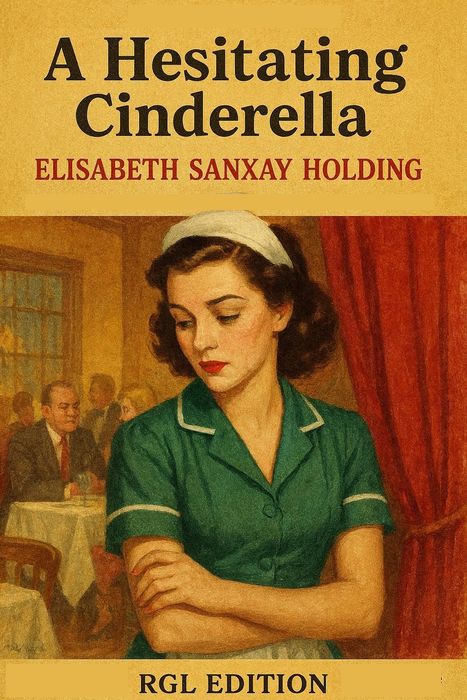
RGL e-Book Cover
Based on an image created with Microsoft Bing software
Roy Glashan's Library
Non sibi sed omnibus
Go to Home Page
This work is out of copyright in countries with a copyright
period of 70 years or less, after the year of the author's death.
If it is under copyright in your country of residence,
do not download or redistribute this file.
Original content added by RGL (e.g., introductions, notes,
RGL covers) is proprietary and protected by copyright.
RGL e-Book Cover
Based on an image created with Microsoft Bing software


The Munsey Magazine, July 1923, with "A Hesitating Cinderella"
"I'M no jazz baby," Madeline declared indignantly.
"Well, I never said you were, did I?" demanded Mr. Ritchie.
"Well, you think so," she replied.
"Well, if you can read my mind, it's no use me trying to talk," said he.
"I never asked you to talk!"
They were both aware that their badinage had lost its fine edge.
"Well, I never asked you to listen," Mr. Ritchie said valiantly, but he knew very well that this was not a clever retort.
At that moment he was greatly dissatisfied both with his wit and his person. He thought it brutal on the part of fate that a young man as passionate and resolute as himself should have so frail a form, and that after having taken a correspondence course in rhetoric and oratory he should still be so tongue-tied—especially with Madeline.
He could see himself in the mirror opposite. He sat so straight that he leaned over backward a little, but this did not disguise the fact that his shoulders were narrow and not quite even, and his chest somewhat hollow. Neither had his studies or his burning thoughts left any visible impress on his sallow, rather ratlike face; and all this hurt his terribly sensitive soul.
"I never said you were a jazz baby," he insisted. "I only said lots of girls were—and that's a fact. Why, a lot of those girls wouldn't spend a cent to get a decent, well balanced meal! All they care about is clothes and—"
"I don't guess you know such a lot about girls," Madeline interrupted.
Her tone was scornful, and the outrageously sensitive Mr. Ritchie at once saw all sorts of implications. She meant that girls wouldn't bother with him. She meant that he was nothing but a mechanic. She meant that his clothes were shabby, and that he was small and slight. She meant everything that could affront his manly pride.
His face grew crimson.
"All right!" he said loftily. "Have it your own way!"
He turned away his head, though he was a little alarmed as he did so. He had always felt that chivalry required him to keep his head turned rigidly toward Madeline, to atone for the fact that she stood while he sat. Of course, that was not his fault. Madeline being a waitress, and he a customer, anything more gallant was impossible.
He certainly did not enjoy being waited on by this splendid girl. In fact, he so bitterly disliked it that he would have ceased coming to Compson's Chophouse, if he had not realized that in his absence she would very likely be waiting on some other man, possibly not so chivalrous.
It was altogether a sacrifice on his part, because the food did not conform to his standards. He could not get here the well balanced rations necessary for building up his physique. Of what use to work night and morning with a patent exerciser, if he did not get the proper muscle-building foods? This worried him very much, for he desired a fine physique as greatly as he desired a master mind.
Then, too, he often had to wait a long while for Madeline to be free to attend to him, and he fretted at the waste of time. He couldn't light a cigarette to beguile his tedium, for he knew that the smoker cannot have a fine physique. If he saw a smoker who looked as if he had one, Ritchie knew him to be a whited sepulcher, with a failing heart, exhausted lungs, and no will power.
To be sure, he might have passed the time with some improving book. He always carried in his pocket a volume of a set he had bought—a set guaranteed to broaden his mind, and to contain all that he ought to read; but he couldn't keep his mind on a book when Madeline was about.
"Have it your own way," he repeated.
This time he said it with a new significance. He meant that, as far as he was concerned, Madeline might have everything her own way forever.
Unfortunately, she wasn't there to hear him. She was waiting on a man at another table. She never so much as glanced at Ritchie. He knew she wouldn't look at him, and he took a gloomy pleasure in staring at her.
She was worth looking at, was Madeline. Tall, spare, straight, in an austere white uniform and a sleek coiffure, she was a miracle to irradiate any chophouse. Her features were subtle—a delicate nose, a rounded chin, a mouth very red in her pale face. Her black brows made an incomparable line above her dark, steady eyes.
In spite of her thinness and her pallor, in spite of twenty years of bad air and wretched food, she was strong and tireless, with muscles like steel—a heritage from ancestors of Slavic peasant stock. She had a cool, careless manner, inclined to sudden hauteur when she thought it necessary, but she could also chat with the greatest affability—as she was doing now.
"Trying to make me jealous!" thought Ritchie. "What do I care?"
He had merely invited her, very politely, to a dance to be given by the Coyote Club that evening. He worked very hard all day as a mechanic in a garage. In addition to building up a fine physique and broadening his mind by reading, he was taking a correspondence course in mechanical draftsmanship; and the Coyote Club, of which he was treasurer, was his one frivolity.
Every week they engaged a pianist, a saxophonist, and a drummer, and had a dance in a hall over a restaurant on Eighth Avenue. There was no "rough stuff." It was a seemly and refined entertainment—Madeline ought to have known that. Ritchie only meant that some of the girls brought by some of the Coyotes were jazz babies. The remark was not intended as personal, and she shouldn't have taken it as such.
"Don't know much about girls, don't I?" he reflected angrily.
Nothing could have been more galling, especially as it was true. Ritchie had noble ideas about girls, though. He was not exactly in a position to marry at the present moment; but later on, when his heroic efforts began to show results, he intended to have a home, a garden, and a wife whom he would venerate and take to lectures and concerts.
He did not care to admit that that wife must be Madeline or no one. He was far too proud to acknowledge how much he cared for a girl with her silly ideas; but unhappily he was not clever enough to conceal it, and Madeline knew only too well.
These were her silly ideas. Knowing herself to be rare and seductive, she intended to marry a millionaire. She was weary and disgusted with her present condition. She wanted a life of exquisite refinement and languor. She hated the restaurant, she hated her home, her uniform. She turned up her delicate nose at everything about her, including Ritchie. Not that he wasn't "refined," for he surely was, and she secretly admired him; but it was not the right, the princely, sort of "refinement," and she would have none of him.
Still, she felt a pang of regret when he went out. A girl as attractive as she, alone in the world, could not well help learning to appreciate the chivalry and restraint of Mr. Ritchie. He never "said anything," and never would, until encouraged. He came every night to Compson's for his dinner, and of late he had fallen into the habit of being on the corner when she came out, at ten o'clock. He never said that he was waiting for her, and she had manners enough to be surprised every time. He walked home with her, both of them conversing with the utmost formality.
He had never invited her anywhere, except to this dance at the Coyote Club. He had never so much as shaken hands with her. She knew very well that the reason for this was his severe sense of respect for her. While she admired this, she would have been better pleased with a little more impetuosity.
Still, it was no use denying that he left a gap. Madeline missed him. Even when she was busy, she had found comfort in the sight of his head bent over one of his little books.
"Now he's mad," she reflected. "He won't come back. All right! I don't care! Let him go to his old dance and have a good time with the jazz babies!"
She consoled herself by imagining the balls she would go to in the future, when the millionaire arrived—balls like those she saw in the movies. She herself would wear a long, swathed dress and carry a feathered fan. She would be languid and scornful, and would flirt in a refined manner impossible to one who was at present a waitress in Compson's Chophouse.
BY eight o'clock the room was growing empty. As a hint to possible intruders, each time a table was left vacant the lights near it were turned out. A few solitary men still ate, in bright oases, but they had a hasty and guilty air; they knew that their tardiness was resented.
One by one the waitresses disappeared into the little back room where they changed into their street clothes, and returned, crossing the restaurant with eager steps, until there remained only Madeline and Miss Sullivan. Miss Sullivan remained because her customer was a pig-headed old gentleman and refused to hurry; but Madeline was there because Mr. Compson had great confidence in her, and allowed her the privilege of turning out the lights and locking the door.
The proprietor himself had gone, with the cash box. Madeline would have the responsibility of guarding, until morning, whatever sum the pig-headed old gentleman might pay.
"Gosh, I could stick a pin in him!" murmured Miss Sullivan. "Twenty past! There goes that dishwasher, even!"
"I'll look after him," said Madeline. "You can go, if you like."
Toward her own sex Madeline was not haughty, but quite good-natured.
"I'll do as much for you some day," declared Miss Sullivan, like a creature in a fable, and off she went.
The room was very still. At intervals the elevated trains went by with a thundering roar, leaving behind a sort of vacuum of quietness. The old gentleman looked up.
"Piece lemon meringue pie," he said briefly.
"Kitchen's closed," Madeline replied, with equal brevity.
This annoyed him very much; but in view of the fact that he was known never to leave more than a nickel for a tip, his annoyance never caused much concern in Compson's. He got up, folded his newspaper, felt in all his pockets, and very slowly took down his overcoat.
Madeline, leaning against the wall in a careless attitude, refused to show signs of impatience. Indeed, when she saw him struggling into the tight sleeves of his shabby old coat, she felt an impulse of scornful pity, and came to his aid. He didn't thank her. Apparently he preferred to consider it her fault that he was old and slow and stiff, and couldn't enjoy his dinner.
After he had gone, she began turning off the few remaining lights. The place was nearly in darkness when the door opened and two men came in.
"Closed!" said Madeline.
But the taller of the two led his companion to a table and pushed him into a chair.
"Can't you manage a cup of coffee?" he entreated. "My friend's ill."
Madeline was not very credulous. She snapped on the nearest light, so that she might look at the alleged invalid.
One look was enough. She hadn't lived twenty years without learning something, and she knew at once what ailed the fellow; but she didn't care. She felt instinctively that he was a victim. He had been led astray, very likely by this burly ruffian with him.
"Poor feller!" she said softly.
His curly head was thrown back, his eyes were closed, and he seemed sunk in innocent slumber. Not only was he singularly handsome and engaging, but he wore a dinner jacket. Never had Madeline seen one so close at hand before. It invested the suffering hero with a high, romantic interest. It thrilled her. He was a creature strayed from another world. He was helpless and abandoned, and not for anything on earth would she have forsaken him.
"I'll get him some coffee," she said.
She said it rudely, because she hated the other man, and knew it was all his fault.
There was a little left in the coffee urn, and it was still warm. She brought it promptly, but the sufferer could not be roused to drink.
"Good Lord!" said the other impatiently. "I don't know what to do with the young idiot! Pour water on him."
"I never!" cried Madeline, with passionate indignation. "And get his nice clothes all wet?"
"Well, do something with him," said the other. He showed an alarming tendency to shift the responsibility for his unconscious companion to Madeline's shoulders. "I can't take him home with me. Lock him in here till the morning, and let him sleep it off!"
"I never!" she said again. "Just suppose he waked up all alone in the dark, and couldn't get out! Don't you know where he lives?"
"Of course I know, but he wouldn't thank any one for sending him home in this state. He's the only son of wealthy and respectable parents," the other answered, in a flippant tone that was obnoxious to Madeline. "It would bring their gray—or dyed—hair to the grave in one swoop. This fellow, my dear girl, is young Benny Bradley!"
"I don't care who he is, he'd ought to be took care of. He's got to be!" Madeline said sternly.
"Not by me," returned the other. He rose, and looked at Madeline with a smile. "It's time for me to clear out."
"You can't!" the girl protested.
"I shall," said the man. "I make you a present of Benny Bradley."
He was actually going, but she caught him by the sleeve.
"Oh!" she cried. "You ought to be ashamed! What ever can I do?"
"I don't know. Why not call the police?" said he.
He unclasped her fingers, and, raising his hat gallantly, went out.
"Oh, my!" cried Madeline, in despair. "Oh, my! What ever will I do with the poor feller?"
She dipped a folded napkin in water, and laid it on his forehead. A glance in the mirror startled her. In her white uniform, wasn't she just like a trained nurse with a wounded hero? The vision inspired her. She felt that she must be calm, brave, resourceful.
Somewhat timidly she lifted his limp, white hand, to feel his pulse; but, having little idea how a pulse should behave, she gained no reassurance.
"Poor feller!" she repeated. "Anyway, I'm not going to leave you, if I have to sit here the whole night!"
She would have done that, and would have faced Mr. Compson and her sister workers the next morning undaunted, if she had not been saved by the entrance of Mr. Ritchie.
TO the casual observer there was nothing heroic in Ritchie's coming, but truly it was heroic. It had cost him a horrible effort to subdue his outrageous pride, to forego the Coyotes' dance, and to return here for the ungracious Madeline. And how did he find her? Bending over a strange man in evening dress, all alone, long after the place should have been closed!
"Well!" he said. "What's all this?"
With vehement indignation Madeline told him the story of the base desertion of the helpless sufferer.
"And what am I going to do with him?" she ended. "It's the worst I ever heard—going off and leaving him like this!"
"Well, send for the police," said Mr. Ritchie, but he regretted his words when he saw her eyes blaze.
"Shame on you!" she cried. "The state he's in!"
"Well, now, see here," said Ritchie. "I guess you don't know what's the matter with him. He's not sick; he's just—"
"Hush up!" she interrupted fiercely. "I guess I do know! It isn't his fault—he got in with bad comp'ny."
"How do you know?" he inquired.
"I do know," she replied firmly. "Never you mind how! And I'm going to see he gets taken care of till he's all well again."
All this did not contribute to Mr. Ritchie's happiness. Wasn't it just like a woman, he thought, to be captious and haughty to a devoted young man of blameless life, and an angel of compassion to this unknown profligate?
Nevertheless, in spite of his jealous alarm and his pain and his distrust, it was Ritchie's sure instinct to behave generously. Heaven knows where he got his magnanimity. He hadn't learned it in the mean and sordid little home of his childhood. He hadn't been taught it in school, and it had been a part of his nature long before he had read a line of those improving little books.
His sallow face flushed.
"Well!" he said. "I'll take him home with me."
Madeline didn't know how to be gracious, but she appreciated this.
"He can't walk," was all she said.
"All right!" said Ritchie grandly. "I'll call a taxi."
He had never done this before. He hastened to a cab stand on Fifth Avenue, and it seemed to his proud soul that all the chauffeurs knew he had never used a taxi, and despised him. He was very truculent about it.
An infinitely greater humiliation was in store for him. When he returned to the restaurant, he couldn't lift, or even move, the helpless young man. All those hours with the exerciser availed him nothing. His physique was shamefully deficient.
"Let me," said Madeline. "I'm real strong."
Without much trouble, she took the fellow under his arms and got him to his feet. He opened his eyes, then, and smiled a dreamy, innocent smile. Supported by Madeline and pushed by Ritchie, he made a sort of attempt at walking to the cab.
"I'd better go with you," said she, "or you'll never get him up the stairs."
Sick with shame, Ritchie was obliged to consent. Neither of them for an instant contemplated asking the chauffeur's assistance; and the chauffeur, being class conscious, did not volunteer it.
Ritchie had the worst fifteen minutes of his life during his first ride in a taxi. He felt himself a mean, contemptible, worthless thing, with his lack of bodily strength. He contrasted his worn, shabby suit with the stranger's expensive clothes. He knew that Madeline must despise him. She would despise him far more when she saw his room, yet he could devise no way for preventing that.
When the cab stopped before his door, he paid the fare, torn between a certainty that his natural enemy, the chauffeur, was cheating him, and his desire to appear lordly before Madeline. Then, together, they began to get the stranger up the stairs.
The noise of the operation made Ritchie's blood run cold. Suppose some one saw him with a drunken man and a girl? He hauled at the fellow's arm in no very gentle manner.
At last, at the top of the house, he unlocked a door, and, supporting the stranger against the wall of the corridor, he brusquely said to Madeline:
"All right! You might as well go now."
"I'd like to see him settled," said she.
So Ritchie had to light the gas and had to let her in.
The room was a bleak, bare, cold little cell, with the exerciser fastened to the wall, and the window nailed open, to admit all the hygienically fresh air possible. On the bureau, instead of the little accessories of a fastidious gentleman, were a pair of military brushes, the vital library, all in a row, and a bottle of ink. On the table were an alarm clock and the apparatus of the correspondence course. There were no other visible articles personal to Ritchie, except a razor strop and six cakes of carbolic soap, economically unwrapped to dry.
He pushed the stranger down on his cot.
"All right!" he thought defiantly. "Now you can see just how I live—and I hope you'll like it! Go on—laugh, if you want to!"
But she was not laughing.
"Oh, my, what a dusty towel!" she was thinking, in distress. "And no curtains. The woman that runs this house ought to be ashamed of herself!"
She turned to Ritchie without the least trace of haughtiness.
"Well, good night, Everard," she said.
It was the first time she had used his name. He needed that assuagement to compensate for the lingering glance she gave to the prostrate unknown.
RITCHIE came home in a somewhat bitter humor, partly due to his having spent the night on a hard chair, and partly to other and finer causes. He hoped that drunken fellow would be gone. He wished never to see him again; but when Ritchie opened the door, there he was, lying on the bed and reading one of the little books.
"Hello!" he said, as joyously as if Ritchie were his heart's dearest friend.
"Are you feeling better?" Ritchie curtly inquired.
Without waiting for a reply, he began to take off his grimy work clothes.
"I don't know how to thank you," the other went on. "Absolutely the whitest thing I ever heard of! I must have been pretty far gone last night—can't remember a blamed thing."
He was not discouraged by his host's silence.
"I shan't forget this, you know," he continued. "You darned nearly saved my life. Can't imagine what my people would have said, if I'd come home like that. You know how it is—"
"No, I don't," interrupted Ritchie. "I'm a teetotaler."
"Shows sense," said the other warmly. "I think I'll have to be one myself. My name's Bradley." He waited. "What's yours?" he asked.
"Ritchie," responded the other. "And as good as Bradley any day," he added mentally.
In some respects, however, honesty obliged him to admit that he was not so good as Bradley.
Bradley, after stretching, got up. He was in his shirt sleeves, and Ritchie surveyed his tall, slender figure with the eye of a connoisseur in physiques. The fellow was young yet, not fully developed, but certainly those shoulders, that solid neck, that broad chest, were promising—very promising.
"Well, he probably eats too much meat," thought Ritchie, with dejection. "Living like he does, he won't last!"
In order to show his perfect ease and indifference, he began to wash, whistling when the process permitted.
"I must be badly in your way," said the other, in his good-humored manner. "I'll clear out, I think. Got a spare overcoat? I don't like to go out like this."
Ritchie grew scarlet. His overcoat—certainly spare enough—was in that place where winter overcoats naturally go in the spring.
"No," he said sullenly.
"Then I—" began Bradley.
There was a knock at the door. Ritchie flung it wide open, with the air of one who has nothing to conceal. In the hall stood two resplendent young heroes, broadly smiling.
"Still alive, Bradley?" said the taller and older of the two.
They both came into the room as if Ritchie did not exist. Trembling with resentment, he stood aside, collarless, in his cheap striped shirt, with his black hair still wet on his forehead. These three well fed, well clothed creatures, with their vigorous voices, completely filled the room—filled, he thought, the whole world, squeezing him out of it.
In an affectionate and blasphemous manner Bradley reproached his friend for deserting him the night before.
"You ought to thank me," said his friend, "for leaving you in the care of that peach of a girl!"
"What peach of a girl?" asked Bradley, pleasantly surprised.
The friend recounted the circumstances. No one observed Mr. Ritchie's rage and dismay.
"I went there just now to make inquiries," the friend went on, "and she told me where I'd find you. Bradley, old son, if you're a man and a brother, you'll go there at once and thank her! She's a beautiful girl, and—"
"Here!" interrupted Ritchie. His voice was so strange that they all turned to look at him. "Leave her out!" he cried. "You can thank me!"
Bradley was smitten with compunction. He began thanking Ritchie with energy, introduced his friends, and invited him to dinner.
"No!" said Ritchie. Like many teetotalers, he had acquired the habit of saying "no" somewhat ungraciously. "No! But you can just leave her out!"
Again he was thanked by all of them, and at last they left his room; but he knew that Madeline would not be left out. He felt certain that they would go at once to Compson's Chophouse. He could see them talking to Madeline. He knew how she would admire their dress, and their silly language, and their frivolous and disgusting manners.
"All right!" he said to himself. "You're welcome to 'em; but you don't catch me going there any more, to be made a fool of. Not much!"
Suddenly he decided that he wanted no dinner—not at Compson's, or at any other place. He threw himself down on his cot, with a scornful laugh that sounded like a sob. Fellows like that always got everything. They thought they owned the earth—and very likely they did.
YOUNG Bradley was not subtle or astoundingly clever, but he did know better than to go to thank a beautiful girl in the company of his two friends. He went alone.
He was instantly struck down, completely conquered, by Madeline's haughty glance. It was the first time he had met a haughty girl. He found most girls very much otherwise. He was accustomed to the ardent pursuit of mothers and aunts, and not much coyness on the part of their protégées. He had no conception of Madeline's idea of man as a dangerous and persistent hunter, with woman as his prey. In his circle the girls did the hunting and he the evading.
He was captivated by her severity. She refused to go out with him that evening; so he came again the next evening.
"Please come!" he entreated. "I've got the car outside. I'll wait for you as long as you like, and then we'll run up to a little place on the Post Road."
"No, thank you," said Madeline. "I never go out with strange gentlemen."
"How am I going to stop being a strange gentleman if you'll never go out with me?" he complained.
Madeline didn't know, and didn't care to encourage strange young men by trying to explain. She knew perfectly well that he would come back.
To be sure, he did, and this time he was dreadfully insistent. Now perhaps the cause of Madeline's hauteur was the take-it-or-leave-it attitude of the men she knew. Certainly she had never before encountered a persistent suitor, or one who was not offended by rebuffs. Customers inclined to gallantry were very much annoyed if not encouraged. Even Mr. Ritchie was fatally ready to be insulted; but this young fellow didn't care in the least. Let her be haughty, captious, even cruel, still he was charmed and delighted.
Though she did not think this quite manly, Madeline could not withstand the cajolery of the handsome and good-natured boy. She was thrilled with pride that this splendid creature should come to seek her in Compson's lowly chophouse. She was secretly overwhelmed when he brought her orchids. She didn't really resent the innuendoes of the other girls. They were simply jealous because no such hero ever had or ever would come to seek them.
In her heart she was grateful, almost humble. She regarded her incomparable Bradley with something very like awe. To placate Compson, he would order coffee and pie while he waited to talk to her; and his manner of eating and drinking, the way he rose and remained standing when she approached, all the careless ease and grace of him, were a marvel and a joy. Moreover, even in her most fervent admiration, she had never lost the protective tenderness she had felt the first time she had seen him. She worried about him, about his health and his morals.
This was really the reason why she finally consented to go out with him—so that she could talk seriously and firmly, and perhaps reclaim him.
"Well, you can be waiting for me to-morrow at nine o'clock," she said. "You'd better go along now."
As he was leaving—a notable figure in a suit such as never entered Compson's, and a straw hat, and a walking stick—he was met by Ritchie coming in. Ritchie was dressed in threadbare serge, and wore brown shoes, which he had attempted to make black. Bradley went by without a sign—not by intention, for he would have saluted his benefactor joyously if he had known him; but Ritchie, to him, was exactly like countless others, and quite indistinguishable.
Of course Ritchie took this apparent neglect as a personal insult. He sat down at his usual table, burning with shame and fury. When Madeline approached, he said truculently:
"I suppose you don't want to go to the movies to-morrow night?"
It was an announcement, rather than a question.
"Well, I'm sorry," replied Madeline, "only I got a date."
"Him, isn't it? All right! Go ahead! That's just like a woman," said Ritchie. "If a feller has good clothes and a fine physique, what do they care if he drinks, or anything?"
"I wasn't aware I was requesting your valuable advice, Mr. Ritchie," observed Madeline frigidly.
"I wasn't giving it," said he. "All I was saying was, women are all for show. They never see below the surface. Anyway, I'm going to Chicago the end of this week. I'm sick of New York!"
"My! Poor New York!" murmured she.
"I'm sick of the girls here," he went on vehemently. "Just a lot of jazz babies—that's what they are!"
"Here, now!" she cried.
"Jazz babies," he repeated. "There isn't one of them with—with any brains or any feelings."
Madeline had turned pale.
"I'm not paid to be insulted by customers," said she. "I'll send some one else to wait on you. I'm sure I hope you'll find some one in Chicago that's good enough for you, if such a thing is possible!"
And thus terminated their acquaintance. They were now complete strangers.
IN the course of her twenty years Madeline had not shed so many tears as during this one night. There was time for a deluge, for it was surely the longest night that had ever covered the earth. It had the interminable confusion of a dream; and, like a dream, it was made up of vivid and apparently unconnected flashes.
First there was herself leaving Compson's with a not very genuine air of composure, entering Bradley's car, and settling herself by his side, determined not to be impressed or perturbed either by his magnificence or by the rakishness of the small car.
Then there was the flight through the bejeweled and marvelous city—a delight seriously marred by her companion's sinister silence. Not being a driver herself, she had mistaken his preoccupation with traffic signals and so on for a grim and alarming determination. She had, as etiquette required, tried to talk, but he scarcely answered.
Then they shot out into the country—a world dark and unfamiliar to her. Almost the first thing Bradley did was to draw up the car by the roadside and produce a pocket flask. He had been surprised and amused at her indignation, and not overawed by her firm principles. She had said that she wished to go home, but he had been so very persuasive about the supper agreed upon that she had yielded.
She had regretted her weakness. The road house was an awful place. It was like the "haunts of vice" that she had read about in the Sunday newspapers. The prices on the menu appalled her, and the dancing was beyond imagining. Bradley knew some of those people, and had danced with a girl, leaving Madeline alone and unprotected at their table.
He said that what he had to drink was ginger ale, but she didn't believe it. Ginger ale couldn't have made him so flushed and silly; and when at last, after he had sat there smoking cigarettes and dawdling, they rose to go, she had noticed that his gait was unsteady. He had grown talkative, too, and never had she heard such silly conversation.
And now here they stood, on the brow of a hill. It was dark, but the dawn was already tingeing the sky. The birds were awake all about them, each one giving his own note—a reedy quaver, a chirp, a clear, exultant carol, each one indifferent and independent, but part of a glorious orchestral symphony. It was dawn, and here they were, for the graceless Bradley had lost his way in the dark.
They had gone jolting up lanes that ended in walls and fences, they had rushed across bridges, they had turned this way and that. Bradley made inquiries, but was not quite capable of profiting by them. Moreover, Madeline's tears and reproaches had made him frantic. Dawn, and here they were! So fair and tranquil a dawn, it might have inspired to poetry the most insensitive soul; but to poor Madeline it meant only another working day. It made her think of Compson's.
"Oh, my!" she cried. "Oh, what shall I do? Oh, how could you do such a thing?"
"I'm very sorry," was all that the sobered young man could say. "I didn't mean to."
"My aunt'll never let me in the house again!" she lamented. "Somebody's sure to come from Compson's and ask where I am, and my aunt'll say she don't know. I wish I was dead!"
"But can't you explain?" Bradley asked patiently.
She was amazed at his stupidity, but the poor chap was quite unaware of the villainous aspect he had in the eyes of Compson's staff. He had never considered himself a villain—certainly not where Madeline was concerned. He was very grateful to her, and he had tried to show his gratitude. That had not been at all difficult, because she was so pretty; but, thought he, what an awful temper!
Bradley was used to girls who concealed the most fiendish rages when in his company, and he believed that all girls were amiable. Ritchie would have understood Madeline's outbreak. He might perhaps have quarreled with her, but all the time he quarreled he would have been terribly moved by her plight. Bradley couldn't see that there was any plight. If she hadn't been so terribly upset, he would have thought the thing a joke.
"Explain!" she cried. "Who do you think would believe me?"
He was about to speak, but when he looked at her, he could not. Some faint comprehension of her point of view came to him. The more he looked, the better he understood.
Grief had dignified her. Her tear-stained face, her brimming eyes, her trembling lip, distressed him beyond measure. He was an honest and kind-hearted fellow, and even something more than that. In his way, he was chivalrous. He felt deeply ashamed just then to remember that only a few hours before he had thought it rather comic to be taking out a waitress. He regretted the harmless but not very decorous jokes that he and his friends had made about the episode. He wished he had shown his gratitude in some other way. She wasn't a waitress—she was a forlorn and miserable girl whom his ill-behavior had got into a situation which she regarded as serious.
"I'll make it all right," he said earnestly, wondering how this might be done.
"Well, you ought to!" she replied.
She didn't mean to be ungracious or unkind, but she was in anguish. Neither she nor any of the people she knew could take such things lightly. She saw herself irretrievably disgraced, her haughty respectability forever tarnished. She knew so well what the girls at Compson's would say!
She had been so proud of her discretion, of her superiority! She had been so very cautious about "strange gentlemen"! And to be away from home all night! She couldn't bear it. Grief and resentment drove her to tears again.
"Don't!" entreated Bradley. "Please don't! I'll make it all right, somehow—I give you my word I will!"
What he meant was that he would fly to some sympathetic feminine spirit, who could and would make it right for him.
MADELINE'S aunt didn't believe one word of her niece's story. Madeline quarreled haughtily and scornfully with her, but in her own heart she couldn't blame her. She wouldn't have believed it herself. Getting lost in a motor car with a millionaire! That was simply nonsense.
She lay down on the bed in her dismal little room, as close to despair as she was ever likely to be. One of the girls had come from Compson's, and her aunt had said she didn't know where Madeline was.
"I can never go back there!" she thought. "Never, never!"
She might have been mourning for a lost paradise. After all, it was as hard for her to lose her standing among her peers at the chophouse as for a duchess to lose prestige in the drawing-rooms of Mayfair. She had nothing else.
She neither expected nor wished to see Bradley again. He was a sinister mystery to her; she couldn't understand him at all. She was convinced that he had got lost on purpose. The very fact of his not having tried to make love to her made the case all the more perturbing. He must have some deep design which she could not yet fathom.
He was bad. He drank. He went gladly to road houses where every one was bad, and drank, and danced improperly. His fascination was the fascination of a villain. His whole life must be a phantasmagoria of splendid evil.
As the room grew dark, she shuddered at the very thought of him. She dozed, and dreamed nightmares, and woke and cried and slept again. The blessed security of her honest, hard-working life was gone. She would have to give up her job. She couldn't face the other girls again. Perhaps she was caught in one of those awful snares elaborately laid by millionaires for the daughters of the poor. Perhaps it was Bradley's purpose to see that she never got another job—to hound her to the brink of starvation, that she might be obliged to listen to his evil proposals.
"I'd rather die!" she cried to herself with a sob.
There was not a soul in the world to assuage the heartsick young creature, no one to speak a word of common sense or solace. Her preposterous fears were terribly real to her. She had eaten nothing all day. She was exhausted, frightened, inimitably wretched.
She heard her aunt moving about in the kitchen. She knew that nothing on earth could induce the older woman to bring her even a cup of tea, and nothing could persuade her to ask for it.
"Not after what she said!" thought Madeline. "It would choke me!"
She fell asleep again, and was awakened by her aunt's hand on her shoulder.
"Here's that Mr. Ritchie," the aunt announced.
"Well, tell him to go away!" replied Madeline.
"Tell him yourself," said her aunt promptly. "I guess I got something better to do than carry messages for you!"
Her aunt was a severe, stout, bespectacled creature of fifty, a woman of invincible propriety, and Madeline's conduct had stricken her to the heart. She was as glad to see Ritchie as if he were an angel, because obviously he could remedy all that was wrong; but she had no other way of expressing gratification, affection, or the most profound grief, than by her habitual disagreeableness.
"That's just like you," said Madeline.
She rose, too wretched to care how she looked, and went into the lugubrious little parlor where Ritchie waited.
"Well! I thought maybe you were sick," said he.
"Well, I'm not," she replied.
There was an awkward silence.
"Well!" he said at last. "Then what about going to the movies?"
Although he refused, as always, to look squarely at her, he had none the less observed her wan and tear-stained face, her untidy hair, her piteous dejection. Something which he imagined to be anger came over him.
"You been out with that feller?" he demanded.
"That's my business!" returned Madeline valiantly.
"Well, if you—if you had more sense," he said, and paused. He could not well have been more miserable than he was at that moment, nor could he have concealed it better. "Well!" he said again, with a sort of fury. "All right! It's nothing to do with me. Go ahead! Suit yourself!"
He drew one of his books from his pocket, opened it, and held it out to her in a shaking hand.
"You can just look at this, if you like," he said. "I'm going away to-morrow—that's all I've got to say!"
She did look. Heavily underscored were two lines unfamiliar to her, and of striking beauty and significance:
'Tis better to have loved and lost
Than never to have loved at all.
Mr. Ritchie flung the book down on the table and walked out.
THE very next evening, when he should have been on his way to Chicago, he was ringing the door bell of Madeline's flat. His presence brought ineffable consolation to the aunt, and was not displeasing to the girl herself.
"My!" she said loftily. "I wouldn't have thought you'd come back!"
"Well, I did," said he. "Aren't you going back to Compson's any more?"
"That's my business!" she answered, but she let him in, and he did not appear rebuffed.
"Well, I guess they miss you there," he observed.
"Let 'em!" she retorted with spirit. They were both too polite, too formal, to take any notice of the tears rolling down her cheeks. "I went out with that Mr. Bradley, and we got lost in his car. We never got back here until near noon. There's no use telling those girls that. They're awful spiteful, and they'd never believe me."
"Well, I do," said Ritchie.
"I should think you ought to!" said Madeline, with a sternness that concealed a very warm gratitude.
"Well, I said I did, didn't I?" pursued Ritchie.
There was a pause.
"He was here to-day," said Madeline; "him and his sister. I must say I didn't think much of her—all painted and everything. She wants to get me a job with one of those Fifth Avenue dressmakers, as a model, to show off the dresses."
There was calm triumph in her tone, but despair seized Ritchie's heart.
"She says I'd be an elegant model," observed Madeline.
"All right!" said Ritchie. "Go ahead! Be one! Suit yourself!"
Another pause.
"That po'try you showed me," said Madeline. "I thought it was sweet."
"It's not meant to be sweet," replied Ritchie severely. "It's more like, now, tragic. If you'd read more—"
"I always admired the way you read such a lot," said Madeline.
In spite of himself, he was mollified. He glanced at her covertly. She was quite as lovely and disturbing as ever.
"Well," he said, "of course I got to read. I want to get on. I'm making twenty-seven a week now, and more when there's overtime. I spend a good lot on those correspondence courses, and the Coyote Club and all; but I guess I could do without them, if I felt like it."
"I'm not going to take that job," said Madeline suddenly. "I wouldn't—not for anything. I guess I've had enough of that kind of people—all that drinking and all. I'd never get on with that kind!"
"Well, twenty-seven a week, clear—" said Ritchie.
The collapse of castles in the air doesn't make a sound. Down came the magnificent edifice of Everard Ritchie's ambitions, and the airy palace of Madeline's dreams. In their place was instantaneously erected a three-room flat in a respectable quarter.
Their hands met, but not their eyes. They were timid lovers; but by that handclasp they could say all they wished.
"Those people just make me sick," said Madeline. "You ought to have seen them dancing out at that place!"
Then their eyes did meet, full of profound confidence and understanding. His arm went round her shoulders, and she drew close to him.
"I know!" said he. "Fellers like that are no good at all; and those girls!" He looked at his haughty and incorruptible Madeline. "Those girls," said he, from the depths of his vast worldly knowledge, "are nothing but a bunch of jazz babies!"
Roy Glashan's Library
Non sibi sed omnibus
Go to Home Page
This work is out of copyright in countries with a copyright
period of 70 years or less, after the year of the author's death.
If it is under copyright in your country of residence,
do not download or redistribute this file.
Original content added by RGL (e.g., introductions, notes,
RGL covers) is proprietary and protected by copyright.