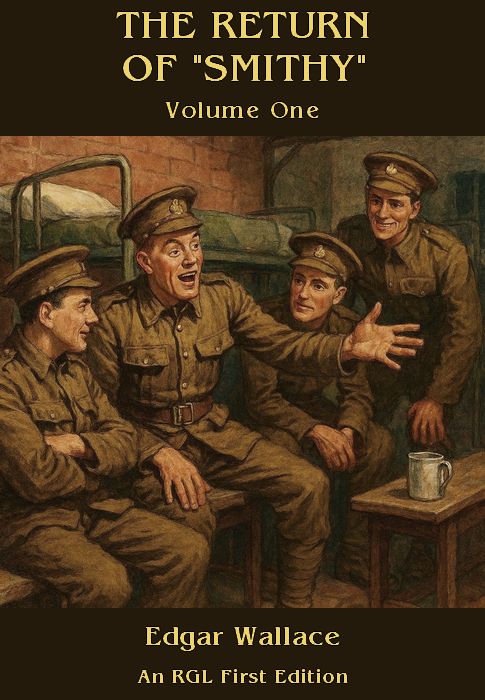
An RGL First Edition, 2025
Based on an image created with Microsoft Bing software
Roy Glashan's Library
Non sibi sed omnibus
An RGL First Edition, 2025
Based on an image created with Microsoft Bing software

Between 1904 and 1918 Edgar Wallace wrote over 200 mostly humorous sketches about life in the British Army relating the escapades and adventures of privates Smith (Smithy), Nobby Clark, Spud Murphy and their comrades-in-arms. A character called Smithy first appeared in articles which Wallace wrote for the Daily Mail as a war correspondent in South Africa during the Boer war. (See "Kitchener's The Bloke", "Christmas Day On The Veldt", "The Night Of The Drive", "Home Again", and "Back From The War-The Return of Smithy" in the collection Reports From The Boer War). The Smithy of these articles is presumably the prototype of the character in the later stories.
In his autobiography People Edgar Wallace describes the origin of of his first "Smithy" collection as follows: "What was in my mind... was to launch forth as a story-writer. I had written one or two short stories whilst I was in Cape Town, but they were not of any account. My best practice were my 'Smithy' articles in the Daily Mail, and the short history of the Russian Tsars (Red Pages from Tsardom, R.G.) which ran serially in the same paper. Collecting the 'Smithys', I sought for a publisher, but nobody seemed anxious to put his imprint upon my work, and in a moment of magnificent optimism I founded a little publishing business, which was called 'The Tallis Press.' It occupied one room in Temple Chambers, and from here I issued "Smithy" at 1 shilling and sold about 30,000 copies."
Link to a complete list of Smithy and Nobby stories.
The present volume contains the first 12 installments of the series that Wallace wrote for the London weekly Ideas under the title The Return of Smithy.
"THERE are ways an' ways an' ways of makin' money, an' Nobby Clark's tried all of 'em." Private Smith, of the 1st Royal Anchester Regiment, nodded his head with so much emphasis as to render any question of his statement futile and absurd.
Smithy was sitting on the low wall which marks the boundary between the kitchen garden of the adjutant and the colonel's cabbage patch.
We had been talking about small-holdings for soldiers.
"If there was money in diggin' up the ground," continued Smithy, "Nobby Clark would have wangled it. He wouldn't have dug it up hisself, because there's always plenty of young recruits desirin' to curry favour with their betters, an' Nobby would have got 'em busy.
"I remember once when we was in India, an' the officers was inventin' games to keep our mind off death an' bubonic plague, there was a grand regimental flower show, an' quite decent chaps used to go potterin' about gardens, smokin' their pipes to kill the earwigs an' other diseases that attacks flowers in that lovely climb.
"Nobby was one of the fellers who got a prize for a pet Virginia creeper. The feller that grew the geranium was quite cross about it, but Nobby explained that bein' a creeper, it must have crep' into Nobby's garden in the night.
"'You come here,' sez Nobby, very indignant, 'accusin' me of pinchin' your flowers when you know as well as what I do that if you'd kept your creeper chained up, an' fed it properly, it wouldn't have come sneakin' into my garden in the middle of the night. I've a good mind,' sez Nobby, very fierce, 'to prosecute you for trespassin', or not keepin' your creeper under proper control.'
"'It was in my garden the night before the show,' sez the feller, with tears in his eyes.
"'That don't prove anythin',' sez Nobby.
"'Why don't you grow your own flowers?' sez the feller—'you've got as much time as I have—instead of spendin' your time in the canteen, whilst me an' the other fellers are smokin' the caterpillars out of our garden, an' waterin' 'em to make 'em grow?'
"'That ain't the way to make caterpillars grow,' sez Nobby.
"'For two pins,' sez the feller—Mousey Grey it was—'for two pins I'd report this here. I spent weeks trainin' that creeper. It was almost like a brother to me, it was. Used to foller me about, almost—'
"'Look here,' sez Nobby, thoroughly exasperated, 'if you say another word about it, I'll set it on to you—train it!' sez Nobby, scornful. 'Why, it never had no trainin' till it came into my garden. Since I've had it, there's been a wonderful change. I've taught it to sit up, an' the way it wagged its leaves at me when I came into the garden this mornin' was one of the most touchin' things I've ever seen.'
"To cut a long story short, when the officers came round to judge the gardens—little bits of gardens just outside the cantonments—Nobby got a prize. It seems there was one prize too many, an' the officers had to give it to somebody, so Nobby got it.
"I think that must have turned Nobby's mind in the direction of agriculture, because after that he used to chip in every time the question of turnips or chickens, or any of them land problems came up in the canteen.
"He was always a rare one for collectin' information, an' it wasn't long before he was what I might term an authority. He could tell you where pertaters come from, an' what was the best kind of land for growin' daisies in, an' why pigs had curly tails. He knew all about ploughin' an harrowin'. He knew what was the best season to sow apples, an' what was the proper month to reap tomatoes. In fact, there wasn't a single wheeze in farmin' that Nobby hadn't got hold of.
"There was a discussion one night in the canteen about farmin', an' Spud Murphy, who couldn't bear to see Nobby havin' all the limelight, chipped in:
"'I know somethin' about farmin', too,' he sez, 'havin' been brought up on a farm.'
"'Baby farm?' sez Nobby, politely.
"'No,' sez Spud, 'on a real farm, with cows, an' turnips, an' pigs.'
"'I've always said,' sez Nobby, 'that you must have kep' curious company when you was young.'
"'An' all I can say is,' sez Spud, takin' no notice of Nobby—'all I can say is that when you say you grow bananas from seeds you made yourself, you're talkin' through your hat. There, ain't any such thing as home-made seeds. Seeds grow, every fool knows that.'
"People don't realise," said Smithy, solemnly, "how quickly big ideas grow in the mind of a feller like Nobby.
"Them words of Spud was responsible for a lot. To everybody's surprise, instead of answerin' them cruel words of Spud's, Nobby went off into a sort of thoughtful fit.
"It was a rare take-down for fellers like myself who believed in Nobby's knowledge of land questions. But he said nothin', an' Spud was very jubilacious.
"Nobby was very quiet for a couple of days after this, an' then one night, when we was on guard, an' sittin' on the verander outside the guard-room, Nobby up an' told me all about his great agricultural scheme,
"'It come to me in a flash,' sez Nobby, very proud. 'When Spud was tryin' to prove you couldn't make seeds—an' I've got some' receipts for seed-makin' that have been in the family hundreds of years—it sort of flashed on me—Why not make chickens?'
"'Eh?' I sez.
"'Chickens,' sez Nobby, quite excited with his idea, 'look at the price of eggs; look at the price of hens!'
"'Well,' I sez, how are you goin' to make 'em?'
"'Clark's Patent Incuberator,' sez Nobby, gettin' prouder an' prouder; 'it's me own idea. I'll get Jerry Jordan, who's a bit of a carpenter, to knock up a few boxes, I'll buy a few eggs from the bazaar—an' there you are!'
"I didn't trouble to ask any further questions, because I knew that owin' to Nobby's havin' such a big intellect, I shouldn't be able to understand his idea, even if he explained it.
"'The first thing I must do,' sez Nobby, thoughtful, 'is to start a company, so as to have somebody to share my profits with.'
"'Are you feelin' ill?' I sez when I heard his wild words.
"'No,' sez Nobby, 'but on a job like this you always get a company together. Partly," sez Nobby, carefully, 'to share the profits you make, an' partly,' he sez, 'to share any experience you may have.'
"Nobby's Chicken Company was a success from the start.
"Everybody wanted to take shares in it, an' anybody who wanted shares got 'em.
"'What's the capital?' sez Spud Murphy.
"'It all depends on how much I get,' sez Nobby.
"Spud was a bit suspicious, but he took four shillin' shares, Fatty Green took three, Billy Mason gave Nobby a canary an' a pair of boots for six—Billy was a great believer in Nobby—an' all the other fellers in 'B' Company bought shares.
"'What you've got to understand,' sez Nobby addressin' a meetin' of shareholders in the canteen, 'is this: the profits the first year won't be more than fifty per cent. I don't want to deceive you, but it's only fair to tell you that you mustn't expect more than sixpence profit in the shillin' the first year.
"Chaps was so impressed by Nobby's honesty that they took twice as many shares as they intended takin'.
"Nobby waited a week to see if any more money come in, an' at the end of that time, when fellers were gettin' impatient, an' was askin' for their money back, Nobby began his work.
"There was a couple of days' delay whilst Nobby an Jerry Jordan was arguin' about how the incuberators should be made. Nobby's idea was to hang a little bell outside the incuberators, with a little bit of string inside. As soon as the chicken was born, all he had to do was to ring the bell, an Nobby would go to him an' give him a drink of milk or whatever was handy.
"'When the company gets in a more flourishin' condition,' sez Nobby, 'we'll have electric bells, with the word "push" in chicken language.'
"The cause of the trouble between him an' Jerry was over the question whether Nobby would make up his mind once an' for all an' have done with it. Nobby was such a genius that he kept changin' the plans of the incuberator, an' Jerry had no sooner sawed up a bit of wood to make one before Nobby changed his mind as to the shape, an' Jerry had to begin all over again.
"At last the first one was finished. It was a curious-lookin' thing, a cross between a bird-cage an' an aquarium. But I must do Nobby justice an' say that it was filled up regardless of expense. There was little wooden steps for the little birds to walk up an' down; there was a little basket with the words, 'When born, please place your shells in here, an' keep to the right.' There was a little basin for them to wash theirselves, an' little clean towels to dry theirselves on. There was tiny bits o' lookin'-glass, so that the little hen chicks could look an' see if their feathers was on straight.
"It was the grandest incuberator that's ever been seen, an' it was all Nobby's own idea!
'"All we've got to do now,' sez Nobby, 'is to get the eggs an' wait for their birthdays.'
"'What about heat?' sez Spud. 'Your bloomin' incuberator's got no stove. You can't hatch chickens without warmth.'
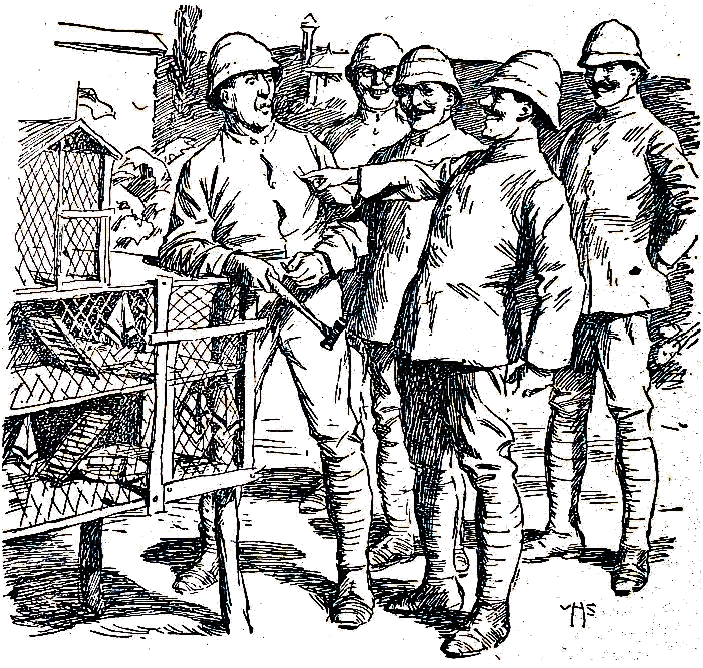
'What about heat?' sez Spud. 'Your bloomin' incuberator's
got no stove. You can't hatch chickens without warmth.'
"Nobby was a bit put out, because he hadn't made arrangements for warmin' 'em.
"'My idea,' he sez, slowly, 'was to put the eggs in the sun all day, an' take 'em to bed with me at night,' but he, so to speak, yielded to argument, an' put a paraffin lamp in the box.
"We was stationed at Pungwallah at the time—I forgot to tell you that—an' we had plenty of time to grow chickens. We fixed the incuberator up at the back of the cook-house, an' me an' Nobby an' Spud an' a few other shareholders, when we'd got the machine in perfect order, went down into the bazaar an' bought the eggs.'
"It was a long business, because Nobby was so cautious. He wanted to test all the eggs. He took 'em an' he looked through 'em, an' one or two he cracked to see if there was anythin' inside 'em.
"But he was satisfied at last, an' the best part of the workin' capital bein' spent—except a special reserve fund for paraffin oil to keep the lamp goin'—we went back to barracks.
"We all took a turn in workin' that incuberator. Fatty Green polished the eggs, Nobby trimmed the lamp, Spud laid out the eggs in two ranks, sizin' off from the right; an' me an the others chaps gave advice.
"We got the lamp lit an' took our last look at em before goin' to our bungalows.
"'That chap,' sez Nobby pointin' to one of the fattest of the eggs, 'he'll be a cochin-china—I know the signs.'
"'That one will be a leghorn,' sez Spud. 'I'll train him up to foller me about an' crow.'
"'When I think,' sez Nobby musin'ly, 'of the pounds an' pounds we'll make out of this, I'm almost sorry I didn't keep the idea to meself.'
"Then Last Post sounded, an' we went to bed dreamin' of chickens.
"For the next three weeks we talked about nothin' else. That incuberator was the centre of what I might call admirin' crowds. When chaps had nothin' to do they used to go down to the back of the cook house an' look at 'B' company's fowls.
"As the openin' day grew closer, the excitement became intense Nobby got three days C.-B. for crowin' on parade, an' nearly got put into hospital for madness owin' to his bein' discovered by the medical officer cluckin' round the incuberator.
"'In a manner of speakin',' sez Nobby, 'they're my children; I take what I might call a motherly interest in 'em.'
"They was due to be born on a Thursday, an' up to Wednesday all went well. The lamp was kept alight all this time. Nothin' had happened to upset the harmony, but on Wednesday mornin' our colour-sergeant went down with fever, an' we got a chap from 'H' company over—Sergeant Toggs, a most unfeelin' man.
"Nothin' happened that day, except old Toggs went walkin' round the bungalows of 'B' findin' fault with everything an' sayin' he wished he had the handlin' of us for a month, an' he'd make men of us, but we bore up, thinkin' of the precious young lives that was comin' to us.
"That night we paid a sort of farewell visit to the incuberator, an' Nobby could hardly be stopped from kissin' the eggs, an', when we'd trimmed the lamp an' made all snug for the night, an' Nobby had put some condensed milk in the lid of a tin in case any of the little fellers was born in the night, we went back to quarters.
"Last Post sounded, an' then 'lights out,' an' we closed down for the night.
"I'd hardly shut my eyes when I heard Sergeant Toggs' voice said: "'Put that light out!'
"'That's No. 2 Bungalow,' sez Nobby, 'they're always dragged.'
"'Put that dashed light out!' roars Toggs' voice again.
"There was no sound an' we thought the light must have been put out, when Toggs shouted again:
"'Put that light out—in the cook-house!'
"Nobby sat bolt upright in bed. 'Horror!' he whispered; 'he's talkin' to the chickens!'
"With that he nipped out of bed (it was a warm night) an' sprinted over to the incuberator.
"We got up an' looked through the winder You could just see the cook-house, an' the little gleam of light the lamp made. Our own colour-sergeant knew all about our chicken company, but it was no good explainin' to Toggs, an' by-an'-by I saw the light go out. We saw Toggs walkin' over to the cook-house, but Nobby managed to dodge him, an' came creepin' back terribly agitated.
"'I've put the lamp out,' he sez in tones of anguish. 'He'll never spot the incuberator, but if he don't go away quick he'll spoil my hatch.'
"It was a long time before the sergeant went, then Nobby nipped out an' lit the lamp again.
"He was as excited as anythin' when he came back.
"'There's a hole in one of them eggs,' he sez. ' I see a little eye peepin' at me through it. I think—'
"'Who the devil has left a lamp by the cook-house?' roars Toggs' voice outside, an' we nearly jumped out of our skins.
"We stood by the winder of the bungalow, petrified. We saw him go to our incuberator, look in, open the door; an' we ran down after him.
"'Half a minute, sergeant,' sez Nobby, an' he turned, his hands full of chipped eggs.
"'So you're the man who's disobeyin' orders, are you?' he sez. 'Attend company office tomorrow.'
"'I don't care what you do,' sez Nobby, desperately, 'but spare my chickens.'
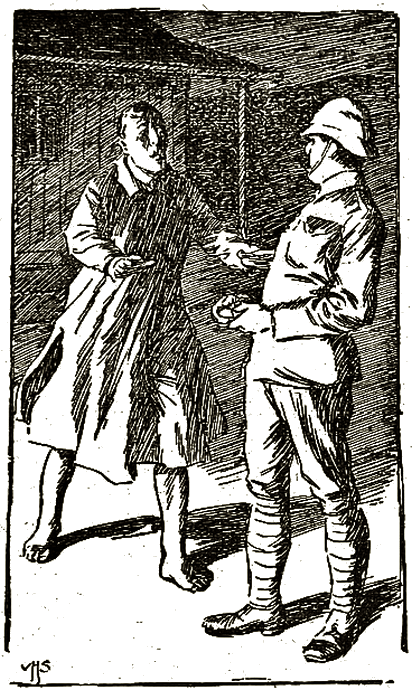
'I don't care what you do,' sez Nobby,
desperately, 'but spare my chickens.'
"'I'll show you what I'll do with your chickens,' sez Toggs, an' takin' up a double handful of 'em he walked to the pond at the back of the cook-house an' chucked 'em in....
"Me an' Nobby went back to our room with a sorrowful heart that night, an' spent a couple of hours discussin' how we could kill Toggs without bein' found out.
"When Reveille sounded we got up.
"'Let's go down to the pond,' sez Nobby sadly, 'perhaps some, of them eggs escaped.'
"We walked to the pond—an' Nobby nearly fainted.
"There they was, twenty-four of 'em, swimmin' all about like grown-ups—ducks every one of 'em, except two, who was real chickens "
"But, Smithy," I expostulated, "chickens couldn't swim."
"They wasn't swimmin'," explained Smithy, "the ducks was holdin' 'em up."
"SOLDIERS," said Smithy, sententiously, "are queer fellers; they're never satisfied. After the things that Nobby Clark's tried to do for the regiment, you'd think he'd be the popularest feller in the battalion— but he's not."
"When I think," said Smithy, bitterly, "of what Nobby's done for some fellers, I'm disgusted with the ingratitude of chaps. When Sid Taylor's dog got kicked most severe for puttin' his muddy paws on Nobby"s clean straps, who was the first to say 'let by-gones be by-gones?' It was Nobby. When Spud Murphy got locked up in town for fightin' with another chap, who was it that helped take Spud to the police station? Nobby. When Fatty Green got delirium on the brain owin' to wonderin' how he should spend that twenty pounds what an old aunt died an' left him, who was it spent hours an' hours workin' out plans for gettin' rid of the money? Nobby.
"If I ever wrote a book, I could fill it with the good turns that Nobby's done for people; the ideas he's had; the schemes he's invented, an' the money he's collected on behalf of deservin' cases.
"I don't say," continued Smithy cautiously, "that I know what's happened to the money when he has collected it. I've never enquired. It would look like pryin' into people's private affairs. All I know is that he's collected it, an' that's enough for me..
"When the news came that Billy Owen had met with a great misfortune whilst on furlough, it was Nobby that went round with the hat. When Billy got to hear of it, an' denied that he ever sent a telegram sayin' he'd met with a great misfortune, it was Nobby that produced the telegram with his thumb over the place where it was sent from so as not to prove Billy a liar, an' it was Nobby who sent the money away to a foreign mission, 'on behalf of a good cause.'
"So that's why when I say that I'm disgusted with 'B' Company for their unfeelin' conduct unto Nobby, you can understand that they've got a bit thicker than usual.
"Nobby has always been what I might term without offence, the top dog of 'B,' an' bein' a free an' careful fighter he's always been looked up to an' respected. It was about a month ago when the sad affair what I'm goin' to tell you about happened.
"It was just about then that Nobby had got up a syndicate to fight the winner (if any) of the Johnson-Jeffries fight (if ever).
"'I know a young feller that could put it right acrost any of them chaps,' sez Nobby, addressin' a crowd of his admirers in the canteen. 'All he wants is trainin' an' feedin'. Now, my idea is this,' sez Nobby very business-like. 'Suppose we put a bit of money together, an' run him. When he's drawin' a thousand a week from the music-halls we'll take half between us. We'll take half of all the money he makes through fightin', an' half of all the money he makes through writin' his recollections for the Sunday Chronicle, an'—'
"'Hold hard, old feller,' sez Spud Murphy, 'who is this mysterious feller?'
"'For the moment,' sez Nobby Clark very secret, 'he prefers to remain incognito; his name is The Unknown.'
"Well, after Nobby had told all the chaps what a fine fighter The Unknown was, an' what a terrible Right he had, an', what a perishin' Left; an' what fine foot-work he had, an' the splendid recovery he always made after bein' knocked out, the chaps fairly fell in love with the idea, an' subscribed enough money to buy the chap a punchin' ball to practice on before he hit Johnson or Jeffries as the case may be.
"'That punchin' ball's necessary,' sez Nobby, 'to teach The Unknown not to hit too hard. I want him to tone his blows down a bit. We don't want to see either of them pore fellers killed owin' to The Unknown hittin' too hard.'
"An' everybody agreed that it was very thoughtful of Nobby to think these things out. Nobby got an Advisory Committee together to show everythin' was square an' above board, but the committee soon fell out owin' to some doubt as to whether their job was to advise Nobby or whether it was Nobby's job to advise them.
"Anyhow, as nobody took anybody else's advice, the committee didn't count very much, but at the time it was fine.
"Nobby used to take the money out of barracks to The Unknown. He wouldn't let on where The Unknown was, or who he was.
"Fellers used to follow him, but Nobby always gave 'em the slip somehow, an' they was as wise as ever.
"But they got their money's worth when Nobby came back, for the tales he used to tell about The Unknown was honestly worth all they ever gave.
"They might have been content with what they got, only Spud Murphy started agitatin' for results.
"'When's this here serial story o' yourn goin to finish, Nobby?' he sez one day. 'We're gettin' fed up with this way of goin' on, an' we'd like to have a dekko at the fightin' man.'
"The end of The Unknown business was that one pay night, after Nobby had drawn a bit on account from the chaps, Spud an' Tiny White an' Marshy (who's a bit of a detective) tracked Nobby out of barracks, an' although he tried to shake 'em off, they stuck to him. They came up to Nobby just after he'd gorn into the post-office, an' spyin' through the winder they saw Nobby puttin' their hard-earned money into the savin's bank in his own name.
"There was an awful row about it, an' some of the chaps was goin' to bring the matter before the Adjutant, but Nobby swore that he was only puttin' the money aside for The Unknown, so as he could have a bit of stuff to start with after he knocked out Jeffries or Johnson.
"The troops didn't much care for this yarn, but on Nobby takin' his oath that he'd produce the unknown champion, they were pacified.
"Nobby came to me afterwards very serious.
"'Smithy,' he sez, a bit agitated, 'what am I goin' to do?'
"I was rather surprised.
"'Why,' sez I, 'perduce the Unknown chap.'
"'I don't know where to find him,' sez Nobby.
'"What!' I sez, aghasted.
"'Of course, I don't,' sez Nobby, rather annoyed. 'How can I perduce him when he's unknown?'
"'But,' I sez, 'you know him, don't you?'
"'That's the awkward part of it,' sez Nobby, most melancholy, 'I've never seen him in me life—that's why I call him The Unknown.'
"'But how did you send him the money?' I sez —'the money the fellers subscribed.'
"'It was by a method of me own,' sez Nobby, 'that I can't divulge even to you.'
"We had a long talk about the matter, me an' Nobby, an' at last Nobby hit upon a bright idea.
"'There's a chap I know in London, he sez, 'he's in the boxin' line, I'll get him to send a chap down.'
"So with that Nobby wrote to the feller in London, an' by return of post got a reply sayin' that on the follerin' day a boxin' chap would be sent down—we was stationed at Anchester at the time—carriage paid.
"Nobby got frightfully proud when the reply came, an' started swaggerin' about barracks like a chap who'd discovered a gold mine.
"'Yea,' he sez to Spud that night in the canteen, 'he's comin' down to-morrer night. Spud,' he sez, confidential. 'I don't mind tellin' you that it's me brother.'
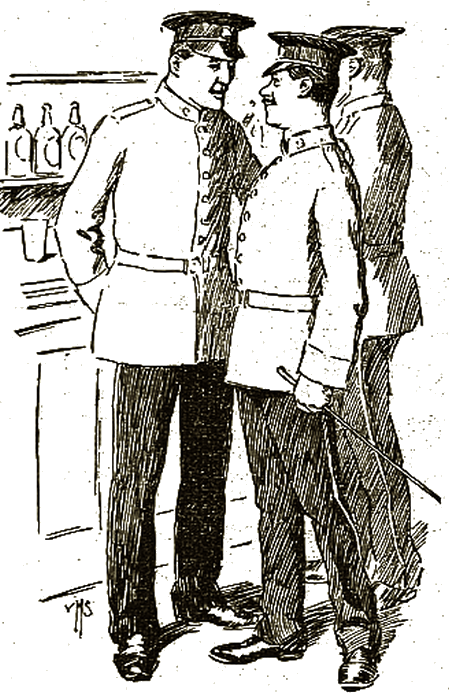
'He's comin' down to-morrer night. Spud,' he sez, con-
fidential. 'I don't mind tellin' you that it's me brother.'
"'Your what?' sez Spud.
"'Me brother,' sez Nobby, 'that's why I never let on that he was a boxin' feller; it's a awful sore subject in me family; we never speak about Augustus.'
"'Why didn't you tell us at first?' sez Spud.
"'It's me pride,' sez Nobby, sadly ; 'it runs in the family. I shrink from acceptin' money for any member of me family.'
"'I've never noticed it,' sez Spud.
"'You wouldn't,' sez Nobby; 'I've learnt to restrain meself. Not only that,' he sez, 'but I don't think Hubert would have liked it.'
"'Who's Hubert?'
"'Me brother,' sez Nobby.
"'You said Augustus just now,' sez Spud, suspicious.
"'Hubert Augustus—that's his name,' sez Nobby, very quick.
"The news that Nobby's brother, the celebrated unknown boxer, was comin' down spread all over barracks, an' Nobby got prouder an' prouder. The news got over to the officers quarters, an' the Adjutant sent for Nobby.
"'I understand, Clark,' he sez, 'that your brother is comin' down to give an exhibition spar?'
"'Yes, sir,' sez Nobby, quite delighted with all the attention he was creatin'.
"'Good,' sez the Adjutant; 'I don't think you men see enough good boxin', so we'll have him over in the gymnasium just to show the men a few points.'
"'Certainly, sir,' sez Nobby, 'me brother Francis will be very pleased.'
"'Has he always been a boxer?' sez the Adjutant.
"'Ever since he was a little nipper, sir,' sez Nobby. 'I remember when he was three he won the two-stone championship of Haggereton, knockin' out another little nipper in four rounds.'
"All that day Nobby was, practically speakin', the king of Anchester. People, who'd never been as much as polite to him, treated him quite respectful.
"He bounced around the gymnasium, givin' orders here an' orders there. He had the platform shifted twice.
"'Me brother can't box with the sun in his eyes,' he sez to Jerry Jordan who, bein' a defaulter, was on 'fatigue' duty.
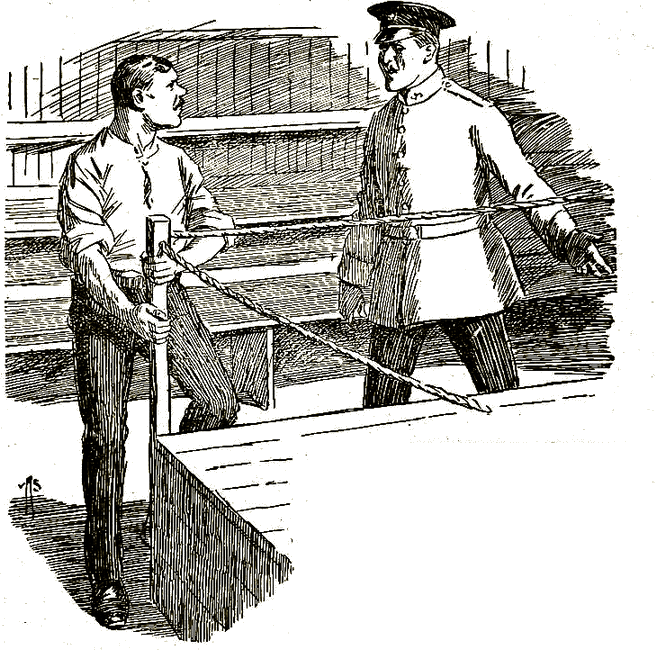
'Me brother can't box with the sun in his eyes,' he sez to
Jerry Jordan who, bein' a defaulter, was on 'fatigue' duty.
"'Well, let your brother turn his back on it,' sez Jerry, resentful. 'You don't expect the bloomin' sun to go out of its way to oblige your brother, do you?'
"'I do, an' I don't,' sez Nobby.
"Anyhow, be got the platform shifted again.
"Nobby bad s little talk with me about the boxin' feller's comin'.
'"The first chance I get,' he sez, 'I'll have to explain to him all about this brother idea of mine,' he sez. 'I'll go down to the station to meet him.'
"But that part of the programme came unglued, for the adjutant was so keen on Nobby helpin' in the final arrangements—he was gettin' up a couple of boxin' bouts so as to make an afternoon of it—that the officer couldn't spare Nobby.
"'Tell off Private Murphy,' he sez to the colour-sergeant, 'to go across to the station to meet Clark's brother.'
"I'd rather go, sir,' sez Nobby, considerably upset.
"'No, I want you,' sez the adjutant. 'Murphy will recognize him , he's rather like you, isn't he?'
"'Yes, sir' sez pore Nobby, 'there's what I might call a strong family likeness.'
"'That's all right,' sez the adjutant, an' then Nobby had a bright idea.
"'If you don't mind, sir,' he sez, 'I'll write him a note.'
"'Do,' sez the adjutant, an' Nobby went off to the library an' scribbled a letter.
Dear What's-your-name,—Whatever you say to the feller that comes to meet you, don't forget to tell him that you're my brother. So no more at present.—Nobby Clark.
"'Give this to me brother,' sez Nobby, handin' the letter to Spud, 'an' whatever you do don't say nothin' to him till he's read it.'
"'Why?' sez Spud.
"'He's very shy,' sez Nobby, 'especially with strangers, an' I've just written to tell him what a decent chap you are.'
'"It sounds like a lie,' sez Spud, 'but I'll do it.'
"Almost everybody in barracks was assembled in the 'gym. There was all the officers an' all the sergeants, an' Nobby was what I'd call the centre of interest owin' to his bein' related to a celebrated unknown brother.
"The boxin' chap was due at five, an' as the hour got nearer the excitement got more an' more high.
"Then on the stroke of five in walked Spud Murphy, lookin' very flushed. He was excited, too, for, jumpin' up on the platform which was by the side of the door, he yells:
"'Gents—Nobby's brother!'
"All eyes was turned on to the doorway, an' in walked the boxer, an' the whole audience gasped.
"The boxin' feller was a nigger!
"Rememberin' all the things that Nobby's done for the regiment," said Smithy, continuing his earlier theme, 'you'd have thought that people would overlook a little lapse like that, but not they.
"'So that's your brother, is it?' sez Spud after the gymnasium show was over—the chap the boxin'-man sent down gave a good exhibition.
"'Yes,' sez Nobby, as bold as brass.
"'How did be get that colour?' sneers Spud.
"'Through my keepin' him dark,' sez Nobby."
"IT'S a rum thing," reflected Smithy, stopping to light a villainous cigar in a sheltered doorway, "it's the rummiest thing in the world about Nobby Clark, that whatever he does is misunderstood by some people. Nobby bein' in touch with all the leadin' trainers an' jockeys naturally knows what horses are goin' to win races, an' bein' of a friendly nature, he ain't above passin' tips on to his friends.
"No," admitted Smithy, in a burst of candour, "he's never passed 'em on to me, because, in a manner of speakin', Nobby wouldn't like to do me a bad turn.
"There's many a chap who goes racin' regular who knows less about horses than Nobby Clark, although that ain't sayin' much, but that's partly because Nobby's well in with racin' people, an' partly because he's so scrupulous honest.
"People give Nobby tips because they know he won't back 'em hisself.
"As soon as flat racin' starts all the chaps begin askin' Nobby what's goin' to win, an' sometimes Nobby tells 'em, an' sometimes he don't.
"He's very particular.
"'What's the good?' he sez, 'what's the good of me tellin' you what's goin' to win the Jubilee? It'll only get out, an' stop the other owners from runnin' their horses.'
"Then, as Nobby often said, it ain't fair on the owners an' trainers that send him confidential letters.
"There's a certain trainer—well, not exactly the trainer hisself, but a feller who knows the brother of the man who used to shave a trainer's head-lad—who sent tips to Nobby regular.
"Fine tips they was, an' some of 'em would have won if it hadn't been for the rain.
"I don't know how Nobby got in touch with him, but I've got an idea that it was owin' to Nobby havin' met him in the dark an' bein' too kind-hearted to pretend he didn't know him when he met him in broad daylight.
"But he took quite a fancy to Nobby, an' seemed to spend all his spare time in sendin' notes into barracks tellin' Nobby to put his shirt on various horses.
"I admit," Smithy went on carefully, "that they didn't win, but they was such a nice price that it was quite a pleasure to sit down in the barrack-room with a pencil an' paper an' work out what a lot of money you'd have made if they had won.
"The novelty of it pleased Nobby immense at first, but after a bit he got fed up with it, especially as we had a feller named Wilkie with us about then who was very keen on racin'.
"Wilkie used to come up to Nobby every day in the canteen.
"'Got anythin', Nobby?' he'd say.
"'Yes,' sez Nobby, 'the bloomin' hump of seein' your dial.'
"'What I meant to say,' sez Wilkie, 'is this: "What's goin' to win the Windsuckers' Plate?"'
"'Blue Nose,' sez Nobby, very weary.
"'But won't Corfdrop beat him?' sez Wilkie, who was a rare chap for meetin' trouble half-way.
"'I dessay,' sez Nobby.
"'I somehow don't fancy Blue Nose,' sez Wilkie, shakin' his head.
"'Then don't back it,' sez Nobby.
"'I won't,' sez Wilkie.
"As a matter of fact, Wilkie never backed anything, only he was very keen on workin' out his system, an' used to make millions a year doin' it.
"His system was a good one. You back every horse in the race except one, an' he always took Nobby's one as the feller to leave out.
"But the chap who used to make Nobby wildest of all was Spud Murphy, who was always full of scornery for Nobby's tips.
"'I notice that there tip of yours didn't win, Nobby,' he sez one night.
"'What tip?' sez Nobby.
"'Tender Feet for the Walkingham Stakes,' sez Spud.
"'Oh, that?' sez Nobby, careless; 'he'd have won all right, but he happened to be scratchin' his ear when the starter's pistol went off.'
"On another night, when the canteen was full of chaps, Spud had another cut at Nobby.
"'Talkin' about horses—' he sez.
"'Nobody was talkin' about horses,' sez Nobby, hasty.
"'I was,' sez Spud—'talkin' about horses, I notice that Jamberee H., that famous steed, didn't win the Nuttingham Handy Cup.'
"'No,' sez Nobby, short, 'he didn't.'
"'Unless me eyes deceive me,' sez Spud, 'he was last.'
"'He was,' sez Nobby, 'owin' to bein' bit by a rabbit just before the race.'
"'It's very funny,' sez Spud, musin'ly, 'somethin' always happens to these 'ere horses that Nobby tips.'
"'Somethin' will happen to you one of these days,' sez Nobby, very wild.
"And he was very wild," said Smithy, gravely, "owin' to Spud Murphy tryin' to get a rise out of him for one thing, an' owin' to not knowin' enough about horses to answer him back for another.
"'But,' sez Nobby to me when we was crossin' the barrack square, 'I'm goin' to settle that blighter Spud in a way he won't like.'
"Next day, instead of givin' fellers tips when he was asked, Nobby shook his head an' smiled mysterious.
"'I've got nothin' for to-day,' he sez, 'but to-morrer I've got a tip for a horse.'
"'What is it?' sez Spud, sneerfully.
"'I'm not at liberty to say,' sez Nobby, more mysterious than ever.'If the owner—what told me in confidence—knew that I breathed a word to a soul he'd never forgive me.'
"They tried to get the horse out of Nobby, but he wouldn't let on, an' even on the day of the race he wouldn't say a word, even to Wilkie.
"In the evenin', when the paper came out, Nobby opened it careless, an' we was all watchin' him.
"'Ah,' he sez, lookin' down the sportin' column, 'I see me tip's won.'
"'What was it?' sez everybody.
"'Jujube for the Everton Sweetstakes,' sez Nobby, 'started at 20 to 1—I've won a cool tenner.'
"'Then,' sez Spud, nastily, perhaps you'll pay the four bob you owe me before that cool tenner of yourn gets too hot to touch.'
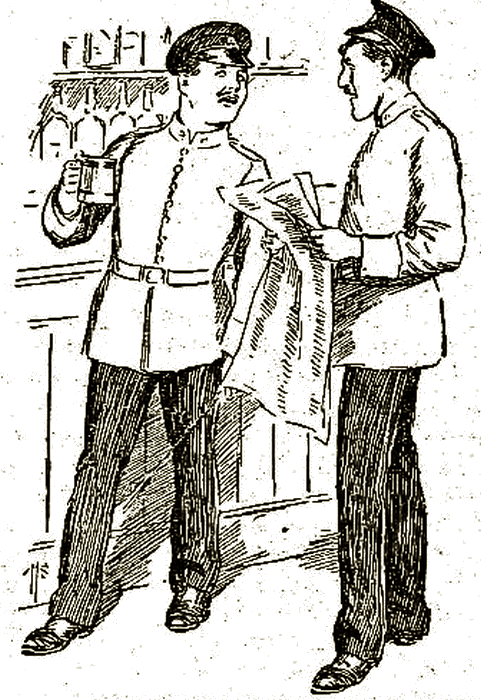
'Then,' sez Spud, nastily, perhaps you'll pay the four bob you
owe me before that cool tenner of yourn gets too hot to touch.'.
"'When I say I've won it,' sez Nobby, hasty, 'I mean I've half won it; it's a sort of double event with another horse that's runnin' to-morrer."
"Naturally enough, the fellers wanted to know what the other horse was, but Nobby was as close as an oyster.
"'I'd be betrayin' the confidence of me friend Lord X—,' he sez, 'what put me on to it.'
"'Will it win?' sez Spud, a bit impressed.
"'It's got a stone in hand,' sez Nobby.
"'Which hand?' sez Spud.
"'The hand it cleans its teeth with,' sez Nobby.
"Spud did his best to persuade Nobby to tell him, but Nobby wasn't givin' information to the Press, so to speak.
"'No, Spud,' be sez, sorrerfully, 'you go scepticatin' round when I happen to give a few tips that don't come off, an' you mustn't expect me to put you on to a certainty.'
"'But is it a certainty?' sez Spud.
"'It's such a certainty,' sez Nobby, confidential, 'that extra police will be watchin' the railway stations to-night to prevent the bookmakers escapin'.'
"'If I thought it was a certainty,' sez Spud, hesitatin', an' thinkin' very hard, 'I've got a bit put by for a rainy day—'
"'Don't trouble about the weather,' sez Nobby.
"'If I was certain sure it'd win,' sez Spud, 'I'd risk it.'
"'I dessay you would,' sez Nobby, 'only I'm not goin' to give any information, unless you apologise.'
"'If I've said anythin' to you I'm sorry for,' sez Spud, 'I apologise.'
"'Wait here half a tick,' sez Nobby. 'I'll go over to the barrack room an' get you that tip.'
"Me an' Nobby went over together.
"'I'll have to see the paper first,' sez Nobby to me, 'an' when I do,' he sez, very grim, 'I'll give Spud Murphy a tip that'll make him grin on the other side of his face.'
"We got the mornin' paper out of Nobby's box, an' he looked down the list of horses.
"'Here's one,' he sez; 'it's called Stately Microbe—no horse could win with a name like that; let's lumber Spud on to it."
"So back we went to the canteen, an' Nobby, takin' Spud into a corner, told him the name of the horse, after makin' him swear he wouldn't tell anybody where he got his information from. Spud was tremendous excited.
"'There's a bookmaker in the town,' he sez. 'I'll get the regimental postman to put it on for me.'
"'How much are you goin' to put' on?' sez Nobby.
"'A pound,' sez Spud.
"'Is that all you've got?" see Nobby.
"'No,' sez Spud, 'but I want to be cautious.'
"'This ain't the time to be cautious,' sez Nobby, an' did his best to persuade Spud to do the Jubilee Plunger* act, but Spud wouldn't.
* The nickname of Henry Ernest Schlesinger Benzon (1866-1911), a wealthy young man who became infamous in late Victorian Britain for recklessly gambling huge sums on horse racing during Queen Victoria's Golden Jubilee year (1887) —RG.
"'Anyhow;' sez Nobby, when we was alone, 'a pound's a lot for Spud to risk—won't he be wild when he finds that Stately Microbe came in ninth?'
"Spud went gassin' about barracks, as we knew he would, about the plunge he had, an' when the evenin' paper became due great local excitement prevailed.
"The evenin' papers was delivered at seven an' the boy who brought it to the canteen door was nearly mobbed.
"Spud got hold of the paper first, an' walked back to the bar with it, lookin' very pale.
"'I'll bet it hasn't won,' he sez, his voice shakin'.
"'I'll bet it hasn't,' sez Nobby to me.
"'I reckon my pound's as good as lost,' sez Spud, 'but I don't mind.'
"'That's the way to take it,' sez Nobby, pattin' him on the back—'better luck next time.'
"'I never expected it would win,' sez Spud, still holdin' the paper in his hand.
"'Open it an' see,' sez all the fellers, an' very slowly, with his hands shakin', Spud turned the paper inside out.
"We held our breath as Spud read down the column. We saw his lips movin' as he read out the names to hisself. Then he turned to Nobby.
"'Nobby,' he sez in a broken voice, 'Nobby—you're a true friend—it's won!'
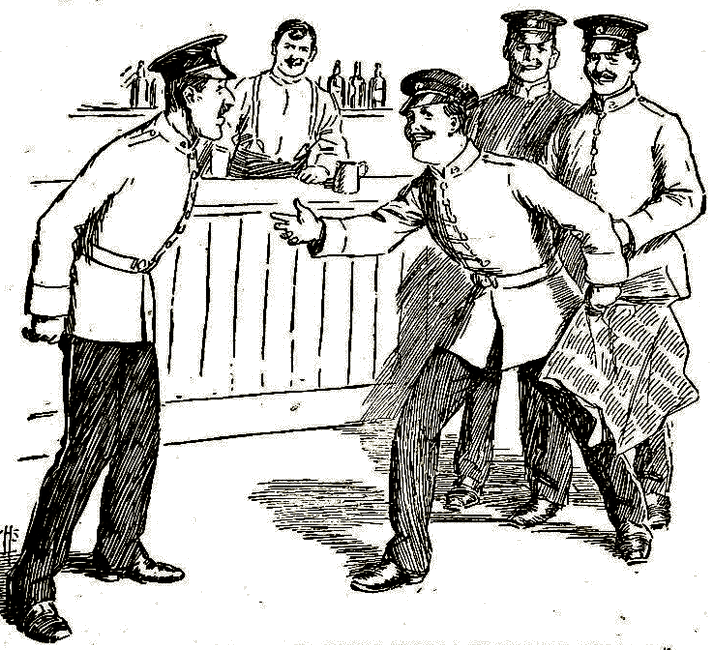
'Nobby,' he sez in a broken voice,
'Nobby—you're a true friend—it's won!'
"'Eh?' sez Nobby.
'"It's won,' sez Spud, falterin'ly, 'at 16 to 1.'
"I thought Nobby would drop on the floor. It was one of the biggest shocks he'd ever had.
"'Won?' he sez, in a far-away voice. 'Why?'
"'I don't know,' sez Spud, an' Nobby took the paper an' read through the race.
"'None of the other horses seem to have died suddenly,' he sez half to himself—'well, well, well.'
"It was what I might term a pathetic sight to see all the fellers crowdin' round Nobby congratulatin' him on bein' such a fine tipper, an' Nobby tryin' to look pleased.
"'I'll never hear a word against you after this, Nobby,' sez Spud, wringin' his hand.
'"Perhaps the bookmaker won't pay,' sez Nobby, hopeful.
"'Oh, yes he will,' sez SpUd, confident; 'he's got lots of money—he's a publican.'
"'Perhaps there'll be an objection,' sez Nobby, but none of them things happened, for the bookmaker paid out that very night.
"Poor Nobby was dazed with the unfortunate affair, but cheered up wonderful towards the end of the evenin', when he got a bright idea.
"'What you've got to do now, Spud,' he sez, 'is to have all that money on another horse what I know about.'
"'All of it?" sez Spud, doubtful.
"'Every bit,' sez Nobby, emphatic, 'an' any more that you happen to have by you.'
"'What's the horse?' sez Spud.
'"I'll tell you to-morrow,' sez Nobby, 'as soon as I've had private information from me friend, who trained the winner of the Waterloo Cup last summer.'
"'Does it run to-morrer?' sez Spud, an' Nobby said it didn't, but it ran the day after.
"The follerin' afternoon Nobby went down town to see the chap who used to send him tips.
"'What I want you to do,' sez Nobby, 'is to find me a horse that could win a wheelbarrer race, or a sack race, or a thread-the-needle an' chalk-the-pig's-eye race, but couldn't possibly win a real horse race.'
"'I've got one on me books,' sez the tippin' feller, 'that I'm sendin' out to all me clients as an Unbeatable Gem.'
"'That's the sort of thing,' sez Nobby.
"'Its Begorra in the Badcesster Cup,' sez the tippin' feller, 'an' if that can win I can eat coke.'
"So back went Nobby, feelin' very happy at the idea that he was goin' to do Spud a shot in the eye.
"He took Spud down into the back field to tell him this one, because it was the greatest secret that was over known, an' Spud dug out eight pounds an' sent it out to the bookmaker.
"It was a terrible day for Spud, an' as the newspaper time came nearer on' nearer he got palpitation of the heart so bad that we thought e would have to go into hospital.
"'It's a terrible business gamblin', Nobby,' sez he.
"'Not if you win,' sez Nobby.
"'But it ain't gamblin' if you win,' sez Spud.
" The paper time came round, an' the excitement was immense.
"'He can't possibly win this time,' sez Nobby, with a very knowin' smile.
"'Why?' I sez.
"'Because I've backed it meself with a bookmaker friend who stands outside the Phoenix,' sez Nobby, 'that'll kill it.'
"The paper came, an' Spud was so nervous that Billy Mason had to open it for him.
"'Break it to me gently,' sez Spud in a faint voice.
"'What's the name of the horse?' sez Billy.
"'Begorra,' sez Nobby prompt; 'you'll find it half-way down the account of the race with a big 0 against it.'
"There was a silence as Billy read the results carefully.
"'You've won, Spud,' he sez, readin' the account. 'Begorra made all the runnin', an' won in a canter by ten lengths.'
"Everybody cheered, an' Nobby smiled a bit painful.
"Spud nearly fell on his neck, but Nobby pushed him off with what I might call unnecessary violence.
"'The only satisfaction I've got,' sez Nobby to me after we left the canteen, 'is that I backed that bloomin' horse myself; let's go into town on' draw the stuff.'
"So we got into 'red,' an', puttin' our belts on, we sauntered out of barracks.
"We made our way to the saloon bar of the Phoenix, where the bookmaker gentleman always paid out. He wasn't there.
"'Mr. Welch?' sez the landlord when we asked him—'why, haven't you heard the news?'
"'No,' sez Nobby, turnin' pale.
"'He was pinched by the police this afternoon for bettin'.'
"'But,' sez Nobby, agitated, 'I had a bet with him. I writ it on a piece of paper: "Begorra, 10s. to win." What happened to that?'
"The fellow shook his head.
"'I saw him chewin' somethin' on his way to the station,' he sez, 'very likely it was your bet.'
"Nobby never got a farthin' of his money," said Smithy sadly, "but Spud got every ha'penny of his, because he had a different bookmaker.
"He wanted Nobby to give him some more tips, but Nobby wouldn't. He was afraid to. He knew they'd win. The only other tip he ever gave Spud was a horse called 'Tinskin ' for the Derby. An' he didn't give that till he read in the Sportin' Chronicle:
"SOLDIERS are very trustin'—very trustin' indeed," said Smithy, shaking his head frowningly. "Some say it's because, bein' wide theirselves, they don't think anybody can be wider: others say it's the natural born innercence of the fellers.
"Nobby Clark is the most untrustin' man I know on' the chap that stopped outside of Waterloo station one night, an' tried to sell him a diamond ring what he'd picked up in the gutter, got a push in the face that dislocated his memory.
"But the rum thing is that although fellers in the battalion would send stamps to feller chaps who advertised, 'How to make a million pounds with a Penny Stamp,' an' although chaps like Chico Johnson would give a friend what he met one night half-a-crown to hold to prove his confidence in this friend—he never saw him before, an' he ain't seen him since—none of our chaps trusted Nobby Clark sufficient to finance one of them famous schemes of his, for makin' the regiment rich.
"I must say that Nobby took the mistrustfulness in very good part.
"'It's an ole sayin' an' a true one,' he sez, 'no feller can make a profit in his own Company—you have to go outside to find the mugs.'
"What worried Nobby as much as anythin' was the idea that all these chaps who say, 'Oh, yes!' an' 'I dessay' an' who nodded an' winked when he gave 'em good schemes, should think that they was wider than him.
"In a manner of speakin', all the suspicion that came Nobby's way did him a lot of harm, socially—to use a political term. He was always the leader, of any wheeze or wangle that was goin'.
"When newspapers ran competitions, it was to Nobby that the chaps used to come. Suppose it was one of them political competitions, where you had to find out what member a picture represented: the moment Nobby saw a 'drawin' of a church, an' a hill, he knew it meant 'Churchill' in a flush! He was always that quick that you couldn't foller him. It was Nobby that started writin' testimonials for fountain pens an' cough mixture; it was Nobby who set the fashion in our regiment of drinkin' ginger-ale an' beer mixed; there wasn't a single wheeze that ever went but what Nobby invented it.
"After our regiment got into the semi-final in the Army Cup after a most desprit an' bloodthirsty match that got into the papers, it was Nobby who used to walk down town with a limp, so that everybody turned to look at him an' say 'there goes one of them brave Anchester chaps what nearly won the Army Cup—see how badly injured he is?'
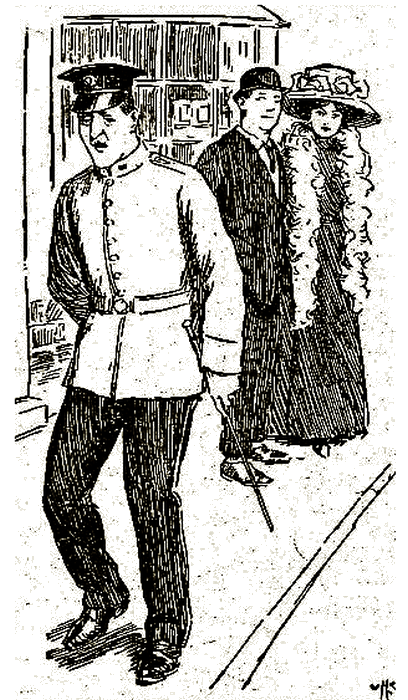
It was Nobby who used to walk down town with a
limp, so that everybody turned to look at him
"In a week the whole battalion was limpin'.
"But as I've said before the Anchesters haven't got the slightest gratitude, an' after a few of 'em had been run in by the military police for 'walkin' improperly an' pretendin' to be drunk,' they would round on pore old Nob.
"'Hark my words, Smithy,' he sez very solemn one day, 'mark my words, these fellers will be sorry for what they are doin' one of these days.'
"It was about this time that he was enjoyin' a lot of unpopularity, owin' to one of his schemes not comin' off as everybody thought it would. I think it was the boxin' affair."*
[* See "An Unknown," Ideas, April 6.]
"He was Ishmaelited, every pot was closed against him. Wherever he went there wasn't one friendly face that said, 'Have one with me, Nobby,' an' although nobody tried to take advantage of him owin' to his Deadly Left an' Handy Right yet the way the chaps treated him began to tell on him.
"They even went so far as to come over to our barrack room an' ask him to return blackin' brushes what he'd borrowed years before.
"At kit inspection they sort of hovered round his cot like bloomin' vultures.
"'My shirt, I think,' sez Sid Taylor, pickin' it up.
"'There's a pair of socks I lent you last general inspection,' sez another feller, an' if Nobby hadn't tore 'em out of their hands, an' sternly ordered them to desist a bit, he'd have lost his kit.
"But they made a mistake in givin' the frozen face to Nobby; for there came a time when they wanted him.
"We were stationed at Anchester at the time—it was after we'd come home from the Cape, an' before Nobby had any what I might call serious ideas of life.
"One Sunday mornin' we fell in for church an' marched out of barracks, a beautiful sight to behold.
"Me an' Nobby sat side by side, bein' of the same religious opinion, an' sleepin' turn an' turn about. It was my turn to sleep—we tossed up for it before we fell in, an' I won the sermon—an' I was just dozin' off when Nobby whispers:
"'See that girl in the gallery—she's lookin' at us?'
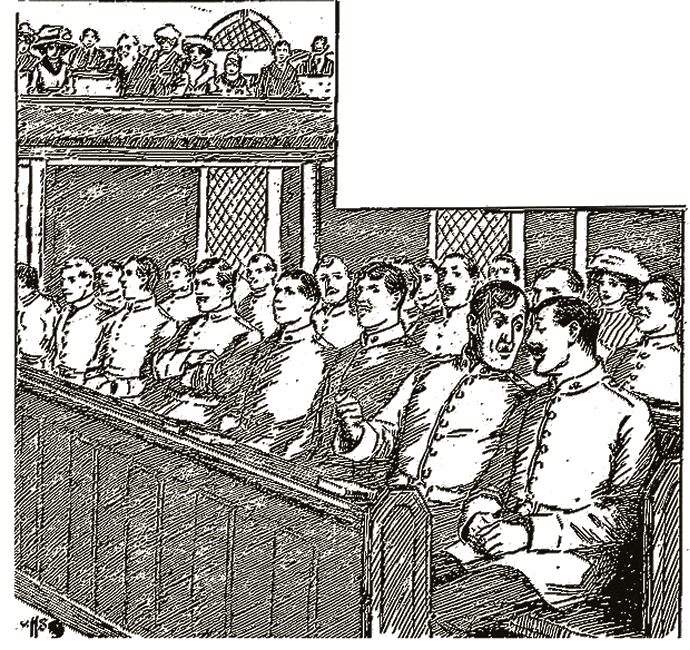
I was just dozin' off when Nobby whispers: 'See
that girl in the gallery—she's lookin' at us?'
"'Point her out after the sermon,' I sez, closin' my eyes devotefully.
"'She's lookin' at you, Smithy,' sez Nobby.
"'Call me at 12-15,' I sez.
"I didn't hear any more about the girl. Just as I was dreamin' I was bein' bit by an ostrich. Nobby pinched me an' whispers, 'sermon's over—wake up an' sing, you unreligious blighter.'
"All the time he was singin' he kept lookin' up at the gallery, but as far as I could see there was no girl there worth mentionin'.
"Nobby got checked comin' back to barracks for talkin' in the ranks about the girl he'd seen in the gallery makin' eyes at the soldiers.
"'She wasn't lookin' at me,' sez Nobby, 'an' she wasn't lookin' at Smithy.'
"'I didn't see—' I started to say.
"'You didn't see who she was lookin' at,' sez Nobby very quick—'no more did I.'
"We talked about it at dinner time—at least Nobby did—an' the other fellers got quite curious.
"'What was she like, Nobby?' sez Spud, but Nobby looked at him very cold.
"'I'm addressin' me remarks to me friend Smithy,' he sez haughtily, 'an' the intermejections of a perishin' flat-footed plasterer's labourer that's crep' into the army to get out of the cold is singularly uncalled for.'
"Nobby said a few other things, an' Spud was so dazed by Nobby's eloquent remarks that he said nothin'.
"We might have forgotten all about the girl; in the gallery, if it hadn't been for the Anchester News. The News comes out on a Wednesday, an' a good number of our fellers bought it about that time because it reported all our football matches, concerts, an' other comic things. But what sold the paper like wildfire was an advertisement on the front page.
"It was under a headin' called 'Personal,' an' it went somehow like this:—
Soldier with the Slight Moustache an' Blue Eyes: I saw you in church but you did not look at me. I often see you in town: won't you speak to me?—Girl in the Gallery.
"That was all it said, but it sort-of sent a flutter through the regiment. You saw chaps walkin' about in the back field lookin' sentimental an' holdin' the paper in their hands.
"They didn't discuss what was in their minds because their feelin's was too deep for words, besides which they didn't want to look silly. But I got a few hints from one or two of 'em, an' drew me own conclusions.
"'Smithy,' sez Fatty Green one day, somewhat careless, 'How would yon describe me?'
"So I told him.
"'I didn't ask for offensive remarks,' he sez reproachfully. 'What I meant to say was, would you call my moustache a slight one?'
"'I should call it ginger, meself,' I sez.
"'You don't quite gather me meanin', sez Fatty, most patient, 'never mind about the colour—would you call it slight?'
"'Slightly slight,' I sez, 'an' slightly heavy.'
"Fatty was very pleased.
"Jerry Jordan was another chap who was keen on havin' his moustache diagnosed.
"'An' what sort of eyes would you say I had?' he sez.
"'Puppy-dog eyes,' I sez, 'them kind that bulges out.'
"'What colour?' he sez.
"'Pink,' I sez.
"But it was to Nobby they had to go: they was very humble an' Nobby was very uppish, but bein' naturally kind-hearted, he let bygones be bygones.
"'Do you think it was me. Nobby?' sez Spud.
"'I shouldn't be surprised,' sez Nobby; 'now I come to think of it, she was lookin' in your direction.'
"'I've got an idea,' sez Bill Mason, takin' Nobby aside in the canteen, 'that that advertisement was meant for me—'
"'Very likely,' sez Nobby, noddin' his head; 'come to consider the matter she was lookin' your way.'
"'Nobby,' sez Tiny White, gettin' him confidential by the arm an' leadin' him behind the cookhouse, 'as a man of the world I would like your advice on a certain secret matter: doubtless,' he sez, 'you have seen a certain advertisement in a certain paper. Now,' he sez, confidentialer than ever, " now I've got reason to believe that I'm the feller referred to.'
"'I shouldn't be surprised,'sez Nobby; 'I noticed particularly that she was lookin' at you.'
"'Did you, Nobby?' sez Tiny, quite delighted.
"'I did,' sez Nobby.
"'You're a true friend,' sez Tiny, shakin' him by the hand, 'an' I beg to withdraw all them remarks what I made about your bein' an unprincipled rogue an' a thief—I don't think I was right.'
"'Don't say that you don't think,' sez Nobby, irritated; 'say you're jolly well sure.'
"'I was never a feller to gush,' sez Tiny, cautious, 'but I'll go as far as sayin' that you're misunderstood.'
"Half the battalion came to Nobby in confidence for advice, an' Nobby's advice was, 'Wait for developments.'
"'There's sure to be another advertisement,' sez Nobby.
"Next Sunday we marched to church as usual. It was the biggest church parade we'd ever had.
Nobody tried to get excused; nobody applied for passes to attend his sister's wedding, or to go to a funeral, an' the battalion marched out as near fall strength as makes no difference.
"The next mornin' half the fellers were sufferin' from a crick in the neck, owin' to their tryin' to get a glimpse of the girl in the gallery. There was lots of girls there, but none that looked very friendly, an the chaps came away a bit disappointed.
"But they waited for the Anchester News to come oat, an' sure enough, there was the advertisement:
Soldier with the Blue Eyes: I saw yon lookin' up at me; but why have you not answered me? Will you meet me by the old mill on Saturday week at 6-30? I shall be dressed in brown an' wear a pink rose.—Girl in the Gallery.
"If war had been declared the regiment couldn't have been more agitated. The only feller who was in any way suspicious was Spud Murphy, an' he told me what he thought.
"'If there was any money to be made out of this girl in the gallery business,' he sez, 'I'd know it was one of Nobby Clark's fakes; if it said—"Send twelve stamps for me photograph," I'd be cock-sure Nobby was at the bottom of it, but as it is, I'll risk it, an' see her.'
"You will?' I sez; 'why you?'
"'Because it's meant for me,' sez Spud; 'anybody can see that.'
"Nobby's clients was at him day an' night.
"'What do you think I ought to say to her?' sez one chap.
"'Say to who?' sez Nobby.
"'That girl what's advertisin' for me,' sez the chap; so Nobby told him what to say an' what to do.
"'First of all,' sez Nobby, 'you'll have to put an advertisement in the paper to say you're comin', an' then—'
"'What sort of an advertisement?' sez the feller.
"'As long as possible,' sez Nobby.
"'Some of the chaps he gave this advice to didn't like it on account of the expense, but as Nobby pointed out, what's money when a chap's in love?
"I don't know," said Smithy, thoughtfully, "how many fellers went to Nobby for advice, but when the Anchester News came out there was four columns of replies to the Girl in the Gallery.
"One said:
Girl in the Gallery: I have loved thee for a long time. I will be at the Old Mill on Saturday, so no more at present.—Soldier.
"But that was very short compared to some of 'em. Tiny White did in a week's pay by puttin' a poem into the paper, which him an' Nobby made up between 'em:
The rose is red,
The violet's blue;
You be at the Old Mill at half-past six
An' I'll be there, too.
Oh, girl in the gallery,
I give you my heart;
With my wealth an' my salary I gladly will part.
—Yours truly, Blue-Eyed Soldier.
"There was yards of stuff like this an' the publication of all their replies caused a great sensation."
"IT'S not for me," said Smithy, modestly, "to describe the fights that occurred in barracks between chaps who thought they was the only one meant by the Girl in the Gallery. It's not for me to tell how about 300 of our fellers dressed in their Sunday best went wanderin' up to the Old Mill outside the town.
"I saw it though Nobby didn't, for he went to London that night on leave, an' I should have gone too, only I happened to be on picquet duty
"'I can't stay here an' witness these disgustin' sights,' sez Nobby, jinglin' some money in his pocket in an absent-minded way; 'mor'n depravity I call it.'
"So off he went to London,
"The next day, when the regiment was feelin' very down-hearted an' most of the blue-eyed soldiers was black-eyed soldiers, an' the guard room was full of chaps who had tried to drown their sorrer in drink, I was walkin' down town when I met the young feller that runs the Anchester News.
"He stopped me an' gave me a Fumigator da Cuba.
"'Wonderful feller that pal of yours,' he sez.
"'Nobby?' I sez.
"'Yes,' sez the Anchester News chap. 'A month ago he came to me an' asked me if I'd give him a commission on all advertisements he got from his friends.'
"'An' did you?' I sez, beginnin' to understand things."
"'Did I?' sez the chap, 'I should say I did! Fifty per cent I gave him, an' what's more,' he sez, 'I inserted a couple of advertisements free.'
"I didn't ask him which advertisements they were, because I could guess."
THERE was trouble in "B2."
A man may not speak when he is on sentry-go, but under cover of the darkness Smithy, standing at the end of his beat, commented caustically upon Private Mason's character, morals, and conduct generally.
In the shadow of the big tree near the barrack gate, I waited, cautiously concealing the red glow of my cigar in the palm of my hand, for I have a soldier's horror of being detected in the act of committing a breach of rules.
By-and-bye there emerged from B2 room a tangled, swaying, bunch of men and a loud voice, and the voice was Billy Mason's. The party staggered and zig-zagged across the square to the guard-room, and Smithy, bringing his rifle to the slope, stepped briskly towards it, and regarded the party with sublime benevolence.
Then the owner of the loud voice recognised him.
"Smithy!" he yelled, "Smithy, you putty-eyed rooster! Smithy——!"
I did not hear the remainder, for the waiting cell door slammed, and the eloquence of Private Mason was summarily arrested.
Smithy walked leisurely back to where I stood.
"Billy Mason," he said laconically, and added, quite unnecessarily, "he's drunk!"
He stood silently surveying the gloomy void of the square, and the twinkling lights in the barrack room.
"Wilkie's set," he said.
The next day I met him in town, and he explained.
"There's lots of chaps in the world who have got an idea that fellers have nothin' else to do but to get one another 'set,'" he said, "but old Mason's 'set' because he asks for it."
Now, it is at once a miserable and a horrid experience to be "got set" in the Army.
Men have committed outrageous military crimes under the suspicion that somebody or other in office had "got them set." Sometimes it is an officer, sometimes it is a colour-sergeant—these are the greatest "setters" of all—sometimes a mere bit of a lance-corporal.
And the English of it all is this: A man who is "set" is a marked man; a man to be found fault with on every conceivable occasion; a man who never does things right; the sort of man who, on the other side of the water, is tersely designated "It."
"I've only known one feller who ever made anythin' out of bein' 'set,'" reflected Smithy; "an' that was only because people thought he was much worse.than he was.
"There was a chap in 'H' by name of Wilkie—Wilkinson his full name was. Nice-lookin' chap, with a fierce moustache, an' rather reddish to look at.
"Well, somehow, old Wilkie couldn't do the right thing. He wore two pairs of boots out on defaulter's drill, an' used to spend all the time he'd got free inventin' a thing what'd pick oakum while you slept.
"Up at the orderly-room he was, three days a week.
"'What's the meanin' of this, Wilkie?' sez the officer.
"'I can't help it,' sez pore Wilkie, ' the colour-bloke's got me "set."'
"'Three days' "C.B.,"' sez the officer, an' that was all the satisfaction Wilkie ever had.
"Whenever there was anythin' wrong in 'H,' and they didn't know who did it, they used to run in Wilkie.
"Anybody that studied Wilkie's case would have seen in a tick that he wasn't as wicked as he was unfortunate, but then nobody took the trouble to study Wilkie's case, an' he got worse an' worse till Nobby nearly wrote a play about him called 'The Worst Man in the Anchesters.'
"But the moment he got fairly settled down with a real bad reputation, people began to take an interest in him. The colonel's wife, who was a bit religious, used to have him for half-an-hour on Wednesdays, an' the adjutant's wife, who wore glasses, used to have him for half-an-hour on Fridays, an' read poetry to him in the hope of sof'nin' his hard heart.
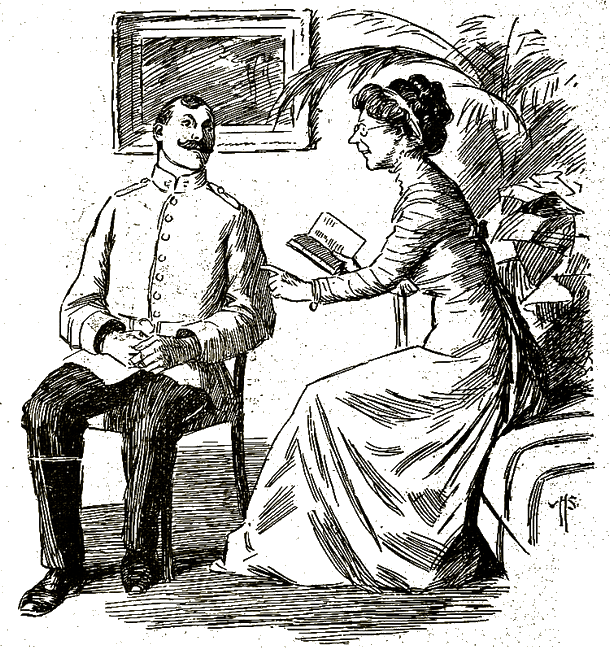
The adjutant's wife read poetry to him in the hope of sof'nin' his hard heart.
"Then the chaplain took a hand, an' some kind friends in town got interested, an' Wilkie bucked up wonderful.
"Used to walk about barracks with a sweet, sad smile, an' a far-away look in his eyes.
"'No, Smithy,' he sez one night, when I asked him to have a drink, 'I've given up the cursed stuff wot's brought me as low as the beasts in the field.'
"'But you never drank much,' I sez.
"'No,' sez Wilkie, thoughtful; 'now you come to mention it, I didn't. But I've promised Mrs. Colonel that I wouldn't touch, taste, nor 'andle.'
"Pluckin' Wilkie from the burnin', so to speak, became a fashionable pastime in Anchester. When a parson got up in church an' sez, 'I ask the prayers of the congregation for a pore feller strugglin' in darkness,' you knew he was speakin' about Wilkie. He was so much sought after by people who wanted to show him the errow of his ways that he hadn't time to do punishment drill, an' whilst virtuous chaps like me an' Nobby an' Spud Murphy was carryin' coals to the married quarters, me bold Wilkie was either sittin" under a tree in the back field, readin' 'A Guide to Sinners,' or else walkin' down town with a pretty girl, most earnestly discussin' hell an' things like that.
"What's more, the colonel transferred him to our company where nobody had him 'set.' As a matter of fact, if the colonel had done that before, there wouldn't have been any need to convert him. He would have been all right, anyhow, but comin' as he did, as a sort of reformed character, tryin' to lead a purer life, everybody did their best to make B Company as comfortable as possible for him.
"Somehow Wilkie took to 'B.' He seemed to understand the colour-sergeant, got on all right with the officer, an' before he'd been in the bloomin' company a month, lo! an' behold, here was Wilkie gettin' fat billets over the heads of the likes of me!"
Smithy's voice rang indignantly.
"I was sittin' in the Coffee Bar one. night, havin' no money to spend on respectable drinks, when in walks Nobby as wild as anythin'.
"'Heard about Wilkie?' sez 'e.
"'No,' I sez.
"'Why, the bloomin' lobster's been made Company Storeman!'"
Truly, this was honour indeed, for the storeman's post is a sinecure; he is excused most parades, he is on familiar terms with corporals and colour-sergeants, and by virtue of his office may assume masterly airs in his dealings with common privates.
"You could ave knocked me down with a feather," said Smithy, bitterly. "Here was a chap we took in out of the cold, so to speak, a sort of nobody's child, wot was always gettin' into trouble, an' he comes into our bloomin' company like a wolf in lion's clothes, an' starts bitin' the hand what warmed him!
"Next night, bein' pay night, me an' Nobby goes over to the canteen, an' there was Wilkie as large as life.
"'Hullo. Nobby, he sez, 'have one with me?"
"'Thank you kindly,' sez Nobby, 'but I'd rather drink with me own countrymen.'
"'What d'yer mean?' sez Wilkie, flushin' up—I told you be was reddish-lookin'.
"'What I mean.' sez Nobby, 'is that you're a bloomin' alien, a bloke that gets kicked out of his own company, an' comes into ours, a-takin' the bread out of our mouths by gettin' jobs you've no right to,' sez Nobby.
"Nobby was wild, an' very natural.
"Owin' to goin' to church regular,' said Smithy, "I'm well up on religions subjec's, an' it's always struck me about the Prodigal Son business, that the chap to be pitied ain't the feller that went away an' did in his share of the money with the Hogsteins, but the brother that stayed at home an' looked after his father an' kept the home together; but other people think different.
"'It seems to me,' sez Nobby that night, 'that the thing to do is to get a bad character, an' make yourself interestin' to the community at large,' so he started doin' his best to get himself into trouble.
"Nobby is the sort of chap that don't have to try very hard at that sort of thing, an' before a week was over his head, he'd been before the Company Officer three times an' was workin' out ten days' C.B.
"At last the colonel spotted all this, an' had Nobby in front of him.
"'What the devil do you mean?' he sez, 'by behavin' like this—a good, clean soldier like you to be "run" three times in one week—why, it's disgraceful!' he sez.
"So Nobby up an' told him he was tired of the Company, an' wanted a change, an' the old man looked awful puzzled, because we're all very fond of Umfreville, our Company Officer.
"'All right,' he sez, 'you can go to "G,"', an' Nobby's dial fell, because 'G' is the blackest an' worst company in the whole battalion. But he freshened up when the colour-sergeant of 'G' sort of fell into his arms. For Nobby, bein' a nice soldier, is the sort of feller any 'colour' is glad to have in his company.
'"I shall be Company Storeman in a week,' sez Nobby, very satisfied with himself, 'an' whilst you pore chaps are doin' drill an' fatigues, I'll be sittin' in front of a nice cosy fire thinkin' of mother.'
"An' sure enough, he was.
"An that," explained Smithy, "is how all the trouble in 'B' Company came about. Nobby led 'em all astray. Chaps who'd lived uninterestin' lives, without gettin' into trouble, began to ask theirselves, wot's the good? An' crime began to grow, because fellers saw that a chap who wasn't known wasn't respected, an' they started in to advertise theirselves.
"Some did it by gettin' drunk, an' offerin' to fight the provost corporal: some did it by slackin' in their work. Fatty Green did it by refusin' to scrub out his cot, an' other gallant fellers did it in various ways.
"For about a fortnight the regiment had such a bad character that they had to borrow two extra clerks from the Army Service Corps to enter up the defaulter sheets.
"The colonel was very much annoyed, an' signified the same in the usual manner, an' one half of the battalion was doin' defaulters' drill an' the other half was doin' punishment fatigue, before you could say 'knife.'
"We've got a chaplain attached to us, a nice, kind young feller, from Oxford or Cambridge, or one of them boat race places, an' he tried his best to persuade the sinful Anchesters to do the right thing, an' asked the colonel if he couldn't try moral somethin'-or-other.
"'I will.' sez the colonel, very grim, 'I've tried defaulters' drill, an' I've tried cells,' so he put out a new order that the next good character that went wrong should be sentenced to go to church three times on Sunday an' twice durin' the week.
"But there wasn't any necessity to go to what I might call extreme measures, for whilst the crime was at its worst, the thing happened what converted the regiment, automatic.
"There was two regiments in Anchester at the time, us an' the Buffs, an' when we was at our worst, the Buffs went away to Aldershot, an' the Wigshires were sent from the 'Shot to relieve 'em.
"Anybody who knows anythin' about the Army don't want to be told that there ain't a worse regiment in the British Army than the Wigs.
"They ain't smart an' they can't shoot; they're the worst marchers, the slackest workers, an' the best talkers that ever marched behind a band—an' their band ain't no Besses-o'-th'-Barn* either.
* A well-known English brass band with a rich histor y dating back to 1818. It is one of the oldest brass bands in the world, originating from the village of Besses o' th' Barn in Greater Manchester.
"They came marchin' into Anchester out of step an' out of tune but very joyous, an' after they'd been dismissed to their quarters, a lot of 'em came over to our canteen.
"'We're very glad,' sez one of the chaps—Hoggy by name—'to be lyin' against another rorty regiment.'
"'Meanin' thereby,' sez Nobby politely.
"'What I mean to say is,' sez the feller, 'we're tired of always bein' pointed out as the worst regiment in the brigade, an' from all accounts, the old Anchesters are a bit O.T.—warm. Don't think,' he sez enthusiastic, 'we don't respect you for bein' independent an' sportin'. In these here democratic days—if I might use the expression—there's too much kow-towin', too much brass-polishin' an' strap-cleanin', an' when we hear of another regiment that won't be put upon, we honour it.'
"'Oh, you do, do you?' sez Nobby; ' an' what,' he sez very fierce, 'do you mean by a-comin' over into our canteen an' mentionin' the Dirty Wigs an' the Anchesters in the same breath?'
"'No offence,' sez Hoggy. 'You don't see me meanin'. The Wigs an' the Anchesters have always been unfriendly. Now. my idea is that, bein' in the same boat, so to speak, an' bein' tarred with the same brush, so to say, we ought to hang together. So the chaps have asked me to come over an' invite you to a grand smokin' concert at our canteen next Tuesday.'
"Nobody said anythin'. The idea of bein' compared with the Wigs had never occurred to anyone. At last Nobby found his voice.
"'I'm sorry we can't come on Tuesday—it's the night our Mutual Improvement Society meets.'
"The Wig was staggered.
"'What about Wednesday?' he sez.
"Nobby shook his head.
"'That's the annual meetin' of our Debatin' Club,' he sez; 'an' Thursday the Anchester Military Temperance League has a readin' from Tennyson.'
"'What about Friday?' sez the Wig, feebly.
"'Friday?' sez Nobby, impressively, 'we have our weekly competition for all-round smartness an' good behaviour, an' there's so many entries our officers are up till two in the mornin' judgin' the results.'
"'But,' sez the Wigshire chap, bewildered, 'I thought you fellers was bad characters?'
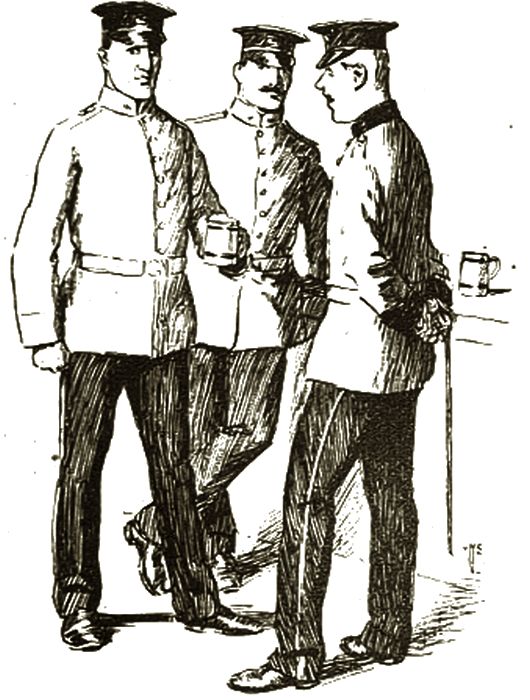
'But,' sez the Wigshire chap, bewildered,
'I thought you fellers was bad characters?'
"'Now you come to mention it.' sez Nobby careful, 'I believe there was a bit of trouble last week owin' to Fatty Green only goin' to church twice, after he'd promised me an' the colonel he'd turn up for the three o'clock service.'
"It's a rum thing about soldiers," reflected Smithy, "that they're very much like ordinary human bein's. Nobody likes a feller to say to him, 'I'm as good as you,' but what he hates worse than anythin' else, is for some silly feller to come along an' say 'I'm nearly as bad as you are.' The Anchesters reformed from that night."
"HAVE you ever heard of the Anchester Grand Pageant of the British Army?" demanded Private Smith. "It was in all the newspapers that published it, but it wasn't in others. The feller responsible for the pageant was Nobby Clark, but he don't boast about the fact owin' to certain circumstances over which he had no control, as Shakespeare sez.
"Pageants are fashionable just now. There ain't a town in England where somethin' or other didn't happen a hundred years ago, that everybody's forgot.
"I feel sorry for a little town that don't want no pageants or upset of any kind, an' has to have it whether it wants it or not. There it is, baskin' in the sun, people goin' about their business not knowin' the thing that's goin' to happen to it when along comes a poet that's took up pageants as a side line.
"He looks up an' down the street.
"'Hullo,' he sez, 'the very place for a pageant,' an' off he goes to the Mayor of the town.
"'What about a pageant?' he sez.
"'What pageant?' sez the Mayor.
"'The Pageant of Mudboro'-on-Posh,' sez the feller.
"'The only pageant you're likely to see here, sez the Mayor, shakin' his head, 'is the Salvation Army Pageant, every Sunday mornin' at 10,' he sez.
"'Look here,' sez the long-haired bloke, 'you leave everythin' to me an' you'll have a pageant before you can say honk. In the first place well have the episode of St. Augustine comin' to Mudburo' an' preachin' to the rabble.'
"'He didn't come here,' sez the Mayor, 'at least not in my time.'
"'That don't matter,' sez the pageant feller very enthusiastic. 'St. Augustine went everywhere. Then we'll have the episode of Queen Maud appealin' to the loyal burghers of Mudboro'.'
"'Burglars?' sez the Mayor.
"'Burghers, I said,' sez the pageant chap. "Then we'll have King John signin' his Magnum Opus at Runnymede.'
"'But that ain't in Mudboro',' sez the Mayor.
'"It ain't more than two hundred miles away," sez the pageanter, 'an' any way, nobody will know the difference.'
After describin' Queen Elizabeth's visit to Mudboro', an' how King Charles hid in an oak tree, an' how the young Pretender fought his last battle on the banks of the Posh, the pageant chap goes away with a hundred pounds in his pocket on account of expenses, leavin' the Mayor highly dazed.
"One of the easiest things in the world is to run a pageant showin' all the famous people who have been in a place, because, bein' dead, they naturally can't come forward an' slosh the feller that's libellin' 'em.
"Th» Anchester Military Pageant is supposed to be the Mayor's idea, but it was Nobby Clark who suggested it.
"Nobby was readin' a paper one day when he come across a bit about pageant-makers' profits, an' that put him on the track.
"It wouldn't have come to anythin' if Nobby's first scheme had come off, but the chaps were a bit shy of Nobby's business ideas, an' when he started collectin' money to buy armour an' costumes with, the sergeant-major interfered, an' made Nobby hand the stuff back.
"The sergeant-major must have told some of the officers, an' the officers must have told the Mayor, who used to dine at the mess on guest nights. Anyway, the first thing we know was an announcement in battalion orders that a grand military pageant was to be held on behalf of the funds of the Anchester Hospital.
"'My idea,' sez Nobby, very bitter, 'pinched, in a manner of speakin', under me very nose. It's enough to make a feller give up thinkin'.'
"But he brightened up wonderful when the Mayor sent for him an' asked him to help get the show up.
"Nobby told the chaps that night in the canteen what the Mayor had said to him.
"'It's to be an indoor pageant,' he sez, 'an' there's a chance for everybody. Any feller who wants to play a part in the pageant has only got to apply to me—I'm takin' on the hands.'
"'Do we get anythin'?' sez Spud Murphy, an' Nobby looked at him reproachful.
"'I'm surprised at you, Spud,' he sez, sorrerful, 'all you think about is money—what you get is honour.'
"'What do you get?' sez Spud.
"'That's nothin' to do with it,' sez Nobby, changin' the subject quick.
"The regiment took to the idea of the pageant, especially when it came out in orders that all chaps takin' part in it would be excused afternoon parades.
"The Anchesters had to do three episodes, the Murder of Thomas à Becket, the Execution of King Charles, an' the Battle of Trafalgar.
"There was so many fellers who wanted to be the executioner in King Charles' Act, that Nobby put up the job to auction, an' it fetched two shillin's. A chap named Moley, who'd got what I might call actor's blood in his veins, bought it. His father used to be a limelight man at the Drury Lane, so naturally he was well up in actin'.
"The feller that bought the part of King Charles was Tiny White, an' him an' Moley used to practise the execution scene day an' night.
"It was one of the sights of Anchester. We'd be sittin' peaceably at tea, when in would rush a feller from 'H' Company in a state of excitement.
"'If any of you chaps want to see Moley execute Tiny, you'd better pull up your socks—he's just goin' to begin.'
"So we'd drop what we was doin' an' rush off to 'H' Company's barrack room, an' find it crowded.
"There was King Charles, with his shirt sleeves rolled up, an' a tattoo mark, 'I Love Emma,' on his arm, an' there was Moley with a wooden axe.
" Now we'll start, sez Moley.
"'Right o!' sez King Charles, an' strikin' an attitude, he'd begin in a sing-song voice:
Me days are numbered on this earth.
Me royal throne, me noble birth.
Me (forget this little bit) are fled,
I'm going to loose me bloom in' head.'
"'Not bloomin' head,' sez Moley, very stern. 'Royal head.'
"'Royal head, sez Tiny; 'now it's your turn.'
"Then Moley strikes an attitude.
Me trusty axe is in me hand,
I must obey me lord's command;
If I don't catch your bead a crack,
I'm pretty sure to get the sack.
"I might say," said Smithy in parenthesis, "that them beautiful words was written by the Mayor's eldest son. Well, after they were said, amidst loud applause from the assembled garrison, Tiny lays his neck on the edge of the coal box, an' Moley raises his axe.
"This was the part that Tiny didn't like, an' him an' the executioner always had words about it.
"'You be careful,' sez King Charles.
"'Don't worry,' sez the executioner, 'I shan't hurt you; put your napper a bit further over.'
"'It won't go any further,' sez King Charles, 'besides it's makin' me neck dirty.'
"'Nobody will notice it,' sez the executioner, raisin' his axe.
An' now me duty I must do,
Me trusty axe strikes fair an' true —
With one stout stroke—
"'Here,' sez King Charles lookin' up most apprehensive, 'you go steady with that axe of yourn.'
"'Shut up,' sez the executioner,
With one stout stroke' I end—
"'I've known accidents to occur like this,' sez King Charles, 'many a feller's lost his life—'
"'Dry up,' sez Moley, stern, 'you're spoilin' the scene.'
With one stout stroke I end his life—
"'All I want to say,' sez King Charles, 'is this: don't get carried away by the excitement of the piece.'
An' put an end to all the strife,
sez Moley, an' brings the axe down whack on Tiny's neck.
"'Wow!' roars Tiny, jumpin' up with a yell, 'I told you to be careful, you perisher.'
"Through the winders we watched King Charles chasin' the executioner, an' it was one of the most realistic bits of pageantin' you could possibly imagine.
"There was always a crowd to see this bit, but the best part of the time the fellers was so busy rehearsin' themselves, that they hadn't time to go watchin' other fellers.
"Me an' Nobby an' a lot of fellers of 'B' had a great scene that was called 'An Episode in the Peninsular War.' It was supposed to show somethin' that happened to an officer of the Anchester Regiment, who was captured by the enemy, tied on to a bed because he wouldn't give away the password, an' blown up.*
* There was some such occurrence In the history of the Anchesters.
"Nobby gave up bein' Lord Wellin'ton to take the part of the blown-up feller, an' it was one of the realisticest things you ever saw, Nobby strugglin' with the hateful Spaniards. After every rehearsal one feller at least bad to go up to the hospital to have his wounds dressed.
"The pageant came nearer an' nearer, an' everybody in Anchester stood on the toe-nail of expectation. The excitement in barracks was enormous. You couldn't get into some of the rooms owin' to what was goin' on.
"If you strolled over to 'G' Company you'd find a feller on guard outside the door.
'"Very sorry. Smithy,' sez the feller, 'you can't come in here; St. Augustine is addressin' the Early Christians.'
"If you listened hard you'd hear St. Augustine speakin:'
"'Yatesey,' sez the Saint, 'if you don't cover your face with your hands an' moan, like Nobby told you to, I'll come over an' give you a punch in the neck.'
"'Get on with it, Gus,'sez the Early Christian, 'the canteen will be closed if you don't get a move on.
""'Hear, hear,' sez all the Early Christians.
"Nobby Clark was everywhere," an' I must say this about Nobby, the way he wangled everythin' was truly wonderful: even the officers complimented him.
"One minute he'd be showin' the Black Prince how to get out of his armour without usin' a tin opener, the next he'd be teachin' Thomas à Becket how to say his lines.
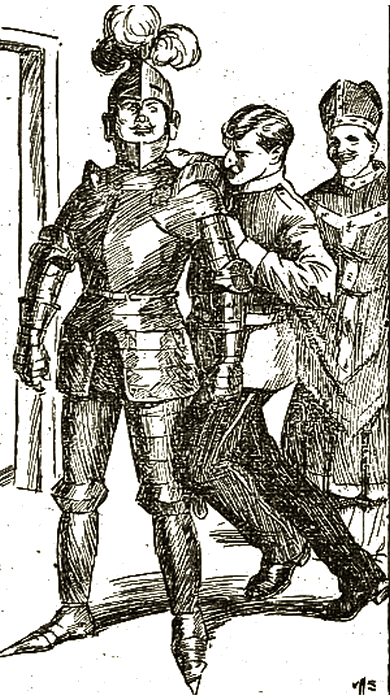
One minute he'd be showin' the Black Prince how
to get out of his armour without usin' a tin opener.
"It only shows what hard work will do. On the day of the pageant the Anchester fellers was the only people who wasn't nervous.
"'I shall bring the house down with my little bit,' sez Nobby proud, 'that little bit where the officer is bound to the bed. It's the last scene—all I want now is a feller to lay under the bed. what I'm bound on, an' as soon as he hears me give the tip, light the cracker.'
"Anchester had been covered with placards for weeks.
INTRODUCIN' SCENES AN' EPISODES
IN THE HISTORY OF ANCHESTER.
MAGNIFICENT MILITARY SCENES!
(PERFORMED BY REAL SOLDIERS
OF THE ANCHESTER REGIMENT!)
CONCLUDIN' WITH AN
INTENSELY DRAMATIC EPISODE
(FOUNDED ON FACT) ENTITLED,
"FAITHFUL TO DEATH," OR
"AN ANCHESTER SOLDIER'S HONOUR."
Captain de Gallant ....... Private Clark
Orlando Oliveoillo ....... Private Cassidy
Jose Torredoro ........... Private Murphy
Tommasso Oniono .......... Private Green
SCENE: A LONELY HUT IN THE MOUNTAINS.
"You can see how much the pageant people depended on Nobby.
"The Town Hall was crowded on the night of the show. All the officers was there, an' lots of people who had come down from London.
"From first to last it was the most successful pageant that there had ever been in Anchester.
"Behind the scenes, so to speak, all was animation. All the players was tryin' to buck one another up.
"'Whatever you do,' sez Thomas à Becket to one of the murderers; 'leave out that bit where you clap me on the shoulder an' say:
False priest, the King has sent me here
To stop your everlastin' sneer.
"'You can say them words,' sez Thomas (a feller of "H," named Isaacs), 'but don't clap me on the shoulder, because I've got a boil on me neck.'
"Nobby, dressed as Captain de Gallant, looked a perfect picture.
"'Now, then, gents," be sez, 'all on for the first episode.'
"THE only part of the pageant that the audience didn't care much about was the part played by the civilians. They was much too tame an' gentle. But then they had the mildest parts, such as King Alfred burnin' his boots, an' King Cannot rebukin' the sea for bein' wet, an' there really wasn't any sudden death tably-oh ±ill a fierce army led by King William Mason, of 'G' Company, landed on the English shore, an' drove King Fatty Green, the rightful King of England, from one side of the stage to the other. This scene brought down the house, an' a part of the scenery, owin' to Fatty, in the excitement of the moment, fallin' against a bit of Hastin's an' upsettin' it.
"'Everything's goin' smooth,' sez Nobby in a tremble of excitement—I wAs behind the scenes helpin' to dress some of the characters—'everythin' depends on my little bit at the end.'
"There was a chap in B' called Creeps— Jimmy Creeps his name was—who wAs a great admirer of Nobby's. He was a meek an' mild sort of chap, the very feller that Nobby would have chosen to blow hisself to bits in friendship's name, an' in the interval before the last scene, Nobby gave him his final instruction.
"'Now, Creepy,' sez Nobby, producin' one of them big red crackers, 'you know what you've got to do?'
"'Yes, Nobby,' sez Creepy.
"'Before the curtain goes up,' sez Nobby, 'you've got to got underneath the bed—the bed clothes will hide you—an' stay there till the end of the scene.'
"'Yes, Nobby,' sez Creepy, very obedient.
"'When you hear me say, "Must I die like a rat in a trap?" You set light to the cracker.'
"'Yes, Nobby,' sez Creepy.
"'It won't hurt you—much,' sez Nobby, 'but take jolly good care it don't hurt me.'
"If he told Creepy once, he must have told Creepy twenty times, an' at last, he stowed him away underneath the bed, an' the curtain went up.
"It was a magnificent play (did I tell you it was written by the Mayor's son?") an' it kept the audience spell-bound.
"There was Nobby disguised as a gentleman, an' strugglin' with Spud Murphy disguised as a Spanish Brigand—though, as Nobby said all along, he didn't want much disguisin'.
"I've got that play by heart.
Fatty:
Come, British Soldier, tell us true
The pass-word, or we'll mangle you.
Nobby:
Tear me to pieces if you will
The password I won't tell you still.
Spud:
Don't think you'll take from us a rise
By tellin' us a lot of lies.
Nobby:
A gallant British soldier I
Your machinations I defy.
(Great applause.)
"That's when the struggle began, an' the excitement was terrific when Nobby was caught an' bound on to the bed, an' all the Spanish villains (except Fatty Green, whose whiskers fell off in the struggle an' who went outside to fix 'em) gathered round Nobby.
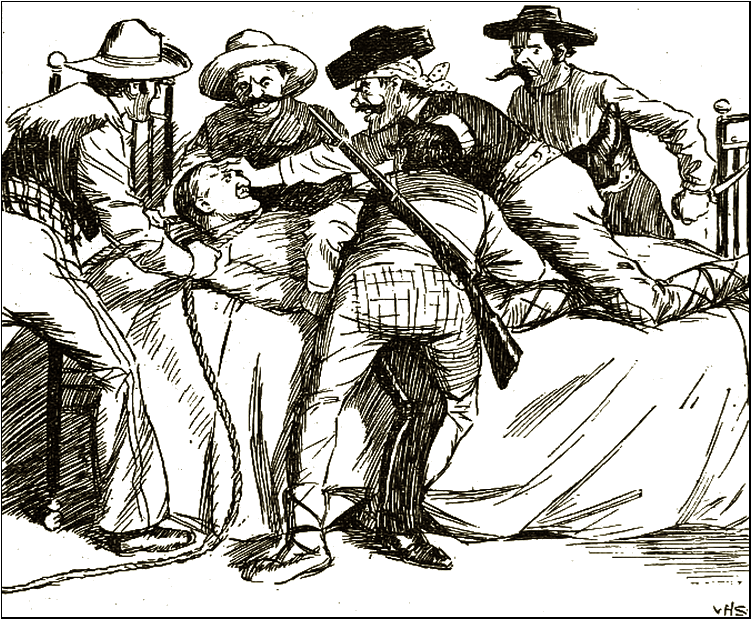
The excitement was terrific when Nobby
was caught an' bound on to the bed...
Spud:
Under this bed there is a bomb
This hut shall be your livin' tomb.
Nobby:
I do not care: my bosom stirs,
I'm dyin' for the Anchesters!
(Loud on' prolonged applause.)
"After this the villains left Nobby alone, an' he delivered a long speech about how glad he was, considerin' all things, to die for his country, an' how it was all for the best, an' with that he started strugglin' to get free.
"We all held our breath when Nobby, strugglin' like anythin', cried :
Must I die like a rat in a trap?
"But there was no explosion, an' I could see from where I stood at the wings, that Nobby was agitated. He raised his voice a bit an' shouted:
Must I die like a rat in a trap?
"Then he whispered very fierce. 'Creepy! you silly ass, light that bomb!'
"But nothin' happened.
"Nobby struggled again, an' yelled:
Must I die like a rat in a trap?
"There was a horrid silence, an' then Creepy's head came out from underneath the bed.
"'Beg pardon, Nobby,' he sez, 'but could you oblige me with a match?'"
"IN me time," said Smithy gravely, "I've seen some marvellous changes in the Army. I've seen Glengarries go out, an' forage caps come in; I've seen Brodricks, that look like sailor hats, in fashion; I remember the time when all line regiments that wasn't 'royal' wore white facin's; I remember the 'long shoulder,' when a man who presented arms from the 'slope' would have got a regimental court martial; an' I remember when majors had brass swords an' brass spurs."
After this recital of the faded glories of the Army, Smith paused, and filled his pipe slowly, shaking his head the while.
"But in all me days," he continued, "an' in all me service in India, Africa, the West Indies, Aldershot, an' other outlandish places, I don't remember the time when the regiment hadn't a 'sooner' in it, who caused grief an' woe to everybody, includin' hisself.
"A 'sooner' is a chap who'd sooner sleep than work, an' sooner die than wash his neck more than twice a week, an' the reason you meet 'em in the Army is because there's more than a few in civil life, an' naturally quite a number of 'em enlist under the impression that soldierin' is a job where the worst that can happen to you is that you'll be killed whilst chargin' the savage foe.
"Lots of chaps enlist with the idea of dyin' a hero's death, but they usually choose a time when there's no war on.
"'Good-bye, all,' sez the chap to his mournin' friends an' relations, 'I'm goin' for a soldier!'
"'You'll be killed!' sez his mother, cryin' bitter.
"'I don't care—I can only die once,' sez the chap.
"'You won't have much money to spend,' sez his father, more practical.
"'What's money?' sez the hero.
"'You'll disgrace the family,' sez his sister who married the master butcher.
"'They've disgraced me enough," sez the chap, an' off he goes an' swears hisself in. He soon finds that although he can only die once, he's supposed to scrub out his bed-cot every week, an' although he doesn't get much money, he has to earn what he gets, an' whilst the Army don't take much notice of how a chap disgraces his family by enlistin', it is most anxious that he shouldn't disgrace his regiment.
"Teachin' a young soldier proper pride is tho hardest bit of teachin' the Army takes on.
"Mornin', noon an' night, the bugles are playin' one tune, an' that tune is, 'Pull up your socks.'
"Some fellers survive it, an' when the first shock is over an' they realise that the Army didn't want 'em, an' only took 'em in out of charity, they turn out smart soldiers, but it takes other chaps years to make this alarmin' discovery.
"All this is calc'lated to put 'paid' to the account of the 'sooner,' unless he's a natural born 'sooner,' in which case he wants somethin' drasticer.
"The laziest feller I ever knew in the Anchesters was a chap called Jacko. His real name was Jacks, but we called him Jacko for short, owin' to his weary habits. It wasn't only that he was lazy, but he was lucky with it.
"Once when we was on manoeuvres we got so fed up with the rapid way he went to sleep when there was any work to do that we chucked him in the river. He was too lazy to swim, but he was a fine floater, an' when he floated to shore with a fair wind behind him, we found that when he sunk to the bottom he'd sort of grasped a handful of mud in desperation, an' in that handful he'd found half-a-sovereign what somebody had dropped overboard from a boat!
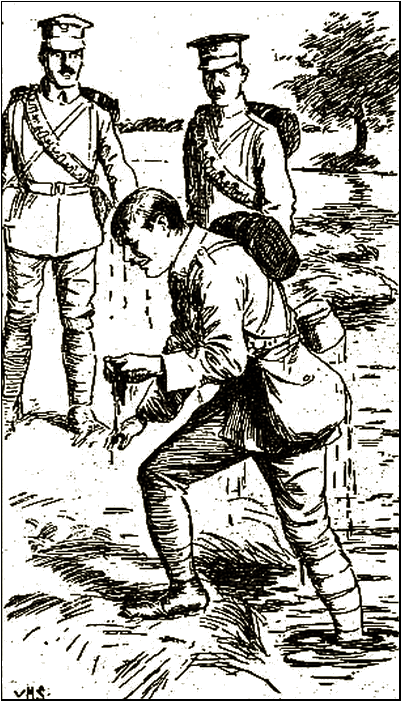
In that handful he'd found half-a-sovereign what
somebody had dropped overboard from a boat!
"He was so lazy that he didn't talk much. He used to point to things, an' nod his head at things. If he worked up enough energy to borrer a bob till pay day, he was always too exhausted to pay it back by the time pay day came round.
"We tried all sorts of ways to show Jacko the errow of his ways. We tried gentle ways, such as chuckin' him in the river, like I told you about, an' harsh ways like takin' him down to the back field on pay day an' emptyin' his pockets, but nothin' affected him, an' he might never have been cured of his born idleness, only somethin' turned up unexpected.
"Jacko's great gag was to go to sleep at all odd hours of the day.
"'I'm like Napoleon Bonaparte,' he sez proudly. 'He could go to sleep anywhere, an' anyhow. I'm rather like Lord Wellin'ton, too, an' General Blucher.'
"'When you're finished runnin' through the list of low public-houses you're acquainted with,' sez Nobby, 'I might add that even if you were like the Lord Nelson, the King's Health, an' the Dun Cow there wouldn't be any excuse for you.'
"'Them famous men,' sez Jacko dreamily, 'had what I might call an habit of fallin' off to sleep at a minute's notice.'
"'They had a habit of washin' theirselves once a day regular, too,' said Nobby unpleasantly. This didn't apply to Jacko, because he was, in his wakin' moments, a fairly clean soldier, but Nobby was a bit annoyed.
"Whether Jacko was trying to be a general or not, I don't know, but he was qualified for a 'sleep-at-a-minute's-notice' certificate. He'd sleep on fatigue, an' sleep on guard; he'd fall asleep in the canteen—after he'd drunk his pint—an' he'd fall asleep on parade an' go through his drill in a sort of dream.
"What would have happened to him if the war hadn't broke out I don't know. We was in India at the time, an' when the news came that the regiment was ordered to the front, the chaps went frantic with joy.
"Everybody was shakin' hands with everybody else, an' chaps who hadn't spoken to one another for years was havin' high words as to who should pay for the beer.
"'Where's Jacko?' sez Nobby—we were in the recreation room at the time—' somebody ought to tell Jacko.
"'Last time I saw him,' sez Spud Murphy, he was asleep in his bungalow.'
"'I've seen him since then,' sez another chap; 'he was asleep in the library.'
"So a deputation went an' found Jacko. He was havin' about eighty-five winks in the shadow of the cold-store.
"'Wake up. Jacko,' sez Nobby; 'war's declared, an' we're for it.'
"'Oh,' sez Jacko, openin' one eye. 'Oh,' he sez, settlin' hisself more comfortable; 'well, you can call me when it's all over.'
"An' with that he fell asleep again.
"Nobby looks down at him.
"'He's got,' sez Nobby, thoughtful, 'what I'd call a boisterous an' enthusiastic nature, ain't he?
"So we left ole Jacko to finish his sleep.
"Jacko was the only chap in the regiment who didn't get excited at the prospect of war. He sort of dozed through all the bustle of preparation, an' the first thing he did when he got on board the transport was to find a nice quiet corner an' go to sleep.
"'I'm surprised at you,' sez Spud—who was a pal of his—very reproachful; 'I'm really surprised at you, Jacko; here's all this honour an' glory ahead an' you go sleepin' your brains away—it ain't decent.*
"'But it's very comfortable, sez Jacko. 'Besides,' he sez, 'in a few weeks' time we shall be on the gory field,' he sez, 'facin' them terrible bores, an' a chap won't be able to get any sleep for guns goin' off—I'm takin' a year's supply in.'
"'You'll be found sleepin' on your post, an' be shot,' sez Spud warnin'ly.
"'It'll be a pleasant death,' sez Jacko, 'so long as they don't wake me up to do it.'
"Nobody ever saw Jacko awake after that—except when he was havin' his meals or attendin' mornin' parade on the upper deck, he was dead to the world.
"We got into a typhoon off Madagascar. The ship spent two days tryin' its best to go down with all hands, an' things got so serious that Nobby Clark went as far as makin' friends with Spud.
"'I'd like to part good friends,' he sez; 'it'd be extremely awkward if me an' you met in what I might term "another place" an' we wasn't on speakin' terms.'
"'Make your mind easy,' sez Spud; 'we ain't likely to meet.'
"Nobby has often said that he was never quite sure whether Spud was payin' him a compliment, or whether he was only tryin' to be rude.
"But the main point is this: whilst all the chaps was writin' farewell messages, an' sealin' 'em up in beer bottles, Jacko was sleepin' as peaceful as a child. It was the only time I ever envied him his gift. He slept through it all, an' seemed to wake up more refreshed than ever I've known him to be.
"When we got to South Africa we was sent straight to the front. It was a long journey under a blazin' sky, an' the carriages was as close as they could be, an' the only feller who didn't seem to feel the heat was Jacko, who was still sleepin' when the train drew up at Wopfontein.
"For the next month or so we was hard it, marchin' an' fightin'.
"We tramped across the Orange Free State on half rations, we fought De Wet, Delarey, an' Prinsloo, we dashed up kopjes an' hid in dongas, an' did most of the things that soldiers do in war time.
"We suffered hunger an' thirst, an' sore feet an' other honors of war until the fat chaps got lean, an' the lean chaps got hard, an' our khaki was almost waterproof.
"Then we did our great stunt against a commandant named Vogel. He had 3,000 men, an' six columns was against him.
"By good luck, he was surrounded on three sides. The fourth side was a long range of hills, an' the only way he could come through that was through a narrow nek. an' the Anchesters was sent to hold the nek.
"Now that sounds easy enough, but, as a matter of fact, it was a pretty hard job, because there was a screen of low bills in front of the pass on the Boers' side. If you had the regiment on the hills if might easily be flanked, an' if you had the regiment on the nek itself, there wasn't enough cover to hold it properly, an' just then old Vogel was very savage, an' there was a chance that he'd rush the nek.
"So what our colonel did was to post flyin' sentries on the hills—two men to each post.
"Twenty men was chosen, an' as luck would have it, me an' Jacko were put together on the outlyin' hill.
"'You men must remember,' sez the adjutant, 'that the success of the movement depends entirely on you. You'll be absolutely on your own an' you'll have to use your judgment. Whatever you do, keep a bright look-out, an' at the first sign of a Boer, fire.
"The idea was that one sentry should keep watch whilst another slept.
"'Pretty fine job for me.' I sez as we marched off: 'you'll do the sleepin' an' I shall do the watchin'.'
"I was dog tired, for we d marched twenty miles that day, an' when we were posted I could hardly keep my eyes open. I took the first turn of duty.
"The son was just goin' down, an' all the veldt that stretched away for miles an' miles from the foot of the hill on which we stood was the colour of port wine. I looked down at Jacko. He was as peaceful as a child smilin' in his sleep, an' I could have kicked him.
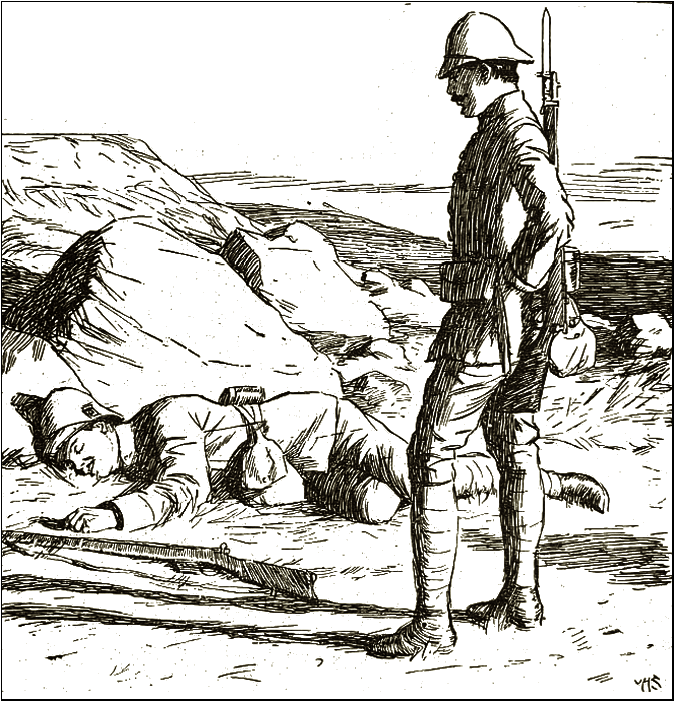
I looked down at Jacko. He was as peaceful as a child
smilin' in his sleep, an' I could have kicked him.
"We weren't allowed to walk about, for fear of a Boer scout spottin' us, an' standin' still, first on one leg then on another, I counted the slow minutes passin'.
"Every now an' again my head would drop forward on my chest, an' I'd have to pull myself together an' pinch my arm to keep myself awake.
"It grew darker an' darker, an' I kept my eyes fixed on the plain ahead till they ached an' smarted.
"But it wasn't only the tiredness that worried me: it was the thought that as soon as Jacko relieved me, an' I was asleep, he'd go fast asleep too. an' the whole bloomin' camp would be at the mercy of the Boers.
"By-an'-bye I looked at the watch I borrered from a feller in 'G' Company, an' saw it was time to kick Jacko, so I did, an' he woke up an' rubbed his eyes.
"'I was havin' a very pleasant dream,' he sez, 'about—'
"'Never mind about your dream,' I sez; 'you keep awake, now: I shall only be dozin', an' I shall wake up every few minutes. If I find you with your eyes shut I'll beat your head off.'
"'I often shut me eyes,' sez Jacko, 'when I ain't really asleep—it's a habit.'
"'It'll be a bad habit for you if I catch you,' I sez, an' lay down.
"I must have dozed straight away, for the next thing I remember hearin' was a sound like a bit of galvanized iron bein' hit with a stick.
"I sat up quick, for I knew that sound, even in my dreams; it was the sound of firin'.
"It was pitch dark, I could see nothin', but the air was full of wailin' noises, an' over by the nek where our fellows were I could see a rugged little fringe of red fire, an' I knew that the regiment was under arms.
"I called for Jacko, but Jacko was gone, an I knew that the only thing for me to do was to make my way back to the lines.
"It was a hard job, stumblin' an' fallin' in the darkness over boulders, an' tumblin' into dry river beds, an' it took me nearly an hour to pet back to our advanced post, an' I'd have been shot for certain only, fortunately, some of our chaps beard me swearin', an' recognised that I was one of the regiment.
"'Hullo, Smith,' sez the officer in charge of the post; 'got back all right—where's Jackson?'
"That was Jacko's official name.
"'I don't know, sir,' I sez—I couldn't very well say that he wasn't at his post when I woke up.
"'It was your post that gave the alarm,' sez the officer, an' I was more surprised than ever.
"The columns closed in the next mornin', an' after a little fight Vogel surrendered. .
"We had a lot of Boer prisoners come into our camp, an' one feller was explainin' to an officer how Vogel nearly got through the nek.
"'We kept clear of the hills,' he sez, 'because we knew you had sentries there, an' we was a bit surprised, considerin' we was miles away, from the nearest post, when a soldier suddenly walked slap-bang into the middle of us.'
"It puzzled me, it puzzled the adjutant, an' I was sent for to the colonel's tent to explain.
"I told 'em how I'd gone to sleep an' left Jacko on duty, an' the colonel nodded.
""The brave feller most have seen somethin' on the plains that looked suspicious, an' gone down to investigate,' sez the colonel. 'Anyhow, it was a courageous thing to do, an' if he isn't killed I shall recommend him for the Distinguished Conduct Medal.'
"Old Jacko wasn't killed. We found him under a wacht-ein-bitje bush about a mile from the hill slumberin' calm, an' woke him up.
"He was quite the hero of the regiment was Jacko, for his noble conduct, an' when the war was over he got his D.C. medal, an' wears it proudly to this day.
"He'll tell you how he saved the regiment from destruction; of how he boldly walked single-handed into the enemy's lines, an' of how they fired at him an' alarmed the camp; but what the beggar won't tell you was that he was walkin' in his sleep an' knew nothin' about it."
"COLLECTIN' stamps is a disease, accordin' to Nobby Clark," said Smithy. Nobby used to collect stamps himself—unused British pennies—until fellers got a bit tired of providin' stamps for him to write with. Nobby used to use lots of stamps, mainly to write to advertisin' people for free samples,
"All sorts of things are diseases accordin' to Nobby, but the worst kind of disease is writin' poetry, because that's a thing you bring on yourself, an' haven't got anybody to thank for it but Mr. Me.
"'You can get the art of thievin' handed down from generation to generation,' sez Nobby; 'you can have a sort of measles that runs through the family, but you have to go out an' look for poetry.'
"What made Nobby so bitter about poetry was the money be lost over a feller named Inkey White, a red-haired feller who was known throughout the Army as the 'Soldier Kiplin'' until Kiplin' got to hear about it an' wrote to the papers. Regular celebrated was Inkey. far an' near, an' chaps used to write for the bits he did, an' other fellers spent hours learnin' to recite 'em.
"He even got a bit put in the Anchester Guardian entitled 'Thoughts on a summer's day in barracks'—an', what's more, he got paid for it, or said he did, though Nobby said he was only boastin', because nobody ever paid for poetry except mournin' relatives who wanted a verse or two for a card. But other chaps say that they saw the very 6s. postal order that Inkey got. Nobby said that Inkey bought it hisself.
"'People talk about Inkey as though he could poetise,' sez Nobby. 'Why, I could write the sort of stuff he writes blindfolded with me left band.'
"'Why don't you do it, then?' sez Spud Murphy with a sneer.
"'Because I promised me father I wouldn't,' sez Nobby, 'not whilst he was alive.'
"I don't mind admittin' that I had a sneakin' likin' for some of Inkey s stuff.
"There was one bit that began:
'Me gallant friends come list to me
An' I will tell you more
About the famous A.S.C, or "Army Service Corps.'
"which was very popular—especially with the A.S.C, an' Inkey was very frequently invited over to their canteen to recite it.
"Fellers who wouldn't as much as ask Nobby if he had a mouth used to push over a pot to Inkey as soon as he got in the canteen, an I've known him to go a whole week drinkin' as much as he liked without it costin' him a penny.
"That there Army Service Corps poem was such a success—we was layin' at Aldershot at the time—that Inkey got more ambitious, an' began to write poetry about other regiments. He did one on the Argyll an' Sutherland Highlanders in their own language, which I'm willin' to admit was a masterpiece of writin'.
"It went somehow like this:
'Do ye ken the bonny Heelanders
On who gude fortune smiles.
The braw bricht moonlicht kilties,
The Ninety-fost A-r-r-gylls?'
It was one of the most successful things he ever wrote. Nobby did a parody;
'Do ye ken the bare-kneed savages,
The 91st Argylls—
A half come out of Birmingham,
A half from Seven Dials?'
"Nobby went down to the Argylls' canteen for a bet an recited it. He got away alive owin' to his bein' a good runner.
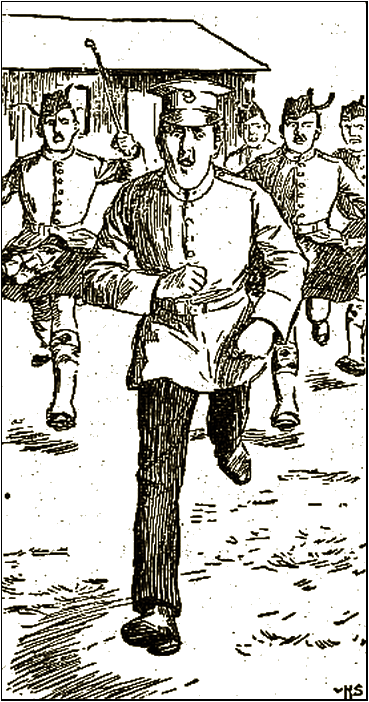
He got away alive owin' to his bein' a good runner.
"But Inkey flourished exceedin'. He was the welcomest feller in the canteens at Aldershot. A little chap he was, with red hair an' freckles on his nose, an' a very quiet way of speakin'.
"Nobby was a bit offensive to him, but Inkey only used to smile superiorly.
"'We ain't all gifted, Nobby,' he sez.
"'We ain't,' sez Nobby emphatic, 'an' you ain't for one.'
"'Poetry comes natural to me,' sez Inkey.
"'It ain't its comin' to you that I object to,' sez Nobby, 'it's the leavin' of you that I don't like. You're gettin' the regiment a bad name.'
"'I can't help it,' sez Inkey; 'it's a habit you might have got yourself, you bein' such a clever chap, only you're so busy with all them schemes of yourn for makin' money, that I don't suppose you've had the time.'
"Nobby was a bit mollified by this, for Inkey had a way of usin' soft soap that'd calm a mhust elephant.
"Me an' Nobby was on guard one night, an' between duties we was talkin' things over.
"'Perhaps there's somethin' in what old Inkey says,' he sez. 'Come to think of it, poetry ain't so hard as it looks. All you've got to do is to find two words that rhyme an' then write in the other words. Take Cat and Rat.
"There was a little cat
Went searchin' for a rat."
"'How's that?'
"'Rotten,' I sez.
"'Its poetry,' sez Nobby very huffy.
"If you know anythin' about a regiment, you know how quick a new game catches on. Sometimes it's shove ha'penny, sometimes it's ping-pong. A feller's only got to start it, for the game to be all over the regiment in two twinks. I've known a chap taken to hospital with diphtheria, an' the next day seein' half the regiment goin' sick with the new disease, not because they had it, but because they tumbled to the idea an' wanted to be fashionable.
"Anyway, it seems that Inkey started givin' Nobby private lessons in poetry, an' before a week was out there was not a chap barracks who wasn't goin' in for the same thing.
"In a fortnight some fellers was so expert in reelin' off verses on the spur of the moment. so's to speak, that life got a bit wearin', an' there was no joy in drinkin'.
"I'd go into the canteen, an' see Nobby. Sez he:—
"'Ah, Smithy, I'm glad to see you've come to have a drink with me.'
"'That's right,'I sez brightenin' up, but he would shake his head.
"'Alas, dear friend, I greatly fear, I have no cash to buy the beer,' he sez.
"'Then what did you ask me for?' I sez.
"'I only asked you, just to see, if I could test a rhyme on thee,' he sez.
"It was perfectly sickenin' because it wasn't only in the canteen you had to put up with it.
"Spud Murphy came in one day, just before kit inspection. 'I do not want your feelin's hurt,' he sez, 'but I'd be greatly obliged if you'd lend me a shirt.'
"As it happened I had a spare shirt, so' I lent it to him, but what he really wanted to borrow was a pair of blackin' brushes, only he couldn't think of a rhyme for 'em.
"The way the disease spread was alarmin'. It wasn't only the private that was affected, but young lance-corporals an' corporals, an' sergeants caught it. On parade it was:—
"'Dress up Private Smith, turn your eyes to the right or into the guard-room you'll go for the night,' an' things like that.
"'There'll be trouble over this,' I sez to Nobby, who was one of the worst rhymers of the lot. 'It ain't natural to talk poetry. Why even the beasts in the field don't do it.'
"'Don't fret your fat, I'll see to that,' sez Nobby.
"'It's got into your bead,' I sez disgusted.
"''Tis better—' sez Nobby, but I didn't wait to hear the poem.
"Sure enough, trouble started to come along. We had a sergeant named Griller, a most fierce old feller without any fancy ideas. He was orderly sergeant, an' it was part of his dutied to tell off fellers for various duties.
"Just before 'Last post' he came into us barrack-room with his note-book.
"'Smith,' he sez.
"'Here, sergeant,' I sez.
"'You'll be for back-field sentry, an' see if you can keep them little boys from climbin' over the fence into the colonel's orchard. Johnson.'
"'Here, sergeant,' sez Happy Johnson, who was one of the fellers that hadn't been tainted.
"'You'll be on duty at the orderly-room, an' try to make yourself a little smarter than usual.'
"'Yes, sergeant,' sez Happy.
"'Murphy,' calls the sergeant.
"Here I am, ready to die," says Spud.
"I hope you'll be as ready to do a bit of whitewashing to-morrow,' sez Griller.
"'The whitewash brush within my 'and I place myself at your command,' sez Spud.
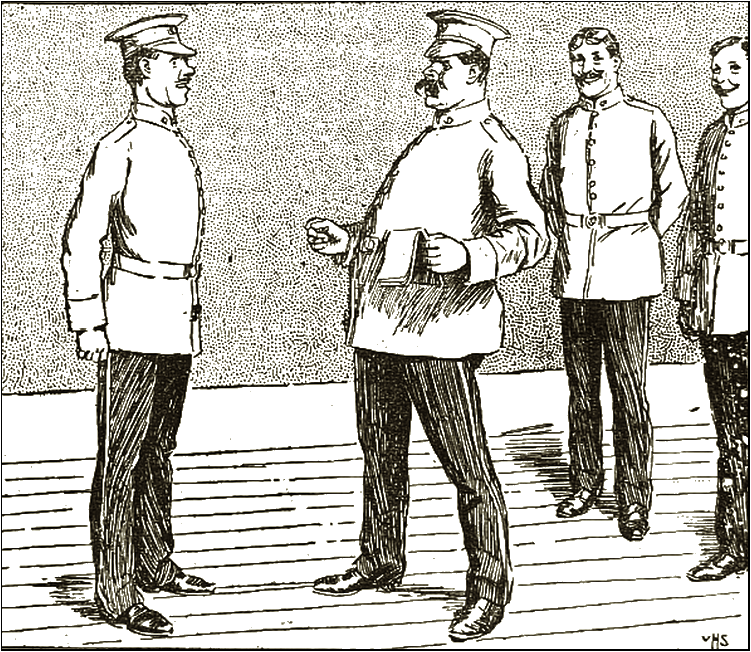
'The whitewash brush within my 'and I place myself at your command,' sez Spud.
"'Don't have so much lip,' sez the sergeant.
"'Clark.'
"It was Nobby's turn, an' me heart was in me boots, for I know what a chap Nobby is for over-doin' things.
"'Here am I, me sergeant dear, your orders I will gladly hear,' sez Nobby.
"'Eh?' sez Griller glarin' at Nobby.
"'Whatever orders you impart, I'll gladly do with all me heart,' sez Nobby.
"'You attend company office to-morrow,' sez the sergeant, 'for makin' an' improper reply to a non-commissioned officer.'
"'I—' sez Nobby.
"'Callin' me a sergeant dear,' sez Griller very wild. 'I never heard such a thing in me life—for two pins I'd jug you.'
"Nobby said nothin', he didn't even say any prose for fear of bein' misunderstood.
"'White,' sez the sergeant, an' Inkey smiled to himself, because he thought that bein' a better poet than the other chaps, the sergeant wouldn't see anythin' wrong in his remarks.
"'Here, sergeant, ready to obey, whatever orders you may say,' he sez
"Old Griller stares at him.
"'You fellers seem to have the gift of the gab tonight,' he sez. 'but don't you come any of your games with me because I won't stand it—you'll be for guard to-morrow at ten o'clock—understand?'
"'At ten o'clock upon parade, a smart appearance vill he made,' sez Inkey proudly.
"'Put that man in the guard-room,' sez the sergeant fiercely, 'he's tryin' to take a rise out o' me.'
"So we marched poor old Inkey off to the clink, me an' Nobby an' Corporal Thomas.
"'I'll get ten days for this,' sez Inkey, very gloomy.
"''Twill cause you mighty bliss,' sez Nobby helpin' him,
"'No, it won't,' snaps Inker. 'I was a fool to try me powers of poetry on old Griller—he ain't got the soul of a pig.'
"Nobby tried to cheer him up by sayin' that bein' in the clink would give him time to think, an' that though the night is full of sorrer, the sun would shine upon the morrer, but Inkey wouldn't be cheered nohow, an' we left him very upset in his mind.
"I think meself that if Inkey had only took the trouble to explain to his company officer that he'd been makin' poetry, he'd have been let off, instead of which be got seven days' C.B. for cheek.
But even that didn't stop the flow of poetry, an' Inkey had hardly got back into the barrack room, when he shook off his depression, an' burst, so to speak, into song.
"'I do not mind the seven days,' he sez, 'it makes me worthy o' me bays.'
"I don't think that bit was sense, because there's only two kinds of bays, one is horses, an' the other is winders. But anyway, Inkey's noble spirit bucked up the other poets, an' in a few hours it was worse than ever.
"If Shakespeare or Tennyson or the chap that wrote the 'Fireman's Weddin'' could only have walked into the Anchester Barracks, they d have felt quite home-sick. I used to feel a bit sick meself.
"'Why don't you take it up, dear friend, this poetry is simply splend,' sez Nobby, who wasn't above makin' words fit.
"'I don't think,' I sez. 'I'd sooner take to drink.'
"'Fine,' sez Nobby. 'You've got it wonderful—you're s poet, an' you don't know it.'
"I never felt so near landin' him a gentle thruster, as I did at that moment.
"But if I'd only known it, young Nemmy's sister was on his track. I don't know Nemmy an' I don't know his sister, but it was a poetical term very much used by Inkey.
"It was the openin' of the cricket season. Everybody who knows our regiment knows that 'B' and 'H' company are the two rivalest companies in the world. The championship matches between company an' company are always the first of the year, an' it is always 'B' or 'H' that wins it.
"So what with poetin' an' preparin' for the great matches, we was pretty well occupied.
"The prelim'nary matches was pretty tame. 'B' beat 'A' by an inning, and 'D' beat 'G, then 'H' beat 'C' and 'F' beat 'E' In the semi-finals 'B' beat 'D' and 'H' beat 'F,' an' there was 'H' and 'B' left in the final as is always the case. The bettin' was 0-4 on 'B' Company, or 0-4 on 'H,' accordin' to the one you wanted to back—Nobby bein' a bookmaker.
It was an unfortunate thing that Inkey knows a lot about cricket. He knows so much that he don't play the game. He's a true umpire, an' bein' chosen by both sides to umpire our match, an' him bein' a 'B' Company man, we naturally supposed that it was a good thing for our side, an Nobby betted most recklessly against 'H.' Our side went in first an' play commenced, Billy Mason an' Tug Wilson battin'.
"After a few minutes:
"'How's that?' sez Coley of 'H,' who was bowlin'.
"'Without a doubt, Tug Wilson's out,' sez Inkey, an' very much astonished poor old Tug left the field.
"'I can't understand it.' he sez, as he was takin' his pads off. 'All that I did was to stop the ball with me leg.'
"A few minutes later, play bein' resumed with thr score at 1—0, Coley sent a fast one down the pitch, an' the ball snicked off Billy Mason's bat into the hands of an 'H' Company fielder.
"'How's that?' yells 'H.'
"'There is no doubt, Bill Mason's out,' sez Inkey, an' the score was 2-0.
"Encouraged by what I might term the success of their enquiries, every time anythin' happened that there might be any question about the 'H' team shouted 'How's that?' and Inkey either said, 'You needn't shout, the feller's out,' or 'Don't sneer or pout, I'll give him out'; an' the end of the first innin's was:—
'B' Company (all out).......... 7
"It was the sensation of the moment; Nobby Clark spent the interval runnin' round the field tryin' to find the fellers he'd bet with, to get 'em to take 2d in the £.
"The officers watchin' the game was as astonished at 'B' Company's downfall as we was, but more astonished at some of Inkey's decisions.
"'Are you sure I was out, Inkey?' sez Nobby, miserably.
"'I'm certain sure, I can't say more,' sez Inkey, lookin' very uneasy.
"It was the most depressin' match I've ever seen. 'H' Company won by an innin's. None of our chaps said 'How's that?' an' consequently, the only time a 'H' Company feller was outed was when he was clean bowled or clean caught.
"Very sad, we walked back to our rooms that evenin', too sad to be poetical, but the worriedest man in 'B' was Inkey.
"He went to the canteen an' drank solitary, takin' no part in the discussion that was, to use a foreign expression, ragin' round Nobby an' his bets.
"'I ain't goin' to pay,' sez Nobby, very firm. 'There was somethin' wrong about that match.'
"He walks over to Inkey.
"'Inkey, you poetical perisher,' he sez, 'own up—why did you give all our chaps out when they wasn't out?'
"Inkey shook his head.
"'Own up,' sez Nobby, an' Inkey hesitated.
"'I might as well tell you first at last,' he sez. 'A lot o' chaps I gave out wasn't out.'
"'What!' sez all the 'B' men, indignant.
"'They was in,' sez Inkey, agitated; 'only—only I couldn't think of a rhyme for Not Out!'"
"TO get on in the Army," said Smithy, "you've got to know how to keep your mouth shut. There's many a feller that's got a reputation for bein' wide an' clever, who's never done anythin' except nothin', an' many a chap who's got promotion by sayin' nothin' more interestin' than 'Yes, sergeant,' or 'No, sergeant,' in the proper tone of voice.
"We had a chap in ours called Higgsey, who never got on because he was too frank.
"'It's me nature,' he used to say, mournful; 'I can't help it. I'm honest—it's me one fault.'
"'Its one of 'em,' sez Nobby; 'I've noticed others.'
"'I can't be two-faced,' sez Higgsey; 'I can't be a white sepulchre, fair to your face an' foul behind your back—it's against me better feelin's. If I don't like you I've got to say so, plump an' plain.'
"About a week after this, when Higgsey was walkin' out in the town, he met Dill Mason an' his girl, an' Bill, bein' very proud of his young lady, introduced Higgsey to her.
-The next day, when Bill met him in barracks. Bill sez, careless:
"'Well, Higgsey, what do you think of my young lady?'
"Higgsey hesitated a minute.
"'Do you want me to be frank?' he sez.
"'Certainly,' sez Bill, kindly; 'I'm not one of them jealous fellers that can't bear hearin' other chaps praisin' their girls.'
"'Well,' sez Higgsey, thoughtful, 'it struck me she was a bit tall, an' I don't like her nose, an' her mouth—'
"'Hold hard,' sez Bill, breathin' heavy; 'hold hard, Higgsey,' he sez, 'or you won't like your own nose. What d'ye mean,' he sez, fierce, 'by insultin' my young lady?'
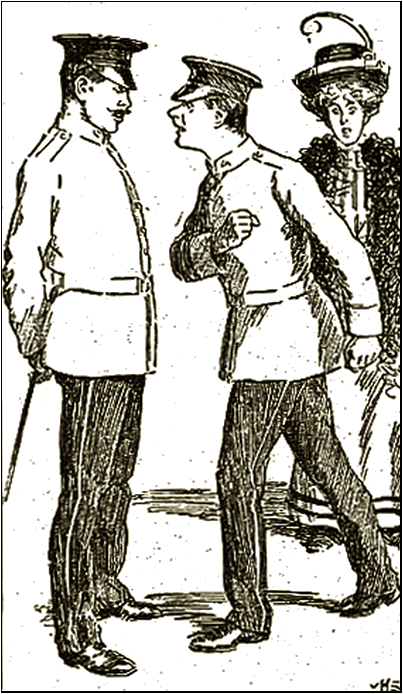
'What d'ye mean,' he sez, fierce, 'by insultin' my young lady?'
"'You asked me frankly,' sez Higgsey, 'an' I told you frankly.'
"Him an' Bill Mason wasn't on speakin' terms for a week.
"Higgsey was cured of his habit after a few years, because when he got older he discovered that if a feller asks for a frank opinion he really wants frank praise; he wants to be frankly told that he's the best chap or the cleverest chap in the world; he wants you to own up frankly that what he's done is right, an' if you happen to tell him frankly that he's a mug you're askin' for an ear-bender.
"In course of time, the most talkative feller can learn to shut up, although it's very hard on some who like to hear theirselves talk; but the most unfortunate chap is the one who, owin' to certain gifts, isn't able to what I might term control his emotions.
"The most wonderful feller I know in that line was Moggy Wilks. Gifted! I don't suppose there are three other people in the world who was gifted like him. I've seen four doctors examinin' him owin' to his remarkable ability.
"I've known fellers come from other regiments to see him—he was one of the best known men in the Army.
"Moggy's gift was this: he could waggle his ears!
"When I say gift, I might go further an' say that it was a curse in some respects to Moggy, because although he could waggle 'em of his own free will, they used to waggle theirselves whenever he was annoyed, or what I might call sneerful.*
* I have every reason for believing this story to be a lie—E.W.
"I've known chaps to get ravin' wild with Moggy for this.
"One day when we was stationed at Wynberg, in South Africa, him an' Spud Murphy had a bit of a row about bein' orderly man. Moggy was orderly man by rights, but he applied for a pass to Capetown, an' Spud was took for the duty.
"Spud was a bit wild, because he'd made arrangements to go out that night.
"'What do you mean by sneakin' out of your duty, Moggy?' sez Spud.
"Moggy said nothin', not likin' Spud, but only looked at him contemptfully an' waggled his ears.
"'Don't do that,' sez Spud.
"'Do what?' sez Moggy, innocent.
"'Don't waggle your ears at me,' sez Spud. 'There you are! You're doin' it again!.'
"'If I am,' sez Moggy, 'I'm doin' it because I'm surprised at your selfishness,' an' his ears went waggle, waggle, waggle, most indignant.
"It was Spud who discovered that Moggy only did his wagglin' out of cheek, an' the news spread through barracks till it came to the sergeants' mess.
"One day on parade Sergeant Griller was puttin' us through the bay'net exercise, an' was explainin' what his candid opinion was.
"It was the mornin' after pay day, an' naturally there was a great feelin' of weariness in military circles.
"'I've seen some soldiers in me time,' sez the sergeant, very despairin'ly. 'I've seen yeller soldiers, an' black soldiers, an' soldiers who weren't one thing or the other; but of all the ten-eyed sons of rest I've ever struck, you're the limit. Wake up, you born-tired perishers—look to your front, Wilkes!'
"'I am lookin' to me front,' sez Moggy.
"'Don't answer me,' sez the sergeant, an' was resumin' his instructions, when—waggle went Moggy's ears.
"'Don't do that,' sez the sergeant, very sharp, an' Moggy's ears sort o' fluttered faintly.
"'Private Wilks,' sez the sergeant, solemn, 'I've warned you once, an' if you do that to me, into the clink you go. We will now go on from the place where we left off. On the command, One! carry the left foot ten inches to the left front, at the same time bring the rifle to a horizontal position....'
"Waggle went Moggy's ears.
"'Into the guard-room you go!' sez Griller, wrathful, an' we fell in round Moggy an' put him into the clink.
"The next mornin' he was brought up before the C.O., charged with 'behavin' in an insubordinate manner, to wit, wagglin' his ears direspectful to his superior officer.'
"The colonel was a bit puzzled.
"'This is a very curious charge,' he sez.
"'Yes, sir,' sez the sergeant, an' explained to the C.O. how Moggy always waggled his ears when he felt disrespectful to people.
"'Just the same, sir,' sez the sergeant, 'as a dog wags his tail, Private Wilkes waggles his ears—it causes a lot of bad feelin'.
"'Beg pardon, sir,' sez Moggy, humble, 'but I can't help it; I own up, sir, that if I'm talkin' to a chap who I think is a mug, me ears always go flip-flap without me bein' responsible.'
"'You must try to cure yourself,' sez the colonel, kindly; 'it's very unfortunate that your feelin's get the better of you—I know how difficult it is to disguise one's feelin's of contempt.... Now, I will take a lenient view of your crime, although I think Sergeant GriLler was quite right to bring you before me——'
"He stopped dead, because. at that very moment Moggy's ears waggled faintly.
"'I say,' sez the colonel, slowly, watchin' Moggy very close, 'the sergeant did right to bring you up. I can understand his annoyance—.'
"Waggle went Moggy's ears, an' the colonel glared at him.
"'So,' sez the colonel, slower than ever, 'in view of all the circumstances, an' knowin' that you are a promisin' young soldier—
"Moggy's ears waggled most contemptful.
"'Ten days' C.B.,' sez the colonel, furious, 'an' if you come up before me again on the same charge I'll put you back for a court-martial.'
"That was only the beginnin' of Moggy's troubles. He got seven days after that for 'wagglin' his ears when warned for duty'; he got crimed with 'improperly wagglin' his ears when on parade;' an' with 'an act contrary to good order an' military discipline,' that is to say, makin' an insubordinate gesture, to wit, with his ear or ears.
"I forget exactly the wordin' of the charge, but it went somehow like that.
"Poor Moggy tried everythin' to cure hisself. He used to go to bed with his ears strapped up, an' tried to put plaster of Paris on 'em to keep 'em quiet.
"He did it one evenin' when he had nothin' else to do, with the assistance of Gus Ward, the Royal Army Medical Corps chap, and really it looked as if it was going to work, until a corporal, who didn't like Moggy, came into the room.
"'Hullo!'he sez, 'what's that you've got on them ears of yourn?'
"'Plaster of Paris,' sez Moggy, proud, an' the corporal sneered.
"'What you want to do,' he sez, 'is to put your head in it.'
"That was enough for Moggy. In a minute the air was filled with flyin' pieces of dried plaster: Moggy's ears were wagglin'—nature was too strong.
"Poor old Moggy got seven days' cells for that, the crime bein' worded, 'assaultin' his superior officer by wagglin' plaster of Paris at him with his ears.'
"All the time this was happenin' we was on the move. From Wynberg we went to India, an' from India back to Africa again for the war, an' what would have happened to Moggy but for the war I don't know. He did everythin' he could; he even went to hospital an' asked the doctors to take one ear off to see if that would do any good, but nothin' came of that.
"'I used to be proud of my accomplishment,' he sez, sorrerful, 'but now 1 see how pride goes before a fall, an' I wish I was dead!'
"But the war changed most people's views of life; things we'd had time to notice in peace time was only small potatoes when war came along an' Moggy began to breathe free because nobody had time to worry theirselves about him. The war was his salvation in more ways than one.
"It was halfway through the war that he did his famous deed.
"We was stationed at Heilbron at the time—the place we saw the ghost—an' was mostly engaged in preventin' De Wet breakin' through the blockhouse lines. It was nervy work. We was on duty all day, an' on guard all night, an' the rest of the time we had to ourselves. Every day we used to send out a scoutin' party to pick up information, an' it was in connection with one of them expedition's that Moggy distinguished hisself.
"It wasn't De Wet that worried us so much as a chap called Field-Cornet Van Hoos, who was half a nigger an' half a Boer. He was a rebel from the Cape Colony, an' was one of the worst fellers I ever heard about durin' the war. He was so bad that half-a-dozen scallywag colonels* formed a sort of Hangin' Club, the main idea of the club bein' that if any member caught Van Hoos, he was to string him up to a tree an' take the pool; but the nigger was a bit too sharp for them.
*Colonels of Irregular Troops.
-He didn't respect anythin', didn't Van Hoos, an' he'd just us soon shoot a cripple as a general, an' the prisoner that fell into his hands had a hot time.
"So naturally all the chaps who went scoutin' in his neighbourhood kept a very bright eye for this nut, an' it was only by rank bad luck that Moggy, skirmishin' ahead of the main scoutin' party, came slap into the middle of Von Hoos's commando.
"He was goin' over a little kopje, when they nabbed him, an' before he could shoot or shout they had him down an' was sittin' on his head.
"The main party of our fellers was on the veldt below, halted, an' waitin' till the advance scouts gave the 'all right!' signal. Van Hoos knew all about this, an' had planned a little ambush.
"He was a funny little beggar, was Van Hoos, short an' broad, with a face that'd stop an express, an' he grinned when they yanked Moggy to his feet.
"'Soldier,' he sez, stickin' the muzzle of a revolver into the pit of Moggy's stummick—'soldier,' he sez, 'do you know who I am?'
"'By your dial,' sez Moggy, his ears wagglin' furious, 'I should say you was either an accident or Van Hoos.'
"'Quite right,' sez the field-cornet, 'an' now I want you to signal them chaps of yours to come ahead.'
"'I won't,' sez Moggy.
'"Oh, yes, you will,' sez Van Hoos, showin' his teeth, 'an' what's more, you'll do it quick.'
"Poor Moggy, with the end of a revolver up against his breakfast, was in a terrible state of mind.
"'Make up your mind quick,' sez Van Hoos, 'before I blow you into little bits.' So Moggy decided.
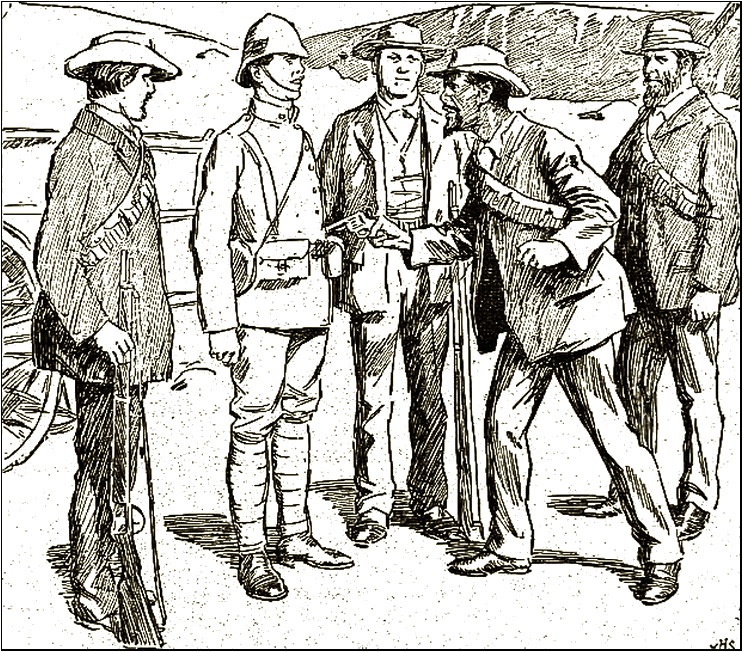
'Make up your mind quick,' sez Van Hoos, 'before I blow you into little bits.'
"'I'll do it,' he sez.
"'Mind you,' sez Van Hoos warnin'ly, 'I know all them signals of yours, an' if you give the "go back" signal, look out!'
"We was standin' on the plain below waitin' for Moggy's signal. We'd seen him go over the top of the kopje an' disappear.
"'He's a long time gone,' sez the officer. 'I hope nothin' has happened to him.'
"We waited for five minutes, an' then suddenly Moggy came into view on the top of the kopje. He was standin' quite still an' doin' nothin'.
"'What on earth is he up to?' sez the officer, an' puts his glasses on him.
"He looked very long, so long we wondered what he was seein'.
"Then he turned just as Moggy (induced by Van Hoos sayin' he'd blow the top of his head off if he didn't do somethin') gave the signal to advance.
"But we didn't advance.
"'Signaller,' the officer sings out, 'take this message down:
"'A-M-C-A-P-T-U "' an' slowly he spelt out—
"'Am captured by Van Hoos—he has fifty men here.'
"Then we all saw what was happenin'—you could see it with the naked eye. Dot-dash, dash-dash-dot—Moggy was sendin' a Morse message with his ears!"
"Everybody knows the story of how we surrounded the kopje, of how two scallywag columns was helioed for, an' how Van Hoos got so frightened that he let off Moggy in the hope of bein' let off hisself.
"He was tried by court-martial an' shot, was Van Hoos. but the most wonderful chance that came about was to Moggy. Whether it was the shock or not I can't say, but after that day Moggy's ears changed their habits: they only wagged when he was pleased.
"'When he was called before the Colonel an' was complimented on his presence of mind, they waggled so furious that the Colonel complained of the draught."
"HOBBIES, as everybody knows," said Private Smith, sententiously, "are the only thing that makes soldierin' possible. Some fellers has one hobby, some have another. One chap will collect cigarette pictures an' glue 'em on the inside of his box, an' gloat over the rare Marie Lloyds an' the first issues of Vesta Victoria he's collected. Other chaps go in for knittin' socks, an' make very fine socks, too. You can't wear 'em because they're a bit big in the foot, but they're very pretty to look at if you see 'em from a distance. Billy Mason used to collect corks, an' Happy Johnson had a fine lot of sea shells that he'd picked up at various places.
"But some chaps have got superior minds an' they go in for hobbies of a highly improvin' nature, such as collectin' butterflies. This is very pop'lar, except amongst the butterflies. Usually it's sergeants an' corporals who go in for this kind of hobby; an' fretwork's another form of lunacy that you seldom see in the barrack-room.
"Spud Murphy was a fretwork feller once upon a time; he used to spend all his spare time cuttin' pipe-racks an' brackets out of cigar lids. Sometimes when he was extraordinary reckless he cut out the Tower Bridge.
"'What's the good of it?' sez Nobby to him one day.
"'It's a hobby,' sez Spud.
"'But what's the good of spendin' your time an' a lot of money that you might be investin' in the canteen fund, in cuttin' out the Tower Bridge?'
"'It employs me mind,' sez Spud.
"'Your what?' sez Nobby.
"'Me mind—M-Y-N-D, mind,' sez Spud, very loud.
"'Oh, indeed,' sez Nobby, very polite. 'Now I come to look at it, it's the sort of thing that would employ a mind like yourn.'
"Spud gave up the fretwork owin' to a row that the room corporal made about the sawdust on the floor. He sold his saw to a sergeant in 'H' company, who wasn't quite right in his head.
"I've known chaps to take up scientific hobbies. There was a feller in 'G' who went in for electroplatin', an' used to turn sixpences into half-sovereigns as easy as I can turn half-sovereigns into sixpences. But he was found out, an' left the regiment sudden.
"But the scientist of all the hobbers was a young feller named Darkie Brown, who was an astronomer. Even Nobby had a great deal of respect for him, an' that's sayin' a lot.
"Darkie was a true science chap. He could make your flesh creep by tellin' you what would happen to the world if the moon came into collision with the solar system, an' the things he used to say about Mars was worth puttin' into a book.
"He had a lot of admirers, an' when he came into the canteen at nights all the chaps who wasn't busy drinkin' used to flock round him. They'd listen to him for hours, eggin' him on.
"'What about them canals in Mars, Darkie?' sez Spud.
"Darkie crosses his legs, puts the tips of his fingers together, an' generally looks wise.
"'Me own impression is,' he sez. 'that there ain't any canals at all; me own observations gives me the idea that them so-called canals are only railin's.'
"'Wot are railin's for?' asks a chap.
"'To keep the people from fallin' off,' sez Darkie. 'You must understand that Mars is nine million miles high, an' if a chap happened to fall off he'd be a bit bent before he hit the earth.'
"'Where would he fall, Darkie?'
"Darkie shakes his head.
"'Its a difficult problem,' he sez, 'that's worried me an' other astronomers for years an' years. Me own theory is that he'd fall into the sea an' he'd be drowned, an' the fact that nobody's ever picked up a mangled Mars feller proves I'm right.'
"There he'd sit, talkin' away, an' all the chaps listenin' an drinkin' every word he said.
"'Lots o' people have got wrong ideas about the moon,' he sez one night. 'Some say one thing, an some say another, but me own observations give me the idea that there's people in the moon. I've got that theory owin' to the moon revolvin' in its own orbit by lunar undulitions.'
"What could you say to a chap after that? You can't argue with a man who's got a brain of that description. As Inkey White, who's a bit of a poet, so prettily put it. 'Darkie defies criticism.'
"But Darkie was always at his best when he brought out his telescope. He only did it now an then, because, as he used to say, he knew so much about the stars that it wasn't worth while tryin' to learn any more; but sometimes, just to oblige the fellers, he'd dig out his telescope, an we'd all go down to the back-field.
"It was a long business, because Darkie said no real astronomiter ever did things in a hurry.
"First he'd breathe on the glasses of the telescope, an' rub 'em with a bit of old shirt; then he'd fix the telescope on its legs, an' begin wagglin' it about; then he'd remember to take the cap off the other end of the telescope, an' by that time it would have got cloudy, or started to rain, an' the experiment would be over for the evenin'.
"'Very annoyin', indeed,' sez Darkie, clickin' his lips. 'I was just goin' to show you the star, Alpha Beta., in the constirnation of O'Brien'—or words to that effect. Or else he'd have been just about to show us the transhipment of Venus across the Milkman's Way—a very pretty effect on a clear night, an' well worth seein'!
"But if he had good luck an' managed to fix his telescope before the bugles sounded 'Lights Out,' an' all the stars went in, accordin' to King's Regulations, there used to be great excitement.
"'Now I'm just goin' to have a look at Venus,' sez Darkie, puttin' his eye to the sharp end of the telescope. 'No—yes—no—yes, here she is! What a wonderful piece of work! How marvellous is Nature! Shinin' so steady—I've lost it—no, here it is—'
"'Here, let's have a dekko,' sez Nobby impatient; 'I ain't seen Venus for years.'
"'Don't touch the telescope,' sez Darkie warnin'ly; 'just look without touchin'—do you see the wonderful phenomenon? Do you see the bright crystal light shinin' so calm? Do you see—'
"'Looks to me,' sez Nobby, squintin' most earnest. 'looks to me like the lamp outside the officers' mess.'
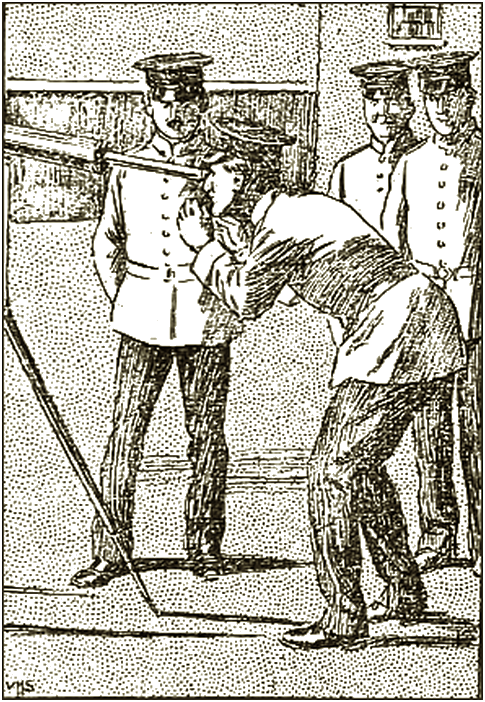
'Looks to me,' sez Nobby, squintin' most earnest.
'looks to me like the lamp outside the officers' mess.'
"Darkie takes another look.
"'So it is,' he sez, surprised. 'That only shows you how careful you've got to be in makin' exact calculations.'
"Even when Nobby found out that Venus wasn't visible except in the early hours of the mornin' it didn't shake our faith in Darkie, who only smiled when Nobby told him.
"'There's a good many things that ain't visible through an ordinary telescope,' he sez, 'that I can see through mine.'
"From what Darkie said, his telescope cost him nearly three pounds second-hand, so it must have been a good one.
"But what made Darkie, in what I might call the scientific world, was his comet.
"The curious thing is that we was talkin' about comets the very night before Darkie made his discovery.
"'Comets,' sez Darkie, 'are chiefly remarkable owin' to their havin' tails; me own theory is that they ain't tails at all—'
"'Whiskers?' suggests Nobby.
"'Don't joke, about celestrial astralations, Nobby,' sez Darkie, reproachful, an' that shut Nobby up quick. 'No,' continues Darkie, 'Professor What's-his-Name, who saw the last comet through his famous Lick telescope, so called because it licks any other telescope except mine, sez that the tail is full of gas; now, me own idea is that the tail is a sort of a radium arrangement, that whizzes round an' round like a propeller, compressin' or deodorizin' the air to such a extent that a sort of nucleus or vac-u-um a caused, thereby producin' a luminous or sky-rocket appearance.'
"'I see what you mean,' sez Nobby, 'a sort of hot-airity.'
"'Exac'ly.' sez Darkie.
"I think that Darkie was one of the most impressive talkers I've ever heard, an' next to him I put Nobby, who was at home in everythin', from science to horse-racin'.
"As I was sayin', it's a curious thing that we should be discussin' comets, because the very next night, whilst Darkie was a-takin' a few private observations to decide a bet between Juggy Jornes an' Mouldy Lee as to which was the farthest away from the earth, the moon or the stars, lo! an' behold! Darkie dekkoed the Comet!
"Unfortunately, he was by hisself when he found it, so he didn't have what I would call evidence, but he came straight over to the canteen in such an agitated state that we knew somethin' had happened.
"'Somethin' gone wrong with the moon?' sez Nobby.
"Darkie shook his head.
"'Stars done a guy?" sez Nobby.
"Darkie shook his head again.
"'Solar cistern overflowin'?' sez Nobby.
"'No,' sez Darkie, in a hushed voice. 'but I've found a comet.'
"'Whose is it?' sez Nobby.
"'It's mine,' sez Darkie, proudly. 'It'll be known as Darkie's Comet; it's one of the most remarkable comets you ever seen. It's got a tail, an it's invisible to the naked eye, an' is at present travellin' between the consternation of O'Brien an' the consternation of Germany.'*
* I gather that the constellations of Orion and Gemini are here indicated—E.W.
"'I hope he's got a ticket,' sez nobby.
"It was a wonderful thing for Darkle to have, because only two fellers have ever discovered comets, an' they're both dead.
"'I ought to keep this discovery to meself,' sez Darkie, shakin' his head thoughtful; ' I ought to write to somebody.'
"'Write to the police, sez Nobby, 'tell 'em you found it, an' if it ain't claimed in three months it's yours.'
"'The curious thing,' sez Darkie, 'is that nobody was expectin' a comet just now, which makes my disoovery all the more wonderful.'
A few days afterwards all the papers was filled with Darkie's Comet, an' it only shows you what a lot of favouritism there is in the world, when I tell you that not one of them papers mentioned Darkie!
"'Who's this Halley?' sez Nobby, readin' an account of the Comet in the Anchester Guardian,' an' what's he mean by claimin' your Comet, Darkie?'
"Darkie smiled sadly.
"'It's jealousy,' he sez. 'Me an' Halley have always been bad friends.'
"'What is he?' sez Nobby.
"'He's got a public-house at Brixton,' sez Darkie; 'but don't let's talk about him—it's a sore point with me.'
"It was very sickenin' to see another chap gettin' all the credit for Darkie's discovery, an' when the Comet got a bit more visible, an' we used to stand out on the square at night watchin' it we realised what Darkie's feelin's must be, to see, so to speak, his own child bearin' another feller's name.
"Nobby wrote a letter to the papers about it, but Darkie persuaded him not to send it.
"'Just wait,' he sez, very mysterious, 'somethin's goin' to happen that'll surprise young Bill Halley, an' he told us that accordin' to his calculations an' ideas, the tail of Darkie's Comet was so long that it would reach the world.
"I tell you it made us a bit uneasy, although as a matter of fact the only person it surprised was Bill Haggitt, quartermaster's store man.
"'What'll happen?' sez Spud Murphy.
"'There's no tellin',' sez Darkie, careless, 'but probably the atmospheric gasses will co-mingle with the cosmic vapours an' there will be slight ebulations.'
"'When will this be?' sez Nobby.
"'Next Wednesday,' sez Darkie, an' Nobby breathed a sigh of relief.
"'I was afraid it would be before pay-day,' he sez.
"We looked forward to Wednesday most apprehensive owin' to Darkie tellin' us what would happen.
"He told us somethin' different every day.
"'Perhaps the air will become swallered up by the vortex,' he sez one day, an' on another, 'Likely as not there will be a mighty convolution of Nature.'
"He got pore little Billy Haggitt, who was the store man, so scared that he locked hisself in the quartermaster's stores the night before the tail came an' drank hisself to sleep, an' even Nobby got uncomfortable, an' talked pretty straight to Darkie.
"'Look here, Darkie,' he sez, very stern, 'just blow out that comet of yours—if it comes vortexin' or convolutin' round me, I'll give you a dig in the jaw.'
"'I'm not responsible,' sez Darkie.
"'It's your comet,' sez Nobby.
I don't accept responsibility for it,' sez Darkie "I wash me hands of it,' he sez. 'Let Jim Halley attend to it.'
"The night before the tail came, we was feelin' very solemn. In the canteen Nobby publicly forgave all his enemies, except Spud Murphy, an' Tiny White got put into the guard-room for hittin' Jerry Jordan, owin' to Jerry refusin' to shake hands an' let by-gones be by-gones.
"I dozed off to sleep that night wishin' Darkie bad never found his comet. I don't know how long I was asleep, but suddenly 'Crash!'
"There was an explosion that nearly lifted the roof, an' we all jumped out of bed together. As we stood there tremblin' an' shakin' in our shirts a bugle sounded by the guard-room.
''Fire!' sez somebody, an' we scrambled into our clothes. An' fire it was, for the quartermaster's stores was blazin'. an' two boxes of ammunition had exploded.
"We heard somebody yellin' inside, an' smashed in the door, an' out staggered poor little Billy Haggitt, the storeman, without any eyebrows, an' not much hair.
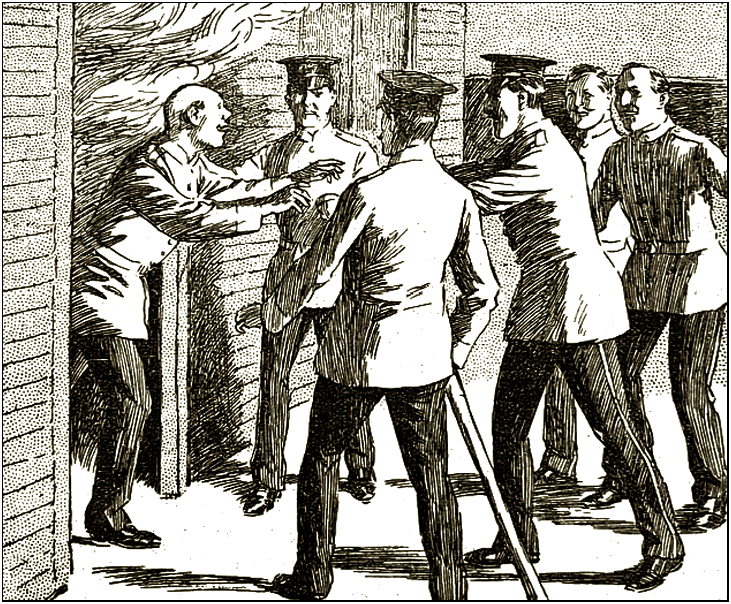
Out staggered poor little Billy Haggitt, the
storeman, without any eyebrows, an' not much hair.
"'Help!' he sez, an' tumbled into our arms.
"He was brought in front of the colonel when he came out of hospital.
"'Comet. Nonsense!" sez the colonel. 'Why did you take a lighted candle into the stores?'
"'To see the comet by, sir,' sez Billy.
"'Did you see it?' sez. the colonel, very grim.
"'I could just see through the tail, sir,' sez Billy.
"'So can I,' sez the colonel—'Ten days' C.B.'
"So the only person who really saw Darkie's comet close at hand was Billy Haggitt, who saw it in the Beery Way, in the Consternation of Delerium Trimmin's."
"GAMBLIN' is forbidden in the Army," said Smithy, "an' therefore it's one of the most pop'lar pastimes. Nobby was one of the most famous gamblers we'd ever had, till 'Jigger' Green came to us from the 1st battalion, an' then Nobby went back to Class Two (hon'rably mentioned).
"Nobby used to have great runs of assisted luck, an' there was one time when his lucky star was shinin' so brilliant that most of the troops took to smoked glasses to preserve their eyesight.
"I've known the time when Nobby couldn't walk under a winder without a brick fallin' near his head, an' on one occasion he took so much money out of 'B' Company at a game called 'Slippery Sam' that he had, so to speak, to get police protection.
"Nobby's luck was wonderful—too wonderful to last.
"Time an' time again," said Smithy, sadly, "I've told him:
"'Nobby,' I've said, 'one of these fine days there'll come along a chap who'll wipe the eye off you,' an' whilst I never dreamt that anythin' so miraculous could come along as a feller cleverer than Nobby, yet, sure enough, the time did come when Nobby was took down.
"I forget where we wis stationed when Jigger came to us, but I rather think it was in Malta, because I've got a recollection of Jigger kickin' a feller down a long flight of steps, an' the only place id the world that I know, which has a long flight of steps in every other street, is Malta.
"Jigger came to Malta—yea, it was Malta, because I remember the troopship comin' in an' me an' Nobby sittin' down by Valetta wonderin' how many mugs it brought—he came on the Tamar, an' was a celebrated feller before he arrived, owin' to the fact that he'd cleaned out all the details* at a new game called 'House on the Top Line.' He arrived full of money an' cockiness, an' Nobby set about studyin' his case.
* Drafts and Re-inforcements.
"Nobby is one of the most scientific studiers I've ever met, an' in three days he'd got Jigger analysed down to n vulgar fraction.
"'He's all gas an' whistle,' sez Nobby, contemptuous; 'he's a hooter an' he's got no more savvy or know-how than a bladder of lard.'
"Bidin' his time, Nobby waited till Jigger was boastin' one night at the Soldiers' Institute how easy it was to make money playin' cards, an' Nobby, careless-like, asked Jigger if he'd ever played a game called 'Aces an' Fours,' an' Jigger said be never had, but he was never too old to learn, so him an' Nobby adjourned to the barrack-room, an' the corporal bein' out, the two sat down to play.
"It was a game that Nobby invented hisself, an' was mostly remarkable for the fact that Nobby made the rules as he went on. That was all right for a bit, but by an' bye them rules of Nobby's came back, so to speak, an' hit him in the eye, for Jigger had a most horrible memory.
"'My trick,' sez Nobby.
"'For why?' sez Jigger.
"'An ace takes a four,' sez Nobby.
"'Just now you said that a four takes an ace,' sez Jigger.
"'Did I?' sez Nobby, very crestfallen, an' paid over.
"To cut a long story short. Nobby lost a month's pay at the game he had invented hisself.
"It gave Nobby paws—or at least he said it did. though he never seemed to hold much of a hand whilst I was lookin' at him.
"He tried every trick he knew, did Nobby, but as sure as he palmed the ace of hearts from the pack Jigger would palm the ace of trumps from under the table, an' Nobby was no better off than he was before he started.
"The very neat day Nobby took him on again, this time at pontoon*, but Nobby might just as well have played marbles, for Jigger just took the money away from him, as though Nobby was an infant at school.
* The reader may recognise the classic game of Vingt-et-un.
"By the time Nobby was through with his experiments he was broke, an' three months pay in debt.
"'I—I don't think he plays honest,' sez he, thoughtful, 'I noticed he laid down the nine an' ten of diamonds, when he couldn't possibly have had 'em.'
"'Why not?' I sez.
"'Because I was sittin' on 'em,' sez Nobby, very simply.
"This Jigger chap was big an' loosely made, with broad shoulders an' an awkward way of carryin' his arms. They sort of hung loose an' swung in the breeze, so to speak, an' he gave you the idea of bein' a fairly unpleasant kind of nut to handle. He wasn't a bad-lookin' chap, though a bit angular in the dial, an' he was one of the best tempered fellers. for all his braggin', that you could to deal with.
"Nothin' upset him; not even Nobby, who could generally be depended on to make a feller lose his temper if he happened to be in a nasty mood.
"'You're a wonderful holder,' sez Nobby one evenin'—we was havin' a quiet game of Nap, an' Jigger was holdin' fours most consistent.
"'I am,' sez Jigger, cheerful, an' shufflin' the cards most dexterous.
"'I am,' he sez, 'I've got medals for holdin' cards.'
"'You ought to have months,' set Nobby, 'with hard labour,' he sez bitterly.
"'It's a matter of luck,' sez Jigger, light-heartedly. 'I'm supposed to be the luckiest man in the world, havin' been born with a silver spoon in my mouth.'
"'That explains the funny shape of it,' sez Nobby, but Jigger only laughed.
"He began to get on Nobby's nerves. Ha took him on at everythin', jumpin, runnin', wrestlin' an' swimmin', an' Jigger beat him easily every time.
"He oven beat Nobby at his own game at collectin' money for worthy objects.
"'I'm beat,' sez Nobby one night, 'I've had me Waterloo—or my Vauxhall, or one of the railway stations. There's only one thing to do, an' that is to fight him.'
"Nobby was very downhearted because he'd been for so many years the most important feller in the regiment—next to the adjutant—an', naturally enough, he didn't like take a back seat.
"But to my surprise, an' everybody else's, the Jigger wouldn't fight.
"'Why should I?' he sez, 'I'm a better man than you, an' it only means that I'd knock the stuffin' out of you in two rounds—besides, since I killed them two chaps in Deptford,' he says, thoughtful, 'I've been very careful about fightin' with novices.'
"This only made Nobby the wilder, an' I don't know what would have happened, only just then all sorts of things was happenin' in the world, an' the most important thing, from our point of view, bein' the rough-house in Crete.x
"The Malta Chronicle was full of news about that place, an' when, one afternoon, there came a hurried order for two companies of the Anchesters to embark on a battleship, there was great local excitement—especially in 'B' Company, which was one of the companies chosen.
"I think I've told you at some time, of the row in Crete, an' how we was sent to spread the good tidin's of civilisation amongst the messy insurgents.
"They didn't want any good tidin's, an' the only way we could send 'em a message of love was by the .303 Express.
"Nobby an' Jigger played banker, an' pontoon, an' House on the Top Line, an' cut-throat brag, all the way to Crete. Nobby hadn't any money to start with, an' played owin's, an' by the time the ship got to Crete Nobby owed Jigger about eight thousand pounds an' a few odd shillin's.
"'I'll take the few odd shillin's,' sez Jigger, 'an' we'll call the odd money off.'
"'I'll give you an I.O.U.,' sez Nobby.
"'Give me a couple of bob, an' we'll call it square,' sez Jigger.
"Whether Nobby obliged him or not I forget, but I should say that he didn't, for Nobby was a cautious payer.
"I say this of Nobby because I know him. Whether Jigger would have paid under similar circumstances I don't know. Jigger's luck was so wonderful that he never had to pay.
"After a hot week in Crete, which was made up of marchin' an' counter-marchin', of standin' under arms all night an' sleepin' in the sun all day, order was to a certain extent restored.
"But there was lots of chaps in the town suspected of bein' in communication with the wild an' woolly rebels outside, an' the first thing that was done by the order of the chap commandin' the allied forces (there was a new commander every day) was to billet a couple of men with every suspected chap.
"Nobby an' Jigger was billeted together, as luck would have it, on a little Greek merchant named Arguropulo.
"A nice, polite, little feller accordin' to Nobby.
"Their instructions was to watch Argu day an' night, an' especially to take care that he didn't send any letters to anybody outside, an' havin' divided up their duties, they sat down to watch his nibs most careful.
"They hadn't been posted a couple of hours before Argu started his game. The house stood in a garden surrounded by a high wall, an' luckily there was only one gateway, an' here the chap on duty stood.
"It happened to be Nobby's turn when a Greek servant came casually down the garden path an' noddin' his head familiar to Nobby, tried to pass.
"'Hold hard,' sez Nobby, barrin' the way, 'where are you goin'?'
"'No spik English,' sez the feller, shakin' his head, an' went walkin' on, till Nobby gave him a clip in the ear that stopped him.
"'You no pass,' sez Nobby, who's a bit of a linguist; 'you go back jeldi, savvy?'
"Back went the servant, an' down came Argu, very polite an' speakin' English as perfect as Nobby himself.
"'I'm sendin' a letter to my mother,' sez Argu smoothly, 'my poor mother who is worryin' about me.'
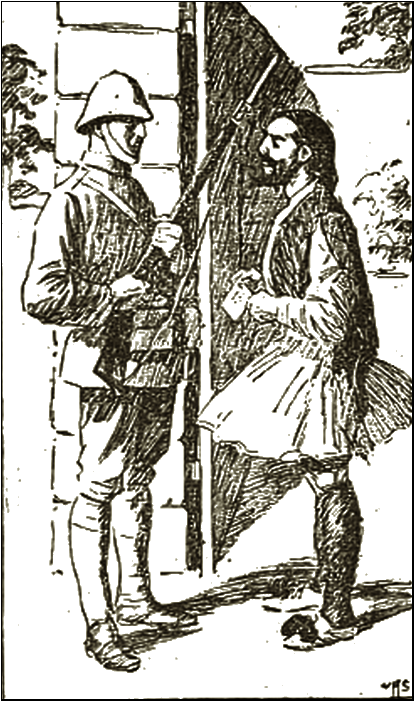
'I'm sendin' a letter to my mother,' sez Argu smoothly,
'my poor mother who is worryin' about me.'
"Can't help your troubles,' sez Nobby; 'it's against orders.'
"The little Greek just shrugged his shoulders an' walked back.
"That night when Jigger an' Nobby was sittin' by the garden gate, playin' a little game called euchre that Jigger had learnt Nobby, the Greek strolled down an' stood watchin' 'em. They'd fixed a table an' two chairs across the entrance so that nobody, could come in or out without their seein'.
'The Greek watched 'em in silence for a while, an' then he drew up a basket chair an' sat down.
"'I'd like to play,' he sez.
"'We're only playin' for love,' sez Nobby.
"'I'm very anxious,' sez Argu, pickin' up an' shufflin' the cards careless, 'to send a letter to me uncle.'
"'You said your mother,' sez Nobby suspicious.
"'Me mother's uncle,' sez the Greek calmly; 'I'll make a bargain with you. I'll lay fifty English pounds against that letter passin'—that is to say," he went on more careless than ever, 'if you win, you take fifty pounds in gold; an' if 1 win, you allow my letter to pass.'
"Nobby an' Jigger looks at each other.
"'Me an' me friend will talk it over,' sez Nobby, an' Argu gets up an' strolls away.
"It's dead easy,' whispers Jigger; 'we'll cut for it, an' if I can't cut a king to every deuce he turns up, me right hand has lost its cunnin'"
"So after they'd discussed the matter, an' decided what they'd do with the poor feller's money, they called him back.
"At first they was afraid that he wouldn't agree to cuttin', but he was very cheerful about it. an' after the cards was shuffled they sat down.
"The Greek had the first cut, an' cut an ace, the highest card in the pack, an' Nobby's heart beat in his boots. But he didn't know Jigger, for, reachin' out his hand, he cut an ace, too.
"Argu looked a bit annoyed.
"'Cut again,' he sez, an' cut another ace.
"'Certainly,' sez Jigger, an' took a wad of cards from the top an' turned 'em up—the ace of clubs was underneath.
"'There seems to be a lot of aces in this pack, sez the Greek chap very huffy.
"'The usual number,' sez Jigger cheerful.
"They cut again: the Greek cut the ace of hearts.
"'Wonderful!' sez Jigger, an' cut the ace of diamonds.
"'Shuffle the cards,' sez the Greek, grindin' his teeth, an' Jigger shuffled 'em.
"'You cut first,' sez Argu, an' Jigger cut the nine of spades.
"'Ah, ha!' sez Argu triumphant, 'now I've got you.' An' with that he cut—the four of clubs!
"Nobby sez he never saw a man look more surprised than Argu.
"'I'll cut again double or quits,' he sez. He did. an' lost.
"They sat there, them two chaps, cuttin' an' cuttin', till the Greek feller had lost every bean he had, an' Jigger was nearly a landed proprietor.
"After a bit the Greek got up.
"'I'm no match for you,' he sez; 'I'm used to playin' with gentlemen*'
"'So I see,' sez Jigger, pickin' up a collection of aces that had fallen from Argu's knees.
"That night, after they'd seen Argu safely to bed, Jigger mounted guard by the gate, an' Nobby laid down to get a bit of sleep. He must have been asleep a couple of hours, when he was woke up. He knew that it wasn't Jigger that woke him, because Jigger wouldn't have caught him by the throat nor brought in a few friends to sit on his legs, an' puttin' two an' two together Nobby came to the conclusion that he'd fallen into the enemy's hands.
"An' so it proved to be, for when he thoroughly woke up he found himself tied up an' gagged in one corner of the room an' Jigger in the other, whilst the room was filled with some of the nuttiest of nuts from Greece-land.
"There was Arguropulo, grinnin' like a cat.
"'Bring him up,' sez Argu, an' the murderin'-lookin' gents hiked Jigger to the table an' sat him down.
"'Now,' sez Argu, 'before me an' my friends depart to the rollin' hills of freedom, I'd like to have one more little game with you.'
"He got a pack of cards an' put 'em on the table, then he loosened Jigger's ropes.
"'Now,' sez Argu, 'the little game I'm goin' to play is called "Red an' Black," the idea bein' that if you cut a red card we kill you, an' if you cut a black card we kill your friend—do you see the idea? '
"'Certainly,' sez Jigger, 'but I can only play that game with a new pack of cards.'
"He was a polite sort of devil was Argu, an' he dug out a brand-new pack, an' sorted 'em most thorough.
"'Now cut,' he sez.
"'One minute,' sez Jigger; 'suppose the card I pick isn't black or red?'
"'I've arranged for you palmin' the blank card,' sez Argu, 'an' in case you cut that you'll both die.'
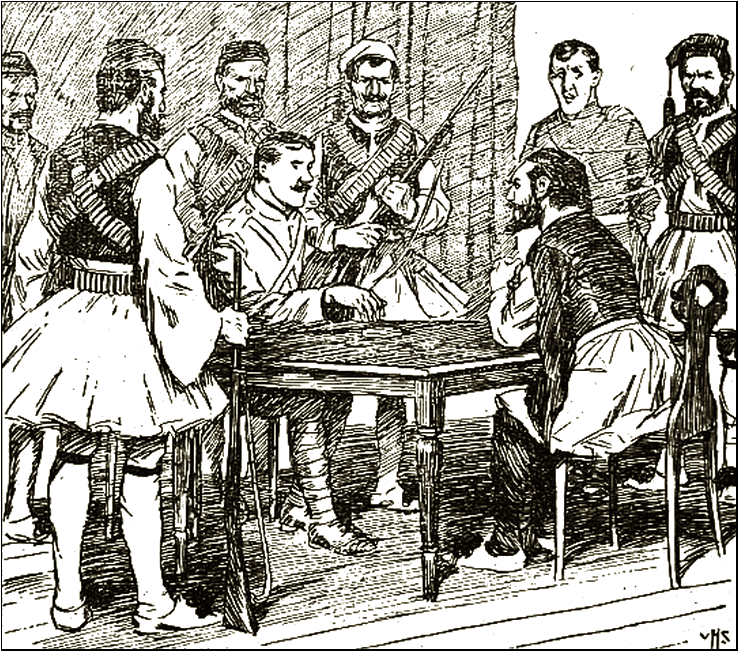
'I've arranged for you palmin' the blank card,'
sez Argu, 'an' in case you cut that you'll both die.'
"'You're one of the most accommodatin' fellers I've ever met,' sez Jigger, an' cut.
"Nobby's heart was beatin' fast, but Jigger was quite cool. He turned up the card. It was red—the nine of diamonds."
In last week's issue Smithy told of the advent of Jigger, who is a wizard with the cards, and who also beats Nobby at any other game in which they engage.
After a hot week in Crete, where a number of men are suspected of being in communication with the rebels, a couple of soldiers are put on guard over every suspect. Nobby and Jigger are billeted together, with instructions to watch, day and night, a little Greek merchant named Arguropulo.
A battle royal in card-cutting ensues between Argu and Jigger, the latter winning every bean from the Greek.
During the night a party of Greeks make the guard captive and Argu intimates that he wishes to play a last game with Jigger ere he and his friends go to their freedom.
"If you cut a red card," he says to Jigger, "we kill you ; and if you cut a black card, we kill your friend."
Nobby's heart is beating fast, but Jigger is quite cool. He turns up a card. It is red—the nine of diamonds.
SMITHY resumed the wonderful story of the adventures of Nobby and the card player in Crete.
"When Jigger turned up the nine of diamonds he didn't bat a lid, although he knew by Arguropulo's unpleasant expression that his number up, but Nobby was so wrought up that it was as much as he could do to prevent himself shoutin'.
"Argu made a sign, an' the fellers who was with him was steppin' forward, when we heard the tramp of feet outside.
"It was visitin' rounds on their way to the main guard.
"Argu whipped out a long knife an' put it to Jigger's throat.
"'Make a sound an' I'll kill you,' he hissed. "They waited until the noise of the marchin' feet grew faint, an' then they started to tie up Jigger again.
"'Hold hard,' sez Nobby, but they only held harder.
"A scarf was tied round their mouths to prevent 'em shoutin', the light was put out, an' very careful they were carried into the garden.
"They were laid down on the ground, whilst Argu an' his pals made a bit of a reconnaissance, an' it was whilst they lay there alone that one of the most surprisin' things happened.
"Out of the shadows of some bushes stepped a girl. She wore a long cloak, an' accordin' to Nobby, she was the most beautiful girl he'd ever seen.
"'Luscious black eyes,' she had,' sez Nobby to me afterwards—'luscious lips an' luscious black hair.'
"She made her way softly to where the chaps lay, an' bent over them.
"'Soldiers,' she sez, an' her voice—accordin' to Nobby—was like eatin' honey with a silver spoon. 'Soldiers,' she sez, 'you are in grave peril.'
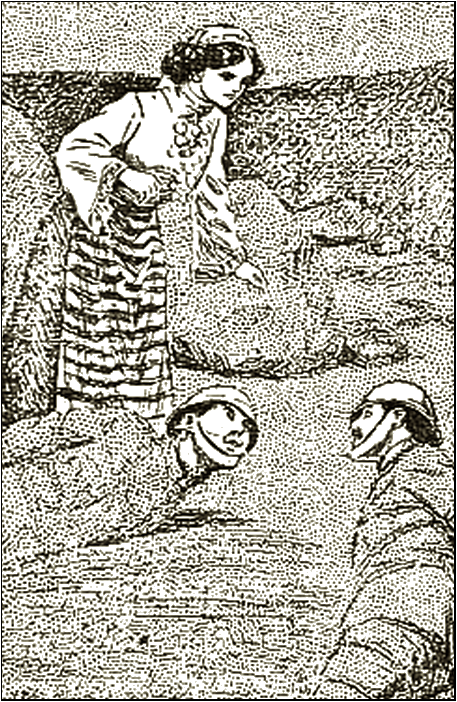
'Soldiers,' she sez, 'you are in grave peril.'
"Nobby said nothin', an' the other feller said nothin', owin' to the fact that they couldn't.
"'They are goin' to take you away to the hills,' she sez, 'an' perhaps they'll skin you alive, an' perhaps they'll boil you in oil. Try the boiling, because it's over soonest.'
"Nobby bein' a polite chap would have said, 'Thank you, miss,' only he couldn't.
"There was a little noise at the garden gate, an' she looked as if she was goin' to run away; but nobody came an' she returned. She held somethin' in her hand, an' bendin' down she put it in Nobby's.
"'I'm Miss Arguropulo, an' I'm very sorry for you—if the worst comes to the worst, an' you can't find father in a meltin' mood, except a meltin'-in-oil mood, show him this.' An' with that she vanished.
"What she'd given Nobby was a playin' card, all crumbled up. In the faint light Nobby saw it was the nine of diamonds, an' across it in funny Greek letters was two lines of writin'.
"Soon after this Argu came back with his pals, an Nobby an' Jigger was lifted careful an' was taken through the gate. There was a cart outside, an' they were laid in this, an' covered with straw, an' the cart began its journey, rattlin' an bumpin' over the rough stones.
"It stopped once when it was challenged by one of the outlyin' sentries of the Italian force—there was about eight armies of occupation about this time—but nothin' happened, an' the cart went on.
"It got lighter an' lighter, an' the two poor chaps underneath the straw got more an' more fed up. There they lay, trussed up like bloomin' pullets.
"At last, when they'd stood as much as they possibly could, the cart stopped, an' they were lifted out.
"They was in a wild an' mountainous country. There was a lot of dirty old tents pitched, an' from the number of tough-lookin' chaps with pistols an' daggers in their belts, Nobby gathered that they'd struck the insurgent army.
"When they were laid on the ground their gags was taken off an' the ropes that tied 'em cut.
Argu was evidently a sort of commander-in-chief amongst these chaps, because they treated him respectful, an' from the disrespectful way they treated Nobby and Jigger it was evident that he'd said a few uncomplimentary things about them.
"'I'm goin' to put you in a tent with a guard over you' sez Argu, 'an' in the evenin' when all me friends are gathered for an' amusin' entertainment, we'll have a little fun.
"'You're a perishin', pawky-headed, wall-eyed basket,' sez Nobby, politely, an' after Jigger had said a few words that made the tents shiver as if a breeze was blowin', they were chucked into a little tent, an' a sentry put over 'em.
"'Nobby,' sez Jigger, 'there's no hope—let's have a dekko at the card that daughter of gave you.'
"Nobby had hid it in his hand, an' passed it over, an' Jigger looked at it.
"'I can't make out what it sez,' he remarked, shakin' his head, 'let's wait a bit an' try it on the sentry.'
"About an hour after this, lookin' through a rent in the tent wall, Nobby saw Argu ridin' out of camp, with a few of the biggest nuts.
"'Now's our chance,' sez Jigger, an' went to the door of the tent.
"The sentry was the ugliest an' dirtiest feller in the insurgent army, but the scientific way be brought his rifle over to the 'present' was highly creditable.
"Nobby showed him the card, but be shook his head, an' bared his teeth, an' when Nobby pointed to the writin' on the card, he shouted somethin' in Greek that brought half-a-dozen fellers from the guard tent.
"They jabbered an' jabbered, lookin' at the sentry, an' lookin' at Nobby; then one of them snatched the card from Nobby's hand an' read it.
"The jabberin' got more excited still, an' one of the fellers went runnin' as hard as he could towards the camp—the tent was pitched just outside the main lines.
"He returned in a minute with an officer. Nobby knew be was an officer because be had three revolvers, four knives, an' two rifles slung at his back.
"The officer took the card, read it, an' looked at the prisoners.
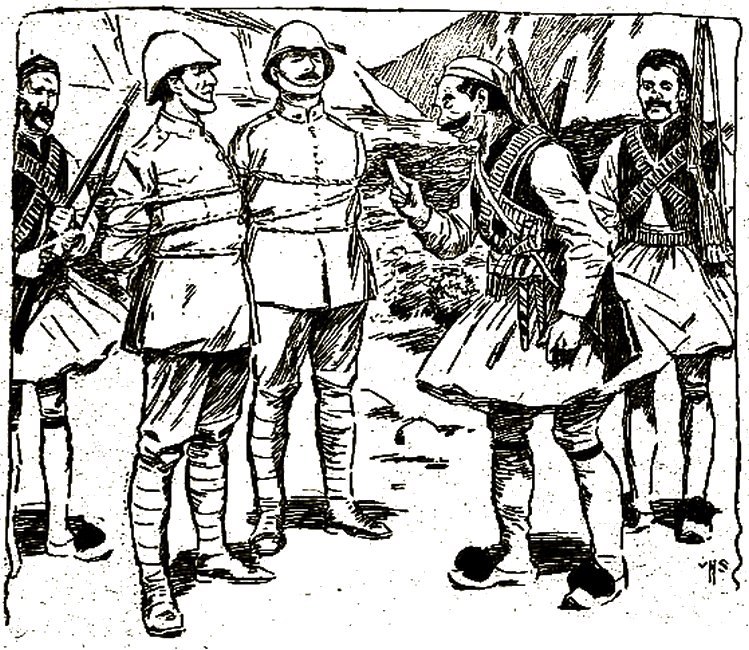
The officer took the card, read it.
"'I spik English,' he sez, 'I say Dam, an' Love-my-duck, an' Come-Home-Beel-Bally.'
"'Very nice indeed,' sez Nobby.
"'You see dat way?' The officer pointed to a road over the mountains, an' the two chaps nodded; 'you go quick—good after-night.'
"'Good August,' sez Nobby, an' the two started off, Nobby holdin' the nine of diamonds tight in his hand.
"They were out of sight of the camp in half-an-hour, an' were still wonderin' at their lack, when suddenly they came upon a little post of men—four men an' an officer.
"'It's all up,' sez Nobby, when he saw their rifles levelled, but in despair he waved the card, an' the officer came forward.
"I spik English varo well,' he sez. 'what you go to—where you goin'?'
"Nobby sez nothin', only handed up the nine of diamonds with them strange words written on 'em.
"The officer read it an' handed it back with a low bow.
"'Certainly,' he ses, Tin varo sore-eye; you go on; have you the ammunition or the gun?'
"'No,' sez Nobby, an' the officer took a couple of rifles an' a few packets of ammunition from the guard, an' handed 'em over.
"'Good lucks,' he sez.
"'Happy new year,' sez Nobby, an' off they went again.
"'It's wonderful—to me,' sez Jigger in an awestruck voice. 'What do you think is on the card, Nobby?'
"'Blast if I know,' sez Nobby. 'Pass Two, Upper Circle, possibly.'
"'It can't be that,' sez Jigger, 'because we're still alive.'
"They walked on until nightfall, when they came to a little village.
"They mere still in the enemy's country, became as soon as they entered the one street of the village the agricultural ladies an' gentlemen turned their dogs loose, an' Nobby had to shoot one before a deputation came out to meet 'em.
"'Show 'em the card,' sez Jigger, an' Nobby did.
"The change was wonderful.
"All the inhabitants started singin' an' hurrayin', an' chaps were led to the biggest house, fire was lit, an' one of the best dinners Nobby ever tasted was cooked.
"The next morning they started off again, an' came to the sea-shore in the afternoon. Laying just outside a little harbour was a Greek man-o'-war, an' by takin' off his coat an' wavin' it Nobby attracted the attention of the people on board. Off came a steam pinnace in charge of an officer, who looked at Nobby an' Jigger very suspicious.
"'I spik English,' he sez; 'it is a varo fine night to-morrow."
"'Good yesterday,' sez Nobby, 'we shall have rain if we're not careful.'
"'Oh, yes,' sez the Greek officer. "Rude Britannia—you British soldiers—yes?'
"'Quite right,' sez Nobby.
"'You deserters—no?'
"'Quite wrong,' sez Nobby, an' showed him the card.
"The officer read it, stood to attention, an' saluted.
"Then he turned to one of the men in the boat an' said somethin' in the Greekish language, an' the sailor started signallin' to the man-of-war.
"'You step this way, sir,' sez the officer, bowing low; 'mind the steps—'
"In a dazed kind of way Nobby an' Jigger stepped into the pinnace, an' it steamed out to the ship. They was half-way there when:
"'Bang!'
"A gun on the cruiser fired.
"'What's the game?' sez Jigger, very startled.
"'Bang!' went another gun.
"'Take off your helmet,' sez Nobby, excitedly, 'They`re salutin' us!'
"An' so they were; there was a guard of honour drawn up on the gangway, an' three admirals an' six captains standin' with their hats in their hands.
"As Nobby stepped aboard, the oldest admiral came up.
"'I spik English,' he sez.
"'I dessay,' sez Nobby, very weary, an' that seemed to discourage the admiral. The two was shown down below to the best cabins on the ship, an' with bands playin' enthusiastic an' the ship dressed with flags, an' guns goin' off at frequent intervals, the ship started.
"I can't remember all that happened, or all that Nobby sez happened on that voyage. All I know is that after a bit the ship came in sight of the town where the regiment lay, on' Nobby an' Jigger was put ashore with great ceremony.
"Immediately afterwards the ship sailed again, an' Nobby an' Jigger was left to walk up to headquarters.
"The first thing that happened then was that they were arrested for desertin' their posts.
"'It'll be all right,' sez Nobby, very confident, 'we'll explain to the Colonel.'
"In about on hour they had their chance. They was marched up before the old man, an' begun their yarn.
"I was one of the escort, an' I could see by the way the Colonel was knittin' his brows that he was highly impressed.
"'Very remarkable,' he sez, 'very remarkable; an you've no idea what was written on the car?'
"'No, sir,' sez Nobby an' Jigger together.
"'I used to be a bit of a Greek scholar,' sez the Colonel. 'Let me see the card.'
"Nobby put his hand in his pocket an' turned pale.
"He'd lost it!"
Roy Glashan's Library
Non sibi sed omnibus
Go to Home Page