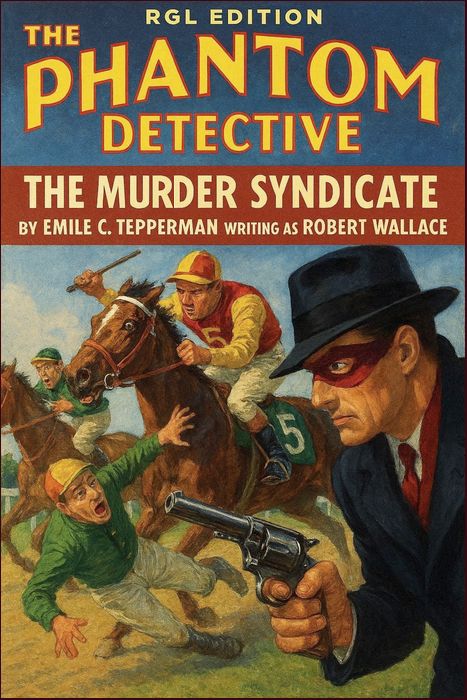
RGL e-Book Cover
Based on an image created with Microsoft Bing software
Roy Glashan's Library
Non sibi sed omnibus
Go to Home Page
This work is out of copyright in countries with a copyright
period of 70 years or less, after the year of the author's death.
If it is under copyright in your country of residence,
do not download or redistribute this file.
Original content added by RGL (e.g., introductions, notes,
RGL covers) is proprietary and protected by copyright.
RGL e-Book Cover
Based on an image created with Microsoft Bing software

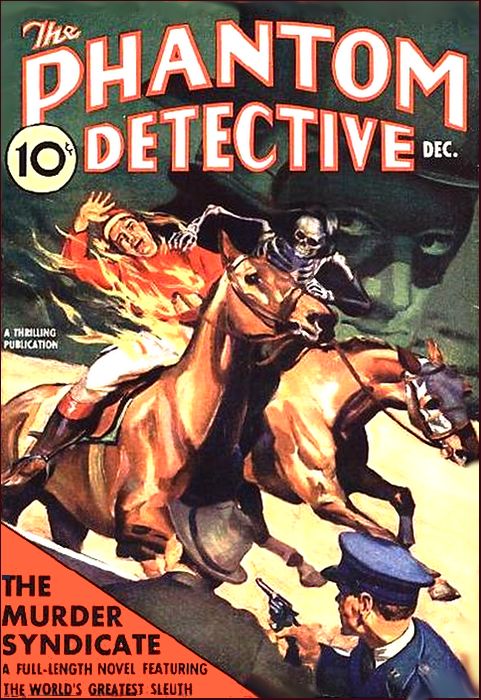
The Phantom Detective, December 1938,
with "The Murder Syndicate"
Menace hovers over the sport of kings and leaves charred corpses in its wake as the fiendish "Dollar Man" strikes—and it's up to the Phantom to stay its hand! Follow this nemesis of crime as he strives to solve a sinister mystery of the race track!
CHRIS RINGOLD was the first of the bookmakers to receive a call from the Dollar Man. It was on Saturday afternoon, the day when the Saratoga Stake was to be run. Customers had already begun to phone in their bets on Bright Chance to win that rich event. Bright Chance, the favorite, went down from six-to-five in the morning line, to become an odds-on favorite at three-to-five before the race was run.
Chris Ringold had just finished giving instructions to his clerks in the outer office not to take any more bets on Bright Chance, even at those short odds. For there wasn't the slightest possibility that the horse could lose.
When the phone rang, the bookmaker didn't suspect anything unusual. The man at the other end simply said:
"Ringold! What are the odds on Bright Chance in the Fifth at Saratoga today?"
"Three-to-five," Ringold answered. "But I can't take any more bets on him. I'm all loaded up—"
"Suppose—" the voice coming in over the receiver sounded low and vibrant, though a trifle distorted—"suppose I could guarantee that Bright Chance won't win?"
"What's that?" Ringold's voice became sharp, suspicious. "Who are you?"
There was a short laugh at the other end.
"Never mind. Call me the Dollar Man. I intend to do a lot of business with you. Imagine what it would mean to you if you could take all bets on an odds-on favorite—and be sure you wouldn't have to pay off. Just to convince you I can deliver the goods, I'm giving you advance information that Bright Chance won't win today."
"You're crazy!" Ringold exclaimed. "Do you take me for a sucker? Nobody can fix that race—" There was a low chuckle.
"Just watch. I'm giving this same information to Schiebert of San Francisco, Bittro of Boston, and a few others. When you're convinced that I can deliver the goods, I'll send for you to attend a conference. You better come then—if you know what's good for you!"
There was a click, and Ringold found himself holding a dead instrument. He cradled the phone, stared at it speculatively. If the call from the Dollar Man were not just a gag, it would mean thousands of dollars in the pockets of the bookies of the country. But it would also mean that a new dictator would crack the whip over the sporting world—
Post time for the Fifth approached, and still Ringold could not bring himself to give the order to take all bets on Bright Chance. And yet he couldn't entirely disregard that queer call. He opened up a little, and increased the load on the favorite by twenty percent. He'd gamble that much.
At five o'clock he went out into the large room and listened to the description of the race coming in over the loud speaker directly from the track. He wiped perspiration from his forehead and the back of his neck.
Bright Chance lost the race by seven lengths.
THE eight men were uncomfortable and uneasy. The room they were in was spacious and well furnished, and the cigars which Victor Purcell had handed them were fragrant and expensive.
But there was an undercurrent of menace which would have been difficult for any one of them to define. Chris Ringold of Chicago tapped the floor uneasily. He got up and went to the window.
Mike Bittro of Boston joined him there, and they looked out over the court which separated them from the Racing Association Building next door.
Charley Schiebert of San Francisco took the expensive cigar from his thick lips. His hand shook so that the white ash dropped to the thick-napped rug.
"What are we waiting for?" he said irritably. "Purcell said he'd be right back. He's been gone a half hour!"
Fennell of Detroit suddenly pushed back his chair and got to his feet.
"I say we scram!" he growled. "No man keeps me waiting this long—after flying through a storm to get here!" He started for the door. "Who's coming?"
Chris Ringold turned from the window.
"I wouldn't go, Fennell," he said in a low voice. "I've heard it ain't healthy to cross this here Dollar Man. Why do you think we all came here in the first place?"
Fennell flushed, but he lost a little of his bluster.
"Okay, I'll wait ten minutes more." He dropped back into his seat.
"Looks like there's gonna be a meeting of the Racing Commission this morning," Mike Bittro said. "They're setting the chairs over there across the court—"
He stopped talking abruptly, for he sensed the sudden hush that had descended upon the room behind him. Slowly he turned away from the window, and his eyes became fixed upon the figure of Victor Purcell, who had just come in silently. And he saw what had caused the hush.
Behind Purcell, another man had entered. This one was covered from head to foot in a collegiate gown such as is used at commencement exercises in universities. And a queer gargoyle of a mask covered his face from ear to ear, with a flap above it that went back over his head to make it look like a hood. There were two slits in the side of the gown, for the strange figure's hands, which were gloved in black.
Everybody in the room stirred with mingled emotions at sight of the queer apparition. Fennell grunted disdainfully, but said nothing.
Effortlessly, Purcell produced a long-barreled revolver with which he covered the men in the room.
"Gentlemen," he said, "meet the Dollar Man!"
The gowned figure stepped past Purcell and spoke through the mask, his voice coming to them strangely distorted. It was evident that he was using some mechanism in his mouth to disguise the natural tones.
"My friends, please do not laugh at my costume. It is for your protection more than for mine that I wear it."
He paused, and the eight men in the room exchanged puzzled glances.
"For our protection?" Fennell said.
"Yes indeed, Fennell. For if, by any accident, any one of you should catch a glimpse of my face, that man would die!"
Fennell's mouth twitched, and his eyes betrayed a quick fear. The statement which the gowned Dollar Man had just made was wild. But the very tone of the masked man's voice convinced the bookmaker that it was the utter truth.
"Even Purcell, here, has never seen my face, and doesn't know who I am. In fact, he doesn't want to!"
The Dollar Man stepped farther into the room, and addressed them all in an easy conversational tone which was rendered rather macabre by the mechanical distortion which he employed.
"You gentlemen were all summoned here to listen to a proposition which I am about to make. You eight men are the leading bookmakers of the country. You all know each other. Your offices are scattered in various cities, and you manage to make a good living. Your business is illegitimate, of course, but you pay enough protection to the police and other authorities to enable you to operate without interference."
CHRIS RINGOLD smiled.
"You've summed it up pretty well. But why are we here? I confess that I, for one, came because I've been hearing stories about the Dollar Man, and I was convinced it would be healthier to accept the invitation."
"Very wise of you," the Dollar Man said. "And now I'll come to the point. Every day of the year you men all accept bets on horse races. You don't gamble yourselves, but you work on a percentage. Out of the money wagered by the public daily, there is usually a small percentage left to give you a profit. On days when a favorite wins, you probably lose money."
"Dot's right!" said Schiebert of San Francisco. "I vish it didn't gif no favorites!"
"Suppose," the Dollar Man said slowly, "I could guarantee to you men that on a certain day the outstanding favorite in one race would lose. What would that mean to you?"
Schiebert's eyes opened wide. He stared at the speaker.
"Vat vould it mean? My Gott! I could take all der bets from dem damned pooblic. Now I got to limit my bets on der favorite. But mit a guarantee, I could get rich in no dime!"
"Exactly!" The Dollar Man seemed satisfied with the reaction to his proposition. "That is precisely what I propose to do. Each Saturday I will select one big race, where there is an outstanding favorite that the public will play big. I will arrange it for that horse to lose. And you, gentlemen, will each pay me only five thousand dollars a week for the service!"
Chris Ringold shuddered.
"You're a pretty coldblooded man, aren't you? How do you propose to make sure that these favorites will lose? We got to be pretty sure. We couldn't afford to take a chance on a fix going wrong. If the horse won instead of losing, we'd be in hock up to our necks. We'd have to quit making book."
"No race that I fix will go wrong," the Dollar Man said coldly. "I have ways of getting what I want. There isn't a jockey living who will dare refuse to play ball with me. For instance, I will give you your first horse now. Black Arab, running at the Golden City Race Track here in New York!"
"Black Arab!" Fennell exclaimed. "Why that horse can't lose today. Tim Connors is the best jockey in the country, and that horse is in top form. And you can't get at Connors!"
"No? Let's see about that!" the Dollar Man said sibilantly. "Just look across the court. The Racing Commission will meet over there in a few minutes to hear a complaint from Tim Connors that someone is trying to intimidate him into throwing the race. Watch carefully, my friends, and you will understand why I am going to have my way. I'll leave you now to enjoy yourselves."
And like an elusive shadow the Dollar Man stepped silently from the room.
JOCKEY TIM CONNORS was a red-headed kid, slim and supple, but with strong hands and wrists that enabled him to ride the most nervous of thoroughbreds. He was a fully licensed jockey, and his standing in regard to races won was the highest of any rider in the East.
He had ridden twenty horses to victory at the Pimlico meet, and now, in the second week of the Golden City Track meet, he had already captured eleven winners' purses. His honesty was a watchword in the racing fraternity.
So great was his reputation that the owners of the best horses in the country competed for his services. Consequently, he always rode in the stake events carrying the most lucrative purses. Connors was one jockey who had more to gain by winning races than by throwing them.
Unaware that he was being observed from across the court, Connors was standing before a table where six men were seated. Five of them were the members of the Racing Commission, entrusted with the task of regulating the business of horse racing in New York State, and of seeing to it that the sport was carried on in an honorable fashion. The sixth was there by invitation.
Judge Treadway, the chairman, who sat at the head of the table, was an ex-justice of the Court of Appeals. A lover of horses, he was the owner of a large stable of well-known thoroughbreds, including the two-year-old filly, Miss Sally, a horse which was expected to become the champion of her class this season.
Judge Treadway had been selected for the post of chairman of the Racing Commission expressly in order that there should be no taint of corruption in the sport. For his reputation as a stern and justice-loving jurist was so solid that the public felt he would never countenance anything underhanded.
The other four members consisted of Samuel Slater, a well-known sportsman; Jerome Phillips, the brother of the governor; Bert Forman, the famous columnist whose daily page was read by ten million people from coast to coast; and Charles Gale, a wealthy clubman. Frank Havens, the owner and publisher of the New York Clarion, one of the most influential papers in the country, was the guest.
A secretary sitting at one side of the table was taking down in shorthand everything that was being said.
Judge Treadway was speaking, in his capacity as chairman:
"Connors, I don't understand. Do you mean to tell us that this—er—this person who calls himself the Dollar Man actually threatened your life?"
Connors nodded defiantly.
"That's it, sir! First he offered me five thousand dollars if I'd lose the race today. Then he told me that if I didn't agree, I could write my will!"
Judge Treadway looked around the table at the other members.
"Any questions, gentlemen?"
Bert Forman, the columnist, had been playing with a pencil and paper, drawing a quick sketch of the jockey.
"Five thousand is a lot of money to turn down, Connors," he drawled. "Weren't you—tempted?"
CONNORS flushed angrily.
"I don't have to make my money like that!" he flared.
"No offense meant, Connors," the journalist apologized. "I was just trying to get your reactions for my column."
"I don't think this is an appropriate time for gathering material for a column, Bert," Charles Gale said severely. "We are faced with a very serious matter." Gale was a stout man, with the pale face of one who has lived in night clubs and bars the greater part of his life. He turned to the jockey. "Just how was this offer made to you, Connors?"
"Over the telephone, sir. The Dollar Man called me twice. The first time he offered me the five grand. The second time he told me I could make my will."
The governor's brother, Jerome Phillips, had been listening intently, playing with his watch-fob in a nervous manner.
"It's obvious that this is the work of some crank, Connors," he broke in. "I don't see why you attach so much importance to it."
"You wouldn't think so, sir," Connors exclaimed hotly, "if you'd seen the two thugs who forced their way into my hotel room this morning. They stripped off my pajamas, and one of them held me while the other beat me with a rubber hose all over the body. They kept it up for ten minutes, without saying a word. Then they dropped me on the bed and went out. At the door, one of them said: 'You'll get a phone call in an hour, kid. Better do what you're told—or you'll wish we'd finished you off just now!' Then they went out, and I lay on the bed gasping for breath. I was too weak to get up and go to the phone, and by the time I caught my breath, they had plenty of time to get out of the hotel!"
The members of the Racing Commission exchanged glances. It was plain to see from their attitudes that they doubted the jockey's story. But they could not understand what motive the boy might have for inventing it.
Samuel Slater, large, bald-headed and florid, who sat at Judge Treadway's right, asked: "Did you notify the police?"
"Yes, sir. A detective came and I told him about it. At that time, the phone call hadn't come in, and I didn't know why in the world they should have wanted to beat me up. They left a man at the switchboard to trace all incoming calls for me. But the Dollar Man didn't phone to the hotel. He was too smart. He waited until I went out for breakfast, and then he called on the public phone in the restaurant where I was eating. So the police couldn't trace it."
"I see," Samuel Slater said ironically. "There were no witnesses to the phone call, then?"
"No, sir," Connors said sullenly. Frank Havens had been intently studying young Connors all this time. His keen, intelligent eyes were sizing up the jockey, and evaluating the honesty of his story.
"How do you feel after the beating, Tim?" he said kindly. "Any marks on your body?"
Connors shook his head.
"It was a rubber hose, Mr. Havens, and it didn't leave any marks."
Bert Forman laughed suddenly.
"So you want us to believe that there is a mythical person called the Dollar Man, who offers you five thousand dollars to lose with Black Arab today, and who threatens to kill you if you win?"
"He's not mythical!" Connors snapped. "If you'd got that beating, you wouldn't laugh!"
JUDGE TREADWAY raised a hand.
"Let's not go off at a tangent, gentlemen. There isn't much time before the race, and we don't want to keep Connors here longer than necessary." He turned judicially to the jockey. "Have you any ideas as to who this Dollar Man may be, Tim?" The red-headed youngster shuffled his feet uncertainly.
"There was something in his voice, sir, that I thought I ought to recognize. But he disguised it somehow, and I haven't been able to place it."
"Did he talk like a man of education, or like a roughneck?"
"He talked very well, sir—as well as any of you gentlemen here. I would say he's well-educated."
Bert Forman, the columnist, suddenly folded up the sketch he had been making, and pointed a finger at the jockey.
"Just why did you come here, Connors? Do you want to be excused from riding Black Arab? Are you afraid?"
Connors flushed.
"I'm not afraid, Mr. Forman. I want to ride Black Arab. But I thought I'd tell you the whole story—in case I do lose the race by accident. I don't want any misunderstandings afterward—"
"So!" Samuel Slater sneered. "You're preparing an alibi in advance!"
"You're wrong!" Connors flared. "And here's the proof. Did you ever see one of these? Those two thugs left it with me!"
FROM his pocket the jockey produced a metal disc about the size of a silver dollar. It was about a quarter of an inch thick, and looked very heavy. He passed it around among the men at the table. They all examined it curiously. One side was entirely blank, exhibiting only the bare face of the metal. But the other side carried a queer, tantalizing design. It was a conventional dollar sign, etched in the metal. And drawn through the dollar sign at an angle was a dagger!
"You've shown this to the police?" Judge Treadway inquired.
"Yes, sir. They think it's merely an attempt on the part of the Dollar Man to be melodramatic. They tested it for fingerprints, and when they didn't find any they told me to keep it as a souvenir."
Judge Treadway turned to Slater. "You owe the boy an apology, Sam," he said severely. "Even without this disc, his story rings true." Connors pocketed the disc, and Slater shrugged.
"All right. I'm sorry, Connors. I did you an injustice. I know you're an honest boy. If you want to ride Black Arab in the fourth race, I'll personally vote to permit you to ride. I know you'll try to win, in spite of any threats."
"I vote likewise!" said Jerome Phillips. Bert Forman and Charles Gale joined them in approval. Frank Havens, the newspaper publisher, shrugged.
"I don't know what to say," he admitted. "Tim, your story sounds just fantastic enough to be the work of some shrewd criminal. I'm afraid you'll be taking a big chance—"
"I don't mind, Mr. Havens!" the jockey broke in eagerly. "I want to show this Dollar Man that I don't give a damn for him!"
Judge Treadway nodded reluctantly.
"Very well. Since a majority of the members vote to let you ride—so be it." He arose. "Good luck to you, Tim!" he said huskily.
The boy thanked him with a smile.
"I won't let you down, sir—"
And that was the last coherent word that Tim Connors ever spoke.
Suddenly, a solid sheet of livid fire seemed to erupt from his body. Flame, hot and searing, filled the room, and the young jockey became a living torch.
Scream after scream came tearing from the youth's agonized throat as his slight body jerked convulsively, twisting and squirming in involuntary spasms of unendurable agony.
All the men in the room were on their feet now, petrified with fear at the sudden doom that had swept upon the boy. A few seconds later Forman tried to get as close to the jockey as the hissing, sparkling flames would permit, in a vain effort to save the boy.
Frank Havens had the presence of mind to leap for the fire extinguisher, but he was too late. Tim Connors lay on the floor, a dead thing, his body twisted into weird, macabre shape. The flames burned for a while luridly on the hard wooden floor, and the fire extinguisher helped to keep them from spreading. But the boy was beyond help.
IT was some time later that Judge Treadway drew Frank Havens aside, away from the crowds of officials and reporters in the offices.
"I want to talk to you, Frank. We see now that the Dollar Man is a real and tangible menace—despite the fact that we can't understand how Connors was destroyed. Do you realize, Frank, what this Dollar Man could do with the power he has? What man would dare to defy him when he has such terror at his command?"
Havens glanced around and saw that the other members of the Racing Commission were all engaged elsewhere in the hall.
"What would you have me do, Judge?" he asked cautiously.
The elderly jurist paused reflectively for an instant.
"I'm afraid the police won't make any headway," he said at last—"Gregg is a good man, but I can see already that he'll be no match for this fiend who calls himself the Dollar Man."
Treadway looked around cautiously, lowered his voice.
"There's one person who could match the Dollar Man, cunning for cunning, cleverness for cleverness; one man who has shown many times in the past that he knows how to fight criminals like this one."
For a long time the two men stood looking at each other, without speaking. Frank Havens knew without asking to whom Judge Treadway referred.
The Phantom Detective answered the description. Many clever and powerful criminals had in the past suddenly found their carefully laid plans disrupted, themselves either killed or delivered into the hands of the law. Sometimes the person who had accomplished these feats was never named to the public. But men ascribed them to the unknown man whose face no one had ever seen, and who was called—the Phantom.
There was only one man in the world who enjoyed the Phantom's confidence, who could get in touch with him. That was Frank Havens.
Judge Treadway was speaking softly.
"I think, Havens," he said, "that this is a case requiring the unusual powers of the Phantom. The Dollar Man must be nipped in the bud—or else he will terrorize the Sport of Kings. I can see the fearful possibilities of this dreadful death by fire. I can see how the Dollar Man can impose his will upon jockeys and owners and stewards and bookmakers. He must be stopped!"
"The Phantom is not in New York at this time, Judge," Havens said softly. "But—I'll see what I can do!"
Nothing more was said.
Later, when Havens left the building, he took a taxicab, drove for a few blocks, then changed to another. He repeated this performance twice again, until he was far up in the Bronx, and was certain that he was not being followed. Then he entered a Western Union office and wrote out a short telegram, consulting a small black book which he took from his vest pocket.
The telegram was addressed to a certain Richard Curtis Van Loan, Esq., at Hollywood, California. On the face of it, it appeared to be a simple business telegram, relating to a series of unimportant business transactions. In reality, it was written in code, and read:
SUGGEST YOU FLY BACK TO NEW YORK AT ONCE. THIS CASE WILL NOT FAIL TO INTEREST YOU. FROM THE WAY IT HAS BROKEN I BELIEVE IT WILL TURN OUT TO BE AS BIG, IF NOT BIGGER, THAN ANYTHING YOU HAVE HANDLED. CAUTION YOU TO BE CAREFUL, FOR NO ONE KNOWS WHO THE DOLLAR MAN IS, AND HE MAY BE SOMEONE IN OUR CONFIDENCE. CONSULT DAILY PAPERS FOR STORY.
It was not signed Frank Havens, but carried another signature. No one would have suspected that it was in any way connected with the gruesome story which broke in the afternoon papers.
Later in the day, a radiogram reached Frank Havens at his office in the Clarion Building. It was a typically extravagant, chatty message from Richard Curtis Van Loan, Esq. That young millionaire sportsman had apparently not worried about the cost, and had wasted a lot of money just for the sake of a little gossip. It read:
HELLO FRANK OLD TOMATO. HERE I AM ON BOARD THE QUEEN OF ARGENTINA, BOUND ON A PLEASURE CRUISE TO BUENOS AIRES. WE'RE THREE DAYS OUT AT SEA, AND WOULD YOU BELIEVE IT, I'M BORED ALREADY. SO I THINK I'LL LEAVE THE BOAT AT THE PANAMA CANAL AND FLY BACK TO CALIFORNIA. HOW IS MY OLD FRIEND JUDGE TREADWAY AND HIS DAUGHTER LINDA? GIVE THEM MY REGARDS.
I JUST REMEMBERED THAT THEIR HORSE, MISS SALLY, IS RUNNING IN THE STEVENS HANDICAP AT NEW YORK NEXT SATURDAY, AND MAYBE I'LL FLY BACK FROM CALIFORNIA TO NEW YORK TO SEE THAT RACE. I ONCE MADE A LOT OF MONEY ON MISS SALLY, AND I'D LIKE TO REPEAT. SO PERHAPS I'LL BE SEEING YOU IN A WEEK OR SO. GREET EVERYBODY I KNOW FOR ME.
DICK.
So Frank Havens knew that a whole week would elapse before the Phantom could appear on the scene to match his wits and his life against the Dollar Man. He prayed fervently that the police under Inspector Gregg would be able to break the case before next Saturday, and before there were any other fire murders.
He was doomed to disappointment.
The stake race in which Black Arab was to compete was scheduled for five o'clock. In order not to disappoint the public another jockey was selected to ride the horse. And Black Arab lost the race disgracefully.
There was no evidence that the jockey, a lad by the name of Gurdy, had held the thoroughbred back. But he forced Black Arab to his utmost, setting a killing pace at the quarter pole. When they came into the stretch, Black Arab was exhausted, and fell behind to come in fifth.
INSPECTOR GREGG decided that Gurdy would bear questioning. Perhaps he had been reached by the Dollar Man, in anticipation of Tim Connors' removal. So Gregg phoned the Westchester police, where the Golden City Race Track was located, and asked them to hold the jockey until he could get a warrant to bring him down to New York as a material witness.
When the two state troopers came to get Gurdy, the jockey broke down and said that he couldn't stand it and would talk plenty. Only let them get him in a cell where the Dollar Man couldn't do things to him.
The two troopers took him in a white police car, and started driving toward the State Police Barracks. That was the last that was ever seen of three of them—alive.
The car, with Gurdy and the two troopers, was found in a side road, burned to a crisp. The bodies were not even recognizable. They had been burned to death, just like Connors. Gurdy would never tell what he knew!
There was no clue. The road was hard, and there were no tire tracks. No one had seen the police car, and no one had seen any other suspicious cars.
The toll for the day was four men murdered by fire, and the mouth of a possible informer forever sealed. The Dollar Man had scored heavily. Throughout the country bookmakers counted fat rolls of profits. All the money that the public had wagered on Black Arab now became theirs.
The Clarion and the other newspapers printed a full account of the murders by the Dollar Man, but the conversation between Tim Connors and the Racing Commission was withheld from the public after consultation. For that news would have meant the financial ruin of every race track in the country, and the lasting discredit of racing as a sport.
That afternoon, an outstanding favorite lost once more. The public had bet heavily on it, and many bookmakers cleaned up, for they had accepted all bets. Among these lucky bookies was Victor Purcell, whose reputation was not very savory, and who, it was suspected, was also involved in the numbers racket.
In order to protect themselves against the odium of being involved with the Dollar Man, a number of the more reliable and conservative bookmakers at the track organized an association, electing Harry Marn as their president. Marn was an educated, cultured man, with a background of scientific achievement, who had got into the business a number of years ago. He began by winning a very large bet from a bookmaker. The bookie, being unable to pay off, had offered Marn his business.
Harry Marn hired the Tuckerton Detective Agency, authorizing them to put as many operatives as they needed on the case, in an effort to discover the identity of the Dollar Man.
Thus, by the end of the week, the Golden City Race Track was virtually overrun with detectives and police officers, none of whom seemed to be getting anywhere.
And indeed, the Dollar Man appeared to be lying low for a few days. It was not until the next Saturday that he struck once more.
HARRY MARN, the bookmaker, snapped off his stop-watch.
"Boy!" he exclaimed enthusiastically. "Did you see that filly run, Mr. Van Loan? A half in .50, cantering. She'll walk away with the Futurity this afternoon!"
He shivered a little in the chill dawn air, and turned up his coat collar. His eyes followed the lithe shape of Miss Sally, the two-year-old filly whose practice run had just elicited his admiration.
The tall, well-knit young man beside him at the rail was one of a small group of perhaps fifteen people who had come out to the track at dawn to see the work-outs. A few feet down along the rail, a blond young woman in a tweed sports suit waved a hand to the young man.
"Hello, Dick," she greeted him. "I didn't know you ever got up before noon. What brings you here so early? Didn't you go to bed last night?"
Richard Curtis Van Loan laughed negligently. "Hello, Linda. To tell you the truth, I want to make some money on Miss Sally. So I thought I'd come up and see her work out before I placed a bet on her."
Linda Treadway moved down the rail alongside him.
"Dad says Miss Sally can't lose—barring accidents. But I don't think the bookmakers will give any odds."
Harry Marn grinned.
"Good morning, Miss Treadway. I guess you're right. Personally, I won't even lay even money against her. Maybe I'll offer four to five when we open up this afternoon."
"Too bad," sighed Richard Curtis Van Loan. "I was thinking of making a small bet on her. But I never play an odds-on favorite."
They all turned to look at Miss Sally, the horse in question, whose jockey was leading her along the rail, back to the paddock.
"Look at her sleek coat," Marn said. "She didn't even raise a sweat. She'll do the Futurity mile this afternoon without turning a hair. I'd be crazy to lay odds on her!"
The jockey, Phil Carter, nodded to them.
"Good morning, Miss Treadway," he said. Then: "How do you do, Mr. Van Loan."
"That was a wonderful work-out, Phil," the girl told him. "Dad is counting on you to win the Futurity today."
YOUNG CARTER shuffled his feet nervously.
"Yes, Miss Treadway." Phil Carter was nineteen, but he weighed only ninety-two pounds, and his face was as boyish as his figure. This morning however, there seemed to be a shadow lurking in his eyes. He began to pass on, leading Miss Sally by the bridle, but Dick Van Loan called to him.
"Just a minute, Phil!"
The little jockey turned reluctantly.
"Yes, sir?"
"Didn't I see you last night on Broadway near Forty-ninth Street?" Phil Carter started convulsively, but he quickly hid his agitation.
"Y-yes, sir. I—I thought I'd take in a movie last night. Sort of quiet my nerves for today's race."
"I see," Van Loan said softly. His cool gray eyes studied the youngster for a moment. "Well, I hope you win."
"I—I hope so, Mr. Van Loan."
He said nothing more, but moved on swiftly, as if fearful of being questioned further.
Linda Treadway looked after him with a puzzled frown. "I wonder what's the matter with Phil," she said. "He looks—frightened!"
Harry Marn shrugged. "Everybody is kind of nervous around the track these days after what happened last week."
Linda shuddered.
"That was terrible. Did you hear about it, Dick? Poor Tim! And Gurdy, too—"
"I read about it, of course," Dick Van Loan said soberly.
"By the way, Mr. Van Loan," Marn remarked, "I understood you were on a cruise. How come you returned to New York so quickly. I heard you flew back in your own plane."
The young millionaire sportsman's gray eyes flickered for an instant. Linda Treadway, looking up at the clean-cut profile of his darkly handsome face, thought that she saw a momentary tightening of the muscles around his jaw-bone, as if he were inwardly seething with suppressed emotion. But she dismissed the thought at once.
Neither she, nor anyone else in the wealthy set in which they mingled, had ever known Dick Van Loan to feel deeply on any subject. Everybody knew that Dick's most arduous task was the job of spending the immense fortune with which inheritance had endowed him. His next words tended to assure her that the general opinion about him was true.
"I did fly back," he said, "but that was only because I heard that Judge Treadway had entered Miss Sally for the Futurity today, and I wanted very much to see the race—maybe make a small bet."
Harry Marn laughed uneasily.
"The police are working on Tim Connors' case, and the Tuckerton Detective Agency has about a hundred operatives assigned to it, too. Between police and private detectives, the track will be swarming with the law this afternoon. I guess there won't be any more murders. But about making a bet, Mr. Van Loan, I wish you'd make it a small one. There'll be a lot of the public's money going on Miss Sally today, and I don't want to take on too much."
He was interrupted by a thin, hatchet-faced man in a gray topcoat and a black derby hat, who pushed up between Van Loan and Linda Treadway at the rail.
"Excuse me," said this man. "I heard you say you wanted to make a bet. I'm Miles Corey—one of the bookmakers here."
Dick Van Loan nodded, his handsome face expressing supercilious distaste.
"I know you, Corey."
The hatchet-faced bookmaker smirked, and threw a side glance at Harry Marn.
"You've always done business with Marn and few of the others, here at the track. But if they can't accommodate you, I'll be glad to handle your bet. I'll give you two to one on Miss Sally."
"Two to one!" Marn exclaimed. "Why, you're crazy, Corey. Miss Sally shouldn't be better than even money. She's bound to win—barring accidents!"
Corey grinned knowingly.
"Well, I'll take a chance. Two to one is what I'm offering."
Dick Van Loan nodded carelessly. "Okay, Corey. Put me down for ten thousand to win on Miss Sally at two to one."
Corey's eyes bulged.
"Ten grand! I'll have to lay some of that off with the syndicate. I can't afford to handle anything like that myself." He shrugged. "I'll take it, Mr. Van Loan. It's a bet!"
He turned to Linda Treadway.
"Your father, the judge, just bet a thousand on Miss Sally. Looks like Mr. Van Loan has more confidence in her than her owner."
LINDA TREADWAY flushed.
"Dad had probably bet much more than that with outside bookmakers. I'm sure he has full confidence that Miss Sally will win, especially with Phil Carter riding her."
Corey shrugged, and gave her a knowing grin.
"There's no such thing as a sure thing in racing, Miss Treadway. And you never can tell these days. Jockeys around this track have been pretty nervous lately. They don't like the idea of being roasted like a pig—like some others!"
He waved a hand and started to amble away, taking from his pocket a pad, upon which he entered a notation of the bet he had just made with Dick Van Loan.
"See you after the race to settle up, Mr. Van Loan," he called back. "You'll find me at Stall number twenty-eight in the betting ring."
Linda Treadway was staring after him with hot anger in her vivacious eyes.
"The brute!" she exclaimed. "To talk that way about poor Tim!"
Dick Van Loan didn't answer her. He was watching Corey's back, and he saw a peculiar coin of some sort fall to the ground out of the pocket from which the man had taken the memo pad. Dick stepped over and picked it up.
"You dropped something, Corey," he called.
The bookie turned, and saw what Dick Van Loan had picked up. His face suddenly turned a dirty green, and a slight gasp escaped from his lips.
Dick threw a quick downward glance at the coin in his hand. It was of silver, and as large as a dollar, but about twice at thick. A piece of cord ran through a hole at the top, as if it were intended to be worn around the neck. And upon its face was etched a design consisting of the conventional dollar sign, with a tiny replica of a dagger drawn through the upright bars, at an angle.
Dick Van Loan's good-natured, almost vacuous countenance betrayed nothing as he handed the coin back to Corey. The bookmaker was looking keenly at Van Loan, as if to guess whether he had noted the insignia. But he could tell nothing from the young millionaire sportsman's expression.
He mumbled a hurried "Thank you, sir," and pocketed the metal disc, then hurried away.
Dick Van Loan turned back to Linda Treadway and Harry Marn. "Now, if you two will excuse me, I'll leave." He grinned. "Got to catch up on my sleep before the track opens this afternoon, you know. I'm not used to getting up at such a beastly hour."
"Why don't you wait a few minutes, Dick," Linda said. "Dad and I are driving back to the city, and we'll give you a lift—"
"No, thanks," he told her. "I've got my own car here. Be seeing you later, Linda. So long, Marn. If you change your mind about laying odds on Miss Sally, I'd like to bet another ten thousand this afternoon."
He left them, and Harry Marn looked after him with a frowning expression of puzzlement. "That's funny, Miss Treadway," he said. "Just a little while ago, Mr. Van Loan was asking me if I'd have breakfast with him. He wanted to ask my advice about a gelding that's for sale here. And now, he gets sleepy, and walks off!"
Linda shrugged.
"Dick is a queer chap. He's always running off at the oddest times as if he just remembered another appointment or something. We've got quite used to his vagaries. But he's a swell sport. And not an ounce of evil in him. If he only had some courage and initiative, he could accomplish so much in this world—because he has plenty of ability. It's too bad he has so much money. It's making him fritter away his life uselessly!"
Marn nodded.
"I guess you're right, Miss Treadway!"
BOTH Linda Treadway and Harry Marn would have been puzzled had they been privileged to witness the actions of Mr. Richard Curtis Van Loan immediately after he left them.
For he did not leave the race track ground. Instead, he made his way through the empty betting ring, pausing only long enough to look at the posted chart naming the jockeys and giving the post positions of the horses. The betting pit occupied the entire length of the enclosed portion underneath the grandstands. In this space, there were set up more than ninety small stalls, each about three feet wide by six feet long.
While the races were going on, every one of these stalls would be occupied by a bookmaker, together with his assistant, one accountant, and a pay-off man. These bookmakers paid a daily fee to the Race Track Association for the privilege of being permitted to do business. In New York State, where parimutuel betting has not yet been legalized, the system of oral betting through bookmakers flourishes.
Before each race, thousands of bettors flock around the stalls, thrusting money at the bookmakers for their bets. No receipts are given. The bookmaker takes the money, calls out the terms of the bet, and the accountant in the rear of the stall enters the bet in a huge ledger, alongside the ticket number of the bettor. This ticket number appears on each admission stub, which the bettor always keeps during the afternoon. If the bettor wins, he comes to the rear of the stall, presents his admission stub, and the pay-off man pays him the amount of the wager as it appears on the ledger sheet.
VAN LOAN had often marveled at the accuracy and honesty of these bookmakers. Thousands of dollars passed through their hands daily, and very seldom was there an error, or a complaint, in spite of the fact that no receipts were issued, and that the bets were made with lightning rapidity.
Now, however, the stalls were empty. They would not be occupied until later in the day, perhaps an hour before the first race, when each bookie would appear with his assistants, and proceed to make out a chart, showing the odds he was willing to pay on each horse.
At each end of the betting ring there was a long lunch counter, while a bar ran down the length of the space behind the row of bookie's stalls. Men were busy at these counters, preparing sandwiches and food for the crowd that would collect later in the day.
At the bar Dick Van Loan saw Phil Carter. The jockey had already changed to street clothes, and was gulping down a glass of straight rye whiskey. He followed it with a chaser of soda, and pushed his glass over to the bartender for another filling.
Dick Van Loan came up alongside of Phil Carter, and nodded to the bartender, who automatically took down from the shelf a bottle of fifty-year old cognac when he saw who his customer was.
"Hello, Mr. Van Loan," he greeted him warmly. "I've got your favorite brandy here."
The young millionaire sportsman sipped the excellent cognac slowly, watching Phil Carter out of the corners of his eyes. Carter was ill at ease. He gulped down his rye, and slapped a dollar bill on the counter.
"Keep the change, Joe," he told the bartender, and started to hurry away.
Van Loan put a hand on his arm.
"Wait a minute, Phil," he said softly. "Have one on me."
Before Carter could refuse, Van Loan nodded to the bartender, who poured out another drink for the jockey. Carter grunted, and stepped back to the bar with obvious reluctance.
"You know, Phil," Dick Van Loan said, "I'm betting ten thousand on you and Miss Sally. And I expect to bet another ten thousand this afternoon. I don't see how you can lose—unless you get yourself so soused that you won't be able to stay in the saddle."
Carter looked up at him with a frown.
"That's a funny thing for you to say, Mr. Van Loan—after buying me a drink yourself."
"I'm buying you the drink because I think you need it, Phil. You look worried about something. Are you in trouble?"
Phil Carter swallowed the jigger of rye. He looked queerly at Van.
"What makes you think of that, Mr. Van Loan?" he asked.
The millionaire sportsman shrugged. "Maybe it's a hunch. The very fact that you're at the bar here shows me you've got something on your mind." He put a hand on the young jockey's shoulder. "If it's money, Phil, I'll be glad to help you. You know I've got scads of it—more than I know what to do with. Just talk up—"
Carter suddenly wrenched his shoulder away from Van Loan's grip.
"It's not so easy!" he spat out through clenched teeth.
Van's eyes narrowed, and he studied the other.
"It wouldn't be anything to do with this Dollar Man I've been reading about, eh?" He saw the strained look in Carter's face, and he laughed loudly. "Ha, ha! Dollar Man! They've been going batty about this business. I don't believe there is any Dollar Man—eh, Phil?"
Carter forced a smile.
"I guess—not, Mr. Van Loan." Van tried another track.
"By the way, Phil, how's your sister, Susan?" he said casually. "Still in college? I haven't seen her for quite a while. She must be all grown up by this time."
The little jockey poured himself another drink, shakily, and downed it at a gulp.
"She—she's all right, Mr. Van Loan."
"Okay!" Van clapped him on the back, and threw a bill on the counter to pay for the drinks. "Chin up, Phil. You win that race for me this afternoon, and I'll buy you an automobile!"
Carter nodded.
"I—all right, Mr. Van Loan—"
"That reminds me—did you see Miles Corey come through here? I made a bet with him, and I want to increase it before I go."
"He went in there, to the cashier's office," Carter told him, indicating the string of offices at the far end of the ring. "There's nobody in there yet, and he generally uses the office to make out his sheets."
Van Loan waved a hand.
"Well, never mind. I'll see him this afternoon. Remember, if you want any help—"
He walked carelessly away, in the direction of the gate. He was halfway across when every other sound in the huge betting ring was suddenly obliterated by an unearthly scream of pain and terror, a cry that filled the air and reverberated from the tall rafters of the grandstand above. So inhuman was that scream that it seemed impossible that any mortal throat had issued it.
And then, just as it reached the highest pitch of possible voice-sound, the source of the scream seemed to be cut off cleanly and efficiently, leaving that last dreadful note of ineffable fright to hang and waver in air, like a soul which has been disembodied.
The half dozen people in the ring stood transfixed, as if set permanently in marble, frozen into those positions by fright. None seemed to know where the shrieks were coming from.
THE frightened neighing and whinnying of the high-strung thoroughbreds in the stable rose to join the last notes of the scream like an echo, and the beat of dozens of pounding hoofs against stable walls drummed in the air like an ominous undertone of accompaniment.
Richard Curtis Van Loan, the millionaire playboy, the trifler and sportsman, was the only one who moved in that agonized instant after the scream broke the stillness of the dawn. His eyes, gray and quick, were now no longer the eyes of one whose weightiest problem in life is the making of a bet on a horse. Once again there appeared in them the gleam which had momentarily disturbed Linda Treadway. He broke into a swift run, heading in the direction of the north end of the betting ring, where the cashier's offices were located.
He alone had guessed the direction from which that scream was coming. And as he ran, his hand slid up under the right lapel of his topcoat, then reappeared gripping a .32 caliber revolver whose hair trigger had been filed down to a shining point.
These offices, built into the grandstand structure, ran along the edge of the betting ring, with windows facing in two directions. There were windows here, in the inner wall, looking into the ring; and there were also windows in the outer wall, opening toward the approach to the grandstand and the five acres of parking space out there.
Van Loan kicked the door open, and at the same time he heard the motor of a car accelerating rapidly somewhere outside. But that sound was driven from his mind by a ghastly sight that now projected itself into his vision.
It seemed to him at first that a vivid ball of molten metal was bouncing about on the floor. And then he realized that it was a man, writhing in the agony of death. Hot, searing flame was licking up from clothing and body. Where the face had been there was only a red hissing mass of fire. There was fire simmering about the arms and the legs, and tongues of flame licking out from coat and trousers.
And even as Van got into the room, the writhing body ceased its twisted, agonized motion, and rolled upon the floor. There it lay, convulsively twitching and shuddering. The man was dead, and no longer in agony. But his body jerked again and again, as will that of a snake whose head has been cut off.
NOT far from the body lay the black derby hat which Van recalled having seen upon the head of Miles Corey. There was no one else in the room with that grisly body. The murderer was gone—and the only way he could have left was by the opposite door, leading out to the grounds beyond the grandstand. It was ajar, and swaying slightly on the rebound, as if the person who had just passed through it had kicked it open hurriedly.
There was absolutely nothing that could be done for poor Miles Corey. His agony was over, and he was beyond help. But there was still a chance to get the fiend who had done this thing to him.
Van Loan sprang across the room, leaped out through the open doorway. Half a dozen men were running from the paddock, over on the other side of the parking space. There were ten or fifteen cars parked there, among them Van Loan's own Daimler. But his eyes focused on the green roadster that was moving out into the driveway, heading toward the outer gate.
The car was being driven in no great haste, and Van's eyes narrowed as he tried to figure time in terms of split seconds. Could it have been possible for a man to have left the cashier's office, crossed the parking lot, got into that car and started it, then driven as far as the gate—in the time that Van himself had taken to get from the betting ring to this doorway?
There was the bare possibility that it could have been done. That alone, of course, would be no basis for accusing anyone. The fact that the driver of the green car was leaving at a time like this was in itself no proof of guilt. It was possible that the driver had not heard the screams above the noise of his own motor.
All this flashed through the mind of the young millionaire sportsman with swift clarity; he realized that it was vitally necessary to know who was leaving in that car.
Behind him in the office, Van heard the shocked and startled cries of other people who had come from the betting ring. The men from the paddock were heading for the clubhouse entrance, under the delusion that the screams had come from there. For the moment the way was clear, and Van took it.
He raced across the grounds to his Daimler, and had the motor going in a fraction of an instant. The long, powerful car purred out of the parking space and into the graveled path just as the green roadster passed through the gate and swung south on the highway.
Van Loan put his foot all the way down on the gas pedal while still in second, and he accelerated to fifty by the time he reached the gate. He made the left turn into the highway on two wheels, and glimpsed the green roadster a half mile ahead. He could see now that there were two men in the car, and they were driving steadily at forty miles an hour—just within the speed limit.
Van slowed up, keeping well behind them. From a compartment in the dashboard he took a small telescope which opened to a length of more than two feet. He applied this to one eye while he drove, and the number on the license plate of the green car became distinctly visible. He committed it to memory—16C-21-50—and then focused the glass upon the heads of the two men, which were just visible above the folding top of the car.
There was nothing familiar about the driver, but Van Loan's blood raced as the man in the next seat turned around and looked behind as if to make sure they were not being followed. Van knew that man! His gaunt, lean face was clearly etched in the lens of the telescope. It was Victor Purcell.
PURCELL, as a bookmaker, had a legitimate reason for having been at the Golden City track this morning, as good a reason as Harry Marn, or any of the other bookmakers who had watched the workouts in order to guide themselves in fixing the odds later in the day. But why had he left at that particular moment? And why was he looking behind now, wondering whether he was being tailed?
Van Loan had no fear of being spotted by Purcell. The use of the telescope enabled him to remain far enough behind the green roadster to avoid all suspicion. He decided to follow it to its destination. True, this might be a wild-goose chase, and Purcell might have had nothing in the world to do with the death of Miles Corey. And in taking the time to run this lead down, Van Loan might be sacrificing the chance of discovering something of real importance back at the track.
But he reasoned that the police would be on the scene of Corey's murder by this time, and they could use all the resources of their authority for questioning and investigating on the spot. Yes, it would be better to stay on Purcell's heels.
He adjusted the telescope in a small rack over the windshield, placed there for that purpose. That adjustment permitted him to look through it continuously while driving, still remain at a safe distance behind his quarry.
The green roadster turned east at Cross-county Parkway, and its speed increased a little. The early morning sun, slanting its fresh beams across the rolling country of Westchester, lent a new beauty to the awakening landscape, and seemed to render unreal all thought that crime and murder, and death by fire could be stalking the haunts of man.
But the hideous truth of what had just occurred at the Golden City Race Track was brought home to Dick Van Loan when he switched on the radio in his dashboard, and caught the short-wave calls from the State Police Barracks:
Cars three, five, and seven, proceed at once to assist car one at Golden City Race Track. Signal Thirty-two. Victim is a bookmaker named Miles Corey. Car six proceed to home of Miles Corey at two-two-four Oakridge Road, Yonkers.
Notify Mrs. Corey of death of her husband. Do it gently, boys. They say he's an awful sight—burned to death the same way as Tim Connors.
Van snapped off the radio and stared grimly ahead over the wheel as he drove. Less than a half hour ago he had talked with Corey, made a bet with him. Corey had seemed strangely agitated over the metal disc that had dropped from his pocket. There had been fear in his eyes. Had he had foreknowledge of what was going to happen to him?
Through the telescope the Phantom saw that the green roadster ahead was turning south once more. They had reached the eastern edge of Westchester, along the shore of Long Island Sound. As Van swung in to the road behind the others, he saw that the roadster was pulling into a gravel driveway in front of one of the many waterfront roadhouses located along the Sound.
He pulled the Daimler over to the side of the road, and focused the telescope more sharply. The sign on the front of the white stucco building announced that it was the Black Swan Inn.
Van watched while Victor Purcell and the driver of the roadster climbed out and went into the building. The driver was short and solidly built. He walked with the lumbering gate of a seafaring man. Van caught only a single glimpse of his face, and that in profile. It showed him a crisscrossed scar on the left cheek, just behind the mouth.
The short man went right into the Black Swan Inn, without looking back once. But Victor Purcell paused at the door, and threw a furtive glance down the road. It was, of course, impossible for him to see Van's Daimler at that distance, and he turned immediately to follow his companion inside.
And now, Dick Van Loan wasted no time. He set to work with a speed and degree of skill that would have astounded Linda Treadway had she seen him, and which would definitely have refuted her remark to Harry Marn about his lack of energy or initiative.
Pressure of his finger upon a hidden button in the rear of the Daimler caused the rear seat to open out in two halves, like the doors of a cabinet. Behind these doors was revealed the strangest assortment of objects which any man has ever imagined. At the left, strung on miniature wire hangers, there were half a dozen suits of clothes of various color and design.
HANGING from pegs above the suits, there was a variety of wigs and scalp coverings, ranging from a thick shock of unkempt black hair to a scalp that appeared to be almost entirely bald.
Next to the wigs, a row of metal clips were screwed to the back of the compartment. Each held a weapon of some sort, clean, shiny and well-oiled. There was a long-barreled Luger of the type once used by the Imperial German Army, with an adjustable sight which enabled it to be fired at a distance approaching approximately that obtained by a twenty-two caliber rifle; there was a long, .30-.30 Winchester rifle with a super-fine adjustable telescopic sight.
Next to it a clumsy looking weapon lay in a clip, a weapon shaped like an old-time blunderbuss, except that it was much shorter and more compact, and that the loading chamber was in the shape of a cylinder about three inches wide. No one but its owner knew the nature of the subtle gas contained in that chamber—a gas which, when fired from the yawning mouth of that peculiar weapon, could send the strongest man into a state of coma at a distance of twenty feet or less.
There were other weapons and instruments in that compartment, and in addition there was a mirror set in the back wall underneath the clips which held the guns. Beneath the mirror a narrow shelf ran the length of the back seat. Upon it, fastened to the shelf, there rested an assortment of boxes and vials, containing pigments, plastic material, cunningly contrived plates of aluminum and duralumin to fit into nostrils and cheeks.
There were fragile-looking brushes made of the costliest horse-hair and yak-hair with which one might draw the faintest and thinnest of lines upon cheek or forehead or lip.
Indeed, that collection of makeup material would have been the envy of every actor and impersonator upon screen or stage. But no actor, no matter how famous or wealthy, could have duplicated the contents of that hidden compartment in the Daimler; neither could he have equalled the consummate skill and artistry of its owner.
It was that skill and artistry which had kept from the world a secret worth a fortune to anyone who unearthed it—the secret that Richard Curtis Van Loan, millionaire sportsman, dilettante, young-man-about-town, idler, and bon-vivant, was in reality the foremost criminologist of his day.
The name of the Phantom Detective had spread to all parts of the civilized world, resounding in story and legend with an ominous note of doom for malefactors in high places. Among the czars of the underworld there was a standing price upon the head of the Phantom—alive or dead. And many men sought eagerly to win that reward by discovering the true identity of the Phantom. Yet none gave a thought to wealthy, carefree Richard Curtis Van Loan. It was unthinkable that this idler should be the deadly Phantom.
YET now, as he worked before the mirror in the rear compartment of the Daimler, it would have been easy to believe. For there was no trace of idle boredom in his countenance. In fact, the familiar features of Richard Curtis Van Loan were rapidly disappearing under the facile ministrations of his deft and skillful fingers.
A touch of pigment here, a bit of plastic mold there, the flick of a brush over eyebrow and forehead, a clever aluminum plate to widen the nostrils, a wig of dark hair tinted slightly gray at the temples, and a new man sat in the Daimler. Quickly, Van Loan discarded his topcoat, exchanging it for one of dark hue, and selecting a narrow-brimmed hat in place of his pearl-gray fedora.
The transformation was completed within four minutes. This elderly gentleman with the full, ruddy cheeks, the long, aquiline nose and the hair slightly gray at the temples was a personality in himself as far removed from Van Loan the playboy as imagination could conceive.
Now the Phantom set to work upon the Daimler. For he could not afford to have anyone recognize the car as belonging to Richard Curtis Van Loan. The convertible top, which caused it to resemble a sedan, came down, converting it into a touring car. The distinctive radiator grille slid out along grooved slots, to reveal another grille of different shape and design underneath it. This grille bore the name Isotta-Fraschini instead of Daimler.
The four hub-caps likewise were replaced with Isotta-Fraschini caps, and the license plates disappeared to give place to a set of Connecticut plates which were impossible to trace. Van made a slight adjustment on the windshield, then smiled with satisfaction. He had done a good job of disguising the car and himself.
The Phantom did not enter the Inn at once. He got out from under the wheel, and stretched himself as if weary after a long drive. In reality he was studying the place. There were two other cars parked in front of the building, in addition to the green roadster, and their owners were seated on the veranda of the Inn, having breakfast. No doubt they were tourists who believed in early morning starts.
But of Purcell or the short man with the distinguishing scar, there was no sign.
The Phantom ascended the low stoop to the veranda. A waiter came up, directed him to a table. Van threw a quick glance toward the inside dining room, but his quarry were not there either.
"I think I'll wash up before I eat," he said quickly to the waiter. "Is the washroom inside?"
"Yes, sir. Right through to the rear."
Van nodded and went inside. At the rear of the dining room he spied a phone booth. The Phantom tautened as he caught sight of Victor Purcell inside it, talking earnestly into the mouthpiece. The short man was nowhere in sight.
THE Phantom hurried a little, and came abreast of the phone. He could look out of the rear window from here, and could see the Sound stretching far out toward the Long Island Shore. The back of the Inn faced directly over the water, and no doubt there was a pier underneath.
But Van was concentrating now on hearing what Purcell was saying into the telephone. The door of the booth was closed, and he could hear only a vague blur of voice, in which no words were distinguishable.
The Phantom stepped to the side of the booth, and took from an inner pocket a flat flexible case made of hand-tooled Cordovan leather. Swiftly he opened this case, revealing a number of queer-looking implements. From them he selected one which resembled nothing so much as a physician's stethoscope—with this difference: that the Phantom's instrument was equipped with a diaphragm three hundred and twenty times more sensitive than that of a stethoscope. He placed this diaphragm against the wall of the telephone booth, at a spot directly behind where the phone was attached to the wall on the inside; and he put the earphones in place against his head.
Immediately the voice of Victor Purcell came to him as clearly as if the bookmaker were speaking directly to him:
"Praugwittz didn't have a car, so I had to drive him down to the Black Swan. The boat will take him across to the airport, and he's flying right back to Pittsburgh. He saw the whole thing, and he's sold on you one hundred percent. He's agreed to kick in five grand a week like the rest of them. I gave him a metal disc, and he made the first payment."
The Phantom tensed as he heard Purcell's report. Several things became clear to him, and two of them were highly important. First, the man, Praugwittz, had one of those metal discs similar to the one that had been in Corey's possession; secondly, there was a landing field somewhere on the Long Island shore, which the Dollar Man used. Perhaps a private one, like his own. If he could follow Praugwittz, he could locate that landing field—and, if he had any luck, get hold of that metal disc. In the hands of the Phantom it might prove a powerful weapon against the Dollar Man—a means of entry to the circle within.
Van Loan caught another voice—queer and distorted—answering Purcell. It came clearly through the diaphragm still pressed against the wall of the telephone booth:
"You did well to take Praugwittz away from the scene. I wouldn't want any of our customers from out of town implicated—yet. You yourself can return to the track. You will not be missed in the confusion. Remain there, and report all developments in the usual way."
The Phantom had been keeping a wary eye on the dining room as well as the kitchen door while he listened through his sensitized stethoscope. Now, as Purcell started to hang up, he quickly put the stethoscope away. His eyes were gleaming with a tense light. Purcell could go; he knew where he would find him later. But he must follow the man, Praugwittz. He knew now just where the short man would be at this moment.
He slipped away from the telephone booth before Purcell got the door open, and made his way as silently as a wraith toward the rear door alongside the kitchen. There was a flight of stairs running down from here to the pier below, and Van saw that his deduction had been correct.
A fifteen-foot motor launch was just nosing its way out from the pier. The man Praugwittz, was standing in the forward well-deck, while another man in a black jersey sweater, a cap and a pair of goggles was at the tiller.
The launch went scudding out into the Sound, cutting a wide parabola against the current. Already it was three or four hundred feet away, and Praugwittz now turned around. He raised a hand, waved once, then faced forward again. Van Loan realized that Praugwittz must have mistaken him for Purcell at this distance.
VAN threw a glance back into the dining room, and saw Purcell hurrying out the front way toward his car. The bookmaker had not bothered to see Praugwittz off.
The Phantom sprang into action. There were five or six outboard motor boats moored at the pier below, and he raced down the stairs, leaped into the nearest one. His expert touch got the motor to turn over quickly, and he was out in the Sound after Praugwittz' launch.
There was no use tracing the call Purcell had made from the booth upstairs, for it was a dial phone; therefore the most valuable thing which the Phantom could accomplish at this moment was to trail Praugwittz to the secret landing field.
But this was not as simple as following the car. For the Phantom now had no telescope or field glasses and he had to keep within sight of the launch. They were almost a half mile out on the Sound when Praugwittz spotted him. He saw at once that Praugwittz was taking no chances on being followed, for the scar-faced man spoke swiftly to the one at the tiller. Suddenly the long launch veered around in a wide circle, and came heading directly for the small motor boat in which the Phantom was following.
Praugwittz knelt in the well-deck and opened one of the lockers. Then he stood erect, holding a submachine gun in the crook of his arm. The steersman was guiding the launch in such a way that it would cut off the small motor boat at a point about a hundred yards distant. It was very evident that Praugwittz' intention was to open up with rapid-fire as soon as he came within range, keeping the machine gun sputtering lead as they passed broadside.
It was the same technique that a pursuit plane uses when strafing troops from the air, or that a battleship would use in attacking an enemy.
In a naval encounter, it is the ship which manages to get its broadside in first that has the advantage. In this case, the single broadside would be all that was required.
The thing that impressed Van Loan about the maneuver was the coldblooded thoroughness of the Dollar Man's agents. Praugwittz could surely not be positive that the small boat was following him, and not bent upon its own business on the Sound. But he was taking no chances. He had decided to eliminate this small boat, just to make sure he was not being trailed.
THERE was less than a hundred feet between the two boats, and at the rate the two craft were moving, the big launch would be within blasting distance inside of half a minute. Van Loan could see Praugwittz tensing in the well-deck, bringing the machine gun up to bear upon him, with a cold, set killer's expression upon his scarred face. There was no mercy in that face; only a desire to kill.
The Phantom was gripping the Webley, while he guided the tiller with one hand, his foot pressing down on the gas as far as it would go. The Webley, though an accurate, long range pistol, could not compete at this distance with the deadly machine gun. In thirty seconds more it would begin its inexorable chatter of death.
Dick Van Loan saw at once the utter uselessness of trying to escape the coming fusillade. Praugwittz' finger on the trip was ready to send the burst. The Phantom dropped to the bottom of the boat, keeping his foot on the gas. And he twisted the tiller a fraction of an inch, enough to send his little craft leaping like a projectile directly at the broadside of the launch.
Above the hammering of his own outboard motor he heard the frenzied cry of fear from the helmsman of the launch, and he saw the man madly dragging at the wheel in a vain effort to avoid the collision.
But it was too late. They had never expected such action. These smug killers of the Dollar Man liked to think of themselves, apparently, as high-handed executioners and men of daring. But their ego and conceit never permitted them to imagine that an intended victim might have more nerve, more daring and more ingenuity than themselves. Thus, they were caught flat-footed by Van Loan's unexpected tactics.
Praugwittz frantically swung the submachine gun, pressing the trip. And in that same instant, a split second before the two boats crashed, Dick Van Loan threw his lithe, tautly-muscled body into a headlong plunge that carried him directly over the beam of the motor launch!
The machine gun was stuttering, its leaden missiles embedding themselves in the framework of the outboard motor boat. But the stammering staccato chatter of the gun was almost drowned by the terrific smashing impact of the two craft. The little motor boat, with an accumulated velocity of almost forty miles an hour, smashed into the launch, almost cutting it in two.
Van Loan struck the water on the far side of the launch a moment after the collision. He went down deep, then rose and treaded water, with the angry waves swirling about him. Bits of burning wreckage floated everywhere. The gas tanks had ignited, and the flames were spreading over the surface of the Sound.
Of the launch's helmsman there was no sign. But the bloody, battered Praugwittz was less than ten feet away, clinging desperately to a spar. There was a ghastly wound in the right side of his head that was staining the water vermilion, and the hand with which he grasped the spar was slashed open from wrist to elbow. Broken, flying bits of splintered wood had done their work upon him.
He was still alive, and queer horrid sounds were coming from his throat.
The Phantom reached his side in four powerful overhand strokes, and reached out to support him. But just then Praugwittz uttered a gurgling cry, and his hand relaxed, fell away from the spar. He began to sink. Van tried to support him, but found the man to be a dead weight. His eyes were glassy, wide open and staring. He was dead.
Van knew that his chance of following the man to the airport was lost; but he still could make an effort to recover that metal disc—which he knew exactly how he intended to use.
Treading the water with difficulty, he started to search the gory dead man's pockets. But he found the coin without having to go through all of Praugwittz' pockets. For the man's shirt was torn open at the throat, revealing a ghastly wound in the chest. And there, just above the wound, that metal disc hung by a cord around his neck.
VAN ripped the disc off the cord, and let the body of the dead man sink. He had no time now to examine that disc further, for a motor boat was cutting across the water toward them from the pier, and other boats along the shore were starting out to give first aid.
The first of the boats was almost near enough now to be able to discern him. Van ducked under water swiftly to avoid observation. He had no desire at this time to be delayed by useless and official questioning. Clutching in his hand the metal disc, he swam effortlessly under water, in spite of his soggy clothing and shoes.
Another man might perhaps not have been able to do it, but the Phantom had trained himself over a period of years for just such emergencies as this. Twice he had to come up for air, but each time he exposed his head for only a fraction of an instant. The fire near the two boats was dying down, and the several craft which had come out were searching for bodies.
Van Loan reached the pier, still keeping under water, and clambered up on one of the struts under the Black Swan Inn. He made his way through the maze of supporting bulkheads to the front of the Inn where his car was parked. There was not a soul there. Everyone was at the other side, watching the work of rescue. No one saw him enter the Daimler and drive away.
It was not until he had put a dozen miles between himself and the Black Swan Inn that he turned into a side road and stopped to change from his dripping, soggy clothing into fresh clothes taken from the hidden compartment in the back of the car. It was a testimonial to the effectiveness of his pigments and plastic material that the immersion in the waters of the Sound had not damaged his makeup in any way.
In spite of the tremendous strain upon his physical and mental reserves which the last half hour had exacted from him, there was no single sign of tautness about him. He seemed no more excited or tired than a man who has just finished an interesting game of billiards.
Nevertheless, there was still with him the consciousness that he had just caused the deaths of two men. No doubt they would both have lived to be electrocuted if they had not died today. But the Phantom never relished the taking of human life.
And there was another matter which he would have to take care of tomorrow. He had usurped some private citizen's boat, and had deliberately destroyed it in the smash-up. Whoever that owner was, he would be reimbursed in full tomorrow. For, much to that man's astonishment, there would reach him an order upon some large boat manufacturer for a craft at least as good as, if not better than, the one he had lost. And he would never know whence had come this anonymous munificence.
BUT the Phantom had another matter to consider. He took the time to examine the disc he had removed from Praugwittz' body.
It was exactly the same kind of disc he had seen Miles Corey drop and pick up at the track that morning. He stared at it speculatively. That familiar dollar sign, with the dagger running through it was the mark of the Dollar Man. It seemed that those in his employ carried them for identification. But why, then, had Tim Connors had one? And why had Miles Corey owned one?
Van Loan thrust the disc in his pocket and slipped once more behind the wheel of the Daimler. Purcell had said over the phone that he was returning to the Golden City Track, and that distorted voice of the Dollar Man had instructed him to remain there and report further developments. Those instructions might very well mean that the Dollar Man was expecting something else to take place at the track this morning; and the Phantom wanted to be there when they happened.
He drove swiftly until he reached a spot on the highway about a mile or two from the track. He had one more task ahead of him before he could appear there. His Daimler was now disguised as an Isotta-Fraschini; but Linda Treadway, and at least half a dozen other people who might be at the track at this time were sufficiently well acquainted with that car so that they might even recognize it. It had been all right in an emergency such as that at the Black Swan Inn, where he had to take a chance. But here at the track it would be different. He must provide himself with another car.
He locked the Daimler and left it at the curb, then walked back a block and turned into a garage which he had noted that morning on his way to the track. The sign in front of this garage read: "Cars for hire—with or without drivers; by the hour, day or week."
He found only a night man on duty here, for it was still not quite six o'clock. The night man was obviously unwilling to rent out a car without the manager's okay, but at sight of the roll of bills which was exhibited by the dignified stranger with the graying temples, his reluctance melted. He indicated a small sedan of recent vintage, and demanded a deposit of two hundred dollars.
Van readily gave him the money, and drove out of the garage, heading back toward the track. If the night man thought it queer that a stranger should come to rent a car at six o'clock in the morning, he said nothing. Any place of business in the neighborhood of a race track is prepared to deal with queer customers.
WHEN Van Loan, driving his inconspicuous rented car, reached the race track, it was no longer a scene of quiet early morning seclusion. A throng of curious and morbid onlookers had gathered miraculously, and a special policeman was on duty to keep them out of the grounds.
The Phantom drove through without argument by showing a press card which indicated that he was a representative of the New York Clarion. Inside the grounds, there were several police cars and numerous autos of reporters and cameramen, as well as a sound truck from one of the newsreel companies. No time had been lost by the gentlemen of the press in reaching the scene of the latest gruesome "fire-murder," as they termed it.
Van Loan left his car and sauntered over toward the grandstand building, near the door of the cashier's office, where a state trooper was standing guard.
He saw Linda Treadway down near the paddock, talking with her father, Judge Treadway, who was the owner of Miss Sally, as well as Phil Carter's employer. The Phantom passed close by them, and Linda looked directly at him, but her glance slipped away disinterestedly at once. She did not recognize Richard Curtis Van Loan in the dignified stranger. Judge Treadway, too, saw him but did not pierce the disguise.
Just inside the track grounds, Harry Marn, the bookmaker, was talking animatedly with half a dozen men. His voice was loud enough for Van to hear him say:
"Why, I only talked to Corey ten minutes before he was killed. He laid Mr. Van Loan twenty grand to ten grand against Miss Sally." Young Phil Carter was in that group, and Van recognized another man in the small crowd around Marn—Victor Purcell!
Van pressed close to the group, and heard Purcell say purringly in answer to Marn:
"It looks to me like Corey was killed for the same reason that Tim Connors got his—not listening to orders!"
As he said it, Purcell looked meaningly at Phil Carter. The young jockey's face grew white. In his eyes there was the look of a trapped beast. Plainly, he was in no condition to ride Miss Sally to victory in the afternoon race. The nervous tension under which he seemed to be laboring was making a nervous wreck of him.
He glared at Purcell, but said nothing. It was Harry Marn who challenged Purcell's statement.
"What do you mean—'not listening to orders'?" He took a quick step nearer to the hawk-nosed gambler. "If you know anything, Purcell, you better tell it to the police." Purcell grinned sardonically.
"I don't have to tell it to the police, Harry. They already know it. Everybody knows. It's common knowledge that the Dollar Man is taking over the racing business. He's lining up all the bookmakers. They're going to pay him a cut of their daily take—or else. You must have heard from him yourself. He's started with the larger bookmakers, and he'll work down to the little fry."
"He'll not get very far with me!" Marn growled. "I run my business honestly, and I pay off fair and square. I can't afford to pay a cut to anybody, and I won't!"
Purcell grinned maddeningly. "Well, just look out that they don't find you all roasted brown in a little while."
Van Loan had edged in unobtrusively so that he was in the small group. Purcell was certainly talking in an indiscreet fashion. There were eight or nine men here, and if any one of them reported what he had said to the police, Purcell would undoubtedly be held for questioning. Yet, Victor Purcell was far from being a fool.
On the contrary, he had the reputation of being one of the shrewdest and most dangerous men on Broadway. After the incident at the Black Swan Inn, it was clear to Van Loan that Purcell was working for the Dollar Man. He must have some deep and compelling reason for thus publicly drawing attention to himself.
PURCELL had not finished.
"I'm a gambler and I always play percentages. I tell you there's no percentage in trying to buck the Dollar Man. When it comes your turn to be propositioned by him—just take it on the chin and follow orders!"
With that last parting shot, Victor Purcell winked at the silent men about him, turned and sauntered away. Van Loan let him go. He would be a tough nut to crack, and there was an easier one right here—Phil Carter.
The young jockey had not said a word, but there were drops of sweat on his face. His hands were thrust deeply into his pockets and his eyes burned into Victor Purcell's departing back as if he would have enjoyed thrusting a knife between his shoulder blades.
Harry Marn cursed softly under his breath.
"I've half a mind to go in and tell the cops what Purcell said. They'd make him talk, all right. Dollar Man! I'd like to see that bloody murderer try his stuff on me!"
There were half a dozen bookmakers in that small group, but none of them said a word. They shuffled around, and gradually the crowd dwindled away. Phil Carter headed out through the gate, and Van Loan followed him.
He caught up with the youngster in the parking lot. Near the door of the cashier's office, some eight or ten men were being detained by the police. Evidently these were the ones who had come into the room where Corey had been killed, and they were waiting their turn to be questioned. Apparently the police found it impractical to detain everyone within the gates, for the reason that so many outsiders had come swarming in, and they could not tell who had been there at the time of the murder, and who had not, in the crowd.
Van felt a measure of satisfaction at that, for he had feared that if Carter were questioned, the boy would reveal that Dick Van Loan had been talking to him just before the killing.
When he had heard that first fearful shriek, he had obeyed a natural impulse to come to the aid of a person in trouble. But it would have been a foolhardy thing, for he could not afford to have the slightest hint of suspicion that Richard Curtis Van Loan was in any way interested in the Dollar Man.
As it was, he could expect to be interrogated by the police when they learned that he had made a bet with Miles Corey. And some one was sure to mention that wager during the course of the routine investigation. Marn had already spoken of it. Linda Treadway and several men who had been at the rail at the time also knew of it.
Fortunately, they had all seen him leave. And Phil Carter was too much in the grip of some other trouble to remember about the drink they had had.
Phil Carter stood uncertainly at the edge of the parking space for a minute, as if debating what to do. He started to head across the parking space toward the road, with the evident intention of picking up a cab to take him back to the city. Van Loan moved up alongside him.
"Going back to the city, stranger?" he said. "Maybe I can give you a lift?"
Carter looked annoyed.
"No, thanks!" he snapped, and kept on walking.
Van Loan kept pace with him.
"Well, if you aren't going to the city, maybe I can take you where you want to go," he persisted.
Carter swung on him fiercely, his lips twitching.
"Scram!" he barked. "I don't want any company!"
Van didn't give up. He considered it vitally necessary to get at the bottom of Phil Carter's trouble. The lad must be made to talk in some way. There was only one way to do it.
"Whether you want company or not—you've got it," the Phantom said levelly.
Phil Carter stopped short.
"Damn it, what do you mean—"
He broke off, his eyes bulging. He was looking down at the metal disc which the Phantom had taken out of his pocket and held inconspicuously in the palm of his hand, with the dollar sign uppermost. It was the disc which he had taken from the body of Praugwittz, and if it was a badge of the Dollar Man's agents, Van Loan reasoned that it should have some significance for Carter—if Carter's secret trouble was in connection with the Dollar Man.
In that surmise Van found himself entirely correct. The effect upon the little jockey was little short of astonishing. His lips twitched like those of a drug addict, and his whole frail body seemed to shrink within itself. A terrible and consuming hate burned out of his eyes.
"You—you're from the Dollar Man!" he gasped.
Van Loan neither affirmed or denied the statement. He said quietly: "Now—will you let me give you a lift?"
CARTER was trembling.
"I wasn't supposed to let you know until ten o'clock," he blurted. "What about my sister? Have—have they done anything to her? I called up twice on the long distance phone this morning—but there's something wrong with the phone at Susan's boarding house. They don't answer!"
Dick Van Loan's heart skipped a beat. Those words of Carter's fairly blueprinted for him the pattern of the pressure to which the young jockey was being subjected. He had met Susan Carter several times. She was a frail, lovely thing of eighteen, in her first year at college in Blakely University, some ninety miles from New York.
Phil Carter was sending her through school on his earnings as a jockey, and she was working hard to prepare herself for a career in journalism. Van Loan himself had procured a job for her the previous summer, in the newspaper establishment of his friend, Frank Havens, the owner of the Clarion. She had worked during the summer, and had then gone back to Blakely for the fall term.
This then, was the reason for Phil Carter's perturbation. Somehow, the Dollar Man had managed to convey a threat to Phil regarding his sister. It was her safety that was being held over his head as a cudgel to force him to throw the race in the rich Futurity this afternoon.
THIS flashed through the Phantom's mind with the speed and clearness of a stereopticon slide; and he knew what he had to do now in order to win the next skirmish with the Dollar Man.
Nothing of his thoughts showed in his face. He must play his part carefully now, and shrewdly, lest he scare Phil Carter into silence.
"We mustn't talk here," Van said. "Let's get into my car."
He led the way, walking swiftly, to his rented car, and climbed in under the wheel. Carter got in next to him, still trembling with emotion. In a moment they were rolling across the parking space, and then they were outside the grounds, on the road. Only then did Carter speak again.
"I'll do anything," he said hoarsely, "for Susan. Damn the Dollar Man! And you too! You're making a crook out of me. I've worked for Judge Treadway for five years. He started me as an apprentice, and got me a jockey's license. And now I've got to doublecross him. He's betting every nickel he has on Miss Sally today—and I've got to ruin him by throwing the race!"
Van Loan drove slowly. He studied the youngster beside him surreptitiously. Carter was as honest a boy as had ever ridden a thoroughbred. And he was a plucky lad, too. The Dollar Man must be shrewd and clever to have guessed that he could not frighten the boy by personal threats. He had reached him by threatening harm to Susan Carter.
Phil put an impetuous hand on his sleeve.
"Why don't you say something? Say Susan won't be harmed. I promise to throw the race. Only for God's sake, don't let anything happen to her!"
Van Loan felt deeply sorry for the boy. But he had to delve deeper before disclosing his hand.
"What about the police?" he asked, using a hard, dry tone. "You weren't thinking of telling them that your sister is in danger?"
Phil Carter laughed bitterly.
"You know very well I wouldn't go to the police—not after the example your Dollar Man showed us. Tim Connors was threatened, and he went to the police. And you got him anyway. And Gurdy. And then, on top of that, you gave Miles Corey the same dose. I wouldn't care about myself. If it were only me you were threatening, I'd quit my job and go away somewhere. But Susan—" there was a deep sob in his voice—"you devils!"
"Devils is right, lad," Van Loan said softly. "This Dollar Man must be a fiend!"
Carter uttered an ejaculation. "You—you call the Dollar Man a fiend? But you work for him—"
Van Loan laughed.
"No, Carter," he said in a low voice. "I don't work for him. I showed you that badge in order to get you to talk. Where I got it doesn't matter—but I didn't get it from the Dollar Man!"
Carter's face was a mask of mingled emotions, following swiftly upon one another. First, there was relief at learning that the man beside him was not an emissary of the Dollar Man; and then, immediately after it, there came panic—panic which was explained by his next words.
"Good Lord! Then you must be the law!" He groaned. "I've done it! I've just the same as condemned Susan to be burned to death! For God's sake, if you're an officer, don't try to interfere in this. They said that at the first sign that I'd called in the police, they'd know it, and Susan would die!"
"Don't worry," Van told him. "I'm not an officer."
Phil Carter's eyes widened.
"I don't understand. Then—who are you?"
Van was silent for a long minute. It was absolutely necessary that he instill full confidence in himself in the heart of the young jockey. There was only one way to do it without loss of time.
"Have you ever heard of the Phantom?" he said slowly.
Phil Carter uttered an amazed gasp.
"You—the Phantom!"
That name was indeed one which people spoke of almost as a legend. There were many stories about this man of a thousand faces, and there were many who daily thanked whatever God had made them that he had seen fit to enter the lists in their behalf.
In far-off Brahmaputra, an Indian rajah kneels at sundown each day, and does obeisance toward the East, thanking the living Buddha for the fact that the Phantom one day intervened to save his little son and heir from a fiendish plot engineered by a group of ruthless adventurers.
In Mesopotamia, on the shore of the Black Sea, a devout Armenian fisherman each New Year brings a few hard-earned coppers to his church to buy a candle for the mysterious person whom he knows only as the Phantom—a wraith who appeared one day at his hut, with a blazing gun in each hand, and cut down to the last man the group of international smugglers who were about to put out the eyes of his lovely daughter in order to compel him to carry a load of contraband across to Constantinople. Likewise, in Paris and in Moscow, in Buenos Aires and in New York—wherever the far-flung adventures of the Phantom had cut across the paths of evil-doers in high places and in low—men and women had cause to rejoice that there was such a being as the Phantom in the world.
IT was not any too strange that Phil Carter should be trembling now with mingled emotions.
"You must trust me," Van Loan said to him. "There isn't much time, and we are both in danger. You must forgive me for misleading you into thinking I came from the Dollar Man. I was afraid you wouldn't even confide in the Phantom."
He continued driving south at a slow rate of speed, continually watching in the rear-vision mirror to see if they were followed. Not for a moment did the Phantom relax his vigilance. Perhaps it was to that, as much as to his great ability, that he owed his continued success in the eternal warfare which he waged against crime.
And this time, as on many another occasion, that vigilance was rewarded. For he noted a powerful, old touring car, which had swung in behind them when they left the race track, and which was still traveling about a quarter of a mile to their rear.
Ordinarily, this would have been no reason for suspicion, since on the road to New York it was to be expected that many cars would travel in the same direction. But Van was only driving at about twenty-five miles an hour. If the touring car was out on innocent business, it should have passed them long ago.
Without saying anything to Carter, Van Loan accelerated up to thirty-five, then to forty. The touring car did the same. Abruptly, he dropped back to twenty-five. The other car gained on them momentarily, until its driver realized that Van was slowing down; then it gradually dropped behind, until the distance between them increased to a quarter of a mile.
CARTER was so tense and excited that he did not notice the little byplay. He had twisted about in his seat, and was staring wide-eyed at Van's face.
"It—it's hard to believe that I'm looking at the Phantom. You—you look just like any other man." Suddenly he put a hand on Van's arm. "It's true. I wouldn't have told you about my sister. I'm afraid—afraid that the Dollar Man will get to her. But now that you know, you see why I must throw that race. Susan is at Blakely University, in Rossiter City, Pennsylvania. The police force in Rossiter City consists of about ten men—hick cops. They'd have no chance against the Dollar Man. And even you, Phantom, can't help me."
"Why not?" Van asked evenly.
"Because I've got to give my answer to the Dollar Man by ten o'clock this morning—whether I'll throw the race or not. And if the answer is no—" he shuddered, and pulled from an inner pocket of his coat a folded and crumpled sheet of paper—"here's what will happen. I found it in my locker this morning."
Van took the paper with his left hand, keeping his right on the wheel. He glanced in the rear vision mirror, saw that the touring car was now gaining on them almost imperceptibly. His lips thinned grimly. There was little time. Something was going to happen soon. Swiftly he smoothed out the paper. It was the back cover torn from a National magazine. Pasted across the face of the advertisement upon the cover, were printed words, individually cut from the text of some newspaper, and forming a message:
SO YOU WANT TO BE TOUGH? YOU ARE NOT WORRIED ABOUT WHAT HAPPENED TO TIM CONNORS. YOU ARE WILLING TO TAKE A CHANCE OF GETTING THE SAME? WELL MAYBE YOU WILL WORRY OVER THIS. MISS SALLY LOSES TODAY OR YOUR SISTER IN COLLEGE GETS A DOSE OF THE FIRE! WON'T SHE LOOK PRETTY! I WANT YOUR ANSWER BY TEN O'CLOCK. YOU WILL BE CONTACTED SOME TIME BEFORE THAT. IF YOU TRY THE COPS I WILL NOT WAIT FOR YOUR ANSWER.
WITH BEST WISHES,
THE $ MAN
Underneath the signature of the Dollar Man there was crudely scrawled the symbol of the dollar sign with the dagger cutting through it.
Van Loan reflected that the man who had concocted this strange message was cleverer than most ordinary criminals, or else he must be fully acquainted with the modern methods of crime detection. For the Dollar Man had not used an ordinary sheet of paper, which might be traced back through the manufacturer and the dealer to the ultimate purchaser, but he had torn the back off a popular magazine. No doubt there would be no fingerprints on the sheet. A criminal as careful as the Dollar Man seemed to be would certainly take precautions against that possibility.
As for the content of the message, it was diabolically clever—except for two details. The first was the statement that Phil Carter would be "contacted" for his answer; the second was the threat against Phil's sister. By that threat the Dollar Man revealed that he was in a position to know Carter's family affairs, and also that he was in a position to know how much the little jockey loved his sister Susan, and how far he would go to preserve her from harm.
Physical clues have often led a detective far astray. But there was another type of scientific detection, just as certain in its results and just as exact in its implications, but which, by its very nature must lead a detective to the true solution of any particular problem. That was what Van Loan had termed in his own mind, "the psychological clue." There was not a single branch of criminology which Richard Curtis Van Loan had failed to study to the most minute detail. When the people of his set thought that he was sound asleep at home, or away on one of his eccentric fishing or sightseeing expeditions, he was really hard at work developing many new and unusual theories of criminal investigation.
Many of those theories had been given definite shape and form in a book recently published under the pseudonym of Peter H. Antom. That book contained a long monograph on the value of the psychological clue, maintaining that in every major case of criminal investigation the malefactor is certain to leave behind him very definite leads which do not take material form but which can be broken down psychologically into valuable clues.
The book, entitled The Psychology of Murder, had created a minor furor. Professors in several of the more advanced universities were attempting to introduce the book as part of their psychology curricula.
But practical detectives, chiefs of police, and other so-called experts in criminal investigation had laughed at the book as being the product of a theorist. There were only a few shrewd detectives here and there who realized that the author of that book was a genius equalled only by a man like Lombroso.
Nobody noted that the initials of the author of The Psychology of Murder were P H—and that those letters in connection with the last name, spelled: P-H-A-N-T-O-M! The book was published by the Clarion Press, a subsidiary of the huge newspaper publishing corporation owned by Frank Havens. And if anyone had quizzed publisher Havens concerning the identity of the author he would have said that he had never met Mr. Antom, that the manuscript had come to him anonymously in the mail, and that the royalties—if any—were directed to be devoted to charitable uses.
It was just such a "psychological clue" as was dealt with in the book that Van Loan now had in his hand. After reading that message, he knew as definitely as if it had been proved by mathematical equations that the search for the Dollar Man could be narrowed down to that small group of persons comprising the inner circles of the racing fraternity.
For Phil Carter had never publicized the fact that he was Susan Carter's brother. He was giving Susan the advantages of an education in an exclusive university patronized by the daughters of wealthy business and professional men; and he did not want it generally known that Susan's brother was a jockey.
Thus, there was only a handful of people who were acquainted with the relationship. The Dollar Man must either be one of that handful or a person so closely related to them as to have heard it in the course of confidential conversation.
The realization of this important fact took Van Loan only a fraction of a second. It was the first thing that struck him when he finished reading the missive.
Phil Carter could not tell from his face what he was thinking. The boy only said: "You see the spot I'm in, Phantom. I'm a man in a trap. I don't dare go to the police. I don't dare defy the Dollar Man. The only thing I can do is throw the race, and hope he'll leave my sister alone!"
VAN LOAN'S precise mind was thinking with staccato regularity and efficiency. He spoke swiftly and crisply, translating into words the plans that were formulating in his mind with the speed of lightning.
"We're being followed, Carter. Touring car behind us. May be the Dollar Man's contact agents. Quick now—I'm giving you your choice; do you want to knuckle under to the Dollar Man, and throw the race? Or do you want to fight him—with my help?"
Phil Carter twisted around in his seat and looked behind. He spotted the trailing touring car.
"B-but—my sister—what will become of her?" he stammered.
Van Loan kept on driving at the same steady pace of twenty-five miles per hour, and the speedometer needle never varied by a notch, indicating the superb control which he had over his nerves.
"You'll have to trust me, Carter," he said grimly. "The Phantom gives you his word that your sister will be safe—or that the Phantom will die with her!"
Carter hesitated for a bare fraction of a minute.
"I believe in you, Phantom!" he finally said. "I don't know how you can do it, but I'll take your word. I'll fight!"
"Good!" said Van. Then he became curt, businesslike. "Give me the address of the boarding house in Rossiter City where your sister lives."
"Twenty South Division Street."
"All right. We'll have to dispose of that touring car that's following us. I can make it to Rossiter City in an hour—by plane. I'll make sure your sister is safe, and phone you."
"But—but what if you should fail?"
"In that case," Van told him grimly, "there'll be nothing else for you to do but to throw the race as the Dollar Man demands. If he should contact you again, stall him off. If you don't hear from me, then forget about fighting him."
DICK VAN LOAN had been watching the touring car in the rear vision mirror. He saw now that it was speeding up a bit, and overtaking them. A hundred feet ahead, he saw a side road cutting off to the right from the main highway. He slowed up, twisted the wheel sharply to the right, and turned into it. He drove on for fifty feet, and heard the skidding wheels of the touring car grinding on the gravel as it swung in after them.
"Sit tight now," he said to the little jockey beside him. From his shoulder holster he took out a flat, snub-nosed gun-metal Webley automatic, and placed it on the seat beside him.
Phil Carter, looking back through the rear window, exclaimed suddenly.
"Look out!" he cried. "Here comes the touring car. It's going to pass us!"
The dirt road was narrow, but the huge seven-passenger touring car with drawn curtains accelerated with a deep-throated roar and raced past them. Then it swung sharply to the right with screaming brakes, and halted almost directly in front of them, making it impossible for them to proceed any further.
Two men darted out of the touring car. Each held a long-barreled heavy-calibered revolver.
They were both big men, big-limbed and heavy-shouldered, and they moved swiftly with the deadly precision of experienced killers.
They separated, one stepping to the right-hand door of Van Loan's sedan, the other to the left. Each one thrust his gun in through the open window, one of them covering Phil Carter, the other covering Van Loan.
The gunman covering Phil Carter at the right hand side of the car was thick-lipped, with a short livid scar over his left eyebrow. He thrust his gun forcibly forward so that the muzzle poked painfully into Phil Carter's narrow chest.
"So you went to the cops after all, punk!" he growled. "Well, the Dollar Man don't take no nonsense from anybody. You got to take it, punk."
As he spoke, his finger curled around the trigger of the heavy revolver in his hand, and Van Loan could see the hammer moving backward into position for the shot.
"No, no! I didn't go to the cops!" Phil Carter exclaimed in a high pitched voice.
The man with the scar held his fire for an instant.
"Then who's this guy?" he demanded, jerking his head in Van Loan's direction. "He's a cop, ain't he? We saw you talk to him at the race track. He showed you a shield. Too bad. You both got to take a dose of lead." He glanced across at his companion standing at the other window. "All right, Smokey. We give it to them together—"
"Hold everything, brother," Van said quickly. "That wasn't a shield I showed him."
The man with the scar hesitated, but he looked skeptical.
"What else would a guy hold in the palm of his hand like that?"
"Do you want me to show it to you?"
"Nix! We ain't letting you put no hand in a pocket."
"It's not in my pocket," Van said mildly. "It's right here on the seat." He had his right hand on the seat between himself and Carter, where it was invisible to the two men, so that they could not see that he was gripping his Webley automatic. Slowly he brought his hand up, with his thumb on the safety catch, ready to click it off. He must not snap off that safety catch an instant too soon, for the telltale click of it would be all too familiar to the ears of the two killers, and would warn them that a gun was coming out.
He raised his hand slowly, with the eyes of the two gunmen glued to his arm. They were both tense, expecting a trick of some sort.
"Would you have had to kill us both if I were really a cop?" Van said casually.
"Yeah," said the man called Smokey. "Orders from the Dollar Man is—'when in doubt about a guy, knock him off'."
THE scar-faced man at the other side of the car snapped:
"Come on, you! Quit stalling. If you got something to show us let's see it!"
Van sighed.
"I'm really sorry about this—" And then he cut his own words with the blinding speed of his own lightning quick action. The Webley came up, and the snick of the safety catch was drowned by the back-handed blow of his left hand which he sent crashing into the face of Smokey. At the same time, he brought the Webley around in an upward swinging arc that smashed into the scar-faced man's wrist, kicking his revolver up and away from Phil Carter's chest.
The revolvers of both Smokey and the scar-faced man exploded simultaneously. But the Phantom's steel-springed muscles and split-second action had deflected both guns away from their marks; so that Smokey's bullet smashed into the dashboard, while the scar-faced man's slug flattened itself into the roof of the car. But neither of those men was licked. They were both apparently experienced in the use of guns, and quick on their feet. Simultaneously with the explosion of their guns, they leaped backward clear of the car, and dropped into a crouch, one on each side. Their revolvers came up with deadly swiftness. They now had Van Loan and Carter in a murderous cross-fire, from which there could be no escape.
Phil Carter must have realized this, must have understood that the end was near. He raised a trembling hand and crossed himself.
But Dick Van Loan fairly threw himself across Phil Carter, thrust his Webley through the right-hand window and snapped a single shot which caught the scar-faced gunman squarely in the bridge of the nose.
The man's face seemed to disintegrate under the force of the steel-jacketed slug, and his body went hurtling backward to crash into the underbrush at the side of the road.
But Van Loan did not wait even to see where his shot had hit. Even while he was pressing the trigger, his left hand had been fumbling at the catch of the door.
He yanked the door handle, and thrust with the full weight of his body against the door, which swung open.
Smokey, on the other side of the car, had leaped to his feet in order to get Van Loan and Carter in the line of fire. But he was too late. With the right-hand door swinging wide open, Van dragged Phil Carter out of the car, thrust him flat on the ground, dropping alongside of him, just as Smokey's gun came up over the window and belched fire with a thunderous, deafening roar.
Had Van and Carter remained inside the car, Smokey's fusillade of shots would have riddled both of them, for Smokey pressed his trigger again and again before he realized that the car was empty. The Phantom nudged Phil Carter to remain on the ground. Then he snaked his long and muscular body underneath the sedan, thrusting himself forward along the ground until he could reach Smokey's feet which showed just beneath the running board on the other side.
He dropped his Webley, reached out both his hands, and gripped Smokey's ankles. Then he yanked hard with all the power of his muscles, and the gunman's shins were dragged against the running board of the car while his body was thrust backward by the sudden pull.
The gunman lost his balance, uttered a yell, and went hurtling to the ground. In an instant, Van was out from under the car and had leaped upon the man. The killer's gun was empty but he clubbed it, and tried to bring the heavy stock down in a smashing blow on Van's forehead.
VAN LOAN was a past master of the art of rough and tumble fighting. He wanted to capture this man alive, and he had deliberately sacrificed his gun in order to do so. He twisted about, and brought up an elbow which took the brunt of Smokey's blow. Then his right fist rose and fell twice in two short, chopping, scientifically administered blows which struck the man upon the temple at a spot about an inch in front of his right ear.
It was known as the "temple blow" in the schools of the East where fighting men of the Orient learn the deadly art of jiu-jitsu. That blow, delivered with sufficient force, can easily kill a man. But Van Loan struck the gunman only hard enough to render him unconscious.
Smokey's body twisted in a grotesque attitude of pain, tensed, and then relaxed as its owner lost all consciousness.
Van Loan sprang to his feet, breathing evenly and regularly, not in the least affected by his violent physical exertion. Phil Carter came running around to his side of the car, and the lad was trembling with excitement, and panting incoherent words of gladness and congratulation.
"I—I thought we were done for! I never saw anyone act so fast in my life, Phantom! You—"
Dick Van Loan interrupted him brusquely.
"Quick! We've got to get out of here before the police come. Get my gun from under the car!"
While Phil Carter obediently crawled under the car for the Webley, the Phantom lifted the unconscious body of Smokey and deposited him in the rear of the sedan. Phil Carter came crawling out with the gun, and Van Loan thrust him inside, then got into the driver's seat. The motor was still running, and he threw it into reverse, backed the car down the side road and out into the highway.
He was just in time, too, for as he disappeared around a bend in the road, he shot a glance behind and saw a car, evidently attracted by the explosive disturbance, slow down near the side road.
"What about that scar-faced man?" Carter asked. "He's dead—"
"We'll leave him for the Dollar Man to bury!" Van Loan said grimly, as he threw the car into first and sent it speeding down the highway toward New York.
IN a room on the eleventh floor of the Hawk Building in New York City, a square-faced man sat at a desk which was equipped with three telephones, a small Monitor Switchboard, and an inter-office phone box. At the right side of the desk there was a teletype machine, and to the left near the wall another man was seated at a telegraph key.
The room was a large one for an office building, and it was apparent that the partitions of three or four adjoining offices had been knocked down to make the one large chamber.
Down the length of this office there ran four rows of small desks, eight desks in a row. On each of these there were two telephones, an adding machine, and a large pad of ruled paper. There was only one entrance to this room from the outside corridor, and that was far at the front.
Between the rows of desks and that door there was a space some five feet in width, set off from the rest of the office by a tall iron grille running from floor to ceiling, with a small gate through which one might pass. The name on the door, in gilt letters, read:
HUDSON AUCTION SYNDICATE
Just inside that corridor door there was a small booth, large enough to accommodate one man. Close inspection would have revealed that the walls of this booth, running about five feet up from the floor, were made of solid sheet steel. Above that, the sides were made of glass covered by a fine wire-mesh netting.
In each of the four glass sides of the booth there was a small loophole about an inch and a half in diameter. These were the sole openings in the booth, except for a low door in one side, cut into the sheet metal.
A man in a khaki shirt sat within this booth. Anyone entering the office would have found it impossible to look over the metal sides to see what he was doing. But anyone so looking would have been both edified and puzzled for they would have seen a heavy revolver strapped to the khaki-clad guard's side, and a short-barreled Mauser rifle lying across his knees.
Further puzzlement might have been contributed by the sight of a highly polished and oiled Vickers submachine gun on the floor at the guard's feet.
Just inside the wire screen which cut off the entryway from the rest of the room, sat another guard. There was no sign of a weapon upon him except for a significant bulge beneath his left armpit underneath the shirt.
It was about an hour after dawn. An electric clock on the wall above the entrance showed the time to be thirty-eight minutes past six o'clock. The thirty-two small desks, comprising the four lengthwise rows, were untenanted. But a small group of men were gathered around the large desk at the rear where sat the square-jawed man. One of the telephones on his desk rang and he waved to the others for silence, picked up the instrument and held it to his ear.
"Fritz Danton talking," he said in a low, sharp voice.
The voice of the operator was distinctly audible through the receiver.
"Mr. Danton, this is the Chicago operator," she said. "I have a person-to-person call for you from a Mr. Chris Ringold. Do you wish to take it?"
"Put him on," Danton said gruffly. Then, after a moment: "Ringold! This is Danton."
The voice of Mr. Ringold at the other end was sharp and impatient.
"What about that dope, Danton? You were supposed to let me know today."
"There's no word on it yet," Danton said into the mouthpiece. "We won't have a definite answer until ten o'clock."
"But—" Ringold's tone became fretful and worried—"some of our joints near the factory districts open early, and we got a lot of workmen who come in to lay bets on their way to work. We got to give them instructions. Should they take bets on Miss Sally or not—"
"If you don't like it, you know what you can do!" Danton barked into the phone.
"Okay, okay," Ringold said. "But you got to let me know what to do. The Big Boss said you'd give me the dope today—"
"I tell you, we won't have the final word until ten o'clock. But it's almost sure. You can go ahead and take the bets, and if anything breaks wrong, I'll phone you right away. Now hang up and don't call back. I'll call you when I hear from the Boss."
DANTON grunted, then hung up. He lit a cigarette and looked up peevishly at the five men who were grouped around his desk.
"I wish the Dollar Man would give me the okay on Miss Sally. Chicago's calling, Milwaukee's calling, Cleveland's calling—even 'Frisco was on the wire for word. It's only two A.M. in 'Frisco now, and there are a lot of guys in the night clubs that are wild to lay down money on Miss Sally, and the boys out there don't know whether it's okay to take it—"
He broke off as one of his other phones rang.
"Danton talking," he barked into the instrument. "Okay, Purcell. Go ahead with your report."
He listened for a moment as the voice of Victor Purcell crackled into the instrument, and his face grew darker, his big hairy hand tightening with a vicious clutch upon the telephone.
"Hell!" Danton exclaimed at last. "Who could that guy be? You say he's about five feet ten, well-built, with gray hair at the temples? Clean shaven, ruddy-cheeked—"
He raised his head from the phone and looked questioningly at the men around his desk.
"Any of you guys know a private dick or a cop who answers that description?"
The five men shuffled uncertainly, and shook their heads in negation. One of them, a gorillalike ape of a man, with a short bull neck, rumbled:
"I know every dick on the Homicide detail in New York, Bronx, and Westchester Counties. There ain't nobody that I can think of that looks like that."
Fritz Danton nodded, and spoke once more into the instrument.
"Man, this is serious. Hang on where you are, Purcell, and call me back in ten minutes. I'll get in touch with the Big Boss and see if he has any orders for you."
He hung up, and glanced at the big clock on the wall. The time was six forty-three.
"Hang around," he told the five men. "There's something doing. Some guy is horning in on the works. The Big Boss is due to call in two minutes. There'll be work for you."
The five men were an ill-assorted, unprepossessing crew. There was not one among them whose likeness did not appear in the Bertillon records of at least one police department, or whose fingerprints were not on file in Washington.
Three of them had served penitentiary terms at one time or another, while the other two had been arrested but not convicted. The crimes charged to them ranged from strike-breaking to murder.
Fritz Danton himself had a long record of arrests, and enjoyed the unenviable reputation of having at one time been the proprietor of America's premier strike-breaking agency. In his employ had always been several hundred thugs and strong-arm men who had never hesitated to break a skull or wield a blackjack in labor disputes. But Danton's strike-breaking racket had petered out with the establishment of the N.L.R.B.
Danton, having been deprived of the means of securing a livelihood in the strike-breaking racket, had mysteriously found employment with the firm known as the Hudson Auction Syndicate. It was his name which appeared on the Certificate of Doing Business filed in the Manhattan county clerk's office for the Hudson Auction Syndicate. The nature of the firm's business was given as that of buying and selling merchandise.
NO ONE ever saw any merchandise enter the offices on the eleventh floor of the Hawk Building, nor were any sales ever conducted here. During business hours, however, the thirty-two desks in the room were all occupied, and the telephones on those desks were in constant use. For from this office was conducted one of the largest and most lucrative bookmaking businesses in the city.
Into the phones on those desks bets came over the wire from every part of the country, relayed by smaller bookmakers who could not afford to handle the wagers themselves. And all along Broadway it was known to the denizens of the White Light District that any bet they wanted to make would be handled by Fritz Danton.
But with it all, it was common gossip that Danton was not the real boss. There was someone big and powerful and wealthy behind him. The mystery of the identity of Danton's boss was a matter of conjecture to many people. But no one thought it very healthy to try to dig into that mystery.
Exactly at six forty-five, one of the telephones on Fritz Danton's desk rang. He picked it up eagerly.
"Danton speaking, Boss," he began. "I've got some bad news. Purcell just reported. Smokey and Wilks saw that kid at the track, talking to someone who looks like a dick. They followed him when he went away in the dick's car—"
The voice of the unknown man at the other end of the wire broke in, deep-toned and imperious.
"I know all about that," it said. "The kid was going to talk. Smokey and Wilks were to take care of that situation. With the kid eliminated, there'll be another rider on the horse this afternoon—someone we can do business with—"
"Wait, wait Boss!" Danton interrupted. "You didn't get the rest of the story. Purcell just told me that Wilks was found shot through the face on a dirt road off the highway. Their touring car was there, near Wilks' body. Smokey has disappeared. It looks like this guy that the kid was talking to knocked off Wilks and took Smokey away with him!"
For an instant there was silence on the telephone. Danton thought that the man at the other end had hung up, but in a moment the Dollar Man's voice sounded once more. "Then the kid is still alive?"
"I'm afraid so, Boss. I can't understand it. Smokey and Wilks were my two best men. And they were fast with a rod. But this guy with the gray hair that was with the kid must have been faster."
"Do you know who he is?"
"I don't, Boss. And we're in a spot here. Chicago and Milwaukee and 'Frisco and a couple of other cities have been burning up the wires, and I don't know what to tell them. If the kid's still alive, and if he's going to ride this afternoon, and if he won't play ball—"
The Dollar Man cut him off curtly. "He'll play ball all right! Send your men out to round him up. Find him, wherever he is!"
"Right, Boss. We'll find the kid all right. But what about the race—"
"We'll attend to that, too. Phone the boys in Rossiter City. Tell them to grab the kid's sister there, and hold her for further orders. It'll take some time to work out the snatch, but we have to do it. When the kid is convinced we've got her, he'll play ball all right!"
"Okay, Boss—"
"And pass the word to the offices in the other cities to take all bets on Miss Sally. Tell them the Dollar Man guarantees she won't win!"
PRECISELY one hour later a small cabin monoplane swung down to a perfect three-point landing at Rossiter Field, about four miles outside the city of Rossiter, Pennsylvania, the home of Blakely University. There descended from the plane a tall, athletic-looking man, ruddy-faced, and with graying hair at the temples. This man aroused the respect of the mechanics at the field by the expert instruction he gave for the care and servicing of his monoplane.
"I expect to be back in about an hour. I'll be taking off again for New York, and I want everything ready so that there will be no delay." He strode away toward the Operations office, and secured a taxicab.
"Twenty, South Division Street," he said. "And a bonus of a dollar if you make it in ten minutes." Within the prescribed ten minutes the cab deposited him before a three story brownstone boarding house on the corner of one of the quieter residential streets of Rossiter City.
"This section is where most of the girls from Blakely University live," the driver explained.
He raised a hand and pointed to the tall spires of a group of buildings which could be seen in the northerly part of the city.
"That's the University. The dormitories were destroyed by fire recently, so the girls have been staying in boarding houses. Today being Saturday, there are no classes."
The gray-haired man thanked the driver, paid him off, and hurriedly covered the few feet toward the corner. There was another entrance to the boarding house on the cross street, he noticed. The gray-haired man frowned as he spied an ambulance with a large red cross painted on its side drawn up at the curb. It was one of those small ambulances generally used by private hospitals. The rear door was partly open, affording a glimpse of the white-sheeted cot and the stretcher rack within.
An interne in a white coat stood alongside the partly open door. The driver, also dressed in white, was leaning out through the window of his cab tautly watching the door of the boarding house from which a blond-haired girl was just emerging, accompanied by a second interne.
The gray-haired gentleman who had just turned the corner noted that the faces of these internes were far from being the clean-cut countenances of the usual medical student working in a hospital or sanitarium. Rather, they were thick-featured, far from cultured or refined. The young woman seemed to be protesting about something.
"But I don't understand," she said loudly, excitedly. "My brother Phil is in New York. He's to ride a horse at the Golden City Track this afternoon. How could he have been in an accident here in Rossiter City?"
The interne at her side shrugged.
"I don't know, Miss Carter. Maybe he was coming to see you. But he got hurt and he's right here in the ambulance. Just take a look at him."
Susan Carter hurried across the sidewalk toward the ambulance. The interne standing near the rear door clambered inside, and suddenly, just as Susan Carter got to the back door, the interne at her side threw one arm around her waist and lifted her bodily off the sidewalk.
SUSAN CARTER shrieked, and began to kick and claw at her captor. But he was big and strong. His coal black hair fell down before his eyes as he struggled to subdue her, and to lift her up into the ambulance from which his companion was leaning out to give him a hand.
"Let me go, you beast!" the girl yelled, and she raked his face with her fingernails. The black-haired bogus interne cursed savagely and raised a knotted fist to smash down into her face.
And just at that instant he froze. Something cold and hard and small was pressing against the back of his neck.
"Let her go," a cool grim voice was saying. "And raise your hands!"
It was the elderly gentleman from the taxicab. For a man of his apparent age, he had moved with startling and surprising agility. Almost at the very moment when the bogus interne seized Susan Carter, this ruddy-faced gentleman's hand had moved up to his shoulder in a lightninglike gesture and had reappeared, gripping a snub-nosed Webley automatic. He had covered the fifteen or twenty feet between himself and the ambulance in almost nothing flat, using the long, space-devouring strides of a skilled athlete, and he pressed the muzzle of the Webley against the back of the impostor's neck.
The black-haired thug was startled into momentary immobility. But his companion, in the body of the ambulance, was quick to act. He dived inside the car. A second later he reappeared holding the wide-muzzled riot gun. He raised the weapon to his shoulder, aiming at the small group on the sidewalk. It was apparent that he was going to fire that riot gun and kill not only the elderly gentleman and Susan Carter, but also the black-haired interne who was his own companion.
In another split second he would have pulled the heavy trigger of the riot gun, but the gray-haired gentleman moved with such blinding speed that one could not have told what it was that he did first. With his left hand he thrust hard against the black-haired interne's back sending both him and Susan Carter sprawling a half dozen feet away on the sidewalk.
Simultaneously, he himself dropped into a crouch and launched his body in the opposite direction, thus leaving only empty space where the three of them had been standing an instant before.
The riot gun exploded with a deafening detonation, and small-shot gauged into the concrete of the sidewalk where they had been. The elderly gentleman rolled over on his back, lifted the Webley, and snapped a single shot at the man in the ambulance. But that fellow had already realized his danger, and he had slammed the door shut. The slug from the Webley climbed harmlessly against the armored steel of the ambulance door.
Suddenly the motor of the ambulance accelerated with a thunderous roar as the driver in the front seat stepped on the gas. And a strange thing occurred. A short length of steel hose slid out from the oblong box underneath the chassis and the ambulance began to back up onto the sidewalk where Susan Carter was still struggling with the black-haired man.
NEITHER the uniformed criminal nor Susan Carter realized their danger. It was the elderly gentleman who must have guessed in a flash of inspiration the deadly purpose of that length of hose. For he suddenly sprang across the intervening space, seized Susan Carter by the arm and fairly yanked her off her feet, out of the path of the ambulance.
His action was not a second too soon, for from the nozzle of the end of that hose there darted a long, fiery flash of flame, white-hot in the intensity of its heat. It was such a flame as a welder employs with an acetylene torch-flame which can sear through the toughest metal and can cut a hole in a brick wall.
The unfortunate black-haired thug was directly in the path of that flame. He uttered a piercing, fright-ridden scream, a cry that was exactly the duplicate of the scream which had been torn from the throat of Miles Corey a few hours earlier at the Golden City Race Track.
The shriek was cut short in the middle as the full blast of that searing fire cut a frightful swathe across the impostor's face. He leaped into the air convulsively and the fire scorched his clothing. In the space of a heartbeat he was converted into a living, burning torch.
His body twisted in a series of gruesome contortions, and where his face had been there was now only a black, charred mass of bone and seared flesh. And when his body crumpled on the ground, still flaming, with the clothing all ablaze, the man was already dead.
The elderly gentleman had not let go of his gun. He thrust Susan Carter behind him, and pumped shot after shot into the cab of the ambulance at an angle from where he stood. But a bullet-proof glass window had already slid up in the side door of the cab, and the shots had no effect.
The driver of the ambulance swung his wheels sharply to the right, and sent the machine slithering in a short semi-circle in order to bring the hissing flame around to bear once more upon Susan Carter and her protector. The gray-haired gentleman must have read the intentions of the driver, for he seized the girl once more by the arm and broke into a swift run.
Three doors down there was a basement entrance with a narrow areaway. He went hurtling through this with Susan, and sent her sprawling down on the ground, dropping beside her just as the acetylene flame hissed over their heads. The car was almost ten feet away from them, yet that long lashing streak of fire reached far over their heads, almost touching the building under whose shadow they crouched.
Susan Carter, staring up from, the ground with frightened eyes, saw the line of flame moving slowly down toward them. The nozzle was being depressed automatically like the snout of a machine gun, so as to bring the flame to bear upon them.
Susan's face was white and strained, and her eyes reflected the terror of the sight she had just witnessed, together with the frightful fear of the hideous death which was about to overtake her. Her lips trembled as she tried to thank her rescuer.
Down came the hissing flame moving in a short, inexorable arc which would in a moment engulf them both in a fiery inferno of blazing death.
But it appeared that the elderly gentleman with the gray hair was not prepared to go before his Maker in a halo of fire. His bag of tricks was not yet exhausted. His head came up above the edge of the areaway, and alongside it the barrel of the Webley automatic. There was only a single shot left in the clip, and it must do its work accurately, or its owner would never have use for the gun again.
As soon as his head appeared above the areaway, the flaming nozzle began to swing in his direction; but before the sizzling lance of fire reached his face, his finger pressed upon the trigger, and the Webley bucked in his hand and roared. He had aimed upward at an angle, at the bottom of the gas tank which was in the rear of the car and just above the spitting nozzle.
The back of the tank was protected by armor plate; but the builders of the car had not thought it necessary to run the armor plate underneath the tank. It was at this unprotected portion behind the armor plate that he fired. The heavy slug smashed into the thin metal covering at the bottom of the tank, and gasoline spurted from the hole, pouring onto the sizzling acetylene fire that was shooting from the nozzle underneath.
A living sheet of fire suddenly blazed up, virtually engulfing the ambulance, and sending a terrific wave of heat up against the building. And then, with an earth-shattering detonation that rocked the very buildings to their foundations, the ambulance exploded. No bulletproof glass, no steel armor plate could withstand the fury of that explosion.
TWISTED chunks of metal streaked through the air, propelled by irresistible force. Bits of torn flesh and bone and twisted wheel and ragged upholstery filled the air and then came raining down upon the ground. Huge cracks appeared in the sidewalk where the ambulance had been a moment ago.
The elderly gentleman hugged the ground in the protection of the areaway, pressing Susan Carter down beside him flat on the hot cement. He held her there only for a minute, until the rain of shattered debris ceased to fall.
"Come on!" he shouted then. "Let's run!"
He came to his feet with a single bound, dragging Susan after him, and led her up the steps of the areaway, then across the scattered debris of the wrecked ambulance toward the corner. The air was still filled with the thunderous echoes of the shattering explosion, rolling back from the buildings on either side of the street. A pool of burning gasoline where the ambulance had been was still sending up licking tongues of flame.
THE cab driver who had brought the old gentleman to the scene was standing at the corner, frozen stiff with terror and dread. His mouth had fallen open, and he was unable to speak. In the distance a police siren sounded, and somewhere in one of the buildings across the street a woman was shrieking hysterically.
People were erupting from the boarding houses on South Division, as well as on the cross street, and heads were being thrust out of dozens of windows.
The elderly gentleman gripped the cab driver by the arm.
"Can you drive?" he asked him swiftly.
The cabby's jaw was hanging slack, and he began to tremble. He shook his head violently from side to side.
"N-not—the way I feel now—" The elderly gentleman thrust his hand into his pocket, brought it out with a roll of money from which he peeled two ten dollar bills. He thrust them into the driver's palsied hand.
"This is to pay you for your trouble and mental anguish, my friend," he said. "I'm taking your cab. You'll find it at the airport, with a hundred dollars more in the glove compartment—provided you don't tell the police where you picked me up or where I'm going, for ten minutes. Do you understand? You ought to be able to act too scared to talk for just about ten minutes longer."
Whatever the condition of the cab driver might have been, he was not too befuddled to comprehend the meaning of the two ten-dollar bills in his hand and the promise of an additional hundred.
He nodded his head in dumb acquiescence.
"Good!" said the elderly gentleman.
He seized Susan Carter by the arm, led her swiftly to the taxicab and thrust her inside, then climbed under the wheel. The driver had left the motor running as cabbies generally do when waiting for a fare, and in an instant the taxi was roaring away down South Division Street. Behind them men and women were screaming, "Stop him! Stop the murderer—"
But the elderly gentleman drove on grimly, with a skill far beyond that of any taxi-driver. The screams and the yells and the shouts died away behind him, and the police siren grew faint in the distance. For five minutes he drove silently until they reached the outskirts of the city.
Then the car swung into the road leading to the airport.
The elderly gentleman ventured a quick glance behind into the tonneau of the cab and saw that Susan Carter was sitting stiffly with her hands in her lap, her eyes, filled with a mixture of admiration and awe, fixed upon him.
"You can relax, Susan," he said gently. "I am a friend of yours!"
YOUNG Phil Carter was blindfolded. The filthy handkerchief which covered his eyes was tied in a knot at the back of his head, and had been drawn so tight that it felt like a surgeon's tourniquet against his throbbing temples. His hands were bound behind the chair in which he sat, and the picture wire cut cruelly into his wrists. Each effort that he made to free himself had caused the wire to dig more deeply into his flesh, and he could feel the warm blood trickling down over his knuckles.
How long he had been here, he did not know. The whole thing was like a mad nightmare.
When the Phantom had dropped him off at his boarding house, he had gone upstairs directly to his room. He had intended to lock the door and wait for a phone call from the mysterious crime crusher who had promised to fly to Rossiter City and make sure of the safety of his sister.
The Phantom's parting words had been:
"If you don't hear from me by ten o'clock, you'll know that I failed; and the only thing left for you to do will be to carry out the orders of the Dollar Man and throw the race."
Somehow, the very manner, the quiet certainty with which the Phantom spoke, had imbued the little jockey with a resurgence of hope. As he mounted the stairs to his room on the first floor of the boarding house he enjoyed a strange, new feeling of confidence which he had not experienced since the moment just before dawn when he had found the note from the Dollar Man in his locker.
He had seen how the Phantom had fought against those two gunmen in the touring car; he had witnessed the coldly calculated actions of a skillful and experienced fighting man, and he realized fully what it meant to have someone like the Phantom on his side.
The Phantom had driven away with Smokey still unconscious in the car, and had told him that he would deposit the khaki-clad gunman in a secret hiding place for further questioning when the Phantom returned from Rossiter City. How, he asked himself, could a man like the Phantom fail to save his sister? He was almost on the verge of whistling a little tune as he reached the first floor landing, and felt in his pocket for the key to his room.
But then he froze starkly stiff, for two bulking, shadowy figures suddenly detached themselves from the shadows at the rear of the hall and closed in upon him.
In that instant he knew terror all over again, as the two men ranged themselves on either side of him. Before he could speak, he felt a gun jabbed into his side with unmistakable intent.
"You comin' with us, Carter—or do we blast you here?" a voice growled.
He was given no chance to reply. Both his elbows were grasped in hard, bony fingers and he was propelled toward the stairs. The three of them descended to the ground floor and out through the door, moving shoulder to shoulder like three musketeers. But those hard fingers still gripped his elbows, and the gun still jabbed against his side.
There were few pedestrians about; and the one or two people who did pass were hurrying to reach their work. They never noticed the three men who moved swiftly across the sidewalk and piled into the closed car that waited at the curb.
Inside the automobile Phil Carter sat still and immobile between his two captors. The driver in front, without instructions, threw the car into gear and sent it hurtling across town toward the East River. Neither of the hard-faced men on either side of the little jockey vouchsafed a single word of explanation. And Phil Carter himself was too despondent to ask questions.
At the East River they swung south, and one of the men took out a filthy handkerchief, raised it to blindfold him. Phil lifted up a hand in protest.
"You can't get away—"
A smashing blow on the side of the head from the clenched fist of the other man sent him crashing back against the cushions, speechless with pain and dizziness. He offered no further protest as the dirty handkerchief was knotted around his head with a tightness that bespoke vicious cruelty.
The car now traveled for about five minutes more, then swung into what might have been a driveway. It came to a halt, and Phil could hear the creaking of a heavy door. The vehicle moved again for about ten feet, then came to another halt. Behind them, Phil could hear the door creaking once more. Then there was a low rumbling of machinery, and the car began to rise.
They were on an elevator of some sort, he guessed, and this must be either a garage or one of the numerous warehouses abutting on the East River.
How many floors they ascended he could not tell. At last they stopped, and the car was driven off the elevator. His two captors hustled him out, and led him across a long floor, then down a flight of stairs, then along a narrow passageway. He could tell that it was a narrow passageway, because they moved in single file, and he felt the propelling hand of one of the men on his back.
Then there was another flight of stairs and another corridor, and then they all crowded into a narrow elevator which descended smoothly and silently.
Neither of the two men spoke a single word. They guided him by the arms, or by poking him in the back. When they left the elevator there followed another long corridor, and then they stopped while Carter could hear one of the men fumbling with a key in a lock. A door opened and he was pushed unceremoniously through, then thrust into a chair. His hands were roughly twisted behind him while they were bound with wire that gouged harshly into his flesh.
"That'll hold the punk for a while!" Carter heard one of the men say.
HEAVY footsteps pounded across the floor, Carter heard a door open and shut. Then he knew that he was alone.
There followed an interminable period of waiting, waiting that was in itself torture far worse than the cruel tourniquet around his temples, or the biting wire against the flesh of his wrists. For himself he had no great fear. He reasoned that they would not kill or maim him. For if they had gone to the trouble of making him a prisoner it meant that the Dollar Man still entertained the hope of making him ride Miss Sally to defeat in the afternoon race; and a boy cannot ride when he is beaten or maimed.
His ears, rendered keener by the blindfold over his eyes and the throbbing of the arteries in his temples, strained to catch any sounds which might herald the return of his captors. But there was only silence—utter silence like that of a great, deserted building.
It was not the fear of torture or death to himself which caused the chilling perspiration at the nape of his neck.
It was the thought of his sister. He saw now that the Dollar Man was not only deadly and ruthless, but was also quick to act and quick to strike. He realized that the Dollar Man must have learned of the defeat of Smokey and the scar-faced gunman up in Westchester, and that he must immediately have sent his thugs to make good Smokey's failure.
It was also possible, therefore, that the Dollar Man had acted with equal speed in the case of his sister. A low groan escaped from his lips as the realization cut through his consciousness with the stabbing force of a knife-thrust, that even at this moment his sister might be screaming in the agony of a burning death out there in Rossiter City.
And that involuntary groan of the blindfolded boy was suddenly echoed by a low, mocking laugh. So engrossed had he been in his fearful thoughts and frightened imaginings that he had not heard the door open. Now he was aware of the sinister personality of the man who had just entered.
Though he could not see him, he felt instinctively that he was in the presence of—the Dollar Man.
ALTHOUGH it had not been the same door by which the two gunmen had entered, Phil Carter guessed that fact. He had been left in the chair, facing the door by which they had entered and gone. But the sound and the low laugh had come from somewhere at his left. The Dollar Man had probably used another means of ingress.
For a long pregnant moment there was no sound in the room except the echo of the Dollar Man's laughter. Then a chair scraped, and ominous footsteps approached him, stopped within a foot of him. His eyes strained futilely against the blindfold.
If he could only manage to wriggle it off in some manner—if he could only get a single glimpse at the face of the Dollar Man! Greater than a fear of his own fate was his curiosity as to the identity of this murderous schemer.
Almost, it seemed that the Dollar Man was able to read his mind, for his voice, sounding in some peculiar fashion brittle and distorted, cut across Phil Carter's thoughts.
"Don't try to get rid of that blindfold, Carter," it said ominously. "Because if you should happen to see my face, I would have to kill you immediately."
"Damn you!" Carter exclaimed hotly. "What are you going to do to my sister, you devil? If you harm her, I swear I'll kill you—"
A vicious back-handed swipe smashed against his mouth, ending his words. Blood flowed from his cut lip, and he tasted the saltiness of it on his tongue.
The distorted voice of the Dollar Man went on with a dangerous purring softness.
"You shouldn't talk about killing anybody, Carter. You ought to be glad you're alive yourself this minute. I should have had you killed out of hand for talking to that detective."
Young Carter strained against the picture wire that bound his wrists, his eyes blinking back involuntary tears of rage behind the dirty blindfold.
"Why don't you kill me then—"
"Because, my friend," the unrecognizable voice of the Dollar Man broke in softly, "I have other, far more interesting plans for you. The Dollar Man always gets his way. Do you know why?"
The pause that followed was only a rhetorical one, because the speaker did not wait for Carter to answer. He went on: "Because I strike terror. I set examples. I am going to make another example of you."
Phil Carter became suddenly cold. The icy cruelty of that voice was filled with unknown qualities of terror. The Dollar Man had moved around behind his chair.
"Let me explain. I have here a very ordinary and common object. The French call it, meche; the old Romans knew it under another form by the word, myxa; the Greeks had a word for it, too—but you wouldn't understand that. I'll give you the Anglo-Saxon word for it—match!"
Phil Carter shuddered.
"What are you going to do to me—"
The Dollar Man chuckled.
"Fire has always possessed a certain fascination for me. You can see that by the very clever way in which some of your friends were destroyed. I'll wager the police haven't the faintest idea how it was done. But about this match. As far back as the days of the Parthian Empire, King Artabanus used to apply burning matches to the bodies of people he didn't like. He used to watch them squirm and listen to them shriek. Now, though I am not a Parthian emperor—"
THERE was the sound of a striking match, and suddenly an excruciating pain seared the back of Phil Carter's left hand. An involuntary cry of agony tore from his throat. He tried to drag his hands away from the match flame, but he could not move them. The fire continued to sear into his flesh unmercifully. The Dollar Man chuckled. And Phil Carter fainted.
The Dollar Man surveyed the unconscious form of the jockey and laughed bitterly.
"My attempt to get your sister failed. But I got what I wanted out of you. And when the other jockeys learn what happened, the Dollar Man will be riding high!"
Carter knew very little of what happened after that, except that he was revived time and again by the pungent odor of smelling salts, only to have more flame applied to his hands, his arms, his face.
The livid shrieks that tore from his anguished throat finally subsided into dull moans. He slumped, unconscious in the chair.
He did not know when the Dollar Man left the room, or when the two thugs reentered and picked him up, carried him roughly into the waiting car. He knew nothing of being dumped out from the moving car near an East River dock, or of being found by a policeman and bundled into an ambulance.
And on the hospital bed he began to mumble incoherently about Parthian emperors, and myxa, and a hundred other things which a police stenographer took down in shorthand.
NEWARK AIRPORT is one of the important terminals for planes bound for New York City from every part of the country.
But few people are aware of the fact that there is another, private landing field, about seven miles from Newark Airport. No outsiders, consequently witnessed the landing of the small cabin monoplane at 8:45 that morning.
The field was privately owned. The hangar at the east end of the two-acre clearing was of fireproof construction, and was equipped with the most modern devices and machinery that could be found in any up-to-date airport.
The hangar itself was large enough to accommodate the huge amphibian, the two cabin monoplanes, and the gigantic tri-motored Douglas transport which it housed, with plenty of room left over for a capacious machine shop. Behind the hangar three small bungalows provided the living quarters for the crew of mechanics and expert craftsmen who were constantly employed there.
The staff was under the impression that their employer was a certain Dr. Bendix, a man of immense wealth and of highly eccentric characteristics. His eccentricity had been demonstrated in many ways. For instance, they knew that he had a burglar proof and fireproof vault in the small apartment above the hangar which he maintained for his own private use on the rare occasions when he visited the airport; and they were aware that he usually kept between ten and twenty thousand dollars in cash in that vault.
They also knew that their mysterious employer often made long solo flights, and that he had established a number of long-distance endurance records without even reporting them or claiming credit for them. There was, for instance, the occasion when he had set out at dawn one morning in the big Douglas, with enough gas in the reserve tanks to keep him in the air for thirty hours, and with a thermos bottle full of coffee and half a dozen bars of bitter chocolate.
For three days they heard nothing from him; and then, seventy-two hours later, his plane reappeared behind the rising sun and effected a perfect landing. The staff at the airport knew better than to ask Dr. Bendix any questions as to where he had been, and he vouchsafed no information. He looked as clean and well-groomed as on the day he had departed, and one might have supposed that he had merely gone for a trial spin of an hour or so.
But after he had left the airport, and the mechanics had begun to service the plane, one of them uttered a low whistle of surprise and called the others who crowded around him to look at the label which he had found gummed to the bottom of one of the wings. It was an inspection tag showing that his plane had been serviced and refueled a day and a half ago—at Croydon Airport in England! Their employer had flown the Atlantic and back—and not even bothered to mention the accomplishment!
There were many other queer things that their employer did, and they had grown used to taking his unexpected goings and comings with a characteristic lack of surprise or inquisitiveness. Therefore, it was not strange that none of them appeared to question it in any way when Dr. Bendix landed at 8:45 that morning in the company of a young lady, after having taken off only about two hours previously. His rented car was still at the field, and he hurried Susan Carter into it.
He took the time only to see her safely ensconced at a small hotel where she registered under another name, so that the agents of the Dollar Man might not find her again. Then he descended to his car once more, and phoned Phil Carter's boarding house. There was no answer.
ON his way out of the phone booth he bought a paper, saw the headlines about Carter's torture. Fifteen minutes later he was at the East Side Hospital, standing outside the delirious jockey's room, and talking with Detective-inspector Gregg, who had personally taken charge of the case.
He had identified himself to Gregg as the Phantom. Now the inspector was giving him a swift resume of the information they had gleaned from Phil Carter's ravings, as transcribed by the police stenographer.
"It's plain as day," Gregg said. "This Dollar Man got hold of the poor kid, and tortured him to make him agree to throw the race this afternoon—"
The Phantom shook his head. "You forget one thing, Gregg," he said slowly. "The Dollar Man would never inflict a single burn on Carter if he wanted him to ride this afternoon. You know as well as I do, that Judge Treadway and the other members of the Racing Commission would never permit a jockey to mount while he was suffering even the slightest injury."
"But why in the world would he torture the kid, then?" the detective-inspector exclaimed. "Out of pure meanness?"
Van Loan shrugged.
"For that matter, there are a lot of things the Dollar Man has done which can't be logically explained—yet. For instance, why does he hand out those metal discs with his insignia? Do you think it's to impress his victims?"
"I don't know. It sounds screwy. He's practically advertising himself. If I could get my hands on one of those discs—"
"I have one." Van Loan showed him the disc he had taken from Praugwittz' body. "Sorry I can't give it to you. I'll need it today."
Gregg looked thoughtful.
"Better be careful, Phantom. Remember, we don't know yet how the Dollar Man burns these men up. It seems you never know when it's going to hit. That business with the ambulance in Rossiter City wasn't the way he does it with the others. There was no machine, and no hose near Connors when he got it—or near Corey either, for that matter."
"I think," Van Loan said slowly, "that I have an idea how he does it." He smilingly shook his head as Gregg pressed him eagerly for details. "I'll know for certain in a little while—provided I'm lucky."
"Okay," Gregg said reluctantly. "But maybe you'd like me to assign you a couple of men for protection."
"No, thank you," the Phantom said. "Where I'm going, I'll be better off without protection!"
VAN LOAN'S first stop after leaving the hospital was at a small building far up in the eastern reaches of the Bronx. This building stood by itself in the middle of six acres of ground, and it was impossible for anyone to reach it without being observed from the house.
It was the secret laboratory of the Phantom, where none but himself ever entered. In the rear of the house, and connected with it by a covered passage, was an unnecessarily large garage, roomy enough to accommodate three cars. Above the garage there were two rooms, and it was in one of these that the gunman, Smokey, was a prisoner. Van Loan had left him here after capturing him in the fight in Westchester early that morning.
But the Phantom did not go at once into the garage. He first entered the house proper, and made his way into a room equipped with every technical device known to modern science. Even Van Loan himself could not estimate the amount of money that had gone into the apparatus in that laboratory. He had not stinted, for he knew that at times the lives of many people would depend upon his ability to apply the refinements of science to some puzzling mystery—and to do it in a short time.
So now he went swiftly into a small, closetlike room, which was one of six leading off the main laboratory. He donned asbestos gloves and a smock of the same material, and placed the metal disc of the Dollar Man upon a bakelite bench. Then he closed the door of that closet, and remained there for almost an hour. When he emerged, there was a thin, bitter smile upon his lips, and a cold bleak expression in his eyes.
He went into a small office in the front of the house, and seated himself at the telephone. He asked for the long distance operator, and put through a person-to-person call for a certain Mr. MacNiell, in the Bureau of Patents in Washington, D.C. To Mr. MacNiell, when he was connected, he gave the name of Dr. Bendix—in whose name the house and laboratory stood.
Dr. Bendix was known well and favorably to the patent officials in Washington, for he had turned over several valuable patents for munitions, gratis, to the United States Government. Therefore, MacNiell was only too glad to oblige the doctor when he asked him to consult the old records of the Bureau with a view to discovering whether a certain patent had ever been granted or applied for.
He was told that it would take at least an hour to delve back into the files, and to call back later for the information.
Having finished this, the Phantom replaced the metal disc in his pocket and locked up the laboratory. Then he made his way along the covered passage to the garage, thence upstairs to the room where Smokey was confined.
Smokey was dazed and a little stupid from a drug which Van had administered to him, before binding him.
His hands and feet were handcuffed to specially constructed, powerful rungs in the rafters, which made escape impossible. When Van entered, Smokey stirred a little.
"Who'n hell is that?" he asked drowsily.
The shades were all drawn, and it was dark in the room. Van did not raise the shades, or make a light. He advanced and stood beside the cot upon which the captive lay, stood looking down at him without saying a word.
SMOKEY shifted uncomfortably. He tried to raise a hand to rub his eyes, found it handcuffed.
"Hey! Where am I?" he said.
"Where you are doesn't matter, Smokey," Van stated coolly. "In a few minutes it won't make any difference to you."
The gunman stiffened. Some of the dullness went out of him.
"W-what do you mean?" he stammered. "Who are you?" He tried to peer up and make out Van's countenance in the dark.
"Who am I?" Van laughed, injecting a harsh, merciless note into the laughter. "Look at this and tell me who you think I am!"
He took from his pocket the metal disc with the dollar sign and dagger. He held it up in front of the gunman. Then he clicked his flashlight on, turned the beam upon the symbol for an instant.
Smokey gasped.
"The Dollar Man!"
"What have you got to say for yourself?" Van demanded sternly.
"W-what do you mean?"
"You fell down on a job."
"Honest, Boss," the other began to whine, with a note of fear. "We couldn't help it. That guy moved so fast, it took us by surprise."
"There is no excuse for failure."
"W-what you gonna do to me?"
"What do you think?"
"Please, Boss, it wasn't my fault. Gimme another chance. Fritz said you was a right guy, and would give us a good break."
Van tautened.
"Fritz?" He was afraid to ask a leading question. Even in his doped condition, Smokey might become suspicious. He had to feel his way carefully. "Fritz told you that? Does Fritz know who I am?" Van was angling desperately to get the last name of Fritz without asking for it.
"Naw. He said he never seen you. He only talks to you on the phone. But he said you was a big shot." Van moved a little, and Smokey's voice immediately broke into a whine again. "Gimme a break, Boss! I swear I'll make good. I'll knock off anybody you say—"
"Would you even knock off Fritz?"
"Huh? Knock off Fritz Danton?" Smokey gasped.
Van Loan was laughing softly. "That's all I wanted to know, my friend!" he said.
He went to a cabinet and picked up a hypodermic syringe, fully loaded. Before Smokey really understood the situation, the needle plunged into his arm, and Van stepped back.
Smokey screamed. He didn't know what was happening to him, couldn't understand what it was about. His dazed mind failed to grasp the significance of Van's last words. Before he could scream again the powerful soporific drug took effect, and Smokey uttered a deep sigh, fell into a sound sleep.
Van went to a small table where lay the possessions of the gunman, which he had removed from Smokey's pockets after searching him upon bringing him here earlier in the day. He replaced everything but the silver disc, which had been tied around the gunman's throat.
THAT disc he carefully wrapped in a piece of chamois, then placed it in a wall safe in the next room. Then he picked up the extension telephone there, and called Police Headquarters. Inspector Gregg had just returned.
"I have definite information," Van Loan told him, "that one of the gangs employed by the Dollar Man is headed by Fritz Danton, the ex-strike-breaker. It might be a good idea to put a detail of men to watch Danton, and possibly to cut in on his wire. Danton does not know the identity of the Dollar Man."
"Great!" Gregg exclaimed. "I'll take care of it at once! But what about the race this afternoon? The public betting is falling off since the news came out that Phil Carter won't ride her. It looks to me like the Dollar Man has put a crimp in his own style. If his stunt is to take the public over, he's ruined himself. The public won't bet on Miss Sally now, and he won't clean up—"
"I'm afraid," Van Loan told him, "that the Dollar Man's plan goes a little deeper than that. I'm not quite sure of it yet. But I suggest that you assign men to tail each one of the other jockeys in the Futurity."
"All right," the inspector said dubiously. "But I don't see the sense of it. The other horses are all evenly matched, and without Carter on Miss Sally, it's anybody's race."
Nevertheless, he agreed to take Van's advice.
"They've got Merriwell riding Miss Sally in place of Carter," he went on. "Lloyd Merriwell. The kid's only an apprentice, and everybody's wondering why Judge Treadway picked him."
He paused a moment, then said excitedly:
"Hey! Hold everything! I've got something here!"
Van Loan held the wire for perhaps three minutes, fretting at the delay. At last Gregg came back on the line, and his voice was thick with excitement.
"I think we've got this cold, Phantom! You remember those stenographic notes containing Phil Carter's ravings?"
"Yes."
"Well, I had a brainstorm. I sent men out to the homes of every important man in the racing game. I took plainclothes men off all routine details, and turned them loose on this. It was my idea that this Dollar Man sort of gave a clue to his personality when he talked to Phil Carter, and that Carter was only repeating just what the Dollar Man told him."
"I see," Van said softly. "So you instructed your men to look around in the personal libraries of these men, and see if they could find books relating to Rome and the Parthian emperors, and Greece."
"That's right!" Gregg said wonderingly. "How did you guess?"
"And you found—what?" Van asked.
Gregg could hardly restrain his enthusiasm.
"I got the name of the man who has a whole shelf full of those books. Tacitus and Suetonius, and Latin and Greek dictionaries, and even manuscripts in dead languages! I'm going to arrest him right away. My God, you'll never believe it when I tell you who it is—"
Van Loan sighed.
"Give me one guess," he said dryly. "It's Judge Treadway."
"That's right! The man who owns Miss Sally! He's pulling this stunt on his own horse. He's the Dollar Man! But how did you know?"
OF course the Phantom did not tell Inspector Gregg that in his own rightful personality of Richard Curtis Van Loan, he had visited in Judge Treadway's house a hundred times, and had actually discussed these old classical language works.
"Don't you think Judge Treadway is too intelligent a man to give himself away so obviously—if he's the Dollar Man?" Van suggested.
"I've thought of that," Gregg said. "But it won't help. The Dollar Man has to be an intelligent man. Every member of the Racing Commission is open to suspicion—Samuel Slater, Bert Forman, Charles Gale—even, Jerome Phillips, the Governor's brother. They're all intelligent men. But the fact remains that Judge Treadway's library is the only one containing books like those. He's the only one of them that seems familiar enough with the classics to have gone slightly batty about them."
Reluctantly, Van Loan had to admit that Gregg's argument was plausible.
"But it's still not proof," he objected.
"MAYBE not. But with the dope you've dug up on Danton and Purcell, we have something to work on. We can sweat it out of those two babies—"
"You forget that they don't know themselves who the Dollar Man is. Why don't you hold off on making the arrest, until after the race? Treadway won't run away, even if he is the Dollar Man. Don't you see that the Dollar Man is planning to step out of the thing and leave someone else holding the bag?"
"All right," Gregg conceded grudgingly. "But I'll keep a tail on the judge every minute from now on—and on every other member of the Racing Commission!"
Van Loan decided to waste no further time.
"I'll see you at the track, then," he said hastily. "Keep Fritz Danton under observation until the last minute, then bring him up to the track when you come. But don't let anyone see him. Get the use of one of the cashier's offices, and keep him there incommunicado."
"I don't understand," Gregg complained, "but I'll do as you say. I'm trusting you entirely, all the way, Phantom."
Van hung up, and hurried back into the next room, where Smokey lay, in a state of coma from the drug Van had administered. The Phantom slung the inert body over his shoulder, carried it downstairs. Then he dumped it into one of the three cars there. He did not use the rented car this time. Later on he would give the keys of that car to some needy cab driver, with instructions to return it to the rental garage and claim the two hundred dollar deposit he had left.
Now he drove swiftly until he was near one of the outlying precinct houses. He deposited the body of Smokey in an alleyway, then phoned the desk sergeant at the precinct house, instructing him to pick up the gunman and hold him for Inspector Gregg.
That done, he set out for the Golden City Race Track.
It was after three-thirty when he reached the track. There was an unusually large crowd in attendance, and the grandstand was filled to capacity, while throngs crowded at the rail along the turf.
Van went into the clubhouse first, and saw Judge Treadway sitting with Linda Treadway, Charles Gale, and Samuel Slater. Not far from the three members of the Racing Commission he spied two Headquarters detectives.
The plainclothes men were keeping an eye on those three.
From the clubhouse he made his way to the paddock. The horses were just being brought out for the Futurity, and he saw Miss Sally prancing and strutting her stuff. People were crowding around the fenced-in enclosure, studying the thoroughbreds, and trying to decide upon which one to bet.
It was here that he saw Inspector Gregg, who had been anxiously looking for him.
"My God, Phantom, I've been waiting for you to turn up. I followed your advice, and I've got a line on so much stuff I'm dizzy. We tapped Fritz Danton's wire, and we heard him talk to a bookmaker named Ringold in Chicago. Ringold was complaining that the bets on Miss Sally weren't coming in from the public, and that he wouldn't be able to pay Danton's boss the weekly payment of five thousand dollars. Do you realize how much the Dollar Man stands to make if he collects five grand a week from every bookie in the country?"
"And that isn't all. If I don't miss my guess," Van Loan smiled bitterly, "he has something a lot deeper under his hat. But what else did you turn up?"
"I took your tip about putting a tail on the other jockeys in this race. I sent a couple of men in to search their clothes while they were in the shower room." He gripped Van's arm. "What do you think they found?"
"They found metal discs of the Dollar Man in the clothes of the other jockeys, too," Van said coolly. Gregg stared at him open-mouthed. "How did you know that?"
"By deduction," Van told him. "The Dollar Man never planned to make a regular business of this. He figures to make one clean-up this afternoon, and then fade out of the picture."
"You mean to say he's going to doublecross those bookies that are working with him?"
"Exactly!" Van nodded gravely. "Tell me this—did every jockey have a metal disc?"
"All of them except one," Gregg told him. "I guess the one that didn't have it doesn't matter anyway. It's that little fellow, Smith, over there. He's riding Longacre, a hundred-to-one long shot, and I guess the Dollar Man figured there was no sense fooling around with that one—"
Van broke in tensely.
"That's the answer, Gregg! Don't you see it? The Dollar Man made his first pile on the Black Arab fix last week. That gave him capital. Now, in this race, he has it fixed for Miss Sally to lose—but he doesn't care if the bookies get bets on Miss Sally or not—because the Dollar Man is betting all his money on another horse, Longacre!"
Gregg's eyes bulged. "Good Lord! He's given every jockey in this race the order to lose—except Smith. Smith will ride that long shot home ahead of the rest, and the Dollar Man will collect a cool million from the bookies all over the country. He's betting the bookies' own money—the money they paid off with on Black Arab—to clean up on them!"
"There must be some way we can stop him—without calling off the race!" Van said hopefully.
Gregg shook his head.
"It's against the rules to talk to the jockeys once they're in the paddock. And even if we could talk to them, those kids are so scared of the Dollar Man by this time that it wouldn't do any good—"
He broke off as Van Loan uttered an exclamation.
"Wait here!" Van told him crisply. Gregg looked after him puzzledly as he went out into the grounds, saw him talking to a group of three small newsboys who were selling late editions of the city papers. He saw Van give each of them some money, then leave the boys and come back to the paddock.
VAN LOAN grinned at his look of curiosity.
"Wait just a minute and you'll see—"
He was interrupted by the shrill cries of the three newsboys who had moved over toward the paddock, and who were now shouting an extra at the top of their lungs:
"Wuxtra! Dollar Man arrested! Read all about it! The Dollar Man is through! Wuxtra! Dollar Man arrested—"
The boys kept on their shouts, edging closer and closer to the paddock, but dexterously avoiding the people who tried to buy their papers. They kept up the "Extra" yells until they had circled the paddock, and then they disappeared in the crowds out in the grounds.
"You paid those kids to yell that—" Gregg exclaimed.
Van nudged him, and pointed to the paddock. The jockeys were all staring after the disappearing newsboys, looking tense and rigid.
"That ought to give them a little backbone!" Van told the inspector. "Those boys will ride a straight race now, and the best horse will win. They aren't afraid of the Dollar Man, now that they think he's arrested!"
"You put it over!" Gregg said jubilantly. "That was damned clever!" At once his face fell. "The Dollar Man will lose plenty on this—but God help those kids. What'll happen to them if we don't catch the Dollar Man for real? He's such a devil, he's capable of burning up those poor kids the way he did Connors. Look what he did to poor Phil Carter—for no good reason!"
"He had a good reason for that!" Van Loan told him. "And we're going to make sure of catching the Dollar Man—now!"
He led the way swiftly through the betting ring toward the cashier's office.
"You have Danton there?" he asked Gregg.
"Yes. Fritz spilled plenty, but he doesn't know much that we don't. Purcell is the Dollar Man's pay-off man, but Purcell has disappeared. Outside of that, Danton can't give us a clue as to the identity of the Dollar Man."
IN the betting ring the jam was terrific, and they had difficulty in getting through. There were eighty-seven bookmakers' stalls in operation today, and there were clusters of men around each, waving their money, waiting for a chance to make their bets.
Van Loan and Gregg eyed the bookmakers' slates as they pushed through the throng, and they saw that the odds on Miss Sally had advanced from six-to-five, to five-to-two. This meant that the public was not betting as heavily on Miss Sally as had been expected. On the other hand, the odds on Longacre, the long shot, had dropped from a hundred-to-one to sixty-to-one.
"There's proof that you were right, Phantom," Gregg pointed out. "The Dollar Man must have poured money into the bookies until they reduced the odds." He laughed grimly. "That's funny—his betting them on a sure thing—with their own money!"
Near the cashier's office they met Harry Marn, who was pacing up and down nervously. Since he had been chosen president of the bookmakers' association, he was not in his stall today, but was busy supervising the activities of the operatives of the private detective agency which the association had hired.
Marn buttonholed Inspector Gregg, but he did not give a second glance to Van Loan, with whom he had been talking only a few hours ago.
"I hope our private operatives don't conflict with your men, Inspector," Marn said worriedly. "The boys are all nervous. Nobody knows what's going to happen. The horses will be going to the post in fifteen minutes, and the bookmakers are worried."
"Excuse me, Marn," Van said, breaking in on the conversation.
Gregg looked at him questioning.
Van Loan put a hand on Marn's coat, pressed against his chest.
"That's a pretty bulky vest you're wearing. Makes you look barrel-chested."
Marn nodded belligerently. He pulled open his coat and shirt, exposing a padded bullet-proof vest underneath.
"I'm taking no chances today. And you'll find plenty other boys in the betting ring wearing them." He shrugged. "You can't blame us for being nervous—when the police don't seem to be able to get to first base on this Dollar Man thing!" He turned to Gregg. "No offense meant, Inspector. But I'd be glad to hear from you that you've broken this case—so I can take the darned thing off!"
Gregg reassured him.
"We're getting close to the Dollar Man. Maybe we'll get him before this race is run, Marn. Tell your friends not to worry."
Marn shrugged.
"It's all right to tell them. But they remember what happened to other people. Someone said they saw you bringing a fellow named Fritz Danton into the cashier's office. Is he involved with the Dollar Man? Has he got one of those Dollar Man's discs?"
"I'll tell you this much, Marn," Gregg said, "but it's for your information only. We have got Danton in there. But keep it to yourself. Wait out here, and I may be able to give you some dope in a few minutes."
GREGG pushed past the bookmaker, with Van following him, and they entered the cashier's office. This was the spot where Miles Corey had been murdered that morning, but all trace of the gruesome incident had been eradicated so as not to spoil the pleasure of the Saturday afternoon throng.
The clerical staff had been cleared out, and the office was now occupied by half a dozen of Inspector Gregg's personal staff. Seated in a chair, and handcuffed to one of the officers who stood beside him, was Fritz Danton.
"Here he is," said Gregg. "Now the show is in your hands, Phantom."
Van nodded. He strode silently over to the phone, disregarding Danton for the moment. He picked up the instrument and asked for long distance. Everyone in the room watched him tensely as he got his number at the Bureau of Patents, and asked for MacNiell. He put his mouth close to the instrument, and asked a question. They could not hear that question, nor could they hear the answer that he got from the other end. But they saw the tight, thin smile on his face when he hung up and strode back to where Fritz Danton sat.
"Gentlemen," he said, "the horses go to the post in fifteen minutes. I hope, when they finish the race, to be able to name the Dollar Man!" He seated himself in a chair directly opposite Fritz Danton, and took out his makeup case.
"Holy mackerel!" the inspector exclaimed. "Are you going to makeup like him?"
Van nodded. He silently pulled over a typewriter table, and spread his makeup kit on it. Danton, sitting in a chair, handcuffed to a burly detective standing alongside him, sat motionless, watching Van's operations with the eyes of a trapped beast.
The detectives in the room began to shuffle around with quickened interest. If this mysterious man—the Phantom—was about to disguise himself as Danton, it would be necessary for him first to remove the disguise he was wearing. There would be a time during the process when they would have a chance to see his true face. They crowded around closer, wondering if the Phantom had overlooked this small matter.
But Van Loan read their minds. He smiled.
"Don't worry, gentlemen," he said. "You're not going to learn anything new about me today."
He propped up the mirror of his makeup kit, and set to work deftly and swiftly. The task was a doubly difficult one, because he was applying makeup on top of the makeup he already had on, building up the contours of his gaunt, sallow disguise into the square-jawed, square-faced countenance of Fritz Danton. He had even taken the precaution of bringing along a wig which was so closely similar to Danton's natural hair that when he finished no one in the room could have told which was the true Danton and which the false.
As he worked, he spoke to his model.
"Gregg tells me you've confessed everything. Have you told him why Miles Corey was killed in this room?"
"Corey was killed for shooting his mouth off too much," the captive said sullenly. "About sure bets."
Van nodded in satisfaction, a gleam in his eyes.
Gregg, who was standing behind the Phantom, broke in.
"That must be the bet that Corey took from young Dick Van Loan this morning right here at the track," he said.
"Quite right, Inspector," Van said dryly.
He had just finished putting away his makeup kit, when the bell in the betting ring rang.
"That's the signal to stop betting!" Gregg said. "That means the horses are at the post. The race will start in a minute!"
"All right," Van said. "Go to the door and ask Harry Marn to go and get Judge Treadway, Samuel Slater, and Bert Forman. Tell him to bring them here. And Jerome Phillips, too. Send one of your men after him."
Gregg obeyed, and in a moment he was back, just as the roar of the crowd from out in the grandstand told them that the race had begun.
"They're off!" Gregg shouted. He hurried to a window from which they could command a view of the course, and Van came and stood beside him.
Gregg strained his eyes, trying to discern which horse was in the lead.
"Look at that!" he said excitedly. "Miss Sally is number six, and she's way behind. Longacre is well up in front!"
Dick Van Loan said nothing. His keen eyes followed the graceful shapes of the racing thoroughbreds as they passed the quarter pole and rounded into the far turn. He was tense, vibrant with a question that rankled within him.
"Can those jockeys throw off their fear of the Dollar Man and run an honest race?" he asked Gregg.
The big inspector nodded.
"See that? Longacre is falling behind already. She's only a sprinter anyway. And here comes Miss Sally! Look at that filly run!"
At the second turn Lloyd Merriwell was crouched low over Miss Sally, giving her the whip. The spirited thoroughbred sprang forward like an arrow in answer to the summons, and her drumming feet ate up the distance separating her from the leading horse. As they raced past the grandstand she took the lead, her jockey easing her off, and she crossed the line more than a length ahead of the second horse.
LONGACRE came in last, ten lengths behind the rest of the field. Van sighed.
"Well, that's that. I don't think the Dollar Man feels very good financially at this minute!" He motioned to Gregg, and two of the plainclothes men took Danton out of the room, leaving Van to sit in his chair. Gregg, looking down at him, marveled.
"I'd swear you were Danton!" he said under his breath. "It's uncanny!"
Van Loan brushed aside the compliment.
"Here's what I want you to do!" He whispered to Gregg for a moment, and then they were interrupted by the opening of the door. Harry Marn entered, accompanied by Judge Treadway, Samuel Slater, and Bert Forman, the columnist. After them came Jerome Phillips, the brother of the governor. All the men were now present who had been in the Racing Commission office when Tim Connors died—with the exception of Frank Havens.
The newcomers ranged themselves around the wall, staring inquiringly at Gregg and the man in the chair who looked like Fritz Danton.
Gregg stared closely from one to the other of them.
"Gentlemen," he began, "I have asked you to come here because you four men are members of the Racing Commission; and you, Marn, are president of the bookmakers' association. You are all entitled to know what takes place here."
HE turned and put a hand on Van Loan's shoulder.
"You know this man as Fritz Danton. He has confessed that he worked for the Dollar Man. Is that true, Danton?"
Van nodded, with an appearance of sulkiness. He took from his pocket the metal disc with the symbol of the dollar sign and the dagger.
"Here it is!" he said. And his voice was an exact reproduction of the real Danton's. "Here's the proof."
"All right," said Gregg. He once more addressed the men around the room. "Danton tells me that the Dollar Man never revealed himself to him. But he managed to find out who the Dollar Man is. He is one of you!"
Judge Treadway took a step forward.
"Do you mean to tell me that the Dollar Man is in this room now? You know him?" He pointed a finger at Van. "I order you to name him!" Gregg put up a hand. Slowly, Van Loan arose from the chair. He was holding the metal disc.
"I ain't afraid of the Dollar Man!" he said. "He can't kill me before I talk—because I'm getting rid of this!"
And suddenly he stooped, sent the metal disc sliding across the floor in an accurate throw that brought it to rest against the toe of Harry Marn's shoe.
Marn emitted a shriek of consternation, and tried to kick the disc away from him. At the same time he kept tugging at something in his pocket, tugging at it frantically.
Van Loan stepped quickly across to him, seized him by the arm.
"It's all over, Mr. Dollar Man!" he said. "Harry Marn, I name you the Dollar Man!"
Marn's face was white and twisted with baffled rage. Van Loan, holding him in an iron grip, ripped away his coat and shirt, exposing a padded, vestlike garment underneath. "So this is your bulletproof vest!" he exclaimed. With a penknife which Gregg handed him he cut away the padding, revealing a series of thin tubes underneath.
The others stared, bewildered and stupefied. Van held the cringing figure of Marn, while Gregg took the man's other arm. Already, somehow, the others sensed that this was not really Danton talking to them, and they may have guessed it was the Phantom.
"But I don't understand—" Judge Treadway stammered.
The Phantom laughed bitterly.
"This is a compact, modified shortwave set fitted into the padded vest. Here, at the bottom, are a group of supercharged batteries by which it is operated."
He stooped and picked up the metal disc.
"This is what gave you away, Marn. Eight years ago you patented a substance which you called tungsolite, and which was highly inflammable when exposed to ordinary short waves for thirty seconds. Quite a few metals become responsive under the treatment of short waves. A key ring in one's pocket, for example, often becomes heated when in the vicinity of short waves vibrating at a certain frequency. Just as a violin note will split a glass vase. Your metal, tungsolite, had little commercial value, so you did not push its manufacture.
"You gave out those discs, made of tungsolite, to all your agents, and to your intended victims—so you could burn them down whenever it suited your convenience. Those discs were hollow, filled with a mixture of concentrated potassium and phosphorus. When exposed to the short waves emanating from under your coat, the discs instantly exploded. That's how you killed young Connors—you probably worked your device from the next room. Your not being in the room alibied yourself, and made those in it suspects.
"Just now you tried to kill me before I could talk, thinking I was Danton. You turned on the short wave apparatus. Then, when I threw the disc at you, you realized that the tungsolite was already impregnated, and would burst into flame before you could move away from it. That's why you gave way to panic."
The Phantom paused and pointed a finger at the gaping Marn.
"But you didn't realize that I had already removed the tungsolite from the disc! That's why there was no fire!" Van let the significance of that statement sink in, then: "And there's the end of your murder syndicate!" he said grimly.
Harry Marn stood there quivering in the grip of Inspector Gregg. The damning evidence was so clear against him that he could find nothing to say.
"You were clever enough to try to lead me off the trail," the Phantom went on, "by needlessly torturing poor Phil Carter, and using language that could only be ascribed to Judge Treadway here. But like the rest of your schemes, that one flopped, too! Killing Corey was another slip. Corey was murdered for shooting his mouth off. In front of whom? The Treadway girl—and you!
"That's why I first suspected you. That's why I looked for the vest underneath your coat!"
LINDA TREADWAY appeared in the doorway at that moment, and she joined the crowd around Marn. Word spread outside that the Dollar Man was really caught, and men came thronging into the office before the police could keep them out.
In the general excitement which followed, the Phantom slipped unobtrusively out of the crowd, and in a moment he was gone. No one noticed him get into his car and drive out of the track grounds, nor did they see him switch, a few blocks away, into his big Daimler, which he had left parked there that morning.
It was about fifteen minutes later that the Daimler swung into the parking space, and Richard Curtis Van Loan, dapper and immaculate, made his way into the clubhouse. There, he saw an excited group consisting of Judge Treadway, Linda Treadway and several of the members of the Racing Commission. It was Linda Treadway who saw him first, and she uttered a cry of pleasure, hurried over to him.
"Oh, Dick," she exclaimed. "Where have you been all day? You missed all the fun."
Dick Van Loan yawned elaborately.
"Why, I went home and took a nap, Linda, and the first thing I knew, I woke up and it was three o'clock. And darn the luck, I missed the fourth race. Did Miss Sally win?"
Linda Treadway gave him a hopeless look.
"Oh, Dick, if you could only get rid of that lazy streak! While you were sound asleep, the Phantom nailed the Dollar Man. And who do you think it was? Harry Marn!" Dick Van Loan yawned again.
"No kidding, Linda. Do you mean that Harry Marn killed all those people?"
"Yes. Would you believe it?"
"And are they going to electrocute him?"
She nodded.
Van Loan took Linda by the arm and led her across toward the bar. "Come on and have a drink, Linda, and let's talk this over. This is very serious. It puts me in an awful spot."
"Why?" she asked, suddenly worried.
"Don't you see?" he explained to her. "If Harry Marn is going to be electrocuted—it means I'll have to find me another bookmaker!"
And so, once more, as so often in the past, the Phantom was merging into the personality of Richard Curtis Van Loan; until the next call-to-arms should be sounded, ringing the signal for the Phantom to walk again!
Roy Glashan's Library
Non sibi sed omnibus
Go to Home Page
This work is out of copyright in countries with a copyright
period of 70 years or less, after the year of the author's death.
If it is under copyright in your country of residence,
do not download or redistribute this file.
Original content added by RGL (e.g., introductions, notes,
RGL covers) is proprietary and protected by copyright.