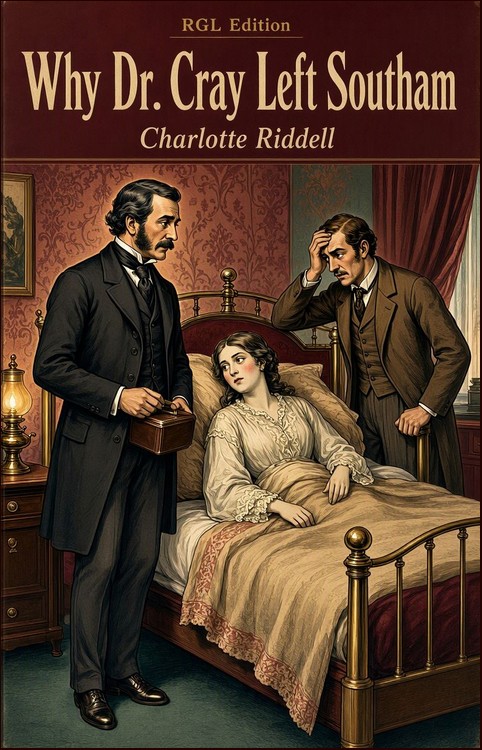
RGL e-Book Cover
Based on an image created with Microsoft Bing software
Roy Glashan's Library
Non sibi sed omnibus
Go to Home Page
This work is out of copyright in countries with a copyright
period of 70 years or less, after the year of the author's death.
If it is under copyright in your country of residence,
do not download or redistribute this file.
Original content added by RGL (e.g., introductions, notes,
RGL covers) is proprietary and protected by copyright.
RGL e-Book Cover
Based on an image created with Microsoft Bing software
Dr. Cray's tale begins as a genial reminiscence but soon darkens into a chilling confession: behind the tranquil meadows and rose-covered cottages of Southam lurked a mystery that gnawed at his professional pride and haunted his sleep. When the delicate Mrs. Glenalbyn failed inexplicably under his care, Cray's suspicions sharpened—fed by eerie midnight whispers, a husband's unsettling glances, and symptoms no medical text could explain. His desperate search for answers led him from quiet lanes to a reclusive scholar's trove of forgotten poisons, and finally to a confrontation that shattered his career. "Why Dr. Cray Left Southam" unfolds as a slow-burn Victorian thriller, where professional rivalry, marital devotion, and the shadow of murder entwine until the doctor's only escape is exile—and the truth remains as ambiguous as the Chase's dark woods.
"YOU want to know why I left Southam?" said the Doctor—meditatively knocking the ashes out of his pipe, preparatory to refilling it,—he had just come back from the diggings with a nugget big enough to make him rich, and, if he pleased, an idle man for life—and he was sitting in Jacob Graham's chambers in Gray's Inn, opposite to his old friend and schoolfellow—the same unkempt, untrimmed, unconventional Jack Cray, Jacob could remember ever since they went—a pair of graceless lads—to Todmarsh Grammar School. "You want to know why I left Southam? Well, I don't mind telling you; in fact, now I am strong enough to stand an action for libel, I don't mind telling anybody."
"There was a scandal, then?"
"Not that ever became public, except about myself; but you shall hear. It was in the spring of 1850, that, investing the small amount of money my old grandmother left me, I became partner to Dr. Montrose, of Southam. It was the sweetest place I ever beheld. Green, sloping meadows, clear streams, wooded heights, picturesque cottages covered with roses and clematis, old-fashioned houses—where old-fashioned people lived within their incomes, and saved fortunes for their pretty daughters—great mansions affected by the nobility and gentry, good boating, good fishing, good shooting; the very beau ideal of a neighbourhood. No wonder Montrose, who was getting into the autumn of existence, wanted a partner to keep his connection together, to prevent any outsider taking the cream of a practice which must have grown of itself, for he could never have made it. I may say, at once, he did not get that partner in me. We had not been trying to run in harness together for three months before he told me, as plainly as long habits of beating about the bush would permit, that either we must separate, or get in a third partner.
"'The suaviter in modo, my good Cray,' he said, 'we want, and we must have a little more of that. You see what my patients are—now, don't you?'
"I did. So we got a third partner—a man who knew even less of his profession than Dr. Montrose himself, but who was pronounced by the ladies, charming. The way he placed two fingers on their wrists was in itself a study, and the reverie into which he fell, when the delicate creatures complained of a pain 'just here,' persuaded the patients themselves, and every relation they had in the world, the case was very serious.
"Why," went on Dr. Cray, waxing indignant, "I have known that fellow keep a girl lying on her back for six months, who had no more the matter with her than I have—and yet he was liked, and I was not! To put the matter in plain language, except in desperate cases, there was a beautiful unanimity in preferring my absence to my presence. It was hard, I felt it to be so; for with all my heart and soul I loved my profession, and sympathised with those who really needed such help as I could give them. What I failed to do was, to treat a fair lady's finger-ache as though she had broken every bone in her body; and prescribe for an idle man's imaginary ailments, as if I were not perfectly aware nothing on earth was the matter with him save the lack of some real trouble to occupy his mind—always supposing he had any.
"But when there was anything dangerous in the shape of accident, sickness, or epidemic, Montrose always sent me to the scene of action.
"'Ah! Cray,' he said, 'if you had only a little tact, you might carry all before you.'
"That was after a railway smash, when our list of wounded would not have shamed a battle-field. We did very well out of that, one way or another; but, somehow, though I had all the work, Dr. Montrose got all the credit—and really, and seriously, upon my honour, Graham, he knew no more about medicine than your clerk."
"I want to know why you left Southam," Mr Graham said; this disparaging reference to his clerk reminding him of his own profession. Why should Dr. Cray suppose Cripps ignorant of medicine? For aught he knew Cripps might have attended all the lectures at St. Bartholomew's!
"I am coming to that, my friend," the Doctor answered. "Only first I must tell you it was after the railway accident he allowed me and Clara to become engaged. She was a dear little thing. I am told she is most happily married, and that her husband is doing wonders as a homoeopathist. I was very fond of Clara, and, if it had not been for that little trouble of mine at Southam, I should, perhaps, ere now have moulded myself on the Montrose pattern and become as genial a practitioner as her father."
"For heaven's sake," his friend entreated, "get on."
"What is the hurry?" asked Dr. Cray. "The night is still young, and already I imagine you must feel yourself in possession of the routine of my life at Southam.
"Was the Squire's coachman thrown off the box of the brougham, I attended his broken leg, which was duly charged to the Manor in our bill. Was there fever at the Hall, I, with the help of God, pulled the patients through. When the rector was stricken with cholera, I never left him till I could give good hope to his weeping wife. When my lord put out his shoulder I reduced the dislocation. When—"
"Jack," solemnly interrupted Mr Graham, "if you do not tell me, and at once, why you left Southam, I shall get up and put your pipe out."
He laughed. Jack Cray was always, except upon some few points, the most good-natured fellow in all the world.
"Well," he said," to cut a long story short, my worthy father-in-law who was to be had a good patient at a place called the Chase; a lady, of course—a married lady. Whenever married ladies took to be chronically invalid, we, I speak now in the partnership sense, found them the best patients of all. The name of the lady was Glenalbyn, née Frottiss. She was about thirty years of age—old looking for that—plain, not clever, extremely slight and lean, feeble, I should have said, of intellect, but Dr. Montrose maintained, 'a most superior person.'
"Anyhow, she 'enjoyed' bad health; from some cause or other she was eternally wanting the doctor. 'A poor, fragile creature,' said my worthy partner. I would have made her walk five miles a day, when I warrant, she would have been well enough. Glenalbyn (Lord! what a name; I would have split it had I been he, and taken either half) seemed wrapped up in her.
"'Such devotion,' said Dr. Montrose, 'I never witnessed. I never saw a couple so attached, and my experience, Cray,' he added, with tears in his old eyes, 'has been large.'
"As far as the Glenalbyns were concerned I had not the smallest reason to doubt my partner's assertion—neither did I. All I thought was, there could not, judging from the medicine made up, be much of consequence the matter with Mrs Glenalbyn. Every preparation sent was of the mildest and most rose-water description.
"Digestion out of order, nerves unstrung—nerves unstrung, digestion out of order—that was the way his patient swung backwards and forwards. These symptoms were occasionally varied with a slight cold, earache, pain under her right shoulder; and all the other trivial ailments that afflict the path of those who have nothing in the world to do except get ill, and send for the doctor.
"Montrose was always being sent for to the Chase, and, you may be very sure, he never, when at home or within possible reach, had to be sent for twice. Mrs Glenalbyn liked him greatly, and Mr Glenalbyn was wont to say, he did not know what in the world he should do if Dr. Montrose were to leave Southam.
"'He understands my wife's constitution to a nicety,' he generally finished; it being a peculiarity of many persons that they think the constitutions of themselves and families are a sort of special creation.
"However, to sum up the position of affairs in our happy village in the June of 1852, there were three persons resident there perfectly satisfied with each other—Mrs and Mr Glenalbyn, and Dr. Montrose.
"Summer outings, which have since then come to be considered an absolute necessity, were not at that time generally common. People who had friends went to visit them; persons who possessed business to see to went and saw to it. Perhaps the same craze for gadding existed, but it was called by another name; the difference might be that families then scattered instead of migrating.
"Anyhow, Dr. Montrose went off to stay with a nephew in Scotland, while his family remained behind. Clara had been away earlier in the year, Mrs Montrose was going later. Southam was fuller than ever, by reason of the many friends who were stopping on visits at the mansions and old-fashioned houses, but still it seemed to our senior that Perry and I could manage all there was to be done, and he said 'he wanted a change'—I am sure, I did."
"Even though Clara remained?" suggested Mr Graham.
"Yes. I did not see much of her, and whenever I did, Mrs Montrose was at our elbow. However, Clara has nothing to do with my story, nothing whatever.
"When Dr. Montrose left, the Glenalbyns were away; but shortly after his departure they returned. Mrs Glenalbyn had not found the air of the place where they were stopping suit her. Mrs Glenalbyn 'did not find the air of any place suit her so well as Southam'—Mr Glenalbyn felt sure, 'no air could suit her as well as the air of the Chase.' It is needless to say Southam repeated and approved this opinion. After all, contentment is a virtue!
"The lady had not, however, been long back at the Chase before her nerves and her digestion commenced their old pranks. Montrose was sent for, and being absent, Perry went.
"'A great pity Mrs Glenalbyn is so delicate,' he said to me, 'delightful woman!' And the mild prescriptions, the pills at night, the draught in the morning, the mixture three times a day, began again, and were duly sent till Mrs Glenalbyn was pronounced convalescent.
"Just at this time Perry had the misfortune to poison his hand. His was not a constitution to bear anything of the sort with impunity, and though I did my best for, and instead of him, he was at last obliged to knock off work, and go to his mother, who lived in Kent. He sent Southam, in his stead, a raw stripling, just fresh from the examiners, but, upon the whole, I do not think this callow bird did much more harm than Perry himself.
"As a matter of course, I could not trust such a mere child with the care of an important patient like Mrs Glenalbyn, for, although she had no disease, Dr. Montrose chose to believe her delicate, and I did not want the practice to suffer during his absence. In the chapter of accidents, it was thus it chanced that on the next occasion when Dr. Montrose was sent for I repaired to the Chase."
"It is a nice name," observed Mr Graham.
"Yes, and it is a beautiful place. As I rode up the avenue—bordered by a double row of the most magnificent lime-trees I ever beheld—I could not help thinking about the apparent injustice of conditions in the world—I had stopped to speak a word with poor old Mrs Jones, suffering from heart complaint, who was labouring away at the wash-tub, and now I was going to prescribe for a fine lady who had nothing on earth the matter with her. Of course we doctors know—"
"Cray, do please proceed with your story, and defer all reflections till after it is finished," entreated Mr Graham. "How did you find Mrs Glenalbyn?"
"As I expected—well enough if she could only have been induced to think so. I had always considered her a plain woman, but she was far plainer than I imagined. When I saw her near, in a good light and without a bonnet, I wondered what in the world Glenalbyn, who was a handsome fellow, could have beheld in her to make him propose.
"If she had been the loveliest creature on the face of the earth, however, he could not have been more attentive to, or seemed more anxious about her.
"'My angel,' he said, leaning over the back of her chair.
"'Darling,' she murmured, rapturously turning a face which might have belonged to a black monkey of an inferior sort, up to his.
"'I shall be in the next room, love, if you want me,' he said.
"'How good you are, dearest!'
"After a little more of this sort of thing he left me alone with my patient. As I knew nothing of her constitution, or, to speak more correctly, of what might be wrong with it, I asked several questions, which she answered satisfactorily. She was not a bad sort of woman, I soon discovered—weak, undoubtedly, and crazily fond of her husband, but not selfish or affected. She had no disease, that I could make out, no real ailment. She was sound of wind and limb, but no one could have pronounced her strong. Upon the whole I felt more charitably disposed towards Mrs Glenalbyn than I could have believed possible, seeing she had only about a quarter of an inch of forehead, and might have been mistaken for the 'missing link.' She was certainly a gentlewoman, and seemed amiable and sympathetic. She promised to help poor Mrs Jones, and begged me not to hesitate to mention any deserving case that came under my notice. As wives go, Glenalbyn might have done worse.
"When I was passing out he intercepted my exit, and insisted I should go into the dining room and take a glass of wine. Whilst this was in progress he asked anxiously what I thought of his wife. In reply I could but echo Dr. Montrose's words of wisdom—she was not strong, but I could detect no sign of disease; her nervous system was poor, and her digestion weak. I would send something round, and trusted in a few days to find her much better.
"Very courteously Mr Glenalbyn thanked me, adding some gracious words of compliment concerning my known skill. Altogether I left the house feeling gratified with the manners of its owners. For almost the first time Dr. Montrose and I were at one in our opinions. Husband and wife were undeniably pleasant people."
"Well?" said Mr Graham, interrogatively, as Dr. Cray paused.
"It was not exactly well," answered the Doctor; "Mrs Glenalbyn failed to recover under my treatment as rapidly as she had done when Montrose attended her. I wish to conceal nothing, so I must tell you at once I had altered the medicine. I thought that by strengthening her general system I might get her nerves and digestion into such a state that our services could be to a great extent dispensed with, but I soon found that some way or other I had made a mistake in my diagnosis. To be brief the lady got no better.
"'Are you quite sure that you understand my wife's constitution?' asked Mr Glenalbyn one day, when, meeting him in the avenue, after an unsatisfactory interview with Mrs Glenalbyn; I was bound to confess the 'improvement slower than I had expected.' 'You must forgive my seeming rudeness in putting the question, Dr. Cray; a husband's anxiety, you know, will supersede politeness—and Dr. Montrose comprehends so perfectly the cause of her slightest ailment.'
"A medical man has to bear a great deal, but though I felt Mr Glenalbyn had hit me very hard indeed on my most sensitive point, I was forced to confess I did not seem to be so successful in my treatment of the lady as my partner.
"'Do not you think it might be well to call in a further opinion?' suggested Mr Glenalbyn blandly.
"I answered I should like a further opinion very much indeed, if he was not afraid of causing unnecessary alarm to the patient.
"'Oh! I can manage that,' he answered. 'And I believe, Dr. Cray, there can be no doubt that in any case where there seems the slightest perplexity it is, even in the interest of a medical man himself, better to take a second opinion. Two heads, you know,' he added pleasantly, as if, by an old saw of that kind, he thought to rob his meaning of its sting.
"Dr. Montrose always insisted one of my faults was a conviction I knew my profession more thoroughly than any other person living. If this were so I had now got a nasty fall; and what made it the more aggravating was I had met with it in such a road. It was like a man who after having hunted a bad county gets thrown in a park, through his horse stumbling over a mole-hill."
"Poor Cray!" ejaculated his friend with suspicious gravity; for Graham well remembered how at school Jack had believed no one knew anything except himself.
"Thank heaven, however," went on Dr. Cray, with a visible increase of animation, "I was in no worse case than the London bigwig I met in consultation. That no mistake might be made this time through any hankering after new ideas, when Mr Glenalbyn asked the name of the physician I considered it would be best to meet, I unhesitatingly mentioned a gentleman in whom Dr. Montrose placed the greatest confidence; by whom, were a stronger expression applicable as regarded my partner, I should say he swore.
"He altered my medicine a little, accommodating it more to the good old Montrose pattern; was most courteous to the lady, encouraging to the gentleman, friendly to myself, and left on good terms with everybody, carrying away with him golden reasons for thinking well of Southam.
"He agreed with me Mrs Glenalbyn had no disease, and yet, perhaps, for that very reason I began to suspect she must have. If only her nerves and her digestion were out of order, why the deuce should she not get better under treatment that ought to have put her to rights at once? I could discern no disease, yet, for all that, there might be one in progress, one yet not sufficiently developed for science to detect its presence. What could it be? I thought over every possible complaint. I studied my patient's appearance. I troubled myself about her; on my honour, Graham, Mrs Glenalbyn's case began to haunt me. I never had been so puzzled before in all my life.
"As delicately as I could hint such a thing, I asked her husband if he knew of any secret trouble. He assured me she was as happy as possible. Her mind is a 'clear pool,' he added, 'I know every pebble at the bottom of it.'
"I then tried to ascertain if there were any hereditary disease; but apparently no member of the Frottiss family had ever died from anything save 'accident or old age.'
"'You are vexing yourself too much over what I am sure is really a very simple ailment,' said Mr Glenalbyn. 'I am not uneasy now; when Dr. Montrose comes back he will set everything to rights.'
"If such a speech were not enough to drive Montrose's partner to frenzy, I should like to know what you would consider sufficient cause to do so!
"That same afternoon I had to visit a patient residing at some distance from Southam, and, as I returned, the fancy took me to make a slight detour through the woods that rose dark and dense at the back of the Chase. They were no part of that property, and the Southam public was free to wander through them at will; possibly that was the reason the Southam public seemed determined to eschew them altogether. They were the loneliest, loveliest portion of the neighbourhood, and I always chose their green glades when time and opportunity permitted.
'I was walking leisurely along the velvety turf, with my horse's bridle thrown over my arm, when, just before I came to a bridge under which the river meandered gently on its way, I met a Mrs Coulton—without exception the greatest gossip in England.
"I tried to pass her with a bow, but she would not let me. She forced me to stop while she stood chattering over the affairs of the village. 'What did I think of the rector's sermon on Sunday? How was Mr Perry? When would Dr. Montrose be back? Why did not Mrs Montrose and Miss Clara accompany him? Had I heard Miss Mowbray was going to be married—yes, to that tall, dark-looking gentleman who sat at the right-hand corner of the family pew on the previous Sunday.'
"I had nearly cut my way through this barrier of talk, and was on the very point of escape, when she said:—
"'And so I hear poor Mrs Glenalbyn is worse.'
"'I am not aware that she is worse,' I answered.
"'Oh, indeed! I was told you met a great London physician there the other day, and that his opinion was she would require the most extreme care.'
"'If he made any remark of that sort, he did not make it to me,' was my somewhat incautious reply.
"'Dear, dear! What a place Southam is for magnifying every little bit of news! But then, Dr. Cray, you see people would naturally say if Mrs Glenalbyn is no worse, why have a great London doctor to see her? Dr. Montrose never needed any other opinion than his own. For my own part I shouldn't wonder if she died; and then all the Southam ladies will be pulling caps for that fine handsome husband of hers. As they walk up the aisle together, sometimes I think, what a contrast!'
"I broke away at last, but after I had crossed the bridge I still heard Mrs Coulton's stream of talk maundering peaceably along. The river did not ripple more ceaselessly between its banks than Mrs Coulton's tongue wagged about business with which she had no concern. What was Mrs Glenalbyn's life or death to her? What right had she to institute comparison between me and Montrose?
"It was late—late for Southam I mean, before I went to bed that night. The day had been hot, and my work heavy, and I was tired, for all of which reasons I fell asleep directly. At the end of about a couple of hours, however, I was awakened suddenly by someone saying in my ear, distinctly, in quite a matter of fact voice,—
"'Mrs Glenalbyn is dead.'
"I started up and looked about me. There was not a soul near. The moon was shining broad and clear into the room, and I could see no creature in it save myself. Nevertheless, I felt quite satisfied someone must have spoken. I was so sure of this I jumped on the floor, and putting my head out of the open window, looked if any messenger were standing on the broad step. No; in the length and breadth of that quiet street there was no living creature, not even a dog. The moonlight lay mellow on the sandy horse-road. The white houses gleamed whiter in its beams. But, look which way I would, not a human being was in sight.
"'What a fool I am,' I thought, and went back to bed again. Still, tired though I was, I could not immediately settle myself to sleep. Mrs Glenalbyn's case would persist in obtruding itself. Mrs Glenalbyn's lack of vital power troubled me to such a degree that at last I thought of getting up and dressing myself, and probably I should have done so but that while I was considering the pros and cons of such a course my eyes closed, and without effort I dropped off into dreamland.
"What I dreamed about I have not the slightest recollection. I must have slept and dreamed a long time, for when I again woke, which I did in a state of terrified alarm, the sounds of labour and of life were commencing. It was broad daylight, and a lovely morning.
"But just then I did not notice the beauty of the morning. I was differently engaged. I was wondering who it was that had said in my ear and startled me, 'Look at his eyes! look at his eyes!' Whose eyes? Why, I knew, I had looked at them more than once.
"I could not shake off the influence of this second fright as I had done the first. I dressed, went downstairs, and I took a long solitary walk.
"What did it all mean? In my sleep I knew I could only have been following out to its legitimate end some course of thought I had been pursuing when awake. Hitherto there was a point where I invariably stopped short, where the actual ended, and the vague and unintelligible began. Now I knew where my doubts had all hitherto been tending. I was suspicious of Mr Glenalbyn—I had felt suspicious of him for weeks.
"Sitting down beside the river, I tried to recall everything I had ever heard concerning that gentleman. There was not much, but I recollected enough to show there might be some ground for my suspicion. Good Heavens! whither was I drifting? Did I really believe the man wanted to be rid of his wife? Did I feel sure he was murdering her before my eyes? I went home and shut myself up. I looked out every book I could find bearing on the points in the case which puzzled me. I suffered nothing to escape my attention likely to elucidate the mystery. I paced my room till I was tired; I thought till I was weary; and at length, when I received an important summons forcing me to go out, I had still to confess myself baffled."
"Did you imagine he was poisoning her, then?" asked Mr Graham, his interest finally aroused.
"Yes—felt sure of it, though there was no poison I was acquainted with that exhibited the symptoms which so puzzled and perplexed me. Needless to say, I went that morning as soon as I could to the Chase. Mrs Glenalbyn seemed neither better nor worse; but she complained of having passed a bad night, and Mr Glenalbyn, who was present, asked if I could not give her something to induce sleep.
"I shook my head, and said, perhaps a little foolishly, that what we wanted to get rid of was the cause which prevented her sleeping.
'"It strikes me, Doctor,' he answered, 'you are a little too fond of searching for causes—don't you think that, till you can find them, it might be wiser to deal with effects.'
"'I will send some sedative if you wish me to do so,' I replied, taking no notice of his taunt; but as I walked away from the Chase, I determined I would not send a sedative, and secondly, that before twelve hours had passed I would try to get to know something more of Mr Glenalbyn's game.
"I could only think of one man in London likely even to be able to help me. If he were alive, I knew I should find him at home, for the simple reason that from year's end to year's end he never went out. He had just enough money to keep a little old-fashioned house, in Westminster, over his head. It was situated near the Horseferry Road. He let off the ground floor to a man who had been forty years clerk in some old bank in the city; he himself occupied the two floors above. He had spent his prime of existence and all his spare cash in purchasing old books, and now in his old age he shut himself up to enjoy their possession.
"I had not seen him for a long time, but I remembered, quite suddenly, he had at one period made poisons his study. He even talked of publishing a book, entitled 'The Poisons of All Times and All Nations.' It had not appeared, however, and I did not think it was likely to appear."
"Why, the title alone," Mr Graham was beginning, when doctor Cray stopped him—
"I am coming to the gist of my story now—let me finish. The same day I ran up to London and found Mr Ordford in cap, slippers and dressing gown. The place might have been cleaner, and so might he for that matter, but I gave little heed at the moment to externals. Time was of value to me. If things at the Chase were as I suspected, not an hour ought to be lost. He was very glad to see me, and offered, in an old-fashioned way, 'such hospitality as his poor house boasted,' but I told him I could not stop—that I had come to him for help. In ten minutes I had told my story, described the symptoms, and asked if in his researches he had come on any poison in use amongst the Hindoos or North American Indians likely to reduce the vital power as I had seen. Ordford had studied medicine, and though some reason—laziness, I suspect—prevented his following it as a profession, he was as well able to follow what I said as the first doctor in London might have been.
"When I had done he rose, and, unlocking a cupboard, produced a manuscript book covered only with brown paper. There were about a hundred such on the shelf piled one above the other. On the outside of each was pasted a piece of white paper. That he first brought out was labelled—
"Opening the folio and running his finger down the index, which was singularly clear and copious he asked, 'What reason have you for thinking your man has resorted to India for his materials?'
"I had no better reason to give than that his father was long stationed in India, he himself was born there, and I vaguely recollected hearing something about when he was 'amongst the Indians.'
"'Ah! that would not be the Hindoos,' said Mr Ordford. 'There is nothing in this volume to help us. Let us try another,' and he produced a second manuscript book labelled—
"I never saw anything so full as that old man's repertory. I will not say every poison on earth was to be found mentioned there; but it seemed to me an almost exhaustive analysis of a subject which has never yet received sufficient attention. The symptoms—the result—the antidote, if any—the mode of use—everything you could speak of almost, was written down in a clerkly hand, with a conciseness and brevity that seemed to me amazing.
"'There is nothing to help us here either,' he said, after he had referred to several books and examined many papers. 'Shall we try Italy?'
"We tried Italy with the same result.
"'What shall we do now?' he asked . 'We are just about as wise as when we started.'
"I felt woefully disappointed. 'Have you no recollection at all,' I inquired, 'of hearing anything or reading of some simple subtle poison, chemistry cannot trace, medicine cannot combat?'
"He smiled, and laid his hand on his manuscript treasures, as he answered, 'Why these are full of such. Chemistry as a rule could not detect them—as yet science cannot combat them. In most cases the antidote, provided by nature for the bane she provides likewise, is known to man, but not to civilised man. Why, our own fields and hedgerows produce the most dangerous poisons, and to how many of them can we point the antidote? And yet there can be no question they grow almost side by side. If you see a nettle, be sure a dock is not far distant, and if we only were wise enough to know, we should be able to place our hand as instantly on the herb from which virtue may be distilled, as on that containing the deadliest poison.'
'"Look here,' he added, and producing another book he placed it before me. This contains a list of poisonous plants growing in the three kingdoms—plants fatal to man or cattle, or both. Here is a harmless-looking weed (for obvious reasons the author refrains from giving either the common or botanical name) which did a good deal of mischief in the middle ages. Ah!—'
"He pushed back his cap, he drew a long breath, he turned towards me, and then with his forefinger pointed to the manuscript.
"'There you have it,' he said, 'there you have your mysterious illness, your "symptoms which baffle the most skilful leeches," your method of preparation, your mode of administration, the time it takes to kill by almost imperceptible degrees, and the antidote,' and Mr Ordford folded up his spectacles, put them in their case, took out his box, refreshed himself with a pinch of snuff, and felt like Sir Christopher Wren when he saw from London Bridge that the lantern spire of St. Dunstan's in the East defied the fury of the gale, and that his faith was justified.
"'My dear Ordford!' was all I could say for a minute.
"'What are you going to do now?' he asked.
"'I don't know,' I answered. 'First tell me where I can get this herb—this antidote—I do not know it even by name.'
"'It was freely grown in English gardens in the time of Gerard,' he replied; 'now it has fallen almost out of cultivation, but it can still, no doubt, be procured.'
"'Where, for Heaven's sake?' I asked.
"'In Covent Garden, I daresay.'
"I could not get it in Covent Garden, however, but was there told where it might be kept, and being fortunate enough to secure a small portion I hastened back to Southam.
"Already I had matured a plan of action—already I was taking the first step in a course which compelled me to leave my partner, my promised wife, give up my professional prospects, and start for the diggings. In wild haste I decocted the antidote, scented it with poppies, labelled it 'Sedative draught,' and rode over myself with it to the Chase. Mr Glenalbyn was absent, and not expected back till late. So much the better.
"Next morning found me again at the Chase. Mrs Glenalbyn had slept a little, and said she thought the draught had done her good.
"'I know you do not like opiates, Doctor,' said Mr Glenalbyn, who came into the room at this juncture, 'but you see I was right. If you think well, she might have another draught tonight—a little stronger.'" I saw what his drift was, but only answered,—
"'I should like to leave one night between.'
"After I had said 'Good morning' to my patient, Mr Glenalbyn, as usual, came down the staircase with me. Instead of going to the hall-door, as he expected, I asked if I could speak to him for a minute.
"'Certainly,' he answered, looking a little surprised; 'you don't think my wife worse, do you, Doctor?'
"'I do not consider her worse this morning,' I replied, 'but, looking back over a week, I cannot blind myself to the fact that she is not making the progress she ought. Has she any friends, that in case of—of—'
'"Good Heavens!' he cried, 'you don't mean to imply that there is danger!'
"'I am not at all satisfied,' I said. 'I have never clearly understood what was the matter; I only see that, from whatever cause, Mrs Glenalbyn is losing strength daily; and, though the end may be long deferred, still if some change does not soon—'
"I stopped. I had been looking him straight in the face, and saw his eyes flash with a momentary delight, which brought again the sleeping horror to my mind. I felt I turned colour—I felt the expression of my face change—but evidently he misunderstood the cause of my emotion, for he exclaimed,—
"'Well, rest assured of one thing, Dr. Cray. Whatever may happen I shall not blame you. So far as you could, you have done your best—'
"'God knows I have!' I interrupted.
"'And though I may foolishly have imagined Dr. Montrose, had he been here at first, might have done more—'
"'He could not,' I interposed.
"'However that may be, you have done your utmost to save her. Do I understand you to say—I am so stunned with the suddenness of the blow—there is no hope?'
"'While there is life there is hope,' I replied; 'but still, unless some great alteration takes place—'
"'Quite so—quite so; I comprehend,' and he turned his head aside as if struggling to conceal the agony of his feelings; then, after a pause 'Her poor father—and—mother, wrapped up in her—only daughter—only—child. Do you think I had better telegraph for them?'
"'There is no actual necessity for such haste as that, I should hope,' I answered, well on my guard to avoid exciting his suspicion.
"'Still it might be more satisfactory. And you do not think you will send her another sleeping draught?'
"'Not tonight. I mean to try altering the medicine a little, and may look in again this evening.'
"'Do so—do so, by all means; and—Cray—if I have seemed at all to question your skill, forgive me; my anxiety has made me occasionally scarcely know what I have been saying.'
"'All now depends on the father,' I thought, after I had left Mr Glenalbyn, his eyes a shade too near together, with a glitter in them which was not agreeable to contemplate.
"Alas! next morning when the father came I saw he was a degree more feeble mentally than his daughter. If anything depended on him she was a dead woman; but Mrs Frottiss was a different sort of person altogether—strong, sharp, brisk, decided—to her I determined to appeal.
"She took me apart from the others, and asked me many questions. She grew so earnest in her maternal trouble and anxiety, that at last she put her hand on my arm and led me through the open window.
"'I can't understand it at all, Doctor Cray,' she said, and her voice never faltered, though her eyes were full of tears; 'it seems so sudden—so inexplicable. What is my daughter dying of, Doctor? Oh! pray, pray be frank!'
"Instantly I took my resolution. 'Mrs Frottiss,' I said, 'I can't tell you here. I want to speak to you alone. Can you make any excuse to come into Southam this afternoon, and call on me. I have something to say which is most important, but—'
"She looked at me keenly, then—,
"'You don't want Glenalbyn to know.'
"I inclined my head.
"She was a wise woman, but she had not grasped the truth, yet.
"Three hours later she was sitting in my room—Mr Glenalbyn's carriage waited outside my door, Mr Glenalbyn's horses were impatiently pawing the ground.
"'I will come direct to the point,' I began. 'Has Mr Glenalbyn any interest in your daughter's life?'
"'No more than in her death,' answered the old lady. 'She inherited a large fortune from her godmother—she ran away with her husband, there were no settlements; he has everything now, and when she dies he will have everything just the same.'
"Then I told her. I began at the beginning, and traced every step of the way. I gave the antidote into her hands and begged her to see it was taken. I said I knew it was not too late to save her daughter's life, but unless she could remove her entirely from the Chase, I failed to see how Mrs Glenalbyn's safety was to be ensured.
"'Would she consult Mr Frottiss,' I suggested.
"'Not of the slightest use,' she answered. 'See, Doctor Cray, are you willing to repeat what you have told me, in Mr Glenalbyn's presence?'
"For a moment I hesitated, but after that I said, 'Yes, I am.'
"'Then I shall telegraph for our solicitor as I return to the Chase.'"
"What was the result?" inquired Mr Graham curiously.
"Such a scene as I trust I may never be present at again. I told my story, and I believe if Mr Glenalbyn could have killed me on the spot, I should not be talking to you now. He vowed and protested—he stormed and raved. He said I was an ignorant impostor, who desiring to escape the consequences of my own want of knowledge, had devised this vile plan of fixing guilt on a husband who only loved his wife too much.
"Like a rock the solicitor stood firm.
"'All we want,' he said, 'is to remove Mrs Glenalbyn; we shall take no further steps.'
"'Because you cannot,' interrupted Mr Glenalbyn.
"We shall remove Mrs Glenalbyn to her father's, where I trust she may recover her health—we desire no scandal—we claim no portion of her fortune.'"
"You got her away, I suppose, on those terms?" said Mr Graham. "Did she recover?"
"Oh, yes, she recovered," answered Doctor Cray, with a grim smile.
"And—"
"The first thing she did was to rejoin her husband! and her next to state publicly I had tried to sow disunion between them. Such is Woman's Devotion!
"Husband and wife and Doctor Montrose and Perry all joined forces against me. A party was formed, I found it useless to resist, and that was the reason I left Southam."
"And is Mrs Glenalbyn still living?"
"No; she died the victim of bronchitis—at least so it was reported. It is possible she succumbed to Montrose and the malady. I don't think Glenalbyn was to blame that time."
"He got all her money, I suppose?"
"Every farthing. He is married again, and still lives at the Chase. He put up a monument, with a most touching inscription to his wife's memory, in Southam Church."
"What is Ordford doing?"
"I do not know; for one thing—he is dead."
"And his manuscripts?"
"He died without a will, and the heir-at-law sold them for waste paper."
"And you, Jack, do you propose to take up doctoring again?"
"No—I mean to follow Ordford's example, and write a History of Poisons."
"Oh!" said Mr Graham, and it would have been difficult to add anything to the significance of that interjection as uttered by the barrister.
Roy Glashan's Library
Non sibi sed omnibus
Go to Home Page
This work is out of copyright in countries with a copyright
period of 70 years or less, after the year of the author's death.
If it is under copyright in your country of residence,
do not download or redistribute this file.
Original content added by RGL (e.g., introductions, notes,
RGL covers) is proprietary and protected by copyright.