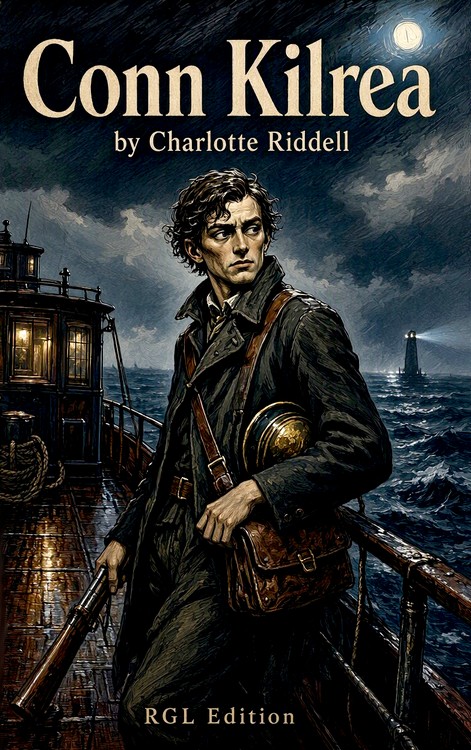
RGL e-Book Cover
Based on an image created with Microsoft Bing software
Roy Glashan's Library
Non sibi sed omnibus
Go to Home Page
This work is out of copyright in countries with a copyright
period of 70 years or less, after the year of the author's death.
If it is under copyright in your country of residence,
do not download or redistribute this file.
Original content added by RGL (e.g., introductions, notes,
RGL covers) is proprietary and protected by copyright.
RGL e-Book Cover
Based on an image created with Microsoft Bing software


Handsome Phil and Other Stories,
F.V. White & Co., London, 1899

Handsome Phil and Other Stories,
F.V. White & Co., London, 1899
Conn Kilrea is a brooding young soldier whose life of quiet melancholy is shattered when a spectral figure—an ancestral omen long feared by his family—rises out of a barrack-room shadow and fixes him with a deathly summons. Haunted by the apparition and driven by a sudden, desperate longing to live, Conn is thrust into a whirlwind of dread, duty, and unexpected grace: a frantic night on the seashore, a tender farewell to his beloved Kathleen, a race across Ireland to the bedside of the grandfather he once wronged, and a reckoning with the past that may yet redeem him....
EVER since morning, when the early post brought him a letter, Private Conway Kilray had been in low spirits; not by any means an unusual occurrence, for no man of his regiment could remember ever seeing him in good, but on the evening of the 14th December, 1892, he seemed to have sounded even a lower depth of depression than that wherein he usually dwelt.
He was young—not eight and twenty—fairly good looking, healthy, in full enjoyment of such faculties, bodily and mental, as God gives to most men, and yet possessed by a demon of melancholy, discontent, or unavailing repentance, that made him a mystery to his comrades and the dullest companion possible.
All the men among whom his lot was cast had tried to pierce the mail of his reserve, and retired worsted, feeling as though they had struck against something tougher than chain armour.
They could not make him out; he was always willing to help, always ready to do a good turn, always civil and quiet spoken, but always also grievously depressed, weighed down by some sin or wrong or trouble which lay heavy at his heart.
When, on the evening of that 14th of December, he entered the barrack library at Weyport, the gloom of his expression so awed the few soldiers present that no one spoke while he passed to a desk, followed by a wiry Scotch terrier, who, being indeed nobody's dog, but only a poor stray, had conceived a fancy for the silent, lonely man.
Private Kilray seemed to have brought a blight into the room with him, which hushed the light chatter of those who were playing cards, and caused others who had selected reading as an amusing way of killing time, to glance constantly at the man who sat writing, cloaked with some strange gloom they could not understand, while the dog lay at his feet silent and self-contained also.
A few of those present winked at each other, or shook their heads gravely, but neither action was of any real import, for they knew nothing of what had put one life out of joint, whether murder, burglary, highway robbery, or forgery.
Some who had once been privileged to see Kilray in a passion held that the first-named crime had driven him into the army, but the most general belief, founded perhaps on his bold and dashing calligraphy, was that signing a name not his own would eventually be found sufficient to account for much that puzzled them.
"Depend upon it, he took to gambling, and then used his pen once too often," said the oracle of "The Light Bays," when Kilray first joined. "He is Irish, yet he enlisted in England, as if there were not always regiments enough stationed in his own country, any one of which might have served his turn. No; we'll hear more about him after a while, and then the whole thing will be plain as a pikestaff."
At the end of eighteen months, however, things were as dark as at first. No inquiries had been made for Conway Kilray. No friend or foe had asked whether he were living or dead. A few letters arrived, which he answered and posted himself. When first he came among the Light Bays a report soon got about that he knew more concerning horses than the riding-master himself, who was asserted to have said he had nothing to teach the young recruit except how to trot.
Private Kilray had found that piece of learning difficult exceedingly, as most good riders do, but he set his teeth and curbed his temper, and ere very long could trot with the best. For the rest he groomed a horse excellently well; no one found any fault with him, no one said a word against him, but yet he was not popular. He walked a living enigma among his fellows, never making merry, never laughing nor joking, never taking part in any buffoonery nor more sober enjoyment. He was sufficient unto himself, which it may here be said is a peculiarity society—any society, whether high or low—cannot forgive, and naturally, since it is unpleasant to be continually getting figurative slaps in the face in return for well-meant civility.
On the evening when this story opens, Private Kilray had not advanced at all in the favour of his comrades, rather the reverse, as he had chosen to keep himself to himself. They, after some attempts at friendliness, held aloof, and looked at him as he sat at his desk with a certain amount of curiosity and dislike.
Never heeding them, he wrote on, filling sheet after sheet, which he blotted off hastily, folded without once glancing over, and placed in a directed and stamped envelope. Then he pushed the letter from him, and, resting his elbow on the desk, leaned his head upon his hand as though tired.
He sat so long thus that a man who was reading close by suspended his occupation in order to watch him. While he was doing so he became aware of a singular change in Kilray's manner. At first while engaged in thinking out some evidently unpleasant subject he kept his eyes dreamily fixed on a corner of the room near at hand which lay in shadow.
After a time, however, he lifted his head and peered into the darkness, as though he saw something he could not quite understand. Involuntarily the man who was watching turned to see what his comrade was looking at, but failed to discern any object.
He had withdrawn his attention only for a moment, yet when he glanced again at Kilray he perceived his attitude was totally changed. Both his hands firmly clenched were on the desk, he was sitting bolt upright, his eyes, filled with an expression of incredulous horror, were fixed on something he perceived looming out of the darkness.
He was white as death—he who was never known to fear—and a sort of grey shade came over his face, as with a shudder he rose and tried to pull himself together.
Then, for the first time, the other noticed that Kilray's terrier was looking into the corner also, every hair on his body standing more upright than ever.
"Hullo! have you seen a ghost, old man?" asked a new-comer who had just lounged up to the little group.
Startled by the question, Kilray turned swiftly round as if to resent it. Instantly recollecting himself, however, he laconically answered "yes," picked up his letter, and strode out into the night, followed by his dog.
INSTINCTIVELY choosing the least frequented road, Private Kilray, feeling like one in a nightmare, walked on till he reached the seashore, and heard the waves washing in over a sandy beach.
It was a dark night—lit not by moon or star—but none too dark for a man, whose whole mind was filled by thoughts of eternity, to wrestle with the terror of that awful warning which had so lately, as he believed, been delivered to him.
Before he began to write he would have told anyone, and according to his then belief, truly, that he felt his life not worth living, that there was little pleasant in the past to look back upon, and nothing hopeful in the future to look forward to; but now, when it seemed his time was come, he could have prayed for more years to be given unto him—years, whether joyful or sorrowful, that he might live and not go to the grave while it was yet noon.
The love of life is a thanksgiving to God. Which amongst us, having some jewel of price received from some earthly friend, decries its value! If we met with such an ingrate, we should write him down accordingly, and what must we say of the man who fails in his heart of hearts to praise God for placing him in a land overflowing with beauty, rich with colour, fragrant with perfume And why? Because he has to work for his day's wage of things good and fair and sweet; he is discontented because he wants to choose his wage rather than accept that his Maker bestows!
Standing by the seashore, with the night wind fanning his face, with the waves' sobbing music sounding in his ears, with heaven's canopy above him and the dear earth beneath his feet, some dim understanding came to Private Kilray that he had been a very churl—that he had not made the best of life; that like a child in a temper he had refused to smile when Nature was putting out her loveliest playthings for his delight, and turned his back on man's more clumsy efforts to please and befriend him.
Ah, if he could only have seen sooner—if sight had not come so late! And then and there he bared his soul before God, and talked with the Almighty as he might aforetime have talked with man.
He had thought in the first bitterness of his anguish, he, who was done with life, to tear his letter to bits, and cast it to the winds; but his heart failed him now. That letter lay close to his bosom, close and warm like some throbbing human heart, and he could not fling it to the mercy of the elements as a thing of no account.
It is a sore trial to have to die, but it is a worse trial to die hard, with an angry and rebellious spirit, with a hand which refuses to take its loving Lord's as guide through the awful darkness of that valley which, willing or unwilling, our feet must tread.
Through the darkness the truth of this came home to one who felt himself standing on the very border of that unseen land whither he was journeying.
"Dear God," he cried in his agony, where there was no one save God to hear, where the night winds alone stirred, and only the sea-birds and the waves broke the stillness, "dear God, forgive my sins, and grant me courage when Thy appointed time comes, to give my soul back into Thy holy keeping, bravely and without fear, for Christ's sake—Amen." And he fell down beside a piece of rock, and covered his face, even though it was night, and dark, and arose comforted!
After a while, hearing some clock strike, he retraced his steps to the barracks, posting that letter by the way. His comrades, who were all acquainted with the fact that Kilray had actually seen a ghost, presumably of someone whose death he would ere long have to answer for, spoke to him with a strange reserve, which did not affect the young man at all.
He knew what they did not know. He was attended to the barrack-room by a face never seen since early childhood, which he had quite forgotten till it looked solemnly at him from out of the darkness of that unlighted corner.
The ghastly inheritance of an old family hovered over his bed, and caused foreboding dreams the while he slept uneasily, surrounded by the careless, the indifferent, the sorrowful, the struggling, the bad and the good till getting-up time came, and awoke with its noisy bustling, memories he would have fain forgotten for a little longer.
It was afternoon before he could snatch a minute in which to write another letter as short as the first had been long.
Dearest Kathleen (he said),
I have bad news for you, love; and yet, perhaps, it is the best I could have to tell you, because it points to the cutting of many a difficulty—to the ending of all anxiety.
I have seen Lord Yiewsley. You know what that means, so I need add no more. I will meet you when and where you appoint to say good-bye. Do not grieve, dear. Fate has settled matters better for us than we could have done for ourselves. God bless you, my faithful darling.
Ever in this world and in the next,
Your devoted lover,
Conn.
If I wrote a word yesterday that caused you annoyance, forgive me. I hadn't seen him then, though the envelope was scarcely closed before he appeared. I thought at one time of tearing up the sheets, but could not—my last love-letter! Oh, sweet! pardon all the pain I have given you—I, who would have died to save you sorrow.
As the day wore on, as the twilight faded and merged into the gloom of evening, the restlessness which had, nearly twenty-four hours previously, driven him out through the night to the sad sea-shore, returned with greater intensity. He could not sit still. He felt like one who, having received sudden marching orders, wants to utilize every moment of the brief time left at his command; who tries to pack, to purchase, to make arrangements, to go and bid farewell, to be at home when someone dear calls, to clasp hands in a parting that may be eternal, to read letters, to write them, to make his will, to speak the tender words which always sound so inadequate. He felt all this; and over and above and beyond he longed for the touch of humanity, to hear the sound of a mortal voice bringing his trouble within the range of possibility. Death and dying in a natural way would have been bad enough, but to have to depart, he knew not how, at the beckoning of a ghostly finger, at the wordless bidding of one from out the world of spirits, added a new horror to the gruesome mandate. He must speak or he should go mad. So, as a sort of forlorn hope, he betook him to the chaplain, though, indeed, he knew rather less of that reverend gentleman than he did of his commanding officer.
At that moment, however, he was not thinking much of incongruities of rank or inequalities of station. He felt only intent on getting a straight-forward answer to a question which was troubling him; therefore, when once he found himself in the clergyman's presence, and taken a chair, having been politely bidden to sit, he said—
"I am distressed in mind, sir; so I thought I would come round to you."
"It is my earnest desire that all who are distressed in mind or uneasy in conscience should bring their perplexities and burdensome sins to me, that I may tell them where to find relief," was the answer.
"You are very kind;" and the pair looked at each other.
"Not at all; I am only doing my duty," said the chaplain, graciously, though he did not quite like or understand his visitor.
If it be true that there is no bar to human progress like a theory, it is equally true that a foregone conclusion destroys human usefulness.
Mr. Pellock had accepted the charge of military souls without the faintest idea of what those souls were like All he felt sure about was that they were wrong in the lump, and he dealt with them accordingly. They were given to drunkenness, brawling, folly, and many other sins—that is, whole regiments, excepting here and there a picked saint, a brand plucked from the burning, who believed in Mr. Pellock, in his sermons, his ministrations, his exhortations, his rebukes. If ever there was a square peg fitted painfully into a round hole that peg was the Reverend Carus Pellock. Of the British soldier, save as a good fighting creature, he had not the smallest opinion. He said sadly that he knew poor Tommy Atkins too well, but there were officers, old and young, who inclined to the belief he knew him too little. However this might be, Mr. Pellock did not think much either of the raw recruit or the finished warrior.
"A soldier disheartened him," he was wont to declare in moments of sadness, when the result of all his efforts seemed about as satisfactory as making ropes from sea-sand. That he might be saved seemed to Mr. Pellock possible, but only through a miracle. Nevertheless, the chaplain tried hard to do his duty, preached at, and to, and over the heads of his people, and was always courteous in a highly dignified sort of way.
He did not like anyone presuming on his affability though, and doubted whether Private Kilray had a proper appreciation of the gulf which yawned between a simple unit in her Majesty's famous regiment, The Light Bays, and the man who had been good enough to undertake the charge of all The Light Bays' souls.
For this reason he answered "not at all," politely, yet with a certain frigid restraint, which failed to produce the desired effect.
"You remember, sir, perhaps, preaching a sermon about angels some little time since."
Remember! as if the Rev. Carus Pellock ever forgot the matter of his sermons. "Really," he thought, "this is very remarkable—very gratifying to find one of the rank and file so appreciative! But he is Irish evidently from his accent, and the Irish are more open to impressions than the English. I must know more of this poor fellow," all of which pleasant music Mr. Pellock played to himself the while he answered—
"You are quite right. I rejoice to find you were so attentive."
"In that sermon you said the angels were always with us."
"Just so, just so," purred the chaplain, feeling like a cat whose back is being stroked gently.
"And I suppose you believed what you said?"
Here was a question to be put to a clergyman wont to talk about angels and archangels familiarly, as though he had been brought up amongst them!
"I should certainly not preach anything I did not believe implicitly," he answered in such a crushing tone that his visitor, humbly apologetic, replied—
"No, sir, I feel certain of that; but it is hard to understand. That was all I meant, I assure you; I intended no offence."
"It is very odd," thought the chaplain, appeased, "but this private speaks almost like a gentleman." Then he said aloud—
"Many things in which we believe most firmly are difficult to understand."
"No one knows that better than I," was the answer so sadly spoken Mr. Pellock felt constrained to reply—
"Only tell me your doubts, and I will try to help you to overcome them."
"I don't doubt; I only wish I could," was the unexpected rejoinder. "You preached another sermon, sir, on All Saints' Eve," continued Private Kilray, before the clergyman could interpose. "I remember it particularly, because in certain districts in Ireland All Saints' Eve is kept with religious observance."
"Very proper, very proper indeed," said Mr. Pellock, who had not the faintest idea what the observance was, and felt more convinced than ever the Irish must be a charming people to work among.
"And if I did not greatly misunderstand," went on Private Kilray, as though he had not heard the chaplain's approving remark, "you are of opinion it is not possible for departed spirits to return to earth."
"I do not imagine I said impossible—only that such reappearances have never taken place," answered the chaplain, immensely interested—so greatly interested that he scarcely noticed the wording of Private Kilray's criticism.
"Never taken place!" repeated that person; "think a moment—only think."
Mr. Pellock did not need to think, and recovered his mistake by a clever flank movement. "Nearly two thousand years have elapsed," he said reverently, "since the Divine reappearance, to which, no doubt, you allude. It was miraculous, and we have no right to quote it as a precedent. What I spoke against, and always shall consider my duty to speak against, are the legendary stories inspired by superstitious fear, and the wicked and pernicious falsehoods continually poured forth from the press, more especially at Christmas—Christmas of all times!"
"But if those legends and what you call falsehoods are true, or at least have a substratum of truth? Dead men did appear to living men once—take the case of Samuel, for instance—why should they not do so now?"
"Idle inquiries are always profitless," was the reply. "Surely it is enough for us to know, that though all things are possible, as a matter of fact the dead do not now return. Tell me the sin or sorrow that is troubling you, and I will do my best to advise and console, but I must decline to discuss abstract questions."
"Then, if I were to tell you that no later than last night I saw one risen from the dead, what should you say?"
"I should say you need either a confessor or a doctor."
"In other words, that I am either criminal or mad; but you mistake, sir; the man whom I saw was done to death more than a hundred years before I came into the world, and during the whole of that time he has appeared to every member of my family previous to his or her decease. He came to me because I have been thankless and foolish, and did not value the gift: of life; and now I want to live—I want to live!"
"You want a doctor, your hands twitch, your cheeks are flushed, your lips parched—you are in an overwrought and highly nervous condition. Go to a doctor, and repeat to him what you have told me. He will know how to deal with your complaint. You ought to see him soon, so I won't keep you longer now, but I should like on a future day to have some more talk with you."
Hearing this broad hint, Private Kilray rose at once and said, in his best soldier manner—
"I thank you, sir, for your kindness; good-night." Then, after saluting, he went out. "Clear case of mania," thought Mr. Pellock. "Religious mania!—worst form of all. An interesting case." After which, the conversation having suggested an idea to him, he turned to his desk and wrote—
"On the fleshy walls of our earthly tenements a mysterious hand is always writing the solemn warning, 'This night thy soul shall be required of thee. Let us take heed that we do not neglect it," with which burst of eloquence he concluded a sermon on the following Sunday—a sermon no single person present understood, for Private Kilray, who might have hazarded a wide conjecture as to its meaning, was not amongst the audience.
NO. Private Kilray, doubtless to his great disadvantage, did not hear Mr. Pellock's famous sermon on the text, "Now, the king's countenance changed, and his thoughts troubled him," which was long remembered among the "Light Bays" by reason of its utter irrelevance to any subject likely to touch or interest that gallant corps.
He was gone on leave. After his interview with the chaplain, he did not seek medical advice; rather, when the proper time came, went to bed feeling sorely depressed, not merely on account of the many things he had from boyhood left undone which he ought to have done, and the many more things he had done which he ought not to have done, but also by reason of the utter impossibility he had always experienced of getting anyone to understand him—except Kathleen.
She was the one sweet exception in a bitter world, and he lay awake a long time, wondering whether there could be anywhere on earth so brave, so patient, so wise, so dear a girl as Kathleen Mawson, once in her little way an heiress, now a homeless orphan, companion to Mrs. Fitz Donnell, widow of Admiral Burke Fitz Donnell, who wrote his name large on the naval history of England? Yes, she was living with that lady in Lowndes Square, and had told him no further back than the previous morning that Mrs. FitzDonnell would not let a private soldier inside her door, not even if that private were her own son. On reading which statement, Private Kilray waxed exceeding wroth, and, not waiting to consider whether there might not be some faint rhyme or reason, or sense, or expediency or anything save prejudice in the amiable old lady's objection to receive such a visitor, delivered his soul of a passionate tirade against a state of society which had compelled him to accept her Majesty's shilling, and Miss Mawson a salary.
This was the letter on which he had been engaged while Lord Yiewsley, dead and buried for a century and a half, or thereabouts, was stealing back from wherever he had gone to, in order that he might frighten one of his enemy's descendants almost out of his wits.
In this amiable intention he succeeded, for Private Kilray, who would have gone into battle with a light heart, was quite demoralized by the sight of that apparition which came he knew not whence, and went he knew not where.
When quite a child, living with his mother on a lonely seashore, he had one night sprung up out of his sleep uttering fearful shrieks and earnest entreaties for his nurse "to take that man away," which shrieks and entreaties were remembered when news arrived of his father's death.
Gossips then shook their heads, and observed, "Aye, he has not forgotten; he'll come, as he promised he would, till there is not one of the stock left to die," which, indeed, had been his lordship's threat. In local opinion this threat received remarkable confirmation from the fact that his enemy's family went on steadily disappearing from the face of the earth. In the ordinary course of events they ought to have multiplied exceedingly, whereas there were now left of an old family but three men and two women.
For which reason it seemed likely Lord Yiewsley's self-imposed task would soon be completed.
The morning's post following his interview with Mr. Pellock might have brought an answer to Private Kilray's letter full of love for Kathleen, and brimful of anger against everyone else, but it did not, and the unhappy young man felt glad to think his darling, having received that despairing second epistle, would not now write to chide him for his first, but despatch instead a tender missive breathing forgiveness, sorrow, pity—
As it is always the unexpected which happens, however, the letter—one of two which reached him in the afternoon—proved quite different from what he had expected.
You silly, silly Conn (began his fair), are you the only one of your name left? Is it because you consider yourself such a great personage that you imagine you must take precedence of the rest of your family If you did see Lord Yiewsley, which I do not for a moment believe, having, as you know, always considered that story on all fours with the mourning coach, the drummer boy, the ghostly funeral procession, the white bird, the wailing banshees, and other cheerful omens proudly claimed by various families, you may live to be ninety notwithstanding. Do try to put away such silly fancies, dear boy. No, I will not meet you anywhere to say good-bye, but I am going to Weyport to bid you hope very much.
I took courage today, and told Mrs. FitzDonnell our story, and what a foolish wrong-headed person my Conn is, prone to give way to little tempers, prone to spoiling his life because the moon won't come down to him, but the most affectionate, generous, honourable darling living, for all that.
And she? Well, she said, "I should like to see this strange creature, so we will take train for Weyport one day before Christmas, and put up at 'The Sussex,' which I know well, and your Conn shall come to us there, and we must think what can be done for him, the poor hot-headed young fellow." There, sir, is not that better than seeing a hundred Lord Yiewsleys? I feel wild with happiness, for Mrs. FitzDonnell would not even half promise anything she was not able to fulfil.
Ever yours,
Kathleen.
I do hope you will get this soon.
It was a well-meant, nice letter—Kathleen all over—affectionate, encouraging, sensible from beginning to end; but Private Kilray derived no comfort from it.
He knew that he had seen Lord Yiewsley, and though that defunct nobleman's visits could not be considered agreeable, still, had they ceased, every member of the young soldier's family would have felt as though some order had been taken from the Kilreas. People who have never owned a banshee, or a white bird, or a phantom drummer, or even a modest mouse, would probably fail to understand either the pride or the fear of possession, but the pride and the fear are both very strong for all that.
Had Miss Mawson been so fortunate as to be able to claim an ancestor who killed his man in the year 1640, she would have cherished his memory just as fondly as anybody else, and respected the family ghost his sin created very much indeed.
Still there was some truth in what she said. Though bad luck had pursued him through life, the summons might not have been specially meant for Private Kilray. His aunts now were getting on into years; one was nearly sixty; perhaps she would like to die; she always said she wished to do so; but, no, he would not think of such a thing; the lot had fallen on him, and he must meet his fate like a man.
While these thoughts and many more were passing through his mind, the second letter lay still unopened. It was disagreeably suggestive of a bill, and though Private Kilray was to die so soon—Lord Yiewsley's shade never gave his victims longer than a fortnight—he did not care to open that business-like envelope, on which one postmark (Dublin) stood out with painful distinctiveness. Others—London, for instance—were but faintly stamped, while Dublin blackly pointed its accusing finger at a young man never backward in the former days about getting into debt.
How had any creditor discovered his whereabouts? and he turned the letter over gingerly.
If a man were going to the scaffold it would give him a shock to be presented with "my little bill, sir," on the way. Humanity to its latest breath retains an insuperable objection to such ghastly reminders of happy times departed, and it was some little while before Private Kilray, taking his courage in his hand, tore open the well-gummed envelope, which he found to contain a letter, a memorandum, and a banker's draft.
The memorandum said—
——— Street, Dublin,
15th December, 1892.
Dear Sir,
By request of Mrs. Kilrea, we beg to enclose draft at sight for ten pounds, and remain your obedient servants,
Kavanagh, Rutland & Co., Ltd.
There are few things capable of producing a more sudden transformation scene than a cheque or its equivalent. Who has not seen sunshine instantly take the place of shade on the receipt of a remittance; the life and joyousness of summer succeed to the cold dulness of winter when, after weeks of shortness, an empty purse is again relined with crisp bank notes? But as every rule has its exception, that ten-pound draft, which, after a fashion, was a fortune to one of her Majesty's rank and file, caused, when he read the sealed letter which accompanied it, an expression of pained grief and anxiety to overspread his countenance.
Moyle Abbey, Moyle,
14th December, 1892.
My dear Grandson (so ran the epistle),
Directly you receive this I want you, if possible, to come over here. Your grandfather is very ill, and has asked for you, and I do hope will not have to ask long in vain. Perhaps he was too hasty; but remember, Conn, you were hasty also when you ought to have remembered he was an old man who had been very kind to you. How could you leave us for eighteen months without knowledge of your whereabouts? But for Kathleen Mawson I should not even now know where to address this letter. With it Messrs. Kavanagh will enclose ten pounds, as you may be without ready money. COME AT ONCE.
Your affectionate grandmother,
Mary Kilrea.
The young man hardly read this letter—rather his eyes galloped over it.
"My God! it is he then; the dear old man," he muttered, as he glanced up at the clock. "I shall have time to do it if I get leave," he thought; "and if I don't get leave I will take it."
Having swiftly decided which point, he rushed off in search of his No. 1, who, yielding to the urgency of his entreaties, forthwith accompanied him to his section officer, who in turn took him into the presence of a commanding officer named Captain Dace.
Now, Captain Dace was just going out, and, not feeling pleased at the detention, sharply refused Private Kilray's request.
He felt that if he granted leave about Christmastime to every man whose father, or grandfather, or sisters, or uncles, or other relatives were ill, he would soon have no men left, and said so in remarkably terse and forcible language.
Everyone, however, knew that Captain Dace's bark was worse than his bite, and the section officer therefore ventured to remind him that Private Kilray had never asked for leave before.
"Well, he has made up for it now; a whole fortnight, no less!"
"I mightn't want so long," said the applicant, in a hoarse whisper.
"Such perpetual applications really cannot be entertained," returned Captain Dace, brusquely, though touched by something in the private's tone. "If it had been your father, now"—relenting—"but a grandfather!"
"He was a father to me when my own died. If you would just glance over this letter, captain, perhaps—"
It was all said in little jerks by one evidently striving hard not to break down while the letter got into the officer's hands, that gentleman himself scarcely knew how.
Much inclined to return it, he nevertheless looked at the written sheet, on the top of which was printed "Moyle Abbey."
Why, he knew Moyle Abbey—at least, where it was. He had once been staying with a friend who lived a few miles from it—about eight—and what are eight miles in one of the wildest parts of Ireland, where gentlemen's seats are few and far between, the roads perfect, the horses almost thoroughbred?
He had heard of Moyle Abbey, and the family that lived there, and thought of all this while he read, and the fashion of his face changed.
"Do you mean to say you are one of the Kilreas, of Moyle Abbey?"
"Yes," answered the young man softly, as though confessing some sin.
"And enlisted under the name of Kilray"—with the accent well on the first syllable, whereas the accent in Kilrea was, the speaker knew, laid on the last.
"No, I gave my right name, 'Conn Kilrea, but the sergeant thought he knew better how to spell and pronounce the word than I—that is all."
"But how the—"
Captain Dace got no further in that sentence, and his private, though he was perfectly aware of the nature of the question left unfinished, made no reply.
"I suppose you are the heir?" were the next words spoken.
"No—Major Kilrea, of the Rushers," a regiment so called because of the wild way in which officers and men had once charged and turned the fortunes of war when defeat seemed inevitable.
"The Rushers, eh?" commented Captain Dace. "Well"—looking at his watch—"you have just an hour before the express for London. You can catch the mail train to Holyhead. I hope you will find your grandfather better," with which words the interview ended, and Private Kilray left his chief, accompanied by the section officer, who felt deeply convinced men may, and often do, even nowadays entertain angels unawares.
AS the Irish mail sped across England, Conn Kilrea thought concerning his past and future as he had never done before, even while the dread of death lay Sore upon him. His own death would have ended the business, written "Finis" to the uncompleted volume, once containing so many hopes, latterly only soiled and blotted by fears, but with the belief that the doom he had shrank from was transferred to another, something for which he could find no name began to struggle within him, and fight with his worse self for mastery.
Looking back, he knew he had been his own most bitter foe—that it was his indifference, his indolence, his love of pleasure, his uncontrolled jealousy, his bursts of passion, which gave a handle to his enemy, while grieving the hearts and wounding the pride of those who loved him best.
He had been given his chance, and neglected it, he bitterly confessed. He thought of his schoolboy days, when he would not learn; of his college career, when he only laughed at opportunity, casting each as it came aside for the sake of some rowdy party or foolish escapade. He had taken life as a jest, and feasted and made merry till the hour of reckoning came, when, solemnly convinced the world was all wrong, or at least Conn Kilrea the only right person in it, he cast himself adrift from old ties, and took refuge amongst those who were but as his father's "hired servants."
Then, instead of making the best of a bad business, as even in the ranks a man may, he had allowed a very demon of sullenness to gain possession of him, and repelled the well-meant, though rough attempt at kindness of those who would have tried to make his life better. Voluntarily he had thrown himself out of the rank in which he had been born, and then he resented the fact that people did not know by intuition he was a prince in disguise.
"A prince," indeed! Nay, rather a humble dependent, who had not been grateful for the money spent, for the money given, for shelter, food, clothing; who had never earned a single penny till he enlisted in the "Light Bays."
He saw it all at last. While the train swept through the night he recalled the story of his life from youth to manhood, and found it wanting.
"God helping me, I'll try to mend my ways now," he thought, "but it's too late to please the dear old man—too late, too late!"
At the very time all this passed through Conn Kilrea's mind, and he was inaudibly uttering his own heartfelt self-condemnation, another man, who had far more reason than his prodigal cousin to love the owner of Moyle Abbey, stood in a brilliant ballroom, waiting and watching for the arrival of one he believed was not indifferent to him.
At last she entered—his fair, his queen. The expectant lover's pulse beat a little faster as he advanced to meet a portly lady, magnificently dressed, glittering with jewels, handsome, self-possessed, a thorough woman of society, and one well able to hold her own in it.
"Ah, Major Kilrea," she said, "we did not expect to see you here tonight."
"Why not?" he asked gallantly, in a tone addressed more to the daughter than the mother.
"Because I thought you would be in Ireland."
"I go to Ireland by the early morning mail."
"Oh!" she returned; and he knew instantly why her manner had changed.
"I was so grieved to hear of Mr. Kilrea's illness," Mrs. Gerard went on, after an almost imperceptible pause.
"Yes, but I trust it is not serious," rejoined Mr. Kilrea's grandson. "He has had similar attacks before." And then Mrs. and Miss Gerard were swept away, and their friend the handsome major was left to his own reflections.
"Just my luck," he thought, "my cursed luck."
Quite an hour elapsed before Miss Gerard could give him the waltz she had promised a week previously.
"You do not blame me for coming here tonight," he said tenderly, as they stopped for a moment.
"Oh no," she returned with a cool ease, which showed she would at some future time be as good a society woman as her mother; "everyone must in such matters judge for himself."
"You speak as though I ought to have gone."—reproachfully.
"I should have gone, but, as I said this moment, no one can judge for another."
The game was up. He felt he had lost her and her fortune as certainly as though a thousand tongues had proclaimed the fact.
"Are you rested? Shall we take another turn?" he asked, and it was not till they paused again that Major Kilrea inquired, "From whom did you hear of my grandfather's illness?"
"From Admiral Gerard, who was saying also how sorry he had been to learn his old comrade's son was in the Light Bays, and only a private. He thought something ought to be done for him."
She spoke quite calmly and distinctly, as if talking about some common matter, but the officer felt there was a sting in every word.
"Conn is an odd fellow, and it is hard to know what to do for him. He has never written me a line since he enlisted."
"Perhaps he expected a line from you," she answered. "I hope you will have a good passage, and find Mr. Kilrea better," she added, as another partner came forward. "Good-bye," and so left him to consider the irony of fate.
This was what was going on a few miles out of London while the Irish express dashed through Wales. The wind had risen, and howled mournfully among the hills.
"Doesn't omen well," said one of Conn's fellow-passengers, and the omen was fulfilled.
But after an awful passage the young man stepped ashore, hurried up to Dublin, and without stopping to eat or drink, crossed the city, and took train for Moyle.
A groom stood outside the station holding two horses. It was like a dream. Conn Kilray had not thought to come home thus or ever!
"How is my grandfather?" he asked the man.
"Very bad, sir; but he'll be better for the sight of you!"
They rode on fast, and in less than an hour Conn was pressing the sick man's hand, but could not speak because of tears which were choking him.
"I thought Leo would have been here by now," said old Mr. Kilrea, feebly.
"I am sure he will come as soon as he can get away," answered the young man, stinting his grief.
"Can that be Conn who spoke?" thought Mrs. Kilrea—Conn who for years had never uttered a word concerning his cousin without an accent of irritation.
Yes, it was Conn—Conn also who sat up with his grandfather, watched him as a mother might a child, raised him tenderly, and twenty-four hours later broke the news just received by telegram that the reason why Major Kilrea did not come was because he had met with an accident!
Before very long they were obliged to tell the old man that accident was death. He had been pitched from his dogcart while driving a friend home from the ball at Stanmore, and killed on the spot.
Said the friend before the coroner: "He drove so recklessly, I wonder I am alive to tell the tale. The horse bolted; we ran into a market van, were both shot out; Major Kilrea was dead when picked up."
The catastrophe affected Mr. Kilrea less than might have been expected. He had heard something about his heir's proceedings, which, perhaps, reconciled him to that heir's premature death. Besides, he himself was old, and felt life very sweet.
"It was not for me then," he muttered, "not for me; poor Leo," and forthwith began to get better.
But Conn took his cousin's fate greatly to heart, and won golden opinions by the humility with which he assumed his new honours, and his gentle forbearance and kindness to all with whom he came in contact.
"The Light Bays must be a gran' corps for training a man," said the old butler to the old cook at Moyle when the spring had come and flowers were blooming, "for it's not Conn Kilrea they've sent back to us, but a saint. He has never rapped out an oath, nor knocked down a single one, nor run over man or woman, child or pig, since he came home! Instead of the biggest divil ever stepped, anybody might think he'd been brought up in a convent—among the holy nuns. Milk is strong compared with him, and if he only holds on as he's doing he'll be the best Kilrea ever owned Moyle Abbey, and there never was to say a bad one yet!"
From which it would seem that Lord Yiewsley's visit had been productive of good, though neither Mrs. Kilrea senior nor junior will permit that nobleman's name to be mentioned in the house.
Roy Glashan's Library
Non sibi sed omnibus
Go to Home Page
This work is out of copyright in countries with a copyright
period of 70 years or less, after the year of the author's death.
If it is under copyright in your country of residence,
do not download or redistribute this file.
Original content added by RGL (e.g., introductions, notes,
RGL covers) is proprietary and protected by copyright.