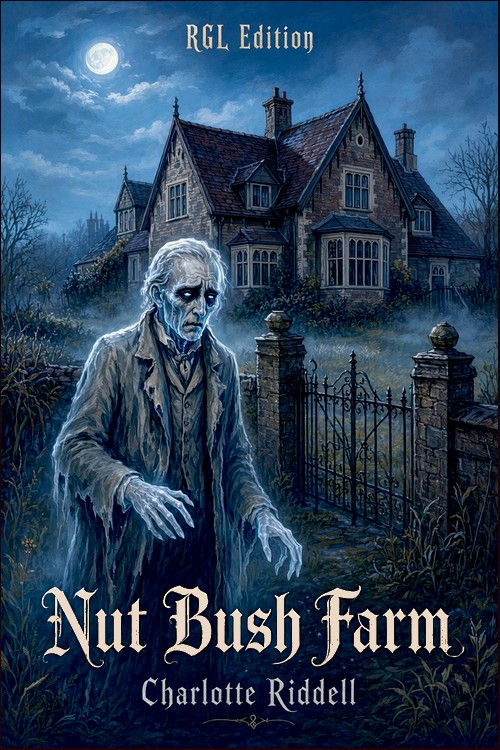
RGL e-Book Cover
Based on an image created with Microsoft Bing software
Roy Glashan's Library
Non sibi sed omnibus
Go to Home Page
This work is out of copyright in countries with a copyright
period of 70 years or less, after the year of the author's death.
If it is under copyright in your country of residence,
do not download or redistribute this file.
Original content added by RGL (e.g., introductions, notes,
RGL covers) is proprietary and protected by copyright.
RGL e-Book Cover
Based on an image created with Microsoft Bing software
When Jack Durrant takes up the tenancy of Nut Bush Farm, he expects peace, fresh air, and a new start for his fragile family—but instead he finds a countryside gripped by whispered dread. Rumours of a gliding figure haunting the Beech Walk and the long field unsettle the villagers, and Jack's own sister soon encounters the eerie presence said to be the vanished former tenant, Mr. Hascot. As Jack struggles to protect his loved ones and uncover the truth behind the disappearance, moonlit paths, tangled nut-tree hollows, and the oppressive silence of the woods draw him ever deeper into a mystery where fear, guilt, and the supernatural blur into one chilling reality.
WHEN I entered upon the tenancy of Nut Bush Farm almost the first piece of news which met me, in the shape of a whispered rumour, was that "something" had been seen in the "long field."
Pressed closely as to what he meant, my informant reluctantly stated that the "something" took the "form of a man," and that the wood and the path leading thereto from Whittleby were supposed to be haunted.
Now, all this annoyed me exceedingly. I do not know when I was more put out than by this intelligence. It is unnecessary to say I did not believe in ghosts or anything of that kind, but my wife being a very nervous, impressionable woman, and our only child a delicate weakling, in the habit of crying himself into fits if left alone at night without a candle, I really felt at my wits' end to imagine what I should do if a story of this sort reached their ears.
And reach them I knew it must if they came to Nut Bush Farm, so the first thing I did when I heard people did not care to venture down the Beech Walk or through the copse, or across the long field after dark, or indeed by day, was to write to say I thought they had both better remain on at my father-in-law's till I could get the house thoroughly to rights.
After that I lit my pipe and went out for a stroll; when I knocked the ashes out of my pipe and re-entered the sitting-room I had made up my mind. I could not afford to be frightened away from my tenancy. For weal or for woe I must stick to Nut Bush Farm.
It was quite by chance I happened to know anything of the place at first. When I met with that accident in my employers' service, which they rated far too highly and recompensed with a liberality I never can feel sufficiently grateful for, the doctors told me plainly if I could not give up office work and leave London altogether, they would not give a year's purchase for my life.
Life seemed very sweet to me then—it always has done—but just at that period I felt the pleasant hopes of convalescence; and with that thousand pounds safely banked, I could not let it slip away from me.
"Take a farm," advised my father-in-law. "Though people say a farmer's is a bad trade, I know many a man who is making money out of it. Take a farm, and if you want a helping hand to enable you to stand the racket for a year or two, why, you know I am always ready."
I had been bred and born on a farm. My father held something like fifteen hundred acres under the principal landowner in his county, and though it so happened I could not content myself at home, but must needs come up to London to see the lions and seek my fortune, still I had never forgotten the meadows and the cornfields, and the cattle, and the orchards, and the woods and the streams, amongst which my happy boyhood had been spent. Yes, I thought I should like a farm—one not too far from London; and "not too big," advised my wife's father.
"The error people make nowadays," he went on, "is spreading their butter over too large a surface. It is the same in business as in land—they stretch their arms out too far—they will try to wade in deep waters—and the consequence is they never know a day's peace, and end mostly in the bankruptcy court."
He spoke as one having authority, and I knew what he said was quite right. He had made his money by a very different course of procedure, and I felt I could not follow a better example.
I knew something about farming, though not very much. Still, agriculture is like arithmetic: when once one knows the multiplication table the rest is not so difficult. I had learned unconsciously the alphabet of soils and crops and stock when I was an idle young dog, and liked nothing better than talking to the labourers, and accompanying the woodman when he went out felling trees; and so I did not feel much afraid of what the result would be, more especially as I had a good business head on my shoulders, and enough money to "stand the racket," as my father-in-law put it, till the land began to bring in her increase.
When I got strong and well again after my long illness—I mean strong and well enough to go about—I went down to look at a farm which was advertised as to let in Kent.
According to the statement in the newspaper, there was no charm that farm lacked; when I saw it I discovered the place did not possess one virtue, unless, indeed, an old Tudor house fast falling to ruins, which would have proved invaluable to an artist, could be so considered. Far from a railway, having no advantages of water carriage, remote from a market, apparently destitute of society. Nor could these drawbacks be accounted the worst against it. The land, poor originally, seemed to have been totally exhausted. There were fields on which I do not think a goose could have found subsistence—nothing grew luxuriantly save weeds; it would have taken all my capital to get the ground clean. Then I saw the fences were dilapidated, the hedges in a deplorable condition, and the farm buildings in such a state of decay I would not have stabled a donkey in one of them.
Clearly, the King's Manor, which was the modest name of the place, would not do at any price, and yet I felt sorry, for the country around was beautiful, and already the sweet, pure air seemed to have braced up my nerves and given me fresh energy. Talking to mine host at the "Bunch of Hops," in Whittleby, he advised me to look over the local paper before returning to London.
"There be a many farms vacant," he said, "mayhap you'll light on one to suit."
To cut a long story short, I did look in the local paper and found many farms to let, but not one to suit. There was a drawback to each—a drawback at least so far as I was concerned. I felt determined I would not take a large farm. My conviction was then what my conviction still remains, that it is better to cultivate fifty acres thoroughly than to crop, stock, clean, and manure a hundred insufficiently. Besides, I did not want to spend my strength on wages, or take a place so large I could not oversee the workmen on foot. For all these reasons and many more I came reluctantly to the conclusion that there was nothing in that part of the country to suit a poor unspeculative plodder like myself.
It was a lovely afternoon in May when I turned my face towards Whittleby, as I thought, for the last time. In the morning I had taken train for a farm some ten miles distant and worked my way back on foot to a "small cottage with land" a local agent thought might suit me. But neither the big place nor the little answered my requirements much to the disgust of the auctioneer, who had himself accompanied us to the cottage under the impression I would immediately purchase it and so secure his commission.
Somewhat sulkily he told me a short cut back to Whittleby, and added, as a sort of rider to all previous statements, the remark: "You had best look out for what you want in Middlesex. You'll find nothing of that sort hereabouts."
As to the last part of the foregoing sentence I was quite of his opinion, but I felt so oppressed with the result of all my wanderings that I thought upon the whole I had better abandon my search altogether, or else pursue it in some county very far away indeed—perhaps in the land of dreams for that matter!
As has been said, it was a lovely afternoon in May—the hedges were snowy with hawthorn blossom, the chestnuts were bursting into flower, the birds were singing fit to split their little throats, the lambs were dotting the hillsides, and I—ah, well, I was a boy again, able to relish all the rich banquet God spreads out day by day for the delight and nourishment of His too often thankless children.
When I came to a point half-way up some rising ground where four lanes met and then wound off each on some picturesque diverse way, I paused to look around regretfully.
As I did so—some distance below me—along what appeared to be a never-before-traversed lane, I saw the gleam of white letters on a black board.
"Come," I thought, "I'll see what this is at all events," and bent my steps towards the place, which might, for all I knew about it, have been a ducal mansion or a cockney's country villa.
The board appeared modestly conspicuous in the foreground of a young fir plantation, and simply bore this legend:
TO BE LET, HOUSE AND LAND,
Apply at the "White Dragon."
"It is a mansion," I thought, and I walked on slowly, disappointed. All of a sudden the road turned a sharp corner and I came in an instant upon the prettiest place I had ever seen or ever desire to see.
I looked at it over a low laurel hedge growing inside an open paling about four feet high. Beyond the hedge there was a strip of turf, green as emeralds, smooth as a bowling green—then came a sunk fence, the most picturesque sort of protection the ingenuity of man ever devised; beyond that, a close-cut lawn which sloped down to the sunk fence from a house with projecting gables in the front, the recessed portion of the building having three windows on the first floor. Both gables were covered with creepers, the lawn was girt in by a semicircular sweep of forest trees; the afternoon sun streamed over the grass and tinted the swaying foliage with a thousand tender lights. Hawthorn bushes, pink and white, mingled with their taller and grander brothers. The chestnuts here were in flower, the copper beech made a delightful contrast of colour, and a birch rose delicate and graceful close beside.
It was like a fairy scene. I passed my hand across my eyes to assure myself it was all real. Then I thought "if this place be even nearly within my means I will settle here. My wife will grow stronger in this paradise—my boy get more like other lads. Such things as nerves must be unknown where there is not a sight or sound to excite them. Nothing but health, purity, and peace."
Thus thinking, I tore myself away in search of the "White Dragon," the landlord of which small public-house sent a lad to show me over the farm.
"As for the rent," he said, "you will have to speak to Miss Gostock herself—she lives at Chalmont, on the road between here and Whittleby."
In every respect the place suited me; it was large enough, but not too large; had been well farmed, and was amply supplied with water—a stream indeed flowing through it; a station was shortly to be opened, at about half-a-mile's distance; and most of the produce could be disposed of to dealers and tradesmen at Crayshill, a town to which the communication by rail was direct.
I felt so anxious about the matter, it was quite a disappointment to find Miss Gostock from home. Judging from the look of her house, I did not suppose she could afford to stick out for a long rent, or to let a farm lie idle for any considerable period. The servant who appeared in answer to my summons was a singularly red armed and rough handed Phyllis. There was only a strip of carpeting laid down in the hall, the windows were bare of draperies, and the avenue gate, set a little back from the main road, was such as I should have felt ashamed to put in a farmyard.
Next morning I betook myself to Chalmont, anxiously wondering as I walked along what the result of my interview would prove.
When I neared the gate, to which uncomplimentary reference has already been made, I saw standing on the other side a figure wearing a man's broad-brimmed straw hat, a man's coat, and a woman's skirt.
I raised my hat in deference to the supposed sex of this stranger. She put up one finger to the brim of hers, and said, "Servant, sir."
Not knowing exactly what to do, I laid my hand upon the latch of the gate and raised it, but she did not alter her position in the least.
She only asked, "What do you want?"
"I want to see Miss Gostock," was my answer.
"I am Miss Gostock," she said; "what is your business with me?"
I replied meekly that I had come to ask the rent of Nut Bush Farm.
"Have you viewed it?" she inquired.
"Yes." I told her I had been over the place on the previous afternoon.
"And have you a mind to take it?" she persisted. "For I am not going to trouble myself answering a lot of idle inquiries."
So far from my being an idle inquirer, I assured the lady that if we could come to terms about the rent, I should be very glad indeed to take the farm. I said I had been searching the neighbourhood within a circuit of ten miles for some time unsuccessfully, and added, somewhat unguardedly, I suppose, Nut Bush Farm was the only place I had met with which at all met my views.
Standing in an easy attitude, with one arm resting on the top bar of the gate and one foot crossed over the other, Miss Gostock surveyed me, who had unconsciously taken up a similar position, with an amused smile.
"You must think me a very honest person, young man," she remarked.
I answered that I hoped she was, but I had not thought at all about the matter.
"Or else," proceeded this extraordinary lady, "you fancy I am a much greater flat than I am."
"On the contrary," was my reply. "If there be one impression stronger than another which our short interview has made upon me it is that you are a wonderfully direct and capable woman of business."
She looked at me steadily, and then closed one eye, which performance, done under the canopy of that broad-brimmed straw hat, had the most ludicrous effect imaginable.
"You won't catch me napping," she observed, "but, however, as you seem to mean dealing, come in; I can tell you my terms in two minutes," and opening the gate—a trouble she would not allow me to take off her hands—she gave me admission.
Then Miss Gostock took off her hat, and swinging it to and fro began slowly walking up the ascent leading to Chalmont, I beside her.
"I have quite made up my mind," she said, "not to let the farm again without a premium; my last tenant treated me abominably."
I intimated I was sorry to hear that, and waited for further information.
"He had the place at a low rent—a very low rent. He should not have got it so cheap but for his covenanting to put so much money in the soil; and well—I'm bound to say he acted fair so far as that—he fulfilled that part of his contract. Nearly two years ago we had a bit of a quarrel about—well, it's no matter what we fell out over—only the upshot of the affair was he gave me due notice to leave at last winter quarter. At that time he owed about a year-and-a-half's rent—for he was a man who never could bear parting with money—and like a fool I did not push him for it. What trick do you suppose he served me for my pains?"
It was simply impossible for me to guess, so I did not try.
"On the twentieth of December," went on Miss Gostock, turning her broad face and curly grey hair—she wore her hair short like a man—towards me, "he went over to Whittleby, drew five thousand pounds out of the bank, was afterwards met going towards home by a gentleman named Waite, a friend of his. Since then he has never been seen nor heard of."
"Bless my soul!" I exclaimed involuntarily.
"You may be very sure I did not bless his soul," she snarled out angrily. "The man bolted with the five thousand pounds, having previously sold off all his stock and the bulk of his produce, and when I distrained for my rent, which I did pretty smart, I can tell you, there was scarce enough on the premises to pay the levy."
"But what in the world made him bolt?" I asked, quite unconsciously adopting Miss Gostock's expressive phrase; "as he had so much money, why did he not pay you your rent?"
"Ah! Why, indeed?" mocked Miss Gostock. "Young sir, I am afraid you are a bit of a humbug, or you would have suggested at once there was a pretty girl at the bottom of the affair. He left his wife and children, and me—all in the lurch—and went off with a slip of a girl, whom I once took, thinking to train up as a better sort of servant, but was forced to discharge. Oh, the little hussy!"
Somehow I did not fancy I wanted to hear anything more about her late tenant and the pretty girl, and consequently ventured to inquire how that gentleman's defalcations bore upon the question of the rent I should have to pay.
"I tell you directly," she said, and as we had by this time arrived at the house, she invited me to enter, and led the way into an old-fashioned parlour that must have been furnished about the time chairs and tables were first invented and which did not contain a single feminine belonging—not even a thimble.
"Sit down," she commanded, and I sat. "I have quite made up my mind," she began, "not to let the farm again, unless I get a premium sufficient to insure me against the chances of possible loss. I mean to ask a very low rent and—a premium."
"And what amount of premium do you expect?" I inquired, doubtfully.
"I want—" and here Miss Gostock named a sum which fairly took my breath away.
"In that case," I said as soon as I got it again, "it is useless to prolong this interview; I can only express my regret for having intruded, and wish you good morning." And arising, I was bowing myself out when she stopped me.
"Don't be so fast," she cried, "I only said what I wanted. Now what are you prepared to give?"
"I can't be buyer and seller too," I answered, repeating a phrase the precise meaning of which, it may here be confessed, I have never been able exactly to understand.
"Nonsense," exclaimed Miss Gostock—I am really afraid the lady used a stronger term—"if you are anything of a man of business, fit at all to commence farming, you must have an idea on the subject. You shall have the land at a pound an acre, and you will give me for premium—come, how much?"
By what mental process I instantly jumped to an amount it would be impossible to say, but I did mention one which elicited from Miss Gostock the remark: "That won't do at any price."
"Very well, then," I said, "we need not talk any more about the matter."
"But what will you give?" asked the lady.
"I have told you," was my answer, "and I am not given either to haggling or beating down."
"You won't make a good farmer," she observed.
"If a farmer's time were of any value, which it generally seems as if it were not," I answered, "he would not waste it in splitting a sixpence."
She laughed, and her laugh was not musical.
"Come now," she said, "make another bid."
"No," I replied, "I have made one and that is enough. I won't offer another penny."
"Done then," cried Miss Gostock, "I accept your offer—we'll just sign a little memorandum of agreement, and the formal deeds can be prepared afterwards. You'll pay a deposit, I suppose?"
I was so totally taken aback by her acceptance of my offer I could only stammer out I was willing to do anything that might be usual.
"It does not matter much whether it is usual or not," she said; "either pay it or I won't keep the place for you. I am not going to have my land lying idle and my time taken up for your pleasure."
"I have no objection to paying you a deposit," I answered.
"That's right," she exclaimed; "now if you will just hand me over the writing-desk we can settle the matter, so far as those thieves of lawyers will let us, in five minutes."
Like one in a dream I sat and watched Miss Gostock while she wrote. Nothing about the transaction seemed to me real. The farm itself resembled nothing I had ever before seen with my waking eyes, and Miss Gostock appeared to me but as some monstrous figure in a story of giants and hobgoblins. The man's coat, the woman's skirt, the hobnailed shoes, the grizzly hair, the old straw hat, the bare, unfurnished room, the bright sunshine outside, all struck me as mere accessories in a play—as nothing which had any hold on the outside, everyday world.
It was drawn—we signed our names. I handed Miss Gostock over a cheque. She locked one document in an iron box let into the wall, and handed me the other, adding, as a rider, a word of caution about "keeping it safe and taking care it was not lost."
Then she went to a corner cupboard, and producing a square decanter half full of spirits, set that and two tumblers on the table.
"You don't like much water, I suppose," she said, pouring out a measure which frightened me.
"I could not touch it, thank you, Miss Gostock," I exclaimed; "I dare not do so; I should never get back to Whittleby."
For answer she only looked at me contemptuously and said, "D——d nonsense."
"No nonsense, indeed," I persisted; "I am not accustomed to anything of that sort."
Miss Gostock laughed again, then crossing to the sideboard she returned with a jug of water, a very small portion of the contents of which she mixed with the stronger liquor, and raised the glass to her lips.
"To your good health and prosperity," she said, and in one instant the fiery potion was swallowed.
"You'll mend of all that," she remarked, as she laid down her glass, and wiped her lips in the simplest manner by passing the back of her hand over them.
"I hope not, Miss Gostock," I ventured to observe.
"Why, you look quite shocked," she said; "did you never see a lady take a mouthful of brandy before?"
I ventured to hint that I had not, more particularly so early in the morning.
"Pooh!" she said. "Early in the morning or late at night, where's the difference? However, there was a time when I—but that was before I had come through so much trouble. Good-bye for the present, and I hope we shall get on well together."
I answered I trusted we should, and was half-way to the hall door, when she called me back.
"I forgot to ask you if you were married," she said.
"Yes, I have been married some years," I answered.
"That's a pity," she remarked, and dismissed me with a wave of her hand.
"What on earth would have happened had I not been married?" I considered as I hurried down the drive. "Surely she never contemplated proposing to me herself? But nothing she could do would surprise me."
THERE were some repairs I had mentioned it would be necessary to have executed before I came to live at Nut Bush Farm, but when I found Miss Gostock intended to do them herself—nay, was doing them all herself—I felt thunderstruck.
On one memorable occasion I came upon her with a red handkerchief tied round her head, standing at a carpenter's bench in a stable yard, planing away, under a sun which would have killed anybody but a negro or my landlady.
She painted the gates, and put sash lines in some of the windows; she took off the locks, oiled, and replaced them; she mowed the lawn, and offered to teach me how to mow; and lastly, she showed me a book where she charged herself and paid herself for every hour's work done.
"I've made at least twenty pounds out of your place," she said triumphantly. "Higgs at Whittleby would not have charged me a halfpenny less for the repairs. The tradesmen here won't give me a contract—they say it is just time thrown away, but I know that would have been about his figure. Well, the place is ready for you now, and if you take my advice, you'll get your grass up as soon as possible. It's a splendid crop, and if you hire hands enough, not a drop of rain need spoil it. If this weather stands you might cut one day and carry the next."
I took her advice, and stacked my hay in magnificent condition. Miss Gostock was good enough to come over and superintend the building of the stack, and threatened to split one man's head open with the pitchfork, and proposed burying another—she called him a "lazy blackguard"—under a pile of hay.
"I will say this much for Hascot," she remarked, as we stood together beside the stream; "he was a good farmer; where will you see better or cleaner land? A pattern I call it—and to lose his whole future for the sake of a girl like Sally Powner; leaving his wife and children on the parish, too!"
"You don't mean that?" I said.
"Indeed I do. They are all at Crayshill. The authorities did talk of shifting them, but I know nothing about what they have done."
I stood appalled. I thought of my own poor wife and the little lad, and wondered if any Sally on the face of the earth could make me desert them.
"It has given the place a bad sort of name," remarked Miss Gostock, looking at me sideways: "but, of course, that does not signify anything to you."
"Oh, of course not," I agreed.
"And don't you be minding any stories; there are always a lot of stories going about places."
I said I did not mind stories. I had lived too long in London to pay much attention to them.
"That's right," remarked Miss Gostock, and negativing my offer to see her home she started off to Chalmont.
It was not half an hour after her departure when I happened to be walking slowly round the meadows, from which the newly mown hay had been carted, that I heard the rumour which vexed me—"Nut Bush Farm haunted," I thought, "I said the whole thing was too good to last."
"What, Jack, lost in reverie?" cried my sister, who had some up from Devonshire to keep me company, and help to get the furniture a little to rights, entering at the moment, carrying lights; "supper will be ready in a minute, and you can dream as much as you like after you have had something to eat."
I did not say anything to her about my trouble, which was then indeed no bigger than a man's hand, but which grew and grew till it attained terrible proportions.
What was I to do with my wife and child? I never could bring them to a place reputed to be haunted. All in vain I sauntered up and down the Beech Walk night after night; walked through the wood—as a rule selected that route when I went to Whittleby. It did not produce the slightest effect. Not a farm servant but eschewed that path townward; not a girl but preferred spending her Sunday at home rather than venture under the interlacing branches of the beech trees, or through the dark recesses of the wood.
It was becoming serious—I did not know what to do.
One wet afternoon Lolly came in draggled but beaming.
"I've made a new acquaintance, Jack," she said; "a Mrs. Waite—such a nice creature, but in dreadfully bad health. It came on to rain when I was coming home, and so I took refuge under a great tree at the gate of a most picturesque old house. I had not stood there long before a servant with an umbrella appeared at the porch to ask if I would not please to walk in until the storm abated. I waited there ever so long, and we had such a pleasant talk. She is a most delightful ----woman, with a melancholy, pathetic sort of expression that has been haunting me ever since. She apologised for not having called—said she was not strong and could not walk so far. They keep no conveyance she can drive. Mr. Waite, who is not at home at present, rides into Whittleby when anything is wanted.
"I hoped she would not think of standing on ceremony with me. I was only a farmer's daughter, and accustomed to plain, homely ways, and I asked her if I might walk round and bid her good-bye before I went home."
"You must not go home yet, Lolly," I cried, alarmed; "what in the world should I do without you?"
"Well, you would be a lonely boy," she answered, complacently, "with no one to sew on a button or darn your socks, or make you eat or go to bed, or do anything you ought to do."
I had not spoken a word to her about the report which was troubling me, and I knew there must be times when she wondered why I did not go up to London and fetch my wife and child to enjoy the bright summertime; but Lolly was as good as gold, and never asked me a question, or even indirectly inquired if Lucy and I had quarrelled, as many another sister might.
She was as pleasant and fresh to look upon as a spring morning, with her pretty brown hair smoothly braided, her cotton or muslin dresses never soiled or crumpled, but as nice as though the laundress had that moment sent them home—a rose in her belt and her hands never idle—forever busy with curtain or blind, or something her housewifely eyes thought had need of making or mending.
About ten days after that showery afternoon when she found shelter under Mr. Waite's hospitable roof, I felt surprised when, entering the parlour a few minutes before our early dinner, I found Lolly standing beside one of the windows apparently hopelessly lost in the depths of a brown study.
"Why, Lolly," I exclaimed, finding she took no notice of me, "where have you gone to now? A penny for your thoughts, young lady."
"They are not worth a penny," she said, and turning from the window took some work and sat down at a little distance from the spot where I was standing.
I was so accustomed to women, even the best and gayest of them, having occasional fits of temper or depression—times when silence on my part seemed the truest wisdom—that, taking no notice of my sister's manner, I occupied myself with the newspaper till dinner was announced.
During the progress of that meal she talked little and ate still less, but when I was leaving the room, in order to go out to a field of barley where the reapers were at work, she asked me to stop a moment.
"I want to speak to you, Jack," she said.
"Speak, then," I answered, with that lack of ceremony which obtains amongst brothers and sisters.
She hesitated for a moment, but did not speak.
"What on earth is the matter with you, Lolly?" I exclaimed. "Are you sick, or cross, or sorry, or what?"
"If it must be one of the four," she answered, with a dash of her usual manner, "it is 'or what,' Jack," and she came close up to where I stood and took me sorrowfully by the button-hole.
"Well?" I said, amused, for this had always been a favourite habit of Lolly's when she wanted anything from one of the males of her family.
"Jack, you won't laugh at me?"
"I feel much more inclined to be cross with you," I answered. "What are you beating about the bush for, Lolly?"
She lifted her fair face a moment and I saw she was crying.
"Lolly, Lolly!" I cried, clasping her to my heart, "what is it, dear? Have you bad news from home, or have you heard anything about Lucy or the boy? Don't keep me in suspense, there's a darling. No matter what has happened, let me know the worst."
She smiled through her tears, and Lolly has the rarest smile! It quieted my anxious heart in a moment, even before she said: "No, Jack—it is nothing about home, or Lucy, or Teddy, but—but—but—" and then she relinquished her hold on the button-hole, and fingered each button on the front of my coat carefully and lingeringly. "Did you ever hear—Jack—anybody say anything about this place?"
I knew in a moment what she meant; I knew the cursed tattle had reached her ears, but I only asked: "What sort of thing, Lolly?"
She did not answer me; instead, she put another question.
"Is that the reason you have not brought Lucy down?"
I felt vexed—but I had so much confidence in her good sense, I could not avoid answering without a moment's delay.
"Well, yes; I do not want her to come till this foolish report has completely died away."
"Are you quite sure it is a foolish report?" she inquired.
"Why, of course; it could not be anything else."
She did not speak immediately, then all at once: "Jack," she said, "I must tell you something. Lock the door that we may not be interrupted."
"No," I answered; "come into the barley field. Don't you remember Mr. Fenimore Cooper advised, if you want to talk secrets, choose the middle of a plain?"
I tried to put a good face on the matter, but the sight of Lolly's tears, the sound of Lolly's doleful voice, darkened my very heart. What had she to tell me which required locked doors or the greater privacy of a half-reaped barley field. I could trust my sister—she was no fool—and I felt perfectly satisfied that no old woman's story had wrought the effect produced on her.
"Now, Lolly," I said, as we paced side by side along the top of the barley field in a solitude all the more complete because life and plenty of it was close at hand.
"You know what they say about the place, Jack?"
This was interrogative, and so I answered. "Well, no, Lolly, I can't say that I do, for the very good reason that I have always refused to listen to the gossip. What do they say?"
"That a man haunts the Beech Walk, the long meadow, and the wood."
"Yes, I have heard that," I replied.
"And they say further, the man is Mr. Hascot, the late tenant."
"But he is not dead," I exclaimed; "how, then, can they see his ghost?"
"I cannot tell. I know nothing but what I saw this morning. After breakfast I went to Whittleby, and as I came back I observed a man before me on the road. Following him, I noticed a curious thing, that none of the people he met made way for him or he for them. He walked straight on, without any regard to the persons on the side path, and yet no one seemed to come into collision with him. When I reached the field path I saw him going on still at the same pace. He did not look to right or left, and did not seem to walk—the motion was gliding—"
"Yes, dear."
"He went on, and so did I, till we reached the hollow where the nut-bushes grow, then he disappeared from sight. I looked down among the trees, thinking I should be able to catch a glimpse of his figure through the underwood, but no, I could see no signs of him, neither could I hear any. Everything was as still as death; it seemed to me that my ear had a spell of silence laid upon it."
"And then?" I asked hoarsely, as she paused.
"Why, Jack, I walked on and crossed the little footbridge and was just turning into the Beech Walk when the same man bustled suddenly across my path, so close to me if I had put out my hands I could have touched him. I drew back, frightened for a minute, then, as he had not seemed to see me, I turned and looked at him as he sped along down the little winding path to the wood. I thought he must be some silly creature, some harmless sort of idiot, to be running here and there without any apparent object. All at once, as he neared the wood, he stopped, and, half wheeling round, beckoned to me to follow him."
"You did not, Lolly?"
"No, I was afraid. I walked a few steps quietly till I got among the beech trees and so screened from sight, and then I began to run. I could not run fast, for my knees trembled under me; but still I did run as far nearly as that seat round the 'Priest's Tree.' I had not got quite up to the seat when I saw a man rise from it and stand upright as if waiting for me. It was the same person, Jack! I recognised him instantly, though I had not seen his face clearly before. He stood quiet for a moment, and then, with the same gliding motion, silently disappeared."
"Someone must be playing a very nice game about Nut Bush Farm," I exclaimed.
"Perhaps so, dear," she said doubtfully.
"Why, Lolly, you don't believe it was a ghost you met in the broad daylight?" I cried incredulously.
"I don't think it was a living man, Jack," she answered.
"Living or dead, he dare not bring himself into close quarters with me," was my somewhat braggart remark. "Why, Lolly, I have walked the ground day after day and night after night in the hope of seeing your friend, and not a sign of an intruder, in the flesh or out of it, could I find. Put the matter away, child, and don't ramble in that direction again. If I can ascertain the name of the person who is trying to frighten the household and disgust me with Nut Bush Farm, he shall go to jail if the magistrates are of my way of thinking. Now, as you have told me this terrible story, and we have reduced your great mountain to a molehill, I will walk back with you to the house."
She did not make any reply: we talked over indifferent matters as we paced along. I went with her into the pleasant sunshiny drawing-room and looked her out a book and made her promise to read something amusing; then I was going, when she put up her lips for me to kiss her, and said—"Jack, you won't run any risks?"
"Risks—pooh, you silly little woman!" I answered; and so left my sister and repaired to the barley field once more.
When it was time for the men to leave off work I noticed that one after another began to take a path leading immediately to the main road, which was a very circuitous route to the hamlet, where most of them had either cottages or lodgings.
I noticed this for some time, and then asked a brawny young fellow. "Why don't you go home through the Beech Walk? It is not above half the distance."
He smiled and made some almost unintelligible answer.
"Why are you all afraid of taking the shortest way," I remarked, "seeing there are enough of you to put half a dozen ghosts to the rout?"
"Likely, sir," was the answer; "but the old master was a hard man living, and there is not many would care to meet him dead."
"What old master?" I inquired.
"Mr. Hascot: it's him as walks. I saw him as plain as I see you now, sir, one moonlight night, just this side of the wood, and so did Nat Tyler and James Monsey, and James Monsey's father—wise Ben."
"But Mr. Hascot is not dead; how can he 'walk,' as you call it?" was my natural exclamation.
"If he is living, then, sir, where is he?" asked the man. "There is nobody can tell that, and there is a many, especially just lately, think he must have been made away with. He had a cruel lot of money about him—where is all that money gone to?"
The fellow had waxed quite earnest in his interrogations, and really for the first time the singularity of Mr. Hascot's disappearance seemed to strike me.
I said, after an instant's pause, "The money is wherever he is. He went off with some girl, did he not?"
"It suited the old people to say so," he answered; "but there is many a one thinks they know more about the matter than is good for them. I can't help hearing, and one of the neighbours did say Mrs. Ockfield was seen in church last Sunday with a new dress on and a shawl any lady might have worn."
"And who is Mrs. Ockfield?" I inquired.
"Why, Sally Powner's grandmother. The old people treated the girl shameful while she was with them, and now they want to make her out no better than she should be."
And with a wrathful look the young man, who I subsequently discovered had long been fond of Sally, took up his coat and his tin bottle and his sickle, and with a brief "I think I'll be going, sir; good-night," departed.
It was easy to return to the house, but I found it impossible to shake the effect produced by this dialogue off my mind.
For the first time I began seriously to consider the manner of Mr. Hascot's disappearance, and more seriously still commenced trying to piece together the various hints I had received as to his character.
A hard man—a hard master, all I ever heard speak considered him, but just, and in the main not unkind. He had sent coals to one widow, kept a poor old labourer off the parish, and then in a minute, for the sake of a girl's face, left his own wife and children to the mercy of the nearest Union. [poorhouse]
As I paced along, it seemed to me monstrous, and yet how did it happen that till a few minutes previously I had never heard even a suspicion of foul play?
Was it not more natural to conclude the man must have been made away with, than that, in one brief day, he should have changed his nature and the whole current of his former life?
Upon the other hand, people must have had some strong reason for imagining he was gone off with Miss Powner. The notion of a man disappearing in this way—vanishing as if the earth had opened to receive him and closed again—for the sake of any girl, however attractive, was too unnatural an idea for anyone to have evolved out of his internal consciousness. There must have been some substratum of fact, and then, upon the other hand, there seemed to me more than a substratum of possibility in the theory started of his having been murdered.
Supposing he had been murdered, I went on to argue, what then? Did I imagine he "walked" ? Did I believe he could not rest wherever he was laid?
Pooh—nonsense! It might be that the murderer haunted the place of his crime—that he hovered about to see if his guilt were still undetected, but as to anything in the shape of a ghost tenanting the Beech Walk, long meadow, and wood, I did not believe it—I could not, and I added, "if I saw it with my own eyes, I would not."
Having arrived at which decided and sensible conclusion, I went in to supper. Usually a sound sleeper, I found it impossible that night when I lay down to close my eyes. I tossed and turned, threw off the bedclothes under the impression I was too hot and drew them tight up round me the next instant, feeling cold. I tried to think of my crops, of my land, of my wife, of my boy, of my future—all in vain. A dark shadow, a wall-like night stood between me and all the ordinary interests of my life—I could not get the notion of Mr. Hascot's strange disappearance out of my mind. I wondered if there was anything about the place which made it in the slightest degree probable I should ever learn to forget the wife who loved me, the boy who was dependent on me. Should I ever begin to think I might have done better as regards my choice of a wife, that it would be nicer to have healthy merry children than my affectionate delicate lad?
When I got to this point, I could stand it no longer. I felt as though some mocking spirit were taking possession of me, which eventually would destroy all my peace of mind, if I did not cast it out promptly and effectually.
I would not lie there supine to let any demon torment me; and, accordingly, springing to the floor, I dressed in hot haste, and flinging wide the window, looked out over a landscape bathed in the clear light of a most lovely moon.
"How beautiful!" I thought. "I have never yet seen the farm by night, I'll just go and take a stroll round it and then turn in again—after a short walk, I shall likely be able to sleep."
So saying, I slipped downstairs, closed the hall door softly after me, and went out into the moonlight.
AS I stood upon the lawn, looking around with a keen and subtle pleasure, I felt, almost for the first time in my life, the full charm and beauty of night. Every object was as clearly revealed as though the time had been noon instead of an hour past midnight, but there lay a mystic spell on tree and field and stream the garish day could never equal. It was a fairy light and a fairy scene, and it would scarcely have astonished me to see fantastic elves issue from the foxglove's flowers or dart from the shelter of concealing leaves and dance a measure on the emerald sward.
For a minute I felt—as I fancy many and many a commonplace man must have done when first wedded to some miracle of grace and beauty—a sense of amazement and unreality.
All this loveliness was mine—the moonlit lawn—the stream murmuring through the fir plantation, singing soft melodies as it pursued its glittering way—the trees with a silvery gleam tinting their foliage—the roses giving out their sweetest, tenderest perfumes—the wonderful silence around—the fresh, pure air—the soft night wind—the prosperity with which God had blessed me. My heart grew full, as I turned and gazed first on this side and then on that, and I felt vexed and angry to remember I had ever suffered myself to listen to idle stories and to be made uncomfortable by reason of village gossip.
On such a night it really seemed a shame to go to bed, and, acccordingly, though the restlessness which first induced me to rise had vanished, and in doing so left the most soothing calm behind, I wandered on away from the house, now beside the stream, and again across a meadow, where faint odours from the lately carried hay still lingered.
Still the same unreal light over field and copse—still the same witching glamour—still the same secret feeling. I was seeing something and experiencing some sensation I might never again recall on this side of the grave!
A most lovely night—one most certainly not for drawn curtains and closed eyelids—one rather for lovers' tête-a-tête or a dreamy reverie—for two young hearts to reveal their secrets to each other or one soul to commune alone with God.
Still rambling, I found myself at last beside a stile, opening upon a path, which, winding upwards, led past the hollow where the nut trees grew, and then joined the footway leading through the long field to Whittleby. The long field was the last in that direction belonging to Nut Bush Farm. It joined upon a portion of the land surrounding Chalmont, and the field path continued consequently to pass through Miss Gostock's property till the main road was reached. It cut off a long distance, and had been used generally by the inhabitants of the villages and hamlets dotted about my place until the rumour being circulated that something might be "seen" or "met" deterred people from venturing by a route concerning which such evil things were whispered. I had walked it constantly, both on account of the time it saved and also in order to set a good example to my labourers and my neighbours, but I might as well have saved my pains.
I was regarded merely as foolhardy, and I knew people generally supposed I should one day have cause to repent my temerity.
As I cleared the stile and began winding my upward way to the higher ground beyond, the thought did strike me what a likely place for a murder Nut Bush Hollow looked. It was a deep excavation, out of which, as no one supposed it to be natural, hundreds and thousands of loads of earth must at some time or other have been carted. From top to bottom it was clothed with nut trees—they grew on every side, and in thick, almost impenetrable masses. For years and years they seemed to have had no care bestowed on them, the Hollow forming in this respect a remarkable contrast to the rest of Mr. Hascot's careful farming, and, as a fir plantation ran along the base of the Hollow, while the moon's light fell clear and full on some of the bushes, the others lay in densest shadow.
The road that once led down into the pit was now completely overgrown with nut bushes which grew luxuriantly to the very edge of the Beech Walk, and threatened ere long to push their way between the trunks of the great trees, which were the beauty and the pride of my lovely farm.
At one time, so far as I could understand, the nut bushes had the whole place almost to themselves, and old inhabitants told me that formerly, in the days when their parents were boys and girls, the nuts used to pay the whole of the rent. As years passed, however, whether from want of care or some natural cause, they gradually ceased to bear, and had to be cut down and cleared off the ground—those in the dell, however, being suffered to remain, the hollow being useless for husbandry, and the bushes which flourished there producing a crop of nuts sufficient for the farmer's family.
All this recurred to my mind as I stood for a moment and looked down into the depths of rustling green below me. I thought of the boys who must have gone nutting there, of all the nests birds had built in the branches so closely interlaced, of the summers' suns which had shone full and strong upon that mass of foliage, of the winters' snows which had lain heavy on twig and stem and wrapped the strong roots in a warm covering of purest white.
And then the former idea again asserted itself—what a splendid place for a tragedy; a sudden blow—a swift stab—even a treacherous push—and the deed could be done—a man might be alive and well one minute, and dead the next!
False friend, or secret enemy; rival or thief, it was competent for either in such a place at any lonely hour to send a man upon his last long journey. Had Mr. Hascot been so served? Down, far down, was he lying in a quiet, dreamless sleep? At that very moment was there anyone starting from fitful slumber to grapple with his remorse for crime committed, or shrink with horror from the dread of detection?
"Where was my fancy leading me?" I suddenly asked myself. This was worse than in my own chamber preventing the night watches. Since I had been standing there my heart felt heavier than when tossing from side to side in bed, and wooing unsuccessfully the slumber which refused to come for my asking.
What folly! what nonsense! and into what an insane course of speculation had I embarked. I would leave the eerie place and get once again into the full light of the moon's bright beams.
Hush! hark! what was that? deep down amongst the underwood—a rustle, a rush, and a scurry—then silence—then a stealthy movement amongst the bushes—then whilst I was peering down into the abyss lined with waving green below, something passed by me swiftly, something which brought with it a cold chill as though the hand of one dead had been laid suddenly on my heart.
Instantly I turned and looked around. There was not a living thing in sight—neither on the path, nor on the sward, nor on the hillside, nor skirting the horizon as I turned my eyes upward.
For a moment I stood still in order to steady my nerves, then reassuring myself with the thought it must have been an animal of some kind, I completed the remainder of the ascent without further delay.
"The ghost, I suspect," I said to myself as I reached the long field and the path leading back to the farm, "will resolve itself into a hare or pheasant—is not the whirr of a cock pheasant rising, for instance, enough, when coming unexpectedly, to frighten any nervous person out of his wits? And might not a hare, or a cat, or, better still, a stoat—yes, a stoat, with its gliding, almost noiseless, movements—mimic the footfall of a suppositious ghost?"
By this time I had gained the summit of the incline, and slightly out of breath with breasting the ascent, stood for a moment contemplating the exquisite panorama stretched out beneath me. I linger on that moment because it was the last time I ever saw beauty in the moonlight. Now I cannot endure the silvery gleam of the queen of night—weird, mournful, fantastic if you like, but to be desired—no.
Whenever possible I draw the blinds and close the shutters, yet withal on moonlight nights I cannot sleep, the horror of darkness is to my mind nothing in comparison to the terror of a full moon. But I drivel; let me hasten on.
From the crest of the hill I could see lying below a valley of dreamlike beauty—woods in the foreground—a champagne country spreading away into the indefinite distance—a stream winding in and out, dancing and glittering under the moon's beams—a line of hills dimly seen against the horizon, and already a streak of light appearing above them, the first faint harbinger of dawn.
"It is morning, then, already," I said, and with the words turned my face homewards. As I did so I saw before me on the path—clearly—the figure of a man.
He was walking rapidly and I hurried my pace in order to overtake him. Now to this part of the story I desire to draw particular attention. Let me hurry as I might, I never seemed able to get a foot nearer to him.
At intervals he paused, as if on purpose to assist my desire, but the moment I seemed gaining upon him, the distance between us suddenly increased. I could not tell how he did it, the fact only remained—it was like pursuing some phantom in a dream.
All at once when he reached the bridge he stood quite still. He did not move hand or limb as I drew near—the way was so narrow I knew I should have to touch him in passing; nevertheless, I pressed forward. My foot was on the bridge—I was close to him—I felt my breath coming thick and fast—I clasped a stick I had picked up in the plantation firmly in my hand—I stopped, intending to speak—I opened my mouth, intending to do so—and then—then—without any movement on his part—I was alone!
Yes, as totally alone as though he had never stood on the bridge—never preceded me along the field-path—never loitered upon my footsteps—never paused for my coming. I was appalled.
"Lord, what is this?" I thought. "Am I going mad?" I felt as if I were. On my honour, I know I was as nearly insane at that moment as a man ever can be who is still in the possession of his senses.
Beyond lay the farm of which in my folly I had felt so proud to be the owner, where I once meant to be so happy and win health for my wife and strength for my boy. I saw the Beech Walk I had gloried in—the ricks of hay it seemed so good to get thatched geometrically as only one man in the neighbourhood was said to be able to lay the straw.
What was farm, or riches, or beech trees, or anything, to me now? Over the place there seemed a curse—better the meanest cottage than a palace with such accessories.
If I had been incredulous before, I was not so now—I could not distrust the evidence of my own eyes—and yet as I walked along, I tried after a minute or two to persuade myself imagination had been playing some juggler's trick with me. The moon, I argued, always lent herself readily to a game of hide-and-seek. She is always open to join in fantastic gambols with shadows—with thorn bushes—with a waving branch—aye, even with a clump of gorse. I must have been mistaken—I had been thinking weird thoughts as I stood by that dismal dell—I had seen no man walking—beheld no figure disappear.
Just as I arrived at this conclusion I beheld someone coming towards me down the Beech Walk. It was a man walking leisurely with a firm, free step. The sight did me good. Here was something tangible—something to question. I stood still, in the middle of the path—the Beech Walk being rather a grassy glade with a narrow footway dividing it, than anything usually understood by the term walk—so that I might speak to the intruder when he drew near, and ask him what he meant by trespassing on my property, more especially at such an hour. There were no public rights on my land except as regarded the path across the long field and through the wood. No one had any right or business to be in the Beech Walk, by day or night, save those employed about the farm, and this person was a gentleman; even in the distance I could distinguish that. As he came closer I saw he was dressed in a loose Palmerston suit, that he wore a low-crowned hat, and that he carried a light cane. The moonbeams dancing down amongst the branches and between the leaves fell full upon his face, and catching sight of a ring he had on his right hand, made it glitter with as many different colours as a prism.
A middle-aged man, so far as I could judge, with a set, determined expression of countenance, dark hair, no beard or whiskers, only a small moustache. A total stranger to me. I had never seen him nor anyone like him in the neighbourhood. Who could he be, and what in the wide world was he doing on my premises at that unearthly hour of the morning?
He came straight on, never moving to right or left—taking no more notice of me than if he had been blind. His easy indifference, his contemptuous coolness, angered me, and planting myself a little more in his way, I began:
"Are you aware, sir—"
I got no further. Without swerving in the slightest degree from the path, he passed me! I felt something like a cold mist touch me for an instant, and the next, I saw him pursuing his steady walk down the centre of the glade. I was sick with fear, but for all that I ran after him faster than I had ever done since boyhood.
All to no purpose! I might as well have tried to catch the wind. Just where three ways joined I stood still and looked around. I was quite alone! Neither sign nor token of the intruder could I discover. On my left lay the dell where the nut trees grew, and above it the field path to Whittleby showing white and clear in the moonlight; close at hand was the bridge; straight in front the wood looked dark and solemn. Between me and it lay a little hollow, down which a narrow path wound tortuously. As I gazed I saw that, where a moment before no one had been, a man was walking now. But I could not follow. My limbs refused their office. He turned his head, and lifting his hand on which the ring glittered, beckoned me to come. He might as well have asked one seized with paralysis. On the confines of the wood he stood motionless as if awaiting my approach; then, when I made no sign of movement, he wrung his hands with a despairing gesture, and disappeared.
At the same moment, moon, dell, bridge, and stream faded from my sight—and I fainted.
IT was not much past eight o'clock when I knocked at Miss Gostock's hall door, and asked if I could see that lady.
After that terrible night vision I had made up my mind. Behind Mr. Hascot's disappearance I felt sure there lurked some terrible tragedy—living, no man should have implored my help with such passionate earnestness without avail, and if indeed one had appeared to me from the dead I would right him if I could.
But never for a moment did I then think of giving up the farm. The resolve I had come to seemed to have braced up my courage—let what might come or go, let crops remain unreaped and men neglect their labour, let monetary loss and weary, anxious days be in store if they would, I meant to go on to the end.
The first step on my road clearly led in the direction of Miss Gostock's house. She alone could give me all the information I required—to her alone could I speak freely and fully about what I had seen.
I was instantly admitted, and found the lady, as I had expected, at breakfast. It was her habit, I knew, to partake of that meal while the labourers she employed were similarly engaged. She was attired in an easy negligé of a white skirt and a linen coat which had formerly belonged to her brother. She was not taking tea or coffee like any other woman—but was engaged upon about a pound of smoking steak which she ate covered with mustard and washed down with copious draughts of home-brewed beer.
She received me cordially and invited me to join in the banquet—a request I ungallantly declined, eliciting in return the remark I should never be good for much till I ceased living on "slops" and took to "good old English" fare.
After these preliminaries I drew my chair near the table and said:
"I want you to give me some information, Miss Gostock, about my predecessor."
"What sort of information?" she asked, with a species of frost at once coming over her manner.
"Can you tell me anything of his personal appearance?"
"Why do you ask?"
I did not immediately answer, and seeing my hesitation she went on: "Because if you mean to tell me you or anyone else have seen him about your place I would not believe it if you swore it—there!"
"I do not ask you to believe it, Miss Gostock," I said.
"And I give you fair warning, it is of no use coming here and asking me to relieve you of your bargain, because I won't do it. I like you well enough—better than I ever liked a tenant; but I don't intend to be a shilling out of pocket by you."
"I hope you never may be," I answered meekly.
"I'll take very good care I never am," she retorted; "and so don't come here talking about Mr. Hascot. He served me a dirty turn, and I would not put it one bit past him to try and get the place a bad name."
"Will you tell me what sort of looking man he was?" I asked determinedly.
"No, I won't," she snapped, and while she spoke she rose, drained the last drop out of a pewter measure, and after tossing on the straw hat with a defiant gesture, thumped its crown well down on her head. I took the hint, and rising, said I must endeavour to ascertain the particulars I wanted elsewhere.
"You won't ascertain them from me," retorted Miss Gostock, and we parted as we had never done before—on bad terms.
Considerably perplexed, I walked out of the house. A rebuff of this sort was certainly the last thing I could have expected, and as I paced along I puzzled myself by trying to account for Miss Gostock's extraordinary conduct, and anxiously considering what I was to do under present circumstances. All at once the recollection of mine host of the "Bunch of Hops" flashed across my mind. He must have seen Mr. Hascot often, and I could address a few casual questions to him without exciting his curiosity.
No sooner thought than done. Turning my face towards Whittleby, I stepped briskly on.
"I ever see Mr. Hascot?" repeated the landlord—when after some general conversation about politics, the weather, the crops, and many other subjects, I adroitly turned it upon the late tenant of Nut Bush Farm. "Often, sir. I never had much communication with him, for he was one of your stand-aloof, keep-your-distance, sort of gentlemen—fair dealing and honourable—but neither free nor generous. He has often sat where you are sitting now, sir, and not so much as said—'it is a fine day,' or, 'I am afraid we shall have rain.
"You had but to see him walking down the street to know what he was. As erect as a grenadier, with a firm easy sort of marching step, he looked every inch a gentleman—just in his everyday clothes, a Palmerston suit and a round hat, he was, as many a one said, fit to go to court. His hands were not a bit like a farmer's, but white and delicate as any lady's, and the diamond ring he wore flashed like a star when he stroked the slight bit of a moustache that was all the hair he had upon his face. No—not a handsome gentleman, but fine looking, with a presence—bless and save us all to think of his giving up everything for the sake of that slip of a girl."
"She was very pretty, wasn't she?" I inquired.
"Beautiful—we all said she was too pretty to come to any good. The old grandmother, you see, had serious cause for keeping so tight a hold over her, but it was in her, and 'what's bred in bone,' you know, sir."
"And you really think they did go off together?"
"Oh, yes, sir; nobody had ever any doubt about that."
On this subject his tone was so decided I felt it was useless to continue the conversation, and having paid him for the modest refreshment of which I had partaken I sauntered down the High Street and turned into the Bank, where I thought of opening an account.
When I had settled all preliminaries with the manager he saved me the trouble of beating about the bush by breaking cover himself and asking if anything had been heard of Mr. Hascot.
"Not that I know of," I answered.
"Curious affair, wasn't it?" he said.
"It appears so, but I have not heard the whole story."
"Well, the whole story is brief," returned the manager. "He comes over here one day and without assigning any reason withdraws the whole of his balance, which was very heavy—is met on the road homeward but never returns home—the same day the girl Powner is also missing—what do you think of all that?"
"It is singular," I said, "very."
"Yes, and to leave his wife and family totally unprovided for."
"I cannot understand that at all."
"Nor I—it was always known he had an extreme partiality for the young person—he and Miss Gostock quarrelled desperately on the subject—but no one could have imagined an attachment of that sort would have led a man so far astray—Hascot more especially. If I had been asked to name the last person in the world likely to make a fool of himself for the sake of a pretty face I should have named the late tenant of Nut Bush Farm."
"There never was a suspicion of foul play?" I suggested.
"Oh, dear, no! It was broad daylight when he was last seen on the Whittleby road. The same morning it is known he and the girl were talking earnestly together beside the little wood on your property, and two persons answering to their description were traced to London, that is to say, a gentleman came forward to say he believed he had travelled up with them as far as New Cross on the afternoon in question."
"He was an affectionate father, I have heard," I said.
"A most affectionate parent—a most devoted husband. Dear, dear! It is dreadfully sad to think how a bad woman may drag the best of men down to destruction. It is terrible to think of his wife and family being inmates of the Union."
"Yes, and it is terrible to consider not a soul has tried to get them out of it," I answered, a little tartly.
"H—m, perhaps so; but we all know we are contributing to their support," he returned with an effort at jocularity, which, in my then frame of mind, seemed singularly mal-apropos.
"There is something in that," I replied with an effort, and leaving the Bank next turned my attention to the Poorhouse at Crayshill.
At that time many persons thought what I did quixotic. It is so much the way of the world to let the innocent suffer for the guilty, that I believe Mr. Hascot's wife might have ended her days in Crayshill Union but for the action I took in the matter.
Another night I felt I could not rest till I had arranged for a humble lodging she and her family could occupy till I was able to form some plan for their permanent relief. I found her a quiet, ladylike woman, totally unable to give me the slightest clue as to where her husband might be found. "He was just at the stile on the Chalmont fields," she said, "when Mr. Waite met him; no one saw him afterwards, unless it might be the Ockfields, but, of course, there is no information to be got from them. The guardians have tried every possible means to discover his whereabouts without success. My own impression is he and Sally Powner have gone to America, and that someday we may hear from him. He cannot harden his heart forever and forget—" Here Mrs. Hascot's sentence trailed off into passionate weeping.
"It is too monstrous!" I considered; "the man never did such a thing as desert his wife and children. Someone knows all about the matter," and then in a moment I paused in the course of my mediations.
Was that person Miss Gostock?
It was an ugly idea, and yet it haunted me. When I remembered the woman's masculine strength, when I recalled her furious impetuosity when I asked her a not very exasperating question, as I recalled the way she tossed off that brandy, when I considered her love of money, her eagerness to speak ill of her late tenant, her semi-references to some great trouble prior to which she was more like other women, or, perhaps, to speak more correctly, less unlike them—doubts came crowding upon my mind.
It was when entering her ground Mr. Hascot was last seen. He had a large sum of money in his possession. She was notoriously fond of rambling about Nut Bush Farm, and what my labouring men called "spying around," which had been the cause of more than one pitched battle between herself and Mr. Hascot.
"The old master could not a-bear her," said one young fellow.
I hated myself for the suspicion; and yet, do what I would, I could not shake it off. Not for a moment did I imagine Miss Gostock had killed her former tenant in cold blood; but it certainly occurred to me that the dell was deep, and the verge treacherous, that it would be easy to push a man over, either by accident or design, that the nut-bushes grew thick, that a body might lie amongst them till it rotted, ere even the boys who went nutting there, season after season, happened to find it.
Should I let the matter drop? No, I decided. With that mute appeal haunting my memory, I should know no rest or peace till I had solved the mystery of Mr. Hascot's disappearance, and cleared his memory from the shameful stain circumstances had cast upon it.
What should I do next? I thought the matter over for a few days, and then decided to call on Mr. Waite, who never yet had called on me. As usual, he was not at home; but I saw his wife, whom I found just the sort of woman Lolly described—a fair, delicate creature who seemed fading into the grave.
She had not much to tell me. It was her husband who saw Mr. Hascot at the Chalmont stile; it was he also who had seen Mr. Hascot and the girl Powner talking together on the morning of their disappearance. It so happened he had often chanced to notice them together before. "She was a very, very pretty girl," Mrs. Waite added, "and I always thought a modest. She had a very sweet way of speaking—quite above her station—inherited, no doubt, for her father was a gentleman. Poor little Sally!"
The words were not much, but the manner touched me sensibly. I felt drawn to Mrs. Waite from that moment, and told her more of what I had beheld and what I suspected than I had mentioned to anyone else.
As to my doubts concerning Miss Gostock, I was, of course, silent but I said quite plainly I did not believe Mr. Hascot had gone off with any girl or woman either, that I thought he had come to an unfair end, and that I was of opinion the stories circulated, concerning a portion of Nut Bush Farm being haunted, had some foundation in fact.
"Do you believe in ghosts then?" she asked, with a curious smile.
"I believe in the evidence of my senses," I answered, "and I declare to you, Mrs. Waite, that one night, not long since, I saw as plainly as I see you what I can only conclude to have been the semblance of Mr. Hascot."
She did not make any reply, she only turned very pale, and blaming myself for having alarmed one in her feeble state of health, I hastened to apologise and take my leave.
As we shook hands, she retained mine for a moment, and said, "When you hear anything more, if you should, that is, you will tell us, will you not? Naturally we feel interested in the matter, he was such a neighbour, and—we knew him."
I assured her I would not fail to do so, and left the room.
Before I reached the front door I found I had forgotten one of my gloves, and immediately retraced my steps.
The drawing-room door was ajar, and somewhat unceremoniously, perhaps, I pushed it open and entered.
To my horror and surprise, Mrs. Waite, whom I had left apparently in her ordinary state of languid health, lay full length on the sofa, sobbing as if her heart would break. What I said so indiscreetly had brought on an attack of violent hysterics—a malady with the signs and tokens of which I was not altogether unacquainted.
Silently I stole out of the room without my glove, and left the house, closing the front door noiselessly behind me.
A couple of days elapsed, and then I decided to pay a visit to Mrs. Ockfield. If she liked to throw any light on the matter, I felt satisfied she could. It was, to say the least of it, most improbable her grand-daughter, whether she had been murdered or gone away with Mr. Hascot, should disappear and not leave a clue by which her relatives could trace her.
The Ockfields were not liked, I found, and I flattered myself if they had any hand in Mr. Hascot's sudden disappearance I should soon hit on some weak spot in their story.
I found the old woman, who was sixty-seven, and who looked two hundred, standing over her washing tub.
"Can I tell you where my grand-daughter is," she repeated, drawing her hands out of the suds and wiping them on her apron. "Surely sir, and very glad I am to be able to tell everybody, gentle and simple, where to find our Sally. She is in a good service down in Cheshire. Mr. Hascot got her the place, but we knew nothing about it till yesterday; she left us in a bit of a pet, and said she wouldn't have written me, only something seemed to tell her she must. Ah! she'll have a sore heart when she gets my letter and hears how it has been said that the master and she went off together. She thought a deal of the master, did Sally; he was always kind and stood between her and her grandfather."
"Then do you mean to say," I asked, "that she knows nothing of Mr. Hascot's disappearance?"
"Nothing, sir, thank God for all His mercies; the whole of the time since the day she left here she has been in service with a friend of his. You can read her letter if you like."
Though I confess old Mrs. Ockfield neither charmed nor inspired me with confidence, I answered that I should like to see the letter very much indeed.
When I took it in my hand I am bound to say I thought it had been written with a purpose, and intended less for a private than for the public eye, but as I read I fancied there was a ring of truth about the epistle, more especially as the writer made passing reference to a very bitter quarrel which had preceded her departure from the grand-paternal roof.
"It is very strange," I said, as I returned the letter, "it is a most singular coincidence that your grand-daughter and Mr. Hascot should have left Whittleby on the same day, and yet that she should know nothing of his whereabouts, as judging from her letter seems to be the case."
"Are you quite sure Mr. Hascot ever did leave Whittleby, sir?" asked the old woman with a vindictive look in her still bright old eyes. "There are those as think he never went very far from home, and that the whole truth will come out someday."
"What do you mean?" I exclaimed, surprised.
"Least said soonest mended," she answered shortly; "only I hopes if ever we do know the rights of it, people as do hold their heads high enough, and have had plenty to say about our girl, and us too for that matter, will find things not so pleasant as they find them at present. The master had a heap of money about him, and we know that often those as has are those as wants more!"
"I cannot imagine what you are driving at," I said, for I feared every moment she would mention Miss Gostock, and bring her name into the discussion. "If you think Mr. Hascot met with any foul play you ought to go to the police about the matter."
"Maybe I will some time," she answered, "but just now I have my washing to do."
"This will buy you some tea to have afterwards," I said, laying down half-a-crown, and feeling angry with myself for this momentary irritation. After all, the woman had as much right to her suspicions as I to mine.
Thinking over Miss Powner's letter, I came to the conclusion it might be well to see the young lady for myself. If I went to the address she wrote from I could ascertain at all events whether her statement regarding her employment was correct. Yes, I would take train and travel into Cheshire; I had commenced the investigation and I would follow it to the end.
I travelled so much faster than Mrs. Ockfield's letter—which, indeed, that worthy woman had not then posted—that when I arrived at my journey's end I found the fair Sally in total ignorance of Mr. Hascot's disappearance and the surmises to which her own absence had given rise.
Appearances might be against the girl's truth and honesty, yet I felt she was dealing fairly with me.
"A better gentleman, sir," she said, "than Mr. Hascot never drew breath. And so they set it about he had gone off with me—they little know—they little know! Why, sir, he thought of me and was careful for me as he might for a daughter. The first time I ever saw him grandfather was beating me, and he interfered to save me. He knew they treated me badly, and it was after a dreadful quarrel I had at home he advised me to go away. He gave me a letter to the lady I am now with, and a ten-pound note to pay my travelling expenses and keep something in my pocket. 'You'll be better away from the farm, little girl,' he said the morning I left; 'people are beginning to talk, and we can't shut their mouths if you come running to me every time your grandmother speaks sharply to you.'"
"But why did you not write sooner to your relatives?" I asked.
"Because I was angry with my grandmother, sir, and I thought I would give her a fright. I did not bring any clothes or anything and I hoped—it was a wicked thing I know, sir—but I hoped she would believe I had made away with myself. Just lately, however, I began to consider that if she and grandfather had not treated me well, I was treating them worse, so I made up a parcel of some things my mistress gave me and sent it to them with a letter. I am glad it reached them safely."
"What time was it when you saw Mr. Hascot last?" I inquired.
"About two o'clock, sir, I know that, because he was in a hurry. He had got some news about the Bank at Whittleby not being quite safe, and he said he had too much money there to run any risk of loss. 'Be a good girl,' were the last words he said, and he walked off sharp and quick by the field path to Whittleby. I stood near the bridge crying for a while. Oh, sir! do you think anything ill can have happened to him?"
For answer, I only said the whole thing seemed most mysterious.
"He'd never have left his wife and children, sir," she went on; "never. He must have been made away with."
"Had he any enemies, do you think?" I asked.
"No, sir; not to say enemies. He was called hard because he would have a day's work for a day's wage, but no one that ever I heard of had a grudge against him. Except Miss Gostock and Mr. Waite, he agreed well with all the people about. He did not like Miss Gostock, and Mr. Waite was always borrowing money from him. Now Mr. Hascot did not mind giving, but he could not bear lending."
I returned to Nut Bush Farm perfectly satisfied that Mr. Hascot had been, as the girl expressed the matter, "made away with." On the threshold of my house I was met with a catalogue of disasters. The female servants had gone in a body; the male professed a dislike to be in the stable-yard in the twilight. Rumour had decided that Nut Bush Farm was an unlucky place even to pass. The cattle were out of condition because the men would not go down the Beech Walk, or turn a single sheep into the long field. Reapers wanted higher wages. The labourers were looking out for other service.
"Poor fellow! This is a nice state of things for you to come home to," said Lolly compassionately. "Even the poachers won't venture into the wood, and the boys don't go nutting."
"I will clear away the nut trees and cut down the wood," I declared savagely.
"I don't know who you are going to get to cut them," answered Lolly, "unless you bring men down from London."
As for Miss Gostock, she only laughed at my dilemma, and said, "You're a pretty fellow to be frightened by a ghost. If he was seen at Chalmont, I'd ghost him."
While I was in a state of the most cruel perplexity, I bethought me of my promise to Mrs. Waite, and walked over one day to tell her the result of my inquiries.
I found her at home, and Mr. Waite, for a wonder, in the drawing-room. He was not a bad-looking fellow, and welcomed my visit with a heartiness which ill accorded with the discourtesy he had shown in never calling upon me.
Very succinctly I told what I had done, and where I had been. I mentioned the terms in which Sally Powner spoke of her benefactor. We discussed the whole matter fully—the pros and cons of anyone knowing Mr. Hascot had such a sum of money on his person, and the possibility of his having been murdered. I mentioned what I had done about Mrs. Hascot, and begged Mr. Waite to afford me his help and co-operation in raising such a sum of money as might start the poor lady in some business.
"I'll do all that lies in my power," he said heartily, shaking hands at the same time, for I had risen to go.
"And for my part," I remarked, "it seems to me there are only two things more I can do to elucidate the mystery, and those are—root every nut-tree out of the dell and set the axe to work in the wood."
There was a second's silence. Then Mrs. Waite dropped to the floor as if she had been shot.
As he stooped over her, he and I exchanged glances, and then I knew. Mr. Hascot had been murdered, and Mr. Waite was the murderer!
That night I was smoking and Lolly at needlework. The parlour windows were wide open, for it was warm, and not a breath of air seemed stirring.
There was a stillness on everything which betokened a coming thunderstorm; and we both were silent, for my mind was busy and Lolly's heart anxious. She did not see, as she said, how I was to get on at all, and for my part I could not tell what I ought to do.
All at once something whizzed through the window furthest from where we sat, and fell noisily to the floor.
"What is that?" Lolly cried, springing to her feet. "Oh, Jack! What is it?"
Surprised and shaken myself, I closed the windows and drew down the blinds before I examined the cause of our alarm. It proved to be an oblong package weighted with a stone. Unfastening it cautiously, for I did not know whether it might not contain some explosive, I came at length to a pocket book. Opening the pocket book, I found it stuffed full of bank notes.
"What are they? Where can they have come from?" exclaimed Lolly.
"They are the notes Mr. Hascot drew from Whittleby bank the day he disappeared," I answered with a sort of inspiration, but I took no notice of Lolly's last question.
For good or for evil that was a secret which lay between myself and the Waites, and which I have never revealed till now.
If the vessel in which they sailed for New Zealand had not gone to the bottom I should have kept the secret still.
When they were out of the country and the autumn well advanced, I had the wood thoroughly examined, and there in a gully, covered with a mass of leaves and twigs and dead branches, we found Mr. Hascot's body. His watch was in his waistcoat pocket—his ring on his finger; save for these possessions no one could have identified him.
His wife married again about a year afterwards and my brother took Nut Bush Farm off my hands. He says the place never was haunted—that I never saw Mr. Hascot except in my own imagination—that the whole thing originated in a poor state of health and a too credulous disposition!
I leave the reader to judge between us.
Roy Glashan's Library
Non sibi sed omnibus
Go to Home Page
This work is out of copyright in countries with a copyright
period of 70 years or less, after the year of the author's death.
If it is under copyright in your country of residence,
do not download or redistribute this file.
Original content added by RGL (e.g., introductions, notes,
RGL covers) is proprietary and protected by copyright.