RGL e-Book Cover©
Based on a picture generated by Microsoft Bing
Roy Glashan's Library
Non sibi sed omnibus
Go to Home Page
RGL e-Book Cover©
Based on a picture generated by Microsoft Bing

"O'Callaghan the Slave Trader"
Digby, Long & Co., London, 1901
"O'Callaghan the Slave Trader"
Digby, Long & Co., London, 1901
A ruthless smuggler, a pair of unsuspecting Kentish boys, and a plot that spirals from midnight chases across the sandhills to a perilous voyage on a captured French yawl—"O'Callaghan the Slave Trader" plunges you into a world where every shadow hides treachery and every oath is a lie. As Stephen Thirlwall and Joseph Condazin are dragged into O'Callaghan's criminal orbit, their struggle to survive leads them from the storm-haunted Downs to the crypts of Amiens Cathedral, where a mysterious countess, a dead bishop, and a looming act of sacrilege converge into a single, breathless night. The novel promises danger, moral conflict, and the unsettling charisma of a villain whose intelligence is as sharp as his pistol—drawing you irresistibly onward into the dark adventure that has only just begun.
FIFTY years seems a long time to the youthful mind, and if anyone had told me that number of years ago that I should to-day not only retain in my mind for such a space a vivid recollection of the strange and mysterious scenes and adventures through which I then passed, I should have laughed them to scorn. I must, however, admit that my naturally retentive memory has been a good deal aided by the copious notes which, by my good father's advice, I made in my diary.
'You will find a diary excessively interesting in future years, my son,' said he to me one day, 'only I would not advise you to commit to its pages anything you would not wish to be made public. Spoken words are soon forgotten; but even your best and most trusted friend may make trouble for you out of that which you have thoughtlessly committed to writing.'
Acting on his advice I set down, as they occurred, many of the things herein recorded, and have even extracted therefrom, verbatim et seriatim, what I have deemed to be of especial importance for the construction of this narrative.
It will conduce to the better understanding of what is to follow if at the outset I state certain commonplace facts, but essential to the telling of the story:—
My name is Stephen Thirlwall, my father being a country gentleman of some means, and a Justice of the Peace, resident in East Kent, and not far from the town of Deal.
It was my father's intention to make me a barrister; but I had no taste for the law, and but little inclination to study, spending much time during my holidays in the little neighbouring town, or, what was even more to my liking, wandering with Joseph Condazin, my boon companion and friend, among the extensive range of sandhills which line the shore between Deal and the mouth of the Stour in Pegwell Bay. Here in the summer time we would make a sort of camp; setting traps for rabbits (which we seldom caught), and watching the white-winged ships as they came round the North Foreland and swept majestically through the Downs.
'Ah, if only we could get on board that vessel!' exclaimed Condazin to me one evening, late in September, as we sat on the side of one of the aforementioned sandhills, a couple of miles to the north of the ancient Sandown Castle.
'Why do you wish to get afloat?' I asked.
'To see foreign parts,' he replied. 'Oh, how glorious it must be to travel about the world and to see its wonders,' he continued, waxing eloquent and stretching forth his arm towards the sea in a fashion quite dramatic. 'I would go to-day if it were not that my grandmother would break her heart at my departure. There's many a ship which brings up in the Downs short of hands; I could get a berth easily enough.'
'Maybe you will be able to go some day. You are but sixteen, and another year or two ashore will do you no harm.'
'You are only eighteen yourself, and you talk as though you were eighty, Master Thirlwall!' he retorted with a laugh. 'I daresay you would not be sorry to go to sea, if the truth be told.'
'I should above all things like to go aboard a man-of-war and fight the French,' I said.
Hatred of the French nation was, at the time of which I write, a devouring passion with the English people. Those who live in more peaceful times have but little notion of the bitterness of that hatred. The very name 'French' was a term of reproach, and a Frenchman ever a fit object for derision. Indeed, there were at that day very few who made any attempt to do justice to the really great nation whose sons have done so much both for art, literature and science, as well as for the general progress and advancement of the human race.
But I knew nothing of such matters at that period. Only I remember that my father, whose mind was enlightened beyond his times, forbade me to revile the French openly, saying that, much as he detested them, there were brave and able men among them.
On the evening of the day of which I write (a momentous occasion it was both to Condazin and myself) we talked till the twilight had faded into night and the north-star was shining over the Isle of Thanet.
'I think it's about time for supper,' exclaimed my companion at length.
'Yes; it must be nearly nine o'clock,' I said.
We scrambled to our feet and were about to start off in the direction of the town, whose lights were just visible in the distance, when Condazin grasped my arm.
'Hark!' he said.
'What?'
'Don't you hear voices?'
I listened, and presently caught the sound of low laughter on the further side of the sandhill.
'Smugglers!' suggested Condazin.
'Too early in the evening for smugglers,' I said.
'At any rate we'll soon find out what they are,' answered my companion, as he began crawling up towards the summit. I followed close at his heels, and presently arrived at a place where the rabbits had dug a trench through the very apex of the hill. It made a capital spy-hole.
We lay flat and with heads close together, and peered into the hollow on the further side. By a little contriving and the scraping aside with our hands of some of the sand, we made the gap wide enough to command a view of the basin-like cavity among the sandhills, which was well shut in from observation.
At the bottom of the said hollow gleamed a light. It came from a horn lantern placed on the ground, and served to reveal to us plainly enough the figures and features of four men who, in various attitudes, were seated about it.
At that period of my life, though I thought I had seen as much of the world as most young fellows of my age, I really knew but little of the chicanery, villainy and fraud of which humanity is capable. But I may safely affirm that in the course of the subsequent fifty years I have never come across such a quartet of evil-looking men as those on which Joseph Condazin and I were looking from the summit of the hill.
Right opposite to us was seated on the sand—cross-legged, after the fashion of a tailor—as curious-looking a man as ever I have seen. Short, thick-necked, having a face deeply pitted by smallpox, ears large and flap-like, eyes little and piggy, he was a striking contrast to the man who sat a few yards away on his left hand. This fellow, who sprawled at full length among the stunted rushes which grew in profusion at the bottom of the hollow, was as long and bony as his companion was squat and stout. His lean jaws were covered with stubble of a week's growth, and his clothing, which was that of a merchant seaman, was not in too good repair. There was a look of general recklessness about him which by no means added to his beauty, and a recently-healed scar across one cheek seemed to bear evidence that he had not been always a man of peace.
'Tell us the name of this Frenchman,' said the stout, pock-marked man.
'His name is Jacques Sabattier,' answered the other.
'And his yawl?'
'The Belle Marie.'
'What time will he be here?'
'He will enter Pegwell Bay at half-past ten, or thereabouts. In less than an hour after, when it will be high water, he will make for the mouth of the Stour.'
'Where we meet him in the boat?'
'Yes.'
Does he know our business?'
'Only this—that we have three casks of the stuff called Parker's Cement, which we wish to have landed near Dieppe.'
'Poor fool!' broke in the other, 'how angry he would be if he knew that more than sixty thousand pounds—'
'Silence, Dawford!' hissed the big man, interrupting. 'You must be a greater fool than you look, to name the sum so loud.'
As he spoke he raised himself and looked up at the very spot where we were concealed. But so completely were we hidden that we had no fear that we should be seen.
'Remember, that fat man's name is Dawford,' whispered Condazin in my ear.
Presently one of the other men began to speak. Only his profile was presented to our line of sight, but we noticed that he had a great romanesque nose and wore a brilliant red neckerchief.
'John Hobinstock,' he began, addressing the lanky man with the scarred face, 'it's my 'pinion as you are puttin' too much trust i' these ere Frenchies. Wot's ter pervent 'em sailin' to another poort wi' the stuff?'
'Nothing, Mr Back—except these toys,' and John Hobinstock drew from a capacious pocket a pair of pistols, which he began to finger affectionately.
'Then are you goin' wi' 'em?'
Hobinstock nodded.
'I like that!' sneered Back. 'When may we expect ter see yer again—eh?'
'Don't you be a fool,' struck in the fat man, who had been called Dawford. 'You know well enough that Hobinstock is as trustworthy as—as yourself.'
Here he grinned, and the worthy referred to chuckled as though he much appreciated the joke. But it was plain that Back was not satisfied.
'Yer might be thinkin' as sixty thou—I mean,' he continued, catching Hobinstock's eye, 'as the stuff in these ere casks could be piled up every day as cheap as this ere sand.' He picked up a handful and tossed it away from him contemptuously.
Up to this point the fourth man—who was seated with his back towards us—had not spoken. His elbows rested on his knees and his head upon his hands throughout the conversation to which Condazin and I had listened; but as Back threw away the sand, some of it fell on him, and this seemed to arouse him from his meditations.
'You're a parcel of quarrelsome knaves!' he growled as he rose to his feet. 'Not one of you is worth his salt.'
Here he turned round a little so that we could see his features.
He was a fine, intelligent-looking man. Younger than any of his three companions and evidently altogether superior to them both in dress and in manners. There was a sarcastic expression on his thin lips which seemed to indicate that, while for certain purposes he made use of those with whom he was associated, in his heart he despised both them and their ways.
'You may thank your lucky stars that you have someone to guide you,' he sneered, 'or you'd all be in Canterbury Jail by to-morrow night!'
The trio whom he addressed scowled at him but made no reply.
'Now, my lads, my orders must be obeyed without question,' he went on in a peremptory tone. 'You, Hobinstock, and you, Dawford, come along with me and we'll dig out the casks. Back must get away to the boat and see that she is ready for launching when we arrive.'
'Ay, ay, Captain O'Callaghan, we'll obey yer!' they growled, but in a tone which seemed to indicate that they were not very disposed to submit themselves to his authority.
Hobinstock, Dawford and Back now rose to their feet, and the two former followed him who had been called O'Callaghan up the side of the basin of sand which was furthest from our place of concealment.
'What whall we do?' whispered my companion.
'We must go after them,' I said, though I confess that I had misgivings that we should be running into danger; for it was evident enough to me that these were all desperate and determined men.
Slowly the party clambered up the slope. The lantern, which was carried by Dawford, who was the hindermost, swinging to and fro and casting weird and fantastic shadows among the clumps of rushes and coarse grass which grew on the sides of the hillocks.
'Out with the light!' cried Captain O'Callaghan as soon as they had reached the summit of the sandhill.
Dawford raised the horn lantern and was fumbling clumsily with the catch of the door when a cry from Hobinstock caused him to pause.
'What is it?' he said, looking round open-mouthed. But the keener-eyed captain had instantly perceived the cause of Hobinstock's outcry, being none other than the sight of our faces, which were now plainly visible (though we knew it not), Condazin's being thrust well forward in the aforementioned trench made by the rabbits, and mine projecting above the summit of the hill.
Without a word Captain O'Callaghan thrust his hand under the great flap of his capacious pocket. I saw the flash of a pistol barrel and ducked my head, tugging at Condazin's arm as I did so.
But—so he afterwards told me—his head had become so tightly jammed between the narrow walls of sand (for in his eagerness he had thrust himself far forward) that he was unable to withdraw it quickly, and had it not been that in his haste Captain O'Callaghan fired a trifle wide, Condazin would have been shot dead on the top of the sandhill.
As it was, the bullet whizzed so close past his head that it clipped the hair and skin therefrom, and with a cry of mingled pain and alarm my friend withdrew from the trench.
'Run for your life!' I exclaimed as I seized him by the arm.
He needed no second bidding, and set off by my side in the direction of Sandwich.
Never shall I forget that race. Up and down the rolling hills of sand, across treacherous swamps; now plunging almost to our armpits, now scrambling through beds of bulrushes. And after us the men whom we had surprised, led by Captain O'Callaghan.
'Come on, m' lads, come on!' I heard him cry with a savage oath, as he distanced his confederates. 'If they escape we are undone.'
Notwithstanding their efforts, however, the men did not gain on us; and by the time we were half way to Sandwich we had plucked up a little courage and had begun to despise our pursuers.
Alas! our self-confidence was misplaced. For on coming to a broad ditch filled with flood-water (there had recently been much rain), we found it too deep to be forded, and as neither of us could swim we must perforce turn off at an angle.
This gave great advantage to our foes. With savage yells they dashed after us, and in a few minutes I heard a sharp report, and Condazin, who was at my heels, cried, 'Ah, they have hit me!' as he measured his length on the ground.
I turned back and raised him.
'My leg—my leg!' he groaned.
'If you can clamber on to my back I will carry you,' I said.
But there was no time for this, for before I could assist my comrade on to his sound foot the knaves were upon us.
'Take them alive!' exclaimed O'Callaghan. 'They'll be of some use to us.'
It was thus we became entangled in the mesh of wicked men and embarked against our will on an enterprise as strange and wonderful as ever fell to the lot of mortals.
HOW shall I describe my own feelings as our captors conducted us back towards the shore, while Condazin limped slowly and painfully by my side, groaning at every step! He, poor fellow, had enough to think of in the physical agony which he was enduring; but, for my own part, while I was free from bodily pain, my mind was on the rack concerning our probable fate. I could think of nothing more likely than that, after these desperate men had examined us to ascertain how far we had overheard the discussion of their plans, they would either shoot us or drown us in the bay.
Luckily for Condazin, the wound in his leg, though it bled profusely, did not altogether hinder him from walking. After we had dragged along for a quarter of a mile I begged that I might be allowed to bind it with my neckerchief, for my companion whispered that he was growing faint.
'Here! let me look at it,' cried he whom they called Captain O'Callaghan, snatching the lantern from Dawford's hand. 'Ah, this must be looked to or the young cub will bleed to death.' So saying, he went down on his knees and with marvellous quickness and skill bound the limb about.
'There! the great men in London could hardly have done it better,' he exclaimed. Then, catching sight of Condazin's face, and seeing how deathly pale it was, 'Here, Hobinstock!' cried he, 'thou hast the strongest back amongst us. Take up this youngster or we shall miss the tide.'
'Better put a bullet through his skull,' growled that worthy, as he turned and scowled upon my unfortunate companion. But he took him up, nevertheless, and presently we were making very fair speed in the direction of the sea.
Before we had gone far O'Callaghan placed himself by my side.
'Your names?' he said abruptly.
'Mine is Stephen Thirlwall,' I replied, 'and I pray you to allow us to—'
I was about to beg for our liberty, but he interrupted by pointing to Joseph Condazin and saying, 'And the name of the boy?'
I told him.
'Ah, I daresay you will serve our purpose.'
'But, sir—' I began.
He laid his great hand heavily on my shoulder, and stooping, said, in a low tone, 'My men would slit your throats or blow out your brains without a moment's hesitation. If you wish to save your lives hold your tongue and do as you are bid.'
He nodded meaningly at me as he spoke, and I saw by the light of the flickering lantern, which Dawford bore just ahead of us, that there was on the man's face a look of set determination, and that we had fallen into the hands of one who was not to be trifled with, for his word was law.
For a while we trudged on in silence and presently we passed the weird figure of a man hanging in chains from a gibbet. A few loose links clanked mournfully in the night-wind as we approached, and the body was swinging slowly to and fro.
Dawford held up the lantern and for a few seconds we stood about the horrid thing.
'Poor Mac!' remarked O'Callaghan; 'he was as honest as the rest of us.'
Whereat the others laughed, and Back observed sarcastically that if Mac had been less soft-hearted he would now have been alive. By which I understood that the dead man had been less of a villain than those with whom we were now perforce associated.
It was with a sinking feeling of sickening dread that I turned away from the dead malefactor and accompanied O'Callaghan and the rest.
Those were days when pirates and suchlike were hanged in chains without mercy on these exposed hills, in order that the seamen who manned the vessels anchored in the Downs might take note thereof and derive a salutary lesson. Was it possible that we might come to be hanged thus through our compulsory association with these villains?
Presently we came to a place among the sandhills well hidden away from observation. Here Hobinstock put down Condazin, and the four men proceeded to scrape away at the sand, presently disclosing three small kegs or casks, each boldly labelled PARKER'S CEMENT. These, though of no light weight, they swung up upon their shoulders—that is to say O'Callaghan, Back and Dawford—and on approaching the water's edge I caught sight of a boat. It was well afloat, for the tide, though nearly full, was still flowing.
'Tumble aboard, all of you!' cried O'Callaghan. 'Out with the light, Dawford; we can talk in the dark, and we don't want to be followed.'
While two of them tugged at the line attached to the boat, the rest of us waded into the water, and in a few moments we were all aboard, Condazin being placed at the stern with me by his side.
No sooner had they thrust off than, regardless of our presence, the men began to talk freely.
'Wot's ter be done now?' asked Back, in a tone which seemed to indicate that he was excessively disgusted and not a little indignant at the turn which affairs had taken.
''Eave 'em o'erboard,' growled Hobinstock.
'Ay, an' save us future trouble,' put in Dawford.
We crouched together, trembling with fear as we listened. But I am bound to add that had O'Callaghan carried out the murderous wishes of his associates the fate of those four men would undoubtedly have been very different.
Of this anon.
After the three men had thus vented their feelings, their leader addressed them in quiet tones.
'Pull away smartly, my lads, and listen to me,' he said.
The growling ceased, and O'Callaghan went on,—
'We shall shed no more blood than need be. These two lads will be of use to us. But there must be a change in our plans; by which I mean that the lads will go with the stuff.'
'In that case we'd better all go, cap'n,' put in Hobinstock.
'Exactly. I've been thinking the same since we laid hands on these two,' and he nodded over his shoulder in our direction.
'Will the Frenchies take so many?' inquired Dawford.
'We won't ax 'em,' cried Back, with a coarse oath.
'Listen, m' lads,' continued O'Callaghan. 'Instead of paying the Frenchmen for conveying the stuff, why shouldn't we undertake the whole transaction? There will be no danger, and we shall be richer by the yawl.'
'What about the cement?'
O'Callaghan paused ere he replied.
'It seems to me,' he remarked presently, 'that we may just as well be hanged for stealing a sheep as for borrowing a lamb.'
'Wot d'ye mean?' asked Dawford, who, being decidedly dull of comprehension, seemed unable to translate the captain's metaphor.
'Why, I mean just this. Here we are doing business on behalf of that old Jew, Simon Solomons. He gets twenty-six shillings for every English pound sterling which we successfully land on French soil. Of this sum we receive a very small percentage. Now why should not we go into business once more on our own account?'
'Piracy?' inquired Hobinstock.
'Call it that if you will.'
'An' if we're caught we shall dance on nothin', like poor Mac.'
'It's worth the risk,' continued O'Callaghan. 'Just consider; here we are as poor as church mice and the fruit of our twelve months' voyage at the bottom of the sea.'
'Curses on that frigate!' exclaimed Dawford.
'It's no use crying over spilt milk, m' lads, and we can now retrieve our fortunes. My proposal is this—we will all go aboard the French yawl, telling Jacques Sabattier that we intend to see the casks safely into the boat at Dieppe. Then, when we are half-way across the Channel we'll seize the craft.'
'But s'pose Sabbattier and his men fight?' objected Back.
'Bah! as if we could not beat half a score of Frenchmen. Are you afraid?' and he turned fiercely on the man.
Back muttered something about 'risk' and subsided into silence for a time.
'Wot d'ye intend to do wi' the yawl?' inquired Dawford.
'We'll keep her just so long as she will be useful to us. You see we've nothing but the boat—and this isn't ours. Now if we are careful we shall be aboard our own fine ship before a week is past, and then for the open sea with its chances of good luck, and the old hiding-place if we should be hard pressed.'
After this the four men pulled at the oars for a while in silence. It seemed to me that O'Callaghan was giving time for his suggestion to be mentally digested by his less intelligent companions. For it was plain enough that none of the three was capable of originating such a plan as O'Callaghan had disclosed.
After skirting the low-lying coast for about two miles we came to the place where the sluggish Stour enters the bay.
'D'ye see the yawl?' asked the captain, addressing me.
I looked round, but at first sight perceived nothing. Presently, however, a faint spark of light in the direction of the north end of the Goodwin Sands caught my eye. It moved slowly, and by the motion was plainly borne by a sailing vessel.
'There is a ship away yonder,' I said, pointing toward the light.
'Ah, it may be the Belle Marie. But we shall soon know. Pull her round to tide, lads—easy all! Keep her there while I look out.'
I could just distinguish his outline in the darkness as he turned on the thwart and watched the approaching vessel.
'Well, what is it to be?' he said, speaking abruptly. 'We must decide at once.'
'I wote fer the cap'n's notion,' said Hobinstock.
'Same 'ere,' chimed in Dawford.
Back only grunted. He had not yet recovered his good humour, but O'Callaghan took the grunt as indicating his assent.
'Then we'll load up,' he said, drawing from his pocket the pistol which had been discharged at poor Condazin and proceeding to recharge it. 'Yours ready?'
'All ready, cap'n.'
'And knives?'
'Yes.'
'Maybe we shall not want 'em, but it's as well to be prepared. Ah! there's the signal!'
I looked ahead and perceived that the approaching vessel had hoisted two more lights, so that the three hung perpendicularly. She rapidly drew near, and almost before I realised what had happened we were alongside and our four companions had clambered on deck. Then we heard exclamations and protestations in French and broken English, and the voice of O'Callaghan speaking in the former language—at first persuasively and afterwards in tones of command.
Then it occurred to me that we might escape in the darkness, for a sense of danger usually sharpens the wits. Whispering to Condazin that I was going to cast the boat adrift, I crept softly over the thwarts towards the bow. There, as I expected, I found that we were held fast to the side of the yawl by a line. It was but the work of a few seconds and my fumbling fingers had loosed the knot. My heart came into my mouth immediately afterwards for someone looked over the side. But apparently he was satisfied on seeing the boat in the place where it had been left.
No sooner had the figure disappeared from the bulwarks than I thrust an oar into the water over the stern, and standing up sculled as noiselessly as possible away from the French vessel.
Fortunately I was an adept at the art of sculling, having spent much time on the water at Deal, and was able to propel the boat at a fair pace, so that in a few minutes the yawl was swallowed up in the darkness and we were making our way, as I supposed, in the direction of the shore.
Alas for our hopes of escape! The direction which I took was actually for the open sea. After I had sculled for about ten minutes we heard the sound of shouts. Then a bright flare was sent up, but I felt certain that we were beyond its range.
'Do you think you could pull an oar?' I inquired of Joseph Condazin.
'I'll try,' said he.
'That's right. Get hold of that one—if you wish for liberty—and pull like a man.'
With more than one groan my companion did as he was bid, and we made better progress.
'The villains will be after us in a few minutes,' I remarked.
'Yes, we have the casks of cement.'
'Bless me, so we have. Then you may be sure they will show us little mercy if we are overtaken.'
So we toiled at the oars with all our might, and I expected every moment that we should be among the low breakers which lined the shore. But an hour passed and still there was nothing but water.
'We must be pulling out into the bay, let's turn to the left,' I said; 'that may bring us to Deal.'
'I cannot pull much further,' remarked Condazin in a faint tone.
Bidding him rest a while I once more thrust my oar over the stern and sculled.
But the excitement and anxiety of the past few hours, as well as the present toil, had told upon my strength, and presently I was compelled to sit down by the side of my companion in misfortune.
Here were we, two unfortunate lads—one wounded in the leg—adrift in the night, having with us in the boat—if our surmise be correct—no less a sum than sixty thousand pounds, the whole of which we would gladly have given if we could have been conveyed safely to our respective homes, and in danger, if we should be recaptured, of having our throats cut or our brains blown out.
The length of that night no words of mine can describe. The hours dragged along with painful slowness. Sometimes we rowed, sometimes I sculled, sometimes we rested and talked, until the first streaks of grey dawn showed us the east, and lo! it was in the direction towards which the boat's head was pointed!
With as much energy as we could command we turned the boat about and pulled shorewards. The increasing light showed us, far away, the coastline. But it revealed also, not more than a mile distant, the outline of a yawl-rigged vessel.
'Look!' said Condazin.
'There she is!' I returned.
A light breeze from the north-east was taking the Frenchman in a southerly direction, but five minutes after we had caught sight of her she trimmed her sails and made straight for the boat.
'It's all over with us!' I exclaimed.
'They'll kill us, you may be sure,' added Condazin.
We had watched the approaching vessel for a few moments, when an idea struck me.
'I have it!' I cried. 'We'll bargain for our lives. Here, help me to lift these casks on to the gun'le.'
With some difficulty, and not a few groans on account of his wounded leg, my comrade aided me, and presently we had two casks of 'Parker's cement' carefully balanced on the edges of the boat, one on either side.
'Now,' said I, 'unless they promise to spare our lives and to treat us well, to the bottom goes this sixty thousand pounds!'
THERE are times of crisis in every life. Sooner or later arrives the moment of decision, when the garment of responsibility comes to be placed on the youthful and hitherto pliant frame. The result is either a marvellous stiffening of the moral character or a woeful collapse. As I look back I can perceive, plainly enough, that when we placed the casks on the gunwales of the boat and determined to make terms with the pirates (for such we believed them to be), the mantle of manliness fell upon us and we ceased to be mere boys.
A small boat was towing astern of the yawl, and this showed us that they had not abandoned the search, for it would certainly have been hauled up if they had been making for the French coast.
'They see us!' exclaimed Condazin.
'Yes—some of them are pulling at the rope!'
'And here they come.'
In a very few minutes we could hear the sound of the oars, and soon, through the morning mist, we were able to distinguish the features of the men.
'Now for it!' I exclaimed.
'Shall I drop my cask over the side?' inquired my companion.
'Not yet. Wait till they are a little nearer.' Five minutes later O'Callaghan's voice reached
us.
'Avast there! what are ye doing with the casks?'
'We're just going to drop them overboard, sir.'
I assumed a simple, innocent tone, but the man whipped a great shining pistol from under the flap of his jacket pocket and swore a round oath that he'd put a bullet through me unless the casks were replaced in the boat.
'Don't give in!' whispered Condazin; 'he knows if he shoots the casks will sink to the bottom.'
'Drop your oars or the casks go!' I shouted in reply to O'Callaghan. But I felt terribly frightened at the sight of the pistol.
However, we made as though we were acting on our threat, and the men instantly lay on their oars and began to consult together.
What shall we do?' whispered Condazin.
'Oh, we must make terms.'
Then came the bargaining. But so eager were the fellows to regain their gold that I verily believe they would have promised anything. The upshot was that O'Callaghan and his crew undertook that we should not be harmed and so we permitted them to draw alongside.
We feared lest they might forget their promises and fling us overboard instead of the casks. But to my surprise the men were so overcome with delight at the recovery of their treasure, and their revulsion of feeling from despair to thankfulness was such that they at once grasped us warmly by the hand, and, seeing that we were exhausted, bade us sit together in the stern while they pulled for the yawl.
'You look as though you would be none the worse for some breakfast,' remarked O'Callaghan, eyeing me attentively.
'Condazin needs it much more than I do,' I said.
'He shall have all he requires. How is the leg, my lad?' he added, addressing my companion in a tone which was not devoid of sympathy.
'Very painful, sir,' replied Condazin.
'It shall be attended to as soon as we are on board.'
These words comforted us not a little, and though I was as anxious as ever to return home I began to lose the feeling of dread which had haunted me for so many hours.
Did you really mean to drop the kegs over the side?' inquired O'Callaghan, looking at me after a curious and inquiring fashion.
Yes, sir,' I answered boldly, for somehow I seemed to feel that it was well to treat him with confidence.
A grim smile came over his face.
'You've pluck and shrewdness,' he said presently, with a knowing nod. Then, after a pause, he added, 'You'd both like to see the world, I suppose?'
'What did he mean? I turned and looked at Joseph Condazin, who was listening open-mouthed, and I recollected our conversation on the sandhills only a few hours previously.
'Y-es,' I returned, but slowly, for I hardly realised what the question implied.
'Look here,' went on O'Callaghan, raising his hand and emphasising his words with his forefinger, 'there is no going back for either of you at present. So make up your minds to that. If you join us we will make you rich men and you shall see the world—which is what all intelligent lads desire to do.'
'And if we refuse to join you?'
He laughed. 'I shall take it that you are a couple of bold fellows.'
Then I turned again towards Condazin, and as he looked up into my face I read there that he would support me in any line I might take, for we thoroughly understood each other.
'We refuse to be partners with evil-doers,' I said, again addressing O'Callaghan.
He laughed again and remarked that people's ideas of right and wrong differed greatly, and that he and his men had no doubt whatever concerning the righteousness of their own transactions.
'"The proof of the pudding"—you know the rest. When you've been with us a month you'll regard us as right honest gentlemen. Isn't that so, Hobinstock?'
'I dun know about gen'lemen,' growled that worthy, 'but I'm sure there's a deal o' trades ashore wot's less honest.'
The ambiguity of this sentence was at the time somewhat lost upon us—though I pondered it afterwards, for as Hobinstock spoke we arrived at the side of the yawl, and in a few minutes stood on the deck.
Though Condazin and I had lived near the sea, and had punted about and fished from small boats, neither of us had hitherto been on board even so large a vessel as the yawl. Hence we gazed about and above us wonderingly, while our captors and the French crew were hoisting on board first the precious casks and afterwards the two boats.
'Not mush loss eef zee cement had gone to zee bottom, eh?' remarked Jacques Sabattier, captain of the yawl, in a tone of contempt as the treasure was safely lowered on to the deck.
'Ah! you cannot get such cement as this at Dieppe,' responded O'Callaghan, promptly.
Sabattier said no more, but I could see that he was in no very good humour and that he cast, from time to time, suspicious glances at O'Callaghan.
In ten minutes the precious casks were lowered into the hold and the French captain was giving orders to his men to trim the sails.
Then it was that I ventured to remind our captors of the wound in Condazin's leg, for he was still in much pain and was leaning against the bulwarks.
Back, who was standing by, swore under his breath, but O'Callaghan ordered him to help Condazin down into the cabin.
A queer stuffy little place it was, having a small table in the middle, over which hung a swinging tray. I noticed further that there were berths round about. In fact, it was a combined living and sleeping room for the French captain, his mate, and any passenger who happened to be on board. The place, though small, was comfortable enough for those who had no taste for luxuries. In those days no one looked for the refinements of modern civilisation such as are now to be found even on small vessels, and I had only eyes for the plentiful supply of food on the table which awaited our arrival.
In a few minutes Condazin was placed in one of the berths and fairly comfortable. The wound in his leg, though painful, was likely to heal in a few days, said O'Callaghan, and it was not long before we were feeling considerably better for a good breakfast.
So close is the connection between mind and matter, and so great in consequence is the effect of wholesome food on the hungry, that by the end of the meal—though I am almost ashamed to confess it—we were on excellent terms both with 'Captain' O'Callaghan and with his men, and were laughing and chatting as though among old friends. But then we were young, and with no knowledge of the world or of the wickedness of men. Nor could we foresee the terrible scenes through which we were to pass on account of our acquaintance with these same four men—O'Callaghan, Hobinstock, Dawford and Back.
Happily, as my narrative will show, the blackness of their characters was not entirely unrelieved by flashes of goodness. For what human being is there so deeply sunk in vice that all trace of the Divine Image is effaced and lost? Who is there, however depraved, that has not remaining some vestige of true manhood or womanhood, which, like a solitary string on a dismantled harp, will vibrate in response to sympathetic touch?
Breakfast ended, I was told that I might tumble into the berth next to Condazin's and sleep off the effects of the long vigil which we had kept.
O'Callaghan's permission, as I could see, was given half in the tone of command, and as it would allow me to remain near my friend I obeyed with alacrity, and before long we were both sound asleep.
IT was late in the afternoon when I awoke. For a few moments I was unable to recollect where I was. But the motion of the vessel soon brought back to my memory the scenes of the previous night, and I started up in the berth with a sense of horror pervading my soul.
Just then the sound of voices caught my ear. At first I could not make out whence it proceeded, for, besides myself, Condazin was the only occupant of the cabin and he was still asleep. As I listened attentively, however, I decided that the speakers were behind the bulkhead, against which my berth was fastened, and I jumped to the conclusion that there must be another cabin of some sort on the other side of the partition.
How much of character is expressed by the human voice! Not merely is there the infinite variety of timbre, accent and emphasis possessed by each individual; there is also the distinguishing tone so peculiarly indicative of the habit of thought and the disposition of the speaker. The voice common to the members of one family; the voice of the pompous and boastful; the voice of the sly and scheming; the voice of the honest and well-meaning; the voice of the tender and compassionate.
It was the last of these which I heard on awaking from that long sleep in the cabin of the French yawl, and the speaker was a woman.
The words of one unseen invariably attract attention. We listen with instinctive readiness, and even eagerness, to that which does not really concern us. At eighteen I was as inquisitive and as susceptible to feminine influences as are most young lads. So that, with beating heart and strained attention, I listened to the following conversation:—
'But it would be so wicked, so inhuman!' said the female voice. 'Why not put them ashore here? They will find their way back to England; and you can surely afford them a few of these sovereigns!'
(She spoke in French, which language, thanks to my former French nurse, the daughter of a refugee from the Great Revolution, I understood fairly well.)
But her words startled me not a little. Was she alluding to Joseph Condazin and myself?
'They will be useful to us, I tell you, madame. We need young blood in our little colony over the seas.' It was O'Callaghan who replied, and in very good French too.
'But you say that you pledged your word—'
'Bah! only that we might save the casks. Otherwise the young gamecocks would have dropped them over the sides of the boat.'
'Then you do not mean to keep faith with the lads?'
'Faith! yes, certainly—so far as it suits me. I wish them no harm, you understand; but their aid we must have.'
'And so you have determined—?'
'To take them to Amiens. Jacques Sabattier and his men are secured, and I am prepared to sail his yawl up the Somme. We shall arrive at the city early in the day—say by noon at the latest—and by daylight on the following morning we ought to be en route for the sea with the booty on board.'
'Yes; but think how terrible is the crime of robbing a church!'
'The Cathedral at Amiens, madame, can well afford us poor adventurers a share of its wealth. Why, they tell me that there are chests crammed with—'
Here O'Callaghan lowered his voice, so that I missed the end of the sentence, while thoughts of mingled surprise and indignation surged through my mind. Even that there should be a partial breach of faith on O'Callaghan's part upset me not a little, and had not my companion awakened just at that moment I verily believe that I should have cried aloud in my rage.
'Where am I?' exclaimed Condazin in a sleepy voice, alternately rubbing his eyes and gazing about him.
'Hush!' I whispered, placing my finger on my lips, for I feared that our neighbours might overhear him. Then, slipping out of the berth, I came to his side and inquired—still in a whisper after his wounded leg. After a time, as the conversation on the other side of the bulkhead had ceased, we began to talk in ordinary tones, and I told him what I had overheard.
'Do you think we shall have to do anything wicked?' inquired Condazin.
'What do you mean?'
'Shall we be obliged to aid them in robbing the cathedral?'
'I trust not. Perhaps we can find a way out of it when we get there.'
'Better by half stay on board this yawl.'
But I was not of this opinion. Besides, though I was determined that we should not lend our hand to anything like sacrilege, I was exceedingly wishful to see the world-famed Cathedral of Amiens. The lust for travel was already aflame in us both. Condazin, being younger than I, was at this time timid and inclined to shrink from the consequences of any step we might take. Though afterwards, as I shall have occasion to relate, he became bold enough, and indeed greatly surpassed me in daring.
'Yes, we'll go with them and see this wonderful church—that is if your leg is better, which I trust it will be by the time we reach Amiens.' I continued: 'The church is said to be one of the wonders of this country, and we may never have another such chance.'
Thus I argued, endeavouring as much to convince my own conscience as to persuade Joseph Condazin's.
I think I succeeded better with his than with my own (though for the world I would not have confessed it), for my mind was terribly uneasy during the time that the yawl was being worked by its captors up the river Somme.
As there was no renewal of the conversation between O'Callaghan and the lady on the other side of the partition, I ventured on deck.
'Here, youngster, lend a hand!' cried Back, who espied me almost before I had emerged from the companion-ladder.
A minute later I was tugging at the ropes as if to the manner born, and aiding generally in working the yawl, Belle Marie, up the tortuous channel which leads to the city of Amiens.
The little brown-sailed vessel was but of forty tons burden, but even this was sufficient to make her touch bottom during this part of the voyage; and it was with no small amount of exertion that we succeeded in bringing the vessel, by noon of the following day, into one of the canals which intersect the city.
By this time Condazin's leg was considerably better, the rest having done him much good.
'Do you think you can manage to walk?' I inquired, stooping over him as he sat on a coil of cable.
'Yes, I've hobbled half a dozen times up and down the deck,' he replied. 'I think I could walk a mile or two.'
I was glad to hear this, for I was anxious that he should not be left behind when we paid our half-dreaded, half-expectant visit to the cathedral.
Hitherto we had seen nothing of the lady whose conversation with O'Callaghan I had overheard; and I had been so busily employed that there had been no opportunity for me to ask questions. Though the fact that there was a woman on board, coupled with the mysterious nature of her remarks, had excited my curiosity in no ordinary degree.
It was dusk—the evening of the day of our arrival—and the twinkling lights of the picturesque city were beginning to glow around us. Condazin and I were leaning over the bulwarks conversing in a low tone concerning our present strange situation and remarking on the grandeur of the cathedral, which towered gigantically against the darkening sky, dwarfing every meaner building.
'I wonder what they mean to do?' queried my companion, referring to O'Callaghan and his three associates.
'They will get into the cathedral and there conceal themselves till about midnight, I suppose.'
'And then—?'
'Then they will help themselves to the valuables.'
'It's horrible sacrilege,' returned Condazin, with a shudder.
'But we can do nothing.'
'Nothing!' he echoed despondingly.
'You can do a good deal if you have the courage,' said a female voice, speaking in French, close at hand.
We started and turned quickly.
Close behind us was standing the tall figure of a woman. She was clad in a long black cloak with a hood, the said hood being drawn over her head in such a fashion as to enclose in shadow, part of the face. Yet in the dim twilight I could see that she who addressed us had regular features and dark eyes, in which were reflected the glitter of the lights which were now twinkling forth beyond the quay. Advancing a step nearer she laid her hand, a white, delicate hand, on my arm.
'Go with them!' she whispered as she looked intently into our faces—first into mine and then into Joseph Condazin's—'Go with them!' she repeated, 'and be brave and resolute when the moment of decision arrives.'
'What do you mean?' we gasped simultaneously.
'Hush!—listen to me. O'Callaghan is at present asleep, but in two or three hours' time he will be awake. You will both be ordered to accompany them to the cathedral. Go with the men without question. On obtaining access to the crypt they will bid you await their return, for their object in taking you with them is that you may assist in bringing away the booty. As soon as they have ascended the steps make for the east end of the crypt—you will know it by a lamp burning before a small altar. Enter a low door on the south side of the altar and ascend the narrow winding staircase. It leads to the back of the High Altar, the place where the holy vessels are kept—some of them of great value. If you arrive at this place in time to warn the old sacristan you will be doing a real service to religion, while at the same time you prevent the wicked men who aid O'Callaghan from adding another to their many crimes. But remember! everything depends on your alacrity in reaching the place I have named. If O'Callaghan and his assistants, who will proceed thither by way of the nave, succeed in reaching the spot before you, or even if they arrive at the same time, you will be able to do nothing.'
There was something so mysterious about the woman's appearance, and her words were so startling, that for a few seconds we gazed at her in silence. Could it be that she was really anxious to save the treasures of the cathedral?—or was this some trick designed for the purpose of entrapping us?
She looked into our faces anxiously as we hesitated; and, while I was trying to frame a reply, broke in earnestly with, 'You will do it for the sake of our holy religion—and for my sake too,' she added.
Her voice was trembling with suppressed emotion and I caught sight of the sheen of a tear as it trickled down her pale face.
It was Condazin who first replied.
'Yes,' he said in an eager whisper, as he looked up at her wonderingly, 'we will—we must do what you ask.'
'You are a brave boy,' she returned, talking him by the hand; 'your reward will be the consciousness that you have done your utmost to defeat the designs of—of wicked men.'
'And who are you?' I asked.
'Perhaps you may know someday. At present I am not able to tell you anything further—maybe I have said too much already and I shall suffer—'
Here she broke off and slipped away from us, for there was a sound of footsteps as of someone coming alt from the forecastle.
It was Back. He paused a moment and looked at us as though he would speak, but apparently thought better of it and went down the companion-ladder instead,
'Is it the woman you overheard speaking to O'Callaghan?' asked Condazin, when the man had disappeared through the hatch.
'Yes—that is, I should say so by the voice.'
'There is certainly something sorrowful in the tone of it,' he mused, turning and looking over the bulwarks towards the lights of the town.
After this we turned in, 'all standing,' as the sailors say—that is, without removing our clothes, so that we might be ready whenever we should be called upon.
It seemed to me only a few minutes later—though in reality it was fully three hours—that I was aroused by a shake administered by no gentle hand.
Springing up I beheld Hobinstock's ugly visage as he bent over my berth. He held in his left hand a horn lantern, and, as I rubbed my bedazzled eyes, he swore at me roundly.
'Tumble out, you son of a sea cook! If we be bound to take the likes o' you wi' us you'll 'ave to 'urry up! Come along now. No skulking, I say!' And he gave me a cuff on the side of the head which drove away the last vestige of sleep from my brain.
But I was not to be treated thus with impunity.
Springing from the berth I hit out right lustily in response to Hobinstock's blow, and presently the lantern fell with a rattle and was extinguished, while Hobinstock himself was rolling on the floor beside it. Condazin, who had been awakened by the noise, scrambled down and forthwith helped me to give the bully as sound a thrashing as our fists were able to administer.
'He'll be our enemy after this,' said Condazin, as soon as we had gained the deck.
'I think not,' I replied; 'we've taught the fellow to respect us.'
And so it turned out, for, as I shall hereafter have occasion to show, Hobinstock was so completely taken aback by the reception which on this occasion we accorded him, and was withal so full of admiration for our 'pluck,' as he was pleased to call it, that he afterwards stood by us in a time of dire need.
But this I will relate in its place.
'Here you are!' exclaimed O'Callaghan as we appeared.
He stood near the narrow gangway in company with Back and Dawford, and I noticed that Back and the captain each carried a bag or sack made of dark brown canvas.
'But where's Hobinstock?' exclaimed O'Callaghan.
'He struck me over the ear and I knocked him down,' I said.
The men laughed gruffly, and as they did so Hobinstock appeared.
'Yes, as good a knock-down as ever I 'ad in all my born days,' he observed, catching my words as he climbed through the hatchway. 'Bless yer, captain, I saw more stars than you can see in the 'eavens when this 'ere young cock struck out. "A reg'lar game 'un," says I to myself; and I med up my mind, as soon as—'
'Stow that jaw and come along, man!' interrupted O'Callaghan. 'You, Dawford, keep a bright lookout. We don't want to find the casks empty when we return.'
'Ay, ay, sir, I'll mind 'em,' returned that worthy; whereupon our leader strode down the plank which led on to the quay.
'Keep jist afoor me,' said Hobinstock, addressing Condazin and myself.
As soon as we were ashore I turned and looked at the yawl, and perceived a female figure in black which rose out of the companion hatchway and approached the side. Hobinstock, too, looked back.
'It's only the Countess,' he said, giving us a slight thrust forward, for the rest were entering a narrow street on the further side of the quay and were nearly out of sight.
'The Countess!' I exclaimed.
'Yes, the Countess Mathilde de Grancey—leastways, she's so called. But that's no business o' yours. So hurry up or we shall be left behind.'
We soon overtook the others. But the words which Hobinstock had dropped had filled our minds with wonder.
Was the lady in black indeed a countess? If so, what was she doing on board the yawl Belle Marie?
THERE are certain hours in one's life which stand out in startling relief. Hours on which so strong and searching a light seems to have been concentrated that the recollection is for ever impressed on the memory, so that the said recollection seems to be even more vividly real than was the actual occurrence.
It was so with regard to our visit to Amiens.
Never can I forget the wonderful and strange events and adventures of that night, namely, how Condazin and I visited the great cathedral of Amiens, and what we saw there, what befell us behind the High Altar, and further, how, being separated from my companion, I endured an experience so terrible that even at this distance of time I shudder at the thought of it.
Up a narrow, ill-paved street, overhung by the upper storeys of buildings which to our eyes had a foreign and curious appearance, we followed O'Callaghan and Back. Twisting about through the narrow lanes we soon reached the cathedral.
Under the shadow of its majestic walls O'Callaghan paused and waited for us to come up. Our hearts were beating fast and we wondered what might be before us. Had I known through what terrible experiences I should myself pass before the sunlight again glinted on the spires above our heads I should have felt doubly anxious. As it was, I had courage enough to inquire of O'Callaghan whether he intended to take us within the church, for I had it on the tip of my tongue to warn him that we would not aid his wicked projects.
But even as I opened my mouth, Condazin, who stood just behind me, nipped my arm as though in warning that I should be cautious, so that I did not finish the sentence as I had intended.
'Yes, you will come with us,' said O'Callaghan in reply to my question; 'we have to make use of your eyes and ears—nothing that you need mind,' he added, as though anticipating an objection on our part.
As he spoke a man came out from a small café opposite, and, seeing us, slowly crossed the street.
'Ah! here comes Alphonse,' exclaimed O'Callaghan, stepping forward to meet the stranger.
'So you received my message,' said the man, speaking in French, but with the accent of the district.
'Yes,' replied O'Callaghan. 'So the coast is clear.'
'Clear enough for your purpose.'
'What! is there anyone within?' and he nodded towards the great building which overshadowed us.
'Yes— Then you have not heard of the Bishop's death?'
'Bishop! No, what have we to do with such as he?' retorted O'Callaghan, sarcastically.
'Not much, I acknowledge,' and the speaker shrugged his shoulders after the fashion of his race; 'but I may as well warn you that the Bishop—a dead one—is within the cathedral.'
I was as greatly surprised at the man's words as I was shocked by his irreverence. But almost before I could wonder what O'Callaghan would do, he had whispered something in the Frenchman's ear, with the result that in a few seconds the worthy Alphonse was conducting us towards the north-east end of the building, and arriving there paused before a low archway.
'This door leads into the crypt,' said he, as he pointed towards the dark entry. 'It is seldom used, and none will suspect that you have entered here. See! this will be wanted when you return,' and he handed a key to O'Callaghan.
'But you must come with us,' returned the captain.
The man protested that he could be of no further service, but our leader was obdurate.
'Not a sou shall you have unless you carry out your part of the bargain to the full,' insisted O'Callaghan.
'Bah! what can I do? You English are too daring for—'
But O'Callaghan cut him short by thrusting him towards the door. 'In you go!' said he. 'Here, take the key and open the door yourself. We'll make you responsible for this part of the affair at least.'
The unhappy Frenchman groaned. But, apparently deeming discretion the better part, he again took the key, and opening the door led the way into the darkness of the crypt.
'Have you a lantern?' he inquired in a tremulous voice.
'Yes,' responded Hobinstock. Then we heard the sound of flint and steel, and presently a dim glow from a horn lantern was making the gloom of the vast space more real to us.
'How huge the place looks!' said Condazin to me in an undertone.
'Lead on!' said O'Callaghan, addressing the cringing Alphonse.
Slowly and with great caution we crept among the columns which supported the great church above us. It now seemed to be the object of the church-robbers to gain the nave from the western end of the crypt; and I began to hope that we might be left at this point while our companions went about their sacrilegious business.
'Do you see anything of the small altar?' I inquired of Condazin.
He shook his head.
'It will be at the other end,' nodding towards the east, where all was darkness.
We now came to the stairs.
'You remain here,' said O'Callaghan. Adding in a gay, light-hearted fashion as he turned towards Alphonse, 'Nom de ciel! They could not run far in this darkness.'
They left us at the head of the steps which lead up from the crypt. As the candle had been extinguished on reaching the nave, we could see nothing of them after they had vanished into the dim north aisle. Not that it was quite dark. A strange glow, almost unearthly in its character, streamed forth faintly from the distant choir. It was a light altogether inadequate to illuminate the gloom of the vast space of the nave, but it served to reveal our pale faces and nervous looks to each other.
'Now!' whispered Condazin.
'Yes, now!' I echoed. Yet neither of us stirred. It is strange how such a place, especially when viewed under circumstances such as ours, strikes awe.
'Are you afraid?' I asked.
'No—that is, not much. Are you?' and he looked into my face.
As he spoke there came upon our ears the sound of voices. They were the singing voices of men. At first the melody was very distant, as though the chanters were approaching from a vestry or chapter-house. Presently the sounds swelled out, like the crescendo of some great organ, and we knew that a procession was entering the far-away choir. At first we could distinguish only sounds. But as louder and more distinct grew the notes we began plainly to hear the words which were being sung:—
'Quantus tremor est futurus
Quando Judex est venturus
Cuncta stricte discussurus!'
'It's the "Dies Irae,"' said Condazin, rather proud, as he afterwards confessed to me, that his slender store of latinity was proving useful.
We listened intently. Then out of the gloom came a tremendous sound—the blare of brazen trumpets. The notes seemed to soar up into the groined and carved roof, high above the realm of the flickering candle-light; and it floated with tremulous vibrations to the very extremity of the vaulted aisles.
Thrice the trumpets pealed forth ere the voices once more rose in melody. This time it was in unison, with so tremendous an emphasis that at our distance the effect was startling:—
'Tuba mirum spargens sonum
Per sepulchra regionum,
Coget omnes ante thronum.'
'Awful!' exclaimed my companion as he clutched my arm.
'It is tremendously grand,' I said, 'but we must hasten away. Come! have you forgotten our promise to the Countess?'
'In which direction?'
'The south aisle will be best. They have gone by the other one.'
Like a couple of shadows we glided past the vast columns which uprose in solemn line amid the dimness of the nave. No one appearing to bar our way we passed on unmolested, hand in hand, like two children. (I laugh as I think of it at this distance of years.) We even made our way to the very choir entrance itself. There, though we ventured not out of the dark shadows of the aisle, we could see plainly enough what was going on. In the centre of the choir was upraised a great bier or catafalque, covered by a purple pall and embroidered with a broad crimson cross. On either side of the elevated bier rose three tall candles, their light casting a misty effulgence over the kneeling crowd which filled the space around. There were other lights, too, but dim ones, which shone on the uplifted shaven faces or bowed heads of the ecclesiastics, who occupied the carved stalls on either hand.
The scene was so striking and strange to us that we clean forgot our errand and the need of haste if we were to save the treasures of the church. As we looked, again the trumpets pealed forth. The players now seemed to us to be high up in the triforium; but we could not see them. Then the choir broke out afresh with the wonderful hymn of which we had already heard a portion:
'Rex tremendae majestatis,
Qui salvandos salvas gratis,
Salve me, fons pietatis!'
Opposite to us were two young monks. Tears rolled down the cheeks of one of them as his lips moved in time with the music. Maybe the dead prelate had been his adviser and spiritual guide. The other gazed, almost affrighted, at the sombre-looking erection in mid-choir, as though he almost expected to behold the form of the dead bishop rising to life again.
There was scarcely a figure in the great chancel which was not eloquent either in posture or in expression. In the first stall I noticed an aged ecclesiastic, perhaps a canon of the cathedral, at one time, no doubt, the friend and adviser of the deceased prelate. His head was bowed as in deepest sorrow, the fringe of scant and snowy hair, through which his lean and shining fingers were thrust as he leant forward, gleamed like frosted silver under the candle-light and seemed to prophesy a not long delayed reunion with his departed chief pastor. Not far away was a very different face. It was that of a strong, alert, ambitious man. His face betrayed plainly enough that he deemed his hour to have come—the opportunity of a lifetime. And I saw that he cast an eager glance at the vacant throne beyond the stalls which was now draped in black cloth.
Was this the future bishop?
Again the trumpets sounded. This time their melody was exceedingly solemn. The notes died away in reverberating echoes and were followed by the choir, which sang in slow, wailing strains the words:—
'Confutatis maledictis,
Flammis acribus addictis,
Voca me cum benedictis.'
Then came a change in the music. Something in the notes expressed penitence and hope:—
'Oro supplex et acclinis,
Cor contritum quasi cinis:
Gere curam mei finis.'
'Come!' whispered Condazin, plucking me by the sleeve, 'we shall be too late!'
'Ah! I had forgotten,' I said, and turned away from the scene which to me had been as novel and strange as it was moving and instructive.
We hurried eastward through the choir-aisle, stooping cautiously when passing any opening through which the light streamed, and in this way gained the space behind the High Altar. The voices still rose and fell, and the trumpet notes still sounded, but no longer had we ears for the Requiem for we had arrived at the object of our search.
'See! we are too late,' gasped Condazin, again grasping my arm and pointing with trembling finger into the dimness beyond.
There was just enough light for us to be able to distinguish the forms of men. On the floor lay an old man, the sacristan. It was plain enough that he had been struck down and was either dead or unconscious. A few yards away was a great iron-bound chest. The massive lid had been opened and the keys hung in the lock.
We were crouching now in the deep shadow.
'They have taken them from the old man,' I whispered.
'Then we are too late!'
'I fear so.'
'What will the Countess say?' and Condazin looked up at me reproachfully.
I made no reply, for I was intently watching the robbers.
One by one the valuables within the chest were transferred to the canvas bags. Chalices, pyxes, and massive and elaborately-chased golden monstrances, crucifixes and many other costly articles, some of them of great age and all of marvellous workmanship, were rapidly removed by the skilful hands of O'Callaghan.
I noticed that he passed them to his assistants without haste and in a manner so cool as to indicate that he was an adept at the art of thieving, weighing each piece in his hands and examining it carefully and with critical eye as though estimating its value. In fact, with a contemptuous smile he replaced within the chest not a few of the holy vessels, and these, I supposed, were not considered good enough for his purposes.
While this transfer of property was in progress the face of the Frenchman was a study.
It was plain that he by no means relished his position. After he had received from O'Callaghan a chalice he would shudder as he handled it with trembling fingers. Glancing apprehensively over his shoulder he passed it into Hobinstock's bag. Then, as the music which floated over the altar rose and fell in solemn strains, he would glance round swiftly and with terror in his eyes, showing himself to be as cowardly as we afterwards found him to be cruel.
One of the brown canvas bags was well filled and the other lacked but the aforementioned golden monstrance, which O'Callaghan was examining admiringly and with the eye of a connoisseur before placing it in his own sack. We could catch, even in that dim light, the sheen of the jewels with which it was adorned, and in our eagerness had stretched forward beyond the shelter of the pillar, forgetful that in so doing we exposed ourselves to view, when Alphonse, with a low cry, leaped forward and snatched at the monstrance as though to wrest it from O'Callaghan's grasp.
But the chief robber was too quick for him, and seizing the Frenchman's arm in his iron grip thrust him back so violently that the man tripped and fell over the prostrate form of the old sacristan.
At the same moment O'Callaghan caught sight of us, for in the interest of the moment we had advanced still further into the zone of light.
There was a momentary pause, then, hastily dropping the monstrance into Back's bag, O'Callaghan rushed at us.
What happened I can hardly explain. The voices beyond the altar had been singing, with a slow and marvellously beautiful pianissimo,—
'Pie Jesu Domine
Dona eis requiem,'
these being the concluding words of the 'Dies Irae,' when in the succeeding silence the clatter on the floor, succeeded by a fierce oath from O'Callaghan (who seemed for the moment to have forgotten the necessity for silence), rang in the confined space.
Instantly all was confusion. The crowding of shaven faces from beyond the screen; the frightened looks in some; of rage or of consternation in others; the rush towards us of the more stalwart and courageous; the mad dash round the further side of the altar; the tumult, the shouting, the shuffling of feet on the marble pavement; all these sounds and sights are impressed with great distinctness on my mind, though 'tis upwards of fifty years since the events of that memorable night.
OFTEN in the succeeding years have I wondered why the stirring scenes which I have witnessed and the many dangers through which I have passed have not obliterated the memory of Amiens and its cathedral. Perhaps the events which happened in the great church remain, as I have said, so vividly impressed on my mind, both because this was the only experience of the kind which I have known as well as because at that period of my life my mind was in a peculiarly receptive condition, the condition in which one learns the quickest and remembers the most—the golden harvest-hour of youth.
'This way!' I cried, grasping Condazin by the collar and thrusting him behind a pillar.
The crowd of our pursuers swept by like hounds in full chase, the quarry being O'Callaghan, Hobinstock, Back and the Frenchman Alphonse.
At least so we supposed, and we listened with mingled curiosity and fright to the confused sounds which reached us from the darkness of the nave, for our place of concealment was in the choir aisle.
After a few seconds the shouting died away, and I, concluding that both the pursuers and the pursued had descended into the crypt, suggested that we should endeavour to escape by some other way.
'Yes, there must be a door hereabouts,' replied my companion.
We peeped into the deserted choir as we cautiously passed along the aisle. It presented a scene of dire confusion. Books lay strewn about the ground; candlesticks were overturned—fortunately the lights had been extinguished in their fall; musical instruments had been thrown down by the performers in their haste to secure the church robbers. Not a soul remained. And the tall candles above the altar and about the stalls—those that had not been overturned—shed their sombre gleams on as strange a scene as ever mortal eye had looked upon within the ancient pile.
'Which way?' inquired Condazin.
'Through the opening yonder. It must lead somewhere.'
'But it is as dark as a tomb.'
'That can soon be remedied,' I replied, as I seized a long wax candle.
By its light we made our way down a narrow passage. It led into a small apartment.
'The sacristan's room, I should say,' I remarked, noticing the contents of the chamber—that is to say, the pieces of candle, the tapers, the brassware, the flower-holders and the like.
'Here is the outer door!' cried Condazin.
'And the key is within!'
'Bravo! we shall soon be safe.'
Alas! we knew not what awaited us. Blowing out the light we opened the door and cautiously went out. The darkness was not so dense as that of the place from which we had just escaped. We could distinguish the outline of the cathedral and the houses on the other side of the street.
'Round the corner—quick!' I said, taking Condazin's arm and turning westward.
It was plain that his leg was painful, but he hurried on bravely by my side.
'Is that the corner of the street up which we came?' he asked.
'Yes.'
'And that the place where we met Alphonse?'
'Yes.'
The word had scarcely left my lips when two men dashed across the road. When it was too late I perceived that the foremost was none other than Alphonse, though how he had escaped so quickly from the cathedral and attained the shelter of the café I could not understand.
'Back!' I exclaimed, 'we must go the other way.'
We had the start of them by not more than thirty yards. But we held on until the east end of the cathedral was reached. Here Condazin's strength began to fail.
'Let's give 'em our fists!' he cried, turning about and setting his back against the wall.
I placed myself just a trifle in front of him. For being both stronger and older it seemed to me that I was now his natural protector.
The fellows paused when they saw that we crouched ready to receive them. For it is my experience that the Frenchies do not appreciate a stand-up fight with fists.
'Let's at them!' cried Condazin.
We sprang forward simultaneously and delivered some stinging blows full in the faces of the men.
This reception took the fellows by surprise. But we had by no means done with them, for they began to utter loud cries for help which drew several persons from the café and the surrounding houses.
'Help! here are the church robbers!' cried Alphonse as their friends came running up. (As I have stated, I could understand his French fairly well.)
'Liar!' I exclaimed, aiming a blow at him which ought certainly to have felled him to the ground. As it was, he stepped aside and I overbalanced myself and fell. Before I could scramble to my feet I was pinned by the arms of half a dozen strong men. Condazin struck out manfully on my behalf, but he too was soon overpowered, for we were now the centre of a considerable crowd.
We sang out lustily for help, hoping that O'Callaghan and his associates might come to our aid; though it was by no means likely that they would venture into the trap into which we had fallen, even if they were within hearing, which we very much doubted.
There was for some minutes much sound of voices and general confusion, some crying one thing and some another, after which we were hurried away through the dark and narrow streets by which Alphonse and the man who had first appeared with him had come. There followed a rabble, clattering in their wooden shoes over the irregular cobble pavement, gesticulating and talking, with all the volubility of their race, as they discussed the perfidy of the English in general and of ourselves in particular.
I cannot describe the route which we traversed. We were taken many turns through many streets of varying degrees of narrowness, though they were alike in being exceedingly dark and ill-paved.
'Where are we going?' I inquired of Alphonse.
'To the place of punishment,' said he.
'In that case you will suffer also,' I retorted.
He said no more and was probably pondering my words. But I perceived my advantage, and when we stopped at a strong-looking building I whispered in his ear,—
'Let us go and you shall not be accused.'
'Nom de diable! But truly you English dogs can bark.'
'Ay, and we bite also; so beware!' I added.
A man who had followed at our heels produced a key and flung open the door. We hung back, for the place was as dark as Erebus. But some of them thrust us in and the door behind us was straightway shut and locked.
For a few minutes neither of us spoke. Our position was altogether new, and withal alarming. It can easily be imagined how disquieting were our thoughts. For oftentimes had we heard stories of the doings of these people. How that not many years previously the streets of their chief city had run with blood; how that they possessed a horrible engine of death—to wit, the guillotine, by means of which heads were struck off with terrible despatch; how that their very women had taken an active part in the murder of the nobles of the land with their unfortunate relatives and supporters.
These tales began to crowd actively into my memory in the first few minutes during which we stood silently side by side within the portal of the lock-up.
Condazin was the first to speak.
'Will they kill us?'
'Nay, even were it true that we had assisted in the robbery they could hardly put us to death.'
'What shall we do?'
'Denounce Alphonse.'
'Will they believe us?'
'They are bound to give us a fair hearing.'
'I am not so sure of that. Remember we are not in England, where justice is always fairly administered.' (In those days Condazin had implicit faith in the administration of the laws of his own country.)
After this we began to examine the place in which we were confined. The faintest possible light came through a barred window and enabled us to grope our way to a bench affixed to the wall. When we were seated thereon we began to discuss anew our forlorn situation.
Here were we, strangers in a strange land, as inexperienced as we were young, without friends, and accused of a crime of which we were altogether innocent, though no one would believe this. For, as my good father used to say, 'a man is known by the company he keeps.'
After a time we stretched ourselves out on the hard bench and dropped off into an uneasy slumber, from which we were soon aroused by the creaking of a rusty key within the wards of a stubborn and equally rusty lock.
Then a light—the gleam from a dark lantern. It shot suddenly into our dazzled eyes. We were unable by reason of the glare to see who was behind it, and our visitor regarded us for a few seconds in silence.
Presently the voice of Alphonse came from behind the lantern.
'If messieurs are prepared to listen to reason I will talk with them,' he said, speaking very quietly.
His calm tone disarmed us, for I confess that we felt inclined to turn to and give the man a sound thrashing. Still, if he had come to offer us freedom, or even to make terms with us, we could do no less than listen to his proposals.
As soon as we had signified our willingness to talk to him he proceeded to set down the lantern in a corner, with its light shaded; then he looked out into the street to ascertain if anyone was about, and finally, having cautiously closed the door, he sat down by our side and continued the interrupted conversation.
He began by telling us that we were in very great danger, for in the morning we should be charged with having robbed the cathedral.
'But, monsieur,' I ventured to remonstrate, 'you know well enough that we did not assist in the robbery.'
'It matters not; you were in their company.'
'But, monsieur, you yourself—'
'Enough!' he cried fiercely; 'you will do well to mind your own affairs.'
His eyes glittered dangerously as he spoke.
'It will be our affair that we tell the truth—the whole truth, and that will certainly implicate you,' retorted Condazin, firmly.
Upon this Alphonse began to argue with us that we could do ourselves no possible good by mentioning his name, and that he would befriend us, and the like. But somehow all the time I felt that he was not to be trusted, for there was no ring of sincerity in his tone, and he looked about after the shifty and uneasy manner of a dishonest and untrustworthy man. Condazin, however, was disposed to place confidence in the fellow, and indeed it would have been well for me had I accepted his proposals.
But with the bull-dog persistence of an Englishman I stood firm and declared that, whatever happened, Alphonse should be involved with us in our punishment.
'Tonnerre! But you English are as stubborn as mules!' at last exclaimed the exasperated Frenchman, now driven into a rage by my firmness, and plainly at his wits' end.
'Liberate us and all will be well with you,' broke in Condazin.
I translated his remark.
The man looked at us gravely and in silence for a few seconds. Then followed a curious smile, as though he were struck by an idea.
'Ciel! it might be managed,' said he.
'Nothing easier—he has the key,' said Condazin, aside to me, adding, 'We could easily overpower the man.'
'Maybe his friends are waiting outside,' I said, for I had a notion that the Frenchman had help within call or, remembering the treatment he had already received at our hands, he would not have ventured alone into the cell.
'Shall we accept his offer?'
'Why not?'
'Suppose he has no intention of conducting us back to the yawl.'
'If he will only set us on the way we may be satisfied.'
So we signified to Alphonse that we would trust ourselves to his guidance in order that we might regain our liberty. But often have I wished that we had smitten the traitorous villain there and then, for then we should assuredly have got back to the yawl safely enough. As it was, our assent to his proposal was to land us—and especially myself—in one of the most unique and terrible experiences which ever fell to the lot of men. I write this deliberately and as one who has no inconsiderable acquaintance with peril.
A few minutes later we were in the street. It seemed to be darker than ever; and knowing nothing of our whereabouts we were compelled to trust implicitly to our guide.
'Ma foi! but it is very dark,' said the man as he darkened the lantern, for it would not do, he explained, to allow its gleam to be seen in the streets.
After winding for a considerable distance through narrow and unsavoury back-ways, Alphonse stopped and knocked at the door of a low and dilapidated-looking building.
'Follow me!' he said.
We were about to question him, when the door opened and several men came out—in the darkness we could not tell how many—and we were hustled without ceremony into a room as filthy as its atmosphere was vile. The window-shutters were carefully closed and barred, so that none of the faint rays of the two guttering tallow dips, set in a pair of uncleaned brass candlesticks on the table, escaped into the street.
But it was neither the filthiness of the room nor the glimmery lights which riveted our attention. Rather was it the curious appearance of the assembly which sat solemnly about the table which caught our eye.
A confused murmur arose among them as we entered, of which I could distinguish a few words—especially the word 'Mouchard!'
'Messieurs, you observe that I have been successful,' broke in Alphonse, indicating us, after characteristic French fashion, with outstretched palms and upraised shoulders.
'Mon Dieu! what do we want with them here?' interrupted a burly red-faced man on the right.
'No English spies!' cried another.
'Listen to me, messieurs!' pleaded Alphonse. 'If these youths are brought before the court to-morrow—Ciel! I shall be arrested before the day is out. These hounds of Englishmen, as you know, are so exceedingly stubborn—they never give in; and I declare that their whelps are as bad as they!'
'Well, what do you want?' growled a voice.
'Give them into my charge and I will take good care of them.'
There was a crafty look in the eyes of Alphonse as he spoke, and I noticed that he looked round as though to see how many were on his side.
But a wild suspicion suddenly took possession of me as I grasped the meaning of these remarks, made in ungrammatical French. Could it be possible that Alphonse had some sinister design in desiring to get us into his own hands? 'Still,' thought I, 'we shall be two to one at any rate.'
But the wily Frenchman had made his plans.
'Have I half a dozen friends in this club?' he asked, as though to challenge the members.
A dozen or more raised their hands.
'Nom de diable! I am pleased that you love me so well,' he exclaimed with a gratified smile. 'Keep an eye on these youths'—this to those near the door. Then, to the others, 'Messieurs, will six of you come hither?'
He led the way to an inner room, and the door was at once closed behind them.
'What will they do?' inquired Condazin, with some anxiety in his tone.
Of course I was unable to give him any satisfactory reply, but I tried to cheer him by reminding him that 'the Countess,' at least, was our friend, and that before long we might expect aid from the yawl.
In my own heart I scarce dared to hope that any help would reach us from this quarter, for, so far as I knew, there was nothing to hinder the departure of the vessel during the night. Indeed, it was hardly likely that O'Callaghan and his men would risk the chance of an arrest by waiting until daybreak.
I said nothing to Condazin concerning such thoughts, but, when the door reopened and Alphonse and his half-dozen ugly-visaged associates re-entered the larger room, I had arrived at a state of mind which was half despairing, half desperate.
'So you have decided?' said one of those who had been watching us.
Alphonse nodded sideways after a knowing fashion, but held his tongue.
'Leave the lads to Alphonse,' observed another. 'He knows how to deal with an English mouchard!'
'Ma foi! he's dealt with them before,' said the first speaker.
After this, to our horror, the men insisted on tying our hands behind our backs. Then they thrust a piece of wood into each of our mouths, securing them with our handkerchiefs.
'Parbleu! but they make a handsome pair!' exclaimed one of the ruffians with a grin, as he admiringly contemplated his handiwork.
'Can you manage them alone?' inquired another, addressing Alphonse.
'Undoubtedly—now that their hands are secured.'
'To say nothing of their tongues!' added the first speaker. Whereat there was a general laugh and cries of 'Adieu!' addressed to us in various keys; whereupon Alphonse opened the cuter door, and, taking us by the shoulders, thrust us out into the darkness.
Bidding us turn to the right and march straight onward, the Frenchman drove us before him like a couple of sheep going to the shambles.
The street ended in a road that led out into the country. We could dimly discern the hedgerows, and the road under our feet was gravelly and more comfortable to our tread than the pebble-paved streets. Still Alphonse drove us on. An hour passed and I turned as though I would stop, but with a torrent of oaths he bade us proceed. Then our ears caught the sound of flowing water, and I began to wonder if we were approaching the river. Or was it a tributary stream?
Shortly after this we came to some buildings. Their outline was dimly visible, and here the sound of falling water was more clearly perceptible to our ears.
'This way!' said Alphonse, guiding us round a corner. 'Now! Straight on!'
He had opened a door, but the place was so pitchy dark that we drew back. He thrust us forward, but we were becoming desperate, and moved by a sudden inspiration I bent my head and butted at his chest after the manner of a ram.
The blow knocked the fellow clean over on to the broad of his back. Had our hands been free we might have secured him. As it was, before I could recover my balance I fell over his prostrate form and in an instant he was upon me.
'Diable! but you shall suffer for this!' he exclaimed, puffing and panting with the effect of the blow which I had given him. For I verily believe that my hard English head had nearly knocked the breath out of the fellow.
After kicking me vigorously he hauled me on to my feet.
'Enter, or it will be worse for you,' he said, speaking fiercely.
Not knowing what was before us, and being helpless without the use of our hands, we did as he bade. But as soon as we had passed the threshold the sound of the dripping and trickling of water, seemingly at our very feet, made us draw back, and I think we should have succeeded in escaping from the place had not our jailer shut and secured the door.
As soon as he had done this the Frenchman proceeded to strike a light. His tinder-box was not in good order; perhaps it was damp with the effect of the night air. At any rate it took him some time to kindle the contents. The lantern, I supposed, having become extinguished by his fall.
'Look here!' said Alphonse, holding up the lantern and pointing towards the space beyond and from whence came the sound of dripping water.
Straining our eyes we looked anxiously into the gloomy depths. The building was so spacious that the tiny light of his candle was altogether inadequate for its illumination. But certain strange features could be distinguished.
'YOU see it is at present motionless.'
The speaker was pointing at an enormous water-wheel, of which we could just discern the web-like shape. The tiny glimmer from the lantern shone dimly upon the green and slimy outline of its circumference, beam-like spokes and interlacing stays and braces, the latter forming a perfect network within the wheel, leaving clear only the centre part. That is to say the back of the great troughs or buckets, by whose weight, when they were filled, the large structure could be made to revolve.
'Motionless—now!' repeated the Frenchman, still pointing to the wheel, and casting upon us a look which, for its set and determined villainy, could only be described as diabolical.
We shrank back from him on the mossy and slippery pavement which formed the floor of the platform, and on the edge of which rested the axle of the wheel. But, bound and gagged as we were, escape was impossible.
'Ciel! but you will find the water cold, I fear—even in summer it is cool down there,' and with a hoarse laugh the villain pointed into the abyss.
I tried to say 'What are you going to do with us?' but the gag, which now was causing terrible aching in my jaws, hindered anything like coherent speech.
'Aha, messieurs! You would have been better off in the prison!'
We shrank back still closer to the wall and looked at him with dread. Though a tall and burly man we should have been more than a match for him had our hands been free. As it was, we were as helpless as infants.
'No help can reach you here,' he said, speaking to us tauntingly. 'The adjoining house is empty—no other within sound of your voices. Look here! You see this?'
He grasped the damp handle of a great wooden lever and pulled it towards him. This was followed by the creaking and groaning of timbers and the wash of waters as the great wheel began slowly to revolve.
'Ma foi! it has been so long unused that I feared it would stick fast. Bien!—there is now no chance of failure. Come along!'
The last words were addressed to Condazin, whom the terrible Alphonse now seized by the arm and dragged towards the opening at the head of the wheel—that is to say, beneath the sluice, where the water entered.
Then it flashed into my mind that he intended to cast us in, so that we should either be drowned or crushed by the revolution of the ponderous machine.
Frantic with terror lest the murderer should accomplish his terrible purpose, I suddenly set my shoulder against him and thrust him back against the wall with all my might. Unfortunately I only succeeded in bringing Condazin to the ground, for the floor was exceedingly slippery and Alphonse saved himself at the lad's expense. Then, with a fierce exclamation, the fellow sprang forward and gave me in return a tremendous thrust.
It was to me a moment of intense horror. To avoid falling into the black gulf I stepped aside, sliding along on the shiny floor in imminent risk of losing my balance.
The baffled and enraged man immediately dropped his lantern, sprang upon me, and threw his strong arms about my shoulders.
'Diable! but you shall go first,' he hissed, as he strove to force me to the edge.
I resisted him with all my might, and in our struggles we began to slip about after a wonderful manner.
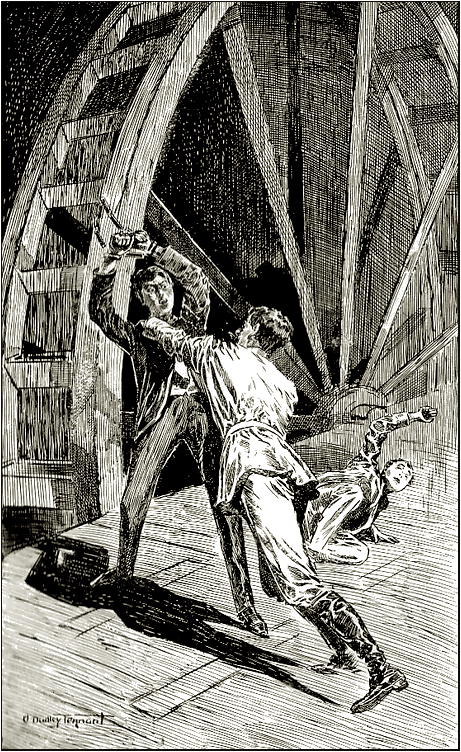
I resisted him with all my might.
Just then I felt that the cord about my wrists was giving way.
With a twist and a wrench I got them free just as Condazin stretched out his leg and tripped up my assailant. Unfortunately we were at this moment on the brink of the yawning chasm.
Too late to save myself, I clutched with my newly-released hands at Alphonse's hair as I went over the edge. For a moment it held; then a handful came out, and I dropped into the seething water, which, by this time, as I soon found, was of considerable depth.
Fortunately I am a strong swimmer. But in that boiling flood, swirling ever onwards towards and under the great wheel, the most I could do was to keep my head above the surface, though I did manage, after a time, to get rid of the gag.
In this way I must have bobbed about for fully ten minutes.
It seemed to me an eternity.
No man ever entered with more complete sympathy into the last agonies of an unfortunate mouse, doomed to swim round a basin till exhaustion compels it to drown, than did I in those ten terrible minutes.
Groping and clutching with desperation at the stonework which formed the sides of the pit, I endeavoured to discover some handhold. But the walls were of dressed stones, fitted closely together with cement, and I was unable to find the narrowest niche into which to thrust my fingers.
It was while I thus struggled with the foaming waters that a gleam of light shone down from above, causing me to hope that help was at hand. Glancing upwards, I caught sight of the outline of the head and shoulders of the Frenchman. He swung the lantern to and fro as though endeavouring to ascertain what had become of me. Immediately after this I heard him utter an exclamation, and both he and the lantern suddenly disappeared.
The darkness recalled me to a sense of my terrible position, for just at this moment I found that I was within an ace of being sucked by the outflow under the square troughs of the ponderous wheel.
With a supreme effort I succeeded in stemming the swiftly-rushing tide and in regaining my former place near the head of the opening.
Here, though the water boiled and swirled tremendously, there was less current, and I was able, by almost superhuman exertions, to maintain my position.
Then it was that I sent up my first cry for help. My voice made the echoes ring in the confined space even above the mingled sounds of the falling waters and the groaning of the ancient oaken timbers of the ponderous wheel.
But no reply came; nor did I again catch sight of Alphonse and his lantern. So that at length the conclusion was forced upon me that he had taken my comrade away—perhaps for his destruction in some other manner.
Minutes flew by—each one seemed an hour, and my strength was giving way. I began to count the strokes of my limbs as I struggled against the current. Twenty more strokes and I must let myself go.
Even now I can remember the very words I used as I commended my soul to its Maker before I allowed the waters to carry me into what seemed to be the arms of death.
After all, drowning was said to be the easiest of deaths; and with the 'Amen' of my prayer I ceased to struggle and was swept away.
Half a minute later, in full possession of my senses, I found that I was grasping something, and that something was in motion.
Yes, it was lifting me out of the water. Slowly, yet surely, was I rising. The truth flashed upon me. I had grasped the edge of one of the broad buckets and had passed right under the wheel.
'Thank heaven!' I cried fervently, as I swung steadily upwards.
It is surprising how speedily hope is revived in the human breast. I could have sung Te Deum as I found myself dragged out of the flood.
The next thought that came to me dashed my hopes clean away. It was plain that as soon as the wheel had revolved far enough I should come under the inflowing current which entered through the sluice doors. Should this fail to drown me, or to hurl me insensible into the abyss, I should pass down, slowly but with absolute certainty, into the awful place which I had just left.
'O God!' I cried in my terror, 'have mercy on me, and save me from so terrible a death!'
For an instant the thought held me that I would shuffle along to the edge of the wheel and make a spring for the stone platform as soon as I had been lifted half-way up. But in that pitchy darkness it was quite impossible to discover when this point would be reached. Besides, there was the risk that I might fall over between the wheel and the stonework; in which case I should certainly be crushed to death. For there was in that place, I felt sure, only a very narrow space.
Meanwhile I was being lifted—lifted—high aloft, till at length (it was only a minute or so, though it seemed hours) the edges of the broad troughs came under my body. They were fully three-quarters of a yard apart and might have been some six yards in length; that is to say, extending right across the wheel from edge to edge of the circumference.
I had to make up my mind quickly, but under such circumstances thought is rapid, for there is nothing like imminent peril for sharpening the wits. So without hesitation I scrambled along the edge of the trough on which I found my feet were resting, which I felt was now nearing the top of the wheel, and, leaning over, I felt about if perchance I should be able to find one of the spokes.
To my joy and intense relief my hand grasped a rod—an iron one. How it was managed I can never explain—even to myself. But somehow I contrived to descend quickly from what had now become the top of the revolving water-wheel, and grasped the rusty iron stays with which the interior was strengthened. So that, by the time the troughs to which I had recently clung had advanced under the sluice and were being filled in turn, I was safe within a revolving prison.
My first impulse was to utter an ejaculation of thanksgiving, my second to lower myself down to the inside of the circumference. Though what would happen to me when I arrived there I knew not.
Happily, as I soon discovered, there was a broad space in the middle which was free from bars and cross-beams, and the idea occurred to me that I might safely walk along at the bottom as the wheel revolved; for the motion was steady and not too rapid, and I deemed it possible that I might be able to accomplish a lengthy treadmill journey without hurry or undue fatigue.
By this time my position, which had been at the top of the wheel a minute or so before, was altogether reversed, and I was deep down at the bottom. Water dripped on every side. Its plunging, as the troughs regularly filled and emptied, kept up a continuous din. Heeding not that I was both tired, cold and drenched to the skin, I at once began to advance boldly towards that part of the circumference which was coming towards me, deeming that I should have little difficulty in keeping pace with its revolutions.
By walking at a brisk pace—it was almost running—I found that I was able to keep up with the motion. Once or twice, by straying from the middle, I came in contact with the iron stays, and only succeeded in keeping clear of them by advancing with outstretched hands, and thus determining my position by touching each rod as it passed.
The cold water had chilled me to the very marrow, so that it was with a sense of comfort that I began to feel the blood once more circulating freely in my benumbed limbs.
Here then was a chance for life. If I could but keep up this strange and dreary march throughout the night it might be possible, when the day broke, for me to swing up on to the stone platform by means of the intersecting rods. Or, failing that, someone might visit the empty mill and discover that the wheel was in motion. For the rolling, grinding sound made by the revolving machinery would certainly be heard some distance away.
During a couple of hours I stepped out briskly enough. My mind was occupied by many thoughts. I was hopeful that Condazin had escaped. It was possible, moreover, that he would be able to procure help. This led me to think about the Countess, and to wonder afresh what she did aboard the yawl. By a natural sequence my thoughts passed on to O'Callaghan, to the robbery of the cathedral treasure, and the scenes which I had witnessed earlier in the night repassed with wonderful vividness before my eyes.
All this time I was tramping along at full speed. After a while my onward motion had become mechanical, for I found exactly the rate of speed which must be maintained. I knew just when to stretch forth my hand to touch the rods as they passed, and by means of which I was able to walk in the middle of the track. The difficulty of keeping pace with the rate of motion of the wheel did not at first seem to me very great; it was only a matter of endurance. I even found myself planning what I should do when again I found myself on solid earth.
About this time—that is to say in the early part of the third hour of my extraordinary imprisonment—I began to become conscious of a horrible feeling of emptiness. No food had passed my lips for a long time, and the night air, united with the plunge into the cold water, had produced a keen appetite. There was no means of satisfying this longing, and my strength soon began to decline. Added to this was a feeling of intense sleepiness which presently caused me to reel like a drunken man, and I clutched at a rod for support, only to find that my feet were being swiftly carried away from under me. In fact, I had a very smart run down hill before I could recover my position at the bottom of the wheel.
For a while I struggled on as bravely as I could. By this time my legs ached terribly. 'How many miles have I walked?' I asked, speaking aloud.
This led me into a new train of thought, and I made out that, at the rate of speed at which I had travelled, I must have covered twelve or fifteen miles.
Again the sleepiness almost overcame me, till I reeled and grasped the passing iron stay.
'Rest!' I gasped, 'rest I must have!' as I clutched convulsively at the rod, clutched and clung, though I knew that the wheel was bearing me up and up, feet foremost now, to the highest point in its revolution.
Fortunately, enough of my senses remained to impel me to entwine my legs about the bar, or assuredly I should have twisted round, and, loosing my hold, would have dashed out my brains. Slowly the wheel turned about, and all the blood in my body seemed to be pouring into my head. But things became better as it continued to revolve, and by the time I again arrived at the bottom I was more than half inclined to try another trip—anything was better than the eternal treadmill march.
This time, as the rod moved upwards out of its vertical position, I gradually shifted my attitude, so that my feet were downwards when I had reached the highest point.
At this moment a new idea occurred to me. Why should I not slide down on to the axle? There the motion would not seem to be so swift. Perhaps I might be able to balance myself on my feet, maintaining my equilibrium by grasping the rods or the spokes of the wheel as they rotated.
It was a terrible venture and might end in my destruction. Still, it was better than to allow myself to be carried round and round until, completely dazed, I dropped from my perch to be dashed to pieces in this relentless moving prison.
I had once more passed the highest point when courage came to me and I slid down the stay.
Joy! my feet rested on the great round axle-tree. But the wheel had progressed too far for me to gain an upright position during this revolution. All I could do was to cling on for dear life until I again found myself vertical.
The motion here seemed to be so slow that I really began to wonder whether the wheel would ever turn about to its former place. The rush of blood to my head was even more intense than before, and I felt that I could not again endure to be turned upside down.
At length—it seemed an age—an eternity—my aching body was raised upright, and with a feeling of desperation I stepped once more on the axle. My fear at first was that my head would come in contact with some of the cross-stays which intersected the interior of the ponderous structure. To my intense relief I discovered that these were not in the way, though it took one whole revolution of the wheel for me to make sure of this fact. The extreme anxiety which I endured during the time thus occupied no words of mine can describe.
Slowly, very slowly the massive beam under my feet turned about. I was able without difficulty to keep pace with its motion and contrived to maintain my vertical position by the aid of the spokes as they successively presented themselves to my hand.
Hope now began to return, and with it prayer for deliverance. For I had well-nigh arrived at that point of despair where men cease to pray.
THUS passed the weary yet all-too-exciting hours of the longest night I have ever known. As I look back upon it I sometimes wonder that my senses did not desert me. Had they done so I should not have penned these words.
At length—oh, how slowly it came!—the dim, ethereal light of dawn began to creep in through openings in the roof—though I could not see of what sort the said openings were—and little by little the web-like structure of my revolving prison was revealed to me. At first the sight of my dangerous position frightened me much, for the darkness had mercifully hidden some of its terrors. The insecurity of my ever-moving foothold; the chance that I might miss handhold and so fall from my unstable perch; the knowledge that my strength was well nigh spent, all combined to augment my terror and my anxiety.
But the increasing light brought also a sight of the green slimy floor on which I had struggled with Alphonse. The marks of our encounter were visible enough, and I began to wonder whether I could not slip through the upright spokes of the moving cage and spring on to terra firma.
For some time I weighed the chances of success. Failure would mean a horrible torturing death, as, in case I missed the ground, or slipped back on reaching it, I should certainly be crushed by the wheel against the side of the stone-lined pit.
On the other hand, it needed but one more venture, one supreme effort, and I should be delivered from my present danger. The leap looked to be easy enough. And yet I shall hardly be believed when I affirm that I was so long making up my mind that it became quite broad daylight before I had decided to venture, for the beam on which my feet rested seemed so strangely secure.
At last, nerving my heart and bracing my muscles for the effort, I squeezed my body through the bars and sprang with all my might.
'He is better.'
'Yes—but seems to be very weak.'
'Surely. Yet it is wonderful that we should find him alive.'
I raised my eyelids and tried to look at the speakers, for at first their voices sounded strange and far-off. Then I saw that one of them was no less a person than she who was named 'The Countess,' who was supporting my head as I lay on the damp floor.
'He is exhausted,' she said, looking up at the man who stood by her, a short, stout Frenchman, with, strange to say, red hair and tiny Mongolian-like slits of eyes.
They raised me into a sitting posture. The wheel was still revolving with its splashing, rumbling sound, and as we watched I saw that the body of a man, which had become hooked to the broken edge of one of the troughs, was borne slowly round towards the inrushing waters. Twice the body appeared in sight and was again carried into the foaming depths, till the Countess cried aloud to her companion to drag me outside, which he was not slow to do, and presently I found myself in the warm sunshine and propped up against the wall of the mill.
'Ah, a ghastly sight!' exclaimed the Countess, nervously, as she averted her face at the thought of what we had just looked upon.
'It might have been myself,' I remarked solemnly.
Then I inquired for Joseph Condazin, for I was exceedingly anxious to discover what had become of him.
To this the Countess replied that he was safe and in good hands.
'On board the yawl?' I asked.
'No, no! In a far safer place,' said she, with a smile. But she would give me no further information.
At this point there was a sound of hoofs and wheels, and in a few moments a coach and four horses swept round the corner of the building and drew up.
'Now,' said the Countess, 'if you walk but a few steps the carriage will do the rest.'
Again she smiled sweetly, and I thought not a little sadly, and I began to wonder afresh who she might be.
'But, madam,' I began, 'can we not return to the ship and to England? Our friends will surely—'
She cut me short by telling me that by this time the yawl was far on her way to the sea, even if she had not already reached the blue salt waters; that there were those in Amiens—friends and associates of the would-be murderer Alphonse—who would not scruple to again cast me beneath the mill-wheel; for my own safety's sake it was necessary that I should at once accept her proffered aid and protection.
'Trust me,' she said pleadingly, 'and I will be your true friend.'
And when I looked into her beautiful and expressive face, and read therein only candour and benevolence, without further hesitation I determined to place myself in her hands.
No sooner had I sunk back on the cushions which lined the interior of the vehicle than I fell into a deep sleep, so great was my fatigue and exhaustion. It was dark when I awoke and still we were travelling, and after partaking of some food, which the Countess, who sat by my side, pressed upon me, I again went to sleep; nor did I open my weary eyes until late the following morning, when the coach stopped with a jerk and I sat up and rubbed my eyes.
'Are you sufficiently recovered to descend without assistance?' inquired my fair companion.
I replied that I felt quite myself again, though indeed I was not long in discovering that my limbs were exceedingly stiff. Still, with as much grace and courtesy as I could command, I handed the lady from the coach while the stout, red-faced man aforementioned clambered down groaningly.
'Where are we?' I exclaimed, gazing around in surprise.
'You are at the Castle of Saint Ange,' said the Countess. 'This is perhaps the best view from the land side. From the sea it is even more imposing.'
Before us spread a beautiful bay, in which the white-crested waves tumbled gaily. The breeze which blew in our faces was delightfully fresh and invigorating, and I inhaled it with delight. Then my eye caught sight of a vast pile of rock which arose on the left and which stood, sentinel-like, well out into the blue waters, it being high tide. The seaward sides were so steep as to be to all appearance absolutely inaccessible, consisting of huge masses of granite, silex and limestone, joined to the land by a causeway or isthmus of rock. Through the lower part of this neck of land the sea had already made a breach, though the upper part held firm and formed a natural bridge.
But it was not so much the rock, in its proud, fortress-like position, which arrested my attention, as the erection by which it was surmounted. I could discern the shapes of towers and battlements, the loftiest point being surmounted by a mighty gilded angel, with outstretched wings which glittered like burnished gold in the morning sunlight. So massive were some of the walls that they appeared to grow out of the rock, so that it was not easy to discern where the latter ended and the former began. From the place where we stood I could view two sides of the serrated and corrugated structure, and judged that the height of the angel above the sea level was quite two hundred feet, and might be considerably more.
I noticed that my companions were following my looks of wonder and admiration with some approval.
'You would like to visit that castle,' said the Countess.
'Yes.'
'Then you shall do so—it is my home.'
I looked at her in surprise. But she had turned and was advancing towards the causeway. So I followed her and we crossed the natural bridge (which was so narrow that no carriage would have passed) and came presently to a massive gateway of stone, having a narrow entrance protected by an oaken door of great strength, iron-bound, and studded with bolts.
As soon as we had passed through it I found myself in a spacious courtyard. Everything was of solid and unyielding stone, fretted and carved in places after a curious fashion and with much skilful workmanship. There were stairways which led to the top of the walls, and doorways which revealed dark passages ending in dim halls. On the right hand arose the traceried windows and crocketed spires of an ancient chapel. Portions of the stonework were falling into ruins, but that which remained was exceedingly beautiful.
'Do you admire my castle?'
'It is a marvellous place, but—'
She detected a tone of surprise and doubt in my voice.
'It is too good for me?' she said archly.
It struck me, as she spoke, what a beautiful woman she was.
'Nay, madam,' I replied, striving to address her with gallantry, 'nothing could be too grand for such as yourself. But what puzzled me is why you should go to sea with such a fellow as—'
'Hush!' she said, checking me by laying her fair hand on my mouth, 'this is neither the time nor the place to talk of such things.' Then she whispered in my ear, 'When a fitting opportunity presents I may explain many things.'
Wondering greatly, I followed her from the courtyard down one of the dark passages, and presently found myself in a spacious room, having a roof of stone, groined and carved.
'Remain here a few minutes,' said the Countess, 'and I will send to you one who will show you a chamber which will be set apart for your use.'
As soon as she had gone I proceeded with some curiosity to examine the room. It was lofty and had windows of richly-coloured glass. The fireplace was especially fine, being an ancient piece of carving representing a battle, and was exceedingly large, reaching right up to the stone roof.
It was while I was admiring these things that the voice of a singer smote upon my ear. I had ever an ear for music, and in these strange surroundings the effect of that clear, strong voice was entrancing, so that I stood stock-still in the middle of the floor listening attentively. The words, of course, were French. It was the first time that I had heard a song in that language. Even at this lapse of time I can recall the tones of that fresh young voice:—
'La boulangère a des écus,
Et moi j'en ai guère,
Elle en a, car je les ai vu,
J'ai vu, j'ai vu la boulangère.'
This was followed by the sound of someone dancing, and presently there skipped mirthfully into the hall a pretty young French girl attired in the short skirts and quaint linen cap of the district, her face glowing with the exercise and her dark eyes sparkling with health and good-humour.
'Pardon, monsieur!' she exclaimed, stopping abruptly as she caught sight of me.
'Pray, proceed with your singing, mademoiselle. One does not often hear the nightingale,' I returned, bowing as politely as I knew how.
She laughed gaily. 'Ah! so you English can bestow compliments! I had not thought it of you. . . . Will monsieur please come with me?'
She uttered the latter words more demurely, and I followed her through dark passages and up narrow winding stairs to a fairly spacious room, high in a turret and commanding a fine view of the sea.
Sitting down by the window I began to think. What a whirl of mystery I had entered! Who was O'Callaghan? and the Countess? Why had I been thrown into the water-wheel? and why brought to this castle? What had become of Condazin? Should I ever see him again? And what would be the end of all these mysteries and adventures?
THAT evening I sat down to a meal more substantial than any I had tasted since Condazin and I had been kidnapped from England. It was served in a dim and stately apartment, where we were waited upon by the stout, red-headed servant, whose name, as I afterwards discovered, was Joseph Vimont.
The hostess, who now appeared in a charming evening dress, was all smiles and engaging chatter. There was a profusion of dishes, the very names being unknown to me. The magnificent and glittering silver, the lights, the unusual splendour of my surroundings, combined to silence my tongue when most I desired to ask questions.
It seemed to me—though certainly I might have been mistaken—that the Countess perceived this, and that she contrived, with much adroitness and animation of voice and gesture, to draw me to speak of fifty other things rather than of that which was uppermost in my thoughts. She talked of the castle, giving me graphic accounts of its past history, its legends, its wonderful chambers and towers. She questioned me concerning England, the customs of its people, and the chances of an outbreak of war with France. She related amusing stories of the peasantry of the neighbourhood, and told me much which was interesting concerning their outlandish ways and quaint speech. And all the time I felt that she was keeping at arm's length the questions I fain would put concerning herself, O'Callaghan and the yawl.
I did manage, however, to slip in one inquiry about Condazin, for he was greatly in my mind, and I was anxious to ascertain whether the villainous Alphonse had done him any hurt.
'No, no!' she cried cheerfully, 'your young friend is safe enough; I have seen to that.'
'And he is—?'
'He will be here to-morrow.'
This was good news, and I began to think that I had better be content to postpone my other inquiries to a more convenient season.
But I guessed not how much I should learn that very night.
The scene from my window in the turret was exceedingly lovely. The wind had dropped till it but gently ruffled the surface of the waves which at high water lapped the foot of the giant cliff, and over which a broad path of scintillating, silvery light was drawn, reaching from the far horizon to the very foot of the crag on which the castle was upreared. The scene was so exquisitely lovely that for some time I remained at the window spell-bound. Then, as my thoughts began to drift across the seas to distant England and my home, I forgot the radiant moon with its glorified image reflected by the tremulant waves, and began to muse concerning my mother, wondering whether she were at this moment thinking of her lost son. I pictured the family party, my parents and my two sisters, the cosy room with all its familiar furniture and household nick-nacks, the evening meal spread on the table. Nay, I could almost detect the odour of the viands, and caught myself in the very act of sniffing, as though the very smell of home had entered my nostrils, when all at once my attention was diverted from these dreams by an object which was slowly passing across the moonbeams' path.
It might have been a mile away, it might have been nearer, but in the clear, cold light every line, spar and sail showed up as distinctly as though limned with a brush on a painter's canvas.
There would have been nothing very worthy of notice in the sudden appearance of this vessel, and I should have looked at her unmoved, had it not been for one fact.
The little ship was rigged as a yawl.
Not that this alone need have astonished me. There were doubtless many yawl-rigged vessels in these waters, but I noticed that this one was being put about and was actually making for the cliff. Even as I looked it sailed diagonally across the pathway of illuminated water and out of the path of silver light into the colder shadow. But I could follow its movements well enough by aid of the clear sheen on the waves, and I saw that they put the little ship on the other tack very quickly, so that she soon returned again into the track of the moon, and this time much nearer to the castle.
With eager gaze I watched her, fearing now that O'Callaghan and his men had come hither seeking me, and wondering what I should do. That the Countess would allow me to be again carried off I could not suppose possible, and yet I felt horribly anxious as the little vessel beat to and fro, at each stretch drawing nearer to the land.
Presently I saw a light. It was run up by jerks to the mast-head. Then appeared two others, one at each end of the deck, the three making the corners of a triangle and plainly intended to be a signal to persons ashore. Whether these were answered or not I was unable to tell, but in about half-an-hour I heard a stir in the castle below, which increased my anxiety, and I concluded that visitors from the yawl had arrived.
After a while all was still, and then my curiosity (as is natural with the young) began to overcome my alarm. Perhaps after all I was mistaken and this was not the yawl which had brought me across the Channel. Was it then a smuggling craft? And did the Countess engage in the illicit, but at that time popular, traffic?
For some time I thought and wondered. Then, my curiosity overcoming my discretion, I cautiously opened the narrow door, and after listening attentively at the head of the stairs and hearing no sounds, I stole cautiously down.
The moonbeams cast a pale ghostly light through the slits of windows on the stairs, enabling me to find my way to the bottom without stumbling. But after this I came to a dark passage, along which I groped with care, feeling the wall with my hand, but knowing not whither it would lead.
All at once I plunged forward in the darkness, falling down some steps upon which I had come unexpectedly. To save myself I grasped at a curtain, or it might have been a piece of tapestry, which hung against the wall. It was possibly old and somewhat rotten, for it tore asunder with a sharp rending sound and I rolled beneath it, hitting my head sharply against a projecting corner of stone at what seemed to be an opening in the wall.
Half-stunned with the blow I must have lain there motionless for a few minutes, for, on recovering my senses, I perceived a dim light and heard voices in conversation, apparently close at hand.
'It was but the wind whistling through one of the ghostly passages of this haunt of owls,' said a voice, which I recognised as that of Captain O'Callaghan.
'At least to me it was an unwonted sound,' replied a woman—the Countess.
There was silence for a few seconds, as though they listened, and in the pause my senses returned to me more fully, and when they again spoke I was alert.
'Then that is the reason why you are here?' said the Countess.
'That is the reason,' replied O'Callaghan.
'But it seems hard and cruel that they should be dragged from their homes—they are so young.'
'We must have men, and these are a pair of plucky English lads. They will make splendid sailors after a year or two's training. And it is altogether impossible, as you well know, Mathilde, for my ventures to succeed unless I have the right sort of men.'
'But you have Hobinstock and—'
'Bah! ill-bred and uneducated fellows! No staying power! Nothing heroic about 'em! No! give me gentlemen for our work. Blood always tells. You know that!'
'But to steal them away—!'
'D'ye think they'd go willingly?' he cried almost angrily. 'Not a bit of it! My plan is the only one. And, as I have told you, men I must have.'
'These lads are so young,' pleaded the Countess again. 'One of them is a mere boy. It is terrible that they should be involved in scenes of bloodshed such as—'
'Such as those in which I am often engaged,' he said, completing her sentence and laughing loudly. 'Have I not told you, dear wife,' he continued, speaking more tenderly, 'that, properly conducted, this slave business is both humane and Christianising. Such is the opinion of many in the English parliament. I am told that less than a month ago one of the most promising of English politicians, in a very eloquent speech, supported slavery, showing that it was only by this means the African could be brought into contact with the influences of civilisation and of the Christian religion. Call me neither a slave dealer nor a pirate, nor a robber of men and women, but dub me a practical missionary.'
Again the captain laughed heartily, as though he enjoyed the idea that his trade might be regarded in the light of a philanthropic and religious enterprise.
I had listened to such arguments as this in my father's house, but they had always seemed to me to be weak and the outcome of cant. And now that I heard them repeated by O'Callaghan I was convinced that there was no soundness whatever in them—as is generally the case with regard to special pleading.
At this point I began to feel so stiff and uncomfortable, by reason of my constrained position, that I moved slightly.
''Pon my word, wife, one might almost believe that this old place of yours is haunted!' exclaimed the captain. 'I heard a creaking sound in the corner yonder.'
'You would have time for nothing else did you follow every creak in this ancient castle,' said she, laughing.
I lay still and soon they resumed their conversation.
'So you have quite made up your mind, Daniel?' continued the Countess, speaking in a firmer tone than she had hitherto used.
'Yes. I shall take them with me to-night. The schooner will be beating to and fro out at sea yonder and will pick us up in the morning if the wind holds.'
'And the money you brought from England in the cement casks?'
'I'll hide it in your cellars till I return. It's a tidy sum, and I was lucky to lay hands on it.'
'But it is not yours.'
'What a wonderful world this would be if every one had his own,' he responded with another of his laughs. 'Why, I should have no right to enter this castle. But come, I must away! See, here is a pocket-book. It contains information which may be of value to you in case I do not come back. And now the English lad—stay! I will go myself.'
I cautiously raised the lower fringe of the tapestry in order that I might watch if they should leave the room, and I was just able to see the Countess draw a step or two nearer to O'Callaghan.
'You will grant me a favour, Daniel,' she said, laying her small white hand upon his broad shoulder.
'What is it?'
She wore the low-cut dress in which she had appeared at dinner, and her snowy bosom gleamed white in the light of the lamp which hung suspended from the roof. She appeared so very lovely that I could not have believed that any man would have refused the petition of such a woman.
For a moment she hesitated and looked up into his face.
'I believe that you love me,' she said.
'I adore you,' he replied, clasping her in his arms.
'Then grant my request.'
'Which is—?'
'That these lads be left here.'
'But I have told you that I need them.'
'You can do without them.'
'Let me at least make them the offer,' said he.
'The younger one does not arrive until to-morrow.'
'Then I will talk with the elder one. He has pluck enough for me. You should have seen him hold that precious cask of gold on the gun'le of the boat in Pegwell Bay. Yes, he's a brave fellow.'
I felt a slight thrill of pride as he said this, for one loves to be accounted brave; and I suppose I was not behind youths of my age in the matter of self-esteem. Yet I checked this thought when the recollection flashed upon me that though I had in the Countess a protectress as powerful as she was fair, I was in reality a homeless beggar, dependent on the crumb of charity and at the present moment at the mercy of this Daniel O'Callaghan as regards my liberty, and perhaps even as regards my life.
While these thoughts passed through my mind—and it is wonderful how rapid is the action of thought at such times—O'Callaghan had taken a pocket-book from the breast pocket of his coat and my lady was pressing it to her lips with terms of endearment and as though he had bestowed on her a valuable keepsake.
'Notice,' he said, 'that it is fastened and sealed. Do not open it until I have been absent at least two years.'
'So long!' she said, with a sigh.
She laid the little package on the table and together they left the room. I had no doubt that O'Callaghan was about to make for my apartment that he might ascertain my mind on the subject which he had discussed with the Countess.
Now, no sooner had they gone than it occurred to me to creep from under the hangings by which I had been concealed and to hide myself in some place more secure until after the departure of the yawl.
For I had no mind to be conveyed away to the slave coast of Africa or to the far-off West Indies.
THUS far I have related how my friend Condazin and I were kidnapped among the sandhills in the neighbourhood of Sandwich in Kent and carried off by Captain O'Callaghan and his men to the ancient city of Amiens in France. How we witnessed the sacrilege of the cathedral. How we were entrapped by the wicked Frenchman, Alphonse, by whose murderous deed I underwent the terrible ordeal of the water-wheel. Finally how the Countess Mathilde de Grancey brought me to the ancient castle of Saint Ange.
Even if this were the end of my narrative it would have disclosed an experience sufficiently exciting for two country-bred English lads. But though we knew it not, there were to come to us revelations so extraordinary and startling that I must now proceed to describe them with some amount of detail, only saying, by way of preface, that these events were the means of disclosing a story not a little interesting, and one which, in the hands of those who write novels, might well form the basis of an attractive plot.
Being myself only a plain and straightforward Englishman and no weaver of romances, I can but set down, in a matter-of-fact way, both the strange things which we saw and the deeds which we afterwards managed to perform.
For a few seconds I stood upright within the empty room, watching and listening. The sounds of the footsteps of the Countess and O'Callaghan had died away in the distance before I cautiously advanced towards the table. On it lay the pocket-book. I had no intention of stealing it; but, scarcely had I taken the packet into my hands—perhaps it was from sheer curiosity, I cannot tell—when the sound of footsteps struck upon my ear, and, before I could replace the book, she whom I had overheard singing, and who only a short time ago had conducted me to my room, suddenly entered the apartment.
I quickly slipped the packet containing the said pocket-book into my own pocket and made some remark to the girl in English.
'Ah! monsieur, I do speak your language but a very leetle,' she said.
Then I told her that I could speak French.
'Bien!' She was very pleased, she said. 'But this is no time for talking. Does monsieur know what is afoot?' she added, drawing nearer to me as she spoke and looking intently into my face.
'Yes, I know that Captain O'Callaghan wishes to take me away to his ship,' I replied, with as much calmness as I could muster.
'Ah! that my beautiful mistress had not married him!' cried the girl, with eyes uplifted and hands upraised. 'His coming to this castle has brought nothing but sorrow—and there is, I fear, more to follow.'
'What do you mean?' I asked.
'Ma foi! This is no time for explanations, if you would save yourself from my master. He is cruel—cruel, yet brave.'
'Tell me where I can hide.'
She thought a moment, with her forefinger placed on her lips.
'There are many places in this rambling castle—the ruins of the chapel—and the dungeons. Yes, the dungeons will surely be safe.'
'But are they not very dark?' I exclaimed, shrinking back as she laid her shapely hand upon my arm, as though she would lead me to the place.
'Dark as night, monsieur; but you shall have light—light sufficient until I release you. Come!' I followed her from the hall and along one of the dark stone passages. From a table she took a lantern, and from a nail in the wall a rusty key of antiquated pattern.
'This will last you for a good many hours,' she remarked as she kindled a light. 'See, the reservoir of oil is quite full.'
We began to descend a flight of stone steps. Down, down, down, till it seemed to me as though we were going into the very bowels of the earth. The walls were no longer of hewn stones but seemed to be cut out of the solid rock. Overhead the low, irregular archway showed marks of pick and wedge, and it was evident that the excavation of this tunnel had been a work of immense toil, though I guessed that hundreds of years might have elapsed since its completion, for there was no sign of recent workmanship, and the roof was everywhere grimed with the smoke of candles and lamps.
'This way, monsieur!' cried my fair guide—she was an exceedingly pretty, dark-eyed Normandy maiden.
We at last reached the bottom of the steps, which had become rougher and more irregular the lower we advanced. At this place we came to several doors of ancient oak, thickly studded with iron bolts like others which I had noticed in the castle, but older, and the ironwork more rusty.
I looked about me in some wonderment. Truly it was a curious place—a kind of lobby or antechamber carved out of the solid rock, with the tool-marks here also everywhere visible, though the hands which had wrought them had long ages ago crumbled into dust. There were stains—dark brown stains—on the floor before the largest of the doors, as though some liquid had been spilt. My companion whispered, with a shiver, that it was blood.
'A great fight with smugglers took place on this spot nigh two hundred years ago,' she said.
'And some were killed?'
She nodded and placed the great key in the lock. For a time it defied our united efforts. But at length, aided by an iron bar which I picked up and employed as a lever, we managed to thrust back the stiff and creaking bolt, and the stout door turned inwards on its unwilling hinges.
'Go forward, monsieur, there is nothing to harm you,' said the girl.
'Is this the place where I am to lie hid?' I asked, as I peered into the vault-like chamber.
There was perhaps a tinge of suspicion in my tone, which my quick-witted companion noticed.
'Does not monsieur trust me?' she said, with a look of inquiry in her dark eyes, and once more laying her hand on my arm.
'Yes, yes,' I replied hastily.
'Then you will remain here till I return.'
'To let me out?'
'At least to bring you news.'
She placed the ring of the lantern in my right hand and the key in my left, and giving me a pleasant smile, which revealed the whitest of pearly teeth, was retreating to the door—for we had advanced a few steps into the dungeon.
'Stay!' I cried. 'What is your name?'
I could hardly say why I put such a question to the girl. But something in her seemed quite suddenly to interest me.
'They call me Geneviève, monsieur,' she said, raising her regular eyebrows as though a little astonished at my inquiry; 'Geneviève Blossère,' she added, with somewhat of a blush, and then—'now you know enough. I am sorry there is no bed more comfortable than the big chest yonder. But men have slept before now on as hard a mattress. Lock the door, and open only when you hear my voice. Shall you remember the sound of it?'
The last question she put in a mischievous tone, and with a sly look of fun in her eyes. Before I could say more she had gone and the door was closed.
My first act was to glance round the place in which I found myself. It was a spacious vaulted chamber, oblong in shape, the roof being supported by two rows of massive pillars, though the walls were apparently in parts solid rock and elsewhere of hewn stone. Around the said walls were piled chests and boxes of various sizes, some of them being plainly of ancient make. I set down the lantern and tried to open the lid of one of them, for curiosity moved me to discover what it contained, but it was fastened with massive locks; nor could I raise the box from the ground when I tried to lift it. Presently I caught sight of the casks of 'Parker's Cement.' Their form was very familiar to me and recalled the adventure in the boat when we gave the slip to O'Callaghan and his men. It was plain that the casks had but recently been brought to this place, for there were stringy bits of seaweed hanging about the hooping which bound them, and the edges were gritty with damp sand.
Holding the lantern aloft I passed down a sort of aisle, that is to say to the left of one of the rows of stone columns, and presently came upon a rack of ancient weapons and quite a large number of suits of armour, some of them being much rusted, but others, though perhaps a trifle tarnished, in excellent preservation.
Among the weapons I noticed some whose very names were unknown to me. Others were familiar to me by pictures which I had seen. Among them were some formidable pikes and halberds, as well as a clumsy and antiquated gun, which I have since learnt is called an arquebus. By the side of these were several curious long pistols, having the butt ends curved almost to a semi-circle, fitted with flint-locks and a pan for the priming powder. I took up one of these pistols and examined it with some curiosity. The stock was elaborately carved and inlaid with coloured woods and stones. It had in addition a massive mount of silver. The lock was in good order, for when I pulled the trigger, brilliant sparks flashed forth—enough to have discharged the weapon had it been loaded and primed.
'Come!' said I to myself, 'I have but to find some gunpowder and if it comes to the worst I shall at least be able to defend my life!'
But I did not guess the service which that ancient pistol would render before an hour had claimed.
I thrust the weapon into my jacket pocket, butt-end downwards, thinking I would examine it more closely at my leisure, for, like most youths, I was always curious about firearms, having also a love for things antique.
'Now for the further side of this queer place,' I muttered, as I crossed the unencumbered space in the middle of the floor and made for the opposite aisle.
The bars of the massive lantern cast strange and fitful shadows, which danced confusedly to and fro among the columns of stone as I moved.
Scarcely had I advanced as far as the centre of the nave (as I may call it), when, to my intense astonishment, the light of my lantern shone upon a human form which lay recumbent on a huge chest standing beyond the line of pillars against the wall.
For a few seconds I thought it must be the dead body of a man, and a horrible feeling of dread seized me, for it happened that never yet had I looked upon a corpse.
In mingled amazement and fear, holding the lantern aloft with trembling hand and stretching forward my head beneath it, with dilated eyes and faltering steps I slowly advanced.
All at once—it was just as the light from the lantern fell on his face—there came from the figure a deep sigh, followed by a very uncorpse-like yawn, and no less a personage than my dear friend Condazin opened his eyes and then raised himself on his elbow. Blinking in the light, and looking even more frightened than I had been, he peered fearfully into the glare and tried to discern who it was who held the lantern.
Half in my amazement, half in a spirit of mischief, I refrained from uttering a word until he had left his hard couch and was on his feet.
'Condazin!' I cried, uttering his name in a solemn tone.
'Ah! it is Stephen Thirlwall. Thank God that you are alive!' he exclaimed with a glad smile, advancing towards me with outstretched hands.
What a talk we did have! Each was anxious to question the other, and it was some time before our respective appetites for information were sated.
'And how did you get here?' I inquired, for I was not a little mystified at Condazin's unexpected appearance in the dungeon.
'It is entirely the doings of the Countess de Grancey,' he said. 'I was brought to the castle only this very night. On arrival I was told by a stout old fellow with red hair—'
'Joseph Vimont, the butler,' I interrupted.
'—that O'Callaghan had come here unexpectedly and that it would be for my safety if I lay hid until after his departure. The butler brought me down to this dungeon and told me to await his return. It was horribly dark after he had taken away the light, but I felt my way to this chest, and, being tired, soon fell asleep.'
We went on to talk about our present extraordinary position, and proceeded to discuss plans for escape.
'You came to the castle over the narrow causeway?' I said.
'Yes.'
'It is evident that we cannot get out by that way without being seen. Not that we should know what to do even if we were able to leave this place,' I continued. 'The Countess is friendly, and will no doubt help us to return to England as soon as O'Callaghan has departed.'
'Does he know we are in the castle?'
'He knows that I am here.'
Then I related to him the conversation which I had that very evening overheard.
'This looks serious,' said Condazin.
'And here are we, like rats in a cellar.'
'Is there no way out but by that door?' He pointed towards the massive portal by which I had entered.
Scarcely had he spoken when our attention was attracted by a sound which seemed to come from a corner to the left of the place where we were sitting. It was at first indistinct, but rapidly increased in loudness. Then we could distinguish the muffled sounds of the voices and footsteps of men, and we gazed into the darkness with much alarm.
'Maybe it is O'Callaghan and his men. They are departing,' whispered Condazin.
I nodded, but my heart came into my mouth a moment later as I recognised one voice above the others.
'Do you hear?' I almost gasped, as I sprang to my feet.
Condazin held his breath and listened.
'That villain Alphonse!' he exclaimed.
A SOUND, as of the groaning of the hinges of a door; the subduing of the voices; the tramp and shuffle of feet, followed. I had enough self-possession to thrust the lantern behind the chest on which Condazin had been sleeping, and its gleam was almost entirely concealed.
'Come along! We must escape by the big door,' I whispered.
With great caution we began to edge along toward the further end of the arcade of stout columns, intending to cross to the other side of the dungeon.
But before we had proceeded a dozen paces a crowd of men had entered and lights flashed along the vaulting and among the pillars.
'Too late!' I said.
'We must hide,' said Condazin.
'Where?'
'Behind these chests.'
'But we shall be discovered.'
'It's our only chance.'
He dived behind some iron-bound boxes, and I followed. There was barely room for us both; and, in my efforts to turn—so as to face the opening by which we had entered—for I desired, if it were possible, to see what was going on—I thrust my foot through the worm-eaten crumbling side of the lowermost box, and a fine powder streamed out over my leg.
Speaking in a whisper I told Condazin what I had done.
'It feels like gunpowder,' he said.
'Taste it.'
He did so, and as soon as I was able to shift my position I tasted it also. It was undoubtedly powder—fine and dry, too.
'This will do for the pistol,' I said, still speaking in a low tone, so as not to be overheard by the new-comers.
'A pistol! Where did you get it?' asked Condazin, in surprise.
'From the rack of weapons over yonder. Hold a good handful of powder for me. That's right.'
I proceeded to load the clumsy but powerful weapon as quickly as the darkness and narrowness of our retreat would permit. Presently Condazin inquired if I had any bullets.
'Not a single one.'
'Then the pistol is of no use.'
Here was a poser. We felt about, but could discover nothing that would serve the purpose.
'The ramrod!' I suggested.
'And then—?'
'Why, then we must surrender.'
There was nothing for it but to leave the short stout ramrod in the barrel. We should at any rate have one opportunity of killing or disabling a foe.
Meanwhile there was much commotion in the dungeon. The sound of the moving of heavy cases on the stone floor; the brisk giving of orders, though in an undertone, and of course in French, by Alphonse; the hard breathing of strong men as they lifted weights; the shuffling of the wooden shoes of peasants and the sea boots of mariners combined in making much commotion and in exciting our curiosity to such an extent that, forgetful of danger, we craned our necks beyond the side of the powder chest in order that we might view the movements of the invaders.
The gaunt, evil-visaged Alphonse was standing by one of the casks of 'Parker's Cement,' which had been moved to the midst of the open space or nave. His assistants, a brutal-looking crew, and comprising many types of wickedness, were not all of them unknown to us, for several of them were those whom we had seen in the house to which we had been taken in the city of Amiens, after Alphonse had so cunningly released us from the lock-up.
'Vite, mes amis! or those English dogs may appear and claim a share,' cried the leader in rasping tones.
'Ace! You might lend a hand yourself. These chests are no light weight,' growled one of the men in reply.
Alphonse evidently thought it well to adopt his follower's suggestion, for he grasped the box at which they were tugging, in order to accelerate its motion towards the (to us) invisible door in the corner.
The sight of the crowd of struggling, perspiring, panting men not only completely enchained our attention, but also tickled our fancy in no small degree; so that, forgetful for the moment of danger, we simultaneously gave vent to a burst of ill-suppressed laughter.
The result was disastrous.
Instantly suspending their task, the thieves (for we had no doubt they were such), who were grouped in various attitudes about the iron-bound chest, paused in their work and gazed open-mouthed and with dilated eyes in every direction but the right one.
'Back!' I whispered, striving to shove Condazin's somewhat bulky form into the recess, for he was leaning over me somewhat heavily. He drew back a little, though clumsily, for his foot crashed with a dull but very audible sound through the rotten woodwork of the powder chest.
This was enough to attract towards us the gaze of Alphonse. With an exclamation he seized a lantern from the hand of one of the robbers and directed its light full on my upturned face as I knelt in the opening.
'Dieu!' he gasped, starting back a pace, his face ashy pale with fright.
It flashed upon me instantly that he was not aware that I had been rescued from the water-wheel, and that, possibly, he took me for a ghost.
To add to the illusion, at this point I gave vent to as dismal and unearthly a howl as I could invent. Its long-drawn echoes rolled with lugubrious vibrations among the groinings of the vaulted roof, with the result that not a few of the gang, now completely alarmed, began to retreat towards the door by which they had come.
Overjoyed at this result, I foolishly overdid my part by sending forth a groan intended to be even more weird in its effect than the howl had been.
Perhaps the band would really have fled; but immediately after my successful groan I turned to Condazin with 'Now for the door!' And we sprang up and made at full speed across the 'nave.'
Seeing this, Alphonse instantly recovered his senses.
'After them! They will rouse the whole castle,' he cried, turning about, and drawing a pistol as he ran towards us.
Thrusting the key into Condazin's hand, in order that he might open the door (for, following Geneviève's injunction, I had locked it after her departure), I turned and faced the infuriated Frenchman.
The ancient pistol was in my hand, and I had been careful not to shake the priming powder from the pan.
'One step further and I will fire!' I cried, raising the clumsy weapon.
He paused, and then broke into a scornful laugh, the other men grouping in a confused crowd behind him and looking at me with half-frightened, half-curious smiles.
'Yield, and I will spare your lives!' snarled Alphonse, advancing.
'As you spared mine when you threw me into the mill-race,' I retorted sarcastically, keeping the ancient piece still levelled steadily at him.
'You shall go to a safer place,' he shouted, with a sudden burst of rage, and raising his pistol as he spoke.
It was the first time that I had faced a loaded pistol, and to this day I can recall the tingling sensation which ran through my nerves as I saw that his weapon was covering my breast. All the same I did not lose my presence of mind, and without the slightest hesitation I pulled the clumsy trigger of my own pistol. It was a very large trigger, being nearly the thickness and length of one of my fingers.
Click—fizz—flash—bang! The recoil caused me to stagger backwards, for I had crammed the thing with the coarse-grained gunpowder and the ramrod was no light missile.
The report rang, and rang again, in the confined space, and a cloud of dense smoke floated before me for a few seconds, so that I was unable to see what had been the result of my shot. It was my one and only hope; so after firing I grasped the muzzle of the piece, expecting that Alphonse would be making a rush, retreating the while backwards towards the door.
Before I reached it the smoke rose and disclosed my enemy. He was endeavouring to staunch the blood which flowed from a wound in his arm; and, judging by the way it hung helpless, I concluded that it was broken (though in this, as I afterwards discovered, I was mistaken). Indeed, so tremendous had been the impact of the improvised bullet, that, after wounding Alphonse's arm, it had penetrated the thigh of one of the robber crew behind him, and the man lay helpless on the ground.
But, although severely wounded, the chief robber was not devoid of courage; or perhaps it was that he dreaded the result if we should escape. For, as soon as he saw me, he sprang forward, shouting to his men, 'Secure them—secure them!—the English curs! Quick!—they will escape!'
Condazin was meanwhile fumbling with the key. As he told me afterwards, it had somehow jammed in the lock and defied his efforts to move the bolt.
'Here!' I cried, 'this will do it!
Thrusting the muzzle of the great pistol into the ring we both applied our weight to it, lever-wise.
For ten seconds it resisted our utmost and united efforts. Then, grudgingly, and with a combination of groan and screech, the reluctant lock yielded and the ponderous door swung open.
On a tick of the clock hangs the fate of us all. We are saved, or we are lost, by the breadth of a hair or the lapse of an instant. It was so in our case. Those ten seconds in which we strained at the key were destined to produce results highly momentous to us both, and which certainly would never have happened had we succeeded sooner in opening the door.
Before we could grope our way into the darkness of the passage leading up into the castle, half-a-dozen of the gang were upon us. I hit out right and left among them with the pistol, and had the satisfaction of seeing two of them fall as the result of my blows, for my blood was up and I smote furiously.
Condazin was even more valiant, and showed unmistakably that, though young, he possessed both resolution and physical strength. Indeed, had it not been that his leg was still weak, I think we should have beaten the villains. But his wound, though healed, had lessened his wonted agility, and he slipped and fell as he was attacking a third opponent.
At this point I glanced round and saw that some of the other robbers had drawn very ugly knives.
'No, no!' cried Alphonse, waving his sound arm, 'we must take them alive. Come on, comrades, come on! Vite! Vite!'
The two unvanquished members of the first attacking party had placed themselves between us and the open door. They were big, burly fellows, each of them; had they been Englishmen, more than a fair match for the pair of us. Nevertheless, I was about to cry out to Condazin to join me in a charge upon them, when another six or eight men came running up in obedience to their leader's summons.
'This way!—So!—Ah, you English curs know how to fight! Jacques! Jean! Adolphe! take them! Take them alive, I say!'
With these and like exclamations the excited chief robber encouraged his men, who in a few seconds were swarming about Condazin and myself, cursing and shouting and effectually hindering each other in the task of securing us. For our part, we hit out, English fashion, right and left among them.
'Here's one!' exclaimed Condazin, as he gave a fat farmer-looking fellow a blow full in the wind, so that the man collapsed immediately.
'And another to follow!' I cried, almost exulting in the tingling pleasure of a real stand-up fight, and, as I spoke, bestowing upon a fisherman such a square blow in the right eye as would spoil his beauty for at least a week or two.
But there can be no doubt that we should there and then have been taken by the robbers had not an event occurred upon which, as we afterwards discovered, neither Alphonse nor his followers and assistants had reckoned.
It was just as we were becoming exhausted by our struggle that English voices sounded in our rear, followed by the quick tramp of feet, and we heard the well-remembered tones of O'Callaghan crying, 'Now we've got 'em, my lads!'
This was followed by a surging back of those by whom we were surrounded, and we were borne by the crowd, nolens volens, to the further end of the dungeon, our progress being accompanied by cries, oaths and imprecations, as the robbers drew their knives and defended themselves in real earnest.
'Ah! ye French knaves, I'll do for some o' ye,' shouted Back, who, with the other three and Joseph Vimont, appeared with O'Callaghan.
'Yes, we'll mak 'em run like rats, Jim,' chimed in Hobinstock, as he picked up one of the ancient halberds.
'See! here's sommat to prick 'em wi',' he cried. 'Hark! d'ye 'ear the rat squeal?'
This had reference to the howl of a man whom Hobinstock had prodded with the point of the weapon.
'Liberate these lads and we will talk with you,' cried O'Callaghan in an authoritative voice, as for the first time he caught sight of us.
But the Frenchmen now began to fight desperately. And though the captain and his men made use of the antiquated weapons aforementioned, they received not a few bad cuts from their opponents, for the latter were adepts at the use of the knife.
Meanwhile we were being borne back—back, till, all at once, we found ourselves through a narrow door—evidently that by which Alphonse and his gang had come—and in pitchy darkness.
'WHERE are we?' exclaimed Condazin as we stumbled down what seemed to be some roughly-hewn steps.
'In the bowels of the cliff, under the castle,' I replied.
There was no opportunity for further conversation. With oaths and execrations the Frenchmen hurried us downwards. I thought we should never have got to the bottom of those interminable steps. At last we caught sight of a dim light. It proved to be the moonbeams shining through a narrow doorway in the rock, and in a few minutes we were standing on the yellow sands and within sound of the roar of the sea.
Had we known it, those same pale yellow sands, in a strange and wonderful way, were to work a terrible vengeance on him who had designed our death in the mill, and who, even now, was meditating, unknown to us, as dastardly a crime as was ever conceived by mortal man.
But though wicked and unprincipled, Alphonse was not devoid of brute courage. Though his arm was injured, no cry of pain escaped him, and when one of his men suggested that it should be bound up, he replied, 'Ah, bah! I can wait for that, mon fils, until we have disposed of our young friends.' And then, to the rest, 'Aux armes! mes camarades. We have more work to do this night. The English hounds shall yet be outwitted. They may be brave, but we shall see who has the deeper cunning.'
They conducted us round the foot of the cliff. The breeze was deliciously refreshing after the confined air of the dungeon and we stepped out briskly, having an eye to opportunities for escape.
But this was not to be. Presently our captors brought us again into the dark shadow, where the moonbeams were kept back by the craggy walls of cliff and castle, and which in this place rose sheer to a vast height above our heads. In the gloom could be discerned the entrance to a cave.
'You will be more comfortable here than in the vaults of the castle,' observed Alphonse, turning to me.
'But, monsieur—' I began.
'Nay, do not apologise for the trouble to which you have put us. True, but for you we should now have been bearing across yonder sands enough wealth to have made us rich. But for you I should by this time be even with that insolent Irishman, O'Callaghan. But for you—Bah! why should I say more? We have failed. Vraiment! another opportunity will come soon enough. As for you English cubs—!'
He did not finish the sentence, but I perceived the sparkle of intense malice in his eyes. He had said what assured me that there still was murder in his mind, and I whispered aside to Condazin that we must certainly make a dash on the first opportunity.
Arrived within the cave, two or three lanterns were lighted—they had been extinguished ere we left the dark passage—and a couple of men busied themselves with the bandaging of the arch-villain's arm. It was plain enough that he was badly hurt and that the wound was painful. Yet Alphonse bore it without so much as a groan, and I wondered much at the strange admixture in the man of crime and fortitude with cruelty and craft.
'You will not be able to use this limb for a few days,' remarked one of them, as he made a bungling attempt to bind it to his side.
'Hélas!' responded the patient, 'my tongue must suffice for the present, and you, camarade, must be a right hand to me.'
The fellow seemed gratified at this remark: and I perceived that, in their rough and selfish fashion, these men were all devoted to the service of the wicked Alphonse.
Truly the tastes of Frenchmen are, to us English, as strange as their ways are diverse from ours.
'Now, to business!' cried our enemy, as soon as his arm was slung about his neck 'There is information to be gathered and there are debts to be paid. Hé, monsieur, venez donc!'
The latter words were addressed to me, and I turned and faced the speaker, determined to give him a piece of my mind should he offer me any opportunity.
He began by asking questions concerning the interior of the castle, the furniture, the servants, the articles of value stored therein. To all of which I vouchsafed no reply, so that Alphonse presently cursed me in his rage. The impromptu conference broke up in a hurry, and the men began to advance towards the innermost part of the cave. By the light of the lanterns we could discern in their faces a look of callous hardness and grim determination which was anything but reassuring. Nor were our fears lessened when, after looking at us fixedly and in silence for a few seconds, by the light which one of the men held on high, Alphonse proceeded to address us.
He began (I can still see his sneering face as I write) by reminding us that we were strangers in a strange land; that it was useless for us to hope that we could ever return to England; that even if we could make our way to Amiens we should certainly be arrested for our share in the robbery of the cathedral. Then he hinted darkly that O'Callaghan's deeds were such that no self-respecting man—such as Alphonse himself—could continue to associate with such a fellow, and that his own attempt that night, which our appearance had frustrated, was for the express purpose of obtaining possession of treasure that he might restore it to its rightful owners.
As this was directly at variance with one of his former remarks, and, moreover, as he was clearly an unmitigated villain, I accepted the latter statement cum grano salis.
This brought the Frenchman to the chief point in his discourse. With much gesture—of course only with his left and uninjured arm—he proceeded to set forth the advantages which would accrue to us if we should join his band.
'Messieurs! believe me, we are not common robbers,' he said. 'Our object is but to redeem those inequalities of property which makes it so inconvenient nowadays to be a poor man. Truly, messieurs, we are among the benefactors of mankind—especially of our countrymen. Join our brotherhood and we will share with you our secrets, our friendship and whatever crumbs good fortune may bestow upon us. Refuse, and it will be the last time you will have the chance either of accepting or of refusing anything at all.'
I translated his remarks for Condazin's benefit. Not at full length, certainly, but still perfectly clearly.
'What shall we do?' said I.
'There can be no two opinions,' he returned. 'We must refuse his offer.'
'But it is our final chance—and he will kill us.'
'Better to risk that than join his vile company.'
'Look here, Condazin. If we appear to consent no harm will be done and some opportunity of escape will surely arise very soon. Otherwise we have seen the last of old England and of our friends—if not of life itself.'
'Do as you like!' retorted Condazin, stoutly. 'I refuse.'
Then I tried to persuade him, while the Frenchmen stood by and listened to our conversation with more patience than I could have given them credit for, seeing they understood not a word of English.
'Don't be a fool!' I continued, getting a little warmer in my temper. 'You will throw away your last chance!'
'It seems to me that you have already done that with your conscience,' he retorted testily.
'Then you refuse?'
'Absolutely.'
Once more I attempted to persuade him. I entreated, prayed, abused. But to no purpose. He was as firm as a rock. Nothing would induce him to accept the Frenchman's offer. I reminded him of his sorrowing grandmother, of his youthfulness, of his prospects in life.
But when I had exhausted my arguments his determination remained unaltered; and when I perceived how firm he was there came a revulsion of feeling in my own mind—a sense of shame; a consciousness that Condazin was morally my superior; and I looked upon him with a feeling of awesome respect which was altogether new. A demon suggested that I should desert him and join the bandits, thus saving my own skin.
It was but for a moment. As though it had been poison I thrust it from me, and, turning to Alphonse, drew myself up proudly, saying, 'We refuse your offer!'
MY experience of life has taught me that there comes to every one of us a period of crisis and decision. The moment arrives when one's moral self is placed in the balance. With many of us it is a time of moral failure or a harbinger of many successive and mournful lapses, each more disastrous to our life than its predecessor. With others—it was so with myself, I confess—moral self-conquest means more than the victory of the moment. It means that our spiritual muscles instantly become braced and strengthened. Oftentimes it comes from example and is a complete revelation to us. In the present instance the example of my friend, Joseph Condazin, not only gave me, as I have said, an immeasurably higher opinion of him than I had hitherto held—though I had liked him well enough, after an unreflecting fashion—but I suddenly discovered that I detested my recent craven self; and in the few seconds which elapsed before Alphonse spoke I felt that I could joyfully have marched to martyrdom by his side.
Strange are the revulsions of human feeling.
'Vraiment! ye are brave!' sneered Alphonse as soon as he had found his tongue. 'But discretion is at times even more valuable. Listen now to me. Ye dogs of English are brave—very brave'—he sneered out the last words, with a sarcastic leer by way of accompaniment. 'See now! I will put your courage to such a test that none will ever doubt it—if, indeed, anyone again gives a thought to such a couple of curs.' Then turning to the villainous rabble (who laughed hoarsely at his remarks), 'Lead on, messieurs,' he said, 'we will show them the chamber of death.'
A murmur of approval arose from the evil-visaged gang, and straightway they led us through a doorway at the further end of the cave. Though old, the door, as we subsequently discovered, was by no means decayed—and lighted by the flickering lanterns we stumbled along a narrow, rough-hewn passage over quantities of fallen rock and débris.
'Messieurs, here is your chamber!' exclaimed Alphonse, with mock politeness, as we entered another and smaller cave.
It was a damp place, a tiny streamlet of water trickled from the dark depths above and found its way out through some crevice. There was no furniture—no anything, but rock.
'We will now secure you against intrusion, messieurs. See! here is a lantern, it will burn for an hour or two.'
He grinned and shrugged his shoulders and displayed the palms of his huge, ugly and begrimed hands. Then they set to work—we did not at first comprehend what they were at—to block up the entrance to the cave. They bade us a mocking farewell as the top stones were added, and we heard them piling up a deep wall behind the larger stones.
How shall I describe the succeeding hours? The despair; the frantic attempts to tear down the huge blocks of stone; the slow dimming of our light; and, finally, the expiring flicker with which it went out; the reviving hope, as Condazin, after almost superhuman efforts, contrived to drag into the cave sufficient of the loose rock to afford passage for his body; my own painful struggle through the same opening; our fruitless attack upon the stout oaken door, now, alas! closed and strongly barred without; our abject misery after we had crawled back to the place which, as we supposed, was to become our tomb.
We were but lads, and we had friends at home to mourn our loss. What wonder then that we wept like little children!
'Don't you think we ought to pray?' said Condazin, presently.
He felt for my hand in the darkness. I took his and pressed it affectionately.
'Yes, Condazin, we will pray,' I said.
We knelt together on the damp, cold rock, and offered a fervent petition for deliverance from our imminent peril. After which Condazin started a hymn. It was Toplady's well-known 'Rock of Ages.' Together we sang it right through, kneeling in that black darkness, and it was just as we sang the words—
'While I draw this fleeting breath,
When mine eyelids close in death,'
that a most extraordinary thing happened.
From far above there floated down to us what we took to be celestial sounds. We listened, thrilled with wonder and expectation. At first we could distinguish no articulate words, but after a few moments the sounds waxed clearer and louder, and with a thrill of delight we caught the refrain:—
'La boulangère a des écus
Et moi j'en ai guère
Elle en a, car je les ai vu,<
J'ai vu, j'ai vu la boulangère.'
'It is Geneviève!' we exclaimed simultaneously.
'But where on earth can she be?' I cried.
To this Condazin could give no answer. That her song should penetrate into this rock-bound cavern seemed nothing short of miraculous.
'Let us shout,' I said.
So we lifted up our voices till the confined space rang again, and then listened anxiously for a reply.
It came at length—after a second shout—a faint whisper from the space above our heads.
'Where are you?' it said.
'It is indeed Geneviève's voice,' exclaimed Condazin.
'Thank God!' I said fervently.
Ten minutes later brawny arms were battering down the oaken door beyond the pile of rock, and we were saved. The pretty Geneviève, lantern in hand, was there to welcome us. From her we learnt that the spring in the centre of the castle yard flowed through a channel to the dairy-room, where she had been employed, and in which she had been singing her favourite ditty. Thence the water found its way to the sands by means of a crevice in the rock. Through this crevice we had heard her voice, and she had caught the sound of our answering shouts.
I COME now to that portion of my narrative in which I must relate the events which culminated in our leaving the Castle of Saint Ange, as well as all the strange and wonderful incidents which led to my meeting the most beautiful and most wonderful woman on earth—for such, at least, is my own opinion concerning the Pale Witch.
After we had related to the Countess all that had happened since we fell into the hands of Alphonse and his men she permitted us to wander freely about the castle, only we were not allowed to pass through the gate. Indeed, without an escort we should not have dared to risk another encounter with the enemy. Thus three weeks passed before another storm burst upon our devoted heads.
During all this time I had completely forgotten the little packet which had come into my possession on the night of my arrival at Saint Ange.
'To think that you haven't opened it!' exclaimed Condazin when I showed it to him.
'Let's open it now.'
We were seated in the deep window of our bedroom—the room which had been ours since our coming to the castle. The broad red beams of the setting sun were shining across the expanse of sea which stretched away westwards as far as the eye could reach. A few flaked clouds were gathering touches of gold and red wherewith to deck the hour of departing day. We had been talking sadly of home and wondering when we should again see our friends, till, to throw off our gloom, we turned to the packet which so long had lain in the breast pocket of my coat.
'Out with it!' said my companion, impatiently.
It was bound about with strong tapes and carefully sealed.
'Do you think we ought to open it?' I said.
'Certainly! We may learn something to aid our escape.'
'Then here goes!'
I cut the tapes and unwrapped the stiff paper cover and drew forth a much-worn pocket-book of large size. The leather binding, which had once been black, was faded and tattered, and one of the clasps (there had been two) had been wrenched off.
Together we bent over the yellow, discoloured pages, and read what was written therein.
At the beginning of the book were a good many pages of figures—calculations, nautical and otherwise. Then came the following:—
'October 14th.—Completed the abduction of Count de Grancey, having brought him from the Castle of Saint Ange, on the French coast, and landed him on Pirate's Cay, on this day, where he will be secure, I trust, for life. Mathilde will now be mine. Oh, joy!'
We looked at each other.
'Then the Countess—' I began, but I did not finish the sentence, the thought was too overwhelming.
'What is this?' asked Condazin, pointing to the next lines.
I continued reading:—
'The hard-hearted fellow has acknowledged to me that he cares nothing for her—and would as willingly relinquish her as once he abandoned his daughter to the African savages.'
After this came many pages of calculations, and about the middle of the book the following note:—
'In the case of my death (which, having regard to the perils of "the trade," is by no means an unlikely event) I hereby bequeath to the Countess Mathilde de Grancey the whole of my share in the money now stored at our headquarters in Pirate's Cay. This may be regarded as atonement for the wrong I have wrought, both towards herself and towards the Count, my late employer.
'Further I ask that she will carefully peruse the following communication (which I have penned for her eye alone), and I beg that she will ever think kindly of him who wrote it.'
It was almost with a feeling of guilt that I read the story to Condazin. Yet, I confess, not only was our curiosity now thoroughly aroused, but also we had begun to think that at length we were to learn something of the history of the redoubtable O'Callaghan.
The page was headed:—
'To the Countess Mathilde de Grancey, to be read by her after my decease.'
The following extraordinary narrative, written in a clear, bold hand, extended over many pages of the book.
'YES, there is no denying it, I am involved in the accursed slave traffic. You may shudder and look startled, but I think I can horrify you still more by an account of one of my adventures—shall I call it a misadventure?
'Unwilling? Well, it was not altogether selected by deliberate choice. I will confess I dropped into it, so to say. But you shall hear the story from the beginning, and I think you will acknowledge that one does not often come across such an experience as mine.
'The men-of-war were making it so hot for the slavers on the West Coast of Africa that it was plain to everyone that the days of the traffic were numbered. I had made several voyages from Liverpool to the Gold Coast as first mate, when one day our owners offered me the command of a five-hundred-ton brig—a very swift, tidy vessel—named the Belle Creole and employed in the West Indian trade.
'"There will be a supercargo aboard," said the Count, my employer, "and you will plainly understand that he will attend to all matters of trade. Your only business is to navigate the ship."
'The Count, though you never perceived it, Mathilde, was a man about whom hung the odour of a mystery. I did not fear him myself, but some of the officers employed on the ships in which he had an interest both dreaded and disliked him. There was a story, which I am sure never reached your ears, that he himself had been the commander-owner of a vessel which traded in slaves between the Guinea Coast and the West Indian Islands, and that he had made enormous sums of money by this traffic. Moreover, there was an old captain, Gerondo by name, who said that the Count's daughter, the child of his former wife, had eight years previously been kidnapped by the Arabs (she being at that time but five years old) as an act of revenge for some injustice he had done them in the course of his slave-dealing, and that the abduction of his little girl had caused the mother's death. Maybe you know nothing of this. He never referred in your presence to these matters after he came to Saint Ange—nor indeed to the fact that he had been at sea.
'"I wish you distinctly to understand, Captain O'Callaghan," he said to me, "that you will have nothing whatever to do with the trading arrangements in this voyage. I repeat, we engage you only to navigate and command the vessel."
'I confess now, though foolishly I did not say so at the time, that the arrangement was not altogether to my taste. But it was my first command, the pay was good, and I knew not what was before me. Had I guessed the horrible position in which the voyage would place me, nothing would have induced me to accept the appointment. Though I have grown harder since those days.
'I have nothing to record either with regard to our voyage to the West Indies, nor with that which we made from thence to the Guinea Coast. Shadrach Saunderson, the supercargo, was a tall, lanky, lantern-jawed man, of Yankee extraction. He could speak French and was not an unpleasant shipmate, but there was something mysterious about him which often puzzled me considerably.
'I had orders to ship suitable cargo and to run again for the West Indies, but the selection of the said cargo, being entirely in Saunderson's hands, did not concern me, though I expected nothing more than the usual produce of those regions.
'I was undeceived, however, by Saunderson himself.
'"I kalkerlate 'at you'll be pretty considerable mistaken ef you imagine that this is an ordinary tradin' trip," he said to me, when we were about a week's sail from the coast. "Ef I get the chance of picking up a few black diamonds I shall du so."
'"I did not know that coal was procurable hereabouts," I said, innocently enough.
'He grinned, showing his long wolf-like teeth as he replied,—
'"Thar air diamonds and diamonds. I refer to niggers," and a curious guttural chuckle came from his throat as he spoke.
"'What! you do not mean slaves!" I ejaculated, at the same time leaning on my elbow across the table and looking angrily into his face.
'I think he noticed the flush in my own, and certainly my clenched fist was sufficiently in evidence.
'"I guess you've no call ter get excited, Captain O'Callaghan," he said quietly; "you 'ave no responsibility whatever in this ere matter."
'"But I never—" I began fiercely.
'"The terms o' your engagement with the owners is that you will navigate the Belle Creole wherever they may direct, and that this ere cargo is under my sole control. I guess you're not going to repudiate the terms you've signed?"
'I scarcely knew what to reply. What he said was true. I had no earthly reason, beyond the trifling one of common humanity, for refusing to navigate the brig wherever required by the owners and with whatever cargo she might contain.
'"Maybe you will obey this," remarked Saunderson, in a sarcastic, drawling tone, as he unlocked a drawer and took therefrom a document. I opened and read it. There it was, as plain as ink could make it, an order to ship male and female negroes from a secret "factory" on the coast of Upper Guinea and to convey them to the island of Cuba in the West Indies, using every precaution to avoid capture by the British men-of-war, which at that time were beginning to look out pretty sharply after French vessels. For at that date the two countries were on the verge of war.
'The very fact that vigorous attempts were being made to stamp out the slave trade led at first to its increase. The price of slaves went up so enormously, in consequence of the risk, that the shipowner who could land in Cuba one healthy, well-grown negro or negress would be able to net the handsome profit of at least two hundred pounds English money.
'What wonder then that men were found who would take the risks and brave the dangers?
'"Wal?" asked Saunderson, eyeing me closely.
'I drummed my fingers on the table for a few seconds. It was a time of crisis for me; one of those moments of decision which sooner or later comes to each one of us. Fool that I was! On the one hand, if I consented to ship the slaves there was the risk, nay, certainty—so it seemed to me then—that I should forever regret my complicity in the affair. On the other hand, it seemed to me no less certain that refusal to carry out the orders of the owners, without any further excuse than my own unwillingness, could bring nothing less than disaster to my career; for I should certainly lose my command, and it might be years before I could again obtain the chance of promotion.
'I suppose that Saunderson was somewhat of a thought-reader, for presently he said: "That'll be all right, captain. I see that you'll do as the owners require; we have everything to gain and nothing to lose by obedience ter orders. After all, we are neither of us responsible."
'"All right, what am I to do with the brig?" I growled, for I felt terribly uneasy in my conscience—I had a conscience in those days.
'After all, my decision was most momentous, as you shall learn. And, further, it has affected my whole life.
'For five days we stood for the coast under a fair breeze. During that time we sighted but one vessel, and that wasn't British, and we began to hope that we should not have any trouble.
'On the morning of the sixth day, and when we were not more than sixty miles from land, a British man-of-war hove in sight. She was a small vessel, but her guns would be powerful enough to smash us into matchwood.
'"What shall I do?" I asked of Saunderson, as together we watched her.
'"Tell her we're English and will do whatever she orders—there is no reason why we should not trade wi' the jack-tars. It'll give 'em confidence in us."
'Presently the signal was run up on board the man-of-war that we should heave to.
'"And a shot across our bows if we refuse!" I cried.
'We lay to while a boat's crew of eight well-armed men, officered by a lieutenant, put off for us.
'"What ship is that?" cried the officer, as soon as they were within hail.
'"The Belle Creole of Liverpool, trading with this coast," I responded.
'"What is your cargo?"
'"General stuff—trinkets and sich like—with cheeses, 'am, potatoes, bottled ale and stout," put in Saunderson.
'I saw a broad grin of satisfaction pass over the faces of the boat's crew as he said this, for, as you are aware, the English love good cheer. Indeed, several of the men passed the back of the hand across their mouths as though his words had made the said mouths water.
'"Who may you be, sir?" said the officer, addressing Saunderson.
'"I am the supercargo o' this 'ere brig, and I shall be glad to du a little tradin' with the officers and men of His Majesty's Navy," he responded, with a bow and an exhibition of his white and fang-like teeth.
'"Who are you, sir?" I asked, for I thought it hardly fair that the questioning should be all on one side.
"'I am third officer of His Majesty's brig Dolphin, and we wish to see your papers."
'In a few moments the officer and his men were on board and our papers were inspected—those that we considered sufficient.
'The man-o'-war's men were far more keen to discover the bottled ale than the evidences that we were sailing under the French flag, and the officer was by no means adverse to a little trading. He told me that they had been on the coast for a considerable time, and that the men were yearning for a change of diet.
'The upshot was that we sold to the officers and crew so largely that they seemed very loth to bid us farewell, and when our sails filled they wished us a successful voyage and good luck.
'It was two days after this that we came to the mouth of a certain river in which, so Saunderson said, lay a "factory" or storehouse of slaves.
'"Are you certain that we shall find a cargo?" I asked.
'"Quite. They 'ave probably been here a month, waiting fer a ship. There is water enough with this south wind to carry the brig right up to the factory, an' the return voyage 'll be easy."
'Much as I disliked the undertaking at the time, I was now pledged to it, and must at least do my best for the safe navigation of my ship. So without ado I directed the vessel's head upstream, and in about six hours we anchored in as strange and wild a place as ever I have seen. The river here wound through a valley bounded by precipitous cliffs, on the summit of which sat rows of huge vultures, while three or four of the same birds were indulging their scavenging propensities on the shore near by us, by tearing the flesh from off the bones of a dead negress. It to me was a horrid sight, though I've seen many more ghastly since.
'As soon as we had made fast, Saunderson went ashore with half a dozen men, who, in addition to their firearms, carried a considerable amount of goods to exchange for slaves. The supercargo seemed to know the place well, and I had a shrewd idea that he was by no means unacquainted with the trade.
'"You will find the irons in the forehold in a long case marked 'Beads and Trinkets,'" he said, giving vent to another of his curious, guttural chuckles, and then he left me to my own unpleasant reflections.
'It was soon after mid-day when Saunderson and his men departed. The moon had risen and was converting into fairyland the valley, with its wonderful tropical scenery, when they returned.
'But they did not come alone. A long, long string of dark-skinned humanity—mostly naked—accompanied them. There was also a party of as villainous-looking Arabs as ever I set eyes on. These, however, departed as soon as our party arrived within sight of the brig.
'I stood at the gangway as one by one the sad-faced throng filed by. It was my first experience of slaving, and I freely confess that it was a heart-breaking sight to see the tall, well-built young men, the shapely girls, and the mothers with infants in their arms and little children running by their side, and I bitterly cursed my want of decision and the fate which made me the agent of conveying these poor souls from their native land.
'There were one hundred and thirty of them, so far as I could guess, of whom some fifty or sixty had passed me, as they crossed the deck on their way to the hold, where Saunderson was stowing them away, when, in the bright moonlight, I caught the sheen of a white skin among the ebony bodies which toiled wearily up the steep gangway.
'Leaning over the side and shading my eyes from the direct rays of the moon, I gazed wonderingly at the white apparition which showed in such startling contrast among the negroes.
'Then I drew back with an exclamation of amazement, for, to my intense astonishment, I saw that the figure which approached was that of a young white woman, apparently some eighteen years of age.
'Except for a short kirtle about her waist she was as naked as the rest. But very different was her figure, for she was tall and lithesome, and carried herself with a proud bearing utterly unlike that of her companions in tribulation.
'As she stepped on the deck she looked me full in the face, and I was immediately struck by her likeness to someone I had seen, though where and when I was unable at the moment to recall. She had wonderful lustrous eyes, and long golden hair which hung in luxuriant tresses over her snowy shoulders.
'"Surely, madam, you are no slave!" I gasped, hardly knowing what I said. Then her cheek blanched and she opened and closed her mouth as though she were dumb and trying to speak.
'"Cannot you speak English?" I inquired, stooping towards her and gazing inquiringly into her expressive eyes.
'"Y-yes," she said, speaking the word with much difficulty.
'Then came a flood of tears, and she hid her face behind her hands, so that I could get no further reply to my questions.
'I motioned to the negress who followed to comfort her; but she took my motion as a sign that they should move on, and so they turned—the black-skinned and the white-skinned sister slaves, and together they proceeded towards the dark and dungeon-like hold, in which they were to lie, in less comfort than hogs in a sty, until they had crossed the vast Atlantic.
'The thought maddened me. It was bad enough that I should have a hand in the torture of the poor helpless negroes, but that a beautiful European woman—one of my own race—should suffer thus was simply unbearable.
'Striding across the deck I laid my hand upon the girl's shoulder.
'"Stop!" I cried, "you shall not go down there!"
'She shrank from my touch in terror; but my blood boiled with mingled indignation and despair—indignation that she should be in such a position, and despair that I should be among her captors.
'"Saunderson," I shouted, "come on deck, come immediately!"
'His voice replied from the depths below, and presently he appeared from the hold covered with sweat, dust and cobwebs.
'"What is the meaning of this?" I asked, in a voice trembling with suppressed excitement, at the same time pointing to the sobbing, shrinking girl.
'"Meanin'? Why, there's no meanin' at all—'cept that she's one o' the lot. She'll fetch a clear two hundred and fifty on the other side—more squaw than plantation-hand, I reckon, eh?"
'His wink was distinctly discernible in the moonlight.
'"Look here!" said I, striding up to him, and hissing the words through my clenched teeth, "I've done with this cursed business. Neither this white woman nor another nigger shall descend into this hold."
'"But you cannot 'elp yourself," he sneered. "Besides, they're bought and paid for. They are now the property of our owners, and you must answer for your share o' responsibility in their disposal."
'"I care nothing for that," I answered. "I tell you I have done with the fiendish business!"
'"And what do yer propose?" he asked coolly.
'"I shall liberate the lot!"
'"To be recaptured in a few days—those, that is, who have escaped starvation and the wild beasts o' this part," and he showed his fangs as he spoke.
'I paused as the meaning of his words came home to me. It was plain enough that to turn the poor wretches adrift now would be greater cruelty than to ship them for slaves.
'"Then think of the magnificent profit!" drawled Saunderson, while the slaves still wearily ascended the gangway and crowded about ourselves and the white girl. "Why, man alive! we shall be able to net a neat little profit of a thousand English pounds apiece before we 'and over a single pound to the Count. Think o' that, man, and don't be a blamed fool!"
'But although I saw no way out of the difficulty his words did not affect me, for my eyes were fixed on the beautiful white slave-girl.
'"Blamed fool or otherwise, I wish to have nothing to do with this business," I said resolutely.
'"Then what are yer going to do?" he inquired with another sneer.
'"Cannot you put this white woman into a decent place? There is the spare cabin aft."
'"Aha! what does a slave woman know about cabins?" and he laughed hoarsely.
'"At any rate that is my condition for making the return voyage," I said, grasping at the only thing I could see likely to be of service to the girl, though utterly in the dark as to the way in which I could secure her safety and liberty.
'Soon after midnight we were dropping down stream, aided by the current, the ebb tide, and the efforts of a boat's crew of lusty rowers. Before daylight the brig was standing out to sea.
'Meanwhile I was feeling thoroughly miserable at my complicity in this nefarious traffic, and I paced the deck uneasily, only too thankful that his new duties kept the supercargo out of my sight.
'Come what might, I was determined that I would not navigate the vessel to the West Indies, though I was quite unable to devise any satisfactory plan for releasing the slaves.
"'Sail on the lee bow!" cried the lookout.
'"What does she look like?" I inquired.
"'I can hardly tell you, sir, but I should say she's not unlike the cruiser that lately overhauled us."
'It will hardly be credited, but his words caused my heart to leap with delight and anticipation. Here was the chance for me to redeem my character and self-esteem!
'"Fetch up the signal flags, Alphonse," I whispered to one of the men—a Frenchman and regular villain.
'He looked up surprised but at once obeyed, and I bent on the code signal "Send help," and myself ran it up to the mast-head, to the astonishment of the whole of the crew, who suspended their work to watch me. Saunderson did not see what I had done, for he was still below, and it was not until the cruiser was within half-a-mile of us that he came on deck.
'His surprise when he caught sight of the man-of-war was considerable. I kept my hand on a revolver in my pocket for fear lest he should resort to violence, but fortunately for me he was unarmed.
'"Lay the main yards aback, my lads," I cried.
'They hesitated.
'"The first man to disobey will be treated as a mutineer!" I said in a firm tone, at the same time producing my revolver.
'The yards came round in a few minutes.
'Then it was that Saunderson noticed the signal flags floating at the masthead.
'"What is the meaning of that signal?" he yelled.
'"It means that we are now in the hands of His Britannic Majesty's Navy," I answered coolly.
'Whereupon he raved about the deck, shouting out orders to the men, and cursing both me and the navy of His Britannic Majesty. But all to no purpose.
'"What is the matter on board this brig?" cried the voice of an officer (it was he who had purchased our provisions) as a boat from the cruiser drew near.
'"Come on board, sir," I replied; "I think I can astonish you."
'He speedily ascended the side.
'"We deceived you. This is a French ship—a slaver, and we have a cargo of one hundred and twenty-nine niggers, and I wish to place them in your care," I said politely as he stepped on deck.
'"What—what do you mean?" he cried, evidently quite astonished.
'Whereupon I told him the whole story, and ended by saying that I surrendered the vessel into his hands.
'"But the white woman—what will you do with her?"
'"She ought to be put in charge of English people."
'"Ah! that can be managed at Sierra Leone. But you must come on board the Dolphin and explain your case to the commander."
'Arriving on board the man-of-war, I was received with politeness and my story was listened to with great attention.
'Saunderson's face, when I returned with the prize crew (for they took us to Sierra Leone) was a study.
'"I'll be even with you one of these days," he muttered between his teeth, as I passed him on the deck.
'Luckily I have not yet fallen into his power, though no one can say what may happen in the future, for he is an unrelenting enemy.'
'IS that all?' asked Condazin, as I closed the book.
'No—but the remainder does not appear to be interesting,' I replied. Adding, 'Quite enough to show us that O'Callaghan is no ordinary man.'
Condazin nodded. 'He seems to have had a conscience once,' he observed thoughtfully.
'So have most people. The worst of it is that so many trifle with it until it becomes untrustworthy. It strikes me, Condazin,' I went on, 'that one's conscience is very much like a watch. It either tells the truth, in which case it is invaluable to its owner, or, if you play with it, it may become as accomplished a liar as the proverbial Cretan.'
'What a strange mixture this man O'Callaghan is!' mused Condazin.
'We've by no means fathomed him yet,' I said. 'But this very strange story will help us to understand the character of the man we have to deal with.'
'What do you propose to do with the book?'
'Place it in the hands of its owner.'
'In that case you'll make a great mistake.'
'Why?'
'He will be none the better disposed towards us when he knows—as in that case he inevitably must know—that we have learnt his secrets.'
'Then we'll show the book to the Countess.'
Condazin reflected a moment.
'Yes, that will be much better. 'But, I say, what an eye-opener it will be!'
'Maybe she already knows all.'
'Not she! Depend upon it O'Callaghan has kept this to himself, or why should he have told her not to open the package until after he had been absent two years and presumably deceased. No, the Countess is completely in the dark, you may be sure, and it's my opinion that O'Callaghan has deceived her in a most heartless manner.'
'We shall at any rate soon discover the truth.'
It was two days before an opportunity presented itself. During the interval O'Callaghan was so much in the Countess's company that we began to fear we should be taken away without a chance of a private interview with her.
Meanwhile there was much bustle in the Castle of Saint Ange. Back, Hobinstock and Dawford, in the subterranean parts of the castle, superintended the preparation of sundry stores, with a view (so we supposed) to an early departure. The yawl had sailed on the night of their arrival, so how the party was to get away was altogether a mystery to us.
It chanced that at this time we had a conversation with no less a personage than O'Callaghan himself, whom we happened to meet in a quiet corner near the parapet on the edge of the sheer precipice on which the castle was built, and whence could be obtained a grand view of the Channel.
Thinking it well to promote friendly relations with our captor, we fell to talking about his voyages, and he interested us not a little by his description of the slave coast of West Africa.
'Tell us something about the country,' I said.
'But little is known of the interior,' he replied. 'In 1787 a few English philanthropists, with a view to teaching Europe and America that colonial productions could be obtained without slave labour, established a settlement, removing from London four hundred and seventy negroes who were living there in a destitute condition. Four years later more than a thousand blacks were brought back from Nova Scotia.'
'The climate too cold, I suppose?'
'Yes—killing 'em by the score. Then in 1800 upwards of five hundred Maroons were transported thither from Jamaica, and others are coming.'
'The population is pretty thick, then?'
'Increasing rapidly. There must be fully forty thousand people now; and since the abolition of the slave trade by England in 1807 the slaves liberated by the British cruisers have been settled there.'
'And inland—?'
'Oh, nothing much is known about the hinder parts of the country. Indeed, further south, the continent is absolutely a terra incognita.'
'An interesting land to visit,' I cried, forgetful of my desire to get back to England.
'Very,' he returned dryly. 'I suppose you are prepared for the tornadoes and the impenetrable hot fogs, as well as a drenching rainfall amounting to twenty-six inches in two days. It is a climate producing every kind of fever, to say nothing of ague! Bless you! iron rusts away in no time, furniture will not hold together, paper in a few days becomes pulp, your clothes rot away on your body, your boots become mouldy in a night. Yes, the West Coast of Africa is a charming and delightful resort—for corpses!'
'You seem to know a good deal about it,' remarked Condazin.
'You're right—I could write a book about it.'
I remembered the pocket-book which lay snugly in my pocket. I thought—yes, I thought that O'Callaghan was, at least, a clever and well-informed man, and wondered hazily whether he would ever mend his ways. But I had not then learnt the arithmetic which teaches—
'Many acts make one habit;
Many habits make one character;'
and that it would be well-nigh as easy to unmould a statue which the sculptor had carved out and fretted with infinite effort as for O'Callaghan to change a mode of life so deliberately adopted against the workings of his conscience.
I confess that, as we talked, I could not help admiring the man. There was something so dashing and audacious about him that it struck our fancy (as we afterwards confessed to each other). Wicked though undoubtedly he was, there was in O'Callaghan none of the crafty, tricky cunning of the Frenchman Alphonse; and had his environment been better I could almost have imagined him among the large-hearted and benevolent.
Truly man is a complex being and hard to understand.
Now it happened, though we knew nothing of the conversation until long afterwards, that while we were thus talking with O'Callaghan, Geneviève was conversing with her mistress at a window which overlooked the terrace on which we stood.
Quoth this sprightly French maid (I translate her words, or rather the report of them which she subsequently gave to us),—
'Madame is distressed on account of the two young Englishmen?'
'Yes, good Geneviève, for I fear that they do not yet realise how hopeless is their position.'
'Then they will go to West Africa with Monsieur le Capitaine?'
'Yes, assuredly.'
'And madame can do nothing to prevent it?'
'Nothing! I have done my utmost for them.'
There was a pause.
Presently Geneviève said, 'Has madame found the lost package?'
'Not yet. I am both distressed and puzzled at its strange disappearance. We must search again and more thoroughly, Geneviève. I dare not tell Monsieur le Capitaine that it is gone.'
'There are the young Englishmen.'
'What of them?'
'The tall handsome one—the first to arrive at Saint Ange—was thrusting something into his pocket when I came upon him in the salon.'
'Ah, Geneviève!'
'I had forgotten it, madame.'
'Hasten to them and inquire whether they have seen the book.'
'But they will protest that—'
'Then bring them to me!' interrupted the Countess, speaking in the imperious tone she was wont to assume (so Geneviève said) when she was offended.
'Madame, they are on the terrace conversing with Monsieur le Capitaine himself.'
'Non!'
'Behold them, madame!' and she led the Countess to the open window.
It was at this moment that Captain O'Callaghan, having completed his account of the African slave coast, was endeavouring to persuade us to join his band of pirate slave traders; dwelling on the freedom of the life and the profits to be made, telling us that we should be apportioned our fair share of the spoil and be treated as officers and gentlemen.
'It's a fine, roving life,' he was saying. 'When we cannot run niggers we snap up a few ships—privateer fashion, you understand! When trade is slack, or when it has grown a little too hot for us in those latitudes, we turn trader or do a little smuggling in the Channel. Ah! it's a merry life enough and full of adventure and variety.'
'But what horrible cruelty is this slave business!' I said, recoiling from the man.
'So I thought at one time. In fact, it gave me the blues when first I dropped into it. But that feeling wears off.'
I thought of the story, written by his own hand, which, all unknown to him, lay near my bosom.
'I give you your choice,' continued the captain: 'either join my company as volunteers—in which case you shall have the position of officers, with share of the profits, or you shall come with us as pressed men, in which case your lot will be considerably harder.'
I saw in his face a look of resolute determination which assured me that O'Callaghan the Slave Trader had quite made up his mind and was by no means to be trifled with.
Maybe I should have yielded and made the best of a bad bargain, but Condazin would have none of it. In a moment the lad's wrath was all ablaze. Even now I can see his fine, handsome face, all aflame as it was with indignation as he turned upon O'Callaghan.
'Do you want to drag us down to your level?' he cried, stepping forward a pace and clenching his fists as though he would strike the captain. 'I tell you we will not volunteer; and if you take us by force we shall escape on the first opportunity.'
'Ah! my young game-cock, chance is a fine thing. You cannot run far on board ship, and if you make a dash for Central Africa joy go with you!'
For a few seconds there was a dead silence. Then Condazin broke out with,—
'Captain O'Callaghan, have you no conscience? Have you forgotten your first slaving venture? You had courage enough to be just when the white slave girl stepped on board the Belle Creole. You defied the villain Saunderson and delivered your ship into the hands of the British. Yet you would force us to join in a trade you at one time detested. Do you desire to make us as wicked as yourself? We shall assuredly escape. Have you not taken enough responsibility in transporting the Count de Grancey to—!'
What he would have added more I know not, for as he uttered the last words there came an exclamation in a woman's voice from above our heads, and we looked up to catch sight of the Countess at the open casement, with Geneviève by her side. Her face was deathly pale, her lips were parted, and her hand was pressed to her heart.
What possessed Condazin I know not, but he shouted afresh to O'Callaghan, revealing in a few sentences all he had learnt from the secrets of the pocket-book.
O'Callaghan's face was a study. Consternation, rage, scorn, in turn played upon his fine features.
'Young hound, you have stolen my book!' he cried, springing forward and seizing Condazin by the collar.
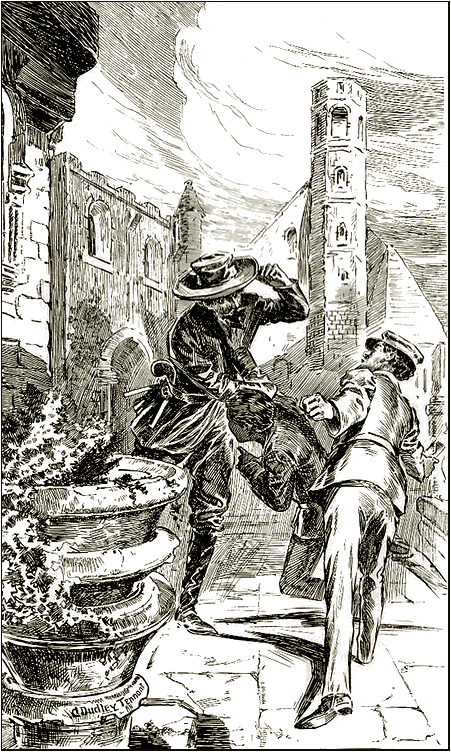
'Young hound, you have stolen my book!'
The lad struggled to free himself, and when I perceived that O'Callaghan, if he attacked myself, would certainly recover the book, I drew it from my pocket and held it up that the Countess might catch sight of it.
'See, here is the truth—written by his own hand!' I cried excitedly.
As I spoke I flung the book so that it alighted on the very bosom of the Countess.
I scarcely know what happened after this. Rough hands, careless of our feelings, seized us—so far as I remember it was Back, Dawford and Hobinstock who came to O'Callaghan's assistance—and in five minutes we were overpowered and under lock and key.
'SO this is the Slave Coast!'
'Yes.'
'It looks pretty enough.'
'Ah! "all is not gold that glitters." Beyond that feathery belt of surf and those elegant palm-trees there is intense human misery. Alas, that we should be brought hither not merely to witness it but to add to it!'
The Countess Mathilde de Grancey heaved a sigh as she spoke. She seemed to be no longer the buoyant, self-reliant woman whom we had lately known at Saint Ange. Though the sea breezes had maintained her health, so that she retained her good looks, there had settled upon her features an expression of gloomy sadness which not all the efforts of Geneviève, backed though they were by Condazin's humour and my own talk, could remove. Ever since the day on which she had learnt that her husband was not dead (as O'Callaghan had led her to suppose), but was a prisoner in some far-away spot among the West Indian Islands, she had become increasingly dejected. Her position was truly pitiable; for, supposing herself a widow, she had suffered herself to be deceived by the dashing O'Callaghan, knowing the while nothing either of his treatment of the Count de Grancey nor of the nefarious trade in which both the Count and himself were engaged.
Little did we suspect the part which the Count himself was destined to play in the most remarkable scenes which I am now about to describe.
But first I have to return to Saint Ange in order to explain how it came that the Countess and Geneviève came to be with us on board the schooner Aurora.
'Done again!' I cried as the door closed upon us after we had been thrust into the cell.
'Yes, this is unfortunate,' said Condazin.
'This is a climax to all our troubles.'
'We're not dead yet.'
'No, but I would not give much for our chance of seeing Old England again.'
'Nonsense, man! we shall have many a merry day on the Sandwich sandhills,' he retorted in a cheerful tone. 'Even if we are compelled to pay a flying visit to West Africa we need not despair. Maybe even there we shall be able to do someone a good turn.'
I have since wondered whether my friend Condazin was gifted with second sight.
For four days we remained in prison, being visited only by Back, who afforded no satisfactory replies to our inquiries.
On the fifth day O'Callaghan entered. He stood for a few seconds with folded arms within the door, a sarcastic smile playing about his thin lips.
'So you have honoured me by reading my chapter of autobiography,' he began. 'An interesting experience—eh? And you are anxious to visit the Slave Coast!—No, you need not protest! I know this craving which young blood has for adventure. Yours shall not go unsatisfied: we sail this very night.'
Knowing that protest would be unavailing, we merely inquired whether we should go as ordinary deck hands.
'That was my original intention, but you have cause to thank your friend the Countess for an improvement in your prospects. Subject to your obedience and good behaviour, you will sail as passengers. When we reach our destination I shall require your services.'
'And the Countess—' I began.
'Will accompany us,' he said, adding, with a knowing smile: 'Maybe the lady will enjoy the change of scene. The air of France is not particularly wholesome just now.'
I detected an ill-concealed sneer in his words, and judged that he feared the Countess might take to flight if she were left at Saint Ange.
'Your treasure will be stolen,' blurted out Condazin.
'By whom, pray?'
'By Alphonse and his gang.'
'Ah! my young friend, I have foreseen that. The cunning Frenchman has met his match.'
Then seeing that we did not understand, O'Callaghan explained that he and his men had had an interview with the robber gang, with the result that four of them, including the redoubtable Alphonse, had bargained to accompany the expedition.
'We have made up our differences—for the present, at least,' he said; 'the Frenchies will be useful to me for I am short of hands. Alphonse was on the Belle Creole, you will remember'—here the captain made a mock bow—'and has quite a genius for slave-trading. It is some years since he was engaged in that line. Possibly petty thieving suits his taste better.'
'He is a murderous brute,' I said, thinking of the way in which we had been entombed.
O'Callaghan laughed hugely.
'You'll see more of his tricks before you are much older,' he said. 'He is none too pleased that you escaped his vengeance.'
Naturally we were very tired of being cooped up on board the small vessel, and though I was anxious enough—as was Condazin—to return to our peaceful English homes, I none the less was curious to see the wonders of the strange land to which we had been brought.
'There is the risk of fever,' said O'Callaghan, in reply to my request that we might be allowed to go ashore.
'When does your cargo arrive?' I enquired. For, though I detested the trade, I confess that I was curious to see the slaves.
'We are a day or two before the time. They may not arrive for a week,' he replied.
Thinking this too good an opportunity to be lost, I began to ply him with questions, and as he happened to be in an excellent humour I was able to extract from him a considerable amount of information. He told us that, in spite of the captures made by the British cruisers, the traffic was still enormous, amounting, on the West Coast of Africa alone, to at least one hundred and fifty thousand slaves per annum.
'Which countries are the chief employers of slave labour?' I inquired.
'The southern states of America. But large numbers go to Brazil and Cuba, as well as to countries under Spanish rule. It is estimated that the annual exportation of slaves by caravans from the great Soudan to Egypt and the Barbary States amounts to twenty or thirty thousand. There is also an extensive trade carried on by the subjects of the Oman of Muscat, who export slaves in Arab ships from the east coast to Arabia, Persia and India, and even as far as Java and the Far East. They say that as many as fifty thousand slaves are sold annually in the Zanzibar market. Yes, you are about to engage in a large and profitable business, and an exciting one to boot.'
'But you run an enormous risk,' struck in Condazin, who stood by.
'Not so great as you imagine. But what do you mean by "risk," my young shaver?'
'You may be captured.'
'True. But are you aware that our average profits—you will share them if you join us—amount to one thousand four hundred per cent. Think of that. I am telling you the truth.'
'The English Government will soon diminish your profits,' I said.
'Do you think so? Let me tell you, then, that never was so much capital invested in the traffic as at the present time. The best families in England and on the Continent are reaping fortunes from it.'
'But the cruelty—the horrible misery of the Middle Passage—I have heard much of it at home, and—'
'You have been misinformed,' interrupted the captain. 'There are no doubt bad cases. I myself have pitched a cargo overboard. Oh! don't shrink back, Master Squeamish, you'll do it one of these days, I dare wager! But most of the cargoes we "run" without trouble and with few losses. Take my last voyage, for instance. I started from this river with as fine a set of niggers as ever man clapped eyes on. We had one hundred and seventy-two men, one hundred and six women, three hundred and four boys, eighty-one girls and about half a dozen babies in arms. Miserable! did you say? Not a bit of it! It's to my interest—and yours—to land 'em fat and healthy. Most of 'em care nothing for the change in their prospects of life, so, depend on it, they're better off than in black old Africa.'
AT the time that Condazin and I paid our ever-memorable visit to the Slave Coast of West Africa little was known of the interior of the country and of its various tribes. In the maps of my boyhood the word 'Desert' was inscribed across the enormous tracts of country. Over other portions appeared the suggestive statement, 'Here are found lions.' Since those days great travellers, such as Mungo Park, Speke, Livingstone, Burton, Cameron and Stanley, men full of intrepid zeal for exploration, have crossed the vast plains and toiled over the mountain ranges, penetrating the dense forests and navigating the sea-like lakes, till it has come to pass that Africa is no longer 'dark,' and the absolutely unknown parts of the continent are comparatively few.
Nor did we understand then that the terrible curse of slavery (though the milder and domestic variety was by no means unknown) was due to the greed and cruelty of the invading Mohammedan Arab races, which, through centuries, had spread, in ever-increasing numbers, southward from the shores of the Mediterranean till they had reached beyond the region of the great central lakes.
The object of their search being ivory, their quarry the bodies of men.
It was five days before the slaves arrived. Five weary, scorching, stagnant days.
'Hélas! that I permitted myself to again be enticed to this accursed place!' cried Alphonse with a yawn.
We had patched up a truce, with the fellow, for it was wise to adopt a policy of conciliation. But so dangerous a character was he that we had determined that he was on no account to be trusted.
As the sequel will show, it was well for us that we made this resolve.
Alphonse was leaning over the bulwarks when he made the above remark. In fact half a dozen of us—or, more precisely, there were seven—were also leaning over the bulwarks, lazily lolling. Some smoking, some talking, some in a semi-somnolent condition. There was O'Callaghan, there were Back and Hobinstock (Dawford had stretched himself at full length on the deck and was apparently fast asleep), there was Joseph Vimont, at one time butler of St Ange, now attendant on the Countess de Grancey, and there were Condazin and myself, while, seated under an awning not far away, were the said Countess and Geneviève.
'Tired already!' exclaimed O'Callaghan, who understood the man's French. 'Wait a day or two and see if you don't have enough to do!'
'Ah bah! I should be satisfied if there was more liquor to be had. What right have you to keep it under lock and key?'
'The right of captain of this schooner,' retorted O'Callaghan.
Then words flowed fast from the Frenchman's lips, and when I saw him place his hand on the haft of a great sheath-knife, I began to fear that there would speedily be bloodshed. But just at this point an exclamation from Geneviève caused us to look away from the scowling pair, and we beheld, filing slowly through the fringe of palm trees, a long string of black humanity. By the time the whole of it had come into sight the quarrel between O'Callaghan and Alphonse was clean forgotten, and we were gazing with wonder and expectation.
'How tall they are!' cried Condazin, pointing to some gigantic fellows who led the van. They were certainly the hugest men I have ever seen; there being twenty who were not far short of seven feet in height.
Of course we knew not at that time whence these men came, nor could we guess how important a part they were destined to play in our future experiences.
'Hé, venez donc!' exclaimed, Geneviève, beckoning me. 'Now, tell me, are these indeed the unfortunate slaves whom we are to take across the ocean?'
'This is our cargo, mademoiselle.'
'But could you not do something for them?' Here she whispered in my ear. 'Surely you two brave Englishmen could release them all. It might be accomplished in the night. The Countess is already in great distress concerning them.'
'I fear we are powerless,' I said, though I was secretly pleased at being considered and styled 'brave'; 'but assure your mistress that if anything be possible we will not be lacking in courage.'
I thought this a diplomatic remark; for there seemed to me to be no possibility of our being able to do what Geneviève suggested.
In a very few minutes were we climbing the bank and threading our way among the piles of rubbish and the tufts of coarse grass towards the spot where the new arrivals stood.
There seemed to be large numbers of them; Africans of various tribes; men and women, boys and girls; even tiny children too. The adults being fastened together in gangs of twenty or twenty-five, males and females indiscriminately. Some of them were so worn and emaciated with their prolonged march and scanty food as to be little more than living skeletons. Others—perhaps they had not travelled so far—were in better physical condition. There was plainly to be seen the cowed and frightened look, expressive of suffering and despair, in the eyes of most of the unhappy wretches. The tall men in the forefront of the party presented an appearance very different to the rest. I was particularly struck by their alertness and look of intelligence. Nor were their bodies wasted by travel as were so many of the others. Strong, muscular, fierce, they stood before us with folded arms; an expression of disdain on their faces, as though they would defy the malice of their Arab captors. Wearing no thick rings of metal about their arms and ankles as did their companions, their hair hanging in long and straight locks over their broad shoulders, they presented a marked contrast to the normal African type. On the breast of each man was a curiously-shaped white mark (whether produced by tattooing or not I could not tell), drawn with care and accuracy, and representing unmistakably the figure of a woman—and not an African woman.
'They are altogether different from the rest,' whispered Condazin in my ear.
'Of a far more powerful and intelligent race than the people of this region, I should say,' I returned.
This was but a guess on my part, but I was near the truth, as I subsequently found.
O'Callaghan's behaviour as we approached the slaves was curious. He seemed to have become suddenly uneasy, scanning the crowd of sad, dull black faces anxiously and half-expectantly, as though fearing that he might discern among them a familiar countenance. Presently, appearing satisfied, his manner changed, and he laughed as though relieved in his mind, and turning to us remarked, in a jaunty, sportive tone, that some of the slaves seemed to be in need of a good meal.
'Look at that fellow,—a mere bag of bones! The man would be dear as a gift, I declare! Now Mr Ishmael'—this to the Arab leader and slave-hunter-in-chief, a venerable-looking, bearded man, and to all appearance by no means such a villain as his assistants—'there must be a liberal discount on the lot. Nay, fully a third of 'em will die on the voyage, I wager.'
Though the Arab did not understand O'Callaghan's words, it was plain to us that he was prepared to haggle over the price of his human commodity, for he shook his head several times solemnly and beckoned a young Arab interpreter to his side. Whereupon there ensued a lengthy bargaining in which each side in turn gave way a little at a time, till at length the happy mean seemed to be reached and a contented look began to settle on the faces of the Arab and O'Callaghan respectively.
Meanwhile Condazin and I walked along the irregular line inspecting the poor wretches. Some had sunk exhausted to the ground, others leaned listlessly against the trees, the burden-carriers, of which there was a considerable number, had one and all laid down their loads. We did not pause until we had walked right round the company and had arrived again at the group of giants aforementioned.
Just as we were passing these magnificent specimens of black humanity I noticed a strange thing.
One of the men, younger than the rest, tall, straight-limbed and keen-eyed, who had been attentively eyeing us, turned as we passed and startled us by pronouncing the unmistakable English sentence, 'Can you help us?'
We paused abruptly, and Condazin was in the act of opening his mouth to reply when I tugged his jacket, for I saw that the evil eye of Alphonse was fixed upon us, and that the expression on his ugly face was indicative of suspicion and hate.
'Don't be a fool,' I muttered, without looking up.
'But the black man—'
'Be cautious! We are being watched.'
'By whom?'
'By Alphonse!'
'It is our duty to aid the poor fellows.'
'We shall best do it by watching our opportunity.'
By this time we had passed the group of giants; but as I glanced back I noticed that the eyes of the young man who had spoken to us were following us attentively.
A few hours later the gangs of slaves (they numbered in all four hundred and fifty-two souls) were toiling up the narrow gangway which united the shore with the schooner Aurora. To the day of my death I shall not forget the expression of anxious misery on the face of the Countess as with clasped hands she stood on the quarter-deck watching the embarkation. Once she turned with flashing eyes and a few burning words upon O'Callaghan, for he had ventured to address to her some jocular remark concerning the unhappy slaves.
'Nay, but they will be merry enough when they have been a week in Cuba,' he replied carelessly.
Alphonse, who stood at the head of the gangway handling the human goods with no pretence of gentleness, grinned sardonically at the distress of the lady, for she and O'Callaghan spoke in French, and out of sheer devilry and wanton cruelty the Frenchman struck with his fist a woman carrying in her arms a tiny babe, and whose weakness caused her to falter as she ascended the steep planks.
'Sacré! but I will hurry your black limbs!' he snarled, with an oath too coarse to be recorded.
The poor creature started aside in her alarm, and missing her footway, fell over the unprotected side of the gangway into the deep water.
Her scream of mingled anguish and terror rang throughout the vessel.
'Fool! you have lost the pair of em,' exclaimed O'Callaghan, springing forward.
Condazin, who was leaning over the rail, darted to the opening at the same instant, and almost before the mother and child had floated the length of the schooner had plunged after them.
Unhappily I am no swimmer. (It is a thing I have always regretted.) But I did that which came first into my mind, for, boiling with indignant rage, I raised my fist and struck the brutal Alphonse full between the eyes as he turned to face the captain. The fellow was standing by the gangway, and so powerful and furious was my onslaught, that he tripped at the edge of the planking and turned a somersault clean over the side of the ship, plunging headlong into the river.
O'Callaghan, fearing that the man would be drowned, shouted to Back and Dawford to lower a boat, and rushed with me to the poop to see what would happen. By the time that the boat touched the water Condazin had reached the struggling negress, who still clasped the baby to her bosom. For he was a strong swimmer, and I well remember the famous race in which he won the challenge cup in the deep water off Deal beach. As for Alphonse, he had gone down once, and was in the act of sinking again, when Back succeeded in grasping him by the hair. They then turned their attention to Condazin, and he and the woman and child were lifted into the boat.
It was pitiable to witness the grief of the poor-forlorn creature when she discovered that the tiny, black mite, beloved by her beyond life itself, and to which with a mother's love she had devotedly clung, was indeed dead. Speedily had the cruel waters quenched its feeble spark of life, and it lay in her arms a limp, wet corpse; happily released, though maybe in her grief she realised it not, from a future of slavery, with its cruelty, sorrow and despair.
As for the Countess, she had witnessed the scene with horror and loathing. Horror at the brutality of Alphonse, and loathing of the apparent callousness of him who against her will had compelled her to become a witness of such scenes.
'Ah, that I could ever have loved you!' she almost screamed, springing like a tigress upon the captain as he came aft. 'Hateful man! murderer! Do you prey upon defenceless women and tiny babes! Nay, I loathe you!' and she raised her shapely hands as though she would thrust him from her.
Even now I can see the tableau as it was presented on the deck of the slaver Aurora in the torrid noon-tide heat of that most eventful day. The startled, indignant face of the beautiful and greatly-wronged Countess; the sarcastic, contemptuous, sardonic smile of O'Callaghan the slave trader, as, with folded arms and half careless attitude, he stood before her; the sullen, revengeful anger of the dripping Alphonse, who had just been hauled on deck; the self-forgetful misery of the dark-skinned mother, standing alone pressing her lips in passionate despair to the face of her dead child; the wondering, scowling throng, having no personal interest in the incident, but looking on half-amused, half-curious. And in the background the dark tropical vegetation, the dilapidated factory, and the decaying rubbish heaps. While ever onward flowed the placid stream on which we floated, rippling as it had rippled for countless ages, all unconscious of the drama of sorrow which was being enacted on its bosom.
It was but for a few seconds. The inevitable revulsion of feeling quickly succeeded, and with tears on her face the Countess de Grancey was led away by Geneviève, whose countenance showed plainly enough that she too was greatly agitated.
'Hateful beast of an Englishman,' hissed Alphonse, stepping up to me as the woman disappeared down the companion hatchway, 'you shall pay for this!' As he spoke he drew his long knife and raised it as though he would plunge it into my heart. I stepped back, lifting my arm in self-defence. But O'Callaghan promptly whipped out a pistol, and presenting it at the Frenchman's head, sternly ordered him to replace his weapon.
'Ciel! but I will not forget!' snarled the baffled villain, after a few seconds' hesitation, in which the captain regarded him with great sternness. 'Le jour viendra! Bien! we shall see! we shall see!'
With this he turned on his heel and returned to the forecastle to change his dripping garments. But as he went the men raised a chorus of ringing laughter which echoed through the whole ship. Alphonse turned and gnashed his teeth in impotent rage.
'We shall have to look out for squalls!' observed Condazin, with a sagacious nod, when the man had gone.
THAT night saw a wonderful change in our fortunes, and a complete and surprising reversal of the relative positions of those on board the schooner Aurora.
It took three or four hours to stow away the slaves, and the sun had set by the time the last ones were enchained in the hold. For it was not considered safe to allow liberty to the men or even to all the women. Iron bars had been stretched across the hold to which the legs of the slaves (usually one limb in each case) were attached by means of a few links of chain and a fetter which clasped the ankle and was secured by a lock.
We had plenty to do during the shipping of the live cargo. Many of the poor frightened creatures huddled together in dark corners like so many sheep scared at the black gloom of their new habitation. Our appointed work was to grope about, lantern in hand, among them, and to persuade them to enter the compartments—more like cattle-stalls than aught else—holding a dozen or so apiece, which had been prepared for their reception. There, on the bare boards, they must lie, except for the short daily exercise on deck, until the broad Atlantic had been crossed. It was pathetic to look into the faces of these children of Nature as we did that afternoon; their widely-opened, fear-stricken eyes; their naked bodies glistening in the lamp-light; the strange chatter of their uncouth tongue, as they endeavoured to express to each other their alarm and dread of the white devils who ruthlessly had brought them into this mysterious floating hell: all combined in making as awful and weird a picture of human misery as ever it has been my lot to look upon, a picture which stands vividly before my eyes to-day. Yes, I can still see them: the cool and seemingly heartless Captain O'Callaghan directing our operations; the brutal Back and Dawford thrusting hither and thither the black wretches, who shrank from their violent grasp only to be kicked and thrust more savagely than before. There is Hobinstock—a trifle less cruel than the others,—for the man, as we subsequently learnt, had a family, and had not altogether sunk to their depth of wickedness and hard-hearted cruelty. I can see, too, as I look back upon that strange scene, the figure of the Frenchman Alphonse. How fiendish he looked in his vindictive malice; how shameful was his ill-treatment of the helpless captives, especially of the women, as though upon them he delighted to vent his bitterest spleen. For ourselves we kept out of his way, but none the less were we conscious that he was only waiting an opportunity of wreaking his complete revenge.
The giants, by O'Callaghan's order, were stowed in the fore part of the hold—the darkest, dampest, most uncomfortable corner of the floating prison. As luck would have it, Condazin and I had the stowing of these men. Indeed, but for the hope that we might have an opportunity of speaking to him who had so mysteriously addressed us, I am sure that we should have refused to assist in the repulsive business. As it happened, as soon as the last slave was ironed O'Callaghan and his men retired for food and rest, for it was not intended that we should start until daybreak.
What the delay meant in our case will be understood very shortly.
'I must speak to the tall man,' said Condazin in a low tone as Hobinstock's legs disappeared up the ladder.
'Will it be wise?'
'Keep guard and I'll make the attempt.'
'Very good; but look alive or we may be nabbed.'
So I stood near the aforementioned ladder while he threaded his way, lantern in hand, among the blacks in the direction of the fore part of the ship. I was watching the light as it swung in his hand, when a voice, which I seemed to know, called me softly, and glancing up I caught sight of the pretty figure and face of Geneviève.
'May I come down?' she said, speaking in the same tone.
'Nay, mademoiselle, this is no place for you. Besides, look at this ladder! it is only for men—and slaves,' I added.
'Bah! where they go I can come!' she retorted, with somewhat of contempt in her voice. A moment later she was descending.
'Voilà! could an English girl have accomplished it more expertly?' she cried, with a smile and a blush which only added to her charms.
'But it is no place for you,' I urged, anxious that she should return on deck.
'Non, non! Now that I am here I will see all. Yes, all! Ah, what misery! what cruel wickedness! To think that I should behold it with my own eyes! And the tall, handsome men—where are they, monsieur?'
I pointed in the direction of Condazin's lantern.
'Then conduct me thither. Yes, I insist!' She stamped with her little foot and nodded emphatically.
'Come,' thought I to myself, 'there is no harm in humouring the bonnie lass,' and beckoning her to follow me, we threaded our way cautiously through the dark, living mass of negroes.
As we approached, I perceived that the whole of the stalwart gang were upon their feet, and that my comrade was conversing earnestly, though in suppressed tones, with the handsome young man who had startled us in saying, 'Can you help us?'
'Then she bade you speak to us these words?' Condazin was saying.
'Pale Witch taught Falenga much wisdom.'
'Could you guide us to her?'
'Falenga and his brothers will serve the friends of Pale Witch when they are free.'
'What is this? What is the man saying?' I exclaimed.
'The men have come from a country far inland, where, according to this fellow, there is a white witch,' said Condazin, turning to us; adding, bless me, mademoiselle, how you startled me!' for he had not at first noticed Geneviève.
She stepped forward into the circle of light cast by the ship's lantern, and as she did so a murmur of surprise went up from the group of black men.
'Surely this is Pale Witch's younger sister! cried the man who had called himself Falenga. He turned and addressed his companions, and with one accord they laid the forefinger of their right hands on the symbol marked on their broad chests, at the same time bowing the head with every token of humility and respect.
'This is very strange,' I said, looking at Condazin.
'The next act will be stranger, I warrant!'
'What do you mean?'
He did not explain, and presently we were whispering together with Geneviève, and endeavouring to hit on a plan for the release of the men. Then the harsh voice of Alphonse sounded in the opening of the hatch, and Geneviève slipped round behind the group of tall men.
'You must go—to satisfy the brute,' said Condazin, hurriedly.
I seized the lantern and made for the ladder. Alphonse eyed me as though he would like to use his long knife, but only said that I was wanted by the captain. For a few seconds I was on the tenterhooks of suspense, for he made as though he were about to descend into the hold. But, changing his mind, he turned and went forward.
As soon as he had passed the corner of the deckhouse, I signalled with my arm to Condazin and Geneviève that they should come up.
'Come to madame's cabin,' whispered the girl, as she stepped from off the ladder to the deck.
'I will come as soon as I have seen the captain,' I replied.
O'Callaghan was enjoying a Cuban cigar in the cuddy: the remains of his meal lay on the table.
'So you have fitted in the big men?' he remarked in a tone of inquiry as I entered.
'Yes.'
'All secure?'
'I believe so.'
'Bravo. You'll soon be an old hand. Viejo como la sarna, as those villainous, dirty, stuck-up Spaniards say, which, being interpreted, means "as old as the itch." Aha! merry devils those Spaniards! You shall be introduced to a few choice specimens when we have crossed the Blue. There! you are hungry. Sit down and have a mouthful. Nay, you shall certainly do so, and a real Havanah afterwards. I've taken a liking to you, my son, and to your bantam game-cock of a friend—let me see, what's his name?—Condazin, did you say? I wonder where he got such a surname—sounds a trifle Spanish too, eh?' Thus he rattled on, evidently in the best of spirits. For he had made with the Arabs a bargain highly to his own advantage; the slaves were safely on board his ship, and there was every prospect that large profits would be made by the venture.
I was on pins and needles to escape, but it would not do to show any agitation, or the man's suspicions would certainly be aroused. So I sat down and ate and smoked, knowing all the time that the others were wondering what had become of me.
'You're a smart young dog!' observed O'Callaghan presently, eyeing the wreath of smoke which floated up lazily towards the stout beams above his head. 'And you have but to throw in your lot with me—you and Condazin—to become rich men.'
'But we cannot consent to—' I began.
'Belay that!' he cried, though not angrily; 'you've been influenced by the Countess, I know. She's as tender-hearted as a child; none the worse for that though—will come round as soon as her mind becomes accustomed to the truth.'
He said this with more feeling in his tone than I could have imagined possible, and once more I wondered at the strange mixture of tenderness and cruelty in the man's character.
'Yes,' he pondered aside, 'it's quite wonderful, when one reflects about it, how soon the mind becomes accustomed to things—a new situation, or a new habit of thought. Sooner or later we all accept the inevitable, though at first we may have declared it impossible.'
Was he thinking of his own career?
As soon as I could decently excuse myself I left the table and made my way on deck. Not finding Condazin there I again descended below, but avoided the cuddy. After a few minutes the face of Geneviève appeared at the door of the cabin set apart for the use of the Countess de Grancey.
'The handsome young Englishman!' she exclaimed, speaking in a half whisper and turning her face towards someone inside the cabin.
Then the door opened and the Countess herself silently beckoned me to enter.
With a feeling of wondering hesitation I obeyed, and found that Condazin was within.
As soon as she had carefully closed the door, the Countess laid before us a scheme so daring, and withal so original in conception, that, as she unfolded it, it seemed to me to be altogether beyond our powers. It was not until she insisted with great earnestness that the scheme was feasible that I began to see how it might be carried into execution.
Briefly her plan was as follows:—
There were among the slaves sufficient men, if they were freed, to overpower O'Callaghan and the crew of the slaver, could we but contrive to liberate these men—it must be done this very night, she said, for to-morrow would be too late—the tables might be turned upon the slave traders. Next she suggested that only in one way could the plan be worked. The 'giants,' as we termed them, must be taken into our confidence and their fetters removed.
'But it will be impossible for us to navigate the ship.'
'No navigation will be needed—except through the forest, and the black men will manage that without difficulty.'
I doubted whether she had judged correctly, but somehow her words and manner fired both myself and Condazin, and presently we were discussing and plotting, speaking all the time in an undertone for fear lest we should be overheard.
It was arranged that Condazin and I, watching an opportunity, were to descend into the hold and release the band of tall men, that we were at once to secure O'Callaghan and Alphonse, as well as Back, Hobinstock and Dawford; afterwards the remainder of the ship's company.
'I trust we shall not kindle a greater fire than we can quench,' I said. For I was terribly apprehensive that there might be loss of life as soon as the blacks found themselves at liberty and got the upper hand.
It was after midnight when we stole on deck quietly, cautiously, and shoeless. The full moon was shining brightly, as only it can shine in the tropics. There were strange, almost unearthly noises in the forest, which spread out dark, dense and mysterious on either hand. These were the sounds of night birds and beasts of prey. Now and then a huge beetle with a sharp 'ping' would pass us. Then a bat would flit silently between the masts. Bullfrogs croaked dismally to the accompaniment of the purling ripples of the water, and the occasional groaning of our own hawsers as the schooner swung to and fro now and again.
'There's Back!' whispered Condazin, clutching my arm.
'Where?'
'In the shadow abaft the deck-house.'
I looked attentively, and discerned the man's figure as he lay on a sail which had been carelessly heaped up in this place.
'I think he is asleep,' I said.
'Yes—listen to his breathing.'
'Then, if there is no one amidships, we can manage it. Have they covered the main hatchway?'
'No, it is left open for ventilation.'
'Good! Come along!'
Slinking cat-like round the corner of the deckhouse, we came to the opening. From it arose a curious smell. It was the odour from the four hundred and fifty slaves.
'We must work in the dark,' said Condazin.
'True; but not for long. We can manage to feel our way for'ard.'
The ladder was in its place, fortunately for our venture, and in a few seconds we stood among the forms of those to whom kind Nature was supplying her chief earthly balm.
'Thirlwall!' said Condazin, speaking softly, so as not to awaken the sleepers, 'we are on the eve of great things!'
AS I look back upon the events which I am now narrating, I can only wonder that we did not more carefully calculate the possibilities of our act. In the mass of sleeping captives about us there were hidden potentialities of which we knew nothing. But we were young, and, after the manner of youth, not given to overmuch reflection, or assuredly we should have hesitated before carrying out the hasty suggestion of an excitable and impulsive woman.
'Hush!' I said. Was that a footstep?'
We listened with strained ears, but could detect no sound louder than the thumping of our own hearts.
'It's all right—come on!'
With the extremest caution we began to creep through the narrow lanes between the recumbent forms of the slaves. There came through the open hatchway a broad gleam of moonlight, which, while it did not penetrate the darker recesses of the hold, at least showed us where we might step. So we advanced towards the bows to the accompaniment of heavy breathing, snores, occasional groans and infantile wails. In one corner I heard the sound of sobs. They came from the woman whose child had been drowned. She sat rocking herself to and fro in her grief, and heeded us not when we passed.
The huge men were asleep, with the exception of him who was called Falenga. He was sitting up as though awaiting our arrival.
'My white brothers are welcome,' he said, in a tone of condescension.
Immediately he turned and aroused his neighbours, and presently the whole gang was awake.
Then we told him our plan.
For a few minutes—it seemed hours, so anxious were we—he sat in silent thought. Then I noticed that he drew himself up as though hope and new life had suddenly entered into him. What he said to his companions we did not understand at the time, but it was clear that the few animated words which were passed round aroused in every one of them keenness of expectancy which was very different from their former attitude.
In five minutes we had liberated the men's legs. (For Condazin, with some forethought, had retained possession of the key.) Having released their limbs, we next removed the said fetters from the iron rod which ran across the width of the hold and to which they had been affixed.
'These are your weapons,' I said, addressing Falenga. 'Do not use them unless compelled to do so. Your object is to make prisoners of the other white men. Remember, you are to avoid bloodshed, and obey us in all things.'
Falenga said nothing, but there was a gleam in his dark eyes as he listened to my words.
We crept back towards the broad band of moonlight which streamed through the open hatchway. But not alone. There followed us the five-and-twenty giants, each grasping his fetter and each inspired by the hope of liberty.
One or two of the sleepers in our path opened their eyes and looked up half astonished as we passed, but no one spoke aloud.
'I will go first,' whispered the intrepid Condazin, placing his foot on the ladder. We swarmed up at his heels; but scarcely had he reached the deck when a figure sprang forward, and he uttered an involuntary exclamation.
In five seconds I had cleared the hatch, and saw at once that he was in the grasp of Alphonse.
'Take him alive!' I cried to Falenga, who was close behind.
There was a cry of alarm; the swarming of a black crowd of gigantic men about the astonished Frenchman; a second cry, this time of rage; the clanking of irons and the hard breathing of struggling men, and Alphonse the cruel was fast in the fetters.
'This way! We must secure the captain,' I said, beckoning to Falenga and his giants.
Even as I spoke, O'Callaghan appeared at the head of the companion ladder. For a moment he looked at us steadily, as though grasping the situation; then, hastily drawing from his capacious pocket a pistol, he raised it and fired point blank at myself.
It may have been cowardice, or it may have been merely that instinct which bids each of us protect his life; be that as it may, I ducked my head low as he pulled the trigger, and one of the giants received the bullet full in the chest. It must have touched the heart, for the poor fellow threw up his arms with a death-yell and fell like a log, the man close at his heels stumbling headlong over his prostrate body.
As soon as he had discharged his weapon, O'Callaghan turned and made for the companion ladder, shouting to his men to come to his assistance.
'Take him alive!' I exclaimed to Falenga.
For the African had raised the heavy fetter, as though he intended to brain the captain.
At this moment appeared Back, Hobinstock and Dawford, with half-a-dozen of the crew. They came running aft to see what was amiss, and would have taken us in the rear had not Condazin been on the look-out for such an attack.
'Ah, would you!' he cried, as Dawford, snarling a savage oath, aimed a blow at him with a cutlass such as they used in the navy.
The lad sprang lightly aside, or certainly he would have received a severe wound, and at the same time one of the giants wrenched the sword from the fellow's grasp while another grappled him round the arms. I did not learn these details till afterwards, for Falenga and I, with three or four of the foremost Africans, were fully engaged with O'Callaghan. Instead of retreating below, he turned like a tiger to bay, dealing out tremendous blows right and left with the butt of his pistol, driving back his assailants by the very rapidity of his movements.
'Back, you black hounds! Young traitors, you shall pay for this!' he cried.
We tried to close upon him, but with a laugh of derision he sprang for the shrouds, and before I realised his intentions he was half way up the rigging. From this place of advantage he encouraged the sailors in their resistance, making several attempts to descend to their aid, but we were on the look-out and frustrated his intention.
Never shall I forget that struggle. To and fro upon the deck of the slaver Aurora surged the crowd of men in the brilliant moonlight. Black wrestling with white; naked with clothed; men of gigantic stature with men of ordinary height but of marvellous agility. Now an English or French oath, now an African yell; curses, exclamations, groans. While from the hold beneath swelled a crescendo of sounds, as the awakened slaves began to realise what was taking place above them. Stubbornly though they fought, the white men were no match for the black, either in number or in physical strength, and in a quarter of an hour the last of them was overpowered and enchained.
It was a curious sight to look upon, this long row of white captives. They stretched the greater part of the length of the schooner's deck. Every man was there, fastened securely by the legs, with the exception of O'Callaghan, who still remained aloft.
'Fools! to be captured by a couple of lads and a parcel of niggers!' he cried.
'Come down, cap'n, and we'll give yer the place of honour at the 'ead o' the gang,' retorted Back, stung by O'Callaghan's words.
But the captain had no intention of surrendering so easily. At first he abused us unsparingly, accusing myself and Condazin of ingratitude and treachery. After a while he changed his tune and tried to come to terms, offering to land us safe on English soil if we would grant him the ship with its live cargo.
Finding us obdurate, he proceeded to plead with us, and with no lack of eloquence, protesting earnestly that he would be ruined, and offering to free the slaves if he might be allowed to retain the ship.
I think that we might almost have been inclined to consider his last proposal, but just then the Countess and Geneviève, who, with the timorous Joseph Vimont, had remained below during the fight, came on deck.
'You have secured him?' she said in a questioning tone.
I pointed to the rigging.
'Then he has escaped.'
'Not a bit of it, madam; he cannot remain up there.'
'Can you endure to see me, your protector, treated with such indignity?' said O'Callaghan, addressing the Countess.
'Vile man! deceiver! Now arrives the day of reckoning,' she cried dramatically, and in a voice which penetrated the whole ship.
I think she would have said more, but the captain, with a short, scornful laugh, deliberately turned his head and proceeded to climb the mast to the place where the main back-stay is attached. Arrived at this point, he paused and cried, 'Will you grant me the ship?'
'Non, non!' exclaimed the Countess, in alarm.
I looked up and shook my head. An instant later he slid down the stay, and, before anyone could hinder, had plunged overboard.
Had not the boat which rescued Alphonse been towing alongside we might never again have seen Captain O'Callaghan. Perhaps it would have been well for some on board the Aurora had he been drowned or devoured by crocodiles. As it was, Condazin and I overtook him as he gained the bank. At the same time Falenga and three of his men, crossing the gangway, came to our assistance, so that in a few minutes O'Callaghan, now somewhat exhausted by his exertions, was overpowered and brought on board.
It was interesting to watch the man as his native dignity asserted itself. Though vanquished and dripping wet, he bowed to the Countess with all the grace of a courtier.
'Madame,' he said, speaking politely, and in a deferential and subdued tone, 'your plan has succeeded; your revenge is complete. In your hour of triumph I pray you remember mercy. You will be wise if you embark not on a voyage of discovery, knowing nothing of your port. There are shoals and rocks which may ere long wreck your venture.'
What he meant by all this metaphor I could only guess. But the Countess, who ought to have been delighted at our success, winced as he spoke, and it seemed to me that she looked at him with something of pity in her glance.
I did not in those days understand that the ways of women are dictated mainly by sentiment; and I felt a little aggrieved that she did not bestow greater praise upon Condazin and myself for the part which we had played so successfully in this West-African drama.
Having placed O'Callaghan in irons, we left the captured party in charge of Falenga's men, first directing that the body of the dead negro should be thrown overboard, while we, with the leader of the negroes, retired to discuss the situation.
It was plain enough that we were face to face with new dangers. While the release of the captain and crew were out of the question, I could think of no way in which we could rid ourselves of them. Condazin's suggestion that we should liberate them after we had landed the slaves, on condition that the slave dealers would undertake to allow us to depart in peace, was disposed of by the obvious reply that they were not to be trusted, and that they would certainly make an attempt at recapture. For most of O'Callaghan's assistants were desperate fellows and capable of any kind of villainy.
The Countess was now for sailing for Sierra Leone. 'There we can leave the slaves,' she said, 'and the English Government will take charge of the ship.'
This seemed to me to be the only practicable course, and we should certainly have carried it out had not Falenga insisted that we should go with his men.
'Hear me! O people with pale skins! Hear me, ye sisters of the White-faced Witch!' he said solemnly. 'Falenga, the chief of the Tall Ones, shall be obeyed. Ye are to journey with us for three moons until ye come to Zen, the ancient city behind strong walls. The city ruled by the fathers of Falenga from the time of the monarch Ham.
'In Zen ye shall dwell in peace and safety under the protection of Falenga and in company with the Pale Witch, whose wisdom guideth the nation of the Tall Ones.'
For a few seconds we gazed at him in speechless astonishment. While we had been wondering, discussing and planning, the black chief had promptly decided. We made a feeble attempt at expostulation, but with a grand gesture he swept our objection aside.
'Ye are not able to take charge of these crafty slave traders. For your own safety we will convey you to our city.'
'And the white men—?' I began.
'Shall become our slaves. Is it not just?' When he had said this, he arose and went on deck, leaving us looking at each other in mute dismay.
I SUPPOSE that never before in West Africa had so curious a scene been witnessed as that of which we were spectators and in which, nolens volens, we were at the same time actors.
Along narrow forest pathways, oftentimes blocked by fallen trees or rank undergrowth; now passing over treacherous swamps or through clinging thickets, now mounting precipitous hills and threading tortuous passages among steep and dangerous rocks, the white slave-gang slowly and wearily made its way towards the mysterious and far-off city of Zen.
Linked together by the long chain, to which were attached at equal distances their iron slave-collars, were O'Callaghan, Back, Hobinstock, Dawford, Alphonse the Frenchman, and the eighteen men who had formed the crew of the slaver Aurora. In the week which had elapsed since we abandoned the schooner a considerable change had come over these men. Those who had been the gayest and most light-hearted were now the most completely despondent. O'Callaghan's three henchmen, at first full of impotent rage, had become moody and surly; Alphonse the cruel, after paroxysms of indignant fury, had finally given way to tears, spending much time in lamenting that ever he had left la belle France. The sailors too, each in his way (especially one of them of whom I shall have occasion to speak), showed that the new position in which they found themselves was telling upon them. But O'Callaghan—the hero of fights and adventures innumerable, O'Callaghan the adventurer, pirate, smuggler and slave trader—by no means suffered from depression of spirits. Marching at the head of the column—(Falenga had given O'Callaghan the place of leader at our urgent request, for we knew him to be a man ever on the alert)—he chatted, joked and laughed as if on an expedition for his own convenience and pleasure, and as though no galling iron encircled his neck. The intense heat seemed to affect him as little as did the choking tugs which those behind occasionally gave to the chain.
'There's no stamina in those fellows!' he exclaimed contemptuously, after Back had stumbled with a groan over a log, giving both his own neck and O'Callaghan's a very unpleasant jerk. 'As soon as misfortune overtakes 'em they lose heart at once and their very legs become cranky. Hold up, man!' (this to Back, who stumbled again); 'd'ye want to break all our precious necks!'
'What do you intend to do with these?' I inquired of Falenga, who had assumed complete command of the party.
We were resting in the shade of a clump of trees on the slope of a hill which overlooked a vast sea of forest. Around us reclined the throng of four hundred and fifty liberated slaves, most of whom bore bundles of goods stolen from the looted slave-ship. The Countess and Geneviève were seated together a little way from us, conversing in low tones and seemingly glad to be able to descend from the litters in which they had been carried. I noticed that the former resolutely abstained from conversation with O'Callaghan, though on several occasions he had attempted to speak to her. At first Condazin and I thought that her conduct was due to natural resentment. After a while, however, we had occasion to change our minds.
But of this anon.
'They were stolen from tribes subject to my nation,' replied Falenga, 'and they will go with us unto the land of the city behind strong walls, even unto Zen.'
Falenga's English, though marvellously correct, was somewhat antiquated in style, and we wondered often how he had learnt it. There was something, too, about the man which made him very different from the ordinary negroes, even from his fellow giants—a nobility of manner and a tone of lofty dignity which always compelled attention and respect.
'Surely you do not intend to keep these men in perpetual captivity?' said Condazin, pointing, as he spoke, to the enchained company.
'Why should they not become our servants?' replied Falenga, haughtily. 'They would have taken us across the deep blue waters, never to return to our own land. Yea, they are our slaves.'
'How did the Arabs contrive to capture such powerful men as yourselves?'
'Falenga and his companions had hunted the elephant far from the City of Zen and were weary. The Arabs who hunt for men came upon them while they slept.'
By this time we thoroughly regretted the step we had taken in liberating the slaves and entrapping O'Callaghan and his men. Our want of foresight had involved us in a mesh from which it seemed impossible that any of us could ever escape. In our inexperience of human nature we had not calculated that Falenga would immediately take matters into his own hands. The toils of the journey had already begun to affect us more than we cared to acknowledge to each other, and much of our time for the past few days had been spent in gloomy reflections on the hopelessness of our position.
These feelings were deepened when the young sailor aforementioned died. He was a quiet and well-behaved fellow, very different to the majority of the crew of the Aurora, who seemed to us to have been selected as much for their disreputable character as for a marvellous facility in the use of abusive and scurrilous language which could only have come as the result of long training.
He dropped quite suddenly one afternoon when the heat was intense even for West Africa. It happened that I was close by, and shouting to the others I sprang to his assistance. There was a cruel jerk as the chain tightened and dragged the man a few feet before those in front could be stopped.
'What's the matter?' cried Condazin.
'The man's ill.'
We raised his head. Then the white slaves crowded about. There were exclamations of pity, of anger, of dismay.
'Here, Falenga!' cried one, with an oath, 'd'ye see this?'
'It's murder!' ejaculated another.
'Mon Dieu! to think I should have seen this?' cried Alphonse, raising his claw-like hands in horror. 'To think that my bones should bleach in this loathsome forest.'
'Your bones, Frenchy, are of no more value than ours,' sneered O'Callaghan. Then, looking round on the company, an inspiration seized him, and he addressed them. I noticed as he spoke a gleam in his eye which showed that the man was full of strong courage still.
'M'lads!' he cried cheerily, 'you'll do no good losing heart. We're in a tight corner, I grant, but it strikes me'—here he glanced significantly at Condazin and myself—'that those who have brought this about did not reckon on the present state of affairs, and are already sorry for what they have done. 'This poor chap'—he pointed to the dead man at our feet—'lost hope; and if you chaps cut adrift from that anchor you'll be cast away on the rocks very shortly. Maybe we have a longish tramp before us, and the stuff these black fellows feed us on is none too good for white men, but remember that you are mostly Englishmen—except that squalling Frenchy and his men'—he pointed contemptuously at the still weeping Alphonse—'so keep up your courage and never say die!'
His harangue had a marked effect on his companions. There arose a murmur of approval from the enchained crowd and a gleam of hope appeared in the eyes of even the most travel-worn and weary. Truly they were a motley squad. Their features stained with dirt and streaked with sweat-lines, so as to render some of them almost unrecognisable; their clothing slit to ribbons by the thorny thickets through which Falenga and his men had conducted us; their legs torn and bleeding by thorns such as only grow in tropical Africa. Add to these long, tangled hair, bristly beards and the galling slave-collars and chains, and you may have a tolerably complete picture of the condition of O'Callaghan and his twenty-two companions.
We should have fared badly as regards food had it not been that Falenga was everywhere recognised by the tribes through whose country we passed. At each village crowds of natives assembled to welcome him and his followers, and to gaze upon the unique spectacle of a white slave-gang. Falenga informed the people (so he told us) that as soon as he had reached the City of Zen he would sell the slaves in open market, and he invited the chiefs to come to the sale two moons hence.
The numbers of negroes who accompanied us from the ship gradually diminished as we came to the districts from which the poor souls had been stolen by the Arabs, so that at length only about a score of them remained with us in addition to the giants. These few were employed in bearing the provisions and other goods, and in carrying the litters in which rode the Countess and Geneviève.
As for the Countess, I confess that during this eventful period her conduct was altogether puzzling to us. Sometimes I thought I detected signs that she was grieved for the sufferings of O'Callaghan and his companions. Yet whenever he addressed her she turned away from him and made no reply. Notwithstanding this, she was strongly moved at the death of the young sailor, and by her tears on that occasion helped to remove the impression that O'Callaghan's conduct had caused her to become callous and unsympathetic.
Frequently by the evening fire-light, after we had encamped, she would peruse Captain O'Callaghan's pocket-book, which somehow she had managed to retain; and from time to time she would hold conversations in a low tone with Falenga, though we could not discover what they talked about, or why she afterwards gazed so intently into the glowing embers. One thing soon became plain—her increasing anxiety to reach the City of Zen, though for what reason we could not discover.
Another person who excited our curiosity at this time was Joseph Vimont.
He had been loud in his lamentations on the day that O'Callaghan compelled him to accompany his mistress when she left the Castle of Saint Ange. Since the capture of the slave traders and the abandonment of the schooner, he had incessantly echoed the lamentations of Alphonse, protesting that he should die in this horrible country.
One day Condazin made the remark that the quondam butler had become very friendly with our arch-enemy, Alphonse. 'I saw them talking together again last evening,' he said.
'No wonder,' I replied: 'they are Frenchmen, and French tongues are not to be restrained.'
'At least they are less hurtful than French hands,' replied my friend, with a laugh, referring, of course, to our adventures at Amiens.
'You see, Vimont cannot well converse with the Countess, and Geneviève seems to hold herself aloof from him,' I said. 'It is but natural that he should turn to his own countryman.'
'I wonder how this weary, disheartening journey will end?' pondered Condazin, aloud.
'We shall soon reach Zen.'
'And then—?'
'We shall interview this White Witch of whom Falenga speaks so enigmatically.'
'There are other enigmas to be solved.'
'Yes, I should much like to learn the truth about the abduction of the Count de Grancey.'
'It would be interesting to discover how O'Callaghan contrived to persuade the Countess that her husband was dead,' remarked Condazin, thoughtfully; adding: 'Maybe Geneviève knows something.'
'Not she! I contrived to talk to her about it only yesterday when you were talking with the Countess. She has been but a year in her service and knows nothing about O'Callaghan's past history.'
'But so intelligent a girl might discover something, surely!'
'Condazin, you're as curious as a woman yourself!' I cried.
'Maybe. After all, the past is not so important as the present and the future. Geneviève is certainly kindly disposed towards us. Suppose you set her to work to discover why the Countess talks to Falenga, and why she seems so eager to reach Zen.'
I shook my head. 'She might warn the Countess.'
'Then you don't trust the girl?'
'Yes, yes! but—'
'I'll talk to her myself,' he cried, with a laugh. 'She will tell me all I wish to know, I'll warrant. Besides, we shall have to contrive some way of getting out of this tangle, and Geneviève has sharp wits.'
'And bright eyes!' I added, smiling at him. For I had a notion that her visual organs were becoming attractive to Condazin.
Thus day by day we penetrated the depths of the West African wilderness, each mile taking us further from civilisation and the chance of escape. Under ordinary circumstances we should all have succumbed from sheer despair, but there was something in the attitude both of O'Callaghan and the Countess (though, so far as I am aware, they never conversed nor did any kind of communication pass between them) which inspired hope in us all. The former from time to time would address words of encouragement to the members of the white slave-gang, telling them that there was every reason for hope, and that the White Witch, if she proved to be a European, would doubtless intervene in their favour.
The Countess, too, frequently spoke with anticipation about the City of Zen, and was only impatient that our progress was so slow.
But, I think, had she known what awaited her in that extraordinary city she would not have been so eager to get there.
OUR first sight of the City of Zen was on this wise.
Upwards of two months had elapsed since we left the Aurora (to be exact, it was on the seventy-fifth day of our journey), and the large party which had started from the ship had melted down to ourselves (that is to say, the Countess, Geneviève, Joseph Vimont, Condazin and myself), the other captives, and Falenga with his two dozen stalwart companions, the last of the other negroes having left us two days previously.
'Behold the City Behind Stone Walls!' cried Falenga, pointing into the distance, where a dim haze overhung the landscape, blurring in its halo all distinct outlines; enwrapping yet not concealing; creating, out of hard, material things, a fairy-land in the gossamer mist.
Shading our eyes we gazed in the direction indicated.
We were on the brow of a hill. Far, far away, across the wide plains which stretched out at our feet, we discerned the city. The misty vapour did not dwarf its proportions, perhaps it even tended to magnify them. There were dimly to be seen massive walls and mighty towers, while above the buildings arose something which glittered with such glorious effulgence that its sheen was almost as resplendent as the sun, from which its glory was borrowed.
'What is it?' I asked.
'The dwelling of the Pale Witch,' replied the chief, solemnly.
'Blest if it isn't on fire!' ejaculated Hobinstock from the midst of the gang. For, like ourselves, they were all attentively regarding the city.
'At last, at last!' cried the Countess, springing from her litter.
'At last—what, madam?' inquired Condazin.
'Soon I shall know the whole truth,' she replied after a moment's pause, during which she regarded the distant view thoughtfully.
O'Callaghan was standing not far off and overheard her words. He looked away uneasily as I glanced in his direction, and I wondered whether he had any idea of what the Countess expected to find in the City of Zen.
At the sight of our destination a new spirit seemed to animate the white slaves. Even the most listless and dispirited gazed with eagerness across the plain, and a hum of expectant conversation arose, which was very different from the moody silence in which they had wearily tramped along during the dreary days which were past.
Falenga now arranged his men in two companies, so that twelve of them, with himself, should lead the van, while the remainder brought up the rear, the Countess and Geneviève being borne by the latter, while Condazin and myself, with Joseph Vimont, were placed among Falenga's company.
Thus we descended the long slope and set off on the last stage of our journey.
'It's now or never!' suddenly remarked Condazin in a low tone.
'What do you mean?'
'There will soon be a change in our condition.'
'But you don't think that Falenga will treat us badly?'
'Perhaps not, but we had better make sure. Besides, we really ought to do something for O'Callaghan and these other fellows.'
'H'm, I'm not so sure of that. But not for Alphonse, at any rate.'
'Why not for him?' retorted Condazin, almost fiercely.
I did not reply, but I thought of the water-wheel of Amiens, of the cave under Saint Ange, and of the drowning of the negro baby.
Presently Condazin proceeded,—
'We must extract a promise from the big nigger that he will not sell the white men to different tribes.'
'Why?'
'Well, you see, their only chance of escape is to hold together.'
This was true enough. What hope could there be in this pathless wilderness for a solitary European, even if he should succeed in escaping from captivity? If spared the arrows of savages and the teeth of beasts he could find neither food to sustain life nor guidance to the far-distant coast.
'What do you propose?' I said.
'We must persuade Falenga to keep them for the present in Zen.'
'But he has invited the chiefs to the sale.'
'Perhaps he will postpone the auction.'
After a while we approached Falenga. There was a look of triumph on his massive face, and he beamed good-humouredly on us, so that my hopes were encouraged.
'You are happy, Falenga!' I began.
'The eyes of Falenga are gladdened by the sight of yonder walls,' he replied, with a dramatic gesture.
'Do not forget that you owe it to us!' put in Condazin, boldly.
Falenga turned and regarded him steadily.
'No chief of Zen forgets to reward those who do him good service, nor neglects to punish the evil-doers,' he replied solemnly.
'We would beg you, for our sakes, to treat our white brothers with kindness,' I went on, imitating, almost unconsciously, his style of address. 'They are not accustomed to the climate of your country nor to the hardships of slave-life. We pray you to let them remain in Zen.'
'Falenga does not forget that they made slaves of him and his men,' he replied, as he turned away from us.
'Not much hope, I fear,' said Condazin, assuming a mournful look; and with cause, for there was no encouragement to be gathered from the chief's words.
Three hours later we approached the mighty walls of the City of Zen. As we drew near we were amazed to notice that not only were they of vast height and strength, but also seemingly of great age. Built of great, hewn blocks of hard grey stone closely cemented together, they towered grimly above our heads, and as we had to wind round them for some distance in order to reach the gateway we had some opportunity of noting their strength.
'Not much chance of getting out from this place,' I remarked.
'Easier than getting in if the gates should be closed,' replied Condazin. 'Look at those fellows up yonder.'
I glanced up and saw that crowds of the tall people were assembling on the walls—men and women, all of immense stature, and from them came cries of surprise and of welcome.
'They're astonished at the sight of our white skins,' I observed.
Back overheard me. 'The black demons'll be a deal more astonished when they lose sight o' us,' he growled.
O'Callaghan turned and looked at the man meaningly, but said nothing.
As we went on the crowds above us increased. There was now continual shouting, with singing and waving of hands. People everywhere struggled for a front place on the walls. A woman was accidentally thrust over by the crowd and broke her neck at our very feet. But such a trifle as this did not delay us. Falenga and our other captors (for such in truth they were) now broke out into a song. We did not, of course, understand the words, but the tones of triumph were unmistakable. They had fine lusty voices, and their notes rang loud against the high walls. The paean of triumphant rejoicing was speedily taken up by thousands of tongues, so that, on the crest of a mighty wave of sound, we swept past the huge pillars and through the gate of the city, to find ourselves in the place which was at once the goal both of our hopes and our fears.
To our great surprise we perceived, as we passed through the ever-gathering crowds, that Zen was no mere collection of negroes' huts. Huts there were, in truth, wretched shanties of sticks, straw and mud; but there were also large and substantial dwellings, all of them hoary with age, and, though bearing in places signs of defacement and dilapidation, on the whole in a state of remarkable preservation.
At the windows of these places appeared the ladies of the city, many of them by no means bad-looking. How they chattered and laughed! How they pointed wonderingly, and with much joking, at ourselves and at the travel-worn gang of white slaves! But I noticed that there were only marks of respect for the Countess and Geneviève.
As for Falenga, he came in for a perfect ovation from the citizens. Indeed, they applauded him so frantically that he turned to us with a look of pride, saying, 'See how Falenga the slave is beloved in Zen!' And my thoughts flew back to the black hold of the schooner Aurora, where, but a few weeks ago, he had been chained by the leg.
No pause was made within the gate. We moved steadily onward down a broad avenue towards the centre of the city, where there ever shone the brilliant object which had attracted our attention when we still were far away. The crowds and shouting increased on every hand, but my own eyes were fixed on the building ahead. It seemed to grow in size and beauty as we approached, until, as we swept into a great square—the central square of the City of Zen, as I supposed—the full, glorious grandeur of the structure burst upon us.
'Magnificent!' ejaculated Condazin at my side.
'Who can have built it?' I cried, amazed at the sight presented to us—the lofty pinnacles, the delicate tracery, the graceful outlines. But chief of all, rising from the centre of the pile, a tower of graceful proportions and of singular shape, the top of which swelled out into a bulb-like protuberance.
It was this which glittered with such effulgence.
'Tell us what makes it shine so!' exclaimed Condazin, grasping Falenga by the arm, and pointing upwards.
Now the chief, though surrounded by his tumultuous and joyful people, had not lost his head, and amidst the distractions of his reception had found time to talk to us.
'The ball is covered with bright stones dug from the earth—they shine like the stars,' he said.
O'Callaghan overheard him.
'Diamonds!' he exclaimed; adding, in wonder, 'Why, there must be many thousands of 'em up there!'
'Worth millions!' ejaculated Condazin.
As if at the word of command we had halted and now were gazing in wonder at the globe of scintillating gems. One had but to move a few inches to and fro to catch its flashes; and presently the greater number of us were bobbing our heads about in the oddest manner, striving to catch fresh sparkles from the glittering spheroid and giving vent to exclamations of wonder.
'Blazes! how it shines!'
'Enough to make us all rich, I declare.'
'Mon Dieu!' (this from Alphonse).
'To think that it all belongs to these niggers!'
O'Callaghan did not add to his first remark, but I thought that the look in his face betokened something more than wonder.
After a few minutes Falenga ordered us to move on, and we ascended a broad flight of steps, somewhat worn by the countless feet which had trodden them, yet none the less in sufficiently good repair to reveal to us that the masonry was of no common excellence.
What I am now about to recount is so indelibly impressed upon my memory, and the details are still so exceedingly vivid, that I can, as I write, see re-enacted the whole of the remarkable events which happened to us in Zen, and especially those which occurred in the House of Shining Light. For such, according to Falenga, was the name of the wonderful building to which we were brought. I can see the crowds of men and women—all of them of immense height and great strength—who watched us enter the doors. I can remember how I looked upon that sea of dusky faces upturned towards us, wondering whence had come the race of the Tall Ones, and then remembering how exceedingly hopeless, through our own fault, had become our position. How should we ever be able to escape from among them? Who was to lead us back to the coast? and how could we be sure, even if we reached it, that we could be conveyed thence to England.
Sick at heart by these reflections I turned and followed the others into the House of Shining Light, recking nothing of what happened to us, and devoid for the moment even of natural curiosity concerning the building and its contents. Though, had I known what would befall us there, or had I suspected the drama which would shortly be enacted within those walls, it is quite certain I should have pressed forward with a considerable amount of impatience.
Four huge-limbed men, clad in skins about the loins, wearing a fantastic head-dress, massive bangles of silver about their wrists and ankles, and each armed with a dreadful-looking spear, saluted Falenga by laying the forefinger of the right hand on the figure of a white woman which was indelibly marked on the breast (after the fashion of the giants with whom we had travelled).
Falenga spoke a few words to these men, and they at once conducted the whole party along a corridor, into a hall of wonderful beauty. It was oval in shape, lofty and well lighted. The walls were covered with sculptured scenes in low-relief, which represented (so I afterwards learnt) famous events in the history of the Tall Ones. Very graphic and life-like some of them were.
At the further end of the oval was a small door, and through this there presently entered a woman.
''Tis Pale Witch!' exclaimed Falenga, as she. appeared in the doorway.
Every eye turned towards her, and we at once perceived that she was not of the race of the Tall Ones. There was something very striking in her aspect—something which impressed me more than I had anticipated. I was prepared to see a remarkable woman, but not one so intellectual and thoughtful of countenance. She was apparently some thirty years of age. Her features were classical, regular and finely chiselled. Her face pale—very pale. Her hair, which hung over her bare shoulders, was as raven-black as were her lustrous, expressive eyes—eyes which glanced swiftly over the throng after an eager, questioning manner.
The woman was attired in a simple robe of white, of some native material, which left her snowy neck and shoulders as bare as her shapely feet. She could not see all the members of the gang of white slaves, for the tall men had grouped themselves about them. But Condazin and I were in front, and close to the chief, and the Countess and Geneviève had dismounted from their litters and were standing on our left.
Fixing her gaze on the two women, Pale Witch stared at them for a few seconds almost defiantly, I thought. Then, her face relaxing into a smile which lighted her whole countenance, rendering its expressive features wonderfully beautiful, she advanced towards Falenga with outstretched hands.
WHAT she said was altogether unintelligible to us, for she addressed Falenga in the language of the Tall Ones, but it was plain to us all that she was greatly pleased to see the chief, and that she was speaking words of cordial welcome to him and to his men.
Falenga's attitude towards the woman was one of deference and profound respect. Indeed, one might almost have imagined that the huge man looked upon the slight, womanly form before him with something of awe. There was an almost perceptible shrinking back on his part as she approached, a look in his eyes that betokened more of dread than of admiration; and, as I looked up into the face of the great Falenga, I perceived that I had discovered his weak point—he was afraid of Pale Witch.
The chief received the lady with a low obeisance, laying his finger respectfully on the image of the woman—her image—which adorned his manly bosom.
Then she turned towards the Countess and Geneviève and vouched an inquiry concerning them, to which Falenga made a lengthy reply.
'But these speak English?' she said, and she turned to us.
'Yes, madam, we do speak English—it's our native tongue,' broke in Condazin.
She smiled. 'Ah! Then we can converse. And these—?' She indicated the Countess and Geneviève with the slightest approach to a frown on her handsome brow.
'They are French, but they know English also.'
I confess that I was not a little surprised at the purity of her tongue, and wondered how she could have retained it amid such barbaric surroundings.
Falenga now proceeded to address her in the old-fashioned, semi-biblical English which he spoke so fluently, giving Pale Witch a brief and succinct account of all that had befallen himself and his men, and concluding with these words:—
'Now, behold, I have brought unto Pale Witch the men who placed iron on our necks. They have become the wearers thereof instead and will henceforth be slaves, even as they made slaves of Falenga and his companions. Surely their wicked deed was worthy of death. I have spoken.'
He gave a signal with his hand to the giants, and drawing aside they disclosed to the view of Pale Witch the gang of white slaves.
There was a hideous scowl on Alphonse's ugly visage, but O'Callaghan wore a look of indifference and disdain.
Pale Witch advanced a step forward, then she stopped, and a wild light flashed into her dark eyes.
'You!' she exclaimed in startled tones, looking first at Alphonse, then at O'Callaghan.
For a few seconds there was a pause and a dead silence. The scene was highly dramatic—the startled woman; the two astonished men; the interested spectators, black and white. I have often thought of that eventful meeting and have wondered at the stupidity which hindered us from grasping its inner significance.
'What do ye here?' cried Pale Witch.
'Ah!' exclaimed O'Callaghan, as a light seemed to break in upon him, 'I wondered where I had seen your face. So you are—'
'Nay, it matters not who I may be,' she interrupted hastily; 'what do you here, I say?'
O'Callaghan raised his head so that she could see his neck.
'You see what I am'—and he pointed to the iron collar and chain—'a slave.'
Another pause.
'I understand it not,' she said presently. 'There is something amiss. And these?' She turned to the Countess and Geneviève.
'They are not slaves, madam,' I said.
Upon this she stood for a few seconds in deep thought, glancing earnestly from one to another of us, as though she would read the secrets of our very hearts; and all the time I did not perceive what the sequel would be, though I was amazed enough that she should have recognised O'Callaghan and Alphonse.
Turning to Falenga, Pale Witch addressed a few words in the tongue of the Tall Ones, and with a sweeping bow—it was worthy of a queen—she retreated towards the door whence she had come.
'Hélas! will she leave us in this state of misery?' whined Alphonse, speaking, of course, in French.
She turned at the sound of his voice, and I saw that her face was ablaze with wrath.
'Take him hence!' she cried in shrill accents, and with a gesture of command. 'He is an evil man.'
'That's true,' muttered Condazin. 'But how does she know it?'
'Maybe she knows more about him than we are aware of,' I replied.
Although Alphonse had not understood her words it was plain that her imperious manner was not lost upon him, for he broke out into piteous cries for mercy, until Hobinstock so vigorously tugged at the connecting chain that the fellow was half choked.
'Yer 'owlin' French fool,' he growled, twitching again viciously at the chain as he spoke, 'ye want ter save yer own skin.' (Here he tugged a third time.)
'Yis, wot about our liberty, eh?' put in Dawford, who was on the other side of the Frenchman, giving a tug the other way, which fairly pulled the Frenchman off his legs.
Upon this the rest of the gang sent up a shout of laughter which echoed round the hall and sounded strangely incongruous in such a place.
The face of Alphonse was a study. Half choked, livid with mingled rage and terror, he staggered to his feet. Not a word did he speak in reference to these taunts, but there came into his eyes a look of murder such as I have never seen in the face of any other man.
Pale Witch was turning away when she again caught sight of O'Callaghan, and a thought seemed to strike her. Beckoning to Falenga, she spoke to him a few words in an undertone, the effect being that the chief stepped up to the doughty captain and presently the galling iron collar (which he had worn ever since the day we had captured the Aurora) was speedily removed from about his neck.
'I'll die sooner than wear that thing again!' he exclaimed, stepping apart from the motley crew to whom he had been so long enchained.
'Follow me!' cried Pale Witch.
We did as she bade—that is to say, the Europeans who were not slaves, and O'Callaghan. Falenga at the same time gave a few brisk words of command to his men, upon which they retired with the gang as they had come.
They went out without murmur or resistance, for either would have been useless. But Alphonse, furious with impotent passion, turned and spat at us.
'It is midnight. The light of the eight-days' old moon, glinting through the branches of a wide-spreading silk-cotton tree (abode and symbol, among West Africans, of all that is devilish and ghostly), reveals a curious congregation of human beings assembled in the spacious court attached to the House of Light. Seated upon an elaborately-carved chair, rimmed and beaded with fine gold, is the beauteous form of Pale Witch. There is something startlingly incongruous in this woman. We have now been three weeks in the City of Zen, and have not yet been able to fathom the twin mysteries of her character and history. As to the former, I think each day makes it more difficult for us to understand the curious mixture of civilisation and barbarism in this woman. How are we to reconcile the quaint correctness of her speech with the savage cruelty which with our own eyes we have seen?
'At one time benign, at another ferocious, she increasingly inspires us with awe. Since we came to this place we have known several instances of conduct so fiendish and bloodthirsty that they belie the beauty of her face. Only yesterday we were taken to witness the execution of a poor female slave, whose only crime was inability to perform the heavy work which her master had imposed upon her. By Pale Witch's order she was strangled in the market-place at the hands of the public executioner and amidst the jokes and laughter of an inhuman populace.
'Yet I remembered that sights almost equally revolting were not uncommon in civilised England.'
Thus I wrote on some scraps of paper which I discovered in the breast pocket of my jacket. For it struck me that such notes might some day be useful.
To return to the assemblage under the ominous shade of the silk-cotton tree.
At Pale Witch's right hand stood the giant Falenga, wearing an expression of mild triumph. Before her, seated on the quaint stools of the country, were ourselves, to wit—the Countess, Geneviève and Joseph Vimont, along with Condazin and myself. Captain O'Callaghan stands apart with folded arms and a little nearer to Pale Witch. Since the day of our arrival at Zen he has had constant private interviews with the remarkable woman who was to have so far-reaching an influence in the lives of some of us. But we had been able to learn from him nothing concerning the conversations, only he had been more dashing in his manners than of yore, and more haughty in his tone.
Arranged in a semi-circle about us are the white slaves. Still securely chained together, they are well guarded by a phalanx of magnificent armed warriors, men whose bodies might have been carved by Praxiteles himself, so well developed are the muscles of their well-moulded limbs. Each one is arrayed in a garment of black monkey-skin embroidered with large beads of gold.
Around the enclosure are clumps of prickly cactus bushes backed by bamboos and tall palm-trees.
There are women, too, in the company, though they are not of the nation of the Tall Ones. These are the slave-girls of Pale Witch and stand on either hand behind her chair.
Black but comely, wearing about their ankles and elbows thick rings of gold, and habited in scanty though gaudy attire, they seem thoroughly contented with their lot of a domestic slave. For these live chattels slavery is not hardship. They are far better off than their sisters who toil among the plantains, cultivate the succulent yams, or sow and reap the guinea-corn for the sustenance of the lords and ladies of Zen.
We had been summoned from our beds, and were in the condition of mind when things seem most uncanny and awesome. There was a stillness in the cool night air—the stillness of a slumbering city. The quiet was broken only by the humming of innumerable insects and the occasional voice of a distant night-jar. That a crisis was imminent I think we all felt.
'What's afoot?' whispered Condazin, who was next to me.
'Hush!' I said, 'look at Pale Witch!'
She had raised her hand as though to attract his attention, and presently she began to address us in a voice so clear and musical that it at once enchained our attention.
'Hearken unto me, O ye white men and women!' she began in her quaint English. 'Hearken unto me, ye travellers o'er the far-off blue waters which spread even to the grave of the sun. Pale Witch hath declared long ago, in her wisdom, that assuredly ye would visit the City Within Strong Walls, even Zen; and, lo! the time has come. Falenga the brave and strong hath brought you hither, and certain of your race who had laid wicked hands on him and on his companions.'
Here a murmur of assent from the chief.
'Unto me hath Falenga come, as unto one who hath Knowledge,' she continued, 'that he might be guided aright in so weighty a matter. Know then that, by the laws and customs of the Tall Ones who inhabit Zen, your bodies are the property of Falenga to slay or to sell as pleaseth him best.'
'But—but—not ours,' I stammered.
'Yea, ye all are slaves,' she repeated emphatically. 'But forasmuch as some of you have shown kindness unto the great chief, releasing him from bondage, I have advised that ye be not sold but that ye have dwellings provided for you within the City of Zen.'
This fairly staggered us, and Condazin and I looked at each other, hardly knowing what to say.
'As for this man!' Pale Witch went on, and stretching out her shapely arm towards O'Callaghan, 'long ago he delivered Pale Witch from the slave ship, placing her in the country called Sierra Leone, the land by the sea, where she learnt both the tongue of the white man and to read many things written within their Good Book. From thence she returned to Zen of her own will, being brought hither by the father of Falenga, that she might speak wisdom to the nation of the Tall Ones.
'It is my will that Captain O'Callaghan' (she pronounced his name after a curious but not unpleasing fashion) 'be advanced to great honour among us.' Here a smile hovered about the corners of that worthy's mouth. 'The Arabs, with certain evil-disposed white men, even now hunt for slaves among the tribes subject to the Tall Ones. We have in Zen many brave men, but none who can foil the wickedness of such as they. The gates of the city are rotten, the walls in need of repair. We require the wisdom of the white man.'
Here, holding forth her arms, Pale Witch cried aloud to O'Callaghan, 'Approach, my brave preserver! Approach, and receive from Falenga, the mighty chief of the Tall Ones, pardon for the past and honour for the future! Zen has need of thy aid, and will reward by her gratitude—yea, by her love.'
Her tones were tremulous with half-suppressed passion, while in her eyes, which were fixed on O'Callaghan, there flashed a fire such as I had never before seen.
Was it the fire of a new-kindled love?
With proud step, as of one who has conquered, O'Callaghan, the ex-slave, who up to this point had been listening to Pale Witch's address in a careless 'stand-at-ease' attitude, now advanced, and amid exclamations of surprise from his late comrades, knelt before the extraordinary woman.
'Bend thy head to the earth,' she said, speaking in a voice vibrating with emotion.
He bent it almost to the ground.
'Receive him, Falenga, as thy freeman and brother!'
Falenga raised his huge foot and placed it on O'Callaghan's neck.
The ceremony is ancient and universal enough, though we had never seen it before. At such an hour, and in this place and company, it was certainly as significant as it was impressive.
'Rise, brother of the Tall Ones,' began Pale Witch. But at this moment the Countess, whose presence I had clean forgotten in my interest in these strange proceedings, with an exclamation rushed forward, and grasping the man by the shoulder while he was kneeling, fairly shook him in the frenzy of her indignant rage.
'Wicked, wicked man!' she exclaimed in French. 'Would you treat this woman as you have treated me? Tell her,' she continued, turning to myself, 'of his villainy!'
Thus appealed to, I was on the point of addressing Pale Witch, and indeed had already risen from my seat, when the midnight silence was suddenly broken by the startling and absolutely unwonted report of firearms close at hand, followed immediately by shouts, yells and execrations.
'The slave hunters!' screamed White Witch, starting to her feet.
'NOW for some fun!' observed Condazin, dryly, in the momentary pause which succeeded.
'Nay, this is a serious business,' I said.
Here another volley and increased tumult outside.
'M'lads,' exclaimed O'Callaghan to the white slaves, 'here's a chance for you to earn your liberty.' Then to Falenga: 'Off with those collars, old Hercules, and by Moses we'll show you what we can do!'
A few minutes later the last of the collars was removed, and leaving the women, the male portion of the assembly was streaming through the passages in the House of Light, eager for the fray.
'Here are weapons!' cried O'Callaghan, as we passed through an apartment stacked with spears, knives, and swords of wondrous shapes and of various sizes.
'Blame me ef this 'ere isn't as good as a cutlass—see! it's got a reg'lar razor edge,' exclaimed Back, as with a grim smile he selected a curved, scimitar-like sword.
'And this for me!' responded Hobinstock, seizing a broad-bladed spear.
I noticed that our Frenchman armed himself literally to the teeth, thrusting no less than three murderous daggers of various sizes into his belt and grasping also a weapon which was shaped like a Fenian's pike.
'You intend to do some execution,' I said with a laugh.
He faced me and made a significant gesture of the forefinger across his own throat.
'Don't attempt it with any of us!' I added in an offhand manner.
But I felt a little uneasy none the less.
It must not be imagined that these preparations occupied much time. Not many minutes elapsed after the first alarm before we were standing on the broad stone platform at the head of the steps which commanded the great doors of the House of Light, and which I have already described. Our arrival was at the very nick of time. The market square was filling with an excited throng. On the left a band of the Tall Ones fought desperately against an overwhelming number of beturbaned Arab slave-hunters. On the right a party of twenty of the invaders was laying violent hands on women and children as they fled for safety, and already more than fifty of them had been placed in chains. At the foot of the steps a dozen of Falenga's braves were weltering in their gore, having been ruthlessly shot down in cold blood.
At that day firearms, though common enough among the Arabs, had not reached the interior as an article of commerce. The 'shooting-iron,' with flint-lock and crooked barrel of gas piping, which shot so beautifully round corners, had not yet come as a boon and a blessing to the benighted African. The weapons of a thousand years or more were still in sole use, whether for sport or war.
The moment we appeared there arose a chorus of yells from the crowd—cries for help mingled with threats, exclamations and fierce oaths. Above the clamour we could hear a strong voice giving the word of command. The language was strange, but the speaker was a white man and the result unmistakable, for fully sixty Arabs raised their muskets and took deliberate aim at us.
'Down you fools, down!' shouted O'Callaghan.
We instantly dropped to the ground behind Falenga and his men. It may have been a cowardly thing to do, but our action was instinctive. The Tall Ones either did not understand what O'Callaghan meant, or did not fully appreciate the death-dealing qualities of the weapons of their foes, and no less than two were killed and six wounded by the volley.
'Now's your chance!' yelled Hobinstock, as he sprang to his feet.
'Yes, m'lads, follow me!' was O'Callaghan's cry, as he leaped over the bodies of the fallen.
I noticed that Alphonse and Joseph Vimont hung back, but put it down to cowardice.
'At 'em before they've time to reload,' said one.
'Yes! you take that tall fellow!'
In three seconds we were among them, cutting, thrusting, hewing, with all the lust of fight—that strange animal instinct which is so near the surface in us all, even after these long ages of Christian civilisation—hot with fierce desire to conquer, to slay. Reckless of danger, yea, of death itself; thus we carved our way, by means of the antiquated but by no means inefficient weapons of ancient Africa, to the very centre of the opposing force. The grey walls of Zen, in their long and forever-buried history, had, doubtless, witnessed many a fight, but I doubt whether they had ever known such a charge as ours.
We (that is to say, Condazin and I) were at the heels of O'Callaghan, and immediately behind us came Back, Hobinstock and Dawford, with the rest of the seamen, cutting, slashing, hewing, stabbing, crying aloud to one another, each after his fashion—
'Come along Aurora's men!'
'Ah, would ye now!'
'And that!'
'Another done for. Hooray!'
Then again the clash of metal, mingled with the other and indescribable sounds of fierce fighting.
All at once there came upon the combatants a most extraordinary, though brief, paralysis.
O'Callaghan had come face to face with a couple of men who occupied the centre of the band. By the all-pervading moonlight it was plain to see that their skins were as white as ours.
'Le Capitaine O'Callaghan!' cried one—a tall, thin, aristocratic-looking Frenchman whose nationality and good-breeding shone conspicuously through his slave-hunter's disguise.
'Wal, I du believe it is O'Callaghan!' chimed in the other, in accents which as unmistakably betrayed the Yankee.
As for our leader, he stood before them as one petrified. His lower jaw dropped, his eyes dilated, his hands hung limp and nerveless, his cheeks blanched with fear. The dashing captain had gone, the craven, conscience-stricken man alone remained.
The pause occasioned by this meeting (of which we understood not the significance) was, as I have said, short lived. Presently O'Callaghan and the two men were violently jostled aside as the struggle was renewed with intenser fury, the combatants surging to and fro, now up to the steps of the House of Light, as the superior numbers of the Arabs told against us, now back to the further side of the great square, as we put forth fresh and more desperate efforts.
Courage is as infectious as fear; and our pertinacity had the effect of inspiring Falenga and his stalwart subjects. With ear-splitting war-cries they now joined in the fray, wielding weighty clubs and spears as though they were playthings, so that many of their opponents were slain at the first onslaught.
In these days hand-to-hand fighting has gone out of fashion. Men 'pot' and 'snip' at each other at distances almost beyond the range of vision, and many a battle is fought and won in cool blood. They tell me that a modern battle 'displays an arrangement as methodical as a chessboard.' Not so in the days of old. Then muscle and thew waited upon nerve. It takes the hand-to-hand conflict to stir all the fiery ardour that lies deep in a man; the clash of steel, the dash, the thrust, the panting breathing of a foe in your very face, the sight of his set teeth and flaming eyes. Ah, I learnt it all in the hour when we so nearly lost the fight in the Market Square of Zen.
What a battle that was!
But we beat them at last! Yes, though fifty of Falenga's men were down—killed and wounded—and eight of ours; though I had an Arab musket ball through the fleshy part of my right arm, and the lobe of Condazin's left ear was shot clean away; though O'Callaghan and the two men had disappeared, and neither Alphonse nor Joseph Vimont had joined in the fray. Yes, we drove them down the very street through which, amid the cheers and songs of the people, we had lately entered Zen, and at last they turned tail and fled; many of them turbanless; their long, white garments fluttering behind them, casting away even weapons in their haste. Away they went, across the plain, those that were left of them, towards the far-distant hills from which we had first viewed the city.
It was a glorious victory. But there were complications to follow.
'This beats everything!'
'It does—completely!'
'I suppose we have looked into every likely corner in this queer place?'
'Yes, so far as I can see.'
'And no trace!'
'Not a vestige—but this!'
Condazin held up a blood-stained dagger.
I recognised it at once by the ugly human face that grinned on the haft. It was one of the daggers which I had seen Alphonse thrust into his belt as we armed for the late fight.
'Where did you find it?'
'Under the silk-cotton tree—that is to say, in it. The point was stuck into the trunk.'
'That's very strange.'
'Like the rest of this business. First Alphonse and the butler hang back when the fun is about to begin—miserable cowards! Then O'Callaghan, just when he is leading us grandly into the thick of the fight, meets two strangers, and instantly becomes as limp as a jelly-fish. To crown all, when the struggle is over, not a trace is to be found either of O'Callaghan or of these same two men. The two Frenchmen have also gone. Neither Pale Witch, nor the Countess, nor Geneviève are to be found. All as clean disappeared as though the earth had swallowed 'em.'
'Depend upon it, Falenga knows something.'
'Not a bit of it. While you were searching the House of Light, he was with me in the garden. The man's as honest as day—for a savage!'
'Yes—for a savage. But—'
'Oh, there are no "buts" in it. The fellow's all right, I tell you.'
Condazin said this a little testily, and, not wishing to anger him, I allowed him to retain his good opinion of Falenga. For my part, I had become suspicious of everyone, and sick at heart to boot. Here we were in the heart of the West African wilderness, enveloped in mysteries, far from hope of succour, and with our chance of escape seemingly diminishing daily. What wonder that I had begun to feel nerveless, depressed and suspicious?
'You'll do no good by looking so miserable!' said Condazin, taking me by the arm. 'See, here comes Falenga! Maybe he has news.'
But the chief could only tell us that the slain of his people numbered upwards of twenty, while thirty had been wounded—some of them severely. As for the missing ones, he had been able to discover no trace of them whatever.
There was an ominously gloomy expression on the giant's face, and, although he was pleased enough at the defeat of the Arabs, it was plain that his mind was still ill at ease.
'Wherefor came the two white men hither?' he said. 'It is not the custom of the slave-hunters to take with them the white traders who cross the blue waters in winged canoes. Verily they have an evil purpose in coming to Zen.'
'It strikes me that slave-hunting is evil enough,' I remarked.
But so accustomed was Falenga's mind to the idea of slavery, and to the horrors incidental to the slave traffic, that he was little affected by this view of the matter. It was the fact that white men had come in company with the Arabs, and the knowledge that they must be even now concealed within the walls of Zen, that made him uneasy.
'There's a dangerous look in the fellow's eye. Perhaps I was mistaken about him,' remarked Condazin, as we watched Falenga's huge form striding down the street.
'But he'll not harm us, surely.'
'Perhaps not. But one can never tell what these savages will do.'
Two hours later Condazin and I found ourselves inhabitants of the State prison.
It came about in this way. Anxious to discover the missing ones, we had attempted to pass through the gate of the city, with a view to a search among the vegetation which grew on the plain. Under the impression that we were about to effect our escape, the guard had laid hands on us, and, in spite of our protestations, had brought us before Falenga.
'To the dungeon-house!' cried the monarch, without waiting to hear our defence.
Now the dungeon-house was an ancient stone building, very near to the House of Shining Light.
IT was about the hour of sunset when we were incarcerated. But before the darkness was upon us, which comes on so rapidly in the tropics, Condazin and I had thoroughly examined the place with a view to effecting our escape.
'It is hopeless,' I said despairingly.
'Hopeless!' he echoed; and I perceived that even his sanguine spirit was crushed by our multiplied misfortunes.
'Maybe the sailors are still at liberty. Hobinstock isn't a bad sort of fellow, and may persuade Falenga to release us.'
'Don't reckon on Hobinstock,' said Condazin, with a doubtful shake of his head.
'Do you think that Falenga will imprison them?'
'No; as I said before, he's friendly. But, you see, his people may insist on putting them in limbo.'
'Maybe O'Callaghan is concocting some plan of escape for us all?'
'Not he—unless it's the only way of saving his own skin.'
'I've a better opinion of him,' I said. 'O'Callaghan is not ungenerous, and though, as I own, he has reason to resent our treatment of himself and his men, he will hardly leave us in this fix.' Thus we talked until, weary and heavy-hearted, we fell asleep.
'Messieurs! Messieurs!'
I sat up with a start and rubbed my eyes. The rubbing did the visual organs no good, for it was pitch dark. Condazin still slept, and snored with all the healthy vigour of youth.'
'Messieurs!' said the voice again, in a louder tone.
'Ah, Countess! is it you?' I exclaimed. But I was utterly astounded and mystified.
'Mon cher ami, do not be alarmed. Though I cannot see your face, I can hear by the accent of your English voice that you are surprised. Rouse your friend and follow me.'
'How did you contrive to—?'
'This is no time for questionings. Much depends on your promptness.'
With a long-drawn yawn, in response to my energetic shake, Condazin awoke.
'Hush!' I said. 'The Countess is here, we are to follow her.'
'The guards sleep. They are tired!' she said.
Whereupon our deliverer softly opened the door which before had been so securely bolted, and there we saw, in the deep shadow where no moonbeams fell, the recumbent forms of no less than four of Falenga's giants. They were armed with broad-bladed spears, and might have made short work of us, for we were armed only with empty pistols and the afore-mentioned dagger, our stock of gunpowder having been long exhausted.
'I noticed other guards in the market-place—they took me for Pale Witch,' whispered the Countess.
Past the forms of the slumbering soldiers, and round the wall of the prison, we crept with extremest caution, and presently came to a corner from which a full view of the House of Light could be obtained.
Viewed in the all-softening moonlight, the building presented an aspect exceedingly beautiful. Its lines, losing the sharpness of the noontide glare, had become etherealised and fairy-like.
Almost instinctively we glanced up at the central tower, surmounted by the great bejewelled bulb. The effect of the moonlight on its myriad gems was most peculiar. Instead of the glittering blaze of day, an ethereal opalescence, even more beautiful, gleamed against the sky, in its glory rivalling the very stars.
It was while our glance was directed upward that a strange thing happened.
Across the face of the 'bulb' a dark shadow slowly crept. It disappeared, and then came again.
On its return its outline was more clearly revealed. It was a man in European attire.
'Alphonse!'
'Nay, O'Callaghan!'
'Look again,' I whispered softly. 'Whose profile is that?'
As the man turned his face sideways for an instant, I thought I could detect the repulsive visage of the Frenchman.
There now floated down to us faint sounds. What could they mean?
'To the shade of the next house,' said the Countess. 'Here!—into this archway!'
She almost thrust us in; for several armed men were crossing the square.
They passed without seeing us.
'You must remain here till I signal to you from yonder little door.' She pointed to a small, dark entry, low down in the wall of the House of Shining Light, and which was opposite to the place where we were standing.
'Be cautious. If you are captured you may be put in fetters.'
'The spirit in that woman is once more aroused,' remarked Condazin, as together we watched her crossing the market-place.
She succeeded in reaching the shelter of the small doorway, and we anxiously awaited her signal.
One, three, five minutes passed, and still no sign of the Countess.
'What can be the meaning of it?' we asked.
Then we thought we saw a figure in the opening.
'That's the Countess,' said Condazin, eagerly.
'Stop! she has not waved her hand.'
But he had started; and, not wishing to be left in the vicinity of our prison, I followed, casting apprehensive glances to right and left as I sped across the open space, and grasping in my hand the blood-stained dagger which Condazin had found in the trunk of the silk-cotton tree.
There was no one in sight, and I gained the door in safety, being close on the heels of Condazin.
'Where's the Countess?' I panted, laying my hand on his shoulder.
'I don't see her. Perhaps she has gone—'
Before he could utter another word a bright light shone in our faces, the door behind us was closed, and we became aware of the presence of Pale Witch.
Exceedingly beautiful she looked in her white robe as she stood in the glow of the torchlight: very pale—paler than usual were her features, contrasting vividly with the hue of two slave women, her torch-bearers. I noticed that one of her arms was bandaged.
'Ah, thou hast the dagger—the dagger! Yes, that will do!' she said, addressing me and stretching forth her sound arm—the right one—for the weapon.
'But, madam, I have no other weapon,' I replied, drawing back a step; for somehow I was reluctant to part with the gory thing.
'I tell thee it is mine—nay, more, the blood thereon is mine also.'
'Yours!' I cried, amazed, 'and how on earth—'
'Stay!' and she pointed upwards with the weapon which I placed in her fair hand. 'This is no time for talk. The evil-faced man is above. Sayest thou not so?' She put the question to someone behind, and then I caught sight of both the Countess and Geneviève.
The Countess nodded and would have spoken, but Pale Witch, who plainly enough was accustomed to command, with a not unfriendly gesture of the murderous-looking dagger, stopped her.
'First must the thief be taken!' she said gravely. Then, addressing us, this very remarkable woman bade us ascend the tower and bring down whomsoever we might find.
Vain were our protests. 'He hath endeavoured to compass my destruction,' she said, speaking in her quaint fashion, 'and if ye go not I must myself ascend.'
She made for the steps which, as I supposed, led to the tower.
'Nay, man alive, we must go!' exclaimed Condazin, as he snatched a torch from the hand of a slave and darted past her.
With much misgiving I followed him. Up and up, flight after flight, till I had to pause for breath, and, looking down, I saw that Pale Witch, with the Countess and Geneviève, were not far in the rear.
The upper steps ascended after a spiral fashion, and but one person could go up at a time. On emerging into the moonlight I found myself on a broad edge unprotected by parapet, and with the gem-bespangled protuberance swelling out above my head. Condazin had disappeared, and for an instant I feared that he had fallen over the edge. But, looking from the dizzy height, I could see no sign of his body.
I confess that I am not a good climber. At any great elevation the impulse to cast myself to the ground is well-nigh irresistible.
The ancient City of Zen lay slumbering at my feet, with only here and there a twinkling light. Far away I could discern the softened outlines of the hills, ensheened in silvery green. The only sounds were those of night birds and insects, with now and then the challenge of a sentinel, which told me that Falenga's guards were on the alert.
The feeling of dizziness so nearly overcame me on the tower of the House of Shining Light that, with a sense of sickening dread, I shrank back, unnerved, against the jewel-set wall. Why had I accepted such a fool's errand? What was Pale Witch to me?
Ah! I knew not at that moment the meaning of the strange fluttering at the heart which that woman's presence had given me. How could I, who was just passing out of the years of boyhood, recognise that magical fascination which goes by the name of Love? How could I, Stephen Thirlwall, understand that the interest I had begun to take in a woman many years older than myself was more than mere curiosity?
It came to me on the tower, as I crouched there in dread. It came suddenly; the consciousness that I loved Pale Witch, and instantly I sprang up to obey her behest.
'Thirlwall! Thirlwall!'
It was the voice of Condazin. I hastened round towards the place from whence the sound seemed to come. The moon did not shine here, but I could see a confused moving mass low down on the ledge. From it again rose the cry. It was of a voice half-stifled,—
'Thirlwall! Help!'
Advancing, I stooped in order that I might make out which was my friend.
'Condazin!'
A half-choked reply, and I perceived that the uppermost was, at any rate, not he. Then it must be the Frenchman who was endeavouring to strangle him. Something must be done, and that instantly. There was no room for me to pass; I could but grasp a leg which happened to be stretched towards me. It proved to be Alphonse's, and I tugged at it with desperation. But the fellow endeavoured to cling to Condazin's throat while striving to kick me off. Condazin all the time struggling to rise, but thrust back repeatedly by the powerful Frenchman.
As for me, I was dashed violently to and fro. Now striking my head against the 'bulb,' now well-nigh swung off my feet. But, with bull-dog tenacity, I hung on, and should certainly have succeeded in my purpose had not Alphonse given his leg a tremendous jerk, which fairly upset my balance, and I fell over the edge, clutching desperately at the man's boot.
Now, my fall would certainly have dashed out the brains of the three of us, for my weight was sufficient to have dragged over the others; but it happened that, at the very moment that I plunged into space, Pale Witch's white-clad form appeared close to Condazin's head (for she had come round, in the other direction), and in the nick of time she seized him by the hands. Although her weight was just sufficient to save us from instant destruction, my own position was by no means to be envied, for I was swinging, pendulum-like, against the face of the tower, supported only by the Frenchman's leg, its owner howling right lustily at the pain caused by the tension.
In the still night the sound of his cries penetrated a considerable distance, with the result that in a few minutes a knot of people had gathered in the market-place below. I could see them quite plainly, and they could see me—a dark shadow against the side of the tower. I can remember quite distinctly that I began to count the people as they ran out of their dwellings, and wondered what they would do when I relaxed my hold and fell. All the time I swung slowly to and fro, each second an eternity in length, while Alphonse, yelling and cursing, held on to Condazin with the clutch of despair.
I OPENED my eyes and gazed around in bewildered wonderment. As soon as I could collect my senses I perceived that I lay upon a couch in as curious an apartment as ever I have seen. That it was a cave-like room was plain enough; although the walls were craggy and rough, there was a barbaric splendour about the place which caused me no little wonderment, and I raised myself on my elbow that I might the more easily look about. From the roof was suspended a lamp of ancient shape and curious workmanship; on the floor were spread mats of divers colours. There were also seats of cunning workmanship, as well as the couch on which I was lying. I saw also sundry hangings, which I judged to be of Oriental manufacture; though how they had reached Zen I could not conceive.
With a feeling of bewilderment I presently sat bolt upright, resolved on discovering my whereabouts. Where, too, was Condazin, and the Countess, and Geneviève?
Even as these thoughts flashed through my brain the sound of singing struck upon my ear. I should have known the voice among a thousand: it was the clear, fresh trill of Geneviève, and she was singing 'La Boulangère' with as much energy as though she had been in the far-away Castle of St Ange.
The door opened and she entered. 'Ciel! You here! And alive! They told me that the wicked Alphonse had given you the coup de grâce.'
'Who told you so, mademoiselle?'
'Joseph Vimont.'
'Joseph Vimont! Then you know where he is?'
'Alas, yes!'
'But tell me,' I continued hastily, 'where I am. Is this the House of—?'
She drew a step nearer and laid her hand on my arm. 'Monsieur, we're all in great danger,' she said, interrupting me.
'What do you mean?'
'Monsieur remembers falling over the edge of the tower?'
'Yes.'
'As soon as that strange and terrible woman they call White Witch called to us—that is to say, the Countess de Grancey and myself—we hastened to her side, and arrived in time to save you from destruction.'
'And Alphonse—?'
'He and Vimont hatched a plot and laid violent hands on us while you fought. 'Worse, he took with him a vast number of diamonds, which he had dug with his knife from their setting on the great ball.'
'Then he will murder us!' I cried in dismay. (Somehow I had treasured a hope that the Frenchman, for all his crimes, would one day receive the punishment which he is so richly merited.)
'Worse—far worse, monsieur!' Here she stooped and almost whispered, 'Alphonse is in league with Joseph Vimont.'
'Well?'
'We are their prisoners.'
'What on earth do you mean?' I exclaimed, springing from the couch as I spoke.
At this moment the Countess entered. Seeing me on my feet, she advanced and began to offer me warm congratulations on my recent escape. I interrupted her by asking for Condazin.
'Alas! the poor boy, he did his best; but he is neither so strong nor so cunning as Alphonse.'
'I entreat you,' I cried, 'to tell me all you know.'
Thereupon the Countess sat down on one of the afore-mentioned beautiful inlaid stools and gave me an account of what had transpired since the awful moment when I hung between life and death over the side of the tower.
She told me that no sooner had Alphonse found himself safe and sound on the ledge than, without waiting to see what would happen further, he had bolted down the steps of the tower. Burning with rage, Condazin had followed. The women, however, were too much concerned at my helpless condition to leave me, for I was in a dead faint. With considerable difficulty they had contrived to convey me to the foot of the steps, and were about to enter one of Pale Witch's apartments when, to their horror and astonishment, Alphonse and Vimont had suddenly come upon them. Bidding the two women drag me down a flight of steps which seemed to lead to the foundation of the building, Pale Witch, dagger in hand, had defended their retreat, being closely pressed by Alphonse, who seemed to have an especial desire to injure her. Employing the dagger with dexterity and effect, though she had the use of but one hand, Pale Witch had been successful in keeping the two men at bay until the Countess and Geneviève were able to convey me far down into the chambers beneath the building. 'I know nothing whatever of this place,' concluded my fair informant. 'We are in the hands of Pale Witch. She will, doubtless, be able to give you more information.'
'But we can get out, surely?' I said.
As I spoke Pale Witch appeared. Standing in the doorway with the light of the lamp shining full upon her, it seemed to me that she looked more beautiful than ever, and I advanced, with outstretched hands and a smile on my face, to thank her for having delivered me from a terrible death.
She responded with a smile which outdid mine, and allowed me to take her by the hand and lead her to a seat.
'Tell me, fair lady, where is my friend Condazin?'
She frowned slightly, as though not pleased that I should first be inquiring for another.
'Ah! he hath gone with the two evil ones.'
'What! with Alphonse and Vimont?'
'Yea, verily.'
'Never!' I exclaimed emphatically. 'Condazin's as true as steel. I'll stake my life on it.'
She smiled again. 'Without doubt he helpeth them who have robbed the House of Shining Light.'
I knew that she did not understand my friend Condazin, and so I made no reply. But I was none the less anxious concerning his fate.Pale Witch now conducted me to the top of the flight of steps, which led, as I supposed, from these subterranean chambers to the basement of the great building. We found that Alphonse and Vimont had contrived to shut down certain great slabs of stone over the stairway: which slabs—so Pale Witch told me—were of ancient make and were for the express purpose of cutting off access to these caverns. They had not, however, been used for many years.
'Cannot they be moved?' I inquired, as I looked up at the huge slabs.
'Not by us. Ten strong men of the Tall Ones might perchance raise them.'
'Then we are prisoners?'
'Yea, until Falenga releases us.'
'Will he soon come?'
'I know not. 'Tis seldom he dares to enter the eastern end of the House.'
'Why, pray?'
'He feareth Ju-Ju.'
On pondering these words I began to understand how this woman contrived to rule in things spiritual over the nation of the Tall Ones. For I had already learnt that of the multitude of devils worshipped by the peoples of West Africa none is so feared as the Ju-Ju, whose Feddah or priest (and in rare cases a priestess) is obeyed and reverenced with extraordinary devotion. The natives literally tremble before the Fetish priests and witches, many of whom are as cunning as they are adept at the black art. It is a mistake to imagine that the Ju-Ju priests are ignorant impostors. They are, on the contrary, the inheritors of certain secrets which, after the fashion of a masonic craft, have been handed down from remote ages. Among these secrets the chief is the art of making and using poisons, in which some of the Ju-Ju men, or Feddahs, have become wonderfully expert. Indeed, I have since learnt that they can administer a fatal drug with such skill that no medical examination or analysis can discover it.
'There is no getting out this way,' I said, with a shake of the head.
'There is another, but—'
I looked up inquiringly.
'Pale Witch will direct your steps thither should Falenga not come.'
Was I mistaken, or did I detect a tinge of sarcasm in her words. Still, she was beautiful—wondrously, gloriously beautiful; and I was becoming rapidly and hopelessly immersed in love.
We turned and descended the steps. There were passages branching to right and left, and I perceived that these caverns were of considerable extent.
'They were made by those who, long ago, dug for the white stones.'
By which I understood her to mean diamonds.
'Have the stones all gone?' I inquired in an eager tone.
'Art thou also smitten with covetous desires?'
She turned as she spoke and looked at me with such fine scorn in her handsome eyes that I dare not utter another word on the subject, though I confess that I longed to know more about the diamond mine.
'I come hither when weary of the Tall Ones and their ways,' she said, speaking in a more subdued tone, as we re-entered the apartment. 'Sit upon this couch; and, ye women, come hither! I have somewhat to say.'
We gathered round her, wondering what was coming.
'It is many years since first I came to the Land of the Tall Ones and the City of Zen,' began Pale Witch, in a low but intense voice. 'Lo, there arises before mine eyes at times a vision of the past—a vision of the blue waters—a vision of high walls and towers by the sea. Oftentimes can I see the faces of my childhood—white faces, like unto mine, and yours—the face of him whom I called—' Here she paused and pressed her hand to her brow. 'Nay, I cannot remember it,' she said, 'save that he brought me over the sea to the place where the white men buy slaves. The day—ah! dark and sorrowful day—when Falenga's father found me wandering, and brought me even to Zen. I was but a child, but I remember—I remember! And then the long years, the slave-raid, the ship, ah! the black darkness of the ship—but not so black as the evil heart of the white man who would have placed me therein, but for O'Callaghan—my saviour and friend!'
'O'Callaghan!' we exclaimed, in utter astonishment.
'Yea. 'Twas he who delivered me from the teeth of the jackal that speaketh through his nose.'
For a few seconds I looked at her steadily, wondering what she might mean. Presently light began to dawn. This, then, was why Pale Witch had been so agitated at O'Callaghan's advent; this the cause of his release and the reason for the private interviews of which I have already made mention. But the 'jackal'—who was he? Then it flashed upon me. 'He that speaketh through his nose.' Could this be the man who had met O'Callaghan in the thick of the late struggle—the American who had come with the Arab slave-traders? Not that I had obtained more than a brief sight of the fellow. But it was possible that he had long been engaged in this accursed traffic. It was even possible that— Stay! could this be Saunderson, the man mentioned in the chapter from O'Callaghan's life which Condazin and I had read in the pocket-book?
'Tell me, who is this jackal?' I asked eagerly.
Pale Witch shook her head. 'It is gone. I bear not his name in my mind.'
'Is it Saunderson?'
She looked at me for an instant in wonderment. Then, leaning forward and laying her hand impressively on my arm, she said, 'Yea, surely; the jackal was called by that name. The recollection thereof cometh back to me. Saunderson! O'Callaghan named him thus.'
My attention at this point was attracted by the behaviour of the Countess de Grancey, who was gazing at Pale Witch in rapt astonishment.
'Mon Dieu! Can it be true!' she gasped, 'that you are the white slave-girl described in—in the pocket-book?'
I saw that Pale Witch did not understand her meaning, and hastened to explain matters, for I was convinced that a great mystery was about to be cleared up.
'THEN you are the child of the Count de Grancey—my lost husband!' exclaimed the Countess, speaking in English and addressing Pale Witch.
She had risen, and stood with hands upraised, her expressive features pallid with suppressed emotion.
Pale Witch, on her part, looked almost equally surprised. For a moment she gazed into the face of the Countess in silence. But memory was working; and presently she cried aloud, 'Ah—de Grancey! Yea, 'tis a name I remember. But where?—and when?'
'Of course you remember it. 'Tis the name of your own father!' cried the Countess, advancing a step as though she would embrace Pale Witch. But that remarkable personage raised her unwounded hand (it still grasped the blood-stained dagger, but she did not present its point to the Countess), as though to ward her off.
'Stay, woman!' she exclaimed. 'I know you not. The past has for ever fled. I am now the White Witch of Zen, who giveth wisdom unto the Tall Ones. When Falenga shall have opened the stone doors, which, doubtless, he will do speedily, the Pale Witch will hear more of these matters.'
What further might have transpired between the two women no one can tell, for just as Pale Witch spoke these words there was a sound of footsteps close behind me, and before I could turn or realise what was happening, strong arms had seized me and I was being dragged towards the door. When I managed to catch a glimpse of my assailants, I saw that two of them were the Frenchmen, Alphonse and Joseph Vimont, the others, to my amazement, we're the crew of the slaver, including Back, Hobinstock and Dawford.
But I did not see O'Callaghan, or the two white men whom he had encountered in the recent fray.
'Now it's our turn!' snarled Back, as, with altogether unnecessary violence, he tugged at me.
'Yis, this time there'll be no knockin' off irons!' added Dawford, with a malicious twist of my left arm.
'Gently, chaps! No need to 'urt 'im,' put in Hobinstock, who, as I have before recorded, was in disposition far more humane than the others.
The attentions of our visitors were not confined to myself. They laid their rough hands also on the three women.
'Pardon, madame!' exclaimed Alphonse, with a malicious grin, as he snatched the dagger from Pale Witch, who, I verily believe, was about to plunge it into his heart. 'Ciel! but now we are quits. No, madam, it is not my intention at present to hurt you.' Here he thrust the weapon into his belt.
I confess that I was horror-struck when I contemplated the fate of my fair companions.
Together we were now conducted through winding underground passages which ages ago had been constructed by the race of the Tall Ones under the House of Shining Light and the City of Zen. The seamen were well supplied with torches and seemed to be already familiar with this subterranean place, for they advanced without hesitation, until at length we entered a cavern of such vast size that the feeble gleams of the torches altogether failed to illuminate its depths.
Alphonse, who was leading, paused, and, raising his light, gave vent to an exclamation which he followed by some remarks in French. These he ordered me to interpret to the English sailors. They were to the effect that some of them were to take charge of us while the rest assisted him.
I soon perceived that this extraordinary place was the mine from whence came the diamonds which glittered on the dome above the tower. How Alphonse and his present companions had discovered its existence I knew not, but it was plain enough that they were prepared to avail themselves of this opportunity of enriching themselves, for they proceeded to fill their pockets with the rough, uncut gems which had already been piled in little heaps on the floor.
'The forefathers of Falenga, in ancient days, gathered the stones together, that they might sell them unto the Arab merchants.' whispered Pale Witch to me.
For my part, such was the gravity of our position, that I cared nothing about the diamonds. The men were welcome to them if only I could rescue these unhappy women from their hands.
'I will protect you to the uttermost of my power,' I said, by way of reply to my fair companion.
'Do not fear for me,' she returned proudly. 'None can ever harm Pale Witch.'
I looked at her with wonder, and perhaps somewhat of awe. Was it possible that she really possessed the occult powers claimed by the priests and priestesses of Ju-Ju? The coolness and nonchalance of this beautiful woman quite nonplussed me. Could it be that, after all, it might not be she who would need my protection—but ourselves who would require hers? There was a ring of calm confidence and self-reliant security in her tone; the look of a queen in her upright, stately figure. As I looked upon her by the flashing light of the torches in that vast, dark, awesome chamber, I realised how brave and dauntless she was. In beauty worthy of a crown—yea, to be adored as a goddess; in strength of will and quickness of intellect worthy of her French parentage; and in her education (which was an extraordinary combination of the tongue of the English and the dread customs of the Tall Ones), cruel—cruel and relentless in the extreme.
Of the latter I knew so little that it did not dim my eyes to her glorious beauty. Standing by her side in the diamond mine, I began to feel anew the fierce, strong throb of an intense love for this woman. I gazed upon her dazzling white skin, I looked longingly into her dark, flashing eyes, until my soul was completely aflame. Ah, that first, strong, all-devouring blaze of youthful love! The silly moth circling about the candle, the fluttering, panting bird, fascinated by the eye of deadly serpent, are not more dazzled than was I.
It did not take Alphonse and the others very long to appropriate as many of the precious stones as they required (they must have been worth an enormous sum of money), and we were soon moving along a narrow passage, which left the mine on the further side to that from which we had entered it. There was here no chance of escape, ahead marched Alphonse with Back and Dawford, and Vimont, Hobinstock and the other men came behind. Although the way was tortuous there were no side passages into which we could dart.
After a time I began to wonder whether we had passed clean under the City of Zen, and, if so, where we should arrive. It was evident that Alphonse was acquainted with the road, for he kept straight on at a good pace, bearing ahead of us the smoking, fitful torch. For a long time—it might have been an hour—we advanced, and the Countess became so weary that Geneviève had to support her lest she should sink to the ground.
'Hold!' I cried, addressing Alphonse (in French, of course). 'Would you kill these poor ladies?'
But the ruffian took no notice of me, and we dragged on for another ten minutes.
All at once a half-suppressed exclamation from Pale Witch caused me to look up, and right ahead I caught sight of a faint gleam. It was the light of the moon glinting through an opening, and it both told us that we were nearing the outer world and also that day had not yet broken into this long and eventful night.
Pale Witch now turned to the Countess and Geneviève and said in a low tone, 'Keep near to me and no harm shall befall you.'
'Are you sure that you have power to protect yourself—and us?' inquired the former, in a voice which expressed, perhaps, some want of confidence.
'Trust in me!' returned Pale Witch; and I saw a look of determination which was expressed by her compressed lips and unflinching eve.
'Ah, madame, I will never forsake you—I will die with you!' chimed in Geneviève, addressing her mistress.
'Girl, there are things worse than death!' said the Countess.
The exit from the subterranean passage was a small circular hole. We had to crawl through it on our hands and knees and in single file.
'Where are we?' I whispered to Pale Witch.
'I know not the spot. Surely it cannot be far distant from Zen.'
Scrambling to my feet, I looked around. We were on the side of a hill. On the slope above grew an abundance of stunted bushes, like those on the plain outside the city. But I could see nothing of the walls, nor was there any sign of houses, or of human creatures other than ourselves. I noticed that Pale Witch looked around in a puzzled fashion, and it was evident that she was altogether at a loss concerning our whereabouts.
We were not permitted to remain in this spot. In spite of the weariness of the Countess, the men hurried us down into a valley, and thence towards the distant line of forest. As we progressed towards rising ground I turned and caught sight of a distant gleam. Was it the glitter of the great bulb above the tower of the House of Shining Light? The fresh air revived the Countess a little, or she could never have managed the journey, but by the time we came to the forest she was completely exhausted.
I now discovered that we were on the eastern side of the range of hills which bounded the plain of Zen. As the sun rose the city could plainly be seen, the tower with its glittering ball being particularly conspicuous.
That the place to which Alphonse had brought us was known to him was evident. Without hesitation he plunged into the undergrowth, and very soon brought us to an eminence on which stood three native huts. I began to wonder if we should find friends here, but speedily found that they were deserted.
Ordering his assistants to place the women in one of the huts and to keep guard over them, he turned to me, with a malicious grin, and made the following remark,—
'Monsieur, you are clever, I admit, but, like most Englishmen, you have something to learn. If you will join us you shall have a share of our profits. If not—'
He did not finish the sentence, but I could guess the rest. I was either to be killed or to be sold into slavery. Of the two the former was preferable. I shuddered as the thought arose that I might be sent in irons into the interior of this vast and unknown continent, and be lost for ever to home and happiness. So I looked up into the fellow's repulsive face and hesitated. Should I join them pro tem., I thought. I could at least watch for an opportunity of escape, while, as a manacled slave, my position would be indeed hopeless. For I well know how heavy were the shackles which had been worn by Alphonse and his companions. Then the recollection of Condazin's boldness on a former occasion in refusing to join the crew of villains came into my mind. Would he refuse if in my position? Nay, it was possible that he was even in a worse plight at the present time.
'Vite, vite! you must decide at once,' exclaimed the Frenchman.
'And if I say no—?'
'Bah, you will be a fool—like the rest of your accursed race.'
I hesitated so long that the man called to some of the others,—
'Thrust him into the third hut!'
'We will make sure of him!' responded Dawford, who, with a couple of men, came up in response to Alphonse's summons. 'I've not forgotten the stitch in the side you guv me a-runnin' after yer over the Sandwich sandhills,' he observed as they conducted me to my prison.
They thrust me through the low doorway (there was no door), and then proceeded to place fetters on my legs. I saw these instruments of torture lying on the ground as soon as I had entered, and I knew what it meant. But what else could I expect, for had I not been a prime mover in the enslavement of O'Callaghan and the crew of the Aurora?
They left me, and I began to reflect on my foolishness. Why had I not spoken sooner? Nay, I could now save myself by joining the gang of thieves (for they were none other) if Alphonse would but give me the opportunity.
'Hi—come here!' I cried to Dawford, who was standing before the doorway.
'Wat—der—yer—want?' growled that surly personage.
'Call Alphonse. I wish to speak to him.'
The fellow turned with a grin on his face. 'Want the Frenchy, do yer? 'E's engaged just now—a-talkin' ter Miss Pale Witch in the other 'ut.'
I fairly gasped. Was it possible that the obnoxious hound was making love to her? Nay, for some reason (a reason as yet unknown to me) they hated each other. It was clear enough now that Alphonse was neither a stranger in Zen nor unacquainted with the mysteries of the diamond mine. Pale Witch had good reason for hating him, for had he not assaulted her with the dagger? That he was wicked enough to commit murder I had long ago discovered—was he about to make another attempt on her life?
Yet the lovely and mysterious woman had said that nothing could harm her.
'I'll tell 'im,' said Dawford, briefly.
He disappeared, and for more than an hour I endured the torture of suspense. Then Alphonse came. He smiled sardonically as he peered through the opening into my thatched prison.
'I trust that monsieur, the Englishman, is comfortable and happy,' he began.
'Tell me, villain, what are your intentions,' I exclaimed, for I was in no mind to parley with him.
'Intentions! Well, there is no reason why you should not know them. You will not join us, so I shall sell you into slavery, and you will go into the interior.'
'And Pale Witch—?'
'She will become the bride of a gallant Frenchman,' and he laid his hand on his broad chest.
FOR a few seconds I stared at the fellow, speechless. Surely it could not be that Pale Witch had actually consented to become his wife. Had she deluded him? or was it that, hoping to coerce her, he had lied to me?
'What will you do with the Countess and Geneviève?'
'Mon ami, there are willing husbands enough. The difficulty will be to settle their claims.'
Then I told him that if he would allow the ladies to return to Zen I would join his band. On his refusal, I earnestly entreated him to hear me, promising willing service and offering to forego any share in the plunder (not that I ever intended to touch it).
But my prayers were in vain, and in my despair I began to rave like a madman at the callous brute, cursing him with every French expletive at my command. To which he replied with an elaborate selection of epithets altogether beyond the range of my own vocabulary, and finally he left me, making the following significant remark as he departed,—
'If the fool of an Englishman should ever escape from slavery and visit Zen, he will find that what I have told him is true. Pale Witch is no stranger to me, and will certainly become my wife.'
He disappeared, and I sank to the ground fairly crushed. Pale Witch, that most beautiful, most adorable of women, the spouse of this hideous, wicked Frenchman! The bare idea was insupportable. Yet I was helpless—helpless as a babe.
For a long time I lay on the ground. Then Back entered with some food. It was native stuff of some kind—plantains, I think. Being weak with my long fast and the dangers and toils of the previous night, I ate greedily and then fell asleep.
I must have slept soundly and for a long time, for when I awoke it was quite dark. Raising myself, I endeavoured to penetrate the gloom. There was just sufficient light to show me the legs of a man as he passed and repassed, doing sentry duty before the hut. Crawling forward I peered out and presently perceived that it was Hobinstock. He turned quickly on hearing the clanking of my manacles. Then, catching sight of my face, he stooped and in a low tone asked me what I wanted.
'Where are the women?' I enquired.
He pointed to a hut twenty-five yards away.
'Are they alone?'
'No, that French thief is with 'em.'
'Talking to Pale Witch?'
'Yes.'
An idea struck me. Perhaps Hobinstock would befriend me.
'Can you take off these irons?' I asked.
'No—Alphonse would stick his long knife into me. Besides the others would not like it.'
'Then you would help me if you dare?'
He hesitated.
'I'd 'elp yer ter cut and run.'
'There is no place in this wilderness that would shelter me.'
'There's Zen—it's not far off.'
'But I want to speak to Pale Witch.'
'Could yer crawl to the wall o' that 'ut?'
'I think I could.'
'I warn yer not ter let the Frenchie 'ear the clankin' o' them irons. 'E'll guv yer no chance, I can tell yer.'
'I'll risk it,' I said. For I was desperately resolved to learn the worst.
'Git along, then. I'm blind.'
So saying he deliberately turned his back on me, and a minute later I was slowly and painfully crawling through the rank grass which grew in the open space between the huts.
My progress was necessarily slow—painfully slow. Like a snake I crawled along, flat on the ground. As my feet were fastened together by the heavy fetter I could only move them simultaneously, that is to say, crawling on hands and knees was out of the question. Moreover, I was bound to move with extremest caution, for the irons clanked and jingled unless I kept my feet wide apart. Once, in my weariness (for such progress was as tiring as it was tardy), a 'clank' came from my poor feet, and I lay low in the grass, trembling and holding my very breath for dread. A voice cried, 'What's that?' but no one replied, and after lying very still for five minutes I ventured again to move a few inches onward.
All the while I had thoughts—such thoughts! Alternate waves of boiling jealousy and passionate love. A desire to know the worst combined with a dread as to what that worst might be. Strange to say, though careful enough in my movements, I thought but little of my own safety, my one object being to learn the truth. So I wriggled on and on, snake-wise, through the grass, and at length crept close to the wattle wall of the hut. Its thin thatch, while a protection to wind and rain, was by no means sound-proof, and I could distinctly hear voices within.
They were the voices of Pale Witch and Alphonse, who were conversing in the tongue of the Tall Ones. Up to this moment I had no idea that Alphonse could speak this language, and of course I did not myself understand more than a few words. In an agony of suspense I waited and listened. Presently, after a remark in coarse, rasping tones by the Frenchman, came a clear, ringing laugh from Pale Witch. It was the first time I had heard her laugh, and the sound thrilled my soul. Was she scorning him?
My doubts were speedily solved. For she exclaimed in English, as though speaking to herself, 'Ah, the fool! Truly I must be cautious!' Then she addressed him gravely in the former language. And soon the fellow cried out in French, as though in a transport of delight, and I knew that Pale Witch had accepted his offer and had promised to become his wife.
To say that I felt stunned would ill express the sensation which this gave me. I had fondly imagined that Pale Witch was not disinclined to look on me with favour, and I was even more certain that she detested Alphonse. A great revulsion of feeling came upon me. My one thought now was to save my own skin and if possible to rescue the Countess and Geneviève from their present terrible position. So I turned and began to crawl back to the hut, near which the outline of Hobinstock's figure, as he stood silhouetted against the moonlit sky, was distinctly visible. Maybe what I had heard had affected my nerves, or perhaps I did not move so cautiously as before, with the result that when about half way across the space my fetters gave a second 'clank' which sounded loud enough in the night air. Hobinstock turned and looked in my direction, and at the same moment Alphonse rushed from the hut.
I suppose he caught the sheen of the moonbeams on my manacles, for an instant later he was upon me.
'Diable! but you shall pay for this, English dog!'
He stopped, and I caught the glint of the long dagger and clenched my teeth to receive the blow. Then came a flash in the moonlight—of a white garment, not of the weapon; an exclamation; a scuffle.
Now I was on my feet and swinging the heavy chain which united my hands right into the man's face.
With exultation I looked upon him as he fell, fairly bowled over by the blow. Pale Witch exulted too, and was on the point of thrusting into his heart the dagger which she had wrenched from his grasp when I seized her by the wrist, crying, 'Nay, do not kill the man!' and Alphonse, dazed but not stunned, staggered to his feet.
A minute later we were surrounded by sailors, some crying one thing, some another, and all very excited. But I noticed that Hobinstock held aloof and said nothing.
Thrusting me back into the hut, my captors retired, but not until Pale Witch had whispered in my ear, 'Fear not! the evil man shall not harm thee.'
Her words gave me courage, and I guessed that she was only playing with the Frenchman in order to gain time.
Daylight broke at last, and as our captors made no attempt to leave the spot I began to wonder at the reason, and made inquiry of Hobinstock when he brought me another mess of native food (where it had been procured I never knew).
'The black chaps is looking for 'er.'
Then he saw that I did not understand.
'Falenga and 'is big men, I mean.'
'What! Are they in sight?'
He nodded.
'And looking for Pale Witch?'
Another nod.
This was news.
'Are they coming this way?' I asked eagerly.
Hobinstock's conversational powers were limited. By way of reply he shook his head and pointed through the doorway.
This faced towards the portion of the plain which we had traversed, and the tower of Zen was visible far away in the dim distance. It was not Zen on which my attention became fixed, however, but on a party of men which was proceeding in a southerly direction (as near as I could guess).
'Who are they?' I inquired again.
'They look uncommon like Falenga and company, as I told yer.'
All at once it struck me that if I could but signal to them we might be saved.
'Hobinstock,' I said solemnly, 'are you deep in with these men?'
He frowned gloomily.
'You don't like this Frenchman!'
''Ate 'im like pizen.'
'Then why have you joined his—?'
'Couldn't 'elp m'self,' he interrupted. ''Ad to do as the others did.'
'Will you help us to escape?' I said suddenly. After a few seconds' pause, during which he seemed to be weighing pros and cons, he replied,—
'An' 'ave Alphonse's long knife in my vitals.'
'No need for that; you can come too.'
'Where?'
'To Zen, with Falenga. Attract his attention and all will be well.'
So I thought at the time, but had I known what was about to happen I should not have suggested this step.
''Ave yer got a white 'andkercher?' said he.
'Yes—you will find it in this left-hand pocket.'
For I could not, by reason of the manacles, get at the article in question.
He pulled it out, looking cautiously round to see that he was not observed by the others, and began to wave it up and down. The handkerchief must have shown brightly against the black background of the doorway of the hut, for in a few minutes the party on the plain came to a halt.
'They see us!' I exclaimed.
'Blame yer, don't make a noise. Some o' these 'ere chaps 'ud make northin' o' cuttin' yer weasand.'
'What! Falenga's men?'
'No, the derned Frenchies.'
'Give another wave,' I said.
He did so, and something fluttered as though in reply.
'They see us. Thank God!' I exclaimed fervently, quite sure now that we should be rescued.
They turned in our direction, and before long I could distinguish the forms and number of the men.
'About fifty of them,' I said.
Hobinstock nodded.
'Enough to beat these fellows if it should come to a fight.'
He shook his head doubtfully.
But I now felt so certain of deliverance at the hands of Falenga and his men that I became almost reckless.
'Run down to meet them, and tell Falenga how matters stand,' I said. 'Tell him that Pale Witch is in danger, and her sisters the white women.'
To my astonishment he assented to my proposal. In a few minutes he was creeping through the scrub, and soon I caught sight of his great form as he went down the slope at a swinging trot.
But we were not the only persons who had seen the distant party. Though I was not aware of the fact, Alphonse had posted look-outs among the trees on the ridge, and as soon as Hobinstock broke into sight, shouts from several voices warned me that our plan was discovered. I wondered why Hobinstock did not tell me of this, and make it the ground of an objection to my suggestion. But I have since learnt that he had become extremely suspicious of the Frenchman and his ways, and judged that safety lay in returning with the Tall Ones to Zen.
I FIND the following written on a scrap of paper which I have kept by me all these years:—
'Once more we are in Zen. Rapturous crowds have welcomed the return of Pale Witch to the ancient, grey-walled city. Festivities have been celebrated for two days. It is indeed wonderful how these people reverence this beautiful woman. For myself I am lost in a whirl of conflicting emotions. Sometimes I hug to my breast the fond hope, which grows at times almost into certainty, that Pale Witch loves me. Again, I become racked with doubts—horrible doubts—born of my recollection of that which I overheard when lying in the grass outside the hut. To-morrow there is to be a grand function in the great hall of the House of Shining Light. We are all bidden to attend. Falenga informs me that such meetings are held monthly at the full moon, when the great men of the Tall Ones assemble to hear words of wisdom from Pale Witch.'
'Alphonse has not been seen much in public since Falenga and his stalwart men recaptured us. On the two or three occasions on which I have encountered him he has seemed to be strangely elated. Yet why should I call it strange! In bitterness of soul I realise what this elation and unusual affability signifies. The Countess and Geneviève are lodged in apartments in the House of Shining Light; the sailors are somewhere in Zen, I know not where. Hobinstock, whom I constantly meet in company with Falenga, has informed me that the men managed to conceal the diamonds in holes in the floor of the huts before the Tall Ones arrived. Concerning the whereabouts of Captain O'Callaghan, the Count, the Yankee, and my friend Condazin, I know nothing, nor does anyone in Zen seem to know what has become of them.'
Amid the beating of enormous and elaborately-carved drums, and the blowing of titanic trumpets by men of gigantic stature gorgeously apparelled, and who were stationed on the broad steps leading up to the House of Shining Light, we entered the great hall, to witness what was to prove not only a most moving and eventful scene, but which was also for ever to set at rest all my doubts and fears concerning Pale Witch's feelings towards Alphonse the Frenchman. Not that I even guessed the nature of the revelation which was to be made to us.
The interior had been hung, in the vacant wall spaces, with cloths of divers colours. At one end, and close by the door leading to Pale Witch's private apartments, was erected a daïs, in the centre of which stood a post some six feet in height. I was altogether unable to divine its use. I noticed, further, that a coil of stout thongs of hide lay upon the floor.
When I entered a throng of the great ones of Zen already filled the room. Everyone was in holiday dress. That is to say, plumes of scarlet feathers waved above black faces; strings of white teeth—some of them, I verily believe, were human—decorated many a swarthy neck; heavy armlets of gold circled elbows, wrists and ankles. A guard of men, armed with long, broad-bladed spears, whose glittering points added to the general barbaric splendour, was grouped in two bands—one on either side of the daïs.
I looked round eagerly for Pale Witch, but her fair countenance was nowhere to be seen among the black faces. The lords and ladies of Zen at once made way for me, and full of curious anticipation I advanced to the front.
In a few minutes the Countess and Geneviève were ushered in by a stolid-looking official. They greeted me warmly, and I was glad to notice that the face of the former no longer bore marks of fatigue and anxiety.
I inquired whether she had seen anything of Pale Witch.
'La femme mysterieuse! I have not conversed with her since our return, but—' she hesitated and looked into my eyes as though in pity.
'Yes?' I said in a tone of inquiry.
'Madame has seen her in company vis zee vicked von,' put in Geneviève.
'What! you don't mean—?'
'Alphonse!'
'When?'
'Yesterday—under zee silk-cotton tree.'
'But he tried to murder her under that very tree!'
The Countess shrugged her shapely shoulders after the true French fashion. 'A Frenchman has wonderful power over the heart of a woman,' she observed.
'So it seems,' I returned drily.
But my soul was as bitter as wormwood.
At this point there was a commotion near the door; then came a prolonged blast on the trumpets, and Falenga, great chief of the Tall Ones, strode through the throng. He wore a scarlet cloak, and was resplendent in gold and in glittering diamonds. Above his head nodded a chaplet of feathers of rare beauty, while about his massive waist was a kirtle of glossy leopard skin which descended to the calves of his muscular legs.
He was followed by a score of the nobles of Zen, each as tall as the chief, each clad in gorgeous array. They advanced up the middle of the room, those assembled making way for them, and took their stand near to us.
'I can see nothing of Pale Witch,' I remarked to Geneviève.
'Nor can I see Joseph Vimont or the sailors,' said she.
'Ciel! but here comes the hero of the play!' cried the Countess, adding, 'Oh, that he were a true Frenchman. We might then hope to return to our own land!'
Alphonse, accompanied by Vimont, strode up the room. He wore a self-satisfied smile which seemed to add to his ugliness. At the same moment Pale Witch—that adorable angel of a woman!—appeared in the doorway leading from her apartments and stepped on to the platform. Her appearance was so exceedingly striking that even had I not been desperately in love with her I should now certainly have become completely captivated. As it was, from the moment she appeared I had eyes for none other; and had it not been for a certain feeling of awe which somehow came over me, I verily believe that I should have advanced on to the daïs to welcome her.
She stood there in all her beauty—her glorious, radiant, queenly beauty, looking over the throng of dark-hued people which now filled entirely the great hall. Her dress was snowy white, draped so as to reveal the exquisite contour of her womanly form. It was cut low at the neck where its place was supplied by the most glorious display of diamonds on which my eyes had ever rested. On her head too were diamonds, glittering and flashing in a diadem worthy of a goddess.
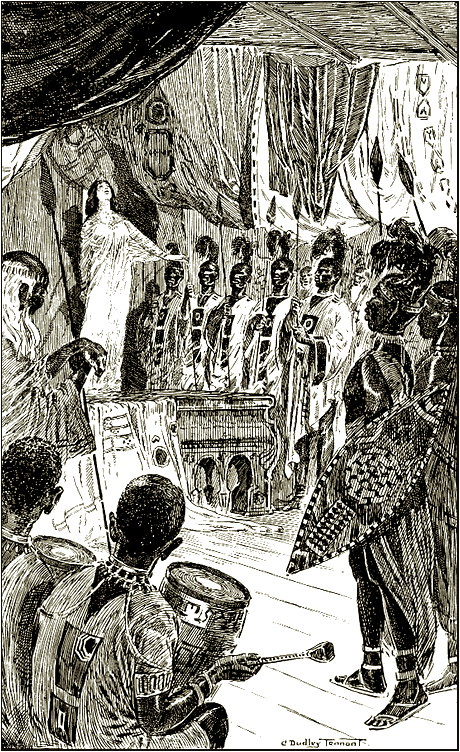
She stood there in all her beauty.
I laid my hand on my heart to still its wild beating, and gazed at her, rapt, ravished and entranced.
Even now, after all these long years, I yearn to look again on that marvellous woman as she appeared on that day in the hall of the House of Shining Light.
Nor was I the only one affected by Pale Witch's extraordinary beauty. A sudden hush came over the assembly, such a cessation of sounds as one feels rather than hears. It was the instinctive tribute of a nation to the loveliest of creatures.
Nay, there were two who stood near me who were unaffected. They were Alphonse the Frenchman, and Joseph Vimont.
'Is yours what they call an affaire de coeur, mon cher Alphonse?'
Vimont grinned as he put this question, as though he knew what the answer would be.
His companion shrugged his shoulders. 'She is pretty enough, and well dressed—et voilà tout, I admit,' he said; 'but you know well enough what I am after. Once let us get clear away with the stones, and we shall not lose time in making for the schooner. Then, with the diamonds and the casks of English gold, we shall have enough to—'
What he said more I missed, for Pale Witch began to speak, and I had ears for none else.
She spoke at first in a low tone, but her accents were so exceedingly clear that they penetrated to the extremity of the building. There was a pathos—a thrill of emotion in her speech that seemed at once to touch a responsive chord in us all. It was such as compelled the sympathetic attention of every soul in that hall. It was something which frequently brought the tears to my eyes and a lump into my throat. Like the strains from some wonderful instrument of music—and yet how far surpassing any of man's device—her tones rose and fell. Now pleading, now passionate, as she spoke to the people of Zen in their own tongue.
I knew not at the time what she said (though I learnt it afterwards); how that she was telling them the history of her life; how she was thanking them for their devotion to her; how she was informing them—this in imperious tones—that now was the hour of her triumph.
That Alphonse understood her was evident enough, for, as she went on speaking, he became quite absorbed in her story and listened with an intentness quite surprising.
All at once, to my surprise, she turned and addressed me in her quaint English—the English which she had taught the chief Falenga, who, with myself, the Countess and Geneviève, alone knew the meaning of the words which she now uttered.
'Ye also, my white friends—my relative,' here she smiled sweetly and kissed her taper fingers to the astonished Countess, 'yea, ye know whence I came in the years long past. And ye know also the love I bear towards him who would make me his bride.'
I fairly gasped for breath as she said this.
'Not for naught hath he in past years visited this land,' she continued. 'He stole men, women and children to take them across the blue waters. He hath robbed us of our white stones, and when I resisted his insults he would have murdered me! For these and other iniquities, he seeks a reward—Myself!'
There was a look of magnificent scorn in the flash of her dark eyes as she uttered the last words, but the object of it was unmoved, for he understood not the English language. Falenga understood, however, and I saw that his huge hand tightened on the haft of his double-edged sword.
Resuming the tongue of the Tall Ones, Pale Witch now addressed Alphonse, and to my amazement he stepped forward and ascended the daïs.
She took him by the arm and turned him so that he might face the audience. There he stood by the side of the loveliest woman on earth—the very incarnation of sensuality, cunning and brutal wickedness. The contrast between the two was so marked that I wondered the Tall Ones did not hound him from the place.
The dead silence which pervaded the room was perhaps more ominous of what was to follow.
Again Pale Witch spoke, now very slowly and with emphasis. She addressed the people, but herself interpreted her words to us sentence by sentence.
'Ye have come here to-day,' she said, 'to witness a betrothal—the betrothal of Pale Witch. Behold him—the man of my choice—the bridegroom!'
Did I hear aright? Was I going mad? My brain reeled. Was this what I had come to witness—the nuptials of Pale Witch and Alphonse the Frenchman? Then a hand was gently laid upon my arm, and the voice of the Countess de Grancey whispered some words of comfort. With the wonderful intuitive perception of a refined and highly-educated woman, she had read my secret.
'The customs of the great nation of the Tall Ones must be observed,' continued Pale Witch.
Then she turned and addressed the Frenchman, still interpreting to us.
'Art thou willing to receive the Sign that thou art accepted by this people?'
Alphonse jauntily signified his assent.
'Behold! Behold! oh, people of Zen, the man of my choice! Behold the man who is willing to receive the Sign!' she cried, raising both her fair, shapely arms aloft.
The response, in its intensity and force, was like the breaking of a wave of the sea on a rock-bound coast.
A smile, as of one who triumphs over a foe, overspread the face of Pale Witch. There was something cruel in that smile, and I watched her intently, wondering what it meant.
'Approach, brave Falenga, and prepare this man for the ordeal!' she cried, speaking in English to the chief.
I saw at once that Falenga had been expecting the summons. He sprang forward with alacrity, and was followed by three of his men. They picked up the afore-mentioned strong hide ropes, and almost before I could realise what they were about they were binding Alphonse to the upright stake.
Pale Witch stood aside and watched them, the smile of one who wins still on her lips. She stood erect and silent until their task was completed and Alphonse was helpless. Not that he showed any sign that he was suspicious of foul play. On the contrary, it seemed to me that he had expected this treatment as part of the ceremony through which he must pass, in accordance with the customs of the Tall Ones, and I concluded that Pale Witch had prepared him for it.
Yet, in spite of this, there was something in the very atmosphere which made us all feel uneasy. It was not unlike the curious prelude which one notices to a thunderstorm—the unearthly stillness, when the very birds fear to twitter and the tiniest leaf is rigid with anticipation.
There was no sign of mirth in the faces of the assembled great ones of Zen; nothing but sternness and silence.
'Ah! 'tis done, 'tis done!' cried Alphonse presently. 'Come, my pretty one, and go through your antics, for these straps are exceedingly tight.'
He spoke, of course, in French, but some of us—I refer to the Countess, Geneviève and myself—understood every word.
Pale Witch, however, was plainly in no hurry. She stood looking at the man as though preparing herself to speak—or to act.
Then she began to address him in the language of the Tall Ones. At first she spoke slowly and quietly, emphasising a word now and again with the slender forefinger of her right hand. After a time her speech grew more rapid, her gestures more significant, she was working herself up into a rage—she went on—her voice rose higher—she became like one frenzied, and I saw that the face of the Frenchman was blanched like chalk.
'Dieu!' exclaimed the Countess at my side. And well she might; for Pale Witch had snatched from the man's girdle the very dagger which he had once used against her with murderous intent. She flourished its keen point in his face; she made as though she would draw its keen, razor-like edge across his bare throat; she aimed a blow as though she would stab him in the heart, and I saw the sweat of agonised terror trickle in streams down the coward's face.
Presently she paused, looked round, and caught my eye.
'See—see this man!' she cried. 'He belongs to a brave race. He is himself a man of courage! Nay, he shall be tested further. Thus!'
To my horror she pricked the miserable wretch in the shoulder—no pin-prick either—with the result that he roared with pain, and began, in extravagant phrase, to implore for mercy.
'Nay, brave Alphonse! thou shalt go through the ordeal or I am no bride of thine,' she cried with shrill laugh, at the same time pricking him in the other shoulder till blood trickled down his shirt.
I was horror-struck when I saw it, and yet I felt completely spellbound. What could I do? Would Falenga and his people permit me to unbind the wretch and set him free? As for Pale Witch, surely she would never inflict unnecessary pain; surely there must be some justification for her treatment of the wicked Frenchman.
But there could be no excuse for her next act. For, as the man again opened his mouth to howl, Pale Witch thrust the dagger through his cheeks and left it there, like a bit between his teeth.
It needed but this act of barbarity to arouse all the savage instincts of the people of Zen. A prolonged shout of approval went up from the spectators, and the sound of it had hardly died away when there rang through the room the sound of an English voice: 'By Moses! the beggars have trussed the Frenchie like a fowl, and the head cook is sticking in the last skewer!'
THAT voice seemed to break the tension which was upon us all. Everyone turned from the sight which had hitherto riveted our attention, and looked towards the great doors. Of course I turned too. It is the hardest thing in the world to avoid doing what everyone else does.
The voice I at once recognised as that of Captain O'Callaghan, though where he had sprung from was a mystery to me. His form, though not so tall as those of the people of Zen, was conspicuous enough. Behind him was a phalanx of sturdy men—the sailors of the Aurora. With them were the two white men whom O'Callaghan had met on the day of the raid of the Arab slave-hunters, and, above all, there was my own beloved friend Condazin.
'Falenga, chief of the people of Zen!' cried O'Callaghan, speaking in tones worthy of a stentor, 'I call upon you to set that man at liberty!'
Not a soul of the vast throng stirred; not a word of reply was spoken. Pale Witch remained standing by her victim, but her gaze was now fixed upon O'Callaghan and his company.
'I warn ye that there is no escape from this place. Not one of ye shall go forth alive if this man be not instantly released,' cried O'Callaghan.
Then, for the first time, he seemed to realise our presence in the hall; for, after a moment's pause, he proceeded to demand a safe passage for the whole party as far as Falenga's dominions extended. 'We are determined to return to our ship, that we may sail across the sea to our own land,' he continued. 'Refuse our demand and not a man of you shall be left alive!'
As he spoke he brandished aloft a sword shaped like that worn by Falenga himself, and which I knew must have been taken from the armoury of the building, and the whole company of white men who filled the doorway behind him did the like with similar weapons. I did not notice among them the lean and lanky form of Hobinstock, the fat, pock-marked face of Dawford or the Roman nose of Back, but on glancing at Alphonse I perceived these worthies, drawn sword in hand, filling the narrow doorway which led to Pale Witch's apartments.
How shall I find words to describe that which now happened—the shout of contempt and defiance from Falenga; the responsive war-cry from his chief men and soldiers; the cries of alarm from the Countess and Geneviève; the sudden surging of men to and fro; the clash of arms; the reiterated cries, groans, curses, execrations, as the sailors, brave by nature, toughened by toil and desperate with unalterable resolve, fought and wrestled with these sons of Anak.
I cried to Joseph Vimont to aid me in protecting the women, but the craven fellow heeded me not, and the last I saw of him was his boots, which protruded from beneath his place of retreat—to wit, the raised platform on which stood pilloried the terror-stricken Alphonse, in whose cheeks the dagger remained.
Above the contending sounds the voice of Pale Witch now arose. I had hoped that she would exert her influence in the cause of peace. But, no! it speedily became manifest that she was as a tigress who had tasted blood.
'Slay them! Spare them not!' she cried aloud to O'Callaghan. I was amazed at her words.
Once more I perceived that though she had the face of a goddess, Pale Witch's heart was the heart of a savage. For it was evident enough that she delighted in carnage.
Never shall I forget the pang of agonising sorrow which this discovery gave me.
Immediately after this there arose a sound without—a roar like unto the bursting of a tropical storm; and I knew that the news had somehow spread abroad, and that the city of Zen had risen in defence of its chief.
AGAIN I make extracts from the precious scraps of paper which served as a diary.
'How shall I describe the misery of our position or the depth of our despair a week after the ever-memorable scene in the great hall of the House of Shining Light! The attempt of O'Callaghan, brave, even audacious as it was, was foredoomed to failure. Even had he succeeded in overcoming Falenga and his well-armed men, what hope was there that he would ever be able to lead us out in safety from the City of Zen and the land of the Tall Ones? And now we are slaves. About my neck is the galling iron collar. I am chained to a white slave gang. Nay, strange irony of fate! the next in the gang is none other than Pale Witch herself.
'Great has been the upheaval in Zen. Fallen from her high estate is Pale Witch, who for years has dispensed wisdom to the nation of the Tall Ones. Strange are the revulsions of popular feeling. How soon is the idol of the hour overthrown, cast down and shattered!
'We have very speedily discovered that Falenga and the Tall Ones, in their resentment, are determined to treat us all alike. After a few days' imprisonment in filthy, loathsome dens, we were coupled together in one gang by slave collars and a connecting iron chain. The arguments of Pale Witch and my own entreaties alike have been without avail. What is to be our destination we cannot discover. Falenga, when he deigns to speak at all, replies in monosyllables to our questions. It is now two days since we left Zen. Already are we footsore and weary. It is agony for me to see the rude iron collar on the fair necks of Pale Witch (cruel though she has been), the delicate Countess and the sprightly Geneviève. Yet they are struggling on, bravely, hopefully—yes, hoping through their tears and against hope.
'Our escort is twenty gigantic men of the Tall Ones, a portion of Falenga's bodyguard. They, like their chief, are sullen and silent.
'It has leaked out that our destination is the blood-stained city of Benin, and that it is "two moons distant." What will happen to us when we reach that place—those of us who survive—I can only guess. The men will be sold, one by one, to the highest bidder, to pass the remainder of their weary existences as tillers of the soil and bearers of burdens; while the women—ah, I cannot bear to think of it!—will become worse than slaves—the mothers of future African savages.
'Hour after hour we plough our way through the dense forest, groaning under the weight of our loads. For the Tall Ones have placed upon our shoulder heavy loads of provisions and articles for barter (we cannot carry them on our heads after the fashion of the natives of this land), and we must needs press on at uniform speed or there will come a cruel jerk at the chain, and the rim of the iron collar will bruise, and even lacerate, the skin of our unhappy necks. Now one of us stumbles, and the chain instantly tightens, dragging the unhappy wretch half-strangled to his feet, though at the expense of another's throat! The cruel thorns tear our clothing to shreds, yea, and our flesh also. I can see the blood trickling from deep scratches, on the fair limbs of Pale Witch as she toils on in front of me—the lower part of her skirt had been completely torn away, and from her knees downwards she is exposed to the knife-like points of revengeful cacti and vegetable spines innumerable. Nay, there are living dangers too. A hissing snake rears its ugly head, to be cut down by Falenga's spear as it is about to strike the terror-stricken Countess de Grancey. There are innumerable insects which bite and sting. There are beasts of prey. There are the wanton arrows of human enemies, some of them, no doubt, tipped with poison.
'Then there is the sweltering, misty, tropical heat. For days no breath of refreshing breeze reaches us. The very heavens are shut out by the dark dense foliage which, while it keeps off the direct rays of the sun, acts also as a screen against the passage of air. Sometimes the scenes through which we pass are weird enough, at others it assumes the appearance of a veritable paradise. Creepers and many-hued trailing plants hang festooned in ever-varying shapes and colours over our heads. The ground is carpeted with magnificent arum lilies and other flowers, many of them unknown in Europe. Here grow stately palms, there we catch a glimpse of the pale-green leaves of the banana. These again are contrasted with the dark foliage of limes and oranges, where the air is heavy and sickly with strong perfumes. Amid it all, regardless alike of its gloom and its beauties, we trudge, toil, sigh and groan, advancing surely, if ever so slowly, towards the goal where our fate awaits us.
'As yet I have had no word with O'Callaghan or Condazin. They are chained with the Count and the Yankee at the further extremity of the gang. Our order of procession is as follows;— First come Alphonse and Vimont. They are followed by the Countess, Geneviève, Pale Witch and myself. Behind me are Hobinstock, Back and Dawford. Then come the seamen, and the rear is brought up by O'Callaghan and his new-found friends. As yet the Countess has seen nothing of the Count, nor has the Count come across Pale Witch.'
I have now to describe the extraordinary manner in which we were delivered from a position of terrible and overwhelming peril, and at the same time I shall relate the way in which, as eternal justice ever demands, virtue triumphed over villainy.
For five days we had travelled through the forest—five weary, torturing days. Often have I wondered how the frail Countess, unused as she was to such exertion, survived that march. Think of the miseries of an enchained slave gang! I had seen, but till now had never experienced them. Think what it meant for delicate and refined women to be chained to men—rough, coarse, uncouth, unrefined men—to have no moment of privacy, but to walk, sit, stand, eat, sleep, continuously in their company.
Ah, I began now to understand what slavery meant. I perceived—it was borne in upon me with overwhelming force—that neither the 'middle passage' not the cruelty of West Indian and American slave-drivers covered all the horrors of the traffic. There were horrors, many of them unrecordable, with which I became perforce acquainted as we were driven like sheep through the African forest. Nor do I forget that from that unhappy continent there still goes up the cry of hearts' agony from miserable slave-gangs, whose members are being driven, as we were, like dumb beasts to slaughter.
It seemed to be Falenga's policy, to avoid villages and towns. But when our provisions became exhausted it was necessary that he should purchase food from the natives. The inhabitants of the little town in which we one evening found ourselves seemed to be known to the chief, for they received him with respect. On ourselves they bestowed unlimited curiosity, for at that day a white man was a rara avis in the interior. While Falenga and his men enjoyed a liberal meal we slaves were fed on a kind of plantain porridge.
'It's fillin' but not satisfyin',' was Hobinstock's remark to me.
Now in the night time, as he and I lay near each other, we had several times (in whispers, of course) discussed our chances of escape, and each time had come to the conclusion that it would be both difficult and dangerous to attempt it.
In fact, had it not been for the event which I am about to record, it is quite certain that we should never have escaped at all.
I WAS awakened by a gentle prodding in my left ribs. It aroused me from a dream of my mother and home.
'Look at that derned Frenchie!' said a voice—the sotto voce of Hobinstock.
I raised myself on my elbow and peered at the place where the recumbent form of Alphonse should have been visible.
He was not there; but following the line of Hobinstock's finger I perceived the figure of a man, dim and shadowy. It was the Frenchman plainly enough. The half-healed scars in his cheeks had by no means improved his personal appearance. He was on his feet, and he was free!
What could it mean?
We watched him in silence, wondering by what means he had removed the iron collar from his neck. For a few moments he remained motionless, and we guessed that he was watching us to see whether we were all sound asleep.
'Lie down!' whispered Hobinstock to me.
I lay back, as though I had only been moving in my sleep, and presently, through my half-closed eyelids, I saw that the fellow was moving silently and cautiously towards Falenga and his men.
The event which I am now narrating happened the night after our visit to the afore-mentioned village. There the Tall Ones had obtained a quantity of palm wine, which they had imbibed freely after we had halted for the night, with the result that their slumbers were unusually sound, as was evidenced by the snores and heavy breathing of the whole party.
Like a panther creeping towards his prey the man advanced towards Falenga, glancing round at almost every step as though to assure himself that he was not being watched. I once caught the gleam of his teeth as he turned, for his lips were drawn back, imparting to his face an expression of bloodthirsty ferocity.
'Watch him!' said Hobinstock in an intense voice, inaudible to any but myself.
As soon as he had reached the prostrate form of Falenga he paused again. Then, stooping over him, with the deftness of a Parisian pickpocket, he relieved the chief of the long, keen-edged knife which he wore in his girdle.
We saw the glitter of the blade as the Frenchman held it aloft, and for a moment I thought he was about to slay the man.
But I was mistaken. It was not at that time Alphonse's object to murder Falenga.
'He's comin' this way!' whispered Hobinstock.
'What is he after?'
'Dun know—mebbe it's Pale Witch.'
My heart stood still. Was the villain about to revenge himself on the woman?
She was only a couple of yards away from me. The circle of iron showed plainly against the fair skin of her shapely neck. Ah, even in her misery she looked wondrously beautiful, and in my yearning pity I almost forgot that she could be cruel. Her face was towards me; her dark tresses were thrown back, her head was resting on her hand, and her bosom heaved slowly and regularly in peaceful sleep. I could even distinguish the fringe of her long dark eyelashes and the colour of her lips.
Now the Frenchman is close to her. I can see the gleam of murder in his eyes. There is no doubt of his intention. Revenge is written on every line of his repulsive countenance.
His object is to slay Pale Witch. I start up, and by a pull at the chain awaken the sleeping woman. She moves, opens her eyes and utters a low cry as she catches sight of the form of Alphonse and the sheen of the upraised knife.
'Shout!' cries Hobinstock, for the chain will not permit us to reach the man.
We shout to the Tall Ones for help, but assistance would have arrived too late had not a heavy stone, thrown from behind us, struck Alphonse full on the chest. He fell; but picking himself up, plunged into the adjoining thicket.
Then we turned and saw that O'Callaghan was on his feet. Not alone had we watched Alphonse. It was O'Callaghan, the slave trader, who had saved Pale Witch's life.
All was now confusion in the camp. The Tall Ones awoke, some of them to gaze about as though in a state of semi-stupor, others to pursue an imaginary enemy in any direction but that taken by the would-be murderer. The rest of us started up in haste, jerking one another's necks uncomfortably. There were cries of alarm and pain from the poor unhappy women, as well as shouts from the men. One thing was abundantly clear, the collar which had encircled the neck of the Frenchman was empty, and its late occupant had gone—clean gone.
'Well done, Frenchie!' exclaimed Back, smiting his knee with energy.
'Yis, 'e's got orf safe enough,' chimed in Dawford in a tone of envy.
'The fool, not to ha' stuck the lot!' cried Hobinstock, contemptuously.
I asked him what he meant.
''E might ha' polished orf the 'ole black crew wi' that knife.'
'And then—?'
Hobinstock made no reply. Possibly he had not looked so far ahead.
How Alphonse had contrived to rid himself of the collar was more than any of us could understand. For, like ours, it had been fastened by a catch, which could only be opened by a kind of key kept by Falenga. I saw the chief examine it carefully, and then shake his head as though completely mystified.
At sunrise, after our unsatisfying meal of coarse native food, we resumed our melancholy trudge through the woods. Slowly but surely the while, though we knew it not, we were drawing near to the hour and the place wherein our wonderful deliverance was to be brought about.
In and out among the trunks of the forest giants and bushes; now plunging into a swampy tract; now clambering over a fallen trunk; onward, ever onward, twined and twisted the long, long chain of white slaves.
'How astonished we should be if we English folk were to see such a sight as this in old England,' I ventured to remark to Pale Witch.
She turned as well as the chain would permit.
'Deliver me from the Tall Ones, and with thee will I go to that land.'
These words were spoken so artlessly, and withal so sincerely, that my heart bounded with intense joy. Could it be that Pale Witch indeed returned my love, my intense, burning devotion?
Forgetting everything—that we were slaves, miserable, forlorn slaves—that we were probably to be sold to different savage masters, and for ever to be separated from each other; forgetful of the presence of Hobinstock, who marched at my heels—of the slave-driver, Falenga, who understood my speech—I drew as near to Pale Witch as the hateful chain would allow and poured out my soul's love. The words flowed from my lips like the bursting forth of a long pent-up torrent. They were earnest words—burning words—welling up from a very furnace of desire. All memory of her cruel treatment of Alphonse was forgotten in the intensity of my longing for her love; or, if remembered, it only served to encourage me to hope that she cared for me and me alone.
'Tell me that you love me, and slavery—even death itself—with you will have no terrors!' I whispered.
Then I paused and awaited her reply. A warm rich blush had overspread her pale features. The chain behind me began to slacken, as though Hobinstock were desirous of enabling me to draw nearer to the lovely slave-woman (Good Hobinstock! how I blessed thee for that!)—and, oh, joy!—I was even able to place my arm about the woman I adored.
Maybe Falenga imagined that I did but assist her. For he himself had been obliged on several occasions to support the faltering footsteps of the Countess. At any rate, he said nothing, and I again poured my love-song into the ear of the loveliest slave who ever had trodden Afric's wilds.
For a few seconds I waited. What an eternity it seemed! The dark forest; the Tall Ones marching by us in moody silence; the heavy links of iron joining together guilt and innocence; the long line of my perspiring, cursing, despairing companions faded entirely from my sight. I saw one and only one object in the world—Pale Witch the Beautiful.
I can see her face now as she lifted her wondrous eyes to mine. Never before had I seen such eyes; never since have I looked into orbs like hers. There was in them a liquid softness, a depth, an intensity of meaning almost unearthly. It hardly needed her words to interpret what those eyes told me—that she loved me with all the passionate devotion of her intense nature.
'Yes, I love thee!' she said, as I pressed her hand to my heart.
I glanced round. A grim smile of satisfaction hovered about Hobinstock's lantern jaws.
That night a tragedy was enacted.
A cry—as of agony—a scuffle—a groan—a body crashing through the tangled undergrowth.
We were all awake now.
'What's the matter?'
'A lion?'
'No; natives.'
But it was neither lion nor African which had stolen into our camp to strike the blow which meant so much for us all.
A shout from the Tall Ones—a question put by Pale Witch—a reply!
'Falenga is dead!' she cried.
'Dead?'
'Yea. He hath been murdered.'
'By whom?'
'The Tall Ones know not.'
'Have they no clue?'
'The key has been taken.'
'Then these collars cannot be removed.'
'Only by cutting off our heads.'
'Horrible!'
''Tis often done.'
'This is the work of Alphonse,' I said. 'He will slay us one by one.'
There was no fear in her looks, but I felt terribly apprehensive. There was something unnerving in our helpless position. We were being followed by this vindictive man on assassination bent.
Who would be the next victim?
I was resolved that, at least, it should not be Pale Witch.
An hour later the dawn came. It revealed to us Falenga, the Great Chief of the Tall Ones of Zen, a mass of lifeless human clay.
How shall I describe what followed? The horrors of that day are for ever imprinted on my memory.
'WHAT are they doing?'
'Preparing for the burial of Falenga.'
I did not understand the meaning of the preparations. A wide trench had been scraped (I cannot say dug) under the shadow of an enormous tree which grew in a natural hollow. It was big enough for three men.
Whereat I wondered.
But I was not to wonder for long. The body of the dead chief was first laid by the giants in the centre of the ditch. Even in death there was a majesty about him, and, in spite of his recent treatment of us, I could not help regretting his tragic end.
When we were drawn by our captors round the grave, I supposed that a kind of funeral ceremony was about to be performed. But Pale Witch drew back with a look of dread on her expressive features.
As the circle about the grave was completed, and the extreme ends of the chain of humanity came in contact, a strange thing happened.
For the first time the Countess beheld the man who was chained next to O'Callaghan. She uttered a wild cry. 'Mon Dieu! It is the Count, my husband!'
As for the Count, he hung his head as though in shame, and did not speak. But Pale Witch, too, uttered a cry as she saw Saunderson. 'Ah, 'tis he!'
Perhaps she would have said more, but he who had taken the place of Falenga as head of the party now began what I supposed to be a funeral oration. As soon as it was over he turned and spoke a few words to Pale Witch.
She started back to the length of the chain and replied in an agitated tone.
The man addressed her again. It was plain that he was insisting on something.
'What does he want?' I asked.
'It is the custom of the Tall Ones that two slaves be buried with the body of a dead chief,' she said.
'Then two of us must die!' I exclaimed in horror.
'Yea. So it must be.'
'Which, of all us?'
'They bid me choose.'
I gazed at her speechless. Perhaps the Tall Ones intended it as a compliment; perhaps it showed that they still revered Pale Witch and believed that her wisdom was infallible; but the situation was appalling.
'Refuse!—refuse to choose!' I whispered.
'Nay, but they will compel,' she said.
'And otherwise—?'
'They say I am myself to die.'
'Oh, that Alphonse had not escaped!' I cried.
'There is Saunderson!'
But I could not bring myself to advise that even he should be slain in cold blood.
The man, however, had heard us mention his name.
'Ef some ov uz has to die, I kalkerlate I'm not afeer'd to satisfy the black fellows' Ju-Ju!' he said.
'But why should anyone die?' I exclaimed.
The Tall Ones were plainly in a hurry to finish the business. Seeing us looking at Saunderson, one of them stole round the circle, and, before I could divine his intention, a keen blade flashed and the head of the unfortunate man rolled into the grave by the side of the dead body of Falenga. The trunk slipped from out the collar and followed suit. It was a sickening and ghastly sight. Immediately this was done the Tall Ones cried to Pale Witch to select another. But in vain. She covered her eyes with her hands and refused to speak.
I gazed upon her in an agony of alarm. What if they should slay my darling!
The savages consulted together for a few moments, and then one of them was told off to act as executioner. He ran round the circle towards the place where stood Pale Witch.
'Help me, if you are men!' I cried in my despair.
'Sweep round, m'lads, sweep round!' cried O'Callaghan.
The sailors did as he bade, and swept round as quickly as the chain would permit, so that in a few seconds we had surrounded the band of giants.
'Disarm them, lads!' cried O'Callaghan. 'All together, or we shall be down!'
There was nothing for it but to join in the mêlée. Though I well knew that it meant death to some of us.
How we fought and wrestled and fought again!
The shouts—the groans—the oaths—the clanking of the chain—the screams of the terrified women, dragged hither and thither by their necks, as the white men, regardless now of their own safety, fought with the desperation of despair.
What was taking place elsewhere I knew not. I only know that I found myself face to face with the huge fellow who had taken Falenga's place as leader of the Tall Ones. As he made a lunge at me with his sword-knife, I attempted to grasp his wrist. Missing it, the blade descended on my shoulder. At the same moment I was jerked aside by a pull at the chain. (We were swaying about in our terrific struggle, and it is altogether a wonder that any one of us kept his feet.)
'Ah, villain, would you!' cried Condazin, who, being at the further end of the chain, was now opposite to me. He seized the leader's black woolly hair and dragged him back. Forgetting for the moment that I was defending Pale Witch, and mad with pain, I at the same time struck at the fellow's face with all my might, so that he went down like a felled ox.
Then I turned. Oh, horror! just in time to see another of the giants, his eyes dilated with fury, plunge his weapon into Pale Witch's white bosom. With a groan she reeled and fell forward as I clasped her in my arms. She was severely wounded. Her warm blood ran over me. Her glorious head rested on my breast. She had fainted.
The struggle was over. Our men had possessed themselves of several sword-knives, though at great cost: two were killed and five had been wounded more or less severely. The Tall Ones, however, had met with more than their match. Eight had been killed. Hobinstock boasted that he had throttled two of them with his sinewy hands, and a number had been wounded. How many we never knew, for they broke through the ring and escaped into the forest.
'Help me to save her life!' I cried imploringly to Hobinstock.
'Here you fellows, give us a little slack,' he cried, tugging at the chain.
They yielded, and we laid the fair form on the ground. It was a ghastly spot. Close by was the shallow grave containing the body of Falenga and the still-bleeding trunk and head of Saunderson. But what cared I! Pale Witch was wounded—dying. In agony I clasped my hands—they were cut and bruised—and prayed as I had never prayed before that she might be saved. But when I looked upon her face I saw that the hand of Death had been laid thereon.
While the sailors attended to each other, and O'Callaghan to all, the Countess de Grancey, Geneviève and Hobinstock knelt on the blood-stained herbage about the form of the dying woman.
'Oh, for a word—a look!' I thought.
She opened her eyes. Though death was visible therein, they were still beautiful. I bent over her and breathed her name.
'Pale Witch—my loved one! My darling!'
A smile, like unto the last ray of a glorious sun, flitted across her face. Then with a supreme effort she raised her arms—her glorious womanly arms, and folded them about my neck. I felt them press on the iron slave-collar as she drew my face down till my lips touched hers. Oh, the bliss, oh, the agony of that touch!
A few moments later her arms relaxed; and when I looked into her eyes I saw that the sunset had passed, for the light thereof had fled.
'Now, m'lads, we've got to save our lives and the lives of these wounded men.'
It was O'Callaghan who spoke. Born to command, he at once took upon himself the leadership. Nor did anyone dispute with him this position. We all knew well enough that if anyone among us could save our lives it was Daniel O'Callaghan.
'First we have to get rid of these collars. Then we must bury the dead,' he said.
But getting rid of the stout collars was no easy task. Though we searched the scanty garments of the Tall Ones as well as the baggage, no trace of a key could be discovered. So that we had perforce to break them open.
Condazin suggested that we should use one of the swords for the purpose of forcing back the catch. After several attempts, in which Back's throat was in no slight danger of being slit, we were successful. It took many hours to liberate the whole party. But at last, by God's mercy, we stood in that African forest-glade FREE.
Yet what was freedom to me without Pale Witch?
Aided by Hobinstock we scratched away the earth and made a rude grave, while the Countess and Geneviève prepared the body for burial by wrapping about it one of their own frayed garments—it was all they had to give. Then Hobinstock and I laid her to rest.
Good Hobinstock! I saw tears in thine eyes, and I knew that, in spite of much that was evil in thy life, all was not bad!
I HAVE now to ring up the curtain for the final scene of this drama.
Once more the moon shines down upon the hoary Castle of Saint Ange, lighting up the great golden angel which rises high above the chapel and the sea, casting everywhere strange, weird shadows, or glinting like shafts of silver through the ruined tracery of Gothic windows. Can it be the same moon which looked upon us in the wilds of Africa? That which illumined the begemmed dome which ever glitters over the mysterious and far-away city of Zen; that which once shone down upon us, a weary, travel-worn gang of white slaves, as we slowly toiled towards the fateful hour of our deliverance.
The moon is the same: it is its light which seems to have undergone a subtle change. 'Tis a parable of ourselves: the same, yet how strangely altered! For myself, who have loved as I can never love again, the light of life, though it still shines, is as the cold moonlight compared with the warmth of the sun. Once have I known that which I can never know again. With me it must ever remain-—the bitter-sweet of memory.
As for Condazin, he too seems to have undergone a change. But in his case it is for the better. He is in love with Geneviève. I came upon them in the moonlight—his arm about her shapely waist, his hand holding hers with tender grasp. They talk the sweet nothings of lovers.
I sighed deeply and passed on into the shadow.
In this place I will once more quote from the diary. (For I have carefully preserved the scraps brought from West Africa and have added them to these scanty records.)
'It is six weeks since we were landed at Saint Ange.
'The schooner Aurora, strange to say, though it had been looted by natives, we found to be uninjured. There were also stores on board which the thieves had not discovered. The captain, who seemed to be softened by his recent experiences and by the sufferings of the Countess, as an act of extraordinary generosity offered to sail at once for France.
'After O'Callaghan had put us on shore (that is to say, the Countess and Geneviève, with Condazin, Hobinstock and myself), he departed at once for his depôt in the West Indies, the Count, who seemed to have no spark of affection for the Countess, electing to accompany him. The ex-butler, Joseph Vimont, has gone with them.
'Here Condazin and I are awaiting an opportunity of returning to England. We have written to our friends informing them of our safety. Perhaps we should ourselves have followed the letter but for Geneviève's pretty face. As for the Countess, she is quite broken down in health after her African experiences. There is a sad, wistful look in her eyes whenever we talk of the past—which is almost daily. I can see that the shock occasioned by the re-appearance of the Count, her long-lost husband, on the occasion of the awful scene round Falenga's grave, has been almost more than her delicate constitution could endure. Believing the Count to be long ago dead, she had loyally loved and trusted O'Callaghan, and now—!'
We saw nothing of Alphonse after the eventful and momentous night in which he stabbed Falenga until the evening before the day on which we were to have left the Castle of Saint Ange for old England.
Hobinstock and I were conversing on the terrace—the very place where O'Callaghan had learnt that we had obtained possession of his pocket-book. Hobinstock had been relating some episodes of his eventful and adventurous life, and especially stories of his former connection with Alphonse the Frenchman. As he talked away in his uncouth lingo, his mind seemed to become aflame with desire to get afloat with his old captain, O'Callaghan, for whose courage and resourcefulness he had an unbounded admiration.
'Niver woz there sich a man as the cap'n!' he remarked emphatically.
It struck me that perhaps this dictum was capable of a double meaning. For my part, I had been urging him to abandon the life of a slave-hunting pirate and to take to the profession of an honest seafaring man.
'Such men as you are wanted, both in the Royal Navy and in the merchant service,' I urged.
He shook his head slowly, and I could see that, though dissatisfied with himself, he still longed for the risks and excitements of the life of the slave trader, the pirate and the smuggler, for he had been all three.
'I shall jine the cap'n when 'e comes back,' he said presently.
'O'Callaghan?'
'Yis.'
'Then you won't abandon the life?'
'Not yit.'
We stood together in silence, and in a few minutes Condazin and Geneviève joined us.
'Alas, to-morrow!' she sighed, looking up tearfully into Condazin's face.
At this moment there came an exclamation from Hobinstock.
'What's the matter?'
'Look there! D'ye see it—in the glow o' the settin' sun!'
We looked in the direction in which he was pointing.
'D'ye see it?' he repeated eagerly.
'I see a ship.'
'Man alive! It's the ship—the schooner Aurora!'
'Never! She's here before her time.'
'It's 'er all the same!'
I saw that the fellow's eyes fairly glowed with excited enthusiasm. We watched the vessel until she furled her sails and dropped anchor right opposite the castle.
I now went in to see the Countess. She was in the room in which we had dined on the night of my arrival at Saint Ange. I noticed that she looked very pale.
'So he has returned!' she said. Her voice was tremulous with emotion.
Did she refer to O'Callaghan? I was not sure, so I merely nodded.
'Promise me that—that he shall not be hurt!'
I looked at her in some astonishment.
'If there should be a struggle and he should fight for me and for the castle. Alas, he has no right to either the one or the other! I would have you take his part.'
'But, madam, the Count is with him,' I cried. But what she had said told me that, in spite of the past, she still loved the dashing slave trader.
'I strove—oh, so hard!—to hate him,' she continued. 'In Africa I steeled my heart against him. For I had discovered the truth concerning the abduction of the Count. Yet at Zen I learnt first to admire, then to love him once more.'
At this point Geneviève entered hastily.
'Madame, they are about to land!' she cried.
'Under the cliff?'
'No, madame, away to the east.'
'But the quicksands, Geneviève!'
'Surely they will avoid them, madame!'
'But they know nothing of their existence. Run, good Geneviève, run to the water's edge and warn them. Keep to the right and you will avoid the soft places.'
'Nay,' cried Condazin, who had entered in time to hear the last words, 'I will go!'
'And I!' I cried.
'This way,' said Geneviève.
Lantern in hand she conducted us through the well-remembered passages and the dungeon where we had been hidden and had afterwards fought Alphonse and his thievish French vagabonds, right down the narrow passage to the sands at the foot of the crags on which stood the ancient castle.
'Keep well to the right,' she said. 'Here, take this lantern with you to warn them. Swing it, and they will pull for you. Yes, all right!' (this to the protecting Condazin) 'I can find my way well enough in the dark.'
She left us, and we started for the water's edge. The tide was low and there was a wide stretch of sand to be crossed.
'I believe they have landed,' said Condazin presently.
We stood still and listened. The wind had dropped and the sound of voices came across the waste of foreshore.
'Yes, there they are! They are coming this way.'
We shouted to them to go back, and waved the lantern to warn them. There was a response, and we dimly saw distant figures in the gloaming.
'Go back, go back! The sands, the quicksands!' we shouted.
Alas! they did not understand, and after a few minutes of anxious waiting we heard a cry of alarm. Then more cries.
'That's O'Callaghan's voice,' said Condazin, suddenly.
At once there came into my mind the earnest request of the Countess that I would preserve the man's life. Surely her command applied to this. If he should be in danger I must do what I could.
Her words seemed to ring in my ears, 'Save him, save him!' Then I remembered that the Count was Pale Witch's father. I must at all costs save him also.
'Come on, Condazin,' I exclaimed.
We dashed off in the direction of the sounds.
'Cautiously, cautiously!' cried my companion as our feet began to sink in the softer sand.
We paused and then proceeded carefully.
'Where are they?'
'Here—help!' cried a voice I knew.
I held up the lantern and peered about. As I stopped the sand under my feet gave way and I began to sink.
'Come back!' exclaimed Condazin, 'or we shall be sucked in.'
He dragged at my coat, but the soft sandy mud already covered my ankles.
'Help, help!' It was the half-suffocated voice of O'Callaghan.
'I must go,' I cried wildly, tearing my coat from Condazin's grasp.
'Let me try,' said he.
He lay down and wriggled along at full length.
'Ha! he is here, but only his hair is above the surface.'
This was awful. Crying to Condazin to free the man's face from the sand, I crawled to the place where he was.
How it was managed I cannot describe. I only know that it was almost by a miracle that the three of us did not go down alive into the quicksand. Oh, the toil, the desperate struggle of those ten minutes! Ten yards away we discerned a man. He had drawn near to us before he saw what we were about.
'Alphonse!' I exclaimed in utter astonishment.
It was indeed the Frenchman. He stopped dead on hearing my voice, and stood as though rooted to the spot.
'Back! Save yourself!' I shouted.
It was too late. The sand in a few moments reached to his knees.
'Diable! This accursed sand is horrible!' he exclaimed, not realising his danger.
Then commenced his struggles. In a few minutes he was waist deep and imploring our aid.
I tried to reach him, but was almost engulfed myself.
'May God have mercy on you; we can do nothing,' I cried, turning back.
With immense toil and difficulty we dragged the exhausted O'Callaghan on to firmer sand. Then we turned and looked for the unhappy Alphonse. He was right in the middle of the quicksand, and only his head was visible.
'He must be saved!' cried Condazin.
The brave fellow now made a splendid attempt to reach the man, but without success. For the tide had turned, and the sand was every moment becoming more unsafe.
'He is sinking; come back!' I shouted.
Two minutes later Alphonse had met his doom. It was a terrible, but by no means unmerited, fate.
'Was anyone else with you?' we inquired of O'Callaghan as soon as the intrepid Condazin had returned in safety.
'Yes—the Count.'
'Then he has gone too!'
By the light of the lantern I saw that O'Callaghan smiled. It was a peculiar smile.
Could it mean that he did not regret the Count's tragic death?
Four years have passed swiftly by. Once more I stand on the Sandwich sandhills—the playground of my boyish days. But I am a boy no longer; for I have travelled, I have learnt much, and, above all, I have loved and have been loved in return.
'Ah, me! the pity of it!'
Northwards towards the Stour, and southwards towards Deal, spreads the barren waste. Yet it is all lovely to me, for it is England, and every hillock is familiar and redolent of old associations.
Away eastwards and south-east is the wide expanse of blue ocean; I can catch the sheen of the white breakers as they dash over the northern spur of the treacherous Goodwin sands. Beyond them is Cape Griz Nez and France; and my thoughts travel to Amiens and its cathedral, and thence to the picturesque Castle of Saint Ange.
I am aroused from my reverie by a woman's voice. She is singing, lark-like, somewhere near at hand. Only I cannot see the songstress. Ah! but I know that old French song:—
'Elle en a, car je les ai vu,
J'ai vu, j'ai vu la boulangère.'
Then a merry, girlish laugh, and two persons appear from behind a sand-heap.
'Enough of this day-dreaming, old fellow; come along!' cries Condazin.
'It is not good for you to be alone by the sea,' laughs his pretty, dark-eyed wife—the Geneviève of the old days.
'Ah, and so you are back from the honeymoon and have found me here!' I exclaim.
'Now for all the news—the grand old castle by the sea, and O'Callaghan, and, above all, the sweet Countess!'
They tell me all. How that O'Callaghan has forsaken his profession, and is now the law-abiding master of Saint Ange; how that the Countess is happy—completely happy, though an invalid to the end of her days, and how that Joseph Vimont has found his way to penal servitude for his crimes. To crown all, how that O'Callaghan, unable to restore the sixty thousand pounds, the owner thereof having died during our absence at Zen, has made over to them, as a marriage portion, one of the casks of 'Parker's Cement.'
Thus we question and talk.
Crossing the breezy hillocks, and passing the place where formerly had stood the gibbet with its ghastly burden—the condemned pirate—we enter Deal High Street. Presently whom should we meet but three sailor men. They draw up and stare at us hard.
'Bless me—you are Hobinstock!' I exclaim, addressing one of them.
The others are Back and Dawford.
'We've turned honest after all!' remarks Hobinstock, drily. 'See, there's our ship!' He points through an opening to a barque at anchor in the Downs.
Then he bends his long neck, and whispers in my ear, 'I've never forget 'er wot died i' Afriky. She woz the fust as med me think o' chuckin' the slavin' job. Savey?'
Grasping the man's horny hand, I look into his eyes, and for the second time see tears glistening therein.
Roy Glashan's Library
Non sibi sed omnibus
Go to Home Page