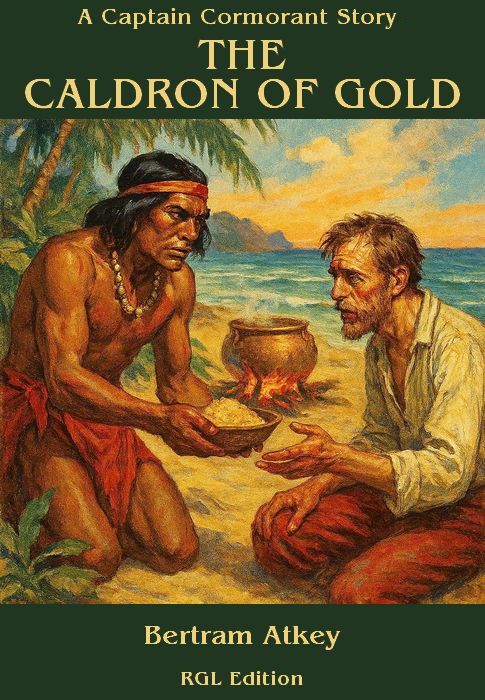
RGL e-Book Cover©
Roy Glashan's Library
Non sibi sed omnibus
Go to Home Page
This work is out of copyright in countries with a copyright
period of 70 years or less, after the year of the author's death.
If it is under copyright in your country of residence,
do not download or redistribute this file.
Original content added by RGL (e.g., introductions, notes,
RGL covers) is proprietary and protected by copyright.
RGL e-Book Cover©
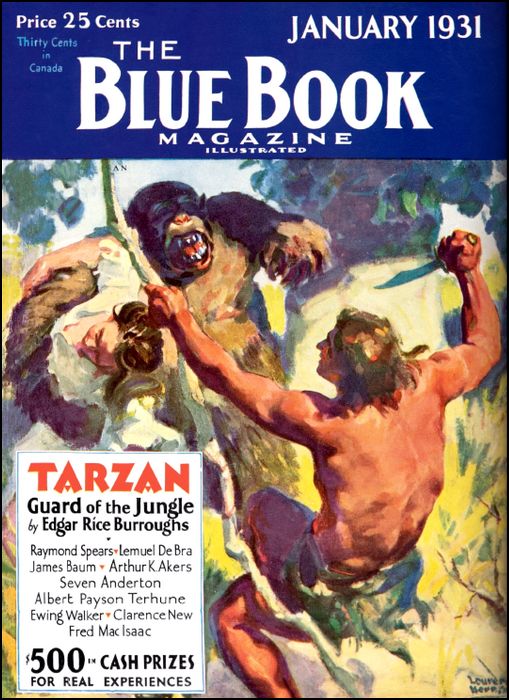
The Blue Book Magazine, January 1931, with "AThe Caldron of Gold"
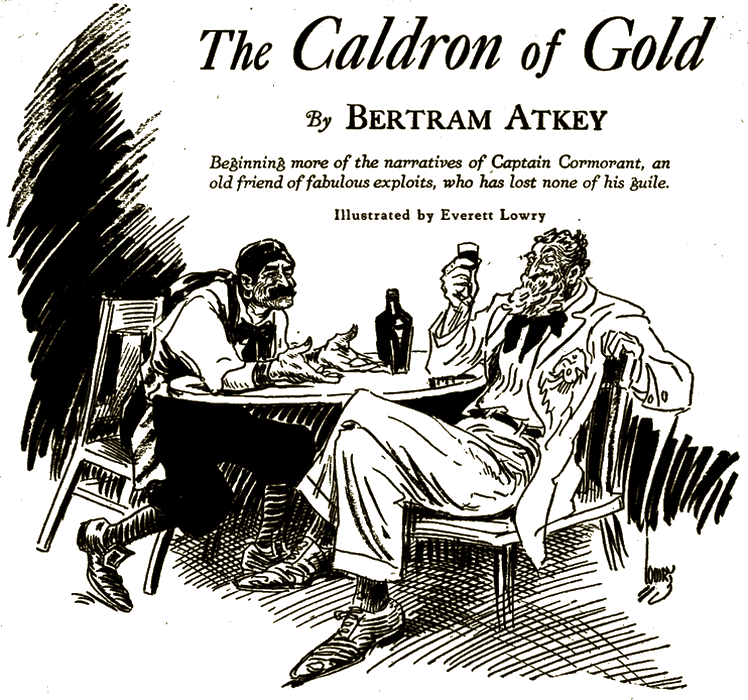
He assured me that the natives of this cannibal island used in
the preparation of their fearfule feasts a pot made of pure gold.
Beginning more of the narratives of Captain Cormorant, an
old friend of fabulous exploits, who has lost none of his guile.
CAPTAIN LESTER CORMORANT, late of the Bolivian Light Horse—so he said—and his wife were spending an evening at home, and things for the hour immediately succeeding dinner had been quiet. They had tried half a dozen stations on the radio and, proving unlucky half a dozen times, had switched off, and settled down before the fire to think quietly.
It was just after the comfortable Louise awoke with a little start that Captain Cormorant, staring through halfclosed eyes at the fire, had yawned with a cavernous liberality that he would have striven to modify had he known that his wife was watching him with her usual fond, if slightly sleepy, interest.
"Why, Lester, you have a broken tooth!" she exclaimed.
"And I've never noticed it before! Does it hurt?"
"Eh, my love?" said the Captain drowsily, then pulled himself together. "Hurt? This tooth! Why, to tell you the truth, dear one, it does at times. Frightfully. A keen, stabbing, shooting pain. Then it goes off again. I must be seeing the dentist."
His eyes brightened a little.
"In fact, I intended to do so this week but,"—he laughed a trifle awkwardly, like a man who seems to feel that a little embarrassment is called for—"the fact is, dear heart, I am reluctant to—um—spend the money. I am a little overdrawn at the bank, as it happens, and I thought I would economize. That's really why. It's nothing, child, nothing at all."
He took a cigar, appearing not to notice his wifes look of concern.
"Lester! How can you do such a thing! To sit there with a stabbing, shooting pain liable to come into your tooth at any minute! Supposing you are overdrawn a little! I think it is manly to be overdrawn a little sometimes. I shall tell Mr. Hammerhead"—her lawyer and trustee of her very considerable fortune—"to attend to it at once!"
She glanced at the clock, rose and went to the telephone.
"But, my love, really—" said the non-moral Captain feebly. "No, really, I protest—this is too kind. It won't do at all. Louise, my love, please do not. I—really, it is time I bore my own burdens, as I bore them in the old, bitter days. Darling, I—er—insist!"
But he was too late altogether. By the time he had managed to extricate his great length from his arm-chair, Louise was commanding the gentle Hammerhead—himself roused from light slumber at his private residence—to attend to the Captain's overdraft.
She turned, beaming with pleasure, from the telephone as the belated Cormorant came across the room to prevent her.
"So, you see, you needn't to have shooting pains in your tooth any longer, Lester!" she said, laughing, looking up to be kissed.
He bent down to two-thirds of his six feet six, a queer expression flitting over his face, and he enfolded her much as an anaconda might enlap something of which it was very fond.
He kissed her gently and a number of times. She let her weight onto his sinewy arms, closed her eyes, and thanked Cupid for him.
"I am, as you know, my darling, a man who from birth has been deprived of morals, good or bad, just as the poor mutes have been deprived, through no fault of their own, of speech, sacred or profane! Yet, if it were possible, for a good woman to create morals where none exist, you, dear heart, are that woman. Yes."
He kissed her until she gasped for breath.
"Aly God, Louise, I love you!"
It was true—though he had, as he freely confessed, married her for her money.
"Kindness, Louise! Kindness, that is the key to happiness! You are wiser than I am—for all my experience! " He released her.
"I suppose, heart of mine, that no man in the world has been so liberally booted out of cities as I—owing to my infirmity—have been! I dare swear, sweetheart, that no poor, misunderstood, moralless wretch has met with greater or more unkindness at the hands—and feet—of the pious than I have. I have become so immune to harshness that harshness transforms me into a man of sheer steel—but kindness turns me into a man of wax. Ah, Louise! I hope I have not hurt you by the violence of my embrace!"
"Oh, no, Lester," sighed the happy wife. "I love you to be violent with me!"
Then they sat by the fire again and the butler's ministrations were called for.
"How did you get your tooth broken, Lester darling?" asked Louise presently.
The Captain drained his whisky and soda, eying her benignly over the rim of his glass.
He did not hasten to reply, for he knew she loved a story out of his immensely mottled past—and a good story needs thinking out, even by a born, a natural, a fluent and ingenious liar.
But at last he smiled.
"Why, soul of mine, there's quite a little story attached to this absurd broken tooth of mine," he said. "Quite a story."
"Oh, tell me, please!"
"Why, with pleasure, my darling!"
The lengthy, red-inustached adventurer thought for a moment. At last he said, with the air of one who makes up his mind about some point of great importance: "Yes, I suppose that I could honestly say that I bit my way out of the tomb at the cost of this tooth."
"Why, Lester! Were you in a position of great danger when it happened?" exclaimed his wife.
. "Danger, my love! It would hardly be an exaggeration to say that, practically, I was dead and buried!"
"Good gracious, how terrible!"
"Yes, at the time I remember it struck me as fairly terrible!" he admitted. "But you shall hear for yourself."
He lubricated his glottis and began. ...
The affair took place during a visit I once made to some of the pearling stations on the Australian coast. Things in general had not been going well with me. In some respects the Australians had failed rather signally to live up to my expectations. I never attempted at any time to conceal from them my infirmity—my unhappy lack of any manner of morals, good or bad—and perhaps that was a mistake, an error of judgment. I am, as you know, dearest, a man of frank nature and I do not hesitate to tell the truth.
If a man unhappily born with no arms drifts into any town in the world he hardly needs to point out his plight to be overwhelmed with kindness, sympathy and hospitality! But if a poor devil—pardon my warmth, darling —who has unhappily been born without any morals, chances into the same town, is he received with kindness, sympathy and hospitality? Not to any permanent extent. He becomes almost instantly the subject of intense concentration by specialists in violence—police, vigilantes, committees of public safety and so on. Illogical, but alas, true—too true.
Shocked and sorry and perhaps a little bitter at my reception in the larger towns, I drifted north to take a look around the pearling stations. They are of a rougher type up there, Louise, and, to their shame, they are of an intensely suspicious nature. They appear to be obsessed by the notion that one is, so to put it, after their pearls!
But in spite of the cold reception I received there, I made a few friends. Among them was a copra trader— a low brute called Copover, but with a wide knowledge of those seas. It was this person who told me of the caldron of gold. He assured me that the natives of the cannibal island known as Hashu invariably used in the preparation of their fearful feasts—a practice now long stamped out—a pot or caldron made of pure gold. No gold exists or is found on those coral islands and it was supposed that this valuable utensil must have been obtained centuries before, probably from the wrecked vessel of some Spanish explorer.
"That caldron would make a charming little souvenir of one's visit to the islands," I said. But the ruffian Cop-over laughed heartily at my chance observation.
"A lot of guys have thought of that," he said. "If I've seen one lunatic set sail to fetch that cooking pot home I've seen twelve in the last ten years. Never knew one to come back with it, however—though I'm willing to bet they all made its acquaintance. They're a very capable crowd of murderers, them Hashus! If you got any idea of going to fetch that pot of their'n you'd better can it, stranger—or it'll can you! "
But it has not been my practice to permit myself to be easily alarmed, heart of gold, and I set about making inquiries.
Three nights later I sailed alone in the man Copover's cutter for the group of cannibal islands of which Hashu might be called the capital. Copover probably would have insulted me before long, so I had no compunction about borrowing his cutter. In any case, I forgot to mention the loan to him.
But single-handed sailing in the South Seas is at best a risky enterprise, my Louise, and, at its worst, is a form of suicide the only merit of which is its entire lack of publicity. And not to weary your charming ears with a long and rather harrowing sea story, I will say at once that three weeks later I, starved into a living skeleton, was cast up on the beach of a small desert islet. This later proved to be one of many such islets outlying the group of which Hashu was the biggest if the most uncomfortable.
I venture to affirm that no being more destitute has ever been thrown up by the sea anywhere, at any time. I had nothing but the clothes I was cast up in and a tin flask, pint size, of a medicine which I, personally, invented and which I regard to this day as invaluable in the tropics. No family there should be without it. It is, in those climes, the true elixir of life. It is of course a medicine rather than a beverage, my darling—consisting as it does mainly of chlorodyne, chloroform, opium and very pure alcohol. I called it "Cormorant's Elixir" and explorers have spoken of it in terms which I should blush to repeat to you, my own. Indeed—but that is another story.
How long I lay unconscious on that beach I do not know. Possibly several days—I do not know, I cannot tell. But presently I became sufficiently conscious to feel some one or something fumbling over me. I felt my jaws opened, and a trickle of fresh water on my tongue. I felt my wrists and temples being chafed. I felt a curious, faintly stimulating sort of broth tasting of fish oil, banana and coconut milk poured, from time to time, between my teeth.
This sort of thing continued for some while. Then I emerged from my semi-swoon and opened my eyes to gaze into those of a woman!
Yes, dear heart—the eyes of a young woman.
She was, of course, a savage, and when I say that she was beautiful I mean, of course, for a savage. Which implies that she was tattooed all the colors of the rainbow and, to be frank, a great many more than any rainbow whose performance I have witnessed ever exhibited.
Yes, love, where that savage young lady was humanly tattooable she was tattooed. Still, she looked pretty to a man in my circumstances. I confess it. She had saved my life, in any case, and if she had been ninety years old and plain even for a savage I, being, I believe, an aristocrat at heart, should chivalrously have considered her whatever she cared to be considered—pretty, say.
Pray do not misunderstand me, I entreat you, star of my life, when I say that the matter seemed to develop with great speed.
Within an hour I was able to eat. She fed me. Within two hours I was able to stand on my feet. She helped me up. Within three hours I was capable—with her lines and hooks—of catching fish. She cooked them.
I found oysters. She opened them. I ate them. I found some coconut-bearing trees. She climbed them— that sort of thing. It went on for some days.
I begjan to catch up—to fill out—to put on weight.
I spent most of my day devouring whatever there was to be devoured. And my nights I passed in the deep and healing sleep essential to a man in my situation. Then, as I slowly recovered my normal poise and balance, I noted a curious thing. Every evening just before the falling of the darkness, Tattoolah—my name for her— disappeared out to sea, only to reappear at dawn with fish and other delicacies.
Whether this was due to a very natural and praiseworthy modest^, a very right and proper shrinking from the idea of sleeping on a desert islet occupied by a strange he-foreigner, I did not know.
But I was soon to learn.
In the daytime, we got to know each other extremely well, as nurse and invalid naturally do, and I confess I came to believe that the young thing loved me, she was so incessantly, so indefatigably, attentive to me. I was not permitted by her to go hungry for one second. On the contrary, to use a vulgarism, I lived like a fighting cock.
Fish, nuts, fruit—all the delicacies of the season—were mine for the lifting of my little finger. Crabs, lobsters, oysters—a thousand luscious sea tit-bits of that description—they became commonplace to me. Tattoolah was indefatigable. So much so that I fear she came near to overdoing it.
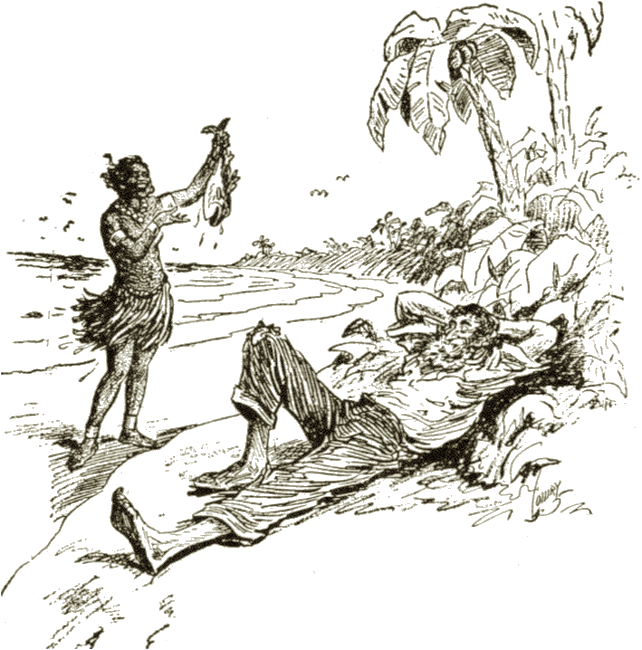
All the delicacies of the season were mine for the lifting of my little finger.
At any rate, she seemed not very well one evening just before she went to her canoe. Sympathizing deeply with her—for, in spite of my non-moral affliction, I think I may reasonably claim to be of a sympathetic turn of mind—I gave her a pull of the half-pint of elixir remaining to me.
With an eloquent look from her eyes, dark, deep and lustrous, under their tattooed lids, she took a draught.
It revived her instantly. Her eyes started out of her head and she immediately started out to sea, paddling strongly.....
As events proved, she never forgot that taste of my Elixir of Life—fortunately for me, dear love, as you will see.
The delicious, dreamy days went by, one by one, I was no longer the miserable wicker-work, of bones and sea-salted skin which had been thrown up by the waves so short a time ago.
No, love, I had become portly—in fact, fat. Naturally,
I had no mirror, but I had what is better than a mirror. I had "instinct." Apart from a growing disinclination to move more than a few steps in any direction, I found myself becoming tired of fish, fried or broiled or otherwise. Nuts I found myself turning from, and fruit failed to attract me.
Tattoolah caught crabs for me. I let them alone. She left lobsters lying where my eyes would fall on them when I awoke. I recoiled from these lobsters.
She dived and brought up all sorts of delicacies—beche de mer, young shoots of seaweed, baby-octopi, squids and so forth. No. I had a sufficiency of fish-food.
BY this time I realized it—I was frightfully fat. I could feel how my cheeks bulged out like sails—under my beard. I cut my foot on a shell on the beach one day.
"Hullo," I said. "Something's been cut down there! I fancy I've cut my foot!" But it was pure guesswork. As far as I could feel it was my foot—but as far as I could see it might have been my knee. My feet had ceased to be visible. When I looked over to try to see them I found that I got in my own way.
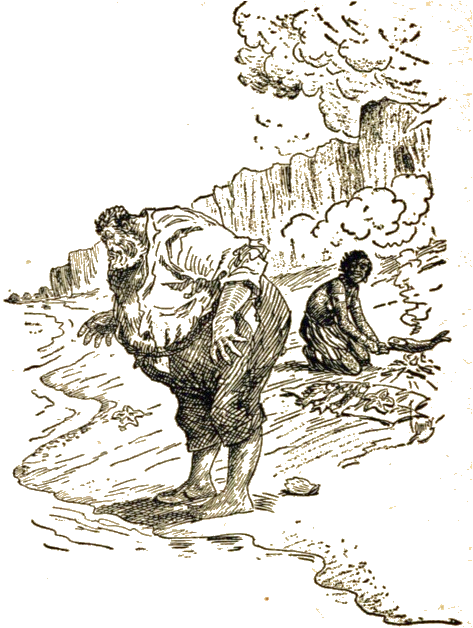
When I looked over the see my feet I found that I got in my own way..
Too fat or, at any rate, quite fat enough! As, indeed, I discovered within twenty-four hours of coming to that conclusion.
I was not alone in my decision that I was fat enough. Tattoolah and her friends evidently thought so too. That night, as I slept peacefully, dreaming that Tattoolah had brought me for my breakfast a glorious dish of steak, fried potatoes and coffee, I was set upon—in my sleep, dear heart—by not less and probably more than a hundred Hashu cannibals!
They were led and guided by,none other than the female Tattoolah! Yes, dearest of all, I have never in the whole of my wide experiences been more deceived in any living female than I was in Tattoolah! I believed she loved me. She did. But not in the way I fancied.
She had cared for me and nursed me back to health. From a thin sack of bones she had built me up to—I make bold to say— a fine, big, portly figure of a man. I had more than once suspected that she intended to ask my hand in marriage when I was well nourished and prosperous in appearance again. But that, golden heart, was an illusion.
She needed me—but not as a husband.
She designed me to be—her twenty-first birthday feast! Yes, Louise, I was to be her and her friends' sumptuous repast on the occasion of her birthday!
The comment of Copover came to my mind as I lay bound by the neck to the center of three posts on Hashu, to which island I was at once transported in a war canoe amid universal rejoicing. "If you have any idea of getting that caldron of gold, can it—or it'll can you!"
The man had been right—absolutely right!
It was just after nightfall that I found myself bound to the post—the main larder post of the tribe—and I re- . alized that my time was short. With the first peep of dawn the cooks would come for me. I had gleaned a smattering of their tongue and that, I gathered, was the general arrangement.
The feast at which I was designed to figure as the most
important item was fixed for midday. They had had an enemy or two from a neighboring island for supper. Gradually the whole cannibal tribe settled down to sleep, and long before midnight I was the only person in the neighborhood who was passing a restless night.
But in those days it was not my custom to yield tamely and I set my brains to work. I perceived that I lay full length on the ground with only my head roped to the post —an ingenious and almost entirely safe way of tying one.
The rope passed round the base of the post and twice round my neck—so tightly that my face was jammed hard against the post. My hands were tied but not my feet. It was, as those heathen hounds realized only too well, quite unnecessary to tie my feet. For while, if I lay still, I was reasonably free from pain, the instant I moved or wriggled I was agonized by the rope. Had I tried to move my body in any direction I should first have dislocated my jaw and if I still persisted I should have broken my neck.
But they had overlooked one thing—the post was pressed close against one side of my mouth!
In those days I had teeth that were like the teeth of a saw—a pair of saws—and it was upon these superb teeth of mine that I now staked my life.
I started to bite through the post, Louise. It was, I figured, about six inches in diameter—and I had about five hours to do it in.
Never, dear heart, shall I forget that night—never! Figure it to yourself. The darkness-enshrouded island, the gross snoring of the sleeping cannibals, the crash of the distant sea, the drone of the wind through the palms. And under those South Sea sounds another sound—low, grim, ceaseless—a sound of gnawing! Like a beaver! The sound of Lester Cormorant making his last bid for life— biting his way to freedom, to England and home.
Halfway through the post this tooth went, then broke on a knot. I was glad—without the sharp edge left I should never have got through the knot.
I won't dwell on the horrors of that night, darling; suffice it to say that just before dawn I ground through the last tough fiber. As the post fell the rope slipped down and off the gnawed end and I was free. It was a simple matter to gnaw the rope on my wrist. For a moment I lay still, listening tautly to ascertain whether the sound of the fallen post had awakened any of the cannibals.
It had—one—the Chief. I heard him stir. He awoke none of the others, but I heard a sound like a man crawling on his hands and knees through the sand toward me. I lay still, feigning to be asleep, but ready to spring, like a leopard, upon him. But he did not immediately crawl within my reach. He stopped a yard away, and I heard a whisper through the dark. "White man, do you sleep?" I made out in frightfully broken English.
I made no answer. I merely waited, tense as a tiger, for the low tough to crawl within my reach.
But he did not. On the contrary he continued to whisper in the disgustingly broken English which he had picked up Heaven knows how:
"White man, you savee you dash me big bottle 'lixir-drink, me unhitch you one time, dash you canoe and you pulla da freight. You buya da pup, you savvy, Mister, one big bottle stomach fire, you sling the hook by my canoe. Yessir! 'Lixir-drink, burna da turn, say, boy, slinga da hook, you no cookee, you go free, aye, aye, sir!"
Picture it, dearest! Me—crouching, tiger-taut on the sand, listening to that fearful farrago of bilgewater English hissed through the darkness at me by the Chief of the tribe—a treacherous ruffian, so debased by his lust for liquor that he was perfectly prepared, even anxious, to release me and let me hurry away in a canoe if only I would give him a big bottle of my Elixir of Life. At least, that was how I translated the suggestion which came through the darkness to me then.
You see, heart of mine, they had stolen my remaining half-pint of elixir when they had captured me, and the Chief had had, for his share, just enough to make him anxious for more—so anxious that he was entirely willing to lose the tribe a good meal to get what he wanted.
Well, it was not for me to grumble about this dusky tough's lack of public spirit. I thought for a moment, then whispered back, so that it went like the hiss of a snake to his huge and listening ears.
"Hey, yes, you son of a sea-cook! Ah, out, m'sieu! Me gotta plenty mucha da bot' buried in the sand. Me gotta forty bottle—feefty bottle—all buried. Enough to give the hull, darned tribe of yez earthquakes in the stum-micks for a month. You savee—you belonga dem bottle you get paralyzed one time. You dash me canoe me dash you dem bottle. Come closer, bo, and let me tell you whar dat treasure's hid up waiting for you!"
Conceive me talking so, my love! Yet I did—for my life—and the creature understood, for he came closer.
In his greed he carelessly squirmed within my reach.
And a second later I was on him like an alligator. You, with your swift sympathy, dearest one, will realize that it was a question of life or death. It was no real desire of mine to be rough with the wretch, but I had to be efficient. One mistake would have precipitated the whole herd of cannibals onto me. I had a fair experience in the art of swift violence in those days. The nature of the life which my deplorable affliction had driven me to lead demanded a perfect—if I may say so—technique in the field of stark plug-ugliness.
In twenty seconds, without a sound, I had that cannibal confounded and confused.
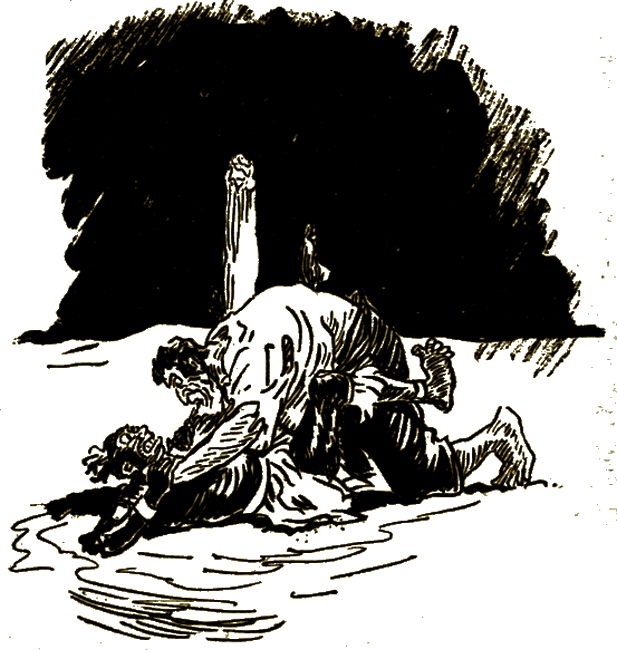
In twenty seconds, without a sound, I had
that cannibal confounded and confused.
Within a minute, I had him roped to Post No. 3, gagged with his own hair, his hands bound, and buried to the chest in sand. Fully alive to the remote possibility of his escaping as I had escaped I had examined his teeth while he was still under the effects of the—so to describe it—the anaesthetic I had administered with my fist.
I found that he had no teeth—of his own. The man was wearing a set of false teeth—yes, love, artificial dentures, top and bottom—ill-fitting, cheap, and probably stolen from some former unhappy victim of the Hashus.
That explained why the Chief felt little interest in Tattoolah's forthcoming birthday feast. Much comfort and easy living has made me soft—even tender—in these days, dear heart. But in those days, darling, I was a man of wire and whipcord under my portliness. It was not difficult to realize that to a cannibal with false teeth designed for some other person I was a far less attractive item of the menu than a bottle or two of my elixir.
I left him tied up in my place—at another post—and silently crawled—whither?
To the canoes, you will naturally say, dear heart? No, I remembered the caldron of gold.
With the silence of a serpent I crawled toward this utensil—which I had seen set up in position scarcely ten yards from my post not many hours before. I raised it in my arms and staggered down the beach with it.
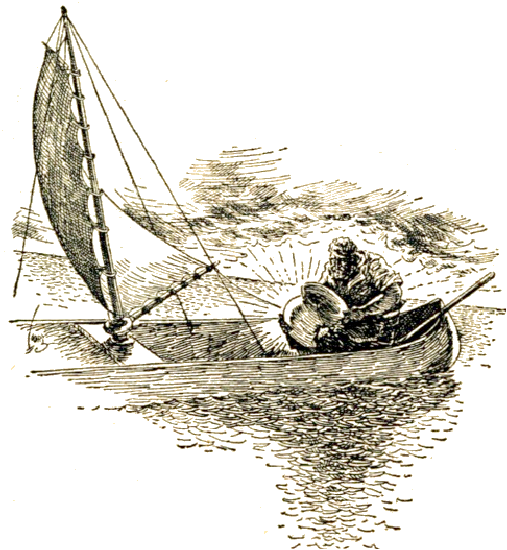
I selected in the first faint streaks of the coming dawn the fastest-looking sailing canoe on the beach, put in the caldron—I remember it struck me at the time as being curiously light for gold—and paddled clear of the island.
I set my sail, the wind freshened up and, to cut a long story short, dearest Louise, even as presently the sun appeared over the eastern horizon so the last lingering tree-top of the island of Hashu disappeared under the western horizon.
Then I examined the caldron of alleged gold.
It was pure brass. I might have known it.
Then in the friendly rays of the rapidly rising sun I set sail for Australia, which after many days and a myriad vicissitudes I reached in safety!
THE captain ceased, and gratefully accepted from the fair hands of his thrilled and adoring wife a large glass of stimulating refreshment.
"Thank you, my El Dorado, thank you," he said, and wiped his great mustache.
"It seems an extraordinary way of losing half a tooth, Lester, doesn't it?" she said, quite innocently and entirely without sarcastic intent.
"Indeed it does, my love," agreed the Captain heartily. "But then, I am, God help me, through no fault of my own, an extraordinary man!"
"Indeed, indeed you are, Lester!" said Louise, and pressed a kiss on his bald spot. "But I, for one would not have you otherwise!"
Roy Glashan's Library
Non sibi sed omnibus
Go to Home Page
This work is out of copyright in countries with a copyright
period of 70 years or less, after the year of the author's death.
If it is under copyright in your country of residence,
do not download or redistribute this file.
Original content added by RGL (e.g., introductions, notes,
RGL covers) is proprietary and protected by copyright.