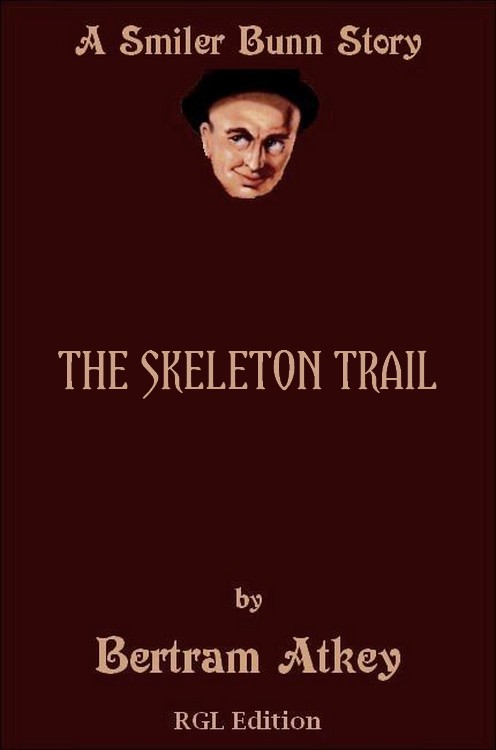
RGL e-Book Cover©
Roy Glashan's Library
Non sibi sed omnibus
Go to Home Page
This work is out of copyright in countries with a copyright
period of 70 years or less, after the year of the author's death.
If it is under copyright in your country of residence,
do not download or redistribute this file.
Original content added by RGL (e.g., introductions, notes,
RGL covers) is proprietary and protected by copyright.
RGL e-Book Cover©
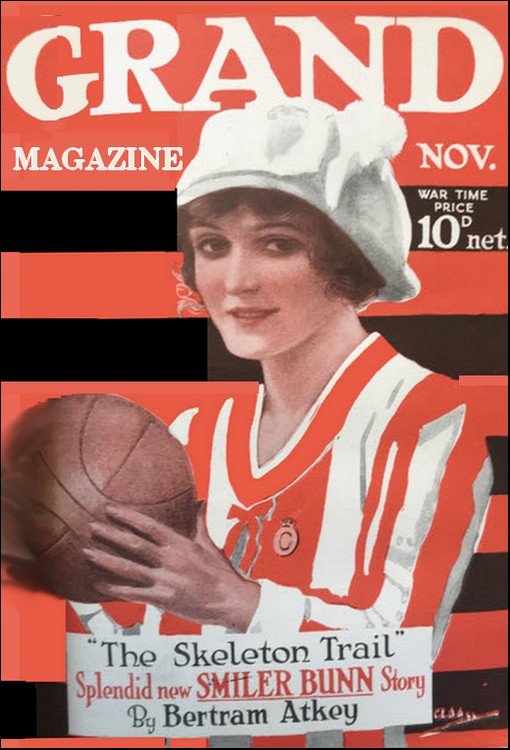
The Grand Magazine, September 1918, with
"The Skeleton Trail"
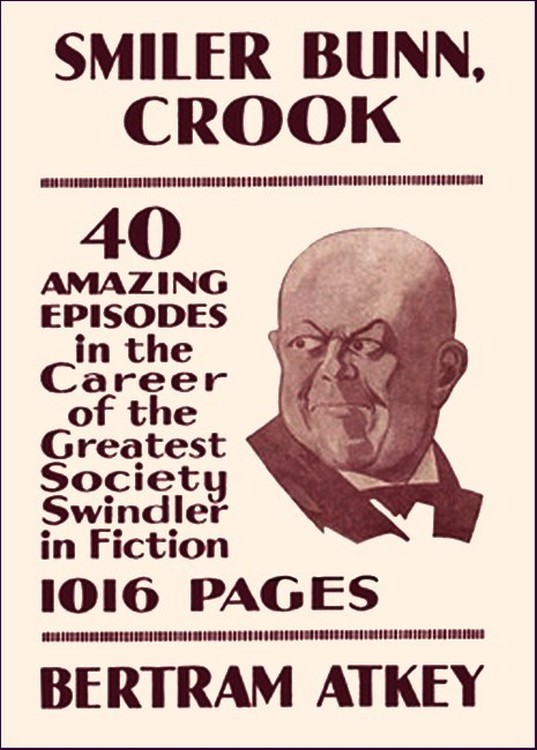
Smiler Bunn, Crook, with
"The Adventure of the Skeleton Trail"
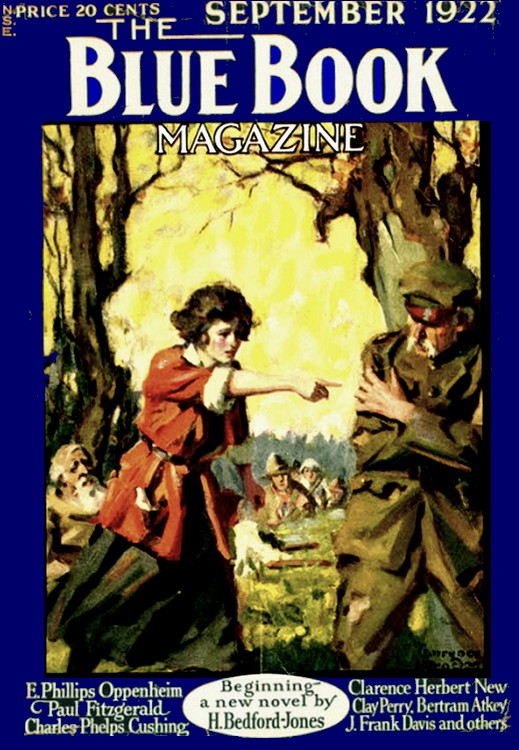
The Blue Book Magazine, September 1922, with
"The Skeleton Trail"
IT was when they were returning from an elaborate lunch at the Astoritz—strolling very gently, for sake of their digestions—that those two genial rascals, Messrs. Smiler Bunn and his wolf-witted friend and partner ex-Lord Fortworth, first noted that there was an unaccustomed look about the window of one Hyams, antique dealer, whose shop occupied a moderately obscure position in one of the side streets through which the two old crooks occasionally meandered on their way back to their flat.
Smiler it was who first pointed out the absence of the skeleton which for some months past had basked in a sunny corner of the window.
"I see," he said, stopping to stare at the shop window, "I see that our young friend Bones has pulled his freight!"
"It'll be a long time before I lose any sleep worrying about that," grunted Fortworth, without much interest, "I never considered him handsome, and he always had a very unburied sort of a look to me."
"Yes—me, too," replied Mr. Bunn thoughtfully, "He was an ugly sight—always looked so damned hungry and kind of empty."
They turned away and slowly resumed their walk, enjoying their cigars.
"I shouldn't wonder but what that he-maneater Hyams was pretty glad to get rid of Bones," mused Mr. Bunn presently.
"Well, I don't care one way or the other," declared Fortworth.
They paced tranquilly onwards, followed by a ragged sidewalk vulture who had caught the scent of their really remarkable cigars from afar off, and was diligently bloodhounding them for the butts.
"Now, I wonder what sort of a figure Hyams would get for a good skeleton," said Smiler presently.
Fortworth was satirical.
"The poor devil is dead, ain't he?" demanded the ex-peer and money-captain. Mr. Bunn smiled.
"Yes—he's dead enough. I've never seen a deader skeleton," he answered.
"He's dead and sold and gone, ain't he?" continued Fortworth, "Well, I'd be very glad if you'd leave him where he is—don't drag him back into the conversation for me. It's doing my lunch no good!"
But Mr. Bunn stopped abruptly. His brains had reached the objective towards which they had been groping.
"And d'ye think the memory of him is cheering me up at all?" he asked heavily, "Because it ain't—only I've been thinking it over, and what I'd like to know, old man, is this. Who buys skeletons and what do they buy 'em for? They can't work and they don't pay any interest on the money sunk in 'em and they ain't any ornament to a house. They don't come under my idea of what you might call Regular Trade. Take a woman, for instance. She's in need of a couple of blankets. She goes up West and goes into a shop after blankets and comes out with a new camisole, a couple of pair of these all-but-silk stockings, a Fiji-silk blouse, and the fixed intention of making her old blankets do till next spring or till poor Henry gets his overdraft screwed down another half-notch. Now that's what I call Regular Trade. We know what she's going to do with the silkette stockings and the blouse, and we've got some sort of idea about what happens to the camisole. That's all right. Regular Trade. But skeletons, no. Skeletons ain't Regular Trade. Those bony gents live under the Worth Inquiry sign. I think I'll just look in on Hyams and inquire." But Fortworth was sceptical. "What for?" he said. "I'll save you the trouble. That sportsman with the ribs was purchased by a medical student. They're great lads for bones, those boys."
"Why?" asked Smiler good-humouredly. "They dissect 'em!" said Fortworth patiently. "They disassemble 'em and label 'em and reconstruct 'em!"
But Mr. Bunn was unconvinced. "Dull work, that," he commented. Nevertheless, he moved on again.
"Not a job I should care much about," he said presently.
"What isn't?" asked his partner. "Taking down skeletons and putting 'em up again!" said Smiler, as though he were talking of motor engines.
"Oh, damn the skeleton, anyway!" snapped Fortworth.
But Mr. Bunn stopped again. "Look here, old man, I've got a Hunch about that skeleton. A big Hunch. I'll just drift back and have a chat to Hyams." Fortworth hesitated.
"Oh, if you've got a Hunch," he grumbled, and resignedly turned with his partner. Hunches—or instincts—were not things which the two old grappling-hooks ever disdained.
"A worn-out skeleton ain't everybody's money," said Smiler soothingly.
In thoughtful silence they retraced their steps to Hyams. (For the benefit of anybody who may be following with breathless interest the tactics of the cigar-butt sleuth, it may be written here that he inherited Smiler's butt as the partners turned, and Fortworth's just outside the "antiques" shop. Clutching both remains in his clammy hand he promptly evacuated both that street and this story.)
"I want," said Mr. Bunn to Mr. Hyams, "to buy a medium quality skeleton. Have you got such a thing for sale. I would go up to £50 for a good one."
Only with a violent effort did Mr. Hyams refrain from bursting into tears.
"Only two days ago I sold the best skeleton in London," he declared. "For twenty pounds!" he said, and added almost in a wail, "Twenty Pounds! Ain't that an awful accident to happen to any man? And I ain't got no other skeleton in stock. Wouldn't no other skeleton suit you? I got a fine skeleton of a badger. Only fourteen pounds!"
"No—no badgers need apply—nor polecats—nor skunks! I want a human skeleton," said Mr. Bunn. "D'ye think your customer would part with his for a profit?"
Hyams shook his head. He seemed very sure of that.
"My customer was a student of oest-osto-some-thing—studied bones, you understand—and he wanted him very badly, that skeleton. He had searched everywhere for one."
"Oh, had he? "Mr. Bunn seemed very disappointed. He reflected for a moment. Then he took out his note-case.
"Better try it, I suppose," he muttered. "Though there's not much chance."
He passed a pound note to Hyams.
"Now, look here," he said authoritatively. "I'm going to try to buy that skeleton off of that medicine-man. I'm a bone dissector and a—a dissembler and reconstructor, and I need that skeleton badly. My name is Sir James Johnson, and I've got an important case, d'ye see? Write me a letter of introduction to the party you sent the skeleton to, and I'll call and try to get him to see that my need of a skeleton is more important than his. There's a pound to pay your expenses, and if I get the skeleton you shall have another fiver for your commission."
Mr. Hyams was a strictly business man, and in less than five minutes, Messrs. Bunn and Fortworth were strolling home with the knowledge that the buyer of the skeleton was one Mr. Roy Rainbird of Alperton West, Hants.
"Alperton West," said Mr. Bunn. "Let's look—that's the place where they have the big sheep, horse, and fat bullock fair every year, ain't it?"
"It is that," replied Fortworth sarcastically. "What about it? Does it seem to convey anything to you?"
"Not at present," said "Sir James Johnson," failing apparently to notice the sarcasm. "Does it to you?"
"Yes," chuckled the ex-peer. "It conveys to me the fact that you're a cold quid out of pocket."
"That's all right. I'll take care of that, old man," said Mr. Bunn, as they let themselves into their flat.
"I'll take care of that," he repeated presently, as he sank into his shamefully luxurious armchair. "Certainly I will!" He pressed the bell, and Sing Song, that Chinese cormorant, who, the absolute property of Mr. Bunn, acted as valet and general conjurer to the partners, entered.
"You can telephone Bloom that we shall be down at Purdston to dine and sleep, Sing Song, my son. And you can't do it too quick to please me. Then you'd better see about the car and get ready."
"Yes, master," purred the sulphur-hued Celestial.
"Not forgetting to bring in some whisky and soda before you get busy," Mr. Bunn reminded him.
"Yes, master. I blinging whisky soda allee same this minute!"
He disappeared, noiselessly, returned like a quick and efficient ghost well trained to work about the house, placed a tray on a table between the partners, and vanished again.
"A good lad—a very good lad. That's a well-trained Chink, that lad is. Trained him myself," said Mr. Bunn, and liberally helped himself. "You've got Bloom pretty well trained"—he referred to the man-servant who, with his wife, formed the indoor "staff" of the partner's tranquil country retreat at Purdston, on the Surrey-Hants border—"but Sing can give him fifty in a hundred and still take the hide off him!"
Fortworth languidly agreed—he held no brief for Bloom—and the two friends quietly dropped off into the deep doze with which they usually aided their vitality after lunch.
The ordinarily somnolent agricultural town of Alperton West was perhaps thirty miles from Purdston, but what was thirty mere miles in those dim, far-off days before the War to a person who owned a perfect Rolls-Royce and a highly competent driver?
Messrs. Bunn and Fortworth were able to rise late, breakfast in absolute leisure, and enjoy a couple of cigars, play a quiet game of billiards, take an eagle-eyed stroll through the hothouse and kitchen garden, on the following morning—a Sunday—and yet reach Alperton West in ample time for a simple but well-cooked lunch (ordered by wire) at The Hawbuck Hotel—the leading hotel of the place.
It was mid-September, and a glorious day.
The great annual Sheep and Cattle Fair had finished the day before, and the two old vultures had the place practically to themselves.
They lunched in a very delightful little summer-house at the foot of a lawn facing the river which runs through Alperton, and, as was their custom, they were attended by Sing Song, supported by an elderly waiter who was almost entirely sober, though he still lacked some of the confidence and steadiness which had characterised him at the beginning of the Fair Week.
A light, thin soup, founded largely upon chicken, two tenderly baked perch fresh from the river, a brace of partridges, one of the world-famous Alperton ducks, a simple rum omelette, a biggish morsel of mellow old Stilton, all tenderly ushered to rest, as it were, with a couple of bottles of the Burgundy without which the partners rarely mobilised, and a glass or so of Green Chartreuse—the whole personally designed by Sing Song and cooked under his supervision—did much to give the partners the high opinion of The Hawbuck Hotel and of Alperton West with which they subsequently went through life.
And when, presently, Mr. Bunn faced the old waiter, for whom he had sent, there was a mild benevolence in his eye which spoke eloquently of hefty tips to come.
"A very neat and gentlemanly little lunch, well cooked and well served, my son," observed Mr. Bunn.
"Thank you, sir," replied the waiter. "Having your Japanese servant to help made a great difference, gentlemen."
"Chinese—not Japanese. That lad is Chinese, and a very good lad, too," corrected Smiler. He took half a sovereign from his pocket.
"Where does Mr. Rainbird live?"
"Mr. Roy Rainbird, the bank manager, sir? He lives at the bank—the West and Home Counties Bank."
"Still over the bank? I understood he had moved from the bank and was living farther out of the town?" continued Mr. Bunn, who understood nothing of the kind nor cared.
"Oh no, sir—not as yet. He still lives at the bank. I haven't heard anything about his living out of the town, sir—and I was talking to Mrs. Doreen Delane, his housekeeper, only yesterday, sir. She was having tea on the lawn here after a row on the river, sir."
"Umph! I must have been mistaken," said Mr. Bunn.
"I'm afraid so, sir. I fancy, sir, Mrs. Delane would have mentioned something about it—she was having tea with a lady friend of hers, and they talked a good deal, sir."
Mr. Bunn put the half-sovereign back in his pocket, and the waiter's jaw dropped. But his features grew more composed when Smiler brought out a sovereign.
"Y'see, sir," said the waiter, "there's a sort of a rumour going round that Mr. Rainbird and Mrs. Delane mean to make a match of it, sir." He paused, watching Mr. Bunn.
"And a very handsome pair they'd make, sir," he added—evidently thinking that Rainbird was a friend of Mr. Bunn.
"Oh, that's what they say, is it, waiter?" Mr. Bunn put the sovereign on the table and lit a fresh cigar. "I don't recollect ever meeting her. Pretty stylish, handsome party, is she?"
The waiter brightened up.
"She is that, sir. She don't need to go out of Alperton West to find a husband, not Mrs. Delane, sir. But there ain't much doubt that Mr. Rainbird is the man, sir."
The waiter came closer to Mr. Bunn—and the sovereign.
"It's no business of mine, sir, of course, but I've got what you might call inside information about them two," he said in a lower tone. "He's a pretty dashing gent, Mr. Rainbird, and she ain't exactly a dull party!" The waiter smiled.
"I was in London a month back, sir, and called round at the Savoy, where I worked when I was quicker on me feet, to see an old friend of mine, a waiter there. I took a look at the dining-room—in a quiet sort of way—and there was Mr. Rainbird and Mrs. Delane tucked away in a corner—seeing life, sir. I asked Jimmy—my friend, sir—about 'em. He hadn't particular listened to their conversation, but he'd sort of gathered, sir, that they'd dined at the Carlton, been to the Lyric, I fancy 'twas, and were winding up at the Savoy, sir. So what I mean to say, sir, it looks like a case, sir!"
"Sure!, "said Mr. Bunn. "Well, well, as it goes. But I should have thought Mr. Rainbird was too studious a man for much of that round-the-town life.
The waiter was surprised. "Studious, sir! Mr. Rainbird!"
"He used to be, but maybe he's grown out of it. Don't he buy any fossils and things—bones and specimens for his collection nowadays?"
The waiter smiled. "Not that I ever heard of, sir."
"Ah, he must have made a fresh hobby—Mrs. Delane, very likely."
"Ha-ha, sir, yessir," agreed the waiter.
Mr. Bunn pushed the sovereign over.
"There's a sovereign for you, my son," he said, though the man was old and garrulous enough to be his father. "A good lunch is worth a good tip—that's my motto."
"Yessir, certainly, sir. My motto, too, sir," and, collecting his loot, the waiter vanished. The two old wolves stared at each other. "There was nothing the matter with that Hunch of yours," said Fortworth.
Mr. Bunn shook his head in agreement. "I knew it was a Hunch and a half all along," he said.
He ruminated silently for a few moments.
"If you can tell me what a good-looking bank manager with a good-looking housekeeper he expects to marry, both with high-priced tastes, needs with a second-hand skeleton, I should be much obliged," he said presently.
The ex-peer smiled a light half-inch smile.
"Well, it won't dislocate anything particular if we stroll down to the bank and get acquainted with the man, will it?" he suggested.
Mr. Bunn rose.
"No. But it's a Sunday and the bank's closed. Still, he lives at the bank, and he might be at home yet—if he values his digestion. Anyhow, we might get a look round—that was the idea of coming down here on a Sunday, wasn't it?"
So they strolled in the leisurely way which usually characterised their strolls down to the West and Home Counties Bank, each pondering in his own way the interesting little problem of the skeleton, and its relation to the bank manager and the lady-housekeeper who apparently shared a taste for seeing life.
The West and Home Counties Bank at Alperton West was not merely one of the newest buildings in the town, but one of the prettiest. It was bank and house in one—the office part of it opening on to the street, and the house part on to a lawn and garden at the side, screened from the street by a well-kept and thriving privet hedge.
Messrs. Bunn and Fortworth paused opposite the bank and openly surveyed it for a few seconds. The street was practically deserted. Save for a dog frantically searching himself for something he appeared most anxious to find, an old man half-asleep on a doorstep some way down, and two children engaged in a desperate game of "Hop-Scotch," the population seemed to be mostly indoors at dinner.
"We'd better put the old story across at him," said Mr. Bunn. "Think of building a factory here, and want a little information about local conditions, and so forth."
Fortworth had no better plan to propose, and they crossed to the gate opening on to the garden, and so to the front door of the "house" section of the bank.
It was, as has been explained, a warm, sunny afternoon, and consequently neither of the partners were surprised to observe that the door was slightly ajar. But they were surprised when, just as they were approaching, that door swung to and closed so silently that its closing could not possibly have been effected by any but human agency.
"See?" said Smiler. "That's queer, ain't it?"
He knocked—a moderate reassuring knock. Nothing loud or startling. There was a longish wait.
Then the door was opened by a pale woman, distinctly handsome, with a mass of rather remarkable brownish gold hair. She was well-dressed, and was wearing a Panama hat and a well-cut blue linen coat and skirt. In one hand she held a pair of gloves, and her coat was unbuttoned, so that she gave one an impression of having just entered the house.
Tall and remarkably shapely—though perhaps a thought full-blown—she was distinctly of the type Messrs. Bunn and Fortworth most admired.
Down the front of her skirt was a long greasy streak as of a fresh oil stain, and there was a pronounced odour of paraffin. Also her pallor was not a natural pallor, but apparently that of anger, and her big blue-grey eyes were bright like blue ice with the sun on it. "Wants a cup of tea, maid's out, got to make it herself, and is having a hell of a struggle with the 'Primus,'" decided Mr. Bunn, in his mind, instantly. "She's a queen all right, but she looks ready to bite just along now."
Aloud he said, removing his hat, "Mrs. Delane, I believe? We wish to see Mr. Roy Rainbird."
She went an angry but attractive pink, and her eyes glinted bluely.
"Very possibly—so do I," she said in a voice that trembled with rage. She was looking them over searchingly, and suddenly her face cleared a little.
"You are detectives," she said, "aren't you?" There was in the personal beauty of the two old crooks a certain severity, an austerity, indeed, one might truthfully say, a hardness which on more than one occasion had been the cause of other people making the same mistake.
Mr. Bunn hesitated, rather artistically. Then he said, "Oh no, not at all, Mrs. Delane. Not detectives. But we'd like a few words with Mr. Rainbird, if he is disengaged." .
"Oh, he's disengaged," she said bitterly, and quite obviously not believing Mr. Bunn's skilfully hesitant disclaimer, "quite disengaged. So much so that I fancy he's disengaged himself from the hank, myself, and Alperton West for ever! Come in, if you like, and look at the place. I think, on the whole, I would prefer you to."
She stood aside and they entered. She closed the door and faced them.
"This," she said, with bitter sarcasm, "is the hall—not, as perhaps you may imagine, the woodshed and oil-house."
They glanced round, and perceived that there was some justification for the sarcasm. The place was piled with shavings, bits of dry wood, and reeked of paraffin.
They surveyed it and smiled a tight-lipped smile. "It's like that in every room," said the beautiful housekeeper. "And the stairs are too quaint! I knocked an open flower bowl full of paraffin off a bracket on the stairway wall a few moments ago. In the bank it's ridiculous. The only thing that amazes me is that the place isn't burnt to the ground. But something went wrong with the programme—the ignition was badly timed, as the motor people say. Come and see it—it's in the bank. Candles and gunpowder and paraffin and string."
They followed her into a comfortable dining-room, looked into the drawing-room, glanced at the highly inflammable stairs, and so through a strong door, plentifully equipped with locks and bolts, into the bank.
Even as she had said, the vanished Mr. Rainbird had made very generous preparations to blot out the bank. On the floor of the manager's office was the "ignition" device of which the dashing-looking lady had spoken. It was a rather complex but well-thought-out arrangement involving the use of a small percussion cap, a falling hammer hinged to a weight, a thin light cord attached to the hand of a big grandfather clock, and a plentiful train of loose gunpowder leading to a pile of well-soaked shavings close by. Everything had quite evidently been thought out and prepared with fastidious care.
Mrs. Delane, clearly, had been studying the methods of the arsonically inclined Rainbird rather closely before the Bunn-Fortworth brace had disturbed her, for she gave them a very instructive little lecture as they looked the device, over.
"He was very thorough, wasn't he? Too thorough! The thing, I fancy, which spoiled everything was the fact that he arranged too completely for draught. Not content with spreading round enough fuel and oil to burn a place three times the size of this, he left open the door of the office and other doors and then—forgot my kitten! I've only had it two days, and it must have completely escaped his memory. The kitten probably wandered in here and, playing with things, knocked the percussion cap out of alignment with the hammer, so that when the movement of the clock hand tightened sufficiently to trip the catch holding up the hammer against the pressure of the spring, and the hammer fell—exactly like a mouse-trap, one of those 'break-back' things—it missed the cap by several inches!"
The partners nodded.
"The last train leaves here at nine—and as a rule everybody is in bed by twelve at the very latest. So he had to get away before nine last night, leaving behind a means of getting the fire started at twelve. Beginning at that hour the place would have been half-burnt down before any one would know it was on fire!"
She smiled bitterly.
"The cord, as you see, tightened sufficiently to trip the catch—the least pressure would do it—at about twelve. It would have been a great success—but for the kitten."
"Was any one sleeping in the house?" asked Mr. Bunn.
"No—yes, one other! But only one!" she said oddly. "I slept with friends in London last night, and the maid had—at his suggestion, I remember now—been given the week-end off. Come this way."
They followed her upstairs into a bedroom.
"This is his room," she said, and went across to the bed—well soaked with oil.
"Yes," she said, "he was very thorough. I'll say that for him!" And deftly pulled back the quilt.
The partners started slightly—but only slightly, for the occupant of the bed was an old friend of theirs.
It was "Bones"—the skeleton—and in his clammy embrace were two rolled ribs of beef that must have weighed something like fifteen pounds each!
Mr. Bunn nodded thoughtfully.
"Yes," he said, "he was a thorough party. It isn't often a firebug provides his own remains!"
He surveyed the skeleton for a moment, then turned away.
"It was a pity to waste good beef like that. They look to me like two amazin' good bits of beef, those joints do!... And now we'll have a look at the safe."
The attractive Mrs. Delane laughed sardonically.
"Yes—it would be a pity not to look at that," she said. "But what do you expect to find in it? Money?"
They stared at her sadly.
"Why, my dear men," she said, "I don't suppose he left as much as a halfpenny stamp in the bank. You don't imagine that Roy Rainbird is the kind of man who forgets to take away his loot—even if he does forget the kitten—and forgets to tell his fiancee that he's leaving home and her for ever and for aye, do you?"
"No, naturally we don't, my dear," said Smiler rather feebly. "But it's just as well to have a look!"
"Oh, certainly," she said. "You may look till you get astigmatism in both eyes, but you won't find anything in that safe resembling money. Why, it was the eight thousand pounds in gold and notes which were paid in during the Cattle Fair week that decided Master Roy to get rich quick."
"Eight thousand?"
"Oh, quite that—in notes. Heaps more if you count the cheques. Sheep at two to three pounds each, bullocks and cows at thirty pounds to fifty each, mount up, you know. This place has a really big fair—thousands and thousands of sheep and hundreds of cattle and pigs change hands—and the dealers use five and ten pound notes and gold to an extraordinary extent!"
The partners nodded; they knew that.
"Of course," said Smiler, as they went downstairs, "you haven't got the faintest idea where lie; went to?"
Her fine eyes narrowed slightly.
"Not the slightest," she said. "And although I like you very much—you're so sympathetic, you know—do you imagine for an instant that I should tell anybody if I did?"
They were all standing in the paraffin-scented hall at the foot of the stairs. Mr. Bunn looked at her carefully, and made a shot in the dark.
"Well, no, Doreen, my dear, I don't," he said deliberately. "But do you think you're man enough to gouge that money out of him all by your little golden-headed self?"
Her eyes narrowed still more as she stared back at him, watchfully, appraisingly, summing him up, as he had already summed her.
There was a tense moment—then she relaxed, smiling.
"And I was innocent enough to think you were detectives!" she said. "Why, you're after the Cattle Fair money yourselves!"
"Sure!" nodded Mr. Bunn amiably. "Why not? Weren't you? We're about even, I think. At first we thought you were so fierce because Rainbird had left you, but it's the kale—the coin—you don't like losing, not Rainbird. That's it, ain't it?"
She flushed a little, and gave a sigh of relief.
"Well, what do you think I've put in two months' housekeeping for that howling waster for? Certainly it was the money. That's why I came back here unexpectedly to-day," she said boldly.
Fortworth broke in heavily.
"And if we stand here holding inquests on money that's gone, long enough, we'll be pinched ourselves," he said, with that sour but practical good sense which distinguished him. "So if you and Doreen, here, want to flirt, Flood, you'd better choose a safer place than this."
"Oh, sure. But if Doreen is coming in with us on the deal we've got to make some sort of plan, haven't we?" replied Mr. Bunn.
"Doreen" was more than willing. No woman likes to be deserted or, "turned down," as Fortworth bluntly put it, and she was quite obviously yearning for revenge on the gentleman who, whether she wanted him or not, certainly did not appear to want her.
The trio went at once into a Committee on Ways and Means, from which it took them not more than five minutes to emerge as a trio of sleuths sworn, as it were, to track down the peccant Rainbird and, "gouge, "from him the ill-gotten gold and bales of greasy, but valuable, notes with which he had so successfully decamped.
It was Fortworth who, prowling with his partner about Rainbird's office, while the brilliant Doreen was changing into something slightly less redolent of an oil and colour shop than her blue linen, discovered in the fireplace the torn label containing the words—on one side:
MR. GREGORY DUNNE,
Passenger to Parkstone,
via Waterloo, L.S.W.R.
and on the other side:
Mr. Gregory Dunne,
"Hawksnest,"
Harbourage Road, Parkstone.
He passed it to Mr. Bunn with a grunt of satisfaction, and Smiler was a pleased man.
"I never yet knew or heard of one of these deliberate crooks who didn't make one bloomer—and this sport has made two!" he said. "He forgot the kitten and he forgot to burn this label. It's pretty clear that he left here by the last train, last night, as 'Roy Rainbird.' In the train he changed the labels on his baggage to 'Gregory Dunne.' So that it's Dunne who arrived at Parkstone probably first thing this morning, or maybe last night, and the remains of Rainbird—a few charred bones—would have been found in the ruins of the bank."
Fortworth nodded.
"Sure. And what we've got to do is to get hold of Dunne about as fast as wheels can get us to Parkstone. Where is it—Bournemouth way, ain't it?"
"It is." Mr. Bunn lighted a cigar with the air of a conqueror, as the Titianish-haired Doreen came in, amazingly well turned out, and fully meriting the frank stares of admiration with which the partners favoured her.
"Is that Rainbird's writing, my dear?" asked Smiler, tendering the torn label. She glanced at it, flushing slightly.
"Why, yes. Where did you find that? In the fireplace!" She laughed—rather a hard, ominous laugh. "Why, that's probably the name he intends to go by! He's been too clever this time! What a fool not to burn that label! Why, all we've got to do is to go to Parkstone and—"
"Collect the money!" said Mr. Bunn comfortably.
"And the sooner we start," concluded Fortworth, "the better!"
So they started—back to The Hawbuck Hotel, where tea and so forth was administered to the delightful Doreen—"so forth" including a couple of bottles of champagne designed to maintain the physical well-being of the partners as well as that of the lady.
"It's a longish run—and dusty," said Mr. Bunn, finishing his glass. "But I think that'll about put us right for the trip. Well, son, ready?" This latter to the leather-clad Sing Song who crossed the lawn as Smiler spoke.
"Yes, master—allee same leddy."
They went out to the big, powerful Rolls-Royce, Doreen between them, very vivacious, though still apt to snap when speaking of the vanished Rainbird.
It was half-past five precisely when they left Alperton West, and the clocks were chiming eight when they pulled up outside the best hotel in Bournemouth, dusty, dry, and desperate—so Mr. Bunn said—with hunger.
Doreen had a headache too. She said she was dizzy with pain, and that she would take two aspirin tablets, a cup of bouillon, and lie down for the half-hour it would take the partners to dine.
"The what!" said Mr. Bunn. "Why, my dear girl, you don't want to think we bolt our food. What's the hurry, anyway? We needn't worry about Dunne for an hour or so. He's probably taking it easy where he is, thinking himself quite safe! It will be a couple of hours at least before we need start out to Parkstone. So take all the rest you need, and when we think we ought to be moving along we'll send up and let you know."
The lady smiled at him gratefully, and Mr. Bunn had her ushered with considerable ceremony to her room. Then they sent Sing Song to procure a meal, ordering him to report back at ten, and having washed, and ordered one or two slight but costly additions and alterations in the table d'hôte as served to them, devoted themselves for the next two hours to a leisurely meal.
"A very neat bit of work, I think, old man," said Mr. Bunn in tones of genuine satisfaction and simple pride, when, at half-past nine, he drained his liqueur glass. "This guy Rainbird, or Dunne, will part with three-quarters of his loot like a little lamb rather than have the police in, and we'll be back in town by midday tomorrow." He glanced at the clock.
"Well, well, I suppose we'd better be waking Doreen," he continued, and beckoned a waiter.
"That's a very charming, attractive, stylish girl, Doreen," he said. "I'd like to see more of her. She's just my style—beautiful and practical. Got her head screwed on right, and very pretty hair. Very pretty tint that red kind of golden hair is—to my mind."
The waiter returned with a large envelope. "From the lady for you, sir. The chambermaid had instructions that the lady was not to be disturbed, sir, but that when you sent up to her you were to have this note, sir."
Mr. Bunn took it, shaking his head. "The poor girl's overdone it," he said, and this proved to be the case. Doreen had sent a hasty little scribble to say that she really was not "up" to tackling Rainbird that night, but hoped that they would do so without her. She knew she could trust them to see that her fair third of the plunder was set aside for her. She enclosed them a photo of Rainbird so that they could recognise him. Also she informed them of several moles of which Mr. Rainbird was the proud possessor—so that, if he were disguised, they yet had a means of surely identifying him. She would thank them at breakfast in the morning, when she would be quite all right again.
The partners were not grieved. It all fitted in beautifully. They preferred it that way.
Women were uncertain, anyway—even beautiful, practical women like Doreen Delane.
"It's better this way, old man," said Mr. Bunn. "She might have forgiven him at the last moment, and made things damned awkward!"
"Sure," said Fortworth readily. "Sure!" He had had a very poor opinion of women since his wife, just before leaving him for life, had refused to lend him a mere hundred thousand pounds on the day he suffered the huge financial collapse which had flung him out of the City, the Peerage, the hands of the police, and into the shelter of an assumed name and partnership with Mr. Bunn some ten years before.
"All right, then. We do this on our own—quietly, neatly, and scientifically—as it should be done," said Mr. Bunn....
Half an hour later their car pulled up at "Hawksnest." They alighted and went to the door. A middle-aged maid of severe aspect answered their ring, and in response to their request to see Mr. Gregory Dunne on urgent business invited them into a sternly furnished hall.
She disappeared, returning a minute or so later with the information that Mr. Dunne would prefer to see them on the following morning unless their business was very pressing indeed.
"It is very pressing," said Smiler.
"Come this way, then, sir, please."
They followed her, each quietly assuring himself that their automatic pistols were at home—not necessarily for publication, but as a guarantee of good business.
"The two gentlemen to see you, sir," said the maid, ushering them into a study and closing the door on them.
A very tall, very lean clergyman, with a face so stern and ascetic that, as Mr. Bunn subsequently said, he had John the Baptist beaten a furlong from home, rose to receive them.
Smiler was so surprised that, without speaking, he took out the photograph of Rainbird and compared it with the clergyman. Then he consulted Fortworth.
"Something wrong, old man, huh?"
"Sure," said Fortworth sullenly.
"Yes, gentlemen?" inquired the Reverend Mr. Dunne in tones of rigour.
"It looks as if we owe you an explanation," said Mr. Bunn. "We're detectives, and we're looking for a man called Rainbird alias Dunne, and, as I say, it looks as if we've got our money on the wrong pony. I suppose you're pretty well known about here, Mr. Dunne?" The austere one reflected.
"If you would care to have the assurance of the local police authorities that I have laboured in this parish incessantly for the last thirty years, I shall be glad to walk round to the local police station with you and procure you the assurance personally," said the clergyman.
But the partners thought not.
"That will not be necessary, I think," said Mr. Bunn. "The man we want is of average height, about thirty years old, and is a bit moley! You are a good six foot three, you're over thirty "
"Sixty-two, to be precise."
"Sure. And you don't wear an eighth-inch mole behind your left ear, and a three-quarter inch one just under your collar?"
"I do not.... And now, as you probably wish to apologise for your intrusion and hurry away, I will take the apology as made, and show you out myself. My parlourmaid was on the point of retiring for the night."
Unusually silent, the partners followed him. The door closed quietly behind them, and they headed for the car.
"Back to the hotel, Sing, and quick, you yellow scoundrel," snapped Smiler.
They sent up a most urgent note to the fair Doreen, with unmistakable instructions that she must be roused. The most enthusiastic knockings upon her door, however, failed to obtain a response, and presently the door was unlocked by the manager's key.
The room was unoccupied—but on the dressing-table lay a note addressed to Mr. Bunn in the name of Robertson—the name he was using that day.
He flashed through it as through a telegram, then put it in his pocket.
"It's all right," he said. "She's gone home by train. She forgot something."
The little crowd dispersed, and Messrs. Bunn and Fortworth adjourned sullenly to the smoking-room.
"She's a she-cat from Catville, that ginger-headed dame is," said Mr. Bunn sourly, passing the note to Fortworth.
The ex-peer read it in silence. It ran :
"When you two fat men knocked at the bank door I nearly fainted. Roy and I had everything ready except for packing up the money. But I soon saw that you were easy. You put me to a lot of trouble, but I managed to keep you quiet while Roy packed the money—in my room. What made you jump to the conclusion that Roy had gone the previous night? Was it because I said so? You oughtn't to believe everything a woman tells you—if you don't believe me, get married and learn by experience. Thanks for the motor run. I hope you got on well with old Dunne. He was parson at Parkstone last year when I was down there—funny his name should come into my head when I wrote that label for you to find in the grate, wasn't it?
"Roy sends you his love and so do I.
"Doreen.
"P.S.—If I were you I'd pass through Alperton West on your way home. Take a look at the bank as you go through."
Fortworth handed the note back, without comment.
"Skinned! She skinned us like a brace of innocent little rabbits!" said Smiler intensely.
"She did. And that's what you call a Hunch!" snarled Fortworth. "We'll never connect with that Cattle Fair coin in this world! Roy's probably spending it somewhere hundreds of miles away by now!"
"Yes—and Doreen, damn her, is on the way to help him!" added Smiler. "We'll certainly pass through Alperton to-morrow, though."
They did.
It was much as usual, they observed, with the exception that the bank was burnt to the ground....
"Well, well," said Mr. Bunn, as the car slid out of the town, "she was sure some housekeeper, Doreen was."
It was his only comment.
But Fortworth was far too disgusted to reply.
Roy Glashan's Library
Non sibi sed omnibus
Go to Home Page
This work is out of copyright in countries with a copyright
period of 70 years or less, after the year of the author's death.
If it is under copyright in your country of residence,
do not download or redistribute this file.
Original content added by RGL (e.g., introductions, notes,
RGL covers) is proprietary and protected by copyright.