RGL e-Book Cover©
Roy Glashan's Library
Non sibi sed omnibus
Go to Home Page
This work is out of copyright in countries with a copyright
period of 70 years or less, after the year of the author's death.
If it is under copyright in your country of residence,
do not download or redistribute this file.
Original content added by RGL (e.g., introductions, notes,
RGL covers) is proprietary and protected by copyright.
RGL e-Book Cover©
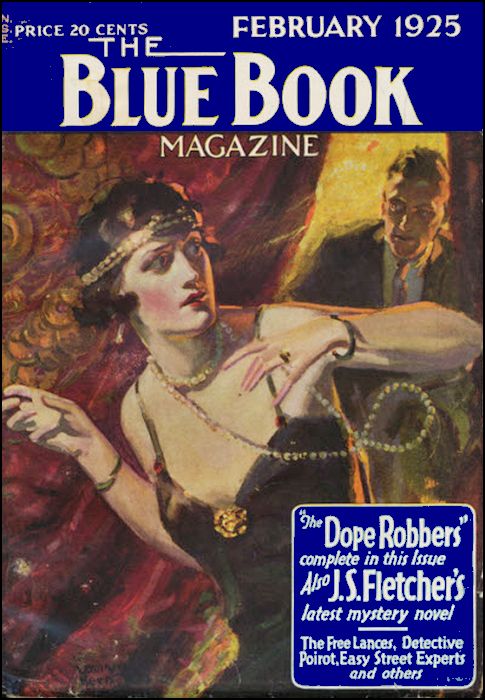
The Blue Book Magazine, February 1925,
with "The Deed-Hannaford Settlement"
MR. SMILER BUNN took his brassie from the caddie in corduroys and pensively surveyed the golf ball where it lay close up under the flint wall surrounding the garden of the house at the foot of the Downs. It lay high, supported by a tuft of coarse grass that had been smoothed and flattened by the wind. It was about a foot from the wall. Then he turned, gazing uphill towards the distant green.
"As near a hundred and eighty yards as makes no matter, boy," he said, in a tone of singular calmness and self-control. "What am I playing, my son?"
"Yer ninth, sir," replied the caddie.
He was very young and very rustic, but he had learned how to control his expression. Not a muscle of his face moved—his look was pure and innocent and solemn, like the face of a very sunburnt harvest moon.
"My ninth, hey, boy—ninth, did you say? What's bogey?" asked Mr. Bunn, still with the same ominous and deadly calm.
"Bogey four, sir," piped the urchin.
"Hum!"
Mr. Bunn turned and fastened his slightly bloodshot eyes on the ball.
He addressed it—both with his brassie and his tongue.
"Now, you hound!" he said very softly, but with a strange ferocity in his tone for all its softness. He swung back with singular slowness and desperate care, and hit with all the force in his big powerful body, grunting as he hit.
The ball rose straight up in the air and sailed softly over the garden wall—dropping not five feet away from them. How it was done no living soul could tell. It takes a beginner to do these things—a professional could not have done it with a brassie once in a hundred attempts.
Mr. Bunn looked thoughtfully at the caddie for a moment, but the youngster could not meet his eyes. Then, smiling like a madman, he swung his brassie again—full at the flint wall. This time he did not miss. There is no resilience worth mentioning in the average flint wall, and the brassie instantly ceased to be a brassie.
Somebody roared with laughter behind him, and he turned.
Ex-Lord Fortworth—now known as Mr. Henry Black—was coming across to him. He seemed enormously amused. If anything, he was a rather poorer golfer than Smiler Bunn; but nothing amuses a poor golfer so much as to see another of his kind in difficulties.
"Come on, Flood—leave it—it's lunch time. We'll finish the match some other day."
Cheerfully, almost gladly, Smiler gave up. He handed his caddie a shilling, and told him to take the remainder of the clubs back to the club-house. He had quite recovered his temper again.
Then, lighting cigars, the partners strolled off quietly towards the old-fashioned village inn at which they were staying.
It was the old story—weight. "Business" had been fair with them for the last month or so, and, alarmed by the signs of prosperity which were becoming physically apparent, they had come to the quiet Wiltshire village of Downmore for a few weeks in order to see what the hilly little nine-hole golf-course could do for them. There were few members, and usually they had the course to themselves.
On the way to the White Hart—the typical old-style hostelry of the place—Fortworth explained that he had received an invitation to dine that night.
"It was while I was ploughing up the other side of the links with my niblick," he said. "I'd noticed a tall, yellowish, hard-looking man watching me, and when finally I got the ball safely landed into the bushes and comfortably lost, he strolled across and borrowed a match. We got into conversation. He seems to know a good many places in America that I know and the average man don't, and the end of it was he asked me to dine with him to-night. My caddie tells me he's got a palace of a place about a couple of miles from here, and that he's considered very nearly too rich to die. As a matter of fact, no man can be too rich to bust, much less die"—he spoke feelingly. "I accepted. It may be worth while cultivating the chap. I said nothing about you, of course."
Mr. Bunn nodded. It was an understood thing that when either of the partners met and became friendly with strangers no mention was to be made of the other. They never knew when it would pay for the other to come on the scene as a stranger.
"Well, the great thing is to get where the money is. That's half the battle. You can't get money where there ain't any. What's his name?"
"Blanchard Deed—been in steel and iron. I've heard of him. He was a great friend of MacKamey, the steel millionaire. He's loaded up to the muzzle with money!" explained Fortworth.
"That's all right, then. The thing is—can we get a bit of it?" asked Mr. Bunn earnestly.
"Well, we'll sure try," rejoined Fortworth, and they went in to lunch.
Sing Song the bland, without whom the partners rarely travelled, was just putting the finishing touches to the table.
"Hump yourself, Sing Song," said Smiler. "For I could eat a camel!"
The Chinaman "humped" himself accordingly, and began to serve the meal on the top speed.
"If there's one thing I like better than another," said Mr. Bunn, "it's killing two birds with one stone. Here we are getting our weight down"—he assisted himself liberally to green peas with the plate of duckling which Sing Song had just set before him—"and a very good chance of getting our bank balance up if this Deed is easy. Burgundy, Sing."
Fortworth nodded agreement.
"I've got a presentiment that there'll be something doing with Blanchard," he said; "I don't know why or how. All I know is I've got it. We shall see."
AND when, shortly after twelve o'clock that night, their big car, with the all-round Sing Song at the wheel, slid up to the White Hart and Fortworth alighted therefrom and proceeded up to the sitting-room where Mr. Bunn awaited him, it was speedily shown that there would be "something doing" in the matter of Mr. Deed before long.
Mr. Bunn was nodding over a cigar, a whisky-and-soda, and a certain little black book of cuttings, names, and comments, which he had laboriously compiled during the past eight or ten years. Many a "crook" would have given gold for the loan of that volume. The names were those of owners of valuable portable property, and as a rule the comments and cuttings referred to that property. It was Smiler's favourite book—next to his pass-book.
Fortworth put his hat on the table solemnly, assisted himself to a drink, disposed of it, and sat down without a word.
Smiler waited—until suddenly his partner spoke.
"Flood," he said—for that was Mr. Bunn's usual alias— "we shall make something out of Deed. With luck, a lot."
Mr. Bunn smiled like a benevolent shark.
"Well done!" he murmured. "You found him a nice, easygoing sort of customer, then?"
Fortworth shook his head.
"No," he said. "He's as hard and keen as a diamond. But he's got a weak spot. His conscience is a great trial to him."
Mr. Bunn sat up.
"Conscience!" he said. "His conscience? I thought he was a millionaire?"
"So he is—a millionaire with a conscience. A sort of conscience, anyhow. Listen to this—it's like a piece torn off a dream. This Deed hasn't got much of a stomach nor a very strong head for wine. But he's very fond of a drop of good port. So, of course, by the time we moved into the smoking-room he was talkative—for him. Not foolishly talkative, you understand, but inclined to dwell a bit on the thorn in his conscience. About anything else he talked as much as a dead parrot. As far as I can make out, about twenty years ago he didn't possess any property you could notice except the patches on his clothes—and there wasn't enough of those to go round. He had ideas but no money, and, as a matter of fact, he was just tramping—padding the hoof—keeping an eye out for the chance of a job. Well, he landed at a place called Clampton, in Gloucester—they've got a pretty good workhouse there, he said. He was strapped—didn't have a cent— and, naturally, he took a walking-on part at this union for one night only. That night he got friendly with a young fellow who had put in at the same hotel for a bed. They did their tasks next morning and hit the road again. They travelled together for a couple of days and got on wonderfully well—so well that they began to swap confidences. It came out by degrees that the younger man—Hannaford by name—had ten pounds in real red money buried away in his clothes. He was tramping it to Leeds, where he had a girl. They were going to get married and open a shop with the ten pounds added to what she had saved. Hannaford blurted it all out to Deed, and Deed felt something inside him just hollering out for that ten pounds. Next day they got work in a hay-field. It lasted 'em three days, and at the end of it they were about eight shillings better off and had defeated a good many gallons of the harvest beer that had been going—enough to make 'em thoroughly thirsty. So they went to the village inn to quench it. They kept on quenching until closing time, when they rolled off to the barn where they were putting-up, with a stone jar containing some 'grub.' Once settled down in among the straw and rats and things, it turned out that Deed had a pack of cards, and as they weren't too tired—the jar being full—they had a game. It was a skin game, for Deed was never more sober, he says. Anyhow, it ended in Deed winning the whole of Hannaford's ten pounds. It didn't worry the lad much that night, but Deed knew he'd have to fight to keep it when they woke next morning, and so he waited until Hannaford was about a hundred feet deep in sleep, and then folded his tent like an Arab and silently stole away—leaving the cards strewn all about to help Hannaford to realise things when he woke. It was pretty stiff—but when men are down in the mud they'll grab hold of anything to get up on the good hard ground again. Well, now he's rich, Deed's sick about that ten pounds, Flood. It gave him a start in life, and he made the most of it. And now he realises that he took Hannaford's start in life away from him, and it sticks in the thing he uses for a conscience like a piece of grit in machinery. He's sort of superstitious about it—kind of afraid. Of course the story about the cards is a lie—he stole that ten pounds, Flood—stole it, and sloped while Hannaford was asleep. But he couldn't say so. He's hunted for Hannaford for the last ten years—advertised—everything —in order to make it up to him. But he can't find the man. More than likely he's dead. But if not, and if he finds him, what d'ye reckon he's going to hand him for use of that ten pounds?"
Mr. Bunn answered without hesitation.
"A thousand pounds," he said.
"He's going to pay him compound interest on the tenner at the rate of fifty per cent per annum for twenty years."
Mr. Bunn finished his whisky-and-soda.
"Is he? How much it that?" he asked. "It's too late for arithmetic for me. What does it come to? Fifteen hundred?"
"Thirty thousand pounds!" Fortworth said like the snap of a whip, and Mr. Bunn rose stiffly from his chair like a mechanical figure.
"How much?" he asked, incredulous.
"Thirty thousand!"
Fortworth fit a cigar and smiled blandly at his partner.
"Why, what with this and the Sheldrupp money and the jewels" Mr. Bunn referred to their last two coups—"it'll set us on our feet again!"
"Sure," said Fortworth. "And it's easy money—this thirty thousand. The easiest money I've ever come across."
Smiler nodded, and looked down at himself ruefully. The thing to do was obvious.
Hannaford must appear on the scene.
"I'm too solid to do the starving tramp act," said Mr. Bunn. "I couldn't look starved to save my life."
Fortworth's face clouded.
"That's true," he admitted reluctantly. "You do yourself too well."
Mr. Bunn flared up.
"Well, hang it all, how about you? You aren't any living skeleton."
Fortworth laughed.
"Me—not likely. I'm the human water-butt. Have another whisky, and we'll talk it over."
Smiler's face lighted up.
"Sing Song can't do it—but Bloom can," he said.
Fortworth reached out his hand enthusiastically.
"Bloom can—and shall—or I'll have him gaoled. The very man. Sit down and we'll fix it up. Deed's invited me to put in a month at his place—he's just starting golf, and is about my class. That'll be useful, too. Well, now—"
They refilled their glasses and began to map out their campaign against what the Socialist papers usually referred to as the iron magnate's "tainted" money.
MR. FERDINAND BLOOM who, with his wife, was in charge of the comfortable but retired little country house retained by the partners at Purdston, on the Hampshire-Surrey borders, was a man who had begun manhood as an actor. Finding that he and his art were not enjoyed either by the public or the managers, he had resigned, and applied himself to the art of butlering. As a butler he might have proved a huge success had it not been for his hobbies—one of which was intoxication, the other being dishonesty. He had drifted into the service of Lord Fortworth during the ex-financier's palmy days, had left hurriedly owing to a little matter of unsuccessful forgery, and, later, had been re-engaged by Fortworth, who had met him penniless shortly after the ex-millionaire had joined forces with Mr. Bunn.
On the morning following the recital of the Deed-Hannaford story by Lord Fortworth, Mr. Bloom was sitting comfortably on a garden seat in the shade of the clump of pine trees at the end of the lawn, reading, with considerable interest, an account of what the sporting press termed a twenty-five-round "clash" between one "Husky" Hammer, the Kansas Octoroon, and "Blink" MacBrown, the Welsh heavyweight, when his studies were interrupted by the low boom of a motor approaching.
He listened for a moment. The car turned into the drive, and came to a standstill at the front door. Mr. Bloom retired to the back door, reaching the kitchen just in time to hear the bell summon him to the smoking-room.
Mr. Bunn was there.
"Morning, Bloom!" he said. "Had your lunch?"
"Morning, sir. No, sir," replied Ferdinand.
"Ah, that's a good job!" said Smiler.
"Good job, sir?"
Mr. Bloom was mystified.
"Yes, you're going into training, my lad—strict training—road work, diet, punch the ball, skipping, and all that."
Mr. Bloom threw out his hands in horror.
"Skipping, sir! —skipping! Me!"
"Every stone of you, Fatty."
Smiler beamed upon the unfortunate man. He was not exactly a "fatty," but he was pronouncedly plump. "You've got just a fortnight to get enough off to play the part of the Starving Tramp, and don't forget it. No lunch for you to-day, Bloom of Roses."
Mr. Bloom shrugged his shoulders.
"I resign," he said flatly. "I give notice—I'm leaving." He moved towards the door. "I'm going to pack," he added, so that there could be no possibility of mistake or misunderstanding on the part of Mr. Bunn.
"Resign!" echoed Smiler sharply. "Resign be—! Mention that word again, and we'll have you gaoled."
Mr. Bloom turned mildew colour.
"This is brutality, Mr. Flood," he said.
Smiler nodded cheerfully.
"That's it," he agreed. "It's a tragedy—for you, Bloomy. You're the star. You've been an actor, so you say, before you took to butlering and forgery. Well, let's see how you can act. That's fair enough, ain't it? Why, as a rule, an actor's only too glad to get a chance of acting. I never heard of such a man as you—always dissatisfied, always unwilling, always miserable. And selfish! Selfish! Why, Bloom, I'm utterly disgusted with you."
Bloom moved his hands aimlessly.
"But the skipping, and all that, sir?" he said feebly.
"Do you good, my lad—do you a world of good. Make another man of you."
His voice took on suddenly a harsh, metallic tone.
"Now, Bloom, that's enough. Understand? You've got to get about two stone of that weight off—and off quick. Now, decide. Will you do it, or will you be given in charge for the forgery business? Make no mistake, laddie. We've got a whole sackful of money depending on this, and we mean getting it. If it comes off you'll get a share—if you've earned it. See? Now, choose."
Bloom looked into Mr. Bunn's eyes, saw no hope there, and chose.
"I'll do it," he said sullenly.
Mr. Bunn smiled.
"Go and fetch Sing Song. He's looking after the car outside somewhere," he ordered, and Mr. Bloom departed.
Smiler pondered.
"He can do a sharp ten-mile walk on the road this afternoon," he muttered thoughtfully. "Sing Song can rub him down—and I think we might go as far as a chop for his supper, without potatoes—if he ain't too tired to eat it. I don't suppose a ten-mile walk is just the sort of hors d'oeuvre to his next meal he's been banking on—but it's the one he's going to get!"
Sing Song and the butler entered.
"Yes, master?"
"You little yellow devils from China and Japan," said Smiler civilly, "know a good bit about wrestling and physical culture, so I understand, don't you?"
Sing Song grinned. He was not very friendly with Bloom, who at times had been witty about the Chinaman's personal habits and tastes in the matter of food.
"Yes, master?" he said, in a tone of inquiry.
"Know how to get a man's weight down, and all that sort of thing, I suppose?"
"Velly easy, master. No feedee—no fatee. Keepee hungly—getee bony? Plentee easy. Makee walkee—lun velly quick longee way—jumpee, skipee, exelcise allee time."
His grin widened.
"That's all right. You can close that mouth, my son. It looks as though it's been struck by lightning. That's better—that's more human. Now, listen to me, you two."
They listened, and within ten minutes fully understood the situation. It was quite simple. Within a fortnight Mr. Bloom was required to reduce himself as nearly as possible to the size of a man who for some years had never found himself face to face with a square meal. Also he was to provide himself with a costume and make-up which would be in keeping with such a cheerless character.
"Understand, Bloom?"
Mr. Bloom nodded sulkily, and Mr. Bunn stiffened.
"Now look here, Bloom—don't let's have any sulking. I hate sulking. What you want to do is to take an interest in the thing—see? Throw yourself into the part, just as if you were going to play it on the stage like Hamlet or Julius Caesar, or one of those cards. Be real and natural. Don't let yourself dwell on the work of it—think of the artistic side of it. See what I mean, Bloom? Put your heart and soul into it. The time'll pass like smoke."
Bloom was not cheered.
"Hamlet never went hungry and Caesar always knew where his next meal was coming from," he muttered.
"Ah, well, that's where you and those two chaps differ," said Smiler blandly. "But you won't be expected to live on air. We'll keep the life in you, anyhow. Now you can go. I'll have lunch at one sharp—you can fill the tank, Sing Song, too. I'll take the car back this afternoon. Slip into it."
And thus cheered on to duty the couple left the room. Mr. Bunn looked after them.
"I don't like doing a man out of his meals," he soliloquised, "but, after all, business is business. He can make up for it afterwards."
THAT afternoon he returned to the White Hart at Downmore. He had nothing to do now but wait until Fortworth—now stopping at Deed House, a huge, raw-looking white stone palace of a place some two miles from the village—gleaned facts from Deed concerning the missing Hannaford.
He met Deed and Fortworth on the links and at first, posing as a slight acquaintance of Mr. Black's—that is to say, Lord Fortworth—soon reached the stage of being invited to dine at Deed House. The three got on amazingly well together. That Deed was very much in earnest in the matter of making restitution to Hannaford whenever the opportunity should arise was very obvious—so obvious as to make the plan of the partners look almost too easy.
They discussed it continually when alone, from all points of view. It seemed sound enough—but it was too simple.
"Why, it's easier than eating apples," said Fortworth, "and that's what I don't like about it. Deed's no fool—as a matter of fact, he's keen like a knife—and I can't help thinking he's keeping something about this Hannaford back."
But Smiler shook his head.
"It's all right," he declared. "It's just one of those easy scoops that crop up every now and then. I've had 'em before, and, please God, I'll have 'em again! Deed's got Hannaford on his conscience, and conscience makes fools of us all, as it says in the Old Testament."
THERE was a knock at the door—they were sitting in Smiler's room at the White Hart—and the landlord put his face round the door-post.
"A lady is asking for you, sir."
The landlord was an ex-footman who had married money enough to start in public life.
"Lady! What lady?" demanded Mr. Bunn.
"I believe the lady is in the position of housekeeper to Mr. Deed, of Deed 'Ouse, sir," explained the landlord.
"Show her up!"
The landlord departed, and the partners looked at one another.
"Easy with her, Flood," warned Fortworth. "I've seen her once, and she looked like a woman with brains."
Smiler nodded, and rose as the caller entered.
She was a tall, fair, slender woman of about thirty, rather smartly dressed for one in her position. She was still quite good-looking, and carried herself with a certain air that was vaguely reminiscent of better days. She was very graceful, and spoke like a woman who has travelled, who knows the world and the people who inhabit the world—particularly the men. She possessed charm, and—they were to discover—strength of character. Her name was Mrs. Paget.
The partners greeted her politely, but she only answered with a smile. Then she turned and locked the door, removing the key and slipping it into her bag. This done she faced them again.
"You must forgive a very natural desire for privacy," she said in a clear, thin, but rather sweet voice. She laughed a little. "But I imagine privacy is quite in keeping with the desires of you gentlemen, is it not?"
She stood looking at them.
Smiler pushed a comfortable chair towards her.
"It will be just as private in the arm-chair, Mrs. Paget," he suggested.
She sat down.
"I am so glad to find you together," she said in her sweet, heady voice.
Fortworth stirred uneasily.
"What can we do for you?" he asked, a frown beginning to settle itself between his brows.
Mrs. Paget laughed a little.
"Oh, come!" she said. "I suggest one-third!"
"One-third! One-third of what?" demanded Fortworth curtly.
Smiler smiled, waiting—he was a judge of character, Mr. Bunn, and he fancied that Mrs. Paget was not a woman to be browbeaten. She looked steadily at Fortworth for a moment—then, with a little shrug, she replied:
"One-third of the money you are planning to obtain from Blanchard Deed by impersonating or arranging for an impersonation of the man Hannaford whom Mr. Deed robbed twenty years ago."
They stared.
"How did you know about it—supposing it's true?" asked Smiler.
"You talk so loudly—after you have dined," said Mrs. Paget. "It is quite a man's habit. You see, Rankes, the landlord here, married a girl who used to be my maid. That was before I had the privilege of keeping house for Mr. Deed," she said, with the least little touch of bitterness, "and so I have practically the run of the house. The butler at Deed House noticed that Mr. Black seemed unusually interested in Mr. Deed's story, and I arranged things a little with Mr. Bankes. This is an old-fashioned hotel, and there is a very quaint old cupboard in this room," she pointed to a corner of the room. "You may have noticed that it possesses no shelves—only hooks. That is because the back of the cupboard is not really a back at all. It is a door—opening into the passage outside. I have the key of that door also. Being anxious as to the reason of Mr. Black's profound interest in the story of Hannaford and the compound interest awaiting him, I have visited the cupboard frequently, at times when I knew you would be together, and—heard what I expected to hear. All's fair in love, war, and swindling—so that you should not be angry—Lord Fortworth!"
Fortworth started.
"What's that you called me?" he said suddenly.
"I addressed you as Lord Fortworth, Mr. Black. But don't be afraid. I have no intention of blackmailing you. Your secret is safe enough with me."
She looked at them both and laughed again, perfectly at ease.
"You're very clever," said Smiler. "Why don't you ask for a half?"
"I shall be satisfied with a third," she replied, and leaned forward, seeming a little moved, but speaking very clearly and rather more coldly. "I will help you—and I can do more than you imagine—and in return you shall pay me a third of the amount you obtain. Before you decide let me tell you that without my help you cannot possibly succeed. Mr. Deed is very clever, and while he seems to get a certain satisfaction from telling the story of Hannaford to men of his own type"—there was a suspicion of scorn in her voice—"he does not tell everything. For instance, Hannaford bore certain tattoo marks. Has Mr. Deed mentioned them to you?"
She looked quickly from one to the other, and laughed softly at the sudden doubt in their eyes.
"You see?" she asked. "All you really know is that Hannaford was dark—with dark eyes. But I could describe the man as well as Mr. Deed himself. When the time comes I shall tell you. Meantime—are we agreed?"
The partners glanced at each other and nodded.
"Certainly—two-thirds for us, and a third for you," said Mr. Bunn. "In return you've to help us, and also forget that Mr. Black is anybody but Mr. Black. That's a bargain, then. Now, what is the absolute limit Deed will pay to Hannaford, or somebody he thinks is Hannaford? He's a very rich man, we know, and rich men are prepared to pay for their fancies. What'll he put up all told? The Hannaford we shall provide will be about the most miserable-looking thing you can imagine out of dreamland. A human wreck—a genuine human wreck! Now, what price will Deed pay for this human wreck?"
There was a short pause. The woman stood up suddenly, a little pale.
"Mr. Deed is quite sincere in his wish to make reparation," she said tensely. "I am sure that if his feelings were properly played upon he would give as much as—oh, well, there is really no limit in a matter like this—but, certainly, he would give a quarter of a million!"
"A quarter of a million!"
"A quarter of a million!"
They echoed it simultaneously. They stared at her, their faces set like steel, their eyes flaring. At the mere mention of the sum they had suddenly changed. It was plain that she was speaking the truth, and the business had thus become more serious. They were in touch with a fortune.
"The man's mad!" said Lord Fortworth in a voice so harsh with repressed excitement that it sounded like a snarl. Even Smiler's smile was a shade artificial.
"Is this true—does Deed take it to heart like that?" he asked, watching her intently. "Will you swear to it?"
The woman nodded.
"I swear to it," she said, her clear, musical voice rather faint. She had seen the sudden passion in the faces of the two men.
"Good!" said Smiler cheerfully. "I only want to ask you one little question, Mrs. Paget. You have controlled Mr. Deed's household for four years, I understand, and I take it you have known about the Hannaford business, and what it's worth to a good impersonator, all the time. Well, why have you waited for us to come along and grab two-thirds when you could have got the lot? Why didn't you go on your own years ago?"
The fair, refined face of the woman suddenly flushed—and as suddenly grew pale. She pressed her hands over her heart.
"Oh, because I have only just become dishonest, I suppose!" she said.
Fortworth was looking at her, his pale, piercing eyes burning coldly.
"I think there's another reason," he said. "You've got an old account to settle with Deed, or I'm no judge. Say now, Mrs. Paget, let's be frank. We understand each other—what have you found out that suddenly makes you anxious to squeeze Mr. Deed?"
She hesitated a moment, seeming to freeze into a cold haughtiness, rose, and then, as her eyes took in the expression on Smiler's face, she thawed again. The keen, hunting look had gone out of Mr. Bunn's face—he was thinking that she looked an unhappy woman, and, soft-hearted as ever, he was wishing he could help her. She must have gleaned his thoughts, for she sat down again.
"Well, it is very simple. Mr. Deed has a son who wishes me to marry him. I met him four years ago at an artist's fancy-dress ball in London. My husband"—she shivered a little at the word, and they guessed that her first experience of marriage was not a pleasant memory—"had been dead a year, and my name was not Paget. That is an assumed name. Quite against his father's wishes, Reginald Deed had become a painter—he loathed steel and iron and finance. Practically his father had cast him off. 'You will get no help from me,' he said. 'Come to me when you're great, and I'll think it over.' Reginald had accepted the decision and had practically broken with his father. But there was one promise he had made. Blanchard Deed is insanely proud, and he had set his heart on a great marriage for Reggie. He had made him promise when he went to make a career as a painter that he would not marry without first consulting him—Blanchard Deed. So presently Reggie went to his father to tell him that he intended to marry me. I am the widow of Major—" she mentioned a name that some years before had rung through Europe. That of a man who had been court-martialled for cowardice in a little border war in India, and sentenced to death. Some technical point had cropped up, the death sentence had been revoked, and he had been sent to England for re-trial. The case had been sensational. He had again been found guilty—but before sentence could be passed had taken poison in court and died then and there.
The widow of this man continued after a pause:
"Reggie knew in his heart that it was quite hopeless. The instant his father heard my name they quarrelled. Reggie is kind and logical. He would not hear one word against me or my name. His father is hard, and narrow, and cruel. He would not listen. Reggie left the house a second time—ruined as far as his father was concerned. That was three years ago. There was an opportunity of becoming housekeeper to Mr. Deed, and I took it in the hope that perhaps I could make myself indispensable to him, perhaps to soften him, to make him like me. He has never known who I am, of course. But it was all useless—useless. Mr. Deed is made of the steel he manufactured, except only for the Hannaford crime. That was so mean that it hurts even him to remember it. I have done all I can for him during the last three years—but I am no more to him than one of his dogs. And Reggie is very poor, and he has been ill. I would not marry him while there was a chance of reconciling them, but it is hopeless. All the regret Mr. Deed has to spare he spends on Hannaford. Reggie could starve, and he would not care. So I am going to Reggie, and—I want to take him something of the fortune that would have been his if he had never met me. Only he must never know!"
She was silent.
Mr. Bunn uttered a word—an ugly word—that he did not apologise for.
"All right," he continued. "Deed's a dog. What the dickens has the cowardice of a woman's husband to do with the woman who is unlucky enough to be his wife? We'll sock it to Deed for this!"
Fortworth nodded dourly. There had been something pitiful about the story.
"Now," said Smiler harshly, "give us the description of Hannaford as he was."
She enumerated a number of points dealing with the tattoo marks, colouring of the man's hair, eyes, and so on, while Fortworth jotted them all down on paper. Then she rose. The partners discussed the thing swiftly, and then turned to her.
"Hannaford will turn up on Thursday evening at about nine o'clock. If it's fine, Mr. Deed and I shall probably be sitting on the terrace smoking a cigar after dinner. A tramp will come across the lawn—that will be Hannaford, who has been abroad all these years, but has come back. He will beg a small loan from Deed—apparently not knowing what Deed is really willing to do for him."
The woman pondered.
"Thursday. To-day is Monday," she said. "I think on Thursday there will be two or three friends dining at Deed House."
"So much the better," said Fortworth. "Deed will ask fewer questions. Shall I run you back in the car?"
Mrs. Paget shook her head.
"No, thanks—I will walk. On Thursday night, then."
She smiled—without pleasure—and left them.
"That's an unlucky woman, Flood, if ever there was one!" said Fortworth.
Smiler nodded.
"Ah, well, we'll get her a bit of her own back, anyhow," he replied, "and a bit for ourselves as well!"
He took up the notes the housekeeper had given him.
"I'll motor up to Purdston and see Bloom and Sing Song this afternoon."
"Right!" agreed Fortworth. "How about a drink?"
"Naturally," said Smiler, and touched the bell.
HE found Bloom as well as could be expected—and considerably thinner.
"This Japanese blackguard's starvin' me to death, Mr. Flood. He's not fit to be loose. He's got the mind of a murderer. I've got so weak, I can hardly drag one foot after another, and yet he makes me go over to Brooklands every morning before dawn—a five-mile walk—and run round the track twice at full speed. I'm not a coward, but he's got a knife, and says it's poisoned. He rushes at me with it, and, of course, I've got to keep away from it, or he'd slip it into me without hesitation. He said he would, and, Mr. Flood, he means it. He makes me sleep alone in one of the attics, and curls up on the mat outside. My wife tried to send me up a bottle of Bass on a string one night, and he twigged it and frightened her to death. She's been deaf in one ear ever since. I can't stand it, sir—I'm going mad. My clothes are hanging on me like sacks, and that yellow devil hasn't let me shave for days. Look at me now, sir—look—"
Smiler broke in on the excited protests of the unfortunate butler.
"It's all right, Bloom," he said soothingly. "It'll soon be all over. You can have as much as you like to eat after about nine Thursday night. And you'll be a hundred quid better off."
Bloom's haggard, unshaven face brightened wonderfully.
"Sit down, Bloom, and listen to me. I've got your instructions, and I want you to learn 'em by heart. Any mistake'll cost us thousands of pounds. And any funny business'll cost you your life. Lord Fortworth swears he'll shoot you if you mess things up. So'll I. And Sing Song'll certainly stab you. So listen here—"
Bloom listened—very attentively.
AT the end of an hour he was word perfect in the matter of his instructions. He had no scruples, and for the first time showed an interest in the scheme. It was quite simple. Bloom (impersonating Hannaford) was to appear to Blanchard Deed on Thursday evening, and tell a pitiful story of twenty years' ill-luck and hardship dating from the time his ten pounds were stolen by Deed in the barn. He had spent the greater part of his time in Australia—whither he had emigrated after the girl in Leeds had thrown him over. (Bloom had been born in Australia, and Deed had never been there.) And so on. Smiler never left the butler until he had the story at his finger-tips.
It was all really well planned, but Mr. Bunn, driving the car back to Downmore, shook his head doubtfully.
"I don't like it, somehow," he said. "Dunno why—but I don't. It's too easy. Still, we shall see."
ON the following Thursday evening four men sat smoking on the broad terrace at the front of Deed House. They had dined well, and had brought their cigars out into the warm summer dusk.
They were Blanchard Deed, the steel magnate whose steel heart had but one soft spot; Sir John Haslotte, a local J.P.; one Colonel Brant, and Mr. Henry Black, otherwise known to a few as Lord Fortworth.
They were discussing money, being the sort of men who rarely discussed anything else.
Little tables stood at their elbows bearing liqueurs and coffee.
A broad lawn, picked out here and there with flower-beds, stretched out from the terrace before them, ending some fifty yards away in a dense rhododendron shrubbery.
And from this shrubbery two pairs of eyes watched the men on the terrace intently—the keen, steady eyes of Mr. Bunn and the hungry eyes of Bloom.
The minutes passed.
Once Mr. Bunn whispered softly:
"What's that over there—to the left—midway between here and the house? A statue or a man? I thought it moved."
Bloom peered out.
"Only a statue, Mr. Flood," he said.
A clock from the stables behind chimed three-quarters, drowning the faint murmur of voices from the terrace.
"Quarter to nine," breathed Smiler. "Ready, Bloom—we'll give 'em another five minutes. Then slip across and introduce yourself. No stage fright, now, my lad. Lord Fortworth's there —and he'll help where he can. But remember you've never seen him before in your life. No mistakes, mind—there's thousands in it. Hello! Who's this?"
A DARK figure suddenly ran out from the shadow of the piece of statuary Smiler had noticed—ran out towards the terrace. It seemed to sob as it ran. Smiler's grip closed like steel on the arm of the man crouching next to him.
"Not a word!" he hissed.
They saw the white blurs of the four shirt fronts on the terrace rise as the figure sped up through the gloom.
Fortworth clenched his teeth as he watched.
"The crazy fool!" he said under his breath. "What's he running for? Why, he's crying—"
The running man leaped on the terrace and stopped, panting.
In the light that streamed from the room stood a tattered, dirty, unshaven, wild-looking creature staring at them. His eyes shifted from one face to the other.
"Who are you? What the devil do you mean by coming here in this fashion? What do you want?"
Deed's edged voice bit across the gloom to the watchers in the rhododendrons.
"I want Blanchard Deed!" cried the ragged man.
"I'm Deed."
"And I'm Hannaford, you dog! Take that!"
A half circle of silver flamed whitely in the light, beginning at the man who had run and ending at Deed. There was an indescribable sound, and Deed pitched forward. A long knife fell to the ground. It was all swift as light.
Fortworth, in spite of his size, leaped at the criminal and took him by the throat, literally snarling with rage and disappointment. Somebody shouted and servants came out, running.
"Out of it!" hissed Mr. Bunn, backing through the shrubbery towards the high road to where the car and Sing Song awaited them. "Something gone wrong."
A voice cried out across the lawn—a lamentable voice.
"But 'e ruined me years ago, I tell yer. 'E stole all I had in the world. 'E sent me to the dogs. I've been wanting him for years!"
THAT was the last they heard. Half an hour later Mr. Bunn and his two assistants were well on their way back to Purdston. That frenzied cry had made all plain to Smiler Bunn.
The real Hannaford had arrived—that night of all nights—and Mr. Bloom had been superfluous.
All that the papers for the next few days did not explain to Mr. Bunn, Fortworth, arriving some days later, did. He had been delayed by the inquest and other attendant matters.
"The man seems to have spent nearly all the twenty years since Deed robbed him drifting from one gaol to the other. The loss of his ten pounds really did ruin him. It broke his spirit. He'd been a sort of hand-to-mouth thief ever since. It was quite by chance he connected Deed the millionaire with Deed the dam thief—heard his voice one day passing through Downmore, and remembered it. He'd been hanging about for days for a chance to get at Deed. I don't know what he'll get—I doubt if they'll hang him. There's plenty of witnesses that his story is true—Deed told a good many people about what he intended to do for the man. It was bad luck for him he didn't know it before he killed Deed. As for us, we're well out of it. Deed was a keen blade, and might have spotted us, anyway."
"How about the lady—Mrs. Paget?" asked Smiler.
"Oh, she's all right!" said Fortworth. "Deed had never altered his will—waiting to see how his son would turn out, I suppose—so the painter inherits everything. Mrs. Paget's left Deed House—for a time. But she's going back."
"When?"
"As soon as she and young Deed can decently get married."
Smiler smiled. The scheme had been a failure, but he was satisfied.
"Well," he said thoughtfully, "I agree with you, Squire. We're well out of it!"
"Sure," replied the ex-millionaire.
Bloom entered.
"You look well, Bloom—healthier," said Fortworth. "Is lunch ready?"
"Yes, sir," said Bloom.
"Then why couldn't you say so without beating about the bush—hey?"
And quietly but firmly the partners headed for the dining-room.
Roy Glashan's Library
Non sibi sed omnibus
Go to Home Page
This work is out of copyright in countries with a copyright
period of 70 years or less, after the year of the author's death.
If it is under copyright in your country of residence,
do not download or redistribute this file.
Original content added by RGL (e.g., introductions, notes,
RGL covers) is proprietary and protected by copyright.