RGL e-Book Cover©
Roy Glashan's Library
Non sibi sed omnibus
Go to Home Page
This work is out of copyright in countries with a copyright
period of 70 years or less, after the year of the author's death.
If it is under copyright in your country of residence,
do not download or redistribute this file.
Original content added by RGL (e.g., introductions, notes,
RGL covers) is proprietary and protected by copyright.
RGL e-Book Cover©
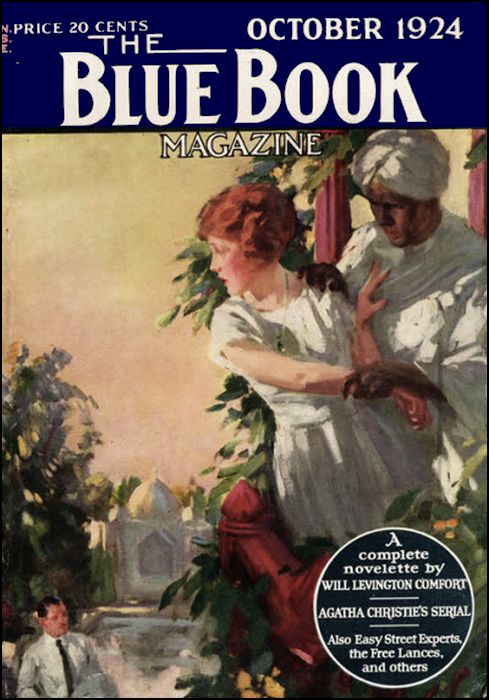
The Blue Book Magazine, October 1924, with "The Mogador Spider"
IT was some months later, when Mr. Bunn was once more "at home," that, one day, he finished the liberal slice of specially recommended Gorgonzola with which he was rounding off his luncheon, and leisurely selecting a cigar, looked up at his Chinaman.
"Sing Song, you lemon," he said cheerfully, "you can tell Purvis I am very pleased with the Gorgonzola. Say I appreciate a man with the sense to send round a decent bit of cheese when he gets it, without first of all waiting for an order. Say I'm very pleased—and tell him that any time he gets anything in which he knows is special he can send a sample round. A large sample, say."
"Yes, master," said Sing quietly, and proceeded to pour black coffee and a liqueur.
Mr. Bunn looked thoughtful—like a man pondering a serious matter. He did not appear to come to a decision until Sing Song was on the point of leaving the room. Then he spoke.
"Wait a minute, Sing," he said, still pondering.
Sing Song waited.
"Just bring in the piece, my lad," continued Mr. Bunn with a benevolent smile.
Sing Song looked puzzled.
"Piecee—how piecee? Not understanding."
"Why, the piece of Gorgonzola," said Smiler sharply. "The cheese, you Chink. Don't run away with the idea that you're going to be allowed to pinch a piece of fine old Gorgonzola like that, my lad—because you aren't. Go and fetch it. I want to have a look at it. Bring a knife, too."
The Chinaman did as he was told, and Mr. Bunn looked over the pound or so of cheese with the profound and slightly cannibal interest of a born gourmet, nodding approval as he did so. Then he looked at Sing Song.
"We've had quiet times lately, Sing," he said, "but you've been a good lad, and you've made me comfortable. Now, I've been a good master to you, and I always will be—as long as you do your duty—and I'm going to give you a little treat."
He took the knife and firmly but gently cut a smallish slice of the Gorgonzola, which he put on a dessert plate. It might have been wedding cake from the care he used.
"There, my lad," he said, "that's for you. Try that. You'll find it an uncommon bit of cheese. Don't go gulping it down—keep it on your palate so that you get the bouquet of it. It's not meant to be bolted—Cheddar's good enough for bolting. I don't suppose you've got the palate I've got—you Chinks eat such uneatable dust-heap delicacies—but you'll appreciate that bit of cheese, or I'm no judge."
He put down the knife and beamed on his valet with the air of a benevolent uncle.
Sing Song bowed, holding the plate in his hand, and began to express his gratitude. But Smiler put up his hand.
"There, there, my lad, say no more. You're welcome. You can wrap up the piece—carefully, mind. We shall be leaving England to-night in Lord Fortworth's yacht, and I'll take it with me for his lordship to taste. And then you can pack."
"Yes, master," said Sing Song, and was about to leave the room, when the electric bell of the door of the flat rang—a series of quick, agitated jerks.
Sing Song moved quietly out, and a second or two later a short, thick-set, well-dressed individual with a rather hard look about him came into the dining-room. It was Lord Fortworth.
"We're jacked up!" said Lord Fortworth by way of greeting.
Smiler looked anxious.
"What's wrong?" he asked.
"Our cruise is off, Flood—killed at the last moment."
"Flood's" face fell slightly.
"Why's that?" he asked.
"My chef's been taken ill. And I'd as soon go to gaol as go for a yachting cruise without a decent chef. What d'ye think?"
Mr. Bunn signed to Sing Song, who was hovering about the door.
"You needn't pack, Sing," he said sadly. "But bring Lord Fortworth a glass of the old brandy first—bring two glasses."
He sat down and the two stared disconsolately at each other.
"This is a great disappointment to me," said Smiler gravely.
"Cuss the chef!" replied the millionaire ex-miner fervently. Obviously it was as great a disappointment to him.
Neither of the epicures spoke again until Sing Song had brought the old brandy and each had half-finished his glass.
Then Mr. Bunn pulled himself together.
"Perhaps it's only temporary—maybe only a short illness?" he suggested hopefully.
But Fortworth shook his head.
"When I last saw him early this morning he was sitting on a frying-pan in the kitchen, swearing that he was savoury omelette! His mind has given way," said Lord Fortworth. "Awful, ain't it? Many's the good dinner he's cooked for me, poor devil. But—he's all in now."
He helped himself to another brandy.
"Well, well, can't be helped," said Smiler at last; "although it certainly jacks up our holiday. What does Lady Fortworth say about it?"
Lord Fortworth looked slightly uncomfortable.
"She seems just as much disappointed as I am. In fact, more so," he answered. "She was going to N'York while I was away. In fact, she's going anyway. Very strong-minded woman, Lady Fortworth is, Flood. She's very much altered from the Irish colleen I knew back in the 'nineties. In those days she used to persuade me—now she hasn't got time for persuasion. When she wants anything done she asks pointblank like a bayonet. And I've kind of got into the way of doing it—and doing it quick. You'll understand the idea better, perhaps, when you're married, Flood. She says I've got to go away for a holiday, and if I can't make up my mind about taking a trip with you, she threatens to take me with her."
Mr. Bunn had never before heard the millionaire talk in this strain, and he gathered that, "tough proposition" as the ex-Klondyker was fond of terming himself, he had been somewhat untoughened by the process and customs of matrimony. His withered bachelor heart went out to his friend, and he nodded expressively and sympathetically.
"I don't suppose you'd care to come along on the yacht without a good chef?" suggested Fortworth rather harshly, because he felt nervous. To offer a friend a possibly indifferent dinner was one of the few things Lord Fortworth was capable of being nervous about. "I've been telephoning and interviewing and bribing half the day, but it's too short notice for all the really hot chefs. Money can't get 'em at such short notice. Of course we'd take Jacks and Hongry, and perhaps you could drag along that Chink of yours."
"Who's Jacks?" demanded Smiler, willing to be persuaded.
"My assistant chef," explained Lord Fortworth eagerly. He had taken an enthusiastic liking to Mr. Flood and was desperately anxious for his company on the cruise. "Jacks is a hummer at soups, Flood. You ought to know—you've tasted it. And Hongry's—Jacks' assistant—a good all-rounder. Of course—neither of 'em's in the same street as Peer, but we could manage with 'em, especially as we'd have your Chink to cook the rice for curries." He stood up suddenly. "Come on, Flood, be a sport and chance it. Two Frenchmen and a Chink ought to make good. Is it a go?"
Mr. Bunn nodded.
"All right," he said. "But it is hard luck for us about Peer." He touched the bell.
"You can get on with the packing, Sing," he said. "You're coming too, so get busy."
He passed the cigars to his friend, and they settled down again over the old brandy.
"I'm glad we've decided to go, Flood," said Fortworth presently, "for I'm a man who likes to combine business with pleasure, and if we cruise round as far as Mogador—in Morocco—there's a chance of doing a stroke of business. I know you don't go much on business, but I'm one of the sort that's always got a hook and line out for a fish. Can't help it. It's the kind of brain I've got."
"I suppose so," agreed Smiler dully. "You're like a razor—keen, sharp, able to cut in and carve off a chunk for yourself. I'm different. I'm slow, solid, fatheaded, know what I like and know what I don't like—and don't know much else. You're one of the eagles. I'm one of the barndoor roosters. What is this business at Mogador? I don't suppose I've got sense enough to understand, but I get kind of interested in following, in my way, the workings of your mind."
The millionaire laughed—a hard, self-satisfied laugh.
"Oh, this ain't a particularly smart stroke of business. I happen to know of a man out there who's got something to sell. To tell you the truth, I don't know just what it is he's got on offer or who and what he is. Calls himself Leopold Blonk. As far as I can see he's got a sort of jewel-mining concession from the chief of some tribe in the wild country back of the Atlas Mountains—it's a tough country down there, I'm told, the Sultan being more of a jack than a king in those parts—and he wants me to buy it. He wants ten thousand for it—cash. Gold—not notes. Says notes ain't any good in the desert. Sounds correct, too. Anyhow, I'm taking out five thousand in gold. If I can't beat down any man living in the Sahara fifty per cent, my name ain't Bill Burgess—I mean William, first Baron Fortworth. Of course, I've known for a long time the country back of the Atlas Mountains is worth opening up, but never had time to see about it. And this holiday cruise is a very good chance to see what's doing out there. If Leopold puts up the right dope, perhaps I'll put some enterprise and money into the country."
"Oh," said Smiler, "I see! I never understood this concession business—but it sounds expensive." Obviously he had not followed his friend's explanation very clearly.
Lord Fortworth stood up.
"Never make a business hog of you, Flood," he said cheerfully. "And I like you all the better for it. But very often there's money in this concession business. You'll see."
"Yes, I suppose I shall," agreed Mr. Bunn doubtfully. "I shouldn't be surprised if I do."
They shook hands.
"I've got a lot to do before night," said Fortworth. "Don't forget! Waterloo—main line—refreshment room—at five-thirty. So long, Flood! I'm sorry about Peer—but you understand, no man, however sharp or rich he is, can help his chef going nutty."
"That's all right," said Smiler cordially. "It's just a slice of bad luck for us. So long!"
FOR some minutes after the millionaire had gone he stared thoughtfully out of the window.
"Yes," he mused dreamily, "he's right. There certainly ought to be money in these concessions." He turned and called Sing Song.
"Sing, my son," he said, "put a canvas bag in among the luggage—a biggish one. You never know when a bag might come in useful." He looked at himself in the mirror over the mantel and nodded playfully at his reflection.
"Supposing you were to find a sum o' money—a sum o' money in gold—out there in the Sahara Desert, what would you do if you didn't have a bag to put it into? You'd look a perfect fool in front of Lord Fortworth. A sharp business man like that would have a bag wherever he went. And a half-witted fathead like you, John Bunn, mustn't think you know better than a clever man of business like William. Certainly you'd better take a bag!"
A shadow passed over his fat face.
"Seems a pity to have to do it on such a sport as Fortworth. But, after all, friendship is one thing and business is another thing—altogether another thing—I'm glad to say."
And he contentedly lighted another cigar and strolled in to sit on the bed and superintend the packing.
THANKS to the unceasing efforts of Jacques (the assistant of the fanciful Pierre), of Henri, and of Sing Song, the Chink, together with the anxiously thought-out suggestions of the two gourmets, Mr. Bunn and his host succeeded in reaching Mogador without experiencing the keener pangs of starvation.
And the Colleen—Lord Fortworth's romantic name for his yacht—had scarcely dropped anchor before the two friends, leaning over the side, arrayed in ducks as white and spotless as the lilies of the field, observed a boat hastily putting out to board them.
"Ah, well, here's Leopold!" said Fortworth. "He's been keeping a pretty keen eye out for us—if it is him!"
Mr. Bunn nodded and yawned.
The boat was quickly alongside, and a moment later the visitor was aboard and facing them.
It was Leopold Blanc, the concession owner. He had the type of nose that many other concession owners possess— semicircular. He was clad in whitish ducks, practically obsolete linen, and a hat that was in keeping with his raiment. He was a smallish man with a swift eye.
He wasted no time in laying his proposition before Lord Fortworth. At first he addressed himself partly to Mr. Bunn; he was not sure which was the capitalist. Both noticed it, and neither felt flattered.
The instant he began to speak they knew that he was not, say, a Scotsman.
He explained that he had what he termed a "privilege" with the sheik or chief of a certain powerful tribe in the interior.
"I am sometimes de agent of dis chief—ven he feels pretty good," he explained naively, motioning with the palms of his hands upwards. "He gif me dis concession to find and haf gons from de teract of country vich he overrules. Exclusive and sole concession—yes? Very valuable concession—you vill realise it very soon. Dis country's full of gems. But vidout capital to vork it my concession dere is no good. Ve vant capital. Oderwise dis concession no good, aind't it? So to you, Lort Fortwort, as capitalist, I make dis offer. I vant to sell it von half my concession to you for ten t'ousand pounts down if you provide vorking capital for to vork de whole concession—half de total profits to go to you and half to me, yes. Dat's fair, aind't it? I vill show you vat proofs you like to ask." He lowered his voice to a whisper, jerking a grimy thumb over his shoulder. "I haf all de proofs you vish to examine and more still at my house. Dere is gold in dis country—dat comes under my concession, yes? I tell de chief gold is a gem. I haf a nukket in my house in Mokador weighing dirty-five pounts. You come and see him, aind't it? I show my gems for a sample, yes. Den we talk over de concession, Lort Fortwort. You brought it de money, no?"
Lord Fortworth looked him over with the slow, hard, hypnotic stare of the successful financier, and nodded.
"I've got the money—if you've got the goods. It's too hot to talk business now, Mister Blonk, but we'll come ashore after dinner, and have a look at your samples." He rose. "If you meet us as we come ashore at eight-thirty to-night we'll look into things. Good morning," he concluded, and Leopold moved away in a vaguely dissatisfied manner.
"Ain't much of a concession, is it, Flood?" grumbled Fortworth. "And yet I expect that oily little devil risked his life to get it I've heard that these chiefs are very hot propositions. Each is a sort of little sultan—as long as he can keep his end up. Still, we'll hear more about it to-night. Wonder what Jacks has fixed up for lunch?"
"I don't pretend to know much about wrong 'uns," said Smiler slowly. "But if Leo isn't one, I'll live on bananas all the way back."
His host laughed.
"Ah, well, if he gets sossy with me he'll discover he's got hold of a mad rattlesnake from the Bad Lands—and one he can't get loose from in a hurry," said the ex-miner ominously. Then the luncheon bell rang, and they went below.
AT the appointed hour they went ashore. Leopold was awaiting them. It had occurred to Mr. Bunn that Sing Song might be useful, and so the Chink was one of the party.
Leopold led them quickly through certain tortuous, narrow streets into even narrower streets, until they found themselves walking in alleys that curled and twisted like the paths of a circular maze. The air was heavy and unclean, and the people they met had the appearance of cut-throats—not merely beginners either, but plus men, if a golfing term is not too out-of-place in a Mogador alley.
But Leopold seemed quite at home. He guided them on with the ease and precision of a ferret in a rabbit-warren.
Then suddenly he disappeared into an archway, beckoning the others to follow him.
"D'ye think it's all right?" whispered Smiler to Lord Fortworth.
The nobleman turned his eyes to Mr. Bunn, and there was a pale glare in them that Smiler had not seen there before.
"If it ain't, I'll cut the ears off Leopold," he said ferociously.
"Oh, well, so long as you leave his scalp for me!" said Mr. Bunn playfully. But nevertheless he kept a grip on the repeating pistol in his coat pocket. He was not feeling unnaturally hilarious himself.
8ing Song plucked at his master's sleeve as they passed under the arch.
"Master come away," he said, his face as expressionless as ever; "no likee this place. Dangelous place."
"What! Have you got the creepy-crawfies too, my lad?" chuckled Smiler.
"Plenty cleepy-clawlies—me 'flaid," said Sing Song blandly. "No stoppee niggels—killee all thlee—takee money—cuttee up in little pieces."
"Ah, well, forget it, Sing Song. You're here now—and if Leopold starts us for the Cuttee Up Stakes you're a certain also-ran. You shut your mouth and keep your eyes open," recommended Smiler.
They entered a big, square, low-ceiled room, chastely furnished with untidy mats and a Windsor chair.
Leopold, who somehow looked more formidable in these surroundings than he had appeared on the dazzling white deck of the Colleen, offered the chair to Lord Fortworth, who surveyed the accumulation of dirt upon it and briefly declined.
"No, thanks—I haven't got my overalls on," said his lordship sourly. "And look here, Blonk, I don't like your house. I don't like the look of it, and I don't like the smell of it. I'm not in the habit of doing business either in this fashion or in this particular kind of pigsty. I'll give you ten minutes. If you've got anything in the way of specimens and documents, trot 'em out quick."
"Vell, if you vait a minute I get dem, yes," answered Leopold. There was a queer gleam in his eyes as he turned to the door. "Vot's your hurry?" he added insolently. "Can't you vait—you gotta vait, yes!"
He flashed an evil grin back at them and disappeared. There was no door, but an iron grille slid forward before the exit.
Smiler and his friend stared at each other uncomfortably. Sing Song took a seat on one side of the least grimy of the mats without exhibiting any uneasiness. When there was no way out of trouble the Chink was a fatalist—or at any rate behaved like one.
"That spider's got us in his parlour all right, Flood!" said Fortworth gloomily.
"Well, it looks like it. Anyhow, he's going the wrong way to work to sell his measly concession. Hello, who's that?"
He broke off, staring up at a trapdoor in the ceiling which had just been opened. Through it a girl's face appeared.
"How do?" said Smiler. "Let me help you down, my dear."
"T'ank you ver' much—but Ai come alone," replied the owner of the face, "eef you will stan' back for me. It is ver' easy, that. Ai 'ave come down dis way ver' many times. Dis is nozzing deeficult for me."
Two delicate little bare feet with gold anklets appeared through the trapdoor, followed by a lithe, slender body, sumptuously clothed in an elaborate linen wrapping in white and blue and gold and scarlet; barbaric, but astonishingly effective. The girl hung for a moment to the edge of the opening, and then dropped lightly as a cat. She turned smiling to Smiler and Lord Fortworth.
"Now eet is four people in prison," she said cheerfully.
She was startlingly pretty. It was obvious that she had native blood in her, but she was not darker than an Italian. Probably she was a French half-caste. From what she had said it seemed as though she also was a prisoner—but it did not appear to worry her to any extent.
"What d'ye mean?" asked Fortworth abruptly. "What d'ye mean by prison?" The girl laughed gaily.
"M. Blanc 'ave kidnap you, is it not?" she said. "You t'ink perhaps not. Bot eef you try open ze gate you see it is so. Ai am kidnap too—but Ai care nozzing. M. Blanc will nev-vaire to dare hurt me. Ai am too verree valuable. Ai hope you are valuable, too. M. Blanc is verree—" She broke off suddenly and ran under the trapdoor.
"Lift me op, please, dear mister. I will come again. Quick, eef you please. M. Blanc he t'ink de trapdoor eet is not known to me."
Smiler hastened to lift her so that she could reach the edge of the trap and draw herself up. She closed the door a fraction of a second before Leopold appeared outside the grille. With him were two big, blackguardly-looking bravos—Arabs of the criminal type.
"Dese are my partners, Lort Fortwort," he explained, with an evil grin. "I have altert my mind about de concession. I vill not sell it de concession vich I explained ven I visit de yacht. I can raise de vorking capital myself." He leered and came nearer the iron grille.
"I vill be short and schveet, Lort Fortwort," he said, and suddenly his face took on an expression of ferocity that was almost animal.
"Yes—short and schveet. You have brought ten t'ousand pounts gold on your yacht. I vant dat money. I vill give you till morning to decide, and if you vill give it up I set you quite free. But if you refuse to pay it my partners and me vill stun you all t'ree, take you out to de desert, and kill you dere quite comfortable. I am busy man—and my partners and me vant to leave Mogador in de morning. T'ink it over. If you vant anyt'ing, rattle de bars of de door—but not for foot or water. Dere is noding to eat or drink!"
He finished abruptly and went away, his "partners" following him.
Mr. Bunn looked at Fortworth and rubbed his chin.
"The man means it?" he said simply. "He'll do it all right. You've got to pay up, I'm afraid."
The ex-miner nodded. He knew when a man was "bluffing" and when he was in earnest. But before he could speak the trapdoor was raised again and the girl came through like a squirrel. She was looking serious.
"Ai 'ave listen," she said naively. "You mus' pay him ze money. Eef you no pay he will keel you. It is nozzing to M. Blanc—he 'as keel ver' much. It is only me of all ze people in ze world he is verree afraid to keel. Ai am so verree valuable."
Smiler's eyes twinkled.
"Yes, my dear," he said, "you're valuable all right—if they put the same value on looks in this country as they do in England. But who are you?"
The girl laughed gaily.
"Ai am Pearl of ze Desert," she explained. "Ai am wife of Ben-el-Dar. Onlee M. Blanc 'ave kidnap me."
"Ben Elder!" said Smiler. He turned to Lord Fortworth. "Wasn't it Ben who gave Blonk the concession—or, at least, so Blonk said?" he asked.
"That's true," said Fortworth. "It only shows that Blonk never had a concession at all. Ben wouldn't give a concession to a man who'd stolen his wife!"
"No—I don't suppose he would," returned Smiler. "What do you think, Pearl? What'd Ben give Blonk for stealing you? Skin him alive, or some pleasant little thing like that, no doubt."
But to their astonishment Pearl of the Desert shook her beautiful head.
"Ai am too verree valuable to Ben-el-Dar. M. Blanc 'ave told me zat eef Ben-el-Dar give preevilege to take gems from Ben-el-Dar's country zen M. Blanc will give me back to Ben-el-Dar. But Ai say long time ago to Ben-el-Dar, zat eef zey find gems in ze country zey must be all for me. For Ai want zem an' Ai am ze chief's wife, so of course zey must be for me—every zing must be all for me if Ai want it. Zen M. Blanc he kidnap me. Soon Ben-el-Dar will find me an' take me and cut M. Blanc verree small and give him to ze vultures." She gave a significant little gesture.
"Bot Ai say to you, poor little misters, M. Blanc is verree angry and disappoint', and he will keel you quick eef you not pay ze money. Zere is no Ben-el-Dar to hont for you because he has great passion for you, and cannot be happy wizzout he 'ave you safe—like me."
There was a little pause, the girl looking anxiously from one to the other. Then Fortworth drew Smiler aside.
"Think she's straight, Flood?" he asked. "Her yarn sounds reasonable enough. Blonk's kidnapped her to get the concession, and kidnapped us so as to get the working capital. He's a pretty good business man, Blonk—in his way. Of course she might be one of the gang—"
But Smiler shook his head.
"No," he said. "She's genuine. It is a case of pay up and look pleasant."
"All right—here goes, then."
He turned to the girl.
"We're going to pay up, Pearl," he said, and her face lighted.
"Oh, that is verree great pleasure to me! Lift me op, please. I will go now, and you shall tell M. Blanc."
SHE climbed again through the trapdoor, and Fortworth rattled the grille—"like a damned monkey," as he angrily put it to Smiler.
Leopold was very ready to do business. It was obvious that the man was desperately anxious to get out of Mogador to some place where he could treat with Ben-el-Dar for the return of Pearl of the Desert safely and at leisure. Evidently he knew about the vultures also.
The parley through the grille was speedily finished, and within twenty minutes Smiler Bunn, with the bigger and most evil-looking of Leopold's partners, was on his way back to the Colleen, with the keys of Lord Fortworth's cabin and safe, and a note to the captain which would give Smiler a free hand. What he had to do was quite simple, and what the result of any mistake or hitch would be was equally clear to him.
He had to take from the cabin five thousand pounds in gold and convey it to Blanc within an hour of dawn. Later than that, Leopold swore, in obvious sincerity, he could not wait in Mogador.
"If you 'ave not returned vit de money by dat time," he had said, "you need never come at all. Lord Fortwort vill be dead. If you bring help I vill kill him before you can enter de house. Dere must be not any mistakes. Belief me, I mean dis, vat I tell you. To kill von or two men is noding to me.
And they had thoroughly believed it. Smiler intended carrying out his share of the programme to the last detail. It hurt him to have to do this. It was a blow to his professional pride, for he had intended having that five thousand pounds for himself. It had looked the "easiest money" that had ever come his way. And now it was going to be given to an unwashed German-Portuguese Jew, who seemed to have carried the fine art of brigandage to the point of sending circulars to prospective customers in England.
"I don't like it," muttered Mr. Bunn to himself as, guided by the Arab bravo, he strode briskly towards the harbour. "I'm not accustomed to being done down and robbed like this." He glared at the dim, silent figure in front of him. "You and your pals are nothing more nor less than dashed highway robbers," he growled.
But there was no way out. Fortworth had to be saved, and nothing but that five thousand would do it. By the time he had rowed out to the yacht he was almost resigned to what he considered the loss of his property.
There was no difficulty with the captain of the Colleen, and within half an hour Smiler and the Arab were making their return journey to the lair of Leopold, driving before them two heavily-laden donkeys which the Arab had obtained while waiting ashore for Mr. Bunn.
THERE was already just the faintest tint of the dawn flushing the skies, and Smiler did not spare the unfortunate donkeys in his haste to get back. The little procession had just entered the maze of alleys in the heart of which Leopold had his stronghold, when suddenly the Arab, who was walking ahead, uttered an interjection which even a novice in Arabic could have recognized as an oath of the most impressive variety, and vanished round a corner with the speed and handiness of a startled rabbit.
Even as Smiler stared, two men with long knives in their hands loomed out of the dimness, running—fierce-looking, lean, hawk-like Arabs of a pure desert type.
They flashed a glance at Smiler, but did not stop, and in a second they were gone, running silent as ghosts, their bare wicked knives glimmering as they ran.
"Hello!" said Smiler softly. "Friends of the black bloke's— I do not think. Well, let's hope they catch him. Come up, there!" He prodded one of the donkeys and moved on uncertainly.
"Which way do I go, though?"
He stopped again.
"Good Lord, this is serious! I've got to get to Leopold's before dawn or it's all up with Fortworth. But nothing but luck'll get me there. How can a man find his way in a place like this?" He peered about him desperately, trying to find some sign or mark that he recognised. But it was hopeless.
Overhead the skies were lightening swiftly. Mysterious muffled people, springing apparently from nowhere, began to jostle past him, scowling curiously and suspiciously at this fat Englishman standing helplessly with two sagging donkeys in the heart of Mogador.
Smiler feverishly wiped the perspiration from his forehead.
"This is a bad job!" he muttered anxiously. "This is a d—bad job! That blackguard'll be getting busy on Fortworth and Sing Song in a few minutes if I don't turn up."
He turned swiftly on a native who was standing watching him contemptuously.
"Say, where does Leopold Blonk live? I'll give you five quid to take me there," he said, adding instantly, as he saw that the man did not understand a word, "Hell! What's the good of talking good English to you, you fool? Get out of the way or I'll blow your face off."
He dragged a repeating pistol from his pocket, and the native gave a grunt and went away from that place.
"Here, this is awful—" began Smiler, when he heard a soft, emotionless voice at his elbow.
"Master!"
Smiler turned to see Sing Song emerge from a narrow alley at his side.
"Sing!" He nearly fell on the Chinaman's neck. "What's up? Where's Lord Fortworth? How did you get here?"
Sing Song smiled blandly.
"Evelything velly nice," he said calmly. "Lold Folthwith allee same happy. No 'flaid Leopold. Leopold dead—cuttee up allee same pigee. Alabs come—plenty Alabs come cleepy—killee Leopold and fliend. Savee little plitty lady. All velly nice."
"What's that?" shouted Mr. Bunn, quite himself again. "Say it again. Whoa! will you? Here, catch hold of this dam' donkey, and say it again—slow!"
Sing Song explained in a rapid whisper.
IT appeared that shortly after Smiler had left for the yacht, Blanc and his remaining "partner" had come to the grille apparently to refresh themselves by insulting the two prisoners—chiefly Lord Fortworth. They had indulged in this pleasant and amiable little relaxation for some minutes, and then suddenly had run from the grille. They were back again instantly, surrounded by a swarm of silent Arabs, all armed with knives. And in another second they were both dead—literally cut to pieces.
Ben-el-Dar had come out of the desert for his bride—and he had found her.
Smiler pondered a moment.
"Where's Lord Fortworth?" he asked. "Is he safe?"
"Plenty safe," answered Sing gravely. "Talkee to Ben-el-Dar and little plitty wifee. Little wifee likee Lold Foltwolth— Ben-el-Dar likee him allee samee—because wifee likee him. All thlee gone halbour. Wifee wanting go aboald yacht. I going halbour too—another way—hope meetee master and tellee him. Master glad?"
Smiler looked his Chinaman firmly in the eye.
"Sing, my son," he said, and patted the portmanteaux on the donkeys, "I have been robbed. That Arab who came with me ran away with all that money, and there's no chance of tracking him down. Understand?"
Sing Song broke into a smile that must have hurt his face.
"Yes, master," he said.
Smiler cleared his throat and lighted a cigar.
"I have here, my lad, on the backs of these donkeys, a few dates I bought at a greengrocer's on the way back, thinking they'd come in handy if any of us felt like enjoying a little fruit. I don't want the bother of carting 'em back to the yacht. But I don't want to waste 'em. They're special dates— Mogador is famous for its dates—in fact, a good Mogador date is the best kind of date in the world. We don't require any more dates on the Colleen, anyhow, and so I'd like to get these put into the hands of a good shipping firm—if there's such a thing in Mogador—and forwarded to me in London. You can't get such dates as these very easily in London. Now I've got to get back to the yacht quick. But if I leave all these valuable dates with you, Sing, my son, are you capable of seeing about having 'em carefully packed in your presence—portmanteaux and all, without opening the portmanteaux—and having 'em shipped to England? I don't know whether you're able to be honest with me—you ain't with anybody else, of course, I know—but if you are it will be pounds in your pocket the day the dates arrive."
He paused. Then, placing his hands on the Chinaman's shoulders, he asked solemnly:
"Sing, can you do it?"
"Yes, master," said Sing Song demurely.
"Then go and see about it, my son."
And giving the Chinaman a handful of money, Smiler turned to retrace his steps to the harbour. He looked over his shoulder once.
"Oh, Sing, you can have the donkeys for yourself—a little commission on account," he called gaily, and disappeared.
LORD Fortworth was delighted to see him back.
"All right?" he said. "Good. Where's the gold?"
"Pinched," said Smiler calmly. "Every cent of it gone!"
"What, that damned Arab—" began Fortworth.
"We were bringing it on some donkeys when the blackguard bolted round a corner and absolutely vanished. I thought I was lost. I tell you, Fortworth, it gave me a turn when I thought of you and the Chink—"
"Oh, that's all right! Can't be helped, I suppose. It was a dashed good thing Ben and his crowd came along, though. If the money's gone, it's gone. We were lucky to get off so cheap. Come below. Ben and Pearl are down there, as pleased as two kids in a toyshop. Come and meet Ben—he's a very good sort, and he's a whale at old brandy."
Smiler went. He felt like a brandy himself. Not quite a whale's share, perhaps—but certainly a shark's.
SING SONG, blandly smiling, came aboard some three hours later. He found Mr. Bunn dozing in his cabin.
"Flench shippee film plomise deliver dates to London in one month," he said softly.
"Awri'!" said Smiler drowsily. "Hook it now—I'm sleepy."
Sing quietly closed the door and "hooked it" as requested. And Mr. Bunn dropped off into a thoroughly refreshing doze. Once or twice he smiled in his sleep. Perhaps he was dreaming.
Roy Glashan's Library
Non sibi sed omnibus
Go to Home Page
This work is out of copyright in countries with a copyright
period of 70 years or less, after the year of the author's death.
If it is under copyright in your country of residence,
do not download or redistribute this file.
Original content added by RGL (e.g., introductions, notes,
RGL covers) is proprietary and protected by copyright.