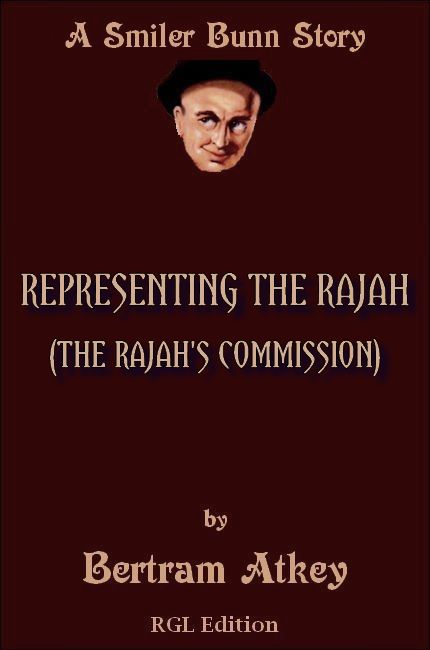
RGL e-Book Cover©
Roy Glashan's Library
Non sibi sed omnibus
Go to Home Page
This work is out of copyright in countries with a copyright
period of 70 years or less, after the year of the author's death.
If it is under copyright in your country of residence,
do not download or redistribute this file.
Original content added by RGL (e.g., introductions, notes,
RGL covers) is proprietary and protected by copyright.
RGL e-Book Cover©
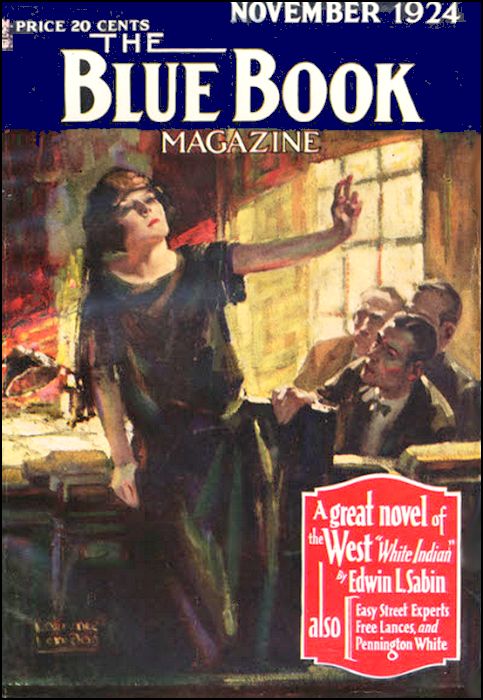
The Blue Book Magazine, November 1924, with "The Rajah's Commission"
DESPITE the regrettable necessity which drove Mr. Bunn to remember with the utmost strictness the adage that "business is business," his friendship with Lord Fortworth daily grew firmer—the last application of cement thereto being, so to speak, a certain lunch in which they indulged a few weeks after their Mogador trip. The lunch finished, Smiler gazed contentedly across the table at his friend Lord Fortworth, and Lord Fortworth gazed contentedly back at Smiler. Silently, calmly, each lighted a cigar and reflectively stared at the arabesques of blue smoke that slowly melted into the air before them.
Then Mr. Bunn sighed.
"What a lunch!" he said devoutly, and relapsed into thought.
Fortworth did not answer. He gravely nodded his head.
Mr. Bunn pulled himself together.
"Which course did you consider the best?" he asked, with a dreamy smile.
His host thought it over, and finally shook his head.
"It all depends," said the ex-gold-digger. "As far as I can judge, there wasn't one course that I would have liked left out. It seems to me that if any of 'em had been left out it would have spoiled the lunch."
Smiler nodded.
"That's true," he said. "There was only one mistake made in the whole lunch—and we were the ones that made it. It's a pity, but it can't be helped now. We ought to have had one more glass of sherry a-piece."
Lord Fortworth looked regretful.
"You're right," he said. "But only half a glass. I noticed it the minute it was too late. Half a glass more would have made all the difference."
But Smiler stuck to his point.
"No," he said good-humouredly, "I can't admit that, Fortworth. One full glass. It was the last oyster that did it. What we really ought to have had was five oysters each to begin with, instead of six, and then we could have arranged for four glasses of sherry instead of three. I was half afraid of it when I had the sixth oyster. But, there it is—can't be helped. We shall know better next time."
"That's so," replied Lord Fortworth, and they beamed at each other as they carefully rose to go to the smoking-room.
"After all," continued Mr. Bunn as they passed out, "a good whisky-and-soda'll put it all right." He dropped comfortably into a huge, soft armchair before the blazing fire and sighed again. "Thank God for that," he added, with such obvious sincerity as to remove the least suggestion of profanity.
Despite the annoying mistake in the matter of the sherry, they were both aware that they had just eaten the lunch of a lifetime; such a lunch, indeed, as only a millionaire could offer to a friend. Lord Fortworth was immensely pleased that Mr. Bunn—or, rather, Wilton Flood, as he was known to the ex-miner—had noticed the one mistake. It was a pleasure— indeed, an honour—to give lunch to a man with such rare and wonderful judgment and appreciation. It had been a perfect lunch, perfectly chosen, perfectly cooked, perfectly served, and perfectly eaten, and Lord Fortworth knew it. What he did not know was that some three years before a red herring was a treat to Mr. Bunn—and tripe a luxury. And Smiler was not in the least likely to inform him.
The lunch had been in the nature of a farewell meal. Lady Fortworth, who was paying a visit to America, had written to her husband instructing him to come over and spend a few weeks there with her before both returned to England. And Lord Fortworth was going quietly like a well-behaved husband. In three days he was sailing. He had been desperately anxious that Mr. Bunn should go with him, but Smiler wanted to "take things easy" for a while. He had been doing well for a considerable time past, and wished to employ a few months in learning to shoot and in getting an idea of golf. Hence he had decided to relieve the nobleman of his company for a while. He had already relieved him of more than enough money to pay the expenses of his "rest."
"It's a surprising thing how much nicer a man's lunch tastes when he takes an interest in it than when he only uses his knife and fork like a shovel and his mouth like a coal shute," said Fortworth brilliantly, as he neared the end of his cigar.
Smiler nodded.
"Yes," he said. "The way some men eat reminds me of filling potato sacks. It's a pity, because they don't know what they're missing. I had a groom once who told me his favourite way of eating bloaters was to hold the bloater in one hand and bread in the other, and take bites—first a bite of bloater and then a bite of bread."
(Smiler was quoting from the list of his own long-discarded habits.)
Fortworth shook his head.
"That's no way to eat a bloater," he said earnestly. "How about the roe? Why, you waste it that way. It's a long time now since I played jig-saw with a bloater and her bones, but I don't reckon I ever tore fish about that way. It ain't fair, Flood—it ain't fair to the bloater, and it's cruelty to your digestion. But, still, some men are like that."
"The worst thing about England is the fish supply—there ain't enough variety," complained Mr. Bunn irrelevantly.
"Haven't I always said so?" demanded Lord Fortworth rather vehemently. "You've got to go to America for fish— England for meat. Now, take a bit of broiled barracuda— that's a dish you can only get in America. But once you've tasted it you'd go to Hades for a second dash at it. Why, the best fish I ever ate in all my life I ate at—"
IT appeared likely they would have continued in this interesting gastronomic strain until dinner-time had not the telephone on the table at Lord Fortworth's elbow suddenly given a musical imitation of an agitated rattlesnake.
Fortworth took the receiver, growled into it, and listened a few seconds. Then he proffered the receiver to Smiler.
"Your Chink wants to speak to you," he said. "He is a good boy, that. Never understood why he left me to go to you, though. Queer birds, these damn Chinks," he said, and relapsed into his chair.
Sing Song seemed almost excited; but probably it was due to the telephone, for Sing Song was never really at ease with a telephone. In some respects he was a simple soul, and there was something mysterious about the instrument which rendered him slightly anxious as to results when he was using it. And he and the girl at the exchange never clearly understood each other.
"Master! Helloah!" he usually began. "Are you master? Missy, you gettee my number, please. Oah, yess; no, not speakee yet. No gettee master. Bellee linging—not hear master talkee—hoh! Yess, master, Sing Song speakee—go away, missy, please—master! Hi—master! Master!!" And then would follow a string of weird Chinese that, from Sing Song, was neither for publication nor a guarantee of good faith—or of any other kind of faith. This was when Smiler, needing amusement, would sometimes answer and then remain dumb for a while in order to listen to Sing Song struggling and swearing (in Chinese) at the other end. But Sing Song was in luck to-day.
He swiftly informed Smiler that the early afternoon editions of the evening papers contained a curious personal advertisement which he would like his master to see.
Smiler replaced the receiver on its hook, and with a short but ready lie to his host (for explanation) glanced through an evening paper that a well-trained and expensive-looking servant had just brought in. It was brief but to the point. One Lucien Santoin announced that he desired to get into communication with the person who had given shelter in his flat to a gentleman of high rank, who had lost his memory some few months previously—and Smiler knew that the person in question was Mr. Bunn. He felt a thrill of excitement as he turned to his host, for Lucien Santoin was confidential body-servant to His Highness the Rajah of Jolapore—the "gentleman of high rank" in question. Mr. Bunn had always had an idea that something good was coming to him from the potentate in question when he had recovered his memory—or, at any rate, the greater part of it. He had been keeping a fairly keen and comprehensive eye upon the Rajah and his suite at the Southern Grand Hotel during the past six months, either in person or by proxy, but the process of recovering one's memory seemed to be lengthy, and he had not expected to get in touch with the Rajah again for a considerable time to come. But this advertisement looked as though His Highness had taken a turn for the better.
He swiftly excused himself to Lord Fortworth on the plea of urgent family affairs, and took a taxi-cab to the hotel.
Monsieur Santoin—a middle-aged Frenchman with a singularly discreet air—was expecting him. Smiler was interested to observe that the valet had not forgotten his name—or, rather, the name he had been temporarily using at the time they met.
"Mr. Coomber Houees, is it not?" queried the discreet one. Even his excellent English was not quite a match for "Huish." "I have not yet forgotten the brave hospitality you extended to my master."
He drew a chair forward for the caller, who, faultlessly-dressed, prosperous-looking, and, wearing a superb fur-lined coat, seemed a wealthier and more important individual than the keen and watchful man who had sheltered the Rajah. The eyes of Monsieur Santoin glistened swiftly over Smiler, and came suddenly to rest full upon the blandly smiling orbs of the "crook."
"Mr. Houees," he said earnestly, "I am your true friend. You are a man of the world. I, too, am a man of the world. It is a good thing to be men of the world; but men of the world must live, and to live one needs money—" His rapid eyes dropped to Mr. Bunn's expensive coat for an instant.
"Certainly," said Smiler. Santoin's wary eyes never left his again. "Certainly, a man must live. But he's not likely to make a fortune rescuing Rajahs on the nod. On the nod, mind you, Santoin. What did I get for saving him from a gang of crooks that would have had his absolute shirt before they'd done with him? What did I get? An unsigned promise to give me a roomful of gold, which was never kept. That's what I got!" He simulated disgust; but Santoin smiled and shrugged his shoulders.
"All in good time," he said. "His Highness has recovered his memory but one day. You have rendered him a great service—and he will not forget that. Only, above all, remember this—that I, Lucien Santoin, am your true friend; all others serving His Highness are sneaks and vipers and canaille that I spit upon!"
For a second he was purely French. Evidently he had a private feud with someone whom Mr. Bunn would shortly meet.
"Your true friend, dear monsieur. Presently you will meet a yellow, crawling reptile called Mirza Khan. He will, perhaps, tell you many things. They will be lies—all lies. Perhaps he will say that he is a friend to you. But that is not true. He has not any friends. Everybody is his enemy. He is his own true friend only. Beware of him, Monsieur Houees. But I am another man—a true man, you will see that very easily. Guard against that yellow crocodile and listen to me!"
He dropped his voice to a whisper.
"His Highness was drugged by a lady who desired to hold him for sake of the rewards that would be offered. You saved him from her, but the drug caused him to lose his memory. Now his memory has come back, and he wishes that lady to be captured for punishment. But how to capture her? Who knows where she is? We know not; the police know not—and you, dear monsieur, it is not possible that you know?"
He paused, his eyes narrowing. But if it was a trap to catch Smiler he had set it much too clumsily. He may have been a wily fowler, but he was dealing with a very much wilier fowl. Mr. Bunn's face was blanker than brick walls; he did not answer.
"It is not possible that Monsieur Houees knows where this lady is that has drugged a Rajah and is not yet punished?" he asked in his silkiest tone.
Then Mr. Bunn knew for certain what he was after.
"Know?" he said innocently. "Of course I know!"
The pupils of M. Santoin's expressive eyes darkened, dilating.
"Ah, that is a good thing! His Highness will be very much pleased. Where is the lady, dear monsieur?"
"It is a kind of old-fashioned habit of mine, Santoin, my son," said Smiler, laboriously sardonic, "to act up to that old phrase 'nothing doing.'"
Santoin smiled, but there was a touch of discomfiture in his smile. He shrugged his shoulders.
"Ah, monsieur, you are truly a man of the world! Come now, let us begin again. This time we will be just plain, simple, straightforward—two reasonable men of the world talking business together like friends. We trust each other perfectly—" He paused a second, listening. Then, lowering his voice, he whispered rapidly, with deadly earnestness:
"Monsieur Houees, I will pay you one hundred pounds for the address of the lady!" He took from his pocket a small bundle of bank-notes. "Quick!"
Smiler took the notes.
"Certainly, Lucien," he said with a chuckle. "It's this. Write it down: 'Kate the Gun, Over the Road, New York, U.S.A.' She told me so herself—and she knows!"
M. Santoin looked puzzled.
"'Over the Road?" he whispered. "Where is 'Over the Road'?"
"'Over the Road' is 'gaol,' my lad. 'Gaol,' Lucien. That's where Kate is—and where she'll be staying for a good many years to come," said Smiler cheerfully, and turned to the door which had opened just as he finished.
From the tail of his eye he saw Santoin's furious face even as he turned.
A FAT Indian in a dark brown frock-coat and tightish white linen trousers was standing in the doorway. He bowed elaborately.
"Good day, sar," he said ponderously, in quite reasonable English. "You have come to see His Highness, responding to the announcement in the newspapers. His Highness is capable of seeing you now. Will you come this way, sar?" He noted the slight movement of Santoin as that seeker after addresses made as though to go to the Rajah. "M. Santoin, His Highness has not sent for you. He desires thiss interview to be private. When His Highness asks for you I will make great haste to inform you. Thiss way, sar!" he added in a deep pompous voice to Smiler, and went out.
Smiler followed him into a small ante-room. No sooner had the door closed than Mirza Khan turned to Mr. Bunn.
"I wish to say, sar, thatt I am your true friend above all others. Bestow no attention upon thee French rag-picker you have just had thee good fortune to leave. He iss natural liar, scoundrel, and an insect!" This last evidently was intended as an insult of the deadliest. "I shall prove to you, sar, that I am true friend."
He took from a pocket a ring that contained a stone which resembled a diamond. Smiler felt that he wanted it the instant he saw it.
"If you will accept thiss poor ring, sar, I hope thatt you will permit me to flatter myself thatt you consider me your true friend," he said, without a change of countenance. "Be seated, sar; I will now proceed to His Highness and inform him where thee lady lives, and thatt you are here."
He had not yet given up the ring. But Smiler held out his hand for it.
"You are indeed a true friend!" he said warmly. "I would trust you, Mirza, my lad"—he took the ring from the slightly reluctant fingers of the Indian and dropped it into his pocket—"I would trust you with any mortal thing of mine that I did not require for myself."
He beamed kindly upon Mirza Khan, into whose eyes a doubtful look had suddenly crept. But he pulled himself together.
"It iss great honour for me, sar," he said, in his deep, serious voice. "I will now tell His Highness where thee lady lives."
He paused expectantly.
He was much cleverer than Santoin.
"All right," said Mr. Bunn densely. "I'll wait."
But Mirza Khan waited also.
"Give me thee address, sar, and I will go hurriedly," he said.
But Smiler wagged his head playfully.
"Sorry, Mirza," he said; "but that happens to be one of the things I require for myself. Anything else, old man—anything else you like. But not Kate's address. I'm sorry to disappoint a true friend, but—I have my reasons!"
Mirza Khan glared. He looked as though he would have liked entirely to ruin Smiler's health. But before he had time to speak somebody coughed in the next room. The sound seemed suddenly to pull Mirza Khan together. He even managed to imitate a smile.
"Thiss way, sar," he said; and added rather feebly, "your true friend."
THEN he ushered Smiler into the inner room, where, lying on a big lounge, was a young man whom Mr. Bunn recognised instantly as the Rajah of Jolapore.
Mirza Khan bowed profoundly, spoke quickly and subserviently, and departed.
The Rajah looked at Smiler, and his eyes seemed to twinkle. Smiler liked the look of him—now that his mind was clear.
"How do you do?" said the potentate affably, with a vague 'Varsity air about him. "I am glad to see you. I owe you an enormous debt of gratitude. Indeed, I have only just realised the extent of my debt to you. But for the truly friendly—"
But Smiler raised his hand.
"No, Rajah," he said bluntly. "Don't you pull that friendly stuff too—er—I beg pardon! Don't think me rude, but, to tell the truth, I have made so many funny friends that—that is, perhaps, I'd better explain."
The Rajah with a slightly surprised look indicated a seat.
"Certainly," he said politely.
Mr. Bunn related the curious welcome he had received from Santoin and Mirza Khan. At the end of it the Rajah was laughing as he had not laughed for some months.
"It is a good thing that you did not tell them the address," he said. "You would never have seen me if you had told either of them. You see, they know that I am going to give a thousand pounds to the person who gives me the address of the lady."
Smiler opened his mouth, but, on second thoughts, closed it. Perhaps the Rajah had more rewards to mention.
"You know where she lives?" inquired the Rajah.
"I do," said Smiler; but he did not volunteer to give it.
"I will talk with my servants presently," said the Rajah irrelevantly, but with a glint in his eye that did not promise anything considerable in the reward line for the "true friends."
There was a little pause. Then the Rajah sat up erectly, like a man who has come to a decision.
"Tell me the address," he said. "And I will tell you why I wish to know it."
"She's in gaol in America," said Smiler.
The Rajah frowned.
"I'm afraid you'll have to let her off," continued Mr. Bunn, noting the frown. "For if they sentence her on each charge they'll bring against her, and the sentences ain't concurrent, why, the poor girl will have about two hundred and twenty-four years to serve. And that won't leave her much time to attend to the sentence she'd get for kidnapping you—if you follow me," he concluded.
The Rajah's frown deepened until he looked very Indian indeed.
"You don't want to be vindictive, Rajah. When she gets what's coming to her she'll have all she can accommodate in this life," urged Smiler affably.
The Rajah glared at him.
"I wish to marry her," he said shortly, and Mr. Bunn nearly fell out of his chair.
"What?" he inquired.
"She is the first handsome woman I have met with courage enough to fear nothing," explained this astonishing potentate, and waved his hand impatiently to indicate his distaste to discuss his feelings further.
Mr. Bunn shook his head.
"It's very awkward—very awkward, indeed," he said.
"I know something of America," said the Rajah evenly. "Tell me precisely how much money would be required to effect the release of the lady."
Smiler pondered. He knew nothing at all about American prisons, and had no idea as to what money it would cost to arrange for Kate's escape. What he wanted was an idea as to how much the Rajah would stand.
"The man's a king," he mused, "and I suppose he's pretty well off. And naturally he expects to be treated as a king."
In the ordinary way Mr. Bunn might have been slightly shy in the company of a king—but he had been in too close touch with the Rajah of Jolapore ever to be shy with him. A man cannot be very shy with a king to whom he has "stood" a steak-pudding lunch—as Smiler had the Rajah. He stood up.
"Rajah," he said, "speaking simply, as man to man, I couldn't get Kate back here in England for less than twenty thousand of the very best. Twenty thousand pounds—and not a ha'penny under it!"
He stared firmly but kindly at the man on the couch. Rather to his astonishment the Rajah remained calm—quite calm.
"I see," he said. "And how long will it take?"
Smiler pondered again. Finally:
"I don't know, Rajah—I cannot say. I couldn't promise less than three months. I might have to pension off half the prison guards, from the boss downwards. It'll come high. I warn you freely and fully. It might run to twice the money, and take a year to do it. It's a risk, and I tell you so."
The Rajah rose.
"When can you start?" he inquired.
"Oh, in three days!" said Mr. Bunn.
"That will do excellently. You shall have a credit of thirty thousand pounds arranged for you at a New York bank. As to the discharge of my personal debt of gratitude to you, we will talk when you bring the lady home—if that is satisfactory to you."
"Oh, quite satisfactory!" said Smiler blandly.
The Rajah smiled.
"Mirza Khan will accompany you. He shall not bother you—I promise that. If you will call here before you go, my secretary will arrange financial questions with you. Only—you must not fail."
"Certainly not," said Smiler.
He became aware that Mirza Khan had appeared at his side, silent as a fat brown ghost; and, with him, he left the Rajah.
In the ante-room he turned to Mirza Khan.
"Here's your ring, Mirza," he said. "I never meant to keep it. Must have my little joke, you know."
"Thank you, sar," said Mirza Khan, a look of relief on his face.
Santoin also received back his hundred pounds. Then Smiler left the hotel.
"The Rajah'll ruin himself over Kate if he doesn't look out," he soliloquised, as he stood on the steps waiting for a taxi.
THE first thing he did on his return to his flat was carefully to look up in a work of reference the amount of the Rajah of Jolapore's income.
It was estimated at slightly over a million pounds per annum.... Smiler ordered in the old brandy and sulked for the remainder of the afternoon.
"If only I'd known!" he wistfully repeated over and over again. "If only I'd known! I'd never have allowed myself to be beat down like that! But I'll make up for it when it comes to the reward of merit due to me. I will that!"
ALL the financial arrangements were made to Mr. Bunn's satisfaction, and, carrying about fifteen hundred pounds cash for emergencies, he crossed the Atlantic with Lord Fortworth, much to that nobleman's delight—and loss, for Smiler took eight hundred pounds from him between Queenstown and New York at poker. Mirza Khan was there, but he was not obtrusive, although he was never far away from Smiler.
During the voyage it occurred to Mr. Bunn to confide in his wealthy friend, whom he conceived, being well known in New York, might be able to help him.
"I'm really going to the States on behalf of an old friend of mine," he told Lord Fortworth. "The black sport you see always hanging round near me is a sort of secretary of his. He's in awful trouble. He's a man you'd never think could have any trouble in the world, but he has. It only shows you. The girl he's in love with is in gaol in New York. I don't deny she's broken the law more than once, but, still, my poor pal's in love with her, wants to marry her, and as he's wealthy enough to put her out of reach of temptation—in the matter of diamonds and so on, poor girl"—Lord Fortworth nodded and looked sympathetic—"why, he's asked me to represent him and do what I can to get her released. Now, can you give me a tip, Fortworth? You know America pretty well, and I don't. I'm a kind of a mug, as you know. But I'm an honest, well-meanin' old mug, and I'd like your help."
Fortworth pondered.
"Money any object?" he asked.
"Well, not in reason," said Smiler cautiously, and the millionaire's face cleared.
"Then she's as good as free. We must find out where she is first. After that it's a matter of money. How much does your friend want to spend?" There was a touch of patronage in Fortworth's tone.
"Oh, I don't know. Matter of five thousand pounds, perhaps."
Fortworth shook his head doubtfully.
"Might be done for that—but there won't be much margin, if I know anything about grafters. What's the limit he'd put up?"
Smiler decided to give his friend a shock.
"Well, he could afford to go up to a quarter of a million—but I doubt if he would," replied Mr. Bunn gravely.
"Snakes in Hades, man, you could empty half the gaols in America for that! Who is your pal?"
"Oh, he's a Rajah—Rajah of Jolapore. Place in India!"
"Is that so?" Lord Fortworth reflected. "I'd like to meet him some time," he said, for he was a natural financier.
"Well, lend me a hand, and I'll take care that you do when we get back," said Smiler carelessly.
Fortworth agreed absently. Already he had a high-class financial "lemon" ripening for the Rajah in his mind. He had no compunction about helping to release the girl, for the impression which a further brief chat with Mr. Bunn left upon him was that the damsel in question was a pretty little lady's-maid who had fallen to sudden temptation and stolen a fistful of her mistress's diamonds. Lord Fortworth, in fact, felt quite sorry for her.
Two days later they landed. Lady Fortworth met her husband and took instant charge of him. He and Smiler had planned a seven-day "look round" New York before the nobleman joined his wife in earnest, but that little idea went gracefully up into the air before the lady had surrounded them two minutes. Lady Fortworth was a woman of character, and was not quite sure that she approved of the intimacy of her husband and Mr. Bunn.
"That's all right," said Smiler, to the lively expressions of regret which Lord Fortworth cautiously began to utter when his wife was momentarily out of earshot. "I've got a few friends in this city I want to see, and I'll call on you in about a week. I want to find out what gaol poor Kitty is inhabiting just at present. When I find out I'll come and see you. Now I'm off. You go and make love to your wife like a good little baron."
They grinned and parted.
SMILER—with Mirza carefully in tow—lost no time in looking up his brother Tony, and Fanchon, his wife. These two were detectives, working with Westerton's, the world-famous detective agency. Fortunately, he decided to call at the office first. He was only just in time—indeed, he met Fanchon leaving the building. She was starting for San Francisco in chase after a bogus princess who had just got out of the city with about thirty thousand dollars belonging to sundry lion-hunting New York hostesses. Fanchon had exactly two minutes to spare. But in that two minutes Smiler learned that Tony was in France hunting for a bank cashier who had no business to be there; that Fanchon was delighted to see him; that things were prospering; that she hoped Smiler was no longer a "crook"; that she thought Smiler ought to get married; and that—in answer to a point-blank question—Kate the Gun was in "Bed of Roses" for twenty-five years.
"What's 'Bed of Roses'? Where is it? I must see Kate," jabbered Smiler anxiously. "It means over a hundred thousand dollars to me, Fanchon!"
Fanchon stared, took a card from her case, scrawled a name and address on it, and signalled to a motor-cab.
"Go to the man on this card—say I sent you," gasped Fanchon, and jumped into the motor. "Good-bye," she called over her shoulder, and a second later she was gone.
Smiler gazed at the card for a moment. Then, placing it carefully in his pocket, he returned to his hotel.
"Daniel MacQuoid, attorney-at-law," he said thoughtfully to himself as he went. "To-morrow'll do for you. We'll have a look round before we start work, Mirza, my lad."
"Yes, sar," said Mirza in his big, booming voice.
DANIEL MACQUOID was the owner of the name Fanchon had written on the card. He does not enter this story to any extent. He was a lean, lantern-jawed individual with a mouth like a rat-trap, and on the following day Smiler, calling at his office, learned from him that "Bed of Roses" was the popular name for a new type of prison which some well-meaning and influential visionary then in power had introduced. The idea was to surround the prisoners with all the comforts of home life, and by judicious hypnotism gradually quench all that was ill in a woman's nature and develop all that was good. Smiler smiled as he pictured the professors lining up to mesmerise Kate. He gathered from Mr. MacQuoid that the Chief Warden or Governor was named Hoit—Colonel Jackson Hoit—and, after a few words at the telephone, that Kate's number was sixty-six. More information than this Mr. MacQuoid did not offer, and not much liking the severely legal look of the attorney, Smiler did not prolong the interview. He left the office and called on Lord Fortworth. Luckily he found his friend alone, and was able to put to him a scheme which he had thought out, a scheme which met with the nobleman's enthusiastic approval.
THREE nights later Mr. Bunn sat in a private room at one of the best restaurants in New York, dining with Lord Fortworth and Colonel Jackson Hoit, the Governor of "Bed of Roses."
Mirza Khan, in his quiet way, had attempted to make one of the party—it was evident that the Rajah, for all his apparent belief in Mr. Bunn's honesty, had given Mirza pretty strict instructions not to lose sight of his "representative."
But Colonel Hoit—a rough diamond—had taken one brief look at the stately Indian and, in the frank unaffected way for which the rough diamond is famous, had explained that he had no intention whatever of eating dinner in his company.
Mirza Khan, gathering from this that his presence at the festive board was not absolutely essential to the harmony of the evening, reluctantly left the room and perambulated the corridor outside throughout the meal.
Exactly how Fortworth had been able to arrange to dine the Colonel so quickly Smiler did not know, nor did he greatly care. The Colonel was there, and all he and Fortworth had to do was to name a price that the Governor would accept for arranging that Kate the Gun should "escape" some night, and get a fair start before the alarm was given.
"He'll be easy," Fortworth had told Smiler over the telephone to notify him of the dinner.
And Mr. Bunn, looking at the rough-cut face of the Governor, and his somewhat rougher method of dealing with food, felt that Fortworth was right.
Colonel Hoit ate and drank very thoroughly indeed, and considerably before the end of the meal he was what he described as being pretty well "lit up."
At any rate, he was sufficiently lit up to confess that, freeborn Irish-American though he was, he admired a lord above most other things. He admitted that, although he was proud of being Governor of the new women's prison, he would have preferred, on the whole, being a lord. Why, he did not quite know; it was just an instinct, he said. He had worked his way up to what he was from a navvy, and he had enjoyed the struggle upwards every inch of the way. But sometimes it had occurred to him that he would have enjoyed being a lord all the time even more. There was no saying, of course—perhaps he was wrong—but, well, that was his fancy. He laughed uproariously and abolished his eighth glass of champagne.
Then Smiler and his host fell to work. Insidiously enough they brought the conversation round to the Colonel's "patients" and the new treatment.
"There's nothin' in the hypnotic dope," he declared. "Why, th' professors ain't got hoss-power enough to mesmerise half th' fairies we git sent along. There's one there now—sixty-six her number is; I forget th' name of her—you couldn't hypnotise with a steam-hammer. No, hypnotisin' is a dream. But it'll pass off in time, and then, mebbe, some of the girls'll settle down to serving their time properly."
He refilled his glass and pulled at a cigar. He had stuck steadily to champagne throughout the evening, and showed no signs yet of leaving it.
"But it's a wearin' life," he went on. "If it was not for me pension I would not stick to th' job."
"Supposing a king or a representative of a king offered you four times the amount of your pension cash down," said Fortworth jokingly, "in return for a small favour, would you take it?"
"I would that," replied the Colonel.
"Well, you're going to get a chance," threw in Mr. Bunn. "Go ahead, Fortworth; give him his chance."
Lord Fortworth leaned forward, looking keenly into the slightly "boiled" eyes of the Governor.
"How much do you want to give number sixty-six a clear road to the outside of your gaol and an hour's grace to get away?" he asked, lowering his voice. He looked at Smiler, who nodded. "Will you take fifty thousand dollars?"
The Irish-American stood up suddenly, swaying a little.
"I will not!" he shouted, and glared and bristled at them like an angry dog.
They stared, astonished.
"I thought y' had some scheme of th' kind when I seen how free y' were with the wealthy water!" He indicated the champagne bottles contemptuously. "And so I laid for y'—and now I got y' where I want y'." He sneered. "There's sure plenty of Irish grafters runnin' round th' city—but I ain't wan of 'em. And it's gaol for yours—"
"Jump for it, Flood!" said Fortworth suddenly, and threw himself at the Colonel. They went down with a crash, Fortworth on top. "Get out," he gasped to Smiler. "I can fix things better without you. Go on—git!"
Smiler got. He collected his hat and coat and Mirza Khan, and departed without delay. Fortworth, who knew America, said he could explain, and Mr. Bunn believed him. In his opinion it was neither the time nor the place for tactless contradiction.
TWO days later Smiler and Mirza Khan were leaning over the rail of a liner bound for England.
"N.G., Mirza—N.B.G. No Blooming Go," said Mr. Bunn regretfully. "In fact, laddie, we can shake hands with ourselves we aren't in gaol as well as poor old Kate. How Lord Fortworth managed to square the Colonel I don't know. Knew something about him, probably. Anyhow, he did it. I'll get the facts when he returns to England. The trouble was we run up against an honest man. Sounds silly, don't it? But we did. There's never much doing when you run up against an honest man. It ain't very often possible to do one, because they ain't greedy—if you see what I mean, Mirza. They don't want anything they don't honestly earn, and so there ain't much in the way of bait you can use to catch 'em. Now, with men like you and me, Mirza, it's different. We're always open to make a bit, aren't we?"
Mirza shot a glance at him that invited confidences. Mr. Bunn continued placidly:
"Take us now, for instance. Here I am with about twenty thousand quid of your master's money within reach of my hand. But here you are with instructions not to lose sight of me until I've reported to the Rajah. Now, suppose I want to keep that money, Mirza—which would be only reasonable, me being human—what should I do? Well, I should say, 'Mirza, my son, I'm going to bung you five thousand pounds, and charge it to "expenses," just because I'm your true friend. If I do this, however, I shall expect you to keep your mouth shut when I explain to your master how it was the trip was so expensive and unsuccessful. So shut your mouth then and for ever henceforth.' What would you say to that, Mirza Khan?"
Without the faintest shadow of hesitation Mirza Khan stretched out his hand.
"I am your true friend, Mister Flood-Huish," he said. "What do I know? Am I not stranger in America? Oh, yess! How can I keep track of such a man as you are in a strange place? I lose you thee day we leave thee ship. I go to bank where I have authority to ask about thee money my master has sent there. They say, 'Yess, thee money iss here.' I say, 'I will remain att thiss place and watch for Mister Huish.' And I remain. But the time passes and I become empty. I say, 'For a little while I will eat, and after I have eaten I will return to watch.' And I go to eat. When I return I inquire again if the money is there." His fat sides shook with noiseless mirth as he continued: "'Oah, no—thee money is gone. Mister Huish came with his papers—itt was all in order, and we have paid thee money to him.' Then I fall to hunting for Mister Huish-Flood. Thee days pass, and on fifth day I meet him. He is dejected. And when I question him he tells me thatt he has failed. He has spent thee whole money, but those thatt he bribed laughed at him after receiving payment, and refrained from helping him. And I say, 'Let us return to my master. For itt is better to return with empty hands than not to return att all.' And soa we return."
Smiler looked at the fat rogue with unwilling admiration.
"Mirza, my lad, you're coloured champion of the world's heavyweight liars," he said.
"I am your true friend, Mr. Huish-Flood-Huish," replied Mirza ironically.
"Ah, well, come below, and I'll count out the notes," said Smiler, and they left the rail.
IMMEDIATELY he reached London Mr. Bunn, delaying only long enough to make at his bank a deposit of a magnitude which caused the manager to smile, went to the Southern Grand Hotel and very shortly was ushered into the presence of the Rajah.
"Well?" said the ruler of Jolapore rather casually.
"Nothing doing, your Highness," responded Mr. Bunn. "I'm not clever enough for New York. I'm a simple old British stick-in-the-mud—steady, solid, honest, and dull as ditch water. Kate's quodded for ever and ever. Twenty-five years, in fact. They've got her and they mean to keep her. I bribed the prison staff, from the Governor to the cook and back up again, but once they'd got the money they just laughed and told me to go chase myself. In fact, they skinned me like an eel. I've got no excuse to make, Rajah. I've tried. I've failed. I apologise." He fumbled in his pocket. "I've saved a little from the wreck—only a little, but the best I could manage."
He drew out a cheque of his own for five hundred pounds.
"It's all I could save for you out of the expenses allowances. Those vultures in New York got the rest. Take the cheque, Rajah. I could have said it was gone with the rest, and have made a trifle for myself. But that's not my way of doing business, Rajah. Solid, honest, genuine—but a bit of a mug. That's me, your Highness. Take it. I saved your life once, but if you'll set off my failure against that and cry quits, I shall be glad—proud."
As he finished, a curtain at the far end of the big apartment slid back and a lady entered. Evidently she imagined the Rajah to be alone. Smiler allowed his glance to flash over her once only. But it was enough to inform him that here stood one of the most beautiful women he had ever seen. She was tall, slender, queenly. Too dark to be European, with extraordinary bronze hair, curiously straight dark eyebrows, a cold, clean-cut face, rather thin but perfectly-shaped lips, a nose with a faint, hardly perceptible curve, and steady, black, heavy-lidded eyes. She looked at Smiler with a strange poise of her head that was beautiful in a queer, boding kind of way. It occurred to Smiler that she looked like a woman with a tragic temper. A half-glance confirmed the impression—her beauty was of an ominous kind, ill-starred, mysterious, Egyptian. Mr. Bunn, to his own utter astonishment, felt that he feared her. She spoke to the Rajah in a cold, clear voice, rather full, using a language which Mr. Bunn did not recognize. The Rajah answered her in the same tongue—it seemed to Smiler with a touch of apology—and she disappeared again.
The Rajah turned to Smiler.
"Mr. Huish," he said quickly, as though anxious to get the business finished, "so far from your mission having proved a failure, it is a success—a bewildering success. When I sent you to America to rescue the criminal who doubtless has well earned any punishment she may be undergoing, I think I could not have been fully recovered from my illness." He dropped his voice a little. "Mr. Huish, I can never be sufficiently grateful that the person you went to set free is not standing here with you at this moment."
Quite involuntarily he glanced at the curtains at the end of the room.
Mr. Bunn smiled.
"Say no more, your Highness," he remarked. "I understand—and if you will forgive a man who has saved your life saying so, I congratulate you on your choice. That lady will make a queen to be proud of, whereas Kate would probably have pinched your crown and pawned it."
The Rajah ignored the congratulation, and handed Smiler's cheque back to him.
"I cannot, of course, permit you to pay me that money, Mr. Huish," he said; "my debt to you already is tremendous. It is my misfortune that I can think of no way whereby I can repay you—except financially. Will you permit me to repay you so?"
"Rajah," said Mr. Bunn with manly simplicity, "I will."
"Will you, then, give my secretary the name and address of your bankers?"
Smiler bowed.
"Certainly," he said, and half turned.
"Good-bye, your Highness," he added.
The Rajah waved a friendly hand.
"Good-bye, Mr. Huish," he said, and Smiler departed in search of the secretary.
He found him, and gave him the names and addresses of exactly five banks.
"Tell his Highness he can pay in at any or all of these on my behalf," he said humorously. "I don't suppose any of 'em will refuse the sum the Rajah will want to pay."
Then he left for home and a dinner which Sing Song had spent the greater part of the day preparing.
"I estimate that the Rajah will pay in a thousand quid at each bank," he said gaily, and lit a cigar....
TWO days later he made a round of the banks.
The Rajah had paid two thousand pounds into each of them!
Smiler stood on the kerb outside the last bank and did a little mental arithmetic.
"This makes me worth something like fifty thousand pounds," he said at last, and drew in his breath. He looked slowly round him at the houses, at the people, at the traffic, at the sky.
Then, slowly letting out his breath again, he summed up.
"Smiler, my lad, this lets you out of the crooked game for good. Honesty is the best policy, they say, after all. And so I'll try it—for a change? I doubt if there's money in it—but we shall see!"
Roy Glashan's Library
Non sibi sed omnibus
Go to Home Page
This work is out of copyright in countries with a copyright
period of 70 years or less, after the year of the author's death.
If it is under copyright in your country of residence,
do not download or redistribute this file.
Original content added by RGL (e.g., introductions, notes,
RGL covers) is proprietary and protected by copyright.