RGL e-Book Cover©
Roy Glashan's Library
Non sibi sed omnibus
Go to Home Page
This work is out of copyright in countries with a copyright
period of 70 years or less, after the year of the author's death.
If it is under copyright in your country of residence,
do not download or redistribute this file.
Original content added by RGL (e.g., introductions, notes,
RGL covers) is proprietary and protected by copyright.
RGL e-Book Cover©
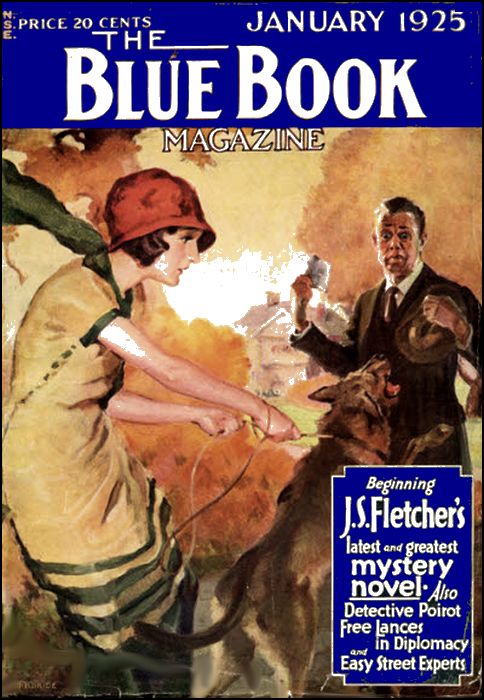
The Blue Book Magazine, January 1925, with "Wine-Vaulting Ambition"
"IN our life a man must have a little stimulant now and again—as well as good food," said Mr. Bunn emphatically, as he set down an empty liqueur glass. "And there goes the last of the old brandy," he added rather sadly.
Lord Fortworth—now, his partner—nodded fiercely. Although some months had elapsed since he dropped his title in favour of the more modest name of Mr. Henry Black (until such time as it would be policy to change it), he found it difficult to bring himself to think economically before he spent money.
The two had not made a coup since they obtained the bulk of Lady Fortworth's jewels on the occasion of their bolting from the Fortworth mansion in Park Lane, and money was getting tight. They were holding the jewels until the hue-and-cry had died down sufficiently to enable them to get a fair price, and although, between them, they had some fifteen hundred pounds or so in ready money, that was not a large sum for two men who dined in the thorough manner to which they had become accustomed, and who had a big motor, a flat in town, and a quiet, unobtrusive little country resort on the Hampshire-Surrey border to keep up.
They were both as far-sighted as vultures and considerably more particular about the quality of their meals. And although not acutely uneasy about the future, nevertheless they had just come to the conclusion that it was time to get actively to work.
It was at this stage that they discovered that the stock of "stimulants" at the flat was running out.
"What we ought to do is to lay in a thoroughly good supply of wines and stuff in the cellars at Purdston. We can supply the flat from there as we need it," said Smiler. "Only it'll cost us four or five hundred pounds that we can't afford."
"But we must have something to drink," said ex-Lord Fortworth across the luncheon table.
"Well, then, we shall have to commit sacrilege, and rob a brewery," suggested Mr. Bunn luminously.
Mr. "Black" nodded.
"Sure," said he, "that's it. What's the matter with taking the car down to Purdston, running out from there one night to the wine vaults at Andover, and bringing away a load or two of the pick of the stuff?"
Smiler's eyes brightened, and he raised them from the empty liqueur glass he had been wistfully regarding.
"Fort—Black, you're a man of ideas. I always knew that a man who'd gone through a course of financial work in the City would make the finest 'crook' in the world—the—finest—crook—in—the—world," he said enthusiastically. "Why haven't we done it before? You ought to know those works like a book—they belong to you by rights, if it wasn't for that lot of creditors. Brewery, distillery, and wine vaults, all in one, ain't it? We might have a look at the safe, too, when we're there." He pressed the bell for Sing Song. "Pack our bags for a week in the country, Sing, my son," said Smiler, "and order the car to be round from the garage in an hour's time."
"Yes, master."
The bright, beady eyes of the saffron scoundrel twinkled as he remarked this sudden activity.
"You needn't look so delighted, Sulphur," commented Mr. Bunn genially. "You'll probably end in getting ten years. Hook it, now."
Sing Song let out a flicker of teeth as he smiled and noiselessly "hooked" it, while his masters proceeded to finish their cigars and take a short nap each for the sake of their digestions.
SOME two hours later the big, luxurious motor slid along the drive of the lonely and retired old house outside Purdston, which the partners had fitted up according to their own ideas of what a "headquarters" should be.
It was a convenient place from which to rob the huge brewery of which, in his palmy days, Lord Fortworth had been chairman and controlling shareholder. The works were at Crayton, just outside Andover, and Purdston was some twenty-five miles or so away.
A stout, very polite manservant of about thirty years received them at the door, and took the car round to the garage. This was Mr. Bloom, an ex-butler of Fortworth's, who had been surprised half-way through an ingenious little forgery scheme involving the borrowing of his master's name. He had escaped in the nick of time; but shortly after Fortworth's failure the ex-millionaire had encountered him, very poverty-stricken, on the pavement, and had put him and his wife into the house at Purdston to look after the place, at the low figure that the lack of a reference made Bloom only too anxious to accept. It would have been sheer affectation to treat the fat rogue as being worth good wages, anyway; but although not such an expert all-rounder as Sing Song, he was very capable, when sober, and his wife was an unusually good cook. Bloom, who had begun life as an actor, would have been a fairly efficient "crook" himself, but was spoiled by too keen an appreciation of the fruit of the vine.
The partners had discussed their plans on the way down, and after an unambitious dinner and a couple of cigars, they had the motor round, and, with a final injunction to Bloom to keep sober if he valued his job (and liberty, for Fortworth still held the attempted forgery over his head), they started for Andover, planning to reach the works at about twelve o'clock.
THERE was a bright moon, the roads were good, and the car—a nearly new Rolls-Royce in which they had invested— ran silent and tranquil as a happy dream.
Smiler sniffed the cool night air appreciatively.
"I feel good to-night," he said; "good and lucky and greedy. I've got an idea we're going to make a haul to-night. I suppose there's some pretty hot stuff lying idle in the vaults, ain't there?"
Fortworth nodded solemnly over the steering wheel.
"There's a bin of '42 brandy in the spirit vaults, worth five pounds a bottle," he replied reverently. "We used to try it at board meetings sometimes. And there's some wonderful East India Madeira. It's not a wine that's so very popular, for some foolish reason or other, but—well, you and I know all that's necessary to know about Madeira. And some of the white wines—particularly an '81 Chateau d'Yquem—are worth attention. The best of the champagne is good—I'm talking of the cream of the vaults—and there's a curious old port that we paid a fancy price for—there was only fifty dozen, and we'll grab the lot—if the directors have left any for us to grab. It's a heavy wine—a very heavy wine to an ordinary man. I guess we shall find it a nice reasonable port. And that reminds me—Gee! was that a goat we went over or only a cat?" he interpolated as the big car lifted a shade—"that reminds me of a few cases of Imperial Tokay one of the Continental travellers found and we bought. We'll sure hook that! The clarets are passable, specially a '77 Chateau-Lafitte there used to be there, and the Burgundies are useful. We must take a few dozen of some Clos-de-Vougeot I know of. There used to be a lot of astonishing Italian wines. You'd think they were rough at the first glass—you know how these Italian wines are—but you'd end in finishing a couple of bottles and cussing the butler for more."
Mr. Bunn sighed regretfully.
"I wish we had a motor pantechnicon," he said. "And were able to take our time."
"Well, nobody believes in wines more than I do," commented Fortworth, "and we'll do our best. It's a big car, and if all goes well we'll call again some day. We turn in here."
He cut off the electric current to the powerful lamps, and the motor swung silently off the main road towards a number of big buildings that stood up blackly in the moonlight.
"They're working in the brewery—that big place with the lights away to the right, but we turn off for the wine vaults before we get very near the beer department," muttered Fortworth. "We shall have to chance the watchman. If we meet him, leave him to me. I did him a good turn in the wealthy weather—when he needed it."
He turned again, ran right up under a long, low building, and, completing a circle, backed the car into the heavy shadows of a paved courtyard. They alighted quickly as firemen and silent as only fat men and thieves can be when they wish.
Fortworth led the way along the side of the building, and stopped some fifteen yards from the motor at a small door.
"Here we are!" he said. "It's locked; but there are no bolts on the inside, if I remember rightly."
Mr. Bunn bent to the keyhole, taking a bunch of rather thick skeleton keys from his pocket. Before starting work on the lock he tentatively turned the handle, and—the door opened!
"It's not locked," said Smiler, and stepped in.
"Ought to be," grunted Fortworth, following.
Sing Song was about to enter in his turn, blandly smiling at the thought of the opportunity to quench his patent Celestial thirst, when Smiler leaned back and, over Fortworth's shoulder, gave him his instructions in a sharp whisper.
"You mind the door, Sing Song, and keep your lamps trimmed for the watchman. If he comes along keep inside till he's past. If he spots the motor, hop out and stop him from giving the alarm."
"Killee him, master?"
"No, you ape! I've spoken to you about your 'killee' tricks before. You start killing anybody while you're in my employment, my primrose coon, and I'll put a magazine-full of bullets into your clockwork. See? When I say 'stop him,' I mean trip him and gag him. When you hear me whistle, come quietly on down the passage for a bit of weight-lifting."
He took out an electric torch and flashed a discreet ray through the gloom ahead.
"Lead on, Magog!" he said, with a dim idea that he was quoting poetry to Fortworth, and the two moved quietly down the passage. At the end of it—some six yards along— they came to a small square recess. Smiler flashed the light in, and both men stiffened. In the recess was a plain deal table and an ordinary Windsor chair with wooden arms. A man was sitting in the chair, his arms sprawling across the table, and his head on his arms, dead asleep. On the table was a bottle of milky-looking tea, half empty.
"The watchman," whispered Fortworth. "Call the Chink in."
But Smiler tip-toed up to the table, took up the bottle, and smelt it.
"It's tea, all right," he said, and looked curiously at the sleeping man, listening to his slow, heavy breathing. "I never heard of a man getting so far as that on tea," he muttered. He craned over the man's flattened shoulder and sniffed. "Drugged!" he said.
"Gee!" muttered Fortworth softly. In the white light of the flash-lamp the two looked at each other interrogatively. "Queer, ain't it?" whispered Fortworth.
"Maybe someone else on the same lay," replied Smiler. "I've known it happen before. But—we'll soon see."
He backed down the passage and uttered a low, soft whistle, that resembled the sound of wind passing a keyhole as much as anything. Sing Song floated noiselessly up, and Mr. Bunn flashed his light over the sleeper.
"See that man?" he said. "It's the watchman—and he's drugged, Sing. You stand here in the dark and watch the watchman—until I want you."
Sing Song took up a coldly business-like position behind the watchman, ready to grip him the instant he stirred, and Smiler turned away. Fortworth was already moving to a door facing the recess. But he did not touch the handle. He waited for Smiler. All that sort of delicate, soundless business was in charge of Mr. Bunn. When Fortworth had been one of the money-captains he exacted obedience from his assistants, and now he was an assistant he had the sense to extend obedience to his superior—his superior in practical burglary, at any rate.
Under Mr. Bunn's firm but suave manipulation the door opened into a room in pitch darkness.
"The general manager's room," breathed Fortworth. "There's a door opposite leading into the counting-house—where the safe is. The entrance to the cellars is on the far side of the counting-house. If there's anybody here, they're at the safe."
"Listen!" said Smiler sharply.
His fingers closed on Fortworth's arm like steel hooks. They stood in the dark, listening. Then, very faint, came a quite unexpected sound—as of someone sobbing quietly in the counting-house.
It is a very disconcerting noise to hear at black midnight in a huge, echoing building—the sound of grief. Smiler lit up the door for a half second and then crept across. Fortworth waited where he was. He heard nothing, but presently he saw a faint, perpendicular knife-edge of light appear on the blackness. His partner was opening the door with the silence and infinitesimal movement of a cat stalking an unsuspecting prey. The sound of subdued weeping grew louder, and the light-streak broadened fractionally, until it was some two inches wide. Then it ceased, and Fortworth suddenly became aware of a shadow at his side.
"Go over and take a look," came Smiler's keen whisper in his ear. "This is a new kind of puzzle to me."
Together they stole over and peered through.
All they saw was the slim figure of a woman bending over a big roll-top desk near the fireplace, hiding her face in her hands and crying hopelessly to herself. Her hat was off, and the gleam from a small bicycle lamp on the top of the desk fell full upon her hair, burnishing it to a bright gold.
"Why, it's Eily—poor little kid!" whispered Fortworth to himself. "What's wrong, anyway?" He drew Smiler back from the door. "That kid in there is assistant cashier. She's the cleverest little dame at figures I've ever struck. She came to me, and I liked the look of her and the way of her. Gave her a trial, and she knocked spots off most of the men. So I made her assistant cashier—though crying here at midnight by the light of a bicycle lamp is no part of her duties."
"How about those account-books, though?" whispered Smiler. The desk at which the girl sat was piled with big business-like books.
"Don't know. Let's ask," said Fortworth, and walked into the counting-house as though he was still monarch of the place. He placed his hand on the girl's shoulder. "Why, Eily, what's the matter? You mustn't cry like this," he said, more kindly than he usually spoke to any woman—not excluding his wife that had been.
The girl looked up with a start. Smiler, his electric lamp in full flood, saw that she was very pretty, in a sweet, wistful, clinging way—only now her face was pale and drawn with weeping.
"It—it's Lord Fortworth!" she said incredulously.
"That's right, Eily Desmond—bankrupt old Lord Fortworth come back again," said the ex-Baron.
But he spoke absently, for his eyes were skimming a sheet of foolscap paper that lay on the desk before the girl, starred with tears. His brows were drawn together in a black frown.
The girl started again, and reached out for the sheet of paper.
"Oh, please, please don't look—" she began.
But Fortworth caught her hands quickly, though not un-gently.
"I must, Eily. It's my business, I think."
The girl lost control of herself suddenly. She fought to free her hands.
"You mustn't—you mustn't," she panted.
Smiler reached swiftly under her arms and twitched the paper off the desk. Fortworth dropped the girl's hands and turned to his partner. His eyes were suddenly bloodshot, and Smiler saw that they glittered with a pale mad light that sent a thrill through him. His hard mouth and jaw were set like stone.
"Give me the paper, Flood," he said. "I'm ripe for murder!"
Eily Desmond covered her face with her hands again and groaned. It was a queer, plaintive, little, hunted sound, such as a hare coursed to the limit of its strength—with death ravening a yard behind it—might utter, and it went to Smiler Bunn's big, generous heart like a knife. No man ever was more ready to help those who needed help—or to help himself from those who needed no help—than Smiler. He bent over the pretty golden head as though Eily Desmond had been his own child—instead of a stranger whom he had never met till then.
"Don't cry, Eily, dear," he whispered. "It'll all come right—we'll see to that, Fortworth and me. Come on, Eily." He patted her shoulder. "You mustn't mind Fortworth. That's his way—besides, he wasn't thinking of you when he spoke about murder. You've got nothing to worry about. I'm here—and Sing Song's in the corridor outside," he added desperately, as the grief of the girl showed no signs of subsiding. "Come on, Eily," he urged. "Look up and you'll see Fortworth's not thinking about you at all. I'd wring his neck if he insulted you in front of me. Perhaps he was thinking of—"
"Sheldrupp, by God! Sheldrupp!"
The name came from behind them like the snap of a whip. The girl raised her head with a start, and both she and Smiler turned to Fortworth, who was smiling cruelly at the paper in his hand. He looked across at Eily Desmond's frightened face and his lips softened.
"I say, Eily, tell me why you came here like this—midnight, bicycle lamp, drugged watchman, and all that—to get out this list of—things?" he asked.
His tone was kind, but his eyes pierced her.
Suddenly she flushed—flushed from the curls at her forehead to the lace at her slender throat. She said nothing. Fortworth drew his own conclusion from the flush.
"Come, Eily—I want to be friends with you. You're in love with Sheldrupp, and don't know how to tell me. Is that it?"
She nodded slightly, and Fortworth made a little sound of regret with his tongue.
"The man's a thief," he said. "You must learn to forget him—he's not good enough for you. Is he still general manager?"
The girl nodded again.
"And he's been faking things." His eyes skimmed over the list once more. "Why, the grafter must have been dipping up the money with a bushel measure! But why are you getting out this list, Eily? Every item is an IOU for penal servitude. Didn't you know that? Oh, you can't go on loving a crook like that, my dear. I thought he was planning to marry the rich old widow woman the other side of Andover—Mrs. Whatsemame—Melford. He told me so months ago. Is that all off?"
"No." The girl's reply came very faint. "They are going to be married next week."
"What?" Fortworth looked puzzled for a moment; then his heavy face lit up with a sort of savage triumph. He winked ferociously but furtively at Smiler. "I see—poor little Eily," he said gently. "The fool threw you over for Missus Moneybags—not knowing that you knew about these secret commissions and things he had been taking and faking, and at the last moment you lost your head a little and decided to let him see that you had him in the hollow of your hand. Only we came and interrupted you—and saved you, Eily. We saved you sure from Sheldrupp, for he would have married you rather than risk this list—and you'd have been done for. You'd have hated him in a week—for the man's a swine, my dear. You're miles too good for him." He took the limp hand of the girl in his own. "Give it up, little Eily Desmond," he said. "We'll look after you—find you a nice boy, straight like an arrow, and blue eyes and curly hair, for a husband. Won't we, Flood? You mustn't think any more about these brewery hogs. You'll give him up now?"
Very slowly she nodded.
"That's a good girl." He shook her hand and became business-like. "Now, Eily Desmond, I want you to do me a small favour. Give me out the books and letters and anything you've got relating to this list, and let me run through 'em. While I'm doing that you show my friend here the way to a few wines." He took a catalogue from a table close by, and rapidly ticked off a number of items therein. "There, Eily, show him and his servant the way to the wines I've marked. I'll take all the responsibility."
The girl obediently brought him the books and documents he asked for, supplementing them with a thick package of letters which were the outcome apparently of her own private inquiries, and, leaving him alone poring over these in the light of the bicycle lamp, she led Mr. Bunn and Sing Song through the wine vaults.
For the next half-hour Smiler kept the Chinaman busy giving an imitation of an overworked baggage camel. Case after case of expensive wine was carried swiftly, silently, and gladsomely out to the big motor, until at last the car would take no more. It was filled to the "brim" with bottles, hastily but carefully packed in straw. A shallow hole had been left for one passenger—for appearance sake—and two fur rugs were flung carelessly over all. Then Smiler and the girl went back to Fortworth. He had almost finished what he had set himself to do. He asked one or two quick questions, and then folded up his papers and put them away.
"And now, you must run away, Eily. It's past two o'clock. Have you got your bicycle? Yes. All right, then. How about your landlady? You've arranged that, have you? Thinks you're at a party, eh? Well, the sooner you're in bed the better for those white cheeks, my dear. So good-bye. Say nothing at all about to-night to anybody, and it'll all come right. We shall write to you, or come and see you soon—when we've found that boy." He chuckled. "Don't worry about the watchman—and throw the rest of the drug down the drain. Little girls mustn't play with drugs. Good night, Eily."
And between them he and Smiler escorted the girl to the door and watched her ride away. Then they returned to the watchman, poured away the remainder of the drugged tea, removed all traces of their visit, closed the doors, and climbing into the car glided silently out into the main road, with Sing Song sitting like a Chinese Bacchus amidst the wine. A little way along they switched on their lamps, and without a hitch or mishap boomed home to a supper which both honestly felt they had earned. They wound up with a bottle of the Imperial Tokay. Its jolting had not improved it, but, nevertheless, it was imperial enough to enable them to perceive that the staircase seemed to have taken a New Art twist as they went upstairs to bed.
THE forenoon of the following day they devoted to figures—clouds of them, like gnats in a sunbeam. And the sunbeam shone full upon one Gregory Sheldrupp—general manager of the Imperial Supply Breweries Company, Limited, of Crayton.
Briefly, it was abundantly clear that Mr. Sheldrupp had for some years past been labouring under the delusion that the I.S.B. Co., Ltd., was in business to act as a kind of automatic annuity-supply to Gregory Sheldrupp. He had robbed the company with both hands and with his teeth also—"tooth and nail," as Smiler put it. Secret commissions, faked purchases, discounts that came back to the giver like a boomerang, advance payments on account for visionary plant, contracts renewed (for heavy secret payments) for months beyond the time-limit, and a score of similar subterranean thefts, some of which had appeared in the books, as, for instance, purchases at prices considerably above market value, and some of which did not appear in any of the firm's books at all. But the letters which Eily Desmond had received from various people and firms shed daylight on these latter transactions. The girl must have worked desperately to have found out what the letters proved.
At last, just as Bloom ballooned silently into the room and announced lunch, Lord Fortworth put down his pen and stood up.
"Well, that hippopotamus-mouthed hog has taken a bite the size of a new moon out of the company—as near twenty-four thousand pounds as you can get. Proved pinchings, mind you. It's made up in about forty items—some big, some small—but the penalty of each is sure penal servitude. We must have him pulled, Flood."
Smiler laughed.
"Pulled!" he said. "I do not pense, as they say in France. You leave this to me from now onwards. There's money in it. Let's have lunch now, and when we've taken the edge off our appetite I'll tell you the way we must get it."
And they went fraternally into the dining-room, discussing as to how soon after its jolting of the previous night it might be possible to start in on the wine seriously and in earnest.
THAT night Mr. Gregory Sheldrupp was dining at "Missus Moneybags," as Lord Fortworth had so coarsely put it. The lady, certainly, was distressingly wealthy, even as she was profoundly intolerant of lapses from the straight but narrow path of rectitude; but save for these little idiosyncrasies—if a permanently bloated bank balance can be called an idiosyncrasy—she was an average, ordinary, everyday woman, kind, fond of entertaining, interested in her clothes, and fond of the homage of good-looking, youngish men. Practically every hard-up "stiff" (from Lord Fortworth's extensive vocabulary) in the South of England had proposed to her. But the happiness of settling down within easy grabbing reach of that bank balance seemed to have been reserved for Gregory Sheldrupp—who, when he had seen the opportunity, had incontinently broken off his engagement to pretty Eily Desmond. A proceeding not difficult, in view of the fact that—for business reasons—it had never been made public.
There were some fifteen guests, including Sheldrupp, at Crayton House, the residence of the wealthy widow—Mrs. Melford—and they were just toying with their dessert in the faintly flushed and slightly overfed manner for which these country-house spreads are not infrequently peculiar, when a big, powerful motor drove up to the door, with two burly, official-looking men in front and a hard-looking, yellowish companion behind.
One of those in front and the tough-featured gentleman at the back alighted in a quick, businesslike style. The driver—goggled and peak-capped and heavily-coated—remained in his seat. Without hesitation the two proceeded to the door, and while one knocked peremptorily, the other played a short but doubtless effective solo on the door-bell push.
Just before they did so the burlier of the two leaned over to the other, whispering:
"Sing Song, my lad, if you mess this up I shall take a chisel and mallet to you when we get back to Purdston. See? So mind your orders—and stick to 'em."
Sing Song, in regulation boots and clothes, which, although quite plain, had a pronounced official look about them, nodded and squared himself. He did not speak. It was one of his orders not to speak that night.
The door opened, and a footman framed himself in the doorway. Smiler Bunn and Sing Song stepped in without words.
Smiler fixed the footman with an eye of steel.
"Mr. Gregory Sheldrupp here, my man? If so, fetch him. Tell him quietly that Detective-Inspector Irons, of Scotland Yard, would like to speak to him."
The footman opened his mouth, observed that in the face of this peremptory caller with the sinister name that caused him to close it, and with a muttered, "Yes, sir," departed, leaving them alone in the hall.
Mr. Bunn's swift eye fell on a gold-mounted jewel-set fan lying slightly under an oak seat at one side of the big hall. Obviously, it had been dropped unnoticed by someone who had been sitting on the seat. He picked it up, with a muttered comment on the untidiness of the rich, and put it—in his pocket. He was a most fastidious man, Smiler Bunn.
Presently the footman returned, followed by Sheldrupp—a tall, fair fellow, handsome in the florid, full-faced style that in the long run develops into terraces of double chins and a Condy's fluid complexion, with blue eyes that were bold enough in a watchful sort of way. He had just reached the age when a man begins to speculate in hair-tonics as a sort of insurance against the time when the leaves begin to fall, and he looked precisely the sort of man who would be likely to get a sixty-horsepower clutch on the heart of a rich widow with a bias towards plainness of face. He came forward briskly enough—the colour on his cheeks going a little patchy as his quick eyes took in the grim, unfriendly aspect of the callers. Smiler, certainly, was not looking cordial, and there was always a touch of the hangman in Sing Song's appearance in English clothes.
But Sheldrupp had nerve.
"Ah, inspector!" he said quickly. "You want to see me about that insurance case, I suppose?" His eyes implored Smiler to avoid a scene before the footman and another of his kind who had arrived from nowhere. "Will you and your assistant come this way?"
Smiler nodded dourly, and Sheldrupp led them to a small room opening off the hall. He carefully closed the door and turned—very pale now.
"Well, Inspector Irons?"
"I have a warrant for your arr—" began Smiler metallically, but Sheldrupp threw out his hand defiantly.
"Oh, never mind the recitation!" he said cynically. "You can do it well enough for an encore, I don't doubt. What do I do now?"
"Oh, you just come along—that's the usual thing now," said Smiler. "You come along with me—I've got a car outside."
He put his hand in his pocket and withdrew a pair of well-polished handcuffs that shone evilly and suggestively in the electric light. Sheldrupp's face changed.
"Oh, hang it all—can't you manage without those beastly things?" he said, agitated. "Look here, who has put you on to this?" he added quickly. "At whose instance are you arresting me? The Board of the I.S.B. Co.?"
Smiler shook his head.
"No—Lord Fortworth."
"Lord Fortworth '" echoed Sheldrupp. "Why, he's bolted! Absconded! The police want him as well."
"That's all right, my friend. The police know where to find him when the time comes, but we want a few of the crooks that robbed him first. You leave the police to attend to their own business—which at the moment is to land you in the refrigerator."
Sheldrupp made one more effort. He came close to Smiler and whispered furiously in his ear. Sing Song, as per instructions, was standing as far from Smiler as he could without attracting attention.
"Look here, inspector," said Sheldrupp. "This is hard luck. I've had about thirty thousand quid from the company all told, and I've lost the lot. Mining specs, mostly. If I go to gaol the company'll get nothing—not a farthing. If they wait till next week I shall be controlling nearly half a million of money—I'm marrying it. And the company will get back every penny, plus interest. Give me a week—I'll make it worth your while, too. I'll see the Board to-morrow and fix them. They stand to make thirty thousand quid by calling you people off. They'll not get an oat by putting me in gaol. And you're on a thousand quid to nothing if you can fix it! Say you couldn't find me—anything. I'll lie low till I fix the Board. Come now, is it a go?"
Smiler pondered it with a deliberation that must have been maddening to the man watching him. Then at last he delivered himself of the result of his cogitations.
"You're going to be pretty liberal with your missus's money, ain't you?" he inquired.
Sheldrupp snarled at him like a trapped wolf.
"What the Bottomless Pit has that to do with you?" he said. "Is it a go?"
"I've got my job to think of," Smiler reminded him.
"Oh, well, say two thousand for you, then!" snapped Shel-drupp impatiently.
Smiler looked at him heavily.
"And my pension," he said.
"Three thousand!"
Smiler slowly shook his head.
"Then there's my wife," he mused aloud.
Sheldrupp stamped with impatience.
"Oh, say four thousand!"
"And the kids! And my life insurance! And the mortgage !"
Smiler rolled them off one after the other, and Sheldrupp ground his teeth.
"Look here, say five thousand for you, then."
But Smiler still shook his head.
"Well, how much do you want, you shark?" demanded Sheldrupp, and Mr. Bunn's face brightened up a little.
"I want the lot!" he said frankly.
Sheldrupp looked dazed.
"But how about the company? If I give it to you instead of refunding to them I'm no better off. I shall only get another detective down for me," he said.
Smiler raised his hand.
"Now, I ask you—is that any of my business? Is it? Your debts to the company is your business. Your debts to me is my business. Please yourself whether you pay the company or whether you don't. But if we do business I've got to have my little bit."
Sheldrupp glared at him.
"It means paying twice over—once to the company, once to you. Sixty thousand quid! My wife won't stand it."
"What do you keep on dragging your private affairs into it for?" said Smiler. "If you can get money from a company you ought to be able to get it from your wife. Anyhow, please yourself."
Sheldrupp gave in—not gracefully.
"All right, you wolf!" he said. "How do you want it? I must have time."
"I'm no wolf," replied Smiler. "I'm your best friend. I'll give you time. I want five thousand the day you get married to the bank. And five thousand a month—kindly close your phonograph till I've finished speaking—five thousand a month for five months. And I'll fix him—no extra charge!" he indicated Sing Song. "I'll keep off arresting you for a week," he said, "and it's for you to arrange with the Board within that time. After that you will be safe enough—unless you try any funny business with me," he added with sudden menace. "I'll take your promissory notes now—so that it doesn't slip my memory."
He produced a packet of stamped forms and a fountain pen.
"I've sold my reputation cheap," he said regretfully as he handed them over.
"Your what?" sneered Sheldrupp.
But he filled in the forms.
"And now get out of my sight," he said, his voice thick with rage.
Smiler read the notes, folded them, and tucked them away in his pocket.
"Yes," he said blandly, "I expect you feel as though you would like to be alone for a little while, don't you?"
Sheldrupp rang the bell for the footman without answering. The servant appeared.
"Well," said Smiler taking his hat, "good night, Mr. Sheldrupp. I will keep in close touch with you—and shall hope to see you at least once a month—until the affair is settled. You may rely upon that. Good night."
Sheldrupp growled "Good night," and the pair followed the footman. Not till the motor was half-way down the drive did Fortworth speak.
"Get anything?" he muttered.
"Thirty thousand—at five thousand a month."
"Gee! snakes, you're a genius! Don't speak. Let it soak in! And I wanted to waste the man on Dartmoor."
Presently Lord Fortworth spoke again.
"Some of the wine ought to be drinkable to-night," he said ruminatingly.
"Ought to!" echoed Smiler. "It's got to be!" Another pause.
Then Lord Fortworth found his voice again.
"When do we get the first five thousand?" he asked.
"The day he's married. Next week. Only—that instalment is for Eily Desmond. She mustn't know where it comes from, of course."
"Sure not," muttered Fortworth. "I agree. Eily deserves it—and she shall have it. How about a share for the Chink—Sing Song?"
"Sing Song!" echoed Smiler. "That lemon! Sing Song can go to the devil. What do I pay him eight bob a week for?"
Sing Song, sitting behind, heard, for he had ears like a bat—both in size and quality. But he only smiled blandly. He knew all about his master. While Smiler Bunn lasted Sing Song was perfectly aware that he was provided for—both as regards work and money.
He chuckled a heathen chuckle, and settled down to take a short nap.
And the big car slid silently on through the night to the comfortable retreat of the two "crooks" at Purdston.
Roy Glashan's Library
Non sibi sed omnibus
Go to Home Page
This work is out of copyright in countries with a copyright
period of 70 years or less, after the year of the author's death.
If it is under copyright in your country of residence,
do not download or redistribute this file.
Original content added by RGL (e.g., introductions, notes,
RGL covers) is proprietary and protected by copyright.