RGL e-Book Cover©
Roy Glashan's Library
Non sibi sed omnibus
Go to Home Page
This work is out of copyright in countries with a copyright
period of 70 years or less, after the year of the author's death.
If it is under copyright in your country of residence,
do not download or redistribute this file.
Original content added by RGL (e.g., introductions, notes,
RGL covers) is proprietary and protected by copyright.
RGL e-Book Cover©
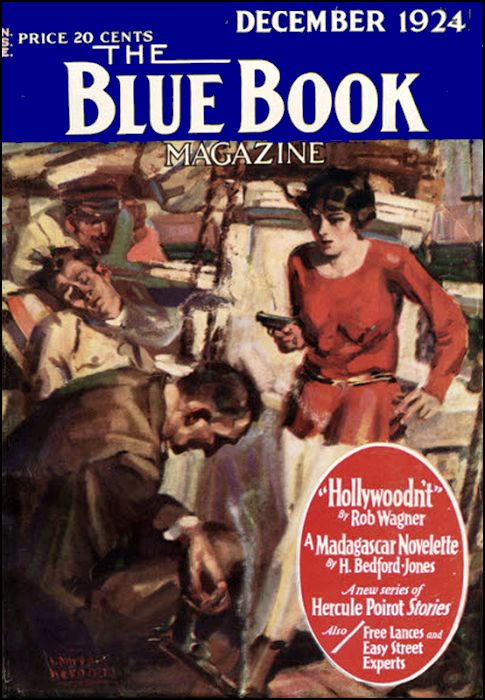
The Blue Book Magazine, December 1924, with "Exit Lord Fortworth"
BUT it was not long before a new form of anxiety began to obtrude itself upon the mind of Mr. Bunn, and one day after an excellent lunch he was moved to unburden himself on the subject to his loyal yellow familiar, Sing Song.
"There's more in being rich than just getting your hooks on the money, Sing Song, my son," he remarked. "You've got to know how to keep 'em on. And to do that properly you've got to be a bit of a conjurer, a bit of a fasting man, a bit of a miser, and a bit of a born genius. And even if you can keep 'em on, there are drawbacks to it. If a man's got money he's a fool if he doesn't do himself well at mealtimes. What's the result? Well, look at me—getting on for sixteen stone, to tell the truth. Very awkward weight. And you've been developing, too, you Mongolian thief. If you haven't put on two stone since I retired from active business, I'll forfeit my breakfast to-morrow. The fact is," he concluded, rising from the table, "the fact is, we're getting too fat—fat-bodied and fat-headed—and it won't do. Damme, we shall be having apoplexy next. I suppose it was all for the best, but the change from Mr. Smiler Bunn, Business Man, into Wilton Flood, Esquire, hasn't improved my beauty nor my brains, and there are times, my lad, when I could very nearly wish myself back in the old hand-to-mouth, happy-go-lucky days. Pass the cigars, and look alive."
He subsided into an easy-chair before the blazing wood fire and prepared to smoke.
"Yes," he continued, half to himself and half to Sing Song, who was moving quietly about the table clearing away the ruins of the lunch. "Keeping your hooks on your own is nearly as troublesome as getting 'em on somebody else's. There wasn't much chance of getting over-stout in the old days; had to keep on the move too lively. But these last years have been easy times, and—" He stopped suddenly, his hand pressing hard upon his heart, his face pale, and his lips twitching with pain.
"Sing Song, it's all over—it's come at last!" he said.
The Chinaman looked startled.
"Master bad?" he exclaimed anxiously, for he worshipped his master.
"Bad! Certainly, you fool—indigestion!" snapped Smiler.
There was a solemn pause while he tenderly felt himself.
"That's done it absolutely, if it is indigestion." He pressed tentatively and recoiled at the sharp pricking pain at his chest. He dropped his hand. "Yes," he said sadly, "it must be. Now, I suppose I've got to starve myself very near in order to get any comfort at all."
He leaned back, contemplating his cigar mournfully. He noticed that the pain ceased as he leaned back. He leant forward again, and instantly felt the sharp, burning stab once more. His eyes suddenly lighted up, and he felt his tie. Then he plunged his hand under his waistcoat, groped there a moment, and withdrew it, holding between his fingers a fine diamond pin.
"Indigestion be damned!" he cried triumphantly. "It was this pin hurting me. Slipped out of my tie and down between my waistcoat and shirt. Give me another liqueur, Sing, my son. I must celebrate this, fat or thin!"
And he did.
SING SONG finished his clearing away with the dexterity and silence which had long become a habit, and departed, leaving Mr. Bunn to the doze which usually followed lunch.
But somehow Smiler could not drop off this afternoon. It had occurred to him that during the last few months his great friend and crony, Lord Fortworth, had not been himself. He had lost spirits, appetite, and more important—weight. He had seemed worried. And it was worrying Mr. Bunn a little, just as it worries one to see one's solicitor worried, when that solicitor has control over the whole of one's income. Which was practically the case with Mr. Bunn.
When he had retired from active participation in what he termed the "crooked game," and in the name of Wilton Flood, had settled down to enjoy life upon the fifty thousand pounds which he had amassed, he had gradually invested the whole of this money in the various companies, breweries, and so on, which were controlled by Lord Fortworth. He knew that Fortworth held him in greater esteem probably than any other man of his acquaintance, and he knew the ex-gold-digger to be enormously wealthy. So wealthy, indeed, as to make the occasional secret grabs at his wealth which Smiler had very successfully taken, losses of little importance. Ever since then Lord Fortworth had regularly obtained a twelve per cent return on the money for Smiler, and the latter, living well up to six thousand a year, had gradually been content to draw his dividends when they fell due, and leave Fortworth to look after the capital.
And now Fortworth was looking worried.
Smiler was not easy about it. True, he was not very disturbed either. After all, Fortworth, apart from his business concerns, possessed a huge private fortune, and, in addition, there was always the big pile of American dollars possessed by Lady Fortworth presumably for her husband to take an occasional hack at, if it should ever become necessary. Sitting in his easy-chair, smoking and thinking, Mr. Bunn had just come to the conclusion that if his digestion only remained as safe and dependable as this six thousand a year, he looked uncommonly like touching twenty stones unless he exercised a little more vehemently, when suddenly the hoarse cry of a newsboy outside smote upon his ear.
"Wextry special! Great City smash! Millionaires ruined! Horrid scenes outside banks! Wextry special!"
Smiler got out of his chair as though he was sitting on red-hot springs. In two quick strides he was at the window, had thrown it up, and had attracted the attention of the newsboy with a yell that also attracted everybody else within a hundred yards. Then he shouted to Sing Song and sent him down for the paper. It arrived, Smiler took one swift glance at it, and sat down with a "dull thud."
"Bring the brandy, Sing," he said urgently. He had seen one word—"Fortworth"—looming up heavily among a ladder of thick, black headlines, and that was quite enough for him.
THE FORTWORTH BUBBLE BURST.
PAYMENT SUSPENDED. ANGRY SCENES.
WHOLESALE COLLAPSE OF COMPANIES
CONTROLLED BY LORD FORTWORTH.
Smiler devoured the foregoing scareheads—and many others—with a feeling that he had fallen down a well. Then he shot his eye along the jerky paragraphs following the headlines. Half a dozen sentences were enough. He dropped the paper as Sing Song entered at a quick trot with the old brandy.
He took a thirsty gulp from the tumbler Sing Song handed him. Now, that brandy was not of the quality which is intended to be drunk from tumblers. It had cost Smiler something in the neighbourhood of five pounds per bottle, and was meant to be absorbed quietly from stingy little liqueur glasses. The sudden imbibing of half a tumbler stiffened Mr. Bunn.
He snapped his fingers defiantly.
"All right," he said, to nobody in particular. "I'm bust, and it's 'back to the army again, sergeant,' for me. I was half asking for it a minute or two ago, and now I've got it, and got it good. Here goes, then!"
He thought for a moment. Then he sent Sing for his coat, and telephoned for his motor.
"I'm going round to Lord Fortworth," he said to the Chinaman. "If anybody special wants me, ring up, d'ye hear? I'm ruined, my lad—understand—bust—and we've got to get busy again like we used to be. So keep those lopsided eyes of yours on the blink, Sing, my son, for the wolf's sniffing round the door!"
He lit a cigar and went down to his car.
TEN minutes later he pulled up at his friend's magnificent place half-way down Park Lane. It was a bitterly cold day in mid-winter, and already it was growing dusk. An ominous-looking crowd was hanging about in front of the house, talking excitedly and angrily. Every now and again a section of them would turn staring up at two huge, brightly lighted windows on the first floor, and break into prolonged and bitter hooting. Already a number of police were stationed around the house, but the crowd was growing so rapidly that Smiler realised it was only a matter of minutes before the police would require reinforcing, should the crowd become vindictive. As his car moved slowly through the crowd up to the door a few hoots were directed at him—for a change apparently.
A big, burly, red-faced ruffian who looked like a blend of prize-fighter, bookmaker, and beerhouse czar, got on the step of the motor-car and thrust his head in at the window.
"Pay up, you blinkin' welsher!" he bellowed. "Why don't you make your welshin' pal pay up, fatty?"
The man had not the faintest idea who Smiler was, but he was just dying to insult someone, and Mr. Bunn happened to be handy.
He thrust his face close to the inquirer's.
"Take that visage out of my car," he said savagely, "or I'll break it. What business is it of mine, you fool? I'm not Lord Fortworth!"
Menacingly he shortened his grip on the big, hammer-headed stick he carried, and the beerhouse autocrat left the step in a hurry. Then the car drew up. Smiler passed through the police, apparently on the strength of his luxurious motor, his fur coat, and general appearance, and was received by a scared footman, who, recognising him, asked if he thought there was any danger.
"No, not danger, my son," said Smiler blandly, "not what you might call danger. We all stand a dashed good chance of being lynched, as far as I can see, so I shouldn't fret much about danger. Where's Lord Fortworth?"
"In the study with her ladyship, sir," replied the footman hastily. "All the other servants have gone, sir. Afraid of the crowd, sir." He peered through a window at the side of the door. "Very threatening crowd houtside, sir."
Smiler proceeded up the stairs to Fortworth's study.
THE corridors had not yet been lighted, and as he passed down to the room he wanted it occurred to him that he saw a man at the far end pass swiftly and silently across the corridor. But he was too anxious to see Lord Fortworth to investigate.
Without knocking, he opened the study door and passed in. Only Fortworth and his wealthy wife were in the room, and they seemed to be engaged in an unusually earnest discussion.
They turned as Smiler entered.
"Hello!" said the visitor cheerily, in quite the old-friend-of-the-family style. "Anything wrong?"
"Wrong!" repeated Lord Fortworth. "My God, Flood, everything's wrong!" He flung out his hand suddenly, indicating Lady Fortworth. "What do you think, Flood—what do you think of a man's wife refusing him a paltry two hundred thousand pounds to save him from ruin?"
He turned to his wife again.
"Why, I've spent that on your fads in one year," he said furiously. "For no damned reason except to please you for a few minutes! And now you refuse me a small loan—a loan, mind you, Flood, to save me millions! Gee, my girl, I made a mistake about you! I thought you were an open-hearted little Irishwoman, and you're only a selfish, cowardly society fake. Why, I gave you a couple of thousand for that bit of fur you've got on!"
He spoke of the wonderful sable coat she was wearing.
Lady Fortworth flushed. She spoke, and her voice was shrill and bitter with rage.
"Not a cent—not a cent!" she said, her eyes hard with selfish fear. "Why, you fool, you couldn't keep it. You a financial captain—you! Why, they'd skin you every time. You a banker! Why, you're nothing but a gambler! Spend! What do I care what you've spent on me? I married a rich man, not a dead-beat faro dealer. I expected to be treated as a rich man's wife." She snatched off the coat and threw it on the floor.
"That's what I think of your gifts. I'm not lending you a cent. I'm going back to the States, and if you approach me there I'll have you arrested. I haven't got any more dollars than I can keep busy, and I've none to spare for a half-witted gambler who's got no more brains than to buck against John D. Rockefeller and his bunch." Her voice rose almost to a scream. "That's what he's done," she continued to Smiler, who stood astonished at this sudden reversion to the language and comportment of her low birth—she had begun life in an Irish-American slum—"he's gone up against the Oil Trust, he's tried to squeeze the Railroad Kings, he's sprawled about in Wheat, he's butted up against the Steel Gang, he's done everything that's crazy and nothing that's sane. He's played the frog that thought he could be a bull, and he's swelled himself up with wind that he thought was as good as money, till the real bulls noticed him and handed him a little dig with one horn—and bust him, like you'd bust a paper bag! And he wants a loan—a loan—pah!"
She ceased suddenly and turned to the window. A storm of hoots from the crowd outside greeted her. They were mostly shareholders in Fortworth's companies or depositors in his bank, and they were hooting for the sake of their money, which they feared, with excellent judgment, was lost. But it sounded as though they had heard the bitter repudiation of the fallen financier's wife, and were directing their hoots at her.
She turned again to the two men.
"Bust!" she repeated, her raucous voice curiously at variance with her costly clothes and elaborate surroundings. "Bust! And I'm quitting while my money's safe!" She seemed to glory in her decision.
Mr. Bunn leaned over to Fortworth.
"Is it bust?" he said softly.
"Sure—by millions. I'm not worth a red cent. It's a devil of a smash. She talks as though I had stolen the money, instead of doing my best to get another five per cent, for that howling crowd outside. But people don't think of that when a man goes bust!"
Smiler grinned—a hungry grin.
"My bit's gone, of course?" he inquired, rather feebly for him.
"Fifty times over and more," said Fortworth, eyeing his wife. "I'll get you what I can, but it won't be much."
Lady Fortworth was pressing furiously at the bell. Mr. Bunn wagged his head at her playfully.
"I'm afraid the servants are 'not at home,' Lady Fortworth," he said. "There was only one survivor when I came in, and if ever a man was on the point of making a high dive for the back stairs and home he was the identical individual."
"See?" said Fortworth, in the tone of a man reasoning with a child. "Now, why don't you be reasonable and stick by me like any other man's wife? I'll see to your safety."
"Oh, cut it out!" replied the lady politely. "I guess Professor Vahana is man enough to escort me to an hotel. And he'll come cheaper. Have you got anything else you want to say before I go?"
"Professor Vahana? Is he in the house?" said Smiler in a low, quick whisper to Lord Fortworth.
"In her boudoir, I guess," said the financier in the same tone.
"Ah, then, I'll get you to excuse me for a few minutes," muttered Mr. Bunn, and swiftly left the study.
HE went straight to the rooms of the lady—cautiously, for he knew Professor Vahana. The Professor claimed to be a palmist, clairvoyant, medium, and all-round master of mystery and purveyor of magic; but Smiler, who had once dined at the same table with him (at the Fortworths'), knew him to be a natural and not unskilful "crook." To have said so to Lady Fortworth would have been much the same thing as asking to be kicked out of the house, for—hard case as she was under her society veneer—she was one of Vahana's most devout and enthusiastic followers. But Smiler had met him in the poverty-stricken past. It had been a good many years before, when he and Vahana—then circulating under the name of La Touche—had planned to amass the jewels of certain suffragettes. The affair had ended in Mr. Bunn getting practically everything, and La Touche unmistakably nothing. Nevertheless, it seemed that La Touche had forgotten Smiler. At any rate, he had shown no sign of recognition when they had met at dinner. He had known him, not as Smiler Bunn, nor as Mr. Wilton Flood, for in those days Mr. Bunn's name was temporarily Louis Connaught. True, Smiler had improved enormously since then in appearance, in manners, and in speech, whereas La Touche had altered very little. He still had the same haggard, vulturine, Sherlock Holmes face, still the same famished, hungry eyes, and still the remote touch of an American accent. Remembering these things, it gave Mr. Bunn an unpleasant qualm to think of the "Professor" in Lady Forthworth's rooms. Probably he was holding a little séance with her valuables. The very thought of it spurred him to travel up the stairs and down the corridors quicker than he had travelled for some time past.
"The man's a dashed thief!" he muttered to himself, as he padded up the wide, heavily-carpeted stairway. "Why, I wouldn't trust him with a broken mouse-trap. It's a hundred to one the blackguard's getting the jewels, if he hasn't got 'em already, and where shall I come in? That's it. Why, the man's no better than a body-snatcher, robbing ruined folks like this!" He slowed down suddenly, for he was now in that part of the house which was supposed to be sacred to Lady Fortworth and her maids. It has been explained that the lady expected to be treated as a "rich man's wife," and the appropriation of about half a house to her own private use appeared to be part of the treatment.
There were plenty of lights burning in this part of the house; probably the Professor had switched them on himself while waiting for the return of his patroness. Smiler stepped behind an elaborate Eastern curtain that marked, as it were, the entrance to Lady Fortworth's quarters, and listened.
Despite the placid laziness of his three years of idleness, Mr. Bunn was pleased to find that he had lost little of his old alertness.
"Now, Professor, let's hear from you!" he chuckled under his breath, as he waited behind the curtain, commanding with one eye a view of the wide, alcoved corridor. Hardly had the curtain ceased to move before he saw a head thrust out from the third door down—a quick, crafty head, with famished eyes, which took a swift survey of the corridor and vanished into the room again. It was the head of Professor Vahana, and its movements resembled those of a burglar in a hurry rather than those of a grave and inscrutable spiritualist.
"Yes, indeed—yes, laddie!" murmured Mr. Bunn ironically. "There's nothing like keeping a sharp look-out, is there?"
He stole noiselessly to the door of the room adjoining that which was occupied by the Professor. He entered, and found himself in a room full of clothes—gowns and costumes, coats, cloaks, furs, and such like. There was a door communicating with the adjoining room, slightly ajar.
Very softly Mr. Bunn took cover behind what looked like a selection of opera cloaks, and listened again. There was no sound; whatever the seer in the next room was doing he was doing very quietly.
Smiler stole to the communicating door and peered in. The Professor was bending over a luxurious open jewel safe, rummaging swiftly through the drawers. Something dropped from his hand and rolled on the floor under the safe just as Smiler looked in. It sounded like a ring. The man went down on his hands and knees groping for it.
Even as he knelt, his face almost touching the floor, a huge shadow slid swiftly across the wall of the room—the shadow of Mr. Bunn, suddenly inspired. The Professor heard the quick pad of footsteps, and would have turned his head, but that something suddenly fell on him—something that weighed about sixteen stones. Mr. Bunn, in fact. Smiler was not a man who believed in violence. Indeed, he loathed it. But he was thorough. He detested doing things by halves. And so he had let himself go the whole hog. He made a wonderfully effective anaesthetic, and the Professor, as his long-haired head came into contact with the floor, went comfortably into a temporary sleep, firmly convinced the roof had fallen in on him.
Smiler knelt beside him, and his fingers almost whizzed in and out of the man's pockets. He had ever been an artist in the matter of picking a pocket, but the speed at which he worked now surprised and delighted him.
It was evident that he had come just in time. Vahana's pockets were literally stuffed with jewellery. It has been shown that Lady Fortworth had a heavy hand financially, and she had not spared either her husband's or her own banking account when she was out on the diamond trail. Mostly the ornaments were diamonds, but there was a leaven of rubies, emeralds, and pearls that somehow made Smiler feel very jocular indeed.
In twenty seconds he had conjured out a selection that, properly disposed of, would keep him from want for some considerable time.
HE was just disentangling a string of fine pearls from the Professor's breast pocket, when he heard a sharp indrawn breath behind him. He turned like a startled fox.
Lord Fortworth was standing in the communicating doorway, staring at him in amazement.
"Good God, Flood, what's this?" he said with a gasp.
Smiler turned to the pearls again, carefully disentangled them, slipped them into his pocket, and stood up.
"A bit of my own back," he said calmly, and patted his pockets. Fortworth scowled. "It's not fifty thousand pounds' worth, I admit," continued Smiler, "but it's a trifle on account."
"But, damn it, you're stealing," said Fortworth, half puzzled.
"Sure, that's it," smiled Mr. Bunn, "stealing from your creditors, if these lovely little toys belonged to you. Stealing from Lady Fortworth, if they belonged to her. To tell the truth, I'm stealing 'em from the man who stole 'em first. I'm stealing, anyhow—it's a hobby of mine. Awful chap for stealing, I am. Didn't I mention it?"
He dropped his flippant tone suddenly, and took two swift steps to his friend. "Halves!" he said tensely. "Is it a go?" He had seen ruin in Fortworth's eyes the moment he had looked at him that night—ruin and more, for he had seen fear. The fear that has haunted many a broken financier, and no doubt is at this moment haunting a few more who are not yet broken—the stark fear of the Law, the fear of the long-term convict squad.
Smiler Bunn had seen it in the eyes of other men, and he recognised it when he saw it. It told him all he wanted to know; that not only was Fortworth ruined, but, further, he dared not risk examination of the operations that had brought about his downfall.
He thrust his face close to his friend's.
"Quick!" he said. "Decide. You'll have to bolt, anyway. If you've got anything stored away to bolt with, so much the better. Come in with me; we'll halve everything and start afresh."
Fortworth shook his head as though to clear his brain. Then his pale eyes gleamed suddenly, and he gripped Smiler's hand.
"I'm in!" he said grimly. "I've got nothing else, anyway. But we're too late. The crowd'll be in in a few minutes. The police can't hold 'em. An inspector came in and warned us. He gave her an escort to an hotel, but he recommended me to wait till more police came up. The crowd don't want her—they want me."
He ground his teeth on the words.
"Ah, well, they haven't got you yet!" said Smiler.
EVEN as he spoke a dull roar from the front of the house penetrated to them—the sound of the mob. Smiler stepped to the window, which faced a garden at the side of the house, and looked out. The garden was full of people. They saw him, apparently took him for Fortworth, and howled at him. It was no ordinary smash, as Fortworth had said; it was a matter of millions, and the owners of a part of these millions were taking it hard. Naturally enough, they had forgotten that if Fortworth's speculations had been successful they, too, would have shared in the profits.
The police round the house were desperately put to it to keep the doors barred, although there was not yet any real violence.
"It's damned ugly-looking," said Smiler. "Let's have a peep at the front of the house. Wait a second, though."
He took two or three of the lesser ornaments from his pockets and replaced them in those of the unconscious Vahana.
"It'll put any well-meaning detective off our track," he said with a chuckle. "The Professor wanted 'em badly enough to pinch 'em, so we'll leave him a few." He stood up again. "Now for it," he said, and they hurried down the corridor to one of the front rooms. Smiler peered out. His hired motor was waiting there. The driver had already driven it into the heads of those nearest the car that his master was not Lord Fortworth, but, indeed, was, he believed, a victim of the noble money-captain.
As he watched, Smiler noticed in the front of the crowd a fat, clean-shaven coloured man in a light grey suit and green wool waistcoat, who was shaking his fists at the windows with an earnestness that spoke eloquently of his feelings towards Fortworth. He was wearing no overcoat. The sight of this black person gave Mr. Bunn an idea. He remembered that once, in the past, he had escaped from the kind attentions of a bad gang that was trying in desperate earnestness to kill him, by the simple process of becoming a coloured ship's fireman himself with the aid of a little soot, a muffler, and a worn peak cap, and it occurred to him that Fortworth might escape through the crowd disguised as a "coon." Then, as he eyed the semi-delirious coloured creditor outside, and vaguely noted the build of the man, there came—suddenly illuminating the problem in his mind as though someone had just switched on a powerful arc-light in his brain—the Real Idea.
"It could be done," he muttered absently, wholly undisturbed by the menacing demonstrations of the crowd outside. He turned to Fortworth, who, realising the futility of leaving more in the house for his creditors than was necessary, had been making a small tour of the room, packing away certain little valuables that until now he had never really appreciated.
"The police may be along at any minute to get my scalp instead of protecting it," said Fortworth. "It's only a question of minutes before the guys back in the City get the general hang of my private books. Some of 'em I had time to shove on the fire, but there's enough left to justify 'em making out a warrant."
Now that he had accepted his destiny, he was himself again—tough, self-reliant, unscrupulous, a bad 'un to handle. He lit a cigar.
"Listen," said Smiler. "There's a fat nigger outside—" he began, and hastily explained his idea. Fortworth shrugged his shoulders.
"Sure," he said. "I'll stand for that scheme, anyway."
SMILER went down to the hall without delay. An inspector and two policemen were stationed there.
"The fools haven't got in yet, then?" said Smiler cheerily.
"No, but they're keeping our men at the door busy," answered the inspector, without enthusiasm, for he did not feel optimistic as to results should the crowd manage to get past the front door.
"Ah, well, I think perhaps Lord Fortworth might be able to fix up everything after all. At least fix up something that'll make the crowd disperse and let things be dealt with properly. But there's one man outside Lord Fortworth has got to have a few words with. He's a big shareholder and depositor, and if we can only get him in for this private conversation it might do a lot of good. He's a coloured gentleman in a light suit and a green wool waistcoat. I want to fetch him. I'm the chief creditor of Lord Fortworth, and the biggest loser unless we can fix things."
The inspector seemed to understand, for he held a short colloquy at the door with the police on guard outside, the result of which was that in a few moments Smiler stood on the steps of the front door facing the crowd. He moved down and scrambled ponderously on to the top of his motor. Then he raised his hand for silence, and there was a momentary lull.
"Gentlemen," he shouted, "I've been talking to Lord Fortworth, and I find there's a chance of getting our own back if we are smart. If there's been money lost Lord Fortworth was the man who lost it. If any money's going to be got back, I'm the man who can get it—me, d'ye understand? I've lost more than most of you put together, and I say it can be got back if you'll only have sense and allow Lord Fortworth time to consult with me and that black gentleman there!" He pointed to the coloured gentleman in the green wool waistcoat.
"He's a big creditor, too, and between us I believe we can fix up a plan at once. I want him to come into the house and consult!"
Those of the crowd who heard began to cheer, and the coloured gentleman was thrust forward into Smiler's arms as he descended from the motor top.
"Wait here," yelled Smiler to the chauffeur; "we shall be going on to the City in a few minutes." The listeners cheered afresh, and informed each other that this began to look more like "business." Smiler and the suddenly happy nigger passed through the batch of police, and the door closed behind them. They went quickly upstairs, followed by the very respectful looks of the police in the hall, to whom the rumour had already penetrated that they were both millionaires, and looked like losing some hundreds of thousands unless they were remarkably brisk.
"Losing much in this smash, sport?" inquired Smiler, as they reached the top of the stairs.
"Yessah—foahteen puhn, sah."
"Um—well, there's two tenners." Smiler handed him two bank-notes. "So you come out a winner anyhow."
The black eyes gleamed.
"Yessah—huh! huh! huh!"
"There's no need to use such a big-sized laugh as that," snapped Smiler suddenly. "This isn't a cakewalk, nor a Thanksgiving feast. Come on. This way."
He opened a door of a room—it was not the study—and politely motioned to the black to go first.
"Thank you, sah—huh! huh!—grr-rr!"
The laugh of the nigger petered out as Fortworth, waiting behind the door, took a double-handed grip on his throat.
"Make one little sound and I'll wring your neck!" said Fortworth, his pale savage eyes glaring into those of the dusky victim. "Give me the gag, Flood—quick."
Smiler handed a big sponge that was placed ready on a chair close by, and together they jammed it into the captive's mouth. He lay perfectly still, obviously scared. Fortworth spoke quickly in his ear.
"Keep quiet, and there's a fiver waiting for you when we've finished; struggle or try to make a noise and you're merely meat!" he said. The man remained almost pathetically still....
Fortworth shaved, and threw off his outer clothes. Soon one side of his face and neck was black and the other white. He was a very horrid sight. Then, while Smiler stripped the grey suit, green waistcoat, collar and tie from the prostrate black, Fortworth, with the assistance of two champagne corks charred and dipped in a saucer of villainous oily-looking compound of the deepest dye, completely changed his hue.
"Rub it well in round the eyes and nostrils and your ears," urged Smiler. "Don't be afraid of it. I'll tell you when you match. Grind it hard into your hair."
WITHIN ten minutes Fortworth had donned the captured clothes and completed his disguise. He looked now to be merely a fat, rather brightly dressed nigger of no particular importance.
Smiler scrutinised him severely, and was satisfied.
"Good," he said; "you look like brothers. Now let's rope this fathead up and hook it."
They wound nearly a furlong of box-cord round the unfortunate "fathead," roped him safely to a settee, a bookcase, and a piano, and, standing back, took a last look at him.
"He'll do nicely for a bit," said Smiler. "Now for it. Leave me to do the speaking. You hop into the motor as quick as you can."
Together they descended to the hall and were carefully passed out through the door. The mob yelled as they sighted them. Smiler gave a sigh of relief as he saw that his car had worked up to the foot of the steps. He politely indicated the motor to his companion.
"Will you get in, Mr. Montezuma?" he said, very loudly indeed. "We haven't much time to waste." A police-sergeant opened the door, and "Montezuma" entered. Smiler climbed to the top of the car again, raising his hand.
"Gentlemen," he shouted, "I'm glad to say we've managed it. At least we've got something. Mr. Montezuma and I are urgently wanted in the City to complete certain loans which will help us heavily. We believe that Lord Fortworth is doing the right thing, gentlemen."
The enthusiasm of the public speaker suddenly gripped him, and "Montezuma," leaning back in the shadow of the car, swore under his breath at the delay. "I say, gentlemen," continued Smiler triumphantly, "that I believe Fortworth is acting like a wise and capable man. His proposals mean business, gentlemen—(applause)—of that I am sure. But if he should be bluffing, then there will be trouble, gentlemen. (Loud cheers.) Mr. Montezuma and I shall return here from the City in less than an hour, and we shall then be in a position to inform you whether your losses will be refunded to you in full, gentlemen, or not! But I do ask you to keep an eye on this house until we return. Don't let us have any backdoor flitting by this bankrupt baron. (Tremendous cheering.) If he's genuine, he'll stay till we return with the guarantees. If not, he'll try to bunk, gentlemen—so look out! Watch the house, keep your eyes on the house, in case of accidents." And amid a hurricane of cheers he clambered down and joined "Montezuma." He thrust his head from the dark interior and roared out Fortworth's address in the City. "And make her move," he added gratuitously—an injunction taken up and echoed uproariously by the crowd. "Make her move!" they cried. "Make her move!"
The chauffeur obeyed, and as the car slid quickly out of sight the mob settled down to follow Mr. Bunn's advice and watch the house.
It was a typical English crowd. All they had wanted was a leader. Mr. Smiler Bunn had supplied the need, and for the next half-hour he was one of the most popular men in that part of London. But at the end of that time two other gentlemen appeared on the steps of the mansion—a lean, long-haired, hungry-eyed, pale-faced mysterious-looking man, with a lump on his forehead the size of a tangerine, and a feverish coloured gentleman airily dressed in so-called "all-wool" underwear, both of them charged to the muzzle with explanations.
But by that time Lord Fortworth and Mr. Bunn were discussing plans for the future, and valuing Lady Fortworth's jewels, over a stiffish old brandy in Smiler's flat.
Roy Glashan's Library
Non sibi sed omnibus
Go to Home Page
This work is out of copyright in countries with a copyright
period of 70 years or less, after the year of the author's death.
If it is under copyright in your country of residence,
do not download or redistribute this file.
Original content added by RGL (e.g., introductions, notes,
RGL covers) is proprietary and protected by copyright.