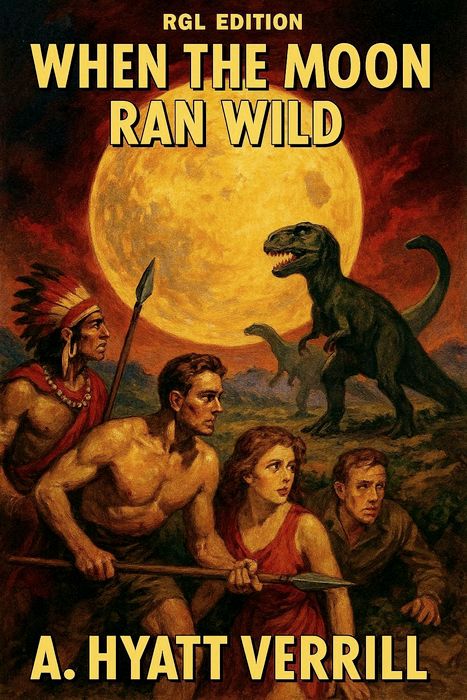
RGL e-Book Cover©
Roy Glashan's Library
Non sibi sed omnibus
Go to Home Page
This work is out of copyright in countries with a copyright
period of 70 years or less, after the year of the author's death.
If it is under copyright in your country of residence,
do not download or redistribute this file.
Original content added by RGL (e.g., introductions, notes,
RGL covers) is proprietary and protected by copyright.
RGL e-Book Cover©

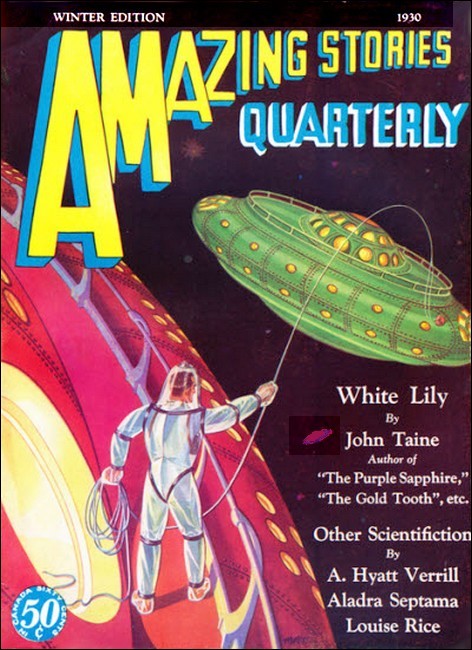
Amazing Stories Quarterly, Winter 1930,
with "When the Moon Ran Wild"
"When the Moon Ran Wild" is a classic science-fantasy adventure that blends speculative astronomy with lost-world exploration and a touch of pulp-era melodrama. The story begins when astronomers detect alarming changes in the Moon's orbit. The satellite appears to be behaving erratically—its path shifting in ways that threaten Earth with catastrophic tides, earthquakes, and atmospheric upheaval. As panic spreads, a small group of scientists and explorers attempt to understand the cause and recover from the disaster. The protagonists embark on a daring journey to a region where strange gravitational disturbances seem strongest. Their investigation leads them to a hidden, prehistoric world—untouched by time...
IN the open seas the tides are at their minimum and in the constricted bays they rise to maximum heights, but always tides are principally due to the gravitational attraction of the moon. To the casual layman observer, cosmic life is apparently unchanging. Yet, infinitesimal as the changes are, changes do occur. Suppose that for some reason, beyond our present scientific knowledge or comprehension, the moon, for instance, should increase its speed of rotation or its frequency, which would mean, of course, that it was coming closer to the earth! Notwithstanding that the world remains certain that such a thing can never happen, it is interesting to figure out, scientifically, of course, the various attendant possibilities with their inevitable dangers and results. When that figuring is done à la Verrill, by Mr. Verrill himself, disappointment must go beyond the bounds of possibility. And it does.
AGE has many advantages, that is, if together with age one retains all one's faculties, one's health, strength and energy. It enables one to observe life from the proper angle, in the proper perspective, I might say; to weigh and measure events according to their influences exerted through a long period of time, instead of for the transitory present. It gives one experience impossible to obtain in any other manner. It instills into one a deep knowledge of men and women and of life in general, that only long years can teach. It demonstrates the triviality of many matters deemed most vital by youth. It gives one a calm, peaceful and optimistic point of view. Most of all, it enables one to revisualize most vividly and accurately the events and occurrences of years past, which, as recorded in books or passed down from person to person, are seldom accurate and frequently are most incorrect.
At the time of the occurrence, of which I write, I was what was then considered an elderly man. Elderly! I smile to myself as I think of that term and what it meant in those days. Barely sixty years of age and "elderly" with the expectation, no, the possibility, of twenty or at most thirty years of life, provided I met with no accident, no serious illness.
Yet now—after more than two centuries have passed—yes, two hundred and fourteen of the old-time years, for it was in the year 1931 of the old calendar that the moon ran wild, while this year, according to the reckoning of my youth, would be 2145 instead of 165 as we know it—after two centuries and more, as I say, I am still alive, I still retain my health, my strength, my vigor, all my faculties, and am no older, mentally or physically, than on that day in 1931 of the old calendar when I was looked upon, and regarded myself, as an "elderly" man of sixty!
But everything in this world—and for all I know to the contrary in the next as well—is a matter of custom, of habit, of environment and of relativity.
I cannot help thinking—and am personally convinced of the fact—that there was an omnipotent power back of the whole affair; that it had been planned and ordered by the Creator from the beginning of time, and was as inexorable as Fate, and that it was Divine justice that the race, having been all but destroyed, should have been given the blessing of longer and better lives than ever before.
And though I am but poorly fitted for the task and am a most unworthy instrument, who can say that it was not in the Plan for me to have survived/where others fell, to have gone through the whole, in order that I might record my experiences for the benefit of my fellow men?
Reasoning from a scientific viewpoint, I feel sure it was but $ repetition of a cycle in the history of the universe and of our planet and its satellite.
No doubt, in fact, beyond any possibility of a doubt in my own opinion, each of the recurrent cycles has been shorter and less violent than those preceding it. And while I am sure that the same or rather a similar catastrophe will be reenacted in the dim and distant future, I am equally convinced that the next occurrence will be more brief and of less intensity than this last.
Yet even today, notwithstanding the vast advances we have made in scientific research, we really know very little about the history of our planet or about the laws governing the universe.
I know—we all know—what actually took place during that shattering, numbing, paralyzing occurrence known as the time "when the moon ran wild." We all know or should know the immediate, far-reaching results that followed and were produced by it. But no one knows—despite guesses and theories advanced—why it occurred, why (within historic times) it had not happened previously, why it did not continue indefinitely, why the universe slipped back into its accustomed (or nearly accustomed) existence or whether it may or may not recur at any moment.
According to all accepted theories and supposedly natural laws, as held in 1931, our earth followed (as is had followed for infinite aeons) a definite course or orbit about the sun, at the same time rotating upon its own axis.
According to the then accepted astronomical and scientific "truths," our own satellite, the moon, followed its orbit about our earth and accompanied us on our journey about the sun. According to these accepted theories the force known as "gravitation" kept everything in place and in proper relationship, and according to the rules of the game, as established by science, any alteration in the fixed positions, the customary movements, the plotted planetary orbits, would result in virtual chaos, the annihilation of celestial bodies and such vast destruction as no one could survive.
Yet when the amazing and terrible event took place all of these theories, these assumptions, these scientific rules and regulations, these accepted "facts," were knocked (to use an expression of two centuries ago) higher than a cocked hat.
There was not even a warning, a premonition of what was impending. No astronomer, studying the heavens night after night, detected anything amiss, anything unusual in the solar system or in space. There was not even a comet, a meteoric shower, a stray aerolite or a "dark planet," speeding through space following a parabola or hyperbola that might cause it to collide with the moon, the earth or any other celestial body. The entire universe appeared absolutely normal, absolutely undisturbed, absolutely serene, and precisely as it had appeared for night after night and year after year for countless centuries.
The phenomenon burst upon us literally from a clear sky, utterly unexpected, utterly unheralded, not even surmised. One moment the earth was rotating smoothly upon its axis, following its accustomed orbit about the sun, with the moon calm, serene, shedding its pale, cold light upon us; the next moment it seemed suddenly to go mad and everything was chaos.
How clearly, how vividly I recall that evening. I was in Peru at the time (you will find the locality indicated on the maps showing the surface of the world prior to the old calendar year of 1931). It was late in the afternoon, and in company with my wife and granddaughter—a child of some three thousand days of age—I was watching the sun sink towards the rim of the Pacific Ocean. In those days the sunsets in Peru were gorgeous sights and always, whenever possible, it was our custom to watch them, thrilled, entranced, impressed by the glory of the gold and crimson sky, the constantly changing play of magnificent colors that painted the entire heavens from horizon to zenith with indescribably brilliant tints and that transformed the lofty Andean Mountains in the near background to dull-red masses that glowed like molten metal.
On this particular evening the sunset was exceptionally gorgeous. It had been, I remember, an unusually hot and sultry day for Peru—such a day as often presaged an earthquake in the vicinity—and we watched the great fiery ball of the sun until it had sunk from sight below the edge of the sea. Then, as I turned for a look at the mountains and the eastern sky, I was surprised to see that instead of fading as the sun sank lower, the lurid light that bathed the mountains and the eastern sky above their summits was rapidly brightening. Even before I could call my wife's attention to the phenomenon (though that was unnecessary, for she, too, as well as our granddaughter, had noticed it) the sky over the Andes blazed with crimson, with scarlet, with gold, with colors more brilliant, more gorgeous than those that had just faded in the west. It was as if an immense, a titanic conflagration was taking place beyond the Andes. I was speechless with wonder, with an indefinable terror that caused chills to run over me. I felt my wife grasp my arm, our granddaughter cowered beside me, uttering whimpering, terrified sounds. I heard the gasping, almost sobbing, breath of my wife. I was aware of a strange, inexplicable hush, of an awe-inspiring silence everywhere; a heavy, oppressive, dead feeling in the air that seemed actually to press me down with its weight and—so strangely do trivial and minor details impress themselves upon one's mind when under the stress and strain of some overpowering emotion—I noticed hordes, thousands, of the black vultures flying madly in a dense cloud across the lurid sky. And then, tense, wide-eyed gasping for breath, numbed with terror of the unknown, as we gazed, a tongue of flame seemed to shoot up to the zenith from the mountain tops. My wife uttered a sharp, blood-curdling scream, the child shrieked, yet that dazzling sheet of fire that flamed above the Andean crest brought sudden relief to my mind, for (so my brain reasoned in the fraction of a second) it explained everything. It was some distant volcano in eruption.
But the next instant reason seemed to leave me. I drew back, tried to shrink away, screamed like a madman. Up from where that flaming light had streamed burst a gigantic, incandescent globe, like a rising sun magnified a hundred times!
I COULD not credit my reeling senses, could not believe what I saw. The sun had sunk as usual in the west not ten minutes before, and here—before my amazed, incredulous, horrified eyes—it was rising, rising with incredible speed and inconceivably enlarged, above the mountains in the east. Unconsciously I had dropped to my knees, was fairly grovelling, as that huge, fiery ball raced—yes, there is no other term to describe it—raced, I say, up towards the zenith.
"My God!" I gasped, hoarsely, chokingly. "My God! The end—"
I felt the spasdomic grasp of my wife's hand relax. I heard her utter a single, half-suppressed, gurgling cry. But I was too horrified, too utterly paralyzed with abject terror and awe, even to glance at her. My eyes, all that was left of my shattered senses, were fixed upon that awful, terrible ball of fire. Each instant I expected to feel its scorching, searing, shrivelling heat. Each instant I expected to see the entire country—the trees, the vegetation, the houses—burst into flames as the incandescent sphere passed overhead.
But nothing happened, nothing, that is, that I expected. I saw the glowing mountains vanish in a cloud of smoke or dust. I saw the tall poplars, the palms, the stately pines bend and sway as if with a gale. A hot, dry, withering wind lashed my face and came shrieking, bearing a cloud of dense impenetrable dust upon us. Then as the awful thing passed swiftly, silently across the lurid sky, and I gazed upward at it through the swirling dust, the sudden numbing, incredible realization came to me.
The dust acted like smoked glass. The dazzling, blinding ball of fire was transformed to a dull-red globe, and clearly visible upon its surface I saw—even in that brief, almost visionary view—the familiar, unmistakable craters of the moon!
SOMEHOW—I cannot even now explain why—my astounding discovery that the gigantic, glowing, incandescent mass was the moon, brought immediate relief. Perhaps my mind was too dazed and numbed by the terror and horror of the events to realize what it all portended, or again, it may be that my paralyzing dread of being burned to a crisp by the sun, supposed to be so near at hand, was suddenly dissipated, when I discovered it to be the moon. For so long had I and everyone become accustomed to regarding the moon as a cold, harmless, innocuous thing, that the idea of its becoming transformed into a fiery, dangerous object was utterly beyond the grasp of the human mind.
Whatever the cause, no sooner had I realized that it was the moon—and so distraught was I, that, at the time, I never stopped to think or wonder how it could be the moon or realized the seeming impossibility of the fact—than most of my terror vanished. Also, the glowing orb had by this time passed beyond the zenith and was well out over the Pacific and growing steadily smaller in the distance. Indeed, had it not been that I actually had witnessed it rushing upward from the east, and had not the scorching hot gale still been screeching over the land to prove the fact, I would have sworn it was but the sun shining redly through the haze of dust that now had spread like a vast, sun-colored fog-bank across the sea. It has taken time for me to describe my thoughts, my sensations, but it must be borne in mind that all had happened in a moment, in the flicker of an eyelid, one might say. My thoughts, my reactions, my realizations all rushed over me at once—confused, jumbled—a chaotic mental storm. Almost coincidentally I realized a dozen different things. I realized—with a dull, numbing feeling—that my wife, who a few moments before had been watching the sunset beside me, exclaiming at its beauty, was dead. That the terror inspired by the sight we had witnessed had been more than her weak heart could bear and—subconsciously—I felt grateful rather than racked with sorrow that it was so, that she had been spared the greater horrors, the worse death, which—at the same time another cell of my brain was telling me—were certain to follow this disruption of the order of the universe. Coincidently, too, I had raised my weeping, almost crazed granddaughter and was—quite unconsciously—striving to calm, to reassure her, while at the same time, my eyes, my conscious faculties were fixed upon the sea.
What I saw was enough to drive any human being mad. Outward from the shore, roaring with the thunder of a thousand hurricanes, was an immense wall of water rushing, surging, hurling itself into the west, following in the track of that speeding, crazed, fiery moon, and leaving the floor of the sea bare, shining, alive with writhing, flapping, twisting, crawling creatures.
For perhaps three seconds I stood there, holding the child in my arms, heedless of the body of my wife stretched at my feet, gazing fascinated with horror at that outflowing ocean and the oozy, horrible depths exposed behind it. Then, with a sudden, numbing, terrible, indescribable terror, I realized what this cataclysm presaged. That mad moon, that racing, disorganized satellite, was dragging the entire Pacific behind it, piling the waters of that vast ocean into a west-bound tidal wave of stupendous, inconceivable proportions. And at any moment, any instant, it might—in fact assuredly would—come rushing, roaring, seething back, a mighty irresistible wall of water that would hurl itself upon the land, would inundate the country, would bury the valleys, the deserts, the hills, even the lower mountains, beneath a raging, turbulent sea, and would wipe cities, towns, and every vestige of life from the face of the earth within its reach.
Realization of this galvanized me into sudden life, sudden activity, sudden conscious voluntary reasoning. I sprang to the vehicle (automobiles they were called) in which we had traveled to the spot, dropped the still sobbing, terrified child upon the rear seat, and drove as I had never driven before, towards the nearby city and my daughter's home. Broken branches, fallen limbs, tangled wires strewed the road, yet I hurled the car through them regardless of such minor dangers. Several other vehicles (we spoke of them collectively as cars) had been upset by the sudden blast of the gale. People, terrified, distraught, some screaming, others praying, still others running aimlessly about, thronged the streets everywhere, and I saw many apparently dead or injured lying where they had fallen.
Only a tithe, only an infinitesimal portion of those terrified, fear-crazed people could be saved from the impending catastrophe—in fact the chances were that everyone on earth would soon perish—yet I felt it my duty to do what I could to warn them of their most imminent peril, and as I passed, I shouted to them at the top of my lungs: "To the hills! To the mountains! Hurry for your lives!"
Perhaps some understood. Perchance some grasped my meaning. But the majority were too excited, too overcome with superstitions and real dread, to give heed. To their minds, no doubt, the end of the world had come—as I felt myself was doubtless the case—and like frightened sheep they milled and crowded and screamed as they rushed about, not knowing which way to turn, from what direction or at what instant a terrible fate might descend upon them.
But it was no time to stop, to argue, to explain. Self preservation is ever man's first instinct, and I had not only myself but my dear ones' lives to save, if saving were possible. I breathed a prayer of thankfulness when at last I reached my daughter's house, and dashing in, found her, insensible, prostrated from terror and shock, but alive, I picked her up and carried her to the car. Her husband—I thanked God for that—was absent, in the interior of the country, in the high mountains and so, I prayed, was safe.
I could not do more. I had intended to try to save others, to take others in the car and carry them in my mad drive into the mountains, but it was impossible. Everywhere the crazed people were rushing, screaming towards me. Had I lingered an instant, I would have been overwhelmed, the vehicle borne under by the fear-driven mob who, too maddened by sheer terror to try to save themselves or to make any effort in their own behalf, saw or imagined they saw safety, salvation in the car, as I dropped the unconscious form of my daughter beside her child.
Even as it was I barely managed to win clear. As the car leaped forward, a dishevelled girl threw herself upon it and clung shrieking. With one hand I reached back and dragged her in, but a moment later she sprang, shrieking, from the car. Two boys raced forward and found foothold on the rear of the machine, only to be dragged off by others. Dozens, scores rushed after us; other dozens strove to bar our way. Yet, so firmly fixed is habit in the human mind that despite their overwhelming terror of the mad moon and the results it might bring, they reacted involuntarily to the more familiar danger of the speeding car and sprang aside ere they were knocked down and ground beneath its wheels.
A MOMENT more and we were free from them. My daughter's house, fortunately, was on the outskirts of the town; only scattered houses and huts lay beyond, and a straight concrete road stretched across the plain and desert to the mountains. It was now dark, yet with a strange, lurid glow in the air, and I was aware rather than saw, that the sky was a dull, horrible red, as though from a far-distant fire. What would be the outcome of this incredible upsetting of the universe I could not surmise. I felt confident, as certain as of anything, that we would all perish, that the tale of life upon earth, if not the earth itself was near its end. Yet so strong is the instinct of self preservation that I drove madly, recklessly towards the dark mountains looming against the lurid sky, my one idea, my one thought to gain the heights, to escape the inrushing tidal wave I knew must come roaring, thundering in from the west; the one tangible, conceivable certain peril that impended. Neither was I the only one who had sensed this most imminent danger. Scores of vehicles were racing along the road, though mine was in the lead. Scores, hundreds of persons—afoot, on horseback, astride burros, driving carts—were streaming across plain and desert, converging from every direction, hurrying, rushing, panting, screaming, cursing, crying as they raced towards the mountains where—instinctively—they felt there was safety. Few of that mob of thousands ever reached their goal. The mountains were miles away, hours were necessary to reach the first heights, and scarcely farther in the rear, that irresistible, terrible, stupendous wave was roaring inexorably in from the west, its foaming, thundering crest reared for hundreds of feet above the ocean's bed, and with half the Pacific Ocean behind it.
Even we in that speeding car barely escaped. I had outdistanced all others; I had left the nearest cars miles behind; I had surmounted the first steep grades and was more than one thousand feet above the level plains, when, through the ghastly red darkness, I saw the first onrushing wave strike the distant coastline. Though it was more than twenty miles distant, yet the thunder of its impact came to my ears. The up-flung spume leaped seemingly mid-way to the zenith, and then coast, plain, desert, towns, cities, vanished as if swallowed by the sea, as that titanic wave roared hissing, seething, crashing in thunder across the land. So tremendous was it that as it reached the base of the mountains, it bolted, surged, was flung upward until the laboring car was spattered with the spray, and for an instant my heart seemed to cease beating as the waters rose nearer and nearer the lofty roadway that wound ever upward ahead.
Barely fifty feet below us the water ceased to rise. For perhaps five minutes I gazed down upon a vast, heaving, turbulent sea, above which the mountains rose. Then, with a horrible, indescribable sucking, sighing noise that I shall remember until my dying days, the water fell, receded. I saw no more. Before me was a deep cleft, a narrow canon through the hills. The land, the horrors of that vast wave were shut out from sight, and though I knew there would be another and another of those incredible, monstrous waves, yet I hoped and prayed that they would be no longer than the first and that ere they came sweeping, rushing in across the land, we would be safe beyond their reach.
Fortunately the dull-red glow that suffused the entire world filled the canon, so that its depths appeared like the interior of a vast furnace, for even the brilliant headlights of the car were inadequate to illuminate the winding, zigzagging, steeply ascending roadway that, barely wide enough to permit our passage, climbed back and forth up the dizzy heights. Even in daylight it was a road trying on the nerves and requiring a steady hand and head to traverse, yet so overpowering was my sense of impending danger, so overwhelming the whole state of affairs, that I drove over it in the semi-darkness at break-neck speed. And it was fortunate that I did so. Before we were half way to the summit of the vast ridge ahead, my ears were deafened by a terrific, thundering roar as of a thousand avalanches, and as I swung about a sharp bend and glanced back, I saw a sight to freeze the blood in one's veins.
Into the narrow gap through which we had entered was pouring a mighty cataract of tumbling white water looking like molten metal in the ruddy glow. Already the narrow canon was deep with it; with incredible speed it was rising, and before I had turned the next bend a swirling, ominous, horrible maelstrom was lapping the road, where a moment before, I had been. I believe I screamed with terror. How much farther would that flood rise? Were we doomed to be caught, overwhelmed, drowning like rats in a trap?
Upward we climbed. Now the summit of the ridge loomed dark against the sky close ahead and above. We were fully three thousand feet above the normal sea level. But the flood below had ceased to rise. Less than one hundred feet beneath us it had stopped, and I knew we were safe from this menace for a space. Yet if those terrific tidal waves could rise for nearly three thousand feet above the normal level of the ocean, how could I be sure they might not rise four, five, ten thousand feet or more and flood the entire continent?
My thoughts were interrupted by hearing my daughter's voice, talking in low tones to the child, comforting, reassuring her. She had recovered consciousness, thank God, and was still sane. But she did not speak to me, asked no questions, and it spoke eloquently of her presence of mind, her courage, her common sense, that she made no inquiry as to her mother. But she knew—as she told me later—that her mother must be dead, otherwise she would have been in the car with us. And even in her heart-breaking sorrow, her mental anguish, her own terror, she choked back the words she longed to utter, the question she ached to ask, for she feared to do so lest it might distract my mind, might draw my attention from the road, from that dangerous, terrible narrow trail we were traversing and where the slightest wavering, the least veering of the wheels would send us hurtling to destruction over the brink of the abyss below us.
As we neared the summit of the ridge, I noticed it had grown appreciably lighter, and as, with a heartfelt prayer of gratitude to the Almighty for having escaped from the awful death that had threatened to engulf us, I stopped the car upon the bare summit of the mountain, the eastern sky was glowing rosy and pale cold. Could it be that so many hours had passed? Could it be possible another day was dawning? I looked at my watch. It was not three o'clock. Sudden terror seized me, held me mute, gaping. What terrible, unknown, inconceivable thing had happened that the sun was rising three hours earlier than it should? Had the whole universe gone mad? My mind by this time was beginning to function sanely,—yet if the} sun were rising the earth must have speeded up its rotations. Could that have happened without my realizing it? Could it be possible that the sphere had so increased its revolutions without destroying everything upon it, without hurling everything about like chaff? But too many incredible, inconceivable events had happened during the past few hours to enable me to find answers to my mental questions. And they had flashed through my brain in the fraction of a.second. Then, above the farther jagged summits and snow-capped peaks, a tongue of vivid red shot upward. And even as realization came to me once again, that huge fiery sphere hurled itself into view from behind the Andes. Gasping for breath I watched it, transfixed. It was the moon, not the earth that had increased its speed, that had made a complete circuit of the earth in seven hours! Yet that did not lessen the danger, did not alter the certain fate to which all life upon earth was doomed. The satellite was near—incredibly near us. It seemed even larger, more terrible than when I had seen it before. Huddled together upon that bleak Andean summit we three watched it with bated choking breaths, too awed to utter a word even to groan in terror. Then I noticed that the surface of the rushing, glowing sphere seemed strangely altered. I could see none of those craters I had recognized before, and with this discovery came wonder that I could gaze at it without being blinded. Certainly—my mind unconsciously reasoned—it was not so brilliant, not so dazzling as before. It seemed more of an orange, a golden color than blazing red. And then—was I going mad?—upon the surface of that great globe, I clearly saw the outlines of land—of continents, islands and broad oceans! What did it mean? What had happened? Was it the moon or some other planet?
Sudden stunning comprehension came to me. I was gazing at the other side of the moon! I was looking upon that surface that never before had been seen by human eyes!. The moon in its doubled speed must of necessity present its entire area to the earth if its rotational speed had increased to correspond with its increased orbital speed. It was clear as day to me now. And then a great relief, a great joy surged through me. The thing could not be ablaze, could not be molten, for the oceans, the water, were there!
Its color, its fiery appearance was optical—the result of atmosphere, of reflected sunlight or earthlight or perhaps because of the satellite's nearness.
Yet my heart sank and I felt numbed, chilled at the thought. Hot or cold that terrible thing must inevitably strike the earth and end all. God! how I hated it! Words cannot describe the hate, the anger I felt. It had robbed me of my wife, had wiped cities from the earth, had destroyed hundreds of thousands of human beings. It would bring about the destruction of every living thing on earth. Shrieking, screaming, I sprang to my feet, cursing, shaking my fist at the speeding nemesis of the human race. For the moment I must have gone raving mad.
THEN came the earthquake. No words can describe the horror of it. The solid rock rose, heaved, billowed. We were tossed about, hurled to the earth. The mountain peaks seemed tumbling about our heads. Stupendous avalanches thundered down the precipices. The world seemed a chaos; the mighty Andes reeled. Great chasms split the rock-walls asunder, and the dust of riven, fountains, of descending landslides enveloped us in suffocating clouds in whose blackness we grovelled, clung with fingers to the stony ground, shrieked in maniacal terror. Then abruptly—silence. Silence as awful as the terrific maddening din of an instant before. It was as if the world had ended. There was the silence of cosmic space. Yet we remained—we three, alive, unharmed upon that isolated mountain summit, perhaps—I shuddered at the thought—the only living human beings remaining upon earth!
And even we seemed scarcely to be alive. All action, all power of speech seemed to have been wrested from us by that fearful convulsion of nature, and we cowered there, wide-eyed, dumb, motionless, tensed, waiting for something—for a repetition of that rending of the earth, for the end of the world, for that vast, suffocating, terrible silence to cease even though it preceded our deaths. It was the child who broke the spell, complaining fretfully that she was thirsty. Somehow that wee, small voice, that familiar sound brought us back to earth and to senses and life with a jerk. And as if the words had been the charm that the whole earth awaited, once again the familiar sounds of the world were resumed. A lizard rushed with a scuttling noise across the rocks. A cactus wren trilled sleepily. A burrowing owl uttered a plaintive hoot. Some insect shrilled. The distant rush of a mountain torrent came to our ears, and the air was filled with the faint, almost inaudible, inexplicable night sounds of the mountain heights. A strange, amazing reaction swept over me. No longer did I feel terrified, dazed, trembling with deadly fear of the unknown. I felt as if I had just awakened from a vivid nightmare. Everything seemed so normal, so natural. Even the night had lost that ominous red glow. Stars shone in the velvet, black sky. Aside from a strange, heavy, humid feel in the still air—the hot, steaming feel of the tropic jungles—where it should have been crisp, cool, invigorating at those heights, there was no sight, no sound, no indication that anything had changed, that the earth, the moon, the universe, were not following their ordinary accustomed courses. Only our presence there upon the mountain top, my daughter and granddaughter there alone with me beside the car, convinced me that it had all been real, that it had been no dream.
I rose. "I'll get you a drink, Chiquita," I said. I went to the car, secured the thermos flask invariably in it—for in a waterless, desert country one never travels without water—and returned with it to the child.
Her mother also drank. But none of us spoke much. A few questions. Answers. A few stifling sobs from my daughter as I told her of her mother's death. A cry of pity and horror for all the thousands who must have perished miserably. Then: "Thank God, Frank may be safe!" she said. "Can we—Oh, Dad, do you think we can reach him? He should be at Rincon. Do you think he is safe there?"
"From the tidal waves—yes," I assured her. "Rincon is over ten thousand feet above the sea. But, of course, no one can say what may have happened during that earthquake. But I feel sure he's all right. Come! We're wasting time. We must be getting on. We must reach some town or village where we can secure food and then push on to Rincon. I—"
"But, but—" she shuddered and clutched my arm convulsively, glancing nervously at the sky as she spoke—"that—that awful thing, that blazing —"
"The moon," I told her, "didn't you know. The moon has gone wild—has flown out of its orbit. But horribly awesome as it is, I do not think we're in danger—yet. Of course, if it is coming closer, if it strikes the earth—even our atmosphere—But it may not, it may be receding. And if it comes no nearer, I don't think anything worse will come than already has occurred."'
We were climbing into the car. "As I look at it," I continued, and I found wonderful relief and a vast amount of returning confidence in talking, "the greatest effects that this mad moon would have upon the earth would have occurred when it first altered its course. Yet as far as we know, nothing but the tidal wave followed. The earthquake was probably the direct result of that. The water, undermining the hills, washing away the deserts, roaring into cracks, faults, crevices or perhaps even reaching the internal heated rocks of volcanoes, would account for that. It may have been very local, too. What the final effects will be, no one can surmise. The oceans must be altered—that goes without saying—perhaps vast areas of land will be transformed to seas, seas to land—and the tides will be terrific, inconceivably high. But the mountains, the heights, may remain unaltered, and barring accidents I cannot see why all who were above the reach of the tidal waves should not be safe."
I started the car.
"Oh, but it's too terrible, too awful to think of the poor people! To think that thousands—millions—must have been killed!" she cried in anguished tones.
"Yes, yes, dear," I comforted her. "But perhaps the loss of life was not so great as we imagine. And we must be thankful—must give thanks to God—that we are saved from such a fate. No doubt thousands of others also escaped. Don't—"
I BROUGHT the car to a jolting stop in the nick of time. Almost under our wheels the road vanished in a yawning black chasm. Our way was barred. The earthquake had split the mountain side from top to bottom and where once the road had been was only abysmal space and riven, scored, shattered rock.
I descended from the vehicle and peered about, but it was impossible to make out anything in the darkness.
"Don't be frightened nor discouraged," I said, as I returned to the now useless car. "When daylight comes we'll be able to find a trail or an old road—the ancient Incan road runs very near here—and we can make our way on foot to the little Village just beyond that hump-backed ridge. We'll find food there, Indians, donkeys. Then we can go on to Rincon. It will take longer, but if it's slow, it will be sure. And—" I added, as I looked at my watch, "it will soon be daylight. We—"
The words stopped on my lips as a new and fearful thought swept through my mind. If I was right, if the mad moon had doubled its old pace, the terrifying red planet would come rushing up from the east almost coincidently with the sun. And if so what would happen? What cataclysm might not result? I was no astronomer, I could not foresee possibilities, could not reason scientifically on the probable results, but I felt—instinctively—that with those two planets rising together, some terrible event must follow. Then abruptly I laughed—hoarsely, madly. The moon had already encircled the earth on its wild flight, somewhere on its journey it must have risen at the same time as the sun. And yet nothing cataclysmic, nothing to disrupt the earth had happened. I felt vastly relieved and almost calmly rejoined my daughter and the child and awaited the coming of whichever planet might be the first to appear.
We had not long to wait. Again the eastern sky glowed and gleamed with colors that at another time and under normal circumstances would have been awe-inspiring in their gorgeousness. Once again that lambent banner shot to the zenith like a fiery herald, and once more like a red-hot cannon ball fired from a titanic gun, the moon seemed hurled from behind the mountains into the sky. But this time—despite ourselves—we cowered with terror-filled eyes from sight, the orb appeared paler, scarcely more than pink and ere it reached the zenith it faded, became a faint rose. With a start I realized that day dawned, that the sky was light and that—God how welcome it seemed!—the sun was rising in all its splendor in the east; the same old sun, unchanged, unaffected by the mad antics of the tiny body that was our satellite.
Words cannot express the relief we felt, the confidence that was instilled into us as the slanting rays of the sun streamed across the mountains. Already that racing, insane moon was dropping toward the west, fading, paling in the increasing light of day, and in that burst of sunshine, that reappearance of the sun, the smaller sphere seemed almost trivial, almost impotent. No wonder, I thought, that the Incans—that all primitive people—had been sun worshipers. The child also felt the change, the joy brought by the sun and daylight. She clapped her hands in delight. Terror fled from her face. She sprang from the car to chase a gaudy butterfly among the wayside heliotrope, and a wan smile flickered over the pale, harrowed face of my daughter.
We had little trouble finding the trail, llama paths led everywhere in every direction. But all, I knew, led eventually to the ancient Incan road, and though the climbing was hard, though we panted and struggled, though in the now torrid, steaming heat we were drenched with perspiration, yet in time we topped the ridge and found ourselves upon the ancient highway. My only fear was that it, too, had been disrupted and made impassable by the earthquake.
In places it had been injured; cracks yawned in it, and in one spot a landslide had swept it away, yet we managed to find a way around the obstacles, and an hour later came to the little village that, I knew, lay tucked into a tiny valley on the further side of -the range. But the place was silent, deserted. The huts of stone and thatch were vacant, empty. The Indians no doubt had been frightened out of their wits and had taken to the hills. But that made little difference to us. They had departed in haste and plenty of food—dried meat, corn, fruits, barley and potatoes had been left behind. And to my delight there were burros grazing in the scanty herbage of a tiny terraced hillside pasture, and in a corral a herd of llamas was gathered, gazing at us with supercilious serenity, and as unmoved by the terrifying occurrences that had taken place, as though accustomed to such phenomena all their unemotional lives.
We ate and rested. At best there was a hard and weary journey before us, and I insisted upon Isobel and Mathilde (the child) having some sleep. Of course Isobel demurred—she was all anxiety to rush on and join her husband—but she was utterly worn out with fear, nervousness and sorrow, and at last she yielded and almost instantly was slumbering soundly. While they slept, I busied myself gathering everything I could find which might be necessary or useful on our coming journey, for with the llamas and the donkeys at our disposal we could carry as much as we desired. There were, as I said, abundant supplies of food such as it was; there were cape-like garments called ponchos that would serve to protect us from rain and inclement weather, there were sandals that would be most useful if our shoes wore through on the rough stony trail, there were rugs and cloth that would serve in place of beds and bedding, and in one house I found a gun—a weapon that was in common use in those days—which pleased me greatly, for with it I felt I could no doubt kill wild birds and animals to supply us with fresh meat food. All these things and many others I packed upon the backs of the llamas, retaining the donkeys for our own use.
AS I wandered about through the village, I might have been—in fact for all I knew I was—the only man left upon earth, yet so normal did everything appear—the sunlight, the mountains, the songs of birds, the llamas and donkeys, the vegetation, the blue sky, the glaciers on the peaks—that I could not force my mind nor my imagination to the realization of what had occurred, even though I had been an eye-witness of it. Environment is, as I have observed, one of the greatest, if not the greatest, factor in governing men's lives in actions, and my environment in that Andean village was (aside from the absence of the inhabitants) precisely what it would have been under ordinary conditions. No, I must qualify that statement. Ordinarily it would have been cool, fresh even at midday at that altitude. Now it was hot, tropically hot, with a strange heaviness in the air, and as I glanced at the glaciers and snowcapped peaks, I noticed that innumerable streams of water were flowing from them, leaping in flashing cataracts down the mountain sides, as the ice and snow of countless ages melted and dissolved under the abnormal temperature. Often, under the force of this water and the erosion of these newly formed streams, great masses of ice and snow would be dislodged and would come thundering down in avalanches. That this unusual heat was the direct result of the moon's wild antics I knew, but I could not reason why it should be so. The moon, I felt assured, was not hot—at least not a molten nor fiery mass—and I reasoned that if the increase in temperature was due to the planet's friction through our outer atmosphere, then that same friction would have transformed the moon itself into a furnace. Not until long afterwards did I learn the reason for this unusual heat. And not until long afterwards—until years later—did we learn of the true state of affairs, the inconceivable alterations that had taken place upon our earth, and of the unimaginable effects brought on by the moon's mad pranks.
But, as it is necessary that some of these be known, if for the better understanding of my readers, I will briefly mention some of the more important matters.
The series of tidal waves that continued for months as the moon raced about the earth had swept coasts, plains, deserts and valleys, every portion of the earth, to a height of over two thousand feet above the sea's normal level. And as fully ninety per cent of the world's greatest cities, its industries, its centers of art, literature, science and learning; its manufacturies, its transportation systems, its governmental seats, its archives, its military forces and its population were situated below the two thousand foot level, every vestige of these, and practically every living thing within that area, had been utterly destroyed. Of course many—though in comparison to those lost a pitiful few.—had escaped. Some had taken to the air in the flying mechanisms known to us of those days as airplanes and dirigibles, others had been borne safely in the ships and vessels that by miracles had survived, and others, like ourselves, had made their way to the higher altitudes by automobiles and other ways. Also, there were many towns, many great cities and a comparatively large population above the reach of the stupendous waves, while still others, even though below the two thousand foot level, were in interior valleys or plains where, protected by impenetrable mountain ranges, the flood could not reach them.
But it was safe to say that fully one half of these, and fully one-half of their inhabitants were destroyed by the terrific earthquakes. Had it not been for the survival of these members of our race, these inconsiderable numbers of cultured, civilized people (I was about to say superior, but we know now that there is no "superior" race, that all, if given the same opportunities would be equal) the plight of humanity would have been hopeless, man never could have faced and conquered the terrible future, the inconceivable terrors and obstacles he was doomed to meet, and humanity would have reverted to what we then called savagery—to ignorance, barbarity, a bestial state—and would soon have been exterminated, for a large portion—at least seventy-five percent of those who dwelt above the two thousand five-hundred foot level, were barbarous, uncultured, hostile, cruel, primitive and nomadic people—the Misguided Ones as we now call them—who soon would have lost what little culture they possessed and would inevitably have succumbed to the strange and terrible changes that were brought about, thus leaving the earth devoid of human life. But fortunately for our race and for humanity, many of our ancestors' great institutions—astronomical observatories, colleges, factories, and countless other accessories of civilization and learning—were beyond reach of the devastating floods and were saved. Also fortunately, as it turned out, many of the great radio-telegraphic stations were beyond reach of those tides so that—in due time—the various isolated groups of our people were able to communicate with one another, though not for years—generations—were they able to meet and join forces. Neither did we learn until many years had passed and the moon had once more become sane and had settled into its accustomed course and men were capable of moving towards the sea and of once again voyaging over oceans, not until then did we learn of what changes had taken place on earth and sea. If you, my readers, will examine one of the maps showing the surface of the world in those ancient days, and will compare it with one of our world of today, you may realize the transformation that was produced. But to us it was even more marvelous, more amazing, more incredible. The irresistible waves, rushing mountain-high over the lower land, cut, scoured and washed away deserts, plains, valleys and hills. Wherever there were large rivers the tides rushed inland along their beds, transforming the streams to great troughs in the surface of the land. And as each of the stupendous waves receded, it carried with it the material it had wrested from the land and deposited it elsewhere—at times on the bottom of the oceans, at other times In distant spots on the shore. Also as the lower lands were washed and torn away by the incoming crests of the great waves, they were transformed into great bowl-like depressions that, filled with water, became immense estuaries, gulfs, bays and inland seas.
NORTH of what was then Europe there had been a group of islands known as Great Britain, a densely populated, industrious, prosperous land,, one of the great powers of the world and the seat of vast manufactures, vast transportation systems, of wealth, culture and business. Yet after the passage of those tidal waves nothing remained above the sea but a few isolated, craggy, barren rocks. Upon what, in the older maps, is marked "Europe," the alterations were even greater. Those countries, then known as France, Holland, Belgium, and Denmark almost completely vanished, and the sea flowed and surged over hundreds of thousands of square miles of what had been prosperous farms, vineyards, fields, great cities and hives of teeming industry. And where a river, known as the Danube, had flowed, the tides had gouged out a great strait fifty miles in width, transforming Italy into an archipelago of low inlands rising in spots to lofty volcano cones, and forming a labyrinthine marsh where much of Germany, Austria and other countries had been. Even that vast land called Russia, with its teeming millions, whose warped minds and views had threatened the peace of the world, was now almost depopulated, its cities submerged, and, with the highlands that remained, separated by great areas of quagmires, of estuaries and of salt lakes. China, the seat of the yellow men, was much the same. Between what had once been Spain and Africa the debris had piled up, until the two were joined by a range of hills and dunes, while eastward, the former Mediterranean Sea had been altered to a mere estuary of the Indian Ocean. In northern Africa there had been the greatest of the world's deserts known as the Sahara, but this had become a portion of the ocean. In the western hemisphere the changes were as great, if not greater. Of that richest of the world's nations—the United States—little remained. A long mountainous archipelago stretched north and south, marking the former Alleghany Mountains and rising above vast mud-flats, bare at low tide. West of where the great Mississippi River had once flowed was a vast marsh with great inland seas and salt lakes stretching to the Rocky Mountains. Southward land no longer separated the eastern and the western oceans, for only upjutting, rocky peaks of desolate islands, and the saw-toothed ridges of the higher mountains rose above the sea. Of all the fair islands that once had dotted the Caribbean Sea only wave-washed rocks remained. The stupendous walls of water, roaring into the mouth of that once mightiest of rivers, the Amazon—had piled up, had swept inland across the South American continent, and breaking in titanic surf against the eastern slopes of the Andes, had gone rushing, roaring back, following the low lands, the river valleys, only to be met half way by another and another incoming tidal wave. The maelstrom created had scoured fathomless holes in what had been Brazil, had piled up vast ridges, had created islands, and had left what had once been South America an unrecognizable ocean dotted with new islands, some of continental size. Only the mighty Andes had remained but little altered; but even they remained, not as a mountain chain rising above deserts and jungles, but as a narrow, lofty peninsula—like the backbone of some gigantic monster—stretching for five thousand miles from north to south. And of course, with this tearing away of the land for millions of square miles in some places, immense new lands had arisen elsewhere. Much of the detritus, to be sure, was deep beneath the sea. Areas that before had been many miles in depth had been filled until they were shoals, and in other spots huge islands—small continents—had arisen from the sea, also in many places, islands, not too far distant from the mainland, had been connected by debris piled up by the waves, until they formed integral portions of the neighboring continents. All of these transformations of the surface of the earth would have been enough to have changed climates everywhere. But in addition, the great ocean currents had been completely altered. That known in my youth as the Gulf Stream—a vast warm oceanic current that flowed northward along the eastern coast of North America—had vanished as soon as there was no barrier for the ever-westward flowing equatorial waters piled up by the trade winds and the centrifugal force of the earth's rotation.
Another great current, known as the Humboldt, that carried the cold waters of the Antarctic northward off the western coast of South America, had been diverted and lost in the mid-Pacific, while the increased temperature of the earth's atmosphere had caused the polar ice-caps to melt and break up, and stupendous currents of cold water filled with floating masses of ice, flowed southward over what had been North America, Europe and Asia and northward over what had once been Australia, Africa and India. For a time all the world—oceans and land, equatorial regions and polar regions—must have been in a chaotic, unsettled state, during which countless forms of animal and vegetable life perished, but so occupied with their own problems were the minds of the few human beings who survived, that no heed was taken of such matters, and it was many years after they had taken place ere anyone knew the whole truth.
By this time, the areas of land and water had become fixed, fully established, the new ocean currents had settled into definite courses, and vegetation, as well as animal life, adapted to the altered conditions had been developed, so that a person who had not known the world as it had been previously, would have thought it always had been as it now was. By that time, too, the moon had once more dropped into a fixed orbit and no longer ran wild. While it still remained far nearer the earth than formerly—barely ninety thousand miles distant—and presented its formerly invisible surface to us (as it does today) its first mad speed had decreased until it required eighteen hours (18.03786 is approximately exact) for it to make a complete circuit of the earth. As everyone knows this resulted in our new and simpler lunar calendar of four hundred and eighty-six days (nine months of fifty-four days each) thus doing away with the clumsy arrangements of our ancestors in which the sun days were counted, with the result that their months were of unequal length and an additional day had to be added every four years.
Naturally these changes in our satellite affected the tides, so that today we deem our two-hundred-foot tides normal, although before the moon ran wild a twenty-foot tide was considered enormous.
But, as I have said, all this was far in the future, when, on that day, I rummaged through the houses of the deserted mountain village, and packed the needful things in preparation for our long journey to distant Rincon.
THERE is no need to record all the incidents of that journey. It was no different from any similar journey over the high Andes, barring the greater difficulties caused by the results of the earthquake and the llamas.
I had always heard that only a native Indian could handle those beasts, and after several hours of futile efforts to control them I was convinced that it was quite true. Then, quite by accident, I discovered that the donkeys could drive the llamas far better than myself. With the long-eared creatures trotting close behind them, the llamas fell into line and became as orderly as a company of well-drilled soldiers. Very probably their Indian masters had been accustomed to riding the donkeys as they drove the pack-animals or perhaps they always drove them with the burros in their rear.
Whatever the reason, we had no more trouble on that score. Neither did the results of the earthquake cause us a great deal of difficulty—not nearly as much as I had feared. For one thing, we were traveling along a summit or ridge where nothing could have tumbled from above and, moreover, the ridge was of dense, solid basalt and had not been riven or split to any great extent. Here and there masses had dropped away, leaving the trail narrow and rather dangerous, and now and then we came to small cracks. But by picking our way with care and making detours, we were little delayed. We slept wherever night found us, in sheltered gullies or on the bare mountainside, for while caverns were numerous I had no mind to be caught in one in case of another quake and thus find ourselves bottled up in a cave. Ordinarily we would have suffered from the biting cold night air of these altitudes, but even at night the air was warm and balmy and we needed no coverings to protect us from the cold. Our greatest trouble was the rain that fell in a steady penetrating mist, like a dense fog, each time the moon raced overhead. And so easily do human beings accustom themselves to the most astounding matters, that, after the first two or three days, we gave but little heed to the great orb which twice every twenty-four hours came hurtling up from the east. Indeed, I believe, had it not risen, we would rather have missed it and would have felt more troubled at its non-appearance than at its appearance. In fact we had begun to take it as a matter of course, and I noticed that each time it rose it showed a different portion of its surface. When it passed, rushing overhead, in the evening we saw the old familiar moon—though vastly enlarged of course—with its craters and forbidding desolation; but each morning—if moonrise could be called morning—we saw the opposite surface with its continents and seas. Also, I noticed—although for the first few days I failed to observe the fact—that it appeared a little later each time. Either the satellite's speed was decreasing, or else it was moving farther away, but as I could see no diminution in its size, I decided the former was the case. I knew that the first time I had seen this huge mad satellite, it had appeared above the Andes at a few moments after seven (of the old time) in the evening. I was then at sea level and the moon had risen back of the Andes, so that—from the height we were now at—it would have appeared some appreciable time earlier.
Also, on that first morning when it had so terrified us as we cowered above reach of the awful tidal waves, I had looked at my Watch (having thought the rapidly increasing light was approaching dawn) and had noted (hat it was barely three o'clock. At realization of this I gasped. Why on earth had I not noticed the fact before? In that first twenty-four hours, the racing moon's speed must have dropped nearly one-half! It had completed its first circuit of the earth in approximately eight-hours* Its next circuit had taken about fourteen hours! And now, by timing it, I determined that it was completing its orbit in sixteen hours, and that each day, it lost several minutes. What the result of this might be. I could not foresee But it reassured me in a way, for I reasoned; that if the satellite's speed continued to decrease, it would not be very long before it had dropped back to its normal orbit as far as time was concerned.
There was another interesting feature of the phenomenon, too. Of course, it was too soon to verify my conclusions, by observation, yet even I, with only a casual knowledge of astronomy, could understand that if the moon went through its familiar phases, they must recur much oftener than before. I tried, mentally to calculate how frequently, but gave it up as far as accuracy was concerned, and decided that, roughly, the moon should wax and wane about every two weeks if it continued to hold its speed. As it had been full when it had first begun its mad pranks, I found—as did Isobel—a great deal of interest in watching for an indication of its waning. This was evident within the first two or three days, and by the-end of the first four days, nearly half of the planet had lost its vivid color and appeared, as a globe, partly silver and partly burnished gold. Yet it never became really dark nor did it, as formerly, rise and set later regularly each day. It rose later each morning but skipped about in seemingly most erratic fashion. Thus the first day it had appeared at seven in the evening and again at three in the morning. A day or two later it had rushed into view earlier in the afternoon and much later the following morning (some time after sunrise). Then it had not appeared until quite late at night and not until late in the afternoon of the next day. And now it was popping up at ten at night and again at two the next morning.
IT was some time before it dawned upon me that this naturally would be the case if the moon was slowing down, and at the same time I realized that if I had not been terrified half out of ray senses, I should have noted the time that elapsed between its rising and setting, if I was to get at any definite decision regarding its actions. But it was too late for that now, and as long as I felt assured that its erratic behavior would not threaten greater dangers than we had passed through, I was quite satisfied to devote my energies and my mind to the more practical and concrete affairs that we faced. Several times we came to villages, but all had been deserted, although in some we found the inhabitants had begun to straggle back. And I was greatly interested and amused—though scarcely surprised—to find that the Indians, who had (ostensibly at least) been good Christians, had all reverted wholly and openly to their ancestral sun-worship. In the great racing sphere that had burst into view they had failed to recognize the moon, but deemed it the sun-god, Inti, the offspring of the sun, who was coming to earth and seeking a safe landing-place (they had seen airplanes and had noticed how they circled and raced above the land seeking a landing spot) and they felt positive, as they assured me, that with the arrival of their sun-god they would regain all their ancient power and would be again ruled by an Inca as of old.
I could scarcely blame them for their belief for, after all, their theory to account for the phenomenon was scarcely less credible than to believe that the moon had run wild.
The Indians, however, were a great help to us. From them I secured guides, men to drive the llamas, and servants, and without mishap we came in due course to Rincon. The meeting between Frank and his wife and daughter need not be described. It was more than dramatic, for he, tortured and torn with anxiety, feeling assured that his family had been wiped out by those vast waves or the earthquake had gone almost mad and had practically given up all hopes, for he was well aware;—as were all others at Rincon—of the terrible catastrophe which had occurred. In fact, they knew vastly more of the results of the tidal waves and quake than I did. At Rincon there was a powerful radio-telegraph, station, and Frank had incessantly been sending out calls asking for details of the world disaster. To be sure, only those stations- that were at altitudes of more than two thousand feet had survived, and owing to atmospheric and electrical conditions, known as static, no communications had been received from distant stations. But several of the nearer posts were within sight of the lowlands, and their reports of the wholesale and complete destruction confirmed Frank's worst fears. There was but one slender, one faint chance which he clung to. The station at San Pablo, which was now isolated on a rocky island rising from a sea of turbulent waters, reported that it was believed many refugees had fled to the mountains in time to be saved, as several hours had elapsed between the outrushing sea and the returning wave. Brave fellows! They knew their own doom was sealed, that, cut off from all the rest of the world, with only limited supplies for a few days, they must soon succumb to death by starvation.
Yet to the very end they continued to keep up communication and to report all that was taking place. And by the merest chance their lives were saved at the eleventh hour. It happened that an airplane had been partly wrecked in making a descent on the high plateau or puna a few miles from Rincon, and when the weary, wounded aviators reached the town and learned of the plight of the San Pablo radio station, they heroically declared that they would patch up their machine, and despite the fact they were short of fuel, would attempt the almost suicidal flight to rescue the marooned men.
The Almighty must have guided and protected them, for not only did they make the attempt, but by a miracle they succeeded in landing on the rock-strewn slopes of San Pablo, and with the starving men they had saved, they took off in safety. Their fuel tanks were dry when they reached Rincon, and had they been forced to fly another mile, they would inevitably have crashed and their magnificent heroic efforts would have been in vain. But theirs was but one of the almost superhuman feats that were accomplished, though at the time we of Rincon knew nothing of them. Scattered throughout Peru and elsewhere in the world that had not been overwhelmed were many airplanes, and while no human beings remained upon the lowlands after these had been swept by the tidal waves, yet there were many isolated communities and even individuals whose lives were saved by the daring men of the air. And later these machines served a most valuable purpose in maintaining a more or less regular communication between the various groups and companies of our race who, though safe and able to subsist indefinitely in their lofty environments, were completely cut off from one another. But of course all this took time—weeks, months, years—for a long period everyone was devoting every energy to organization, to readjusting themselves to the new problems, the new life they faced, and to planning for the future; providing for food to support the people who now were dependent entirely upon the resources of the highlands, and to protecting themselves from the lawlessness of their fellow men. But all of this is matter that should come later.
AS I have mentioned before, many of the world's greatest astronomical observatories were—for the sake of the clarity of atmosphere—situated at high altitudes. As a result, the scientists in charge of these were able to watch the antics of the moon and to draw conclusions. One such institution was near Rincon and from the scientists in charge we learned details of the phenomenon and were informed of the conclusions and the theories that had been formed from their observations.
All agreed that the cause of the moon leaving its orbit was inexplicable. No one had noticed the satellite when the sudden alteration had occurred. It had simply leaped—there is no better term—from its path, had come hurtling towards the earth as a rapidly reddening sphere and had gone madly racing about our planet at terrific speed. Very possibly, some scientists declared, the sudden change had been caused by the moon colliding with some dark unknown planet of small size or even with some enormous aerolite which, upsetting the moon's equilibrium, had thrown it from its orbit. That such a collision would not have been revealed by the flash of light, even the complete incandescence of the planet, was, they stated, explained by the absence of atmosphere on the moon. But at this, other scientists at once reminded their compeers, that it was now known that the moon must possess an atmosphere, and, they asked, why was no scar, no new crater or other indication of the collision visible upon the moon?
No doubt, retorted the sponsors of the theory, the impact took place on one of the continental areas or one of the seas on the heretofore invisible surface of the moon. In fact, they went further and avowed that these seas, the atmosphere of the moon had all been created by and were the direct result of the theoretical collision, the impact having generated oxygen, hydrogen and nitrogen, thus surrounding the moon with an envelope of these gases. In fact, they became very much enthused over their theory, and suggested that it was the presence of these atmospheric gases that had caused the lurid color of the satellite and even its erratic behavior. However, nobody cared in the least whether one theory or another was the correct one. What we all (and of course by "we" I mean only that comparatively small community that survived in the Andes of Peru) what we all wanted to know were facts not theories. We wanted to know what to expect, what lasting effect the alteration of the moon's position and orbit would have upon the earth and upon ourselves, what the climatic and other changes would be, and whether it was scientifically probable that the moon would gradually fall back to its old routine or would remain forever in its new orbit.
To our chagrin and disgust, the astronomers could give no satisfactory replies. They could guess, could surmise, could theorize but could not say definitely what might or might not happen. They did, however, determine that the moon's orbital speed was decreasing (but I had done as much myself) and they plotted its orbit, which as far as I could see was of no practical value. Also, they determined its distance from the earth and announced that it did not reduce that distance—which was comforting, as we still feared that the insane planet might suddenly decide to bang into the earth.
Also, they agreed unanimously that the change in climate was directly attributable to the moon—which everyone had already assumed—and they prophesied (as eventually it turned out) that the atmosphere would in all probability become saturated with moisture owing to the far greater evaporation caused by the increased temperatures over all the earth and the greater areas of water that would in all probability (they did not then know that this actually was the case) be spread over the surface of our sphere. But they fell far short of their expectations in this matter and did not foresee that for years to come—for generations—the greater portion of the earth's surface would be blanketed in an impenetrable fog and that only the higher altitudes would ever be bathed in bright sunshine. Neither could they foresee what terrible results would follow this universally increased warmth and humidity, and while they could not say definitely why the moon's nearness should heat our atmosphere, they were fairly well agreed that it was the result of the sun's light and heat reflected from the surface of the moon as if from a stupendous mirror.
Taken all in all, we found that the astronomers—and for that matter the other specialists in various sciences—were about the most useless and superfluous of the survivors of our race. They had so long been accustomed to working our problems along established lines and to basing all their calculations and assumptions upon recognized and apparently fixed laws, that now, when all fixed laws and established ideas had been knocked topsy-turvy, they were at a total loss. In thus referring to the scientists—who were, thank the Lord, comparatively few—I do not intend to include such as the engineers, the architects, the metallurgists, the geologists and others who had acquired knowledge through practical experience. We were forced to depend very largely upon these men and they were unfortunately, very few in number. But the men on whom we should have been expected to rely—the naturalists, the botanists, the astronomers, the psychologists, the thousand and one other "ists"—simply fell down when it came to practical and useful knowledge and advice.
Perhaps I should not blame them overmuch. Looking back upon those days, I realize that we were all "raw" as the old saying had it. We were all very nervous, all had lost friends, families or dear ones. We were kept in a constant never-ending state of tense expectancy, not knowing what might occur next, and we were faced with terrific problems. And also we all had a tendency to revert to primitive conditions, to drop our veneer of culture and civilization and go back to nature. In fact, I think it speaks more eloquently of our civilization than anything else that we did not all revert to our ancestral types. Some did, but on the other hand, many primitive people went as far the other way, so that in the end civilization was triumphant.
But I am getting ahead of my narrative and am digressing. I must go back to those earlier days when the little, exiled community at Rincon began to plot and plan and discuss matters in view of the future.
Oddly enough, nobody seemed to doubt or to question that there would be a future. We all seemed to take it as a matter of course that we would live, that we would increase and spread, and that eventually the world would go back to normal. Later we learned that exactly the same feelings prevailed in every isolated community throughout the world. But, of course, at that time we did not know there were any communities outside of the narrow limits of the Peruvian Andes. And it was a number of years before we had gotten into direct communication with these various local groups and had become so organized that we could work in unison and could form a more or less homogeneous entity. And here I must digress again to mention the strange fact, that in many respects the hitherto somewhat despised Indians, the supposedly "inferior" natives, took the real initiative.
It was an Indian—though to be sure a most unusual and exceptional Indian—who really paved the way for the survival of our race and our ultimate triumph.
It was the Indians upon whom we had to depend for traversing the mountains and tilling the soil, locating other communities, and often it was these people who successfully combatted the dangers that later on beset us and threatened to eliminate our race. And it was this, or rather, these facts that taught us that our preconceived ideas of "inferior" people were all wrong, that a supposedly "superior" man may abruptly change places with his "inferior" fellow, if his environment is suddenly altered, and that the superiority or inferiority of any race (I do not mean the individual) is wholly a question of opportunity, of environment and of conditions.
If we had accomplished nothing more than to learn this now universally recognized truth in respect to our fellow men, I feel—after all these years—that the terrible catastrophe to the world was not in vain and perhaps was the best thing that ever happened to mankind.
We a£ Rincon numbered—Indians and others—less than five hundred all told, and of this number not more than one-half were of the so-called white race. Fortunately it had been a rather important little center, in the heart of a rich mining area, and there were abundant food supplies and other necessities in the. town. One of our first cares was to organize a sort of vigilance committee (for the native officials had lost practically what little wits they had possessed) in order to enforce law, order and sanitary arrangements, and to take charge of all supplies and see that they were guarded and so apportioned as to last as long as possible. Personally I occupied a rather prominent place in all arrangements, both at Rincon and elsewhere, not because of any superiority of intellect or experience, but largely because I was, as far as known, the only man who had escaped from the lowlands, and also because I was well known throughout the country and not only had dealt a great deal with the Indians but spoke their language fluently. Moreover, I was the "oldest"—how amusing is it to use that term after centuries have passed—and so was considered more capable of unbiased and of mature judgment than were the younger men.
Our inspection of the supplies proved that with care we need not fear famine or other hardships for at least six months, and we were confident that in the meantime we could plant crops and could provide for the future indefinitely. Fortunately many of the crops of the Indians that had not been harvested were not injured by the change in climate. The maize was even improved as were the potatoes; the barley and wheat seemed not to have suffered, and many fruits and vegetables that hitherto grew only in poor stunted forms or with the greatest difficulty, now flourished and bore luxuriantly.
Also, by the time we had organized, we had learned of other communities not far distant. To be sure the great mining centre of Cerro de Pasco had been completely obliterated by the earthquake and avalanches. Huancayo and Ayacucho had been utterly destroyed and few survivors were left, the melting glaciers and snow-caps on the peaks having flooded the rivers, which in turn transformed the interior valleys to great lakes, while Cuzco, the ancient Incan capital, had been practically eliminated by the overflowing of the Amazonian tributaries, when the great tidal waves had forced that mighty river back to its very sources. The same was true of every town of any importance on the eastern flanks of the Andes, and La Paz—or rather the bowl-like valley in which it had been—was now a deep, calm lake—an extension of Lake Titicaca.
Taken all in all, the loss of life and the destruction of cities and of property in the mountainous districts was greater in proportion to the original population than on the lower lands just above the tidal-wave damage. We were, of course, judging only by Peru, but later we found the same conditions everywhere. In fact, eventually, when we were able to get into touch with others of the survivors in the Andean regions, we found there were less than twenty thousand (not including Indians)" many of whom ultimately perished. Yet it was this remaining handful that was the real nucleus of our present-day civilization, and we accomplished more, triumphed over greater odds and more greatly benefitted the human race, than did all the other four million beings scattered over the entire western hemisphere, and, I think, we did fully as much as was accomplished by all the remaining inhabitants of the-earth left alive after the tidal waves and earthquakes had taken their toll. This, however, was not due to any superiority, to any efforts of our own. It was; largely the result of chance, of my own credulity, of an ancient superstition and of my familiarity with the Indians and their beliefs, history and dialects. No, there was one more and even most important factor—that magnificent character, that benefactor of humanity—the Inca, Chukis-Huaray—whom every living man, woman and child reveres almost like a divinity. Neither must I forget those two heroic men—Grayson and Ellis, without whose magnificent courage and sacrifice our people would have been totally exterminated.
But once more I am digressing. I find it hard, indeed, to adhere to the thread of my tale as memories, sweet and sad, crowd upon my brain, as outstanding events and trivial happenings obscure the continuity of my thoughts.
So I had better begin once more and, omitting all the routine and the duties, the acts (important at the time but of no real interest now) the thousand and one details, the daily life, the hopes and fears; in fact, the intimate, monotonous history of the weeks, months and years that followed my arrival at Rincon, plunge at once into those stranger, more dramatic, less known and infinitely more important occurrences that followed.
ONE of the first great changes that we noticed was the vegetation. Within a very short time green things were springing up on every side as if by magic. Even upon the highest mountain tops—where huge glaciers and snow masses still remained—plants began to grow at the very edges of the melting ice. Every crevice and cranny seemed to spring into life. There was no spot so bare, so barren, so apparently devoid of soil or roothold, that plants of some sort did not grow. Mosses, maiden-hair and other ferns spread rapidly over the rocks, vines began to clamber over the sheer precipices; where there were gullies or tiny basins filled with detritus, shrubs and trees shot up miraculously and began to form dense jungles. And in the high mountain valleys, along the river beds and on the stony wastes or punas, rankly luxuriant tropical vegetation rioted. Where the seeds, the spores or the tubers came from, was a mystery. Perhaps they had been there—dormant but living for thousands of years. But inexplicable as it was, the fact remained that in a wonderfully short time the once bleak Andes were magnificently green and as heavily verdured as the tropics in the old days. And with the vegetable growths came living things—reptiles, insects, strange birds, and quadrupeds. Some were those to which we had become accustomed in the lowland jungles and had probably escaped destruction by taking to the hills, but fully as many appeared to be new forms we had never before seen, though doubtless they had existed in the remoter unknown portions of the land. Also, of course, among the innumerable growths were many seeds, nuts, fruits and vegetables, which, for all we knew, might be most useful and important to our lives. Yet the one among us who was a botanist:—or supposedly so—could give us little information in regard to the things. Some, to be sure, he recognized—as did everyone else—but in the case of most he was as much at a loss as any of us. He "thought" this or that might be edible as it was related to some edible species. And he "thought" others were injurious as related species were known to be. I reminded him of the fact that one species of manioc was poisonous and a closely related species was not, and that the poisonous variety could be rendered edible and nutritious, and I pointed out that cashew seeds would take the lining off one's tongue and mouth when raw but were delicious when roasted, and I asked him why he should assume therefore that because one thing was edible or poisonous, a nearly related species should necessarily be the same. He could give no answer and sarcastically suggested I should test them out by eating them. To this I rather hotly retorted that I wouldn't object to trying them on him.
As I had always understood that a monkey could be depended upon to select edible from inedible vegetables and fruits, I set out to capture one of the beasts, and after a few tests and trials, decided we could depend upon his instinct in every case.
As by this time matters in our community were running fairly smoothly—and I must remind my readers that to all intents and purposes we were living in a little world of our own—and as I had had a great deal of experience in exploration work and seemed best fitted for the undertaking, I devoted most of my time to exploring the mountain and high valleys, searching for new and useful plants—as well as for any possible communities of people—and incidentally endeavoring to locate some extensive fertile and otherwise desirable valley at a lower level than Rincon. The altitude of Rincon did not agree with many of the people. There was comparatively little land fit for cultivation in the vicinity, and all had agreed that if the community was to survive and increase and prosper, we must move to a more favored spot.
Very often these explorations took me considerable distances into the mountains, and quite as frequently I came upon isolated villages of Indians who had, I noticed, invariably reverted to their ancient faith and customs. All, however, were quiet and friendly, and as I spoke their tongue and fell in with their customs while among them, I got on famously. So, on one trip, as I pushed my way through a dense growth of tree-ferns and thorny palms filling a narrow cleft in the hills, I was not surprised to hear the distant sounds of music and voices. Expecting to find a small Indian village, I pressed through the last of the jungle and stood transfixed. Before me stretched a magnificent, verdured valley which at my first glance I realized was the ideal spot for which I had searched. But it was not the valley with its sparkling river, its groves of great trees, its well-tilled fields, its grazing flocks and herds that held my eyes. Within it was a city—a city of stone buildings surrounding a pyramidal mound or hill topped by a great stone temple.
In every detail it was the counterpart of the ancient, pre-Incan cities with whose remains I was familiar, cities in ruins and deserted. But the city before me was not in ruins and it teemed with people. That local, present-day Indians had taken possession of a prehistoric city was my first thought, although it was most unusual and remarkable that they should have done so. But my second glance assured me that these were no local, ordinary Indians. Even from the place where I stood I could see that. The throngs that, in a long procession, were moving towards the temple on the mound, were clad, not in the garments of the modern Indians, but in the costumes of the Incans. All the men wore the short ornate tunics, the full cotton trunks, the feather leg-bands, the gleaming ornaments of silver and gold and the turban-like llantus or head-bands, twisted into an ornamental knot above the forehead, all the decorations of centuries long past; and all the women wore the equally ancient dresses, and costumes of Incan days. What did it mean?
Had I by chance stumbled upon that legendary, supposedly mythical-hidden city of the Incas? Before I could find a mental answer to my question the procession had reached the base of the temple-mound.... It divided into two columns that halted, one on either side of the wide street, chanting and singing to the music of querns (Indian flutes), drums and horns.
Then, through the lane thus formed, a group of figures passed, and ascending the mound, stood before the temple doors. No second glance was needed to tell me they were priests of the sun, and that the tall, splendidly regal figure, with his headdress of gleaming gold and flashing gems, was the chief, the king of this city. He might have stepped bodily from some ancient sculpture or tapestry, for in his person I saw the living reincarnation of the Inca. I turned to my Indian guides. But both had fallen to their knees, and with heads bowed to earth, were rendering obeisance to what they had seen in the hidden valley.
BEFORE I could frame a question, a mighty chorus of chanting voices came from the city. Above the forested hills the full moon, a glorious sight now that it no longer inspired terror, was rising majestically, like a great shield of burnished gold. It was late afternoon and the ruddy glow from the great satellite bathed the valley in soft, rosy light and imparted a golden tint to the temple and the buildings of the city. With one accord the waiting lines of people threw themselves upon the ground and bowed their heads. The group at the temple doorway raised high their arms as if in supplication to the planet. Then they, too, dropped to their knees and made obeisance. For a moment they remained thus.. Then they rose and entered the place of worship, and as the reverent throngs rose slowly to their feet a thin column of smoke drifted upwards in a blue spiral from an opening in the temple roof. A deep sigh from my Indians broke the spell. They were gazing transfixed, a strange light in their eyes. But to my question they merely shook their heads. They knew nothing of the city and its people. But they were filled with vague superstitious fears, with subconscious memories of legends, traditions, of mysterious rites and the forgotten glories of their forefathers. And when, the ceremonies in the city over, I started forward to descend to the valley, they drew back, half-afraid, half in awe. Still, they followed, and presently we found ourselves in that city of the past.
No hostility was shown us. The people gazed at us wonderingly, but seemed friendly, and seeing one whom by his dress I took to be an official of some sort, I spoke to him in Quichua and asked to be conducted to the ruler.
He replied in the same tongue and led the way to a large stone building, at whose massive portals stood two armed guards. But I had no need to ask permission to enter. They seemed to be awaiting me, and leaving my Indians outside, I stepped through the doorway of the palace.
As I had moved through the streets I had noticed that the buildings were ancient but had been repaired and renovated within comparatively recent times, and as I entered this massive stone structure I saw with a glance that it had not been in use for very long, that beneath its fresh coating of stucco and its multicolored frescoes were evidences of long disuse and of the ravages of time.
But I had little opportunity to note these facts. I had entered an inner court or patio filled with flowers and shrubs, with bright-plumaged birds in wicker cages, and with a milk-white llama standing at one side.
Seated upon a bench covered with gorgeous robes was the man I had seen upon the temple steps. Though he had discarded his ceremonial dress and was clad in the simple costume of the other people, his commanding presence would have identified him instantly. And the crimson fringe or borla (a tassel) that fell from his knotted llantu over his forehead, and the great shell-shaped golden pendants that hid his ears told me that he was a man of royal blood, that he was recognized by his people as a son-of-the-sun, a reigning Inca. Yet at the time I was scarcely conscious of these details, these accessories, for all my thoughts, my mind were concentrated upon his person and his face. As he rose to greet me, he stood taller than myself. A magnificently-formed, powerfully-built man, broad-shouldered, deep-chested, lithe, muscular and erect. And his face, his features, were those of a king—almost those of a god, I might say. His broad, high forehead spoke of tremendous mentality. His soft, expressive eyes seemed filled with the wisdom of the ages. His straight slightly aquiline, finely-chiselled nose gave a proud, keen expression to his face, and his thin, firm lips flickered to a friendly smile as he welcomed me.
In as few words as possible I explained who I was, what I was doing, and inquired about the city and his people. For a space he sat silent, deep in thought. Then he spoke. "My lord," he said, "asks many things. Know you then, that I am the Inca Chukis-Huaray of the Panaka clan, and that here in this valley of Chincana[1] and in this city of Achupa[2] my people dwelt and my fathers ruled in the days before the Bearded Ones came unto the land of Tahuantisuyo[3]. And by them the land was laid waste and my people destroyed and enslaved, as my lord knows. But it was prophesied by the Holy Ones in the days of the Inca Wira Kocha that when Inti, the sun-god, once again should be born and should flame in the sky, then would my people rise and own the land and dwell within the cities of their fathers and should be ruled by an Inca of the house of Panaka. And behold, my lord, it has come to pass that once again Inti rides through the sky." He pointed dramatically upward to where the great, gleaming moon was riding high in the evening sky. I was beginning to understand. These people—whoever they were—had mistaken the moon for the sun deity (just as had those other Indians throughout the mountains) and they were associating the phenomenon with some ancient prophecy. But who were they? Why were they here in this ruined city?
[1] Chincana—Literally a place of labyrinths.
[2] Achupa—Divination or Prophesy.
[3] Tahuantisuyo—The Inca name for their empire. Literally "The Four Corners of the Earth.
The man who called himself Inca Chukis-Huaray was explaining. "So, my lord," he continued after a moment's silence. "When once again, as foretold, Inti appeared unto us, I, the Inca, summoned my people from far and near and led them to this city of Achupa that we might dwell again in the valley of my fathers and might worship Inti as of old, for the prophecy has come to pass, even as I had it from my father, the Inca Amaru-Huay, who had battled under the banner of Manco[4] with the Bearded Ones, and who died in the year of Mosoc-Nina[5] when I was but a young man."
[4] Manco—The heir to the Incan throne who rose in rebellion against the Spaniards in Cuzco and besieged the city for a year and nearly annihilated the conquerors in 1535 A.D.
[5] Mosoc-Nina—Literally New Fire, about the year A.D. 1760.
I gasped. What was this splendid fellow talking about? What did he mean by calmly telling me that his own father fought with the Inca Manco in that memorable siege of Cuzco four centuries before? And what was this he was telling me about having been a young man when his father died in the year of Mosoc-Nina? Mosoc-Nina—that would have been—I did a quick sum in mental arithmetic—Good Lord! That would have been one hundred and seventy-five years (of the old sun count) ago! And here was this Inca—a man in the prime of life—deliberately and in all seriousness informing me that he was a young man nearly two centuries in the past! Was he mad, was he romancing or was he merely speaking allegorically? My curiosity got the better of me.
"But tell me, O mighty Inca of the house of Panaka," I said, "if thy father fought under the rainbow banner of Manco in the year of Kori-Huayta[6], how could he be yet alive in the year of Mosoc-Nina? And how couldst thou, 0 great Inca, be alive today, if thy father told unto thee the ancient prophecy ere he died in that far-distant time?"
[6] Kori-Huayta—Golden Flower. The Incan year of 1535 A.D.
The Inca smiled. "I wonder not that my lord asks this," he replied. "But my lord is of the race of the sons of Wira Kocha[7], the Bearded One, and he knows not the secrets of the Children of the Sun. Yet will I reveal them unto my lord, for it was foretold in the long ago that even this must come to pass. In this land of Tahuantisuyo, my lord, there grows a tree that is the Tree of Life and he who eats of the nuts of that tree is blessed with years not given unto other men. Mayhap my lord, who knows much of my people's story and of my people's tongue, knows that but thirteen Incas sat upon the throne of Tahuantisuyo between the coming of Manko Kapak and the death of my uncle, the Inca Atahualpa. And yet, my lord, twice Toricuk-Kamachi[8] years had sped during that time."
[7] Wira-Kocha—The Great Wise One, the supreme divinity of the pre-Incas; known also as The Bearded One.
[8] Toricuk-Kamachicuk—One Thousand.
I GASPED. Always that fact to which he referred had been an. archeological puzzle. All scientists agreed that the old Incan Empire must have endured for fully two thousand years, and yet, according to Incan history and tradition, there had been but thirteen Incas and two of those had reigned together. But if—no, that was too incredible. If, I was about to say, each Inca had lived for one hundred and fifty years say—no, I could not believe that. A man might—once in a great while—live to such an age, but as a regular thing—impossible! And what was this nonsense about the Tree of Life, whose nuts endowed the eater with abnormally long life? What strange allegorical myth was this that the Inca was relating to me? Of course, it was a myth, but it was new and interesting.
"And where, O mighty Inca, is this Tree of Life?" I asked. "And why, if the people of thy race know of it, do any die?"
The Inca smiled and his eyes seemed to search my soul as he gazed fixedly at me. "My lord doubts my words?" he said half-questioningly. "Yet to my people—to my fathers—the great machines that fly through the air, that the Bearded Ones build, would be more incredible than the Tree of Life to you, my lord. And the nuts of the trees give not everlasting life nor do they save one from death through violence or sickness. Nay, they but give longer span of life to whosoever eats of them. It was a gift from the gods, my lord. Aye, it is told in the legends of my race that the tree was given unto the great Manko-Kapok by the divine Wira Kocha himself. And only those of royal blood know of the tree and of the powers of its nuts, for it is not well that the common people should be equal to the Incas. And, moreover, this tree bears its life-giving nuts but once in each Pachacayok[9].
[9]Pachacayok—One hundred years.
"But this, my lord, is the year of Puna-Salka[10] when the Tree of Life will bear its flowers and its nuts, and I grieve that I have no son of the royal line that he may eat of the nuts and so live for two Pachacayoks or more to rule my people when I have passed to my fathers. Yet it was foretold, my lord, that with the passing of the last Inca of the house of Panaka, a man of the race of the Bearded Ones would come unto the land, and that his coming would be made known by the coming of Inti riding in the sky, and that to him and to his children and his children's children should the secret of the Tree of Life be made known. And it was foretold that, ever after, my people and the Bearded Ones should live in peace and should abide together and should mingle, and that in the end they should be all of one race and should rule the world—aye, even beyond the bounds of Tahuantisuyo. And now, my lord, thou hast come and the prophecy will be fulfilled. So, my lord, unto you shall I show the Tree of Life and unto this Valley of Chincana you shall lead those that you rule in Rincon, and peace and happiness shall abide and all shall eat of the nuts of the Tree of Life that all may live long and that their progeny may be great, and so will the prophecy of old be fulfilled, for Inti wearies of strife and war and battle among his children."
[10] Puna-Salka—Cold place. The Incan year of approximately 1934 A.D.
For a moment I was silent, actually awed, impressed by his words. Still they were, of course, purely allegorical. All that was of any real moment was the fact that he had given me permission to bring our community to this lovely valley. No doubt he realized that his small community would gradually disappear—they were not natives of the valley but had come there with their hereditary monarch when, to their credulous superstitious minds the sun-god appeared in the heavens, and they would slip back to their old homes and their old ways.
The Inca was a wise, far-sighted fellow, I could see. He had been in touch with white men and civilization, I felt sure; he knew perfectly well that there no longer was enmity between his race and mine, and with white colonists in the valley he and his people would be better off, more prosperous than by themselves. Yet there were a number of matters that rather puzzled me. In the first place, if these Indians had merely come here because of their religion and their faith in the reappearance of the sun-god, as they called the moon, how was it that they possessed all the costumes, the customs, the paraphernalia of Incan people? And why, after all, should this extremely intelligent and wide-awake king want to take the chance of debasing, ruining his people and losing his own prestige by having white men invade his secret domain, now that he and his race had, for the first time in centuries, an opportunity to regain their freedom, their former status and to worship their old gods in their own way without any interference?
The best way, I decided, was to ask him. bluntly.
"The mighty Inca does not then fear the Bearded Ones?" I queried. "Does he not fear that if my people come to this hidden valley they will tread the people of Tahuantisuyo under foot and possess themselves of all? Does he not fear that even he, the Inca of the house of Panaka, will become but a vassal? Did not the Bearded Ones in the past destroy thy fathers' empire and enslave thy race? And why, O Inca, if thou and thy people have dwelt here only since the coming of Inti, dost thou and do they wear the garments of long ago and live and worship as in the days ere the Bearded Ones came into thy land??'
The Inca smiled. "As for that, my lord forgets that three years and more have passed since Inti flamed again in the sky and that much may.be done in that time. And in secret places were stored many things that had been hidden from the Bearded Ones there to await the day when Inti, angry at those who had oppressed his children, should destroy them with his might and should cause the waters of the great sea to flow over their cities—"
Ha! I thought to myself, so he knows of the tidal-waves and the havoc.
"And I fear not—" he went on, "that my lord and his people will enslave those of my people who remain. Long ago did we of the race of Tahuantisuyo learn that there were many tribes of the Bearded Ones, even as there are many tribes of my race, and that some are evil and some are good, even as some of my race are evil and some good. And my lord and those at Rincon are of the good tribe with but few of the bad. Moreover—" he smiled confidently—"why should the Bearded Ones who now are few wish to harm those of my race who are now many? And why should they wish us evil when their lives and their progeny and their future depend upon us? Moreover, my lord, it is not for me to say why matters should be as they are. In the prophecies it was foretold that my lord's people and my people shall dwell together and mingle and be welded into one race; and as the gods will, so must it be done."
It is not essential to repeat in detail all the conversations that followed that day or the next or during the days that followed, while I remained in the valley. The Inca told me many things, much of the history of his race I had never before known, and he was firm in his conviction that the moon was the living manifestation of the sun-god, Inti, the offspring of the sun itself and the moon (Mama-Quilla) for he argued the moon had vanished, it was natural that she should not show her face for a space after having given birth to her divine sun so what better proof was required? While for a time I could not make myself believe that there was any truth in his story of the mysterious Tree of Life, nor in his assertions of his own advanced age and that attained by his father, yet gradually, as he accidentally let slip various statements, I found myself wondering if there was not something in it; if by some chance there might not be some nut that possessed marvelous medicinal properties which actually did prolong the span of human life. After all, I thought, there was nothing supernatural, not even incredible, in the story. Many of the medicinal plants in common use at that time aided, indirectly, in the prolongation of life. They cured or prevented diseases that had formerly killed countless thousands before their time, so why should there not be some medicinal plant that would prevent or at least delay the gradual advance of age and death from old age? And it was certain that;—unless the Inca was a past master at deceit and subtlety—which I could not believe, he had himself lived for more than a century. Repeatedly, and apparently without realizing Or intending it, he referred to occurrences or mentioned events that, I knew, had taken place from ninety to one hundred and fifty (of the old years) previously. Not only such things as great earthquakes, eclipses, and similar matters, tales of which might have been handed down from generation to generation, but petty, unimportant and quite local events.
So, by the time he finally announced that he would show me the Tree of Life, I had become almost convinced—in my own mind—of the truth of the almost incredible and seemingly preposterous tales he had told.
OF course, today, we all know of the results that followed. We all know the revelations made to me by the Inca Chukis-Huaray were the literal truth, that the Inca was unquestionably the greatest benefactor of the human race who ever lived. And so accustomed have we become to living to what, in those days, would have been considered incredible ages, and we are so familiar with the cultivated Life Trees and their marvelous fruit, that my incredulity at that time no doubt seems as remarkable to my readers of today as the Inca's tale appeared to me at that time.
Yet I was not nearly as incredulous as were others. When I at last stood beside that handsome, fern-leaved palm, and gazed at the clusters of polished scarlet berries that gleamed like waxen fruits amid the foliage, I did not hesitate to eat them. And somehow—with my first taste of those peculiarly acidly sweet, pungently spicy, astringently aromatic but horribly evil-smelling palm fruits, I felt a most amazing and indescribable sensation. I felt absolutely convinced that, barring accident and disease, he who ate of the fruit of the Tree of Life would live three or four or perhaps five or six times the supposedly normal life of man.
And a wild Idea came to me. If the tree bore fruit once in one hundred years why shouldn't a person, who had already partaken of the fruit, eat more and so go on living indefinitely? But when I mentioned this to the grave-faced Inca beside me, he smiled and shook his head and informed me that (as we know now) the repeated consumption of the fruits would not add one year to one's life. Once it had been taken, organic deterioration, the wear and tear of years, the effect of time upon the human system was checked, slowed down, but life could not be extended beyond a certain definite period. And no one, so he assured me (and so we today know) could foresee what that span of life might be, any more than could be done in those days when man lived but seventy to ninety years of the old calendar. One individual might live to see two, even three, centuries pass over his head and yet remain strong, active, in full possession of his faculties, while another might die a natural death of old age at a century and a half. But once again I am digressing, am reiterating what everyone today knows and which is of no slightest interest.
I was—let me see—speaking of the incredulity of others when, having myself partaken of the fruit and having gathered more to carry to those in Rincon, I at last bade farewell to the Inca for a time, and returned to my friends.
All listened eagerly and intently to my account of the valley, the people and the Inca. All were enthusiastic over the idea of moving to the place without delay, but all laughed, scoffed and poked fun at me when I told them of the Tree of Life and the Inca's tale. That was too much to swallow, and though a few—more out of curiosity than anything else—munched and ate the fruit I had brought, no one for a moment had the least faith in their alleged properties. I say no one, but I must qualify that statement. Isobel believed, Frank believed and Padre Antonio believed—or at least he did not refuse to believe. He was the village priest, an aged man—how he would chuckle and how his merry eyes would twinkle could he but hear me refer to him as "aged" when he was then barely ninety sun-years old! And what a dear lovable soul he was! Jolly, good-natured Padre Antonio, with his honest, rugged, ruddy face, his merry black eyes and his ever-smiling mouth. He was respected, beloved by all regardless of faith or creed. A wonderfully kind, sympathetic and broad-minded man. How well I recall his words when, after years of patient teaching, preaching and praying, the Indians he had labored so diligently to convert to Christianity cast aside all he had fought to establish and, over night, resumed the faith of their fathers.
"Perhaps," he had said, and there was no trace of bitterness nor of disappointment in his tones. "Perhaps, after all, it makes no difference in the sight of our Heavenly Father whether men worship one way or another. We all look to God in our hour of need and if these people see Him in the sun while we see Him on the Cross, who can say which is the better or if the prayers said by those who kneel before the Cross are more welcome to Him than those uttered by those who kneel before the sun?"
But I must be getting old myself, for I seem unable to keep my mind upon my tale but continue to ramble off into personal reminiscences.
Padre Antonio, as I say, was what we then considered an aged man, and when I told him of the Inca and what he had related to me and of the strange miraculous fruit, the priest neither laughed, scoffed, nor shook his white head in doubt.
"My son," he said, "for nearly three score years and ten have I wandered over this land, and in my wanderings among the Indians many strange and most incredible things have I seen. In my younger days many of these I attributed to Satan, and I prayed that he might be exorcised. But as I grew older and wiser I decided that the evil had naught to do with the matter. Rather, I concluded, there were many things of which we civilized and Christian men were ignorant; many of Nature's laws of which we knew nothing; many powers of the human mind which we could not grasp, but with which these Indians were familiar.
"Many times have they told unto me of events happening many miles distant and of which by no known means could they have had word, but which, always I learned later, were so. Many times have they told me of matters which would transpire in the future, and ever it was as they had said. And many times have I seen them perform what—did I believe in such things—I would have deemed sorcery, magic and witchcraft. And do we not know that from them we white men have learned of the quinine that has saved countless thousands of lives? Was it not from these Indians that our people had the cocaine that has proved such a blessing and a curse to the world? Did they not give to us the tobacco, the potato, the maize, the sarsaparilla, the cacao, the ipecachuana, the bean, the cotton—a thousand things that have made the world better, healthier ¦—that have in their way prolonged men's lives?
"And is the fruit of this Tree of Life really any more marvelous than the bark of the chincona tree that can destroy the germs of the malaria? Is it any more incredible than that the fruit of one tree may prolong the span of life while the juice of another can render human flesh and nerves insensible to pain? No, no; my son! I have no doubts, no disbelief in the Inca's words.
"And as I am near the end of the accepted span of human life, and can hope, as it is now, to live but a few short years more, I am a most excellent subject for experiment—for a test." Padre Antonio's eyes twinkled and he chuckled as he reached for one of the fruits and munched it. "Now," he continued, "you have but a dozen years or so to wait in order to prove to the doubting Thomases whether or not the Tree of Life is all the Inca claims for it.
"If I grow no older, no more feeble, no more senile than I am today, and if I am still hale and hearty and have not broken my neck or succumbed to some malady in a dozen or perhaps fifteen years, you will find everyone rushing to devour these excellent fruits of the mysterious palm. But, my son, if the tree bears but once in a century, I fear there will be few of those living who will be able to avail themselves of its blessings! You—your daughter, her husband and their child; I—and perhaps another half dozen—will be all who will survive of this present community. And you will be robbed of the pleasure of saying 'I told you so!' So, my son, if I were you, I would use every effort to propagate the trees, to so cultivate them that—even if each bears but once in a century—always there will be some in fruit. And in order that those who doubt may not be forced to wait another hundred years for their turn, why not preserve what fruits are upon the trees today?"
Of course, as all know, good, jolly, old Padre Antonio continued to live on, apparently not a day older, until our year of 92 or fully twice as long as he had ever expected it to be possible to live. But long before he had thus proved conclusively the truth of the Inca's tale, everyone had been convinced of the properties of the fruit and every member of the community had partaken of them—thanks to Padre Antonio's foresight in suggesting that a supply of the fruits should be preserved, for—incredible as it may seem today, when the trees are everywhere—there was apparently but one of the trees in Peru, and hence in the entire world at that time!
Months were required to move the men, women and children from Rincon to the Inca's valley. It was a long difficult journey, for, in addition to the people, we transported every article that might be of use to us—¦ which meant practically everything in the town. We even took the radio telegraph station, though more than six months elapsed before that had been carried piecemeal to Chincana and was again in operation—six months in which we were as completely cut off from all other human beings as though upon another planet.
Had it not been for the aid of the Inca and his people, I fear the undertaking never could have been accomplished. But once the Inca felt that the ancient prophecy was being fulfilled and that it was decreed by the gods that we should share his valley, he did everything in his power to facilitate matters. His men cut paths through the dense jungles; they constructed suspension bridges over ravines and torrents; they carried loads, and they helped in a thousand ways.
ONCE we were established, our lot was far better than in Rincon. Though all about was jungle and forest, the valley was kept free of the rank vegetation and was well tilled, and soon it was dotted with neat, prosperous farms and their contented happy owners. Also, we added to our numbers, for we found a number of small isolated groups of people scattered over the country, and at Huarichiri were nearly as many people as in our own community. All these joined us so that our valley now contained over two thousand inhabitants including the Inca's people. Also, many children had been born, and there had been many marriages, for all realized that we must multiply and increase, and that single men and women had no places in this struggling little world of Chincana. And it was most gratifying to see how well the races joined in every way with all old, ill-founded ideas and racial prejudices cast aside, and how the people of the Inca and our own intermarried, until we were like one great family.
One difficulty that I—as well as others—had feared, had been settled. Always religion has caused quarrels, difficulties, even open ruptures in many otherwise prosperous colonies, and I feared that we might be beset with such troubles. So with Padre Antonio and the Inca and a few others I discussed this matter at length. All agreed with me that if we were to avoid friction there could be no established nor recognized creed, but that every person must be free to worship and believe as he or she thought fit, and though good Padre Antonio was a frocked priest of the Catholic Church, yet gladly and willingly he offered to cast aside all dogmas, questions and tenets of his church, and to teach and preach a simple form of the Christian faith, that would serve equally well for those of every sect. And of his own accord he declared that to endeavor to win converts would be but to raise dissent and perchance ill feelings. So there, in the quiet peaceful valley, the temple of the sun-god and the temple of the Christian god stood side by side and men worshiped in either as they saw fit or worshiped not at all. Yet in the end, the two faiths gradually drew closer and in time became one and developed into that simple, sublime and wonderful religion that is ours today.
It was after we had become firmly established in the valley and had become organized and settled with our own little government, of which the Inca unanimously had been chosen the ruler, that we made our first trip to the lowlands. Not since those first overwhelming waves had wrought such disaster and death had any one left the mountain heights. Yet over us had gradually come a curiosity, a desire to learn what had occurred, and I volunteered to lead an expedition to the stricken areas. It was a fearful journey through all but impassable jungles and forests, and when at last we came in sight of what had once been the coastal lands, we found it a vast, fetid miasmic swamp, a terrible place, swarming with noxious insects, with loathsome serpents and reptiles, with great repellent crabs, extending to the verge of the stinking, slimy mud-flats that stretched for miles towards the horizon at low tide. And everywhere hung that sticky, yellowish blanket of dense fog that lay like a pall over all the earth and sea. Never had I seen such a tangle, such a maze, such a terrible waste of riotous vegetation. It seemed incredible that such a jungle of immense trees, vines, thorn bushes and a multitude of shrubs, ferns, lianas (wild vines), weeds, brambles and what not could have grown up during such a short space of time. Many, if not all, were new to me. Never in all my jungle travels had I seen such weird, gigantic aberrant forms, and I could think of nothing but the world as it must have appeared in past geological ages, in the carboniferous period or before. Now we know that my mental comparison was nothing short of the actual facts, and that our planet, or such portions of it as remained above water, had, through the increased temperature and humidity, slipped back, as one might say for millions of years and that we survivors of humanity were living amid the surroundings, were experiencing the same conditions that had existed when the world was young and in its making.
So overgrown was everything, that scarcely a vestige of the once great cities and populous towns remained. Little had been left standing after those terrific surging tidal-waves and what little had been spared was now so covered with the rank verdure that the ruins appeared but jungle-covered mounds. We could scarcely believe that we were traversing what had once been barren deserts, fertile valleys and smiling plains where lofty buildings had towered and teeming thousands had lived and toiled, and so greatly had the surface of the land been altered by the erosion of the tidal waves the incessant drizzling rain, the debris washed down from the hills, the terrible earthquakes and the vegetation, that it was absolutely impossible to identify once familiar landmarks. Our journey, however, was not without results. Among some barren sand-dunes beyond reach of the sea and where the shifting sand sustained but little vegetation, we came upon vast quantities of wreckage left by the great tidal waves that had swept over the land. And among this—though we could not salve them at the time—were many objects that I knew would be of great value to us. And in one spot, wedged between two hills, we came upon a wrecked and stranded ship.
Though she had been badly buffeted and was red with rust, yet to my eyes she did not appear irretrievably damaged. I had half-formed visions of seeing her some day once more afloat and of thus having means of voyaging over seas, of visiting other lands, determining if other colonies of human beings still survived, and if so of succoring them or joining forces. But I realized that, even were it an engineering possibility, it would be a herculean task, that it would take years to accomplish. It was a dream of the future, yet for the present the hulk proved of great value to us. Her hold was still filled with cargo and while much had rotted or had long since been transformed to rusty metal, slimy sludge and unrecognizable detritus, much was still in serviceable condition, much could be salvaged. Among other things, there were tons of coal. And we greatly needed coal if we were to advance, were to have iron and steel tools, implements and machines, for while we had enough for present needs, they would wear out eventually and without coal and a supply of iron we could not hope to replace them. And with coal we would be able to smelt copper and other metals as well. Indeed, the discovery of this store led me to delay my return to the valley and to spend several weeks searching for the stores of coal that, I felt sure, must have been washed up by the sea when it had swept away the wharves, the docks, the naval stores and the coal piles of Callao. Though at the time we were not successful, yet eventually we secured enough to answer all our needs until we had our own mines. But in this search we came upon great numbers of barrels of oil, casks of wine, puncheons of sugar and the wreckage of machinery, of railway carriages and of other valuable and useful materials.
FINALLY, quite satisfied with what we had accomplished, we returned in safety to the valley, and fair and beautiful indeed did it appear after those weeks in the dismal, fog-shrouded, pestilential swampy jungles of the lowlands.
Yet matters had not gone well in the valley, and while we had been absent, our people had been struggling frantically against the dangers that had beset them and had attacked them both from the sky and from the earth.
Out of the heavens had come great swarms of gigantic locusts devouring every green thing that lay in their path, and leaving in their wake a swathe of bare, seared earth and leafless stalks as though a fire had passed across the land. Madly our people had battled with them, fighting to save their crops that meant their very lives, and that had cost years of labor, fighting the winged foe with fire and smoke, until at last, with half the fields laid waste, the remnants of the insect hosts had gone on their way. And constantly, daily, hourly in fact, there was the ceaseless, never-ending battle with the jungle growths that seemed determined to overwhelm the valley and transform it into a wilderness. Yet were we far better off than others who, as we learned by our radio-telegraph, were striving to live and to regain something of their old time status and to increase and to maintain civilization in the midst of the wilderness. Some had been attacked by vast hordes of rats, others had been overrun with armies of giant ants, others had been visited by millions of soldier-crabs, and others still by swarms of noxious insects or other pests and vermin.
Yet all were still holding their own—tiny groups of heroic men and women battling a relentless, pitiless, destructive Nature that seemed determined to leave no civilized human being upon an earth that, itself, had gone back to chaos. Often in our blackest, most hopeless hours, I wondered if it were worth while, if it would not be easier, better to abandon all our efforts to remain civilized beings, and never regain our former status and advancement; if it would not be as well for all, if we, too, threw off the restraint, the culture, the knowledge and the humanity acquired through long centuries of slow progress of groping and of evolution, and following Nature's example, returned to the status of mankind in those dim and distant ages when savage beasts and savage Nature were no more savage than the savage men.
Yet these were but passing thoughts shared with me by others, and never for a moment did we falter; never did we think seriously of admitting defeat. Despite every obstacle, every setback, every new problem that arose to confront us, and despite all odds, we steadily increased; we improved, and we retained all that had been our heritage when the calamity had come upon the world. Nay, more, for combined with what we knew and taught our youth—for we now had schools and other institutions—there was much that was known to the Inca and his people of which we of the white race had never dreamed. It was the Inca, too, who first gave to us our new calendar, basing it upon the ancient system of his forefathers and it was he who suggested and organized the form of government which we still maintain with its tribunal of Wise Men, its Court of Rights, its Inca's Council and its simple yet just laws. And while for a space we had troubles at times with those who would do wrong and injure others and would not obey the rules and laws, yet by forcing these to labor at clearing the jungle and making new farms away from others, in time all became law-abiding and orderly. But these are matters, all of which are well known and are recorded in our histories, while many other matters that I may better relate have been forgotten and are not recorded, or, if they are, are barely mentioned.
NO ONE knows whence or how the Misguided Ones came. Perchance they had always lurked in the unknown jungles to the east and were merely driven into the mountains by the floods. Perhaps they were but the degenerate, perverted members of some race that, before the moon went mad, had been well known and harmless, even cultured. Or—though it seems incredible—perchance, as some claimed, they were the offspring of conditions, brought into existence by the heat, the humidity, the pestilential swamps and jungles. This seems impossible, yet who can say? Before it took place the moon's wild antics would have been deemed impossible. Before the entire face of the earth was altered in a night that would have been scoffed at as impossible. And to my mind it was no more impossible for such beings as the Misguided Ones to have been spawned by Nature in her mad chaotic debauch of those days than that she should have produced those weirdly terrible forests, those nightmarish morasses, those gigantic insects and those inconceivably horrible monsters that sprang into existence in such an incredibly short space of time.
But it made no great difference to us whence or how the Misguided Ones came. They appeared to us suddenly, unheralded, as the hordes of locusts had appeared, and seemingly as numerous and far more terrible.
One moment we were dwelling in our peaceful valley, tilling our fields, tending our flocks, teaching our children, carrying on our accustomed tasks and duties. The next moment wild, demoniacal yells arose, and a horde of horribly evil, brown men, hairy, misshapen, bestial beyond description, naked as apes, were upon us. Unarmed—for we had no reason to expect attacks—unprepared, scattered over the great valley, our people were at the mercy of the little ape-like creatures. Without warning they fell upon those nearest to the jungles. With fiendish ferocity they threw themselves upon men laboring in the fields, striking with their clubs, discharging their rude wooden-tipped arrows from their short powerful bows, screaming like madmen, gnashing their teeth—inhuman, horrible, yet undeniably, human beings.
Yet their very savagery, their demoniacal fury, defeated their ends. Had they come silently, stealthily, few if any of our people would have escaped. But as it was, many were warned. Women and children who were able to do so fled to their houses, where, behind stone walls and bolted doors, they were safe, while the men rallied, quickly gathered together, and, with whatever weapon or bludgeon they could find, rushed to the attack. Still many more were borne down and destroyed in the first rush. I saw one man, ploughing his field, surrounded by a horde of the devilish beings. In an instant he was hidden from sight by brown, writhing, struggling bodies. Once, twice, thrice, I saw that living mass thrown aside. With his bare hands he seized the screeching, snarling things, shook them as a cat will shake a rat, crashed their heads together, and using the dead bodies like flails, mowed down those who tore, bit and struck at him from every side.
Yet no one could triumph over scores. Clubbed, pierced by countless darts, he fell at last, fighting to the end, and ere breath had left his body he was torn to shreds, torn limb from limb as the unspeakable cannibals gorged themselves like ravening beasts upon his bleeding flesh. And we who saw the tragedy, the horror of this and of a dozen similar deaths, were powerless to aid. They were but incidents in the furious battle now raging everywhere, and we were fighting like madmen against the main body of our implacable foes in our endeavor to safeguard the women and children in our midst, as we retreated slowly, step by step, toward the city where, within massive stone walls, we would be safe.
Safe! Safe from the clubs, the missiles of the demons in human form, yes. But trapped, surrounded by the terrible beings who seemed not to heed wounds nor death, as long as they could destroy.
We had few fire-arms—half a dozen of the short-barrelled hand weapons that were called revolvers and pistols and in the old days were used for self defense, perhaps half a dozen of the guns used for hunting, and about twenty of the more powerful weapons that had been in the hands of the soldiers stationed at Rincon, for it must be recalled that, before the moon had run wild, civilized men actually fought with their fellows, and every government had maintained forces of men equipped with weapons for destroying those who broke the laws or who sought to overthrow the existing order of things—as well as for many causes which it is not necessary to mention.
But, having no use for these weapons in this Valley of Chincana, where all was peaceful and we had (so we thought) no enemies and no need of protecting ourselves from harm, these weapons—save for a few of the guns used for hunting and killing wild beasts and birds to provide food—had been laid away and could only be secured by searching about for them and for the ammunition necessary, which would require time and could not be accomplished without first beating off the crowds of bloodthirsty savages who swarmed on every side. But by merest chance some of the weapons of the soldiers had been stored in the building in Achupa, wherein the governing officials held-their meetings, and where were kept all common property—tools, implements, supplies and other articles—that had been brought from Rincon and were not in use. Yet a number of the enemy were between us and the building, so that even knowing the weapons to be there we could not secure them.
IT was then that the Inca's men came forward and volunteered to throw themselves upon the demon-like creatures in an heroic attempt to clear the way. Instantly a number of our men joined them, and arming themselves with knives, axes, bars of steel, pitchforks and whatever they could secure, they rushed upon the savages. Madly the battle raged. Hacking, cutting, stabbing, fighting like madmen, the warriors of the Inca and our fellows mowed down the naked brown men by scores.
Their keen steel weapons bit through flesh and bone. The dead and wounded lay in heaps, and knee-deep in bleeding flesh and writhing bodies the little group forced their way slowly forward, while ever in the lead the Inca shouted the war cry of his people and whirled his great, bronze battle-axe until it flashed like a ring of flame. Time and again I saw a savage head leap from shoulders as the mighty blade reached its victim. I saw brown men's bodies cleft in twain from neck to waist as the gleaming axe swept down, until amid a rain of arrows and a shower of hurled clubs and missiles, the Inca reached the building unscathed with the survivors of his followers about him. Of the fifty men who had sallied forth, a bare twenty reached their goal, but for every man who had fallen, a dozen of the Misguided Ones had been destroyed.
The next moment the little group vanished within the building, and instantly, from every side, hundreds of the maddened, screaming, horrible little savage creatures came rushing to the scene of battle. With fiendish glee they threw themselves upon the dead bodies, upon the still living wounded men, beating them into shapeless pulp, mutilating them, until we sickened with the nauseating horror of it.
Slowly the minutes passed as the diabolical orgy of the savages continued. Then suddenly fire flashed from windows, the crash of a volley drowned the shrill cries of the horde of savages, their triumphant shouts turned to terrified screams, and as dozens fell dead and wounded by the gunfire, the others, mystified, paralyzed with superstitious fear, stood motionless or threw themselves upon their faces amid the blood and battered bodies. Again and again the musketry roared and flashed, mowing down the fear-mad beings, until with despairing cries the few survivors turned and fled from the city.
We in the city were safe, but there were thousands yet in the outlying sections, in the isolated farms, the tiny villages of the valley, and the place still teemed with the naked savages. Now that we possessed firearms we felt we might hope to drive them off, and, equipped with guns and pistols, a force of sixty men went to the attack. But even with these weapons, despite the slaughter they wrought and the deadly fear they inspired in the Misguided Ones, the force was compelled to abandon their heroic efforts and returned with many of their number wounded. To be sure they had rescued a number of our people; they had inflicted heavy losses on the enemy, but they reported that as fast as the fearless, devilish beings were destroyed others appeared, as if by magic, to take their places.
It seemed hopeless to think of saving those of our people who were thus cut off and surrounded. And then, at our darkest moment, came sudden light, the light of inspiration from one of our men. Among other things that we had brought from Rincon was the airplane which, as I have already described, had been the means of saving the lives of the radio operators at
San Pablos. It was of no value to us, for we had very little fuel and there were no spots in that jungle-covered country where the machine might land, yet the young man who had been in charge of the machine had kept it carefully protected and in perfect condition through the months and years that we had been in the valley.
And now, suddenly, a strange, throbbing sound came to our ears, and the next moment over our heads roared the great bird-like machine. For an instant all gazed in wonder at the apparition. Many of us had forgotten the existence of the machine, and no one could imagine why, after all this time, it had come suddenly to life, was being suddenly brought into use. Did the two men up there believe they could summon aid? Did they have some wild idea of rescuing some of our people by means of their machine? Or were they deserting us, taking this means of getting away from the valley and the savages? The next moment our mental questions were answered. With the speed of an arrow the great machine dove, plunged towards the earth. Sharp involuntary cries of pity and of horror arose from the watching throng. The machine was falling, was about to crash to earth, to destroy the lives of two more of our all too few people. Then, while with bated breath we listened for the rending sound of its destruction, it turned, and with a roar of thunder from its motors, it swooped straight at the horde of savages who, transfixed, had been gazing at the giant bird. Screams of mortal terror, of maniacal fear mingled with the roar of the machine. Madly, frantically the terrible creatures who were fearless of death in battle, who had pitted their crude arrows and clubs against keen-edged steel, who had not even been routed by firearms, turned and fled in every direction as this awesome, winged demon from the skies swept upon them. Crowding, milling, madly fighting one another, they strove to escape. Many were struck down by their fear-maddened fellows, and straight into that struggling, seething mob the machine tore with irresistible force. A red haze half hid its whirring propellers, wings and body seemed suddenly painted red, and with a flip of its great metal tail, that killed a dozen savages at a single blow, the airplane rose swiftly upward from the ghastly shambles it had wrought.
Why it was not wrecked, disabled in that mad charge into the mob of savages is beyond my comprehension. When the machine came to rest and the two young heroes stepped forth, they stated calmly that they had never expected to survive, that they had been confident the machine would be wrecked when it plunged into the horde of beings and that they had counted upon the explosion of its fuel and the fire that would follow to complete the destruction and the stampede of the savages.
BUT nothing more was needed. As though the earth had opened and swallowed them up, all the living savages had vanished. Only the dead and wounded remained. Then, as we hurried to reassure all of our people that the danger was over and to take account of our losses, we made a strange discovery that, we decided, accounted for the attack and the seemingly insane ferocity of the Misguided Ones. Not a single woman had been killed or injured, intentionally. Many had been overwhelmed and seized by the terrible creatures, but in every case their captors had used care that they were not harmed, had made every effort to safeguard them, and, thank God, only three had been carried away. The others had all been dropped in that final terrified flight of the creatures. But it was evident to us all that the fiends had fallen upon us to kidnap our women. No doubt they had been driven from their native haunts in some dismal unknown jungles as the overwhelming waters rushed upon them, and their women, burdened with children and weaker and slower than the men, had all, or nearly all, perished. Only the men were left, and having found our valley and seen that women were there, they had come swarming in determined to destroy the men and take the women for themselves. We all shuddered and gave fervent thanks to the Almighty, realizing how nearly they had succeeded. Had it not been for the bravery of our men and those of the Inca, had it not been for our long-disused firearms, and had it not been for the suicidal, heroic inspiration of the two aviators, our valley would have been laid waste, our men butchered and our women carried off to a far worse fate than death.
And though we felt confident that the creatures would not at once return, that for the time being we were safe from their attacks, yet we fully realized that never, as long as any of the horde remained alive, could we feel really secure and that we must be prepared for battle at any time and must be constantly on guard, continually on the alert, to protect ourselves, our women and our homes.
But first there were most repulsively horrible matters to be attended to. There were hundreds of dead, mutilated, mangled corpses to be destroyed or buried, and already flocks of great broad-winged vultures were circling overhead, winged ghouls, seeking a chance to gorge themselves upon the bodies of the slain.
So for hours we labored, digging deep trenches in which to bury the enemy dead, digging graves for those of our own people who had fallen, until at last there was no ghastly reminder of the carnage that had been wrought.
Not until this repulsive duty had been accomplished, did we cease our labors. Then, having gathered the people into the city for safety and with armed sentinels on guard to give the alarm in case the Misguided Ones should reappear, we sought well deserved rest. Little did anyone dream of that even more terrible peril so close at hand; that silent, awful terror that stalked through the night, and whose mysterious ghostly presence caused the stoutest heart to tremble, the bravest face to blanch and the most matter-of-fact minds to be filled with soul-racking, superstitious terror.
NO alarm was given by the sentries, nothing disturbed us during the night. But early the next morning, men who had gone forth to garner their crops and till the fields came racing back, wild-eyed, white with terror and shouting incoherently. Our first thoughts were that the Misguided Ones had returned, that the men had come upon them in the valley. But when the fellows had calmed themselves sufficiently to speak intelligibly, the tale they told seemed too incredible to be true, too ghastly to believe.
Passing near some of the trenches wherein we had buried the bodies of our slain enemies, the men had been horrified to see the earth torn up and thrown aside, while not a trace of the corpses could be seen! Then, as they had stood, filled with vague wondering dread, they had seen in the freshly turned earth the deep imprints of gigantic hands and feet; tracks of flat-soled feet more than a yard in length and of hands half a yard across the palms, with fingers eighteen inches in length and with foot-long thumbs. For a space they had stood there—gazing speechless, with unbelieving eyes—at these mute evidences of the presence of gigantic beings in the vicinity. Then, suddenly realizing that it must have been these ogres who had disinterred and made away with the bodies, filled with such terror as they had never before known, the men had dashed headlong from the spot, expecting each moment to hear the thunder of pursuing footsteps, to see some unspeakably terrible, gigantic beings racing after them.
So vivid was their tale, so manifestly had the men been driven almost mad with fear of what they had seen, that chills raced up and down our spines and we cast furtive terrified glances about as we listened. Yet there was no sign of enemies, no indications of monstrous forms lurking near. All was peaceful, quiet in the valley. What could it mean? What thing, what unimaginable ogre could have wandered about during the night, could have dug up those mutilated, shattered bodies and carried them away? What terrible, mysterious, inconceivable menace lurked in the dense jungles surrounding our valley?
I do not think there was one of our number who did not feel that there was something uncanny, something supernatural about the affair, yet no one would have admitted it, no one would have confessed to being filled with that worst, most terrible of fear, the fear of some nameless, spectral unknown thing.
It was Padre Antonio who was first to speak and break that ominous, awesome silence. "There is nothing on earth or in the sea that is not of Nature," he said. "Whatever being left those footprints is a being of flesh and blood. Often," he smiled, "our imaginations are our worst enemies. Shall we, who have faced and vanquished those hordes of savage men, be dismayed at the mere thought of what is perhaps less dangerous, less savage? Whatever it may be, let us go forth and face it as we have faced all dangers that have beset us. Let us learn what it is and then plan to destroy it. Because it is huge, it may be even the less terrible. Great bodies move but slowly and often the brain of a giant is a tiny thing. Come, my children, let us arm ourselves and set forth at once."
Padre Antonio's sensible words galvanized us into life and realization of our childish superstitious fears. Leaving an armed guard in the city, we set out, with ready weapons, towards the spot where the giant's footprints had been seen. The men had not exaggerated. For nearly fifty feet the earth had been excavated and the dead bodies removed and everywhere were dozens, scores of those immense imprints, imprints so gigantic, so vividly real, so human, that the bravest among us fairly quaked with dread of the monstrous thing or things that had been here during the night. I say thing or things, for there were so many imprints, that no one could be sure whether all had been made by one of the giants or if several had been there. Still we fought back our fears and searched about, striving to trace the marks, trying to follow the trail, to learn whence they came and whither they had gone. Soon we discovered, to our vast relief, that there had been but one of the giants. There was but a single line of the huge footprints leading out of the jungles, a single line where the thing had retraced his way to his hidden lair. And there were no imprints of hands. The thing had walked erect, like any ordinary man! Even Padre Antonio's face paled as we realized this. It was bad enough, terrifying enough, to imagine some giant beast, some inconceivable monster having been there, but a thousand times more terrifying to think that the thing was a monster in human form—a veritable ogre, some being beyond the power of the mind to visualize. And then we made a still more horrible discovery. We found the spot where the giant had squatted—the marks made by his hams were deeply pressed into the earth—and we felt sick and nauseated as we came upon the cleanly picked bones, the half-devoured bodies, that the ghoulish cannibalistic monster had dragged from their graves.
All our forced courage, all our mask of bravery fled at this discovery. Nothing on earth would have induced us to have investigated further, to have approached a foot nearer to the ominous, dark fringe of forest beyond the confines of the valley and its open fields. We drew back, our eyes fixed upon the jungle, momentarily expecting to see some indescribable, terrible thing come rushing forth, scarcely daring to turn our backs and flee. Suddenly, shattering the silence, from the depths of the jungle, came a hair-raising, piercing scream, the scream of a man in mortal terror. Then came a low, snorting, bellowing roar, a crashing of trees, and once again that fearful shriek followed by a chorus of wild frightened cries, a rattling, moaning wail—then silence 1
For an instant we stood there, white-faced, trembling, too paralyzed with abject terror to move. I saw Padre Antonio cross himself and his lips moved in prayer. I saw strong men shaking as with palsy, ready to faint. I saw the Inca stagger back as if struck in the face, and so numb was I with mortal, nameless terror that, had I been attacked, I could not have lifted my weapon to my shoulder. Thus for a brief instant we stood, powerless to move, ears strained, expectant, staring with fear-filled eyes fixed on the forest wall whence those blood curdling sounds had issued. And then—the jungle parted and framed in the dark background of the trees, the thing appeared! No words, no description can convey the horror of it. Until my dying day it will haunt me in my dreams. A monstrous, gigantic, horrible form towering sixty feet above the earth; a vast, paunchy, flabby-bellied thing with skin the livid blue of a putrid corpse; with massive legs the size of tree trunks; with a short, stout neck supporting a misshapen head that might have been that of a demon; with tiny, indescribably diabolical red eyes; with great, loosely-slathering protruding jaws, and with short, crooked arms ending in immense hands, in one of which was grasped the still writhing, horribly mutilated body of a brown-skinned savage!
Yet ghastly, inexpressibly terrible and repulsive as was the apparition, its appearance was a relief to our overstrained nerves. It was a thing of flesh and blood, a thing mortal, alive, and that greater terror, that terror of the supernatural that had filled our minds, though none would admit it, vanished instantly in our knowledge that the thing was real. One instant we had stood shaking, helpless, paralyzed with horror of the unknown. The next moment we were filled with loathing, with deadly hatred of the semi-human monster, and while fear, the fear of imminent peril, was still ours, it was normal, natural; the fear of a powerful, terrible enemy and nothing more.
WHO fired the first shot I cannot say. The report roared out, and as if it had been a prearranged signal, guns flashed on every side. Utterly unconscious of my actions, I found myself shooting, mad with the lust to kill, at the gigantic thing in the shadow of the forest growth. I saw the monster writhe, I heard the dull thud of bullets against its body, I saw dark mucous-like blood spurt from a dozen bullet holes. I saw the mangled body of the savage drop from the creature's grasp. And then, as with a bellowing roar it sprang forward in a prodigious leap, I turned and ran as I had never run before towards the distant city. About me the others dashed, panting, until, almost at the city, we glanced back and saw no sign of the pursuing monster.
No one even knew if the thing had chased us. No one had stopped to look back to learn whether the horrible creature had fallen dead or wounded or had followed for a space and had then turned back into the jungles. AH we knew was, that it was not in sight, alive or dead, and no one had enough courage to go back and ascertain the truth.
The fear that had been inspired by the brown savages was nothing compared to the dread of this new menace. They had been men—fellow human beings even if scarcely human; beings whose ways we could more or less understand, whose forms—dwarfed, apish as they were, were still familiar in appearance, who seemed natural, neither uncanny nor weird. And their actions had been those of men. They had fought with clubs, with bows and arrows, and despite the fact that they had been bestially cannibalistic and repugnant, yet there was nothing that savored of the supernatural about them. But this thing—this monstrous gigantic thing—was unlike any creature we had ever known or imagined. And in the face of such an unknown quantity—even though we now knew it was flesh and blood and merely a titanic beast—in the face of such overwhelming power and size, we felt utterly at a loss, utterly helpless, and I could imagine how the first of man's ancestors must have felt when, cowering in a narrow cave, without weapons other than stones, they shook and trembled at the approach of sabre-toothed tigers, giant cave-bears and lumbering dinosaurs. At the mental picture my thoughts conjured up, sudden light dawned upon me. Dinosaurs! That was it—this monster, this horrible thing that haunted the jungle, was a dinosaur! I felt sure of it, convinced that I was right, and at my announcement all agreed it must be so, and a tremendous burden of fear seemed lifted from our minds. However, the fact that we had accepted my identification of the monster did not lessen our peril or our very imminent danger. The dinosaur, if dinosaur it was, was a ferocious, man-eating creature. We had ample proof of that. He had disinterred and devoured a number of the dead savages, and within our hearing—yes, within our sight—he had killed and had been on the point of eating one of the living Misguided Ones. It was not until we spoke of this, as we discussed what was to be done, that we realized that the monster had actually been of service to us—that he had been more useful than harmful, for not only had he warned us that the savages still lurked close at hand, but:—so all agreed—with him roaming about, there was little fear of the brown men remaining in the vicinity. Still, we could neither hope nor expect that the great beast had any preference for savages, and if our enemies had fled from the neighborhood it only increased our own danger. The monster would be hungry; he had seen us; he would, we felt, follow our tracks and would eventually attempt to attack and capture us.
To be sure there were still hundreds of bodies buried in the valley and these might satiate his appetite for some time. But for all we knew, he might prefer freshly killed meat and we were all convinced that it was but a question of time—of days, perhaps hours—before we would be called upon to defend ourselves from this new and terrible menace. And where there was one of the things there was every reason to expect there would be others. It was inconceivable that there should be but a single individual. Whether he was a stray, a wanderer from the depths of distant submerged jungles, driven like the savages into the highlands, or whether he had been evolved, bred of the humid climate, the rank foetid swamps since the mad moon had knocked everything topsy-turvy, it was certain there must be others of his kind. We might trap or kill one, but what chance would we have against dozens, scores, hundreds—great herds of the giant beasts? Yet something must be done. Some plan must be formed and carried out. We could not remain there penned up in the city, afraid to venture forth, quaking with dread.
Our fields must be tilled, our crops garnered. Our daily tasks must be continued without interruption. Bad as was this monster, he was not one-half, one thousandth as terrible, as the greater, more ruthless monster—famine. We were an agricultural community. We depended wholly for our livelihood upon our fields and crops, and to feed more than two thousand mouths requires a vast amount of food in steady production.
But as long as the monster was known to be near, no one would dare venture from the city. Only after hours of discussion and of argument could a small force of the most courageous be induced to investigate, to determine if our shots had killed or crippled the monster. But they learned nothing.
They found no traces of him, they heard no sounds, when, summoning up all their courage, they had penetrated a short distance into the jungle. But as no vultures circled over the forest, we felt morally certain that the great beast had not died even though he might have been wounded. And when the next day dawned and we found the burial-trenches again torn open and more bodies devoured, we knew that either he or one of his fellows was still near, that he was alive and well and still possessed a most voracious appetite. That day, through sheer necessity, men were compelled to go out into the valley and gather crops. These men were not attacked; the monster or monsters did not appear, and a slight measure of our courage was recovered. Still, the thing or things might, normally, sleep during the day and go foraging at night. Perhaps the savages had aroused that fellow and he had merely killed the man in blind rage instead of deliberately hunting him down. If so, we would be reasonably safe during the daytime and, by lying in wait, we might destroy the thing at night without exposing ourselves to undue danger. So that day the people worked in the fields—ever with ready weapons close at hand—and plans were made to attempt to end the reign of terror, if the monster again returned to disinter and devour the dead.
WE did not intend to depend upon the bullets from our guns. We felt that a regiment would be needed, thousands of bullets required, to cause mortal injuries to that mountain of cold-blooded, tenacious life. But we had, among our unused supplies, a large quantity of explosives—a chemical called dynamite and several cans of blasting powder used for blowing up stumps and rocks, of which we had used very little. With this we planned to lay a mine in the earth above the buried savages, close to the spot where the monster had dug up the bodies on the preceding night. Then, lying in wait at a safe distance, we would watch for the creature's appearance and when he was over the hidden explosives, we would fire the mine and blow him to bits. There seemed but one chance of failure. The beast might not renew his ghoulish work in the spot where we placed the mine. But we had to take that chance.
So, for hours we worked, ever with watchful, frightened eyes upon the forest, until at last all was ready and we felt sure that, should the monster appear and move above our concealed explosives, we would be rid of him forever.
It was nerve-racking work, lying there in the silence, awaiting the coming of that horrible gigantic thing. As long as the great golden moon swung athwart the sky, illuminating the valley with subdued, soft light, it was not so bad. But as the satellite sank towards the west and long shadows crept across the land and in the dusk familiar objects assumed weird unusual shapes and the forest rose in a dense black wall against the sky, we became nervous, tense, filled with a thousand fears, starting at every sound, peering wide-eyed, with bated breaths at every shadow. At last, to our straining ears, came the distant Swish and crackling of branches. We held our breaths, listening, our hearts beating madly. Nearer and nearer the sounds came. Then a faint, squelchy sound, heavy footfalls, felt rather than heard, and then—so suddenly, so unexpectedly that I could scarcely suppress a scream—against the lighter background, loomed a vast black bulk, a bulk appearing thrice its size in the moonlight; a bulk colossal, animate, moving slowly on all fours, sniffing the air suspiciously, as slowly, cautiously,-it approached the spot where our mine lay buried. A moment more and the gigantic beast reached the grave-trench. Rearing itself upon its massive hind legs, it seemed a veritable mountain as it moved its enormous head from side to side, peering about as if suspecting danger or—I trembled in my shoes at the thought and felt sick with dread—scenting human beings that it might devour. For a space it stood thus, as if undecided whether to dig up the bodies of the dead or search for the living. Then it dropped to all fours, moved a few yards forward and commenced digging with its front feet, hurling shovelfuls of earth aside at each stroke. So interested and fascinated had I become, that I forgot the mine.
Suddenly a volcano seemed to spring into eruption beneath the monster. There was a deafening, thundering detonation, a burst of flame. I saw rocks, earth, go hurtling skyward, and the huge monster, the thing that had been impervious to bullets; that had seemed invulnerable, was lifted, hurled aside, rent, shattered. I saw one great fore-foot go sailing off like some huge night-bird. I saw that horrible head severed from the neck and flung in air, and bits of flesh and thick horny hide came raining about me even at the distance I lay hidden from the scene.
No one cared to go very close to that immense mangled and blasted carcass. It was a horrible, a revolting sight, and it smelled to high heaven.
It was enough to know that we had destroyed the monster, that unless there should be more than one, we would be freed from terror of its attacks in the future, and, elated at our success, we returned to the city in high glee.
TO have buried that great body and the various masses of flesh torn from it would have been a tremendous and a most disagreeable undertaking. So, as it was not near any of the farms or houses, we left it to the foxes and buzzards who made short work of it. As no other monsters appeared, and no more tracks were found, we felt reasonably sure there were no others in the vicinity. And as the brown savages did not reappear, we felt that they, too, had left us in peace, and so once more we resumed our former life and labors. Still, we had been taught a lesson and we organized a military or rather a police force, to patrol and watch the valley day and night. It was a tiny organization, and half a hundred firearms were most inadequate to protect several thousand people and an immense valley. But it was better than nothing, and as all houses were strengthened and many were transformed into veritable forts, we were not as helpless as before.
It was several months—I am not sure now just how long—after the final destruction of the man-eating monster, that I made a most startling discovery.
Like every other member of the community, I had a farm of my own. I say my own, but I must qualify that statement. No one was allowed to own land or the products of the soil in his own right. The arable land belonged to the community and was portioned out to the inhabitants according to the number of members of each family. All that was needed for the support of those tilling the soil was their own to use as they saw fit, but all beyond this was the property of the community as a whole. A portion was used to support the aged, the infirm and those too young to labor and whose parents had died or were incapacitated; another portion was reserved and stored away for use in an emergency, and the balance was devoted to a public exchange or market wherein those who were lacking in any one thing could secure it by trading for something else. This market, held every fifteen days, was patterned after the Incan idea, and was a very valuable institution, as it enabled all the people to get together, to have a jolly good time, to secure whatsoever they lacked from others who possessed more than they needed, and—at the close of the fair—to take part in a feast, a dance and a general merrymaking, that was given free to all by the government. At these times, too, all suggestions and complaints were heard and adjusted, new rules and laws were promulgated and voted upon, and all official business was attended to.
So when I said that I had my own farm, I meant that I had been allotted a plot of rich land for cultivation. I took great pride in the place, for in addition to cultivating the necessary fruits, vegetables, grains, etc., that I raised, I conducted a sort of agricultural experiment station and nursery. Here, for example, were hundreds of the Trees of Life, for, acting upon Padre Antonio's suggestion, we not only had gathered and preserved all the fruits of the trees that could be found—and had enough to last the entire community for many years—but in addition we had endeavored to propagate and cultivate the trees artificially. If the trees bore but once in a century, it was obvious that it required a century for them to grow to maturity and, as Padre Antonio had so clearly seen, if we planted the seeds every year, we would eventually have trees bearing continuously.
It had required a vast amount of time, of patience and of experimenting, before we met with any success. But in the end I had succeeded and I now had, as I say, several hundred young trees in various stages of growth. To be sure it would be nearly a century before we could feel sure these cultivated trees would bear fruit, but as I had full confidence in the seemingly magical properties of the nuts, and fully expected to be alive and energetic for another century at least, I looked forward to witnessing the success or failure of my industry and, at times, discouraging efforts.
So, when on the morning I referred to, I started on my daily rounds of inspection, my amazement, my anger, and my horror may be imagined when, upon reaching the grove of these marvelous trees, I found them broken, thrown to the ground, uprooted and destroyed. Only a pitiful few remained unharmed. It looked as if a cyclone had swept through them, yet I knew there had been nothing of the sort. Heartsick, filled with rapidly mounting fury at thought of whoever or whatever had caused such irreparable loss, utterly discouraged at seeing my labor of years thus destroyed in a single night, I glanced about, striving to solve the mystery, racking my brain to think who or what could have done it. Then, glancing down at the earth, I uttered a startled cry and stood staring, trembling. Clearly imprinted in the soft, loose soil where a tree had been uprooted were two enormous footprints! Instantly I realized what had occurred. Another of those monstrous horrible beasts was at large! He had gone through my grove of precious palm trees as a man might push through a clump of weeds.
Ordinarily I should have been terrified, should have been filled with dread at thought of another of the monsters in the vicinity. But I was so outraged at the damage he had done, so beside myself with rage, that I thought only of the results of his presence. Moreover, I knew that the other monster, the one we had killed, appeared only at night, yet consciously, this thought did not enter my mind. I was, as I say, thinking only of my beloved trees. Cursing the beast under my breath, I hurried forward, inspecting the damages, counting the trees injured beyond all hopes, and noting those that might be restored and nursed back to health once more. So I scarcely noticed my surroundings, other than my blasted trees, until, glancing through the wide swatch cut through the grove, and groaning at the wholesale destruction, I saw what appeared to be a great, rounded mound of earth just beyond the trees.
For a moment I wondered how it had come there and, the better to examine it, I stepped forward. The next instant I uttered a frenzied yell that must have been heard a mile away. The mound heaved, moved, trembled as if shaken by an earthquake, and before my horrified eyes, rose on four feet!
I WAS rooted to the spot with ghastly fear. I had almost stumbled onto another of those terrible man-eating monsters! Yet even in my numbing terror I realized that this gigantic thing was not exactly like the first; it was even more terrible, if anything. From its huge, pot-bellied body, swaying on its massive legs, extended an enormously long, almost snake-like neck ending in a small vicious-looking head that, as I gazed with wide eyes, was moving from side to side, sniffing suspiciously, peering this way and that as if trying to locate my presence. Then, either seeing or scenting me, the head reared up like a serpent about to strike, and with its tiny green eyes gazing fixedly in my direction, the monster turned slowly and gathered its stupendous body into an arch as if to leap upon me. Somehow I found my legs, found motion, and turning, I raced, screaming at the top of my lungs, from the spot. Close at my heels I heard the earth-shaking tramp of that gigantic beast. I could almost feel his foetid breath upon my back. I expected each instant to feel his jaws closing upon me. But I dared not even glance back as I dashed along, leaping over fallen trees, dodging between the trunks, in a mad but hopeless endeavor to escape. Then my toe caught on a root, I tripped, plunged headlong, and in a galaxy of stars dropped into a black void of unconsciousness. I opened my eyes, my brain in a turmoil.
For an instant I thought it all some horrible dream. But the lump on my head where I had struck a stone and my aching head itself were very real, and within the circumscribed limits of my eyes I saw broken, wilting Trees of Life. But what had happened? Why was I alive? Why hadn't the monster seized me, devoured me? These questions flashed through my mind instantaneously. Whatever the answers, the fact remained that I was alive, and aside from my bruised head, uninjured. No doubt the beast had gone stumbling on in its mad pace without noting my fall. There seemed no other explanation, and if so, he might be, most certainly would be, coming back to finish me off at any moment.
I was convinced this was the case and was on the point of sitting up, when my heart seemed to cease beating. Close at hand was a strange noise, a sort of deep-drawn, sobbing sound like wind through trees. But it was not continuous like wind, rather It appeared to come and go at regular intervals. It was—yes, there was no doubt of it—it was very like some creature breathing, only it was a hundred, a thousand times louder. The blood seemed to freeze in my veins. Could it be that the monstrous thing was lying or standing close at hand, awaiting my first movement, my first sign of life to leap upon me? Cold sweat stood out on my forehead. What could I do? To remain there quiet, with that terrible mysterious sound throbbing in my ears, knowing that the fearsome gigantic saurian was within a few yards, would drive me stark, staring mad. Yet if I moved, if I attempted even to turn my head to see, those awful jaws or those talon-clawed feet might close upon me. Never in my life have I been so terrified, so sick with fear, so near to losing my reason. Anything, I decided, was better than not knowing. With a tremendous effort I gathered myself together, tensed my muscles, controlled my shaking limbs, preparing to leap to my feet and dash off in a last despairing effort to escape. And then—horror of horrors—a shadow fell across me; and above my face, blotting out the sky, appeared the creature's head!
The wicked baleful green eyes were within a yard of my own. The great horny, driveling jaws partly opened, and like a streak of light, a huge red-forked tongue shot forth and touched my body! I drew back, cowered, and despite every effort, screamed. With a quick jerk the head was drawn back and a sharp hiss, loud as escaping steam, came from the beast's nostrils.
Once again the gigantic head swayed like a huge serpent above me, the tongue played over my body. Then, when I felt that all was over, the head was lifted, the beast gazed at me with what I could have sworn was contempt, and slowly moved away!
I was so amazed, so overcome by the reaction from the strain, that without thinking, I jerked upright. Within a dozen yards of where I sat the huge monster was grazing calmly, contentedly, upon my best maize. At my movement, as I rose to my feet, he lifted his head, craned his neck and peered at me curiously. Then, apparently satisfied that I was quite harmless, as well as worthless, he resumed his meal. For a moment I was at an utter loss. Why hadn't the creature killed me, devoured me? Then sudden knowledge dawned upon me. He was an herbivorous monster! He was not carnivorous! I was perfectly safe! Then, as I noticed how unafraid, how apparently docile was the monster, a mad, insane idea entered my mind. Could the great beast be tamed, domesticated? What an accession such a monster might prove, if tractable and taught to obey orders! Half a dozen elephants could not do the work this monster was capable of performing. To be sure—as I studied him, now entirely over my terror of the creature—he did not appear very intelligent, his head was too small in proportion to the body. Still, he must possess a certain amount of brain, else he would not have realized that I was harmless, as well as inedible. But he might also possess an irascible temper. The way in which he had pursued me indicated that.
Still, now the idea had taken possession of me, I was fascinated by the possibility, and moreover, the confounded beast had done me a tremendous amount of damage and it was his duty to pay for it in labor. Besides, if we didn't do something with him, he'd soon destroy all the cultivation in the valley. It would never do to permit him to roam about at large. He must either be killed or captured and—the thought came to me for the first time—one was about as difficult as the other. All this time I was unconsciously drawing nearer to the monster, who appeared wholly oblivious to my proximity. Almost before I realized it, I was close beside him, for somehow I felt no more fear of the gigantic thing than of an elephant. And then, drawn by some inexplicable fascination, I stretched out my hand and patted the thick, scaly hide. The skin twitched, much as a horse twitches his skin to dislodge a fly, but otherwise the monstrous beast gave no indication that he was aware of me or my act. Growing bolder, I picked up a stick and scratched the beast. Lifting his head, he twisted his long neck about and peered at me, munching a half dozen cornstalks as he did so. Then, apparently satisfied that he had nothing to fear, he continued feeding. I was almost tempted to climb upon his back, for I had unconsciously reached that stage of adventurous bravado that causes the small boy to enter an unknown cave or to see how near the verge of a precipice he can walk. But I wisely desisted, and deciding that if anything was to be done, it must be done while the beast was present and before he caused greater damages, I hurried off to notify the people of my find and of my somewhat wild idea of attempting to capture and domesticate the beast.
Much to my surprise, my suggestion met with almost unanimous support. Man has an inherent and irrepressible instinct to domesticate wild creatures, and I do not believe that human beings could exist happily without pets or tame beasts or birds of some sort. Just as in my younger days those extinct creatures, the elephants, which—strange as it may seem—were considered gigantic, invariably appealed to everyone and proved the most fascinating of all domestic animals, so this gigantic, vegetable-eating monster instantly appealed to the people of our valley. As if going to the market-fair, they came hurrying from every direction, leaving their duties and their labors, swarming towards the spot where the huge beast was still regaling itself on my maize. Despite my assurances of its harmless—or at least its peaceful—character, they kept at a safe distance for the most part.
ACCOMPANIED by a number of men—among them the Inca, Frank, and Padre Antonio, I advanced to a position close to the beast and—perhaps to show off a bit, for the monster was my find and I rather regarded him as my personal property, I gathered a great armful of ripe ears of maize and—with bold front although nervous inwardly—I moved around in front of the creature and tossed the maize ears beneath his nose. With a sharp hiss he drew his head back, then, heaving himself a few feet forward, he seized the corn that lay within a yard of where I stood. Everyone cheered, but when, having devoured the corn, he unexpectedly thrust his great snout almost into my face in a search for more, and with an involuntary cry I leaped back, everyone shouted with laughter. This rather put me on my mettle, and quite recklessly, although it took all my courage to do so, I advanced with the mad idea of stroking the thing's head or neck. But there were limits to the monster's confidence in man. Opening his great mouth, he uttered a deafening hiss and emitted a blast of fetid-smelling breath, that lifted me from my feet and blew me aside like a bit of chaff.
Roars of delight, bellows of laughter, a thunder of hand-clapping came from the watching thousands. Ruefully I picked myself up, unhurt, but with more respect for the beast. Still, my discomfiture had proved the thing was not really dangerous and was not ugly-tempered, for had he been, he could just as easily have snapped off my head with his horny, beak-like jaws or could have knocked life from my body with a blow of his head. But one didn't know just how far one could go without arousing more violent resentment, and I retired to a safe distance to confer with the others as to how we were to make the monster a prisoner. If he once took it into his head to move off, to return to the jungles, we were powerless to stop him. If anything was to be done, it must be done while he was quietly feeding. Some suggested erecting a stout fence of tree trunks about him, others thought the best way was to secure him with cables. But neither method appeared very practical. The man in favor of trussing the beast up admitted he would not volunteer to make the ropes fast to the monster, and it was obvious to all that to erect a palisade that would hold him would require weeks of labor, and that unless it was far stronger than we could hope to construct, the creature would walk through it as if it were paper.
Presently the monstrous thing half solved our problem for us. Quite oblivious of the onlooking crowds he squatted down, rolled over on one side, extended his neck on the ground, rested his head on a pile of broken maize stalks, closed his eyes and apparently slumbered. Here was our opportunity. It would be comparatively simple to place heavy ropes, even chains, about those great feet, about the long neck, and to secure them to some large trees conveniently near. We had no doubt that he would sleep soundly for some hours, and his thick hide could not be very sensitive. Anyhow, it was our chance, and as soon as a supply of our heaviest ropes and what chains we possessed, could be brought, we proceeded to attempt our undertaking. No one wanted to be the first to put the bonds on the monster, so half a dozen of us slipped up together.
It was little trouble to place cables about the immense legs sprawled out so conveniently, but it was a far more ticklish job to get ropes about the monster's neck. But by poking a rope beneath it by means of a long, forked stick, it was finally accomplished. Then, to make assurance doubly sure, we proceeded to attach more ropes, to form a veritable network of cables and lines over the creature, until he reminded me vividly of Gulliver bound by the threads of the Lilliputians. At last only his head was left free, and having become somewhat contemptuous through familiarity, or perhaps feeling confidence in the strength of the ropes to hold him, I crept forward, and with Frank's aid managed to slip a sort of bridle of rope around the monster's snout, with a long halter which we secured to a stout stump. Care had been taken not to bind the creature so closely he could not rise to his feet, and now we had (we flattered ourselves) secured him, everyone was impatient to see what happened when he woke up. Many were for poking or otherwise arousing him, but I argued against it. That might anger the creature—even men, when rudely awakened, are apt to be cross and peevish—and he might struggle, and thrash about, and even if he did not break loose, he might become so furious it would be impossible to tame him.
So for hour after hour we waited, watching the sleeping giant expectantly. At last, when our patience was well nigh exhausted, the monster uttered a deep sigh that sounded more like a gale of wind, took a deep breath, half-opened his eyes, stretched his neck and tried to yawn. But the rope bridle held his jaws and a strange, puzzled expression came into his eyes. He shook his head, rubbed his nose on the ground, and twisting his neck about stared at us and at his own body. Then, apparently realizing something had been taking place while he had slept, he heaved his mighty bulk erect. Scores of cords and ropes snapped like threads but those about his legs held. For a brief instant he stood quietly, examining himself and his mysterious bonds. Then, with a mighty effort he lurched forward, only to be brought to his knees. Even then he did not seem angry nor furious. Rather, he seemed puzzled, and bending his neck, he tried to bite the cables that held his feet. But the halter brought him up short.
For the first time anger surged in him. He hissed, bellowed, champed his jaws, thrashed viciously with his short heavy tail, heaved his bulk first to one side then the other, made short rushes forward and backward. But all to no purpose, and at last, showing far more intelligence than I had given him credit of possessing, he settled down quietly as if deciding to make the best of his fate. We were elated. Judging by his actions, the monster was tractable and should be readily tamed. Stepping forward, one of the men seized the halter rope and gave it a tentative jerk. At this the apparently docile beast became instantly transformed into a maniacal mountain of fury. With inconceivable speed, the head darted forward and came within a foot of the man holding the halter. Had it struck him, he would have been crushed as by a falling tree. Rearing and plunging, the creature snapped two strong chains as if" they had been twine. He swayed back and forth, he hissed until the crowd drew back with frightened cries, and his eyes fairly blazed. But the other cables and chains held, and at last, tired, exhausted with his exertions, and perhaps realizing the futility of his efforts, he sank down upon the earth. By means of long poles we pushed bunches of corn stalks, bundles of sugar cane and other delicacies within reach of him, but he paid no heed whatever. He was sulking, and by the way he eyed us, I felt sure he at last associated us with his predicament.
For that matter we were in something of a predicament ourselves. The monster was our captive, but what could we do with him? To be sure he could not roam, about and cause more destruction, but on the other hand we could scarcely keep the poor thing tied up to starve to death in that spot.
And how did one go about taming such a monster? I had read (as had the others, no doubt) of wild elephants, when captured, being tamed and subdued by domesticated elephants. But I could not recall a single such tale that had described how the domesticated elephants had been tamed in the first instance. And we had no domesticated specimens of this beast to use in taming him.
In fact, we were rather afraid that we had literally caught a tartar and not by any means the least of our. fears was that there might be others of his kind in the vicinity, that they might come to his rescue, and that we might find ourselves beset by a herd of the angry beasts. Even had we so desired, none of us would have dared go near enough to release our prisoner. So at last we decided that the best thing to do was to leave him to himself for a few hours and, feeling sure the monster could not escape, we ordered the crowd to disperse and returned to our various homes and occupations.
WE had placed too much confidence in our ropes, or rather, perhaps we had underestimated the strength and resourcefulness of our captive. At any rate, when we revisited the spot the following morning only frayed and ravelled ropes and churned-up earth greeted us. The monster had made good his escape during the night, and deciding it was hopeless to try to recapture him or to tame him, we rather reluctantly agreed that we must find means of destroying the beast. He was nowhere within sight, and the great number of tracks he had left during the preceding day and night, as he had played havoc with my trees and corn, rendered it difficult to follow his latest trail. Moreover, we proceeded cautiously, for we were not at all sure of the temper he might be in after having received such ungracious treatment at our hands, and we had no desire to come unexpectedly upon him. So, keeping a sharp lookout, we moved slowly forward, following what we thought were the most recent of the huge footprints.
The nearest houses were more than a mile distant where, in a grove of fine trees, was my own residence, Frank's house, and my granddaughter's home—for Mathilde was now a matron with kiddies of her own and I was twice a great-grandfather. Mathilde was an excellent cook, and on this particular morning while we were searching for the escaped monster, she was busy cooking doughnuts.
Having placed a great pan full of the delectably browned rings in the window to cool, she turned back to the stove. Presently the light within the room was dimmed as if a heavy cloud had obscured the sun. Half-turning, she glanced at the open window wondering if a storm was brewing, and at what she saw she shrank back, cowering in a corner of the room, too horrified even to scream.
Filling the window, silhouetted against the brilliant sunlight, was the gigantic, terrible head of the escaped monster! She dared not leave the room; to reach the door she would have to pass within a few feet of the window, and she was far too terrified by the apparition to reason that the beast's head was much too large to enter the aperture. Then, as she watched it, scarcely daring to breathe, unable to move, she noticed that the immense beast was sniffing at the pan of doughnuts. Then his tongue darted out, and with a sharp hiss of surprise and fright at the touch of steaming hot cakes, he drew back. But only for a moment. The next instant the great jaws opened, and before Mathilde's eyes, doughnuts and pan vanished in the capacious mouth!
For a moment the huge jaws champed, the pig-like eyes blinked, and then with a gulp, the hot doughnuts were swallowed and the bent and battered tin was dropped clattering to the ground.
Still terrified as she was, Mathilde thought only of escape from the room. If she could only keep the monster busy she might slip by him and reach the door. A second lot of doughnuts stood on the table, and summoning all her courage, she pushed the table under the window and dashed for the doorway.
Shaking with fear lest at any moment the great beast might wreck the house in his anxiety to reach the doughnuts, for to her terrified senses he seemed large and powerful enough to force a way through the strong stone walls, she gathered up her youngsters, peered about to be sure the beast was still at the rear of the house, and fled through the grove, where she met us just as we reached the first of the trees. Breathlessly she told me what had occurred, and, having calmed her fears somewhat and told her to go to Frank's home, we hurried forward. Looming half as large as the house, the great bulk of the creature was still there. Approaching cautiously we discovered that apparently the monster was securely captured. His great head was wedged in the window-casing, and seemingly, despite his efforts, he could not withdraw it. Like many a human being, he had fallen a victim to his appetite. But as we entered the house and looked into the kitchen, we discovered that the monster was not struggling to escape but was bent only upon securing the doughnuts just beyond his reach. Everyone roared with laughter at the expression upon the creature's face. With rolling eyes upon the dainties so near, sniffing noisily as the appetizing aroma rose from the freshly cooked cakes, and with long tongue extended, he wriggled and strained and grunted to force his broad, armored head a few inches forward.
But the doughnuts might as well have been a mile from him as far as his efforts were concerned. The window-casing was of stout, hard-wood timbers set deeply into the stonework, and though he might easily have battered in the window with a blow of a foot or the weight of his great body, his head had become so jammed that he could exert no leverage. A sudden whim seized me, and stepping forward, I secured a couple of the doughnuts and—rather nervously despite the fact that I was sure he could do no harm—I extended them towards him. With a low bellow, not unlike the purr of a gigantic cat, he opened his great jaws expectantly.
As I tossed the cakes into his mouth and he closed his jaws upon them, he reminded me of nothing so much as an elephant receiving peanuts from a small boy. And it seemed just as ridiculous for this monster to be literally begging for doughnuts, that were mere crumbs in his immense mouth, as for an elephant to bother with such tiny things as peanuts. But the really important problem was how to get the monster's head from the window, and what to do with him in case we succeeded. Possibly, I thought, if the doughnuts were removed, he might work himself free.
I was quite correct in my surmise for, having taken possession of the cakes, we hurried outside the house just in time to see the beast jerk his head loose from the window-casing.
For a moment he stood winking, blinking, gulping, testing his jaws tentatively as if to assure himself no harm had been done. Then a sudden gleam of interest shone in his eyes, he sniffed the air, and before I realized what had happened, he had lurched forward, his great head swooped at me, and half a dozen doughnuts were gulped from the pan in my hand! Startled and frightened I sprang back, dropping the pan with a clatter. But the beast paid no attention to me. Like a famished dog he lapped up the scattered doughnuts and gazed at me with open, waiting, expectant jaws as if begging for more.
There was something so ludicrously hopeful in his expression, something so like that of a harmless puppy, that all fear of the gigantic beast fled from me, while the others, gathered near, burst into hearty laughter. "Hurry up and get some more doughtnuts," I called to Frank, "or pies or cakes or anything of the sort you can find. He's fallen for Mathilde's cooking and the doughnut is mightier than the rope."
FRANK was back in a moment with a basket filled with a miscellaneous assortment of pastry. Instantly the giant beast forgot me and lurched—there is no other word to describe his movements—towards Frank who, dropping his basket, took to his heels. But I had, as I say, lost all fear of the beast, I had no intention of letting him gobble up all the available cakes, pies and cookies at one time, and jumping forward I grabbed the basket from under his very nose. Gingerly I extended half of a pie towards him. Instantly his vast mouth opened, I tossed the pie into his gaping maw, and turning, walked slowly away. For a moment the beast hesitated and then, like a giant colossal puppy, he came lumbering after me. Every few moments I would halt, toss him a cake or a pie and then continue on my way. I turned to right to left. Wherever I went he followed, until finally, having enticed him into the stone-walled cattle corral, I dumped the contents of the basket on the ground and let him eat his fill.
"As long is we can supply him with doughnuts or pastry he's as gentle as a kitten," I declared, as we gathered about to watch the monster. "But we'll have to keep a small army of cooks busy to supply him."
The others laughed and Frank reminded me that while all I said was obviously so, it didn't solve the problem of capturing or killing the creature. That the stone walls of the corral would not hold him if he took it into his head to decamp, and that he would need a great deal more than pastries to support his huge bulk and hence would continue to destroy our crops. But somehow, the idea of killing the great, harmless and naturally gentle thing did not appeal to me, and I declared that in my opinion he'd stick to the corral or the vicinity of the house as long as there were doughnuts or cakes to be had; that if cut cane, corn and other provender were brought to the corral, he would have no incentive for wandering about, and that, in a short time, he would be as thoroughly domesticated as the cattle.
"All right," said Frank, "if you want the monster in your back yard or poking his head Into your windows, go ahead and make a pet of him. But I'm not anxious to have him about my place, and you won't get Mathilde to come back here as long as he's in the neighborhood."
It was then that Padre Antonio, who had joined us, suggested a solution of the impasse. He reminded Us of the big walled courtyard of an ancient ruined city on the other side of the valley. It was a rectangular space sunken several yards below the surface of the earth and with the sides faced with closely-fitted, immense stone blocks. Once within that, the creature could never climb out, and as the Padre pointed out, by securing a good supply of pastry, we might be able to lead the brute to the spot, and by blocking up the one entrance, have him securely confined.
Everything worked out to perfection. Men were sent ahead to prepare huge logs and stones for closing the gateway; others were despatched to gather quantities of sugar cane, corn and vegetables to be thrown into the court, and messengers hurried to the various houses in search of cakes, pies and anything they could secure in the way of pastry. And though several hours were consumed in coaxing the beast across the valley, for we were compelled to halt and feed him at every few yards, we eventually saw him safe in the sunken plaza and quietly munching the food, which we had specially prepared for him.
There is no necessity of relating in detail all the subsequent events regarding the domestication of the monster. Enough to say that within a very short time he was as tame, as tractable and as gentle as though born and bred in captivity; that with little real difficulty he was trained to carry burdens, to haul an immense wheeled vehicle, and to use his stupendous strength in performing various tasks that previously had required the united efforts of scores of men and many oxen. Even the children lost all fear of the great beast and made something of a pet of him, and he, in turn, appeared to be fond of them. He would permit them to frolic about him, to clamber over his back and neck and seemed thoroughly to enjoy it. He was, in fact, a most valuable acquisition to the community, even though a special keeper had to be appointed to look after him while the keeper's wife was kept constantly busy baking gigantic doughnuts for the creature in large quantities.
In time, too, we secured three more of the monsters—though all were much smaller than the first. Recalling the methods of taming wild elephants, we made use of the first beast to control and subdue the others. But there was really little difficulty encountered. The creatures all seemed to have a mania for doughnuts—though other pastries appealed to them also—and once they had discovered that by remaining quietly in the big courtyard and behaving themselves they would be rewarded with their favorite delicacies, all went smoothly. And then, a few months after our first capture, one of the creatures presented us with a litter of sixteen little beasts.
They grew with amazing rapidity and within six months were almost as big as their parents and were as thoroughly domesticated and well trained.
In the meantime many other events had been transpiring. Among other things our operator had managed to get into radio-telegraphic communication with a community of people at Chavin, some two hundred miles north of our valley. Hitherto we had never known there was such a community and they explained that they had only recently erected a radio-telegraph station, having brought the various parts, bit by bit, from other places In the hopes that they might discover that they were not the only survivors in the land. To find that there were hitherto unknown and unsuspected people dwelling so near us came as a great piece of news, and I cannot hope to express the delight and excitement we found in being able to exchange-words, to exchange accounts of experiences with these Chavin people.
IN many ways their history was similar to our own. Just as the nucleus of our community had been the few survivors from the coasts of the south plus the groups and individuals already in the mountains, theirs had been formed of a few survivors from the northern coast towns with additions from many small interior villages. But they had found no friendly, intelligent and cultured Inca to aid them, no Trees of Life, and no such lovely valley as we possessed.
Neither had they an airplane, radio-telegraph equipment nor many of the articles we had been fortunate enough to secure at Rincon. Like us, too, they had been attacked by the brown Misguided Ones, and though they had driven off the savages, they had lost heavily and had been forced to flee for safety to a great stone city and fortress that one of their members recalled having seen at Chavin. Here they were in possession of an impregnable defense, and had begun to increase and to prosper. But they had had internal troubles and dissensions. Some of their numbers had been rough, brutal, lawless men from the mines. These had discovered how to make intoxicating drinks, they had become disorderly, dangerous, and finally had broken into open revolt. Although the better class had won, it was with considerable loss and the malefactors had been condemned to death. Still, the community had been steadily increasing and improving. Several expeditions had been made to the coast and to nearby deserted towns; many useful things had been obtained, and with great difficulty and always with the hopes that there were others within reach, they had at last succeeded in establishing a radio-telegraph and to their inexpressible joy had found we were not far distant neighbors. But they knew no more than ourselves of the fate of the various isolated communities with whom (in the early days) we had been in communication, and we could only assume that these had been wiped out by savages or by savage beasts. Those at Chavin had seen nothing of the man-eating monsters we had encountered, and neither had then suspected the presence of the immense beasts we had domesticated. But they had been terribly afflicted with gigantic, bat-like creatures, huge, winged monsters with long jaws, armed with rows of sharp-pointed teeth, that came forth at night and boldly attacked anyone who ventured forth after sunset.
The community was much smaller than ours—numbering barely one thousand all told—and having learned of our progress, our conditions and our advantages, they suggested that the two communities should join forces. It was a most excellent idea, but one which, it seemed, would be practically impossible to carry out.
For the thousand inhabitants of Chavin to attempt a two hundred mile journey over untrodden, trackless, jungle-covered mountains filled with savage beasts and men was not to be thought of. And it was equally foolish for us to dream of migrating to Chavin. Of course we did not even contemplate such a move, and our schemes and plans were all devoted to some means of bringing those of Chavin to our valley. It was suggested that the great, domesticated beasts might be employed, that they could force a way through the jungles and would protect those who rode upon them from harm. But there was the chance that the beasts might revert to their wild state once they were in the forest; while we had no faith in their ability to attack or drive off such creatures as the man-eating monsters and finally their movements were so slow that long weeks—possibly months—would be required for the journey, even if successful. Had we possessed a supply of fuel for our airplane we might have made a number of trips and thus have transported the Chavin people a few at a time, for they told us there was an excellent spot for landing at their settlement.
But the small quantity of fuel that remained to us would not have carried the machine half way to Chavin. It was then that I bethought myself of the stranded, partly wrecked ship I had discovered on my expedition to the coast.
If we could by any possibility repair and float that ship, we might be able to sail north, land on the coast near Chavin, and there embark all the inhabitants of the place, for they assured us that they could reach the shore in comparative safety and without great difficulty, their settlement being less than a dozen miles from the sea.
But would it be possible to undertake such a tremendous job as to repair and refloat the vessel? And if undertaken, could we hope for success? We discussed the matter at great length. Among our members were two men who had been among the original members of the community and who had been at Rincon for the purpose of erecting mining machinery. Both were what we in those days called engineers, and one had, in his younger days, been in charge of a steam vessel. Had they possessed adequate tools and machinery, they stated they felt sure the ship might be reconditioned in time, but without these it was doubtful. Moreover, they could not say definitely until they had visited and inspected it. To do that was a long and dangerous undertaking, and finally there was the question of refloating the vessel even if she were repaired. But this problem I solved by reminding them of our herd of monstrous beasts. If we could get a number of these great creatures to the coast, we could employ them for digging a great ditch leading from high water mark to the stranded vessel and—so stupendous was their strength—they might even be able to drag the ship or at least start her sliding seaward.
It would be of course a long, heartbreaking, most difficult and perilous undertaking, but we had become accustomed to dangers, to difficulties, and time was of no object. Moreover, there were one thousand fellow men and women calling to us, anxious to join us, longing for our companionship, and that incentive alone was enough to cause us to try almost any feat. So it was at last decided to organize an expedition to the coast, to make an inspection of the ship, and if the engineers decided it possible, to at once start work upon it.
THE journey to the coast was accomplished safely and without incident. As a test, we took two of the giant beasts with us, selecting a pair that had been born and bred in captivity, and these greatly aided us. They had no difficulty in ploughing a way through the thickest jungles. They afforded a means of transporting great quantities of supplies and equipment, and often, when the going was, bad, we rode in ease and comfort upon their great backs. Best of all they showed no signs of a tendency to revert to a wild state, and as we had prepared a vast quantity of their favorite doughnuts, they worked willingly and seemed thoroughly to enjoy the trip through the forests. The ship still remained where I had first seen it, though during the time that had passed, vast quantities of wind-drifted sand had blown up about it and a tangle of vines and trees almost hid it from sight. But in a way these had been a help rather than a hindrance, for they had served to protect it from the elements. As the vessel afforded the driest, safest and most comfortable spot in which to camp, we cleared away the growths, disposed of countless bugs, beasts, reptiles and other living things that swarmed about it, and made ourselves as comfortable as possible, our two beasts being tethered (for they had long since become accustomed to being secured by ropes, which they could easily have snapped had they desired).
Much to our delight the vessel was found in far better shape than we could reasonably have expected. Her iron decks, to be sure, had rusted through in spots. The portions of her hull exposed above the accumulated sand were corroded, thin and in bad shape; her funnels were mere layers of flaky rust, and most of the woodwork had decayed and was riddled by ants and worms. But below decks everything had remained very well preserved through the years that had passed since the tidal-wave had left her here. Parts of the boilers had rusted out, many pipes and fittings would have to be renewed and replaced, but the engines were in good shape and, to the engineers' delight, they found she had a very completely fitted-up machine shop with a fine assortment of tools.
Both men agreed that she was well worth repairing, although they shook their heads dubiously in regard to her seaworthiness. But as we intended to use her for one trip only, and that a short one, and as the ocean was usually calm along the coast, that question did not worry us. The most vital point was whether or not it would be possible to float the vessel, if she was put in serviceable shape. The only means of doing this would be by the help of our powerful beasts, and the only means of ascertaining if this would be feasible was to try them. There is no need to describe in detail our preparations for the test. We managed to rig up some huge scrapers and found that the beasts, once they understood what was required of them, dragged the huge affairs with ease and moved small mountains of sand in a few hours. Then one of the engineers declared that as soon as the boilers were repaired and it was possible to get up steam they could rig up a steam-operated shovel or dredge to expedite excavations. And as an examination proved that a comparatively short and shallow ditch would be all that was needed to allow the incoming tide to reach the ship and so lift her free from her bed, we all felt confidently that, ere many weeks had passed, we would be setting off on an ocean voyage to the rescue of our fellows in Chavin.
The engineers lost no time in starting work; a force of men was sent down, together with six more of the colossadons, as we now called the great beasts, and the old wreck became a scene of busy industry and life.
It reminded me of old times to hear the din of rivet-ting, the deafening noise of hammers pounding rusty iron, the creak and whine of tackles and winches, the squeal of pipe-threading machines, and the countless noises issuing from the bowels of the ship. Meanwhile the six colossadons were steadily reducing the great heaps of sand about the hull and were ploughing and scraping a huge trench from the stranded hulk towards the distant sea, while scores of men were laboring in work-shops and under sun-shelters, sawing, hewing, planing timbers and planks and performing a hundred other tasks. Work went on apace, and it was a great day when at last the boilers had been repaired and the fires in the furnaces lit. And when a column of thick black smoke poured from the newly erected funnel and with a rattle and clank and hiss of steam the hoisting engines on deck were set in motion, we felt that the worst was over and that our final success was assured. Hundreds of people flocked from the valley to the coast to see the show, for many had never seen a ship, nor for that matter a steam engine, and during the weeks that had passed since we had started work, we had constructed a fairly good road between ship and valley, a road over which the colossadons drew immense loads or-carried heavy burdens back and forth.
To carry forty or fifty persons on its back was mere child's play for one of these great beasts, and there was no danger from either wild animals or wild men when riding the creatures. We had had ample proof of this during the first few trips to the coast. Once, a yelling horde of savages had dashed at us, but the instant they caught sight of the great lumbering colossadon accompanying us, they had screeched in terror and had fled as if the devil himself were after them. And on another occasion, when a pack of ravenous, tiger-like beasts, with great dagger-like teeth and sprung from the jungle, our colossadons had seemed suddenly to go mad.
Emitting strange hissing bellows, they had flung themselves with wholly unexpected agility at the snarling giant cats. With the speed of striking serpents their heads had darted forward with snapping jaws, and seizing the tigers, had tossed them right and left to be trampled under their ponderous feet. Not until the-last of their natural enemies had been destroyed or driven off did they quiet down and resume their way, as tractable as ever. Obviously all other creatures gave the beasts a wide berth, and after a few journeys back and forth, we never again met either bands of the Misguided Ones or savage beasts of any description. And though at times I, as well as the others, dreaded lest another of those horrible man-eating monsters might appear—for we felt that against these, our colossadons would have little chance of victory—it was such a remote chance that we gave it little consideration.
OF the actual work upon the ship I saw little, for I had plenty to occupy my time in the valley and in attending to the transportation of men and supplies of which I was in charge. But I made frequent visits to the scene, and I was amazed at the speed with which the two men in charge transformed the half-wrecked vessel, considering the few resources at their command.
The hull was patched, new decks of wood were laid, cabins and fittings replaced, the small boats repaired or rebuilt, and although to my unprofessional eyes it still appeared a hopeless tangle and confusion, an inextricable litter and mess of pieces of machinery, steam pipes, intricate mechanisms, cables, wires, and a thousand and one other parts, of which I did not even know the names or uses, yet it was all plain and simple enough to those in charge, and order came gradually out of chaos. And when the hoisting engines were ready for us, work went much faster. Not only did these labor-saving machines perform a hundred duties that had formerly necessitated scores of men, but soon they were put to work excavating the sand about the ship. Great iron buckets were constructed which could be lowered and raised or swung in any direction by means of cables attached to long arms or beams, and at one scoop tons of sand were lifted, swung aside and dumped into huge vehicles drawn by the colossadons. Long before the interior of the ship and her machinery were in serviceable condition, the sand had been completely removed from about her hull, and all that remained to do was to complete the ditch that would allow the sea to flow in and float her. Yet all was due directly to our tame monsters. Without the colossadons we never could have undertaken the work with any hope of success, and we all blessed Mathilde's doughnuts.
Meanwhile, we were in constant communication with the Chavins and kept them advised of what we were doing and how work was progressing.' They were elated. We seemed like deliverers from heaven to them, for they were having a hard time of it. The land in their vicinity was poor, their crops were not a success, and they had been hard put to it to secure food. In one way they were fortunate. They had a good supply of firearms and ammunition, and by hunting and fishing they had managed to subsist. But they were constantly fighting wild beasts; the great, flying creatures were a constant menace, and they were continually suffering from strange maladies. Worst of all, they had no real leaders, no one with enough intelligence, initiative and ability to take charge, and no organization such as ours. Everyone did about as he or she saw fit. There was no unity of effort, no community spirit, and as a result, they were steadily deteriorating, reverting more and more to barbarism Those who communicated with us were aware of this, for they were the more intelligent members of the community, but they did not appear to be able to change conditions. At the time we thought it the result of the characters of the original members of the community—mainly uneducated, rather uncouth and rough laborers and people of humble origin. But later we decided-it was the result of something in the climate or the environment, for under new Conditions they completely changed. But whatever the cause, it was evident that the settlement was doomed if left to itself, and that the only hope was to rescue them and bring them to our valley.
There is one matter which this brings to mind which I have neglected to mention. I have spoken of the several astronomical observatories in the Andes, and particularly of that one near Rincon. It was inexpressibly sad but utterly unavoidable, that the men in charge of some of these isolated stations should have perished miserably, just as the members of the smaller isolated communities perished. But some managed to reach our valley, and those at the station near Rincon had come with us when we migrated to Chincana.
But of course they had been compelled to leave their largest and best instruments behind, and it was not until we had the domesticated colossadons that there was a possibility of securing the instruments and of establishing an observatory in the valley. Few of us could see the real need of doing this, for the incalculably ancient and very simple Incan Intihuatana* served our purposes for computing time, and as long as the moon did not again go mad, we had little interest in the heavens. Moreover, our faith in astronomers had been rudely shaken in those early days of terror, for they had failed utterly to warn the people of the impending catastrophe. But when the work upon the ship having progressed to the point, where ultimate success seemed assured, we began to discuss who would be competent to navigate the vessel, we discovered that there was no one, other than the astronomers, capable of doing so. And they declared that unless they could take a series of observations and could check up on the sun and stars and bring their astronomical data up to date, it would be suicidal to attempt to navigate the ship. They pointed out that to determine longitude, they must have accurate time and ours was merely approximate; that all the old instruments aboard the ship and all of the former rules for navigating had been based on the solar system before the moon had run wild, and that they would be forced to work out what was practically a new system of navigation.
* Literally, "Where the sun is tied." A form of sundial.
Had the coast remained unchanged, they pointed out, it would have been a simple matter to have navigated a vessel by landmarks. But as it was, there was nothing of the old remaining and there would undoubtedly be many new unknown and exceedingly dangerous reefs, shoals and rocks to endanger our lives.
We were thus convinced that all our labors would be for nothing, and Chavin could never be saved, unless the instruments were brought from Rincon or unless the astronomers could work in the old station.
And as the latter solution seemed the easiest and the quickest, arrangements were at once made and an armed expedition with four colossadons set out with a large supply of food and other necessities. The adventures of the party have no place in this narrative, for I knew nothing of them at first hand. The important part is that they succeeded and that, from that time on, we maintained a line of communication with the observatory and that eventually the entire equipment was transformed to Chincana.
Neither is it necessary to describe in detail every event that led up to that day when the ship on which we pinned our hopes was ready for sea and final preparations were made for floating her. Already the results of the astronomers' observations had proved valuable. They had calculated the time of the tides, and by means which were incomprehensible to me, they had plotted the course-to be followed in sailing to the point where we planned to meet the refugees from Chavin. Thousands flocked to witness the last step in our months' long labors, and the valley was left almost deserted.
Upon the ship, now appearing like new in fresh paint and with steam up, were the crew and officers, and stretching from her to the verge of the sea, miles distant, was the great ditch into which, with the rising tide, the water would come rushing and—so we hoped and prayed—would raise the vessel from her cradle of sand. In the old days of insignificant twenty-foot tides, the vessel would have remained high and dry forever, but with a two hundred foot tide it was a different matter, for when water rises at the approximate rate of thirty feet an hour, it comes with a rush, and our greatest fear was that the wall of water roaring into the channel we had dug might carry the vessel farther inland or wash completely over her or otherwise damage her.
But every care had been taken to avoid any such terrible catastrophe. Long, immensely strong cables had been led from either side at an angle towards the sea and had been securely fastened. Other cables were attached to the harnesses on waiting colossadons ready at a command to lurch forward with all their stupendous strength, and orders had been given to start the engines and set the great screw of the ship in motion the instant the water came pouring into the canal.
IT was a tense moment. In a few minutes we would see all our long and weary labors, all the hopes of rescuing our fellow men utterly destroyed or would see our herculean task crowned with success. And I think that all—that every one of those waiting, expectant thousands—saw in the success or failure of the launching something much greater, much more important than the immediate purpose of our vessel. As far as we knew, that ship would be the only vessel upon the vast oceans of the planet. It would be the first, the only means of learning of the fate of hundreds of millions of human beings, of discovering what had taken place, and it would be the sole and only means of getting in touch with such other members of the human race, as might survive in other lands, perhaps of saving countless lives, of uniting the existing peoples once more. Never, we felt, in the whole history of the world had the launching of a ship been fraught with such vital importance, such romance, such drama, such hopes of the future. It was our argosy, our ark, and a strange thrill, a great elation, a sense of inexpressible power and triumph filled our breasts at the thought that-we would conquer the limitless seas as we had conquered all obstacles we had met, that we of Chincana would be the first of the stricken world to again sail the seas, to set forth on voyages of exploration, of discoveries, of humanity, such as the world had never before known.
That our little community in the Andes would be the first to triumph over the forces of nature, the first to rise above the ashes of universal disaster, the first to take steps to reestablish the old order of things, the first to enable the remnants of our race to join hands and build up the civilization and the commerce and effect the rejuvenation of the entire world.
And when, in the distance, a foaming crest of water was seen rushing like a mighty torrent into the great ditch, we watched breathless, with fast-beating hearts, torn by hopes and fears. No one spoke, no one uttered a sound. The silence was broken only by the faint hiss of escaping steam from the waiting ship, the occasional rattle of harness as an impatient beast shook himself, and the distant roar of the onrushing water.
Then, loud and clear, breaking the stillness like a clarion note, rang the voice of Padre Antonio. "Let up pray!" he cried, and like an echo came the ringing tones of the Inca: "Inti, hear thy children's prayers I"
Instantly every head was bowed, and from thousands of lips prayers to the Almighty—prayers to God and to Inti—arose until the whispered words sounded like a wind rushing through mighty trees, and the sound of the oncoming tide was drowned.
And, as if in answer to our prayers, the furious, irresistible, foam-capped wall overflowed the confines of the trench; it broke and spread harmlessly over the broad mud-flats and beach, and smoothly, like a great tranquil river, the muddy water came onward. It lapped the stern of the ship. It swirled about her sides. With a hoarse bellow of her whistle, the propeller began to churn. The colossadons strained at the cables. Higher and higher the water rose. It began to overflow the banks of the trench. For a moment the vessel remained motionless. We watched with bated breaths. Would she float? Were we doomed to failure at the very last.
And then a deafening roar, a cheer from thousands of throats drowned every other sound. The ship rocked, swayed, floated! The great mooring cables slackened and were cast loose. The colossadons moved slowly forward. The ship slipped backward down the canal!
Slowly, scraping the sandy banks, freed from all cables, she felt her way seaward to meet the incoming tide, to float at last, triumphant, proud, once more upon the ocean's breast.
ONLY those necessary to handle the ship were to go with her, for all her available space would be needed for transporting the Chavin people. So I have no first hand knowledge of her voyage. We watched her as she moved slowly, and majestically out to sea, until only the smudge of smoke from her funnel showed above the horizon, until even that last trace of our ship had vanished.
Then, feeling a strange sensation of mingled joy and sorrow, of hopes and fears, we returned to the valley. But even if she had vanished from our sight, she had not become lost to our hearing. Our radio-telegraph men had repaired the equipment on the vessel, and one of them was on board. As she steamed slowly—feeling her way for fear of hidden rocks and reefs—towards her destination, we in the valley of Chincana were kept apprised of all that transpired. Also, we had notified those in Chavin that the ship had set sail, and the following morning they informed us that they had got into direct communication with the approaching vessel and that they were even then preparing to move to the shore to await the ship's arrival. Late that afternoon we learned that the last man of the refugees was safe on board, but as they had seen smoke rising from an island off the coast they were planning to steam towards it, feeling sure there were persons there. In this they were not mistaken, and early the next day we received word that a settlement of nearly three hundred persons were on the island, but that it would be impossible to transport all at one time and that they had decided to return with the Chavin people and then go back for the islanders.
There is no need to go into details. The return of our ship with its passengers was perhaps the greatest event in our history since we had entered the valley, and no sooner were the refugees safe ashore than the ship steamed away to rescue those on the island. These proved to be the survivors and descendants of survivors of the city of Trujillo and other towns. They had taken refuge on the only available lofty mountain, a mere peak, which had been transformed into an island, when the surrounding plains and deserts had been swept away and flooded by the great tidal waves. Their hardships and sufferings had been terrible, and only by a miracle had any survived. For weeks they had subsisted upon dead fish, sea creatures and cactus pulp, and their only water had been what they could squeeze from cactus stalks and the little they could collect in sea-shells when it had rained. Then a dead sea-lion had been washed ashore; they had dried strips of his flesh and had lived on that, and as vegetation had sprung up, they had managed to eke out an existence.
But it was Fate or Providence that had really saved them. There were remains of ancient inhabitants on the island, and by merest chance some of the tombs were opened and were found to contain corn, beans, peanuts and other seeds that had been buried with the dead. A few of these had sprouted and grown and had formed the nucleus for crops sufficient to support the few people. But they had had no comforts, their only garments had been rudely woven from grass and fibres, and they were in pitiable state when rescued. Yet they had managed to maintain something of their old culture, their civilized habits, and they described with tear-filled eyes how like a vision from heaven the ship had appeared to them, how for a time they could not believe their eyes—for they had imagined all other human beings were destroyed—and what inexpressible joy had been theirs, when they saw that their smoke signal had been seen and the vessel was headed towards their island.
Thinking that there might be other marooned groups of people on the coasts or islands, the ship cruised back and forth for several months, but no others were found. It was on one of these voyages, when I was on board, that we made a most amazing discovery that was destined to entirely alter our lives and the lives of thousands of others, and that was in some ways the most momentous happening that had so far occurred.
As we steamed slowly along one morning and I gazed towards a distant island we were approaching, I started, stared incredulously and rubbed my eyes in utter amazement. Emerging from the shelter of the bit of land was another ship! For a moment I was sure it must be an hallucination, a mirage. It was inconceivable, impossible that another ship was afloat upon that deserted waste of ocean. But the others had seen it also. Everyone was shouting, crying out the news, and everyone was crowding to the rails, staring at the rapidly approaching ship. And as we gazed at her through our glasses, we could see that her rails were lined with men looking at us. No doubt our ship was as astonishing an apparition to them as theirs was to us. She was a much larger vessel than ours, a fine, big ship, though badly kept, rust-streaked and neglected. But we scarcely noticed such trifles. We were filled with wonder, with speculations. Whence did she come? Who were on board her? Where did they live? What was their race or nationality? Whither was she bound?
We were not long in doubt. Our radio operator had been busy, but he could get no reply from the other vessel, although he insisted he could see the rigging carrying her antenna and showing she was equipped with radio. But we were now close to the strange vessel. We were signalling to her, our signals were being answered and presently both ships were motionless and small boats were being lowered from the stranger. Filled with excitement, we peered curiously at those in her boats as they drew alongside. They were swarthy-skinned, finely-built, splendid-looking fellows, dressed in sailors' clothes, and to our further amazement they spoke to us in English, as they came swarming up the ship's side. Never shall I forget the excitement, the confusion, the chatter of tongues, the babel of questions, answers, greetings that followed.
And no wonder. Here were we, thinking ourselves the only men afloat upon the sea, representing perhaps the only surviving people in the world, suddenly meeting another ship filled with strange people, yet who spoke our ancient mother-tongue. And here were they, convinced that they alone possessed a vessel, that they alone survived, coming suddenly upon our ship, to find strangers who spoke their tongue. Never in the history of the world had there been such an epochal, such an unexpected, such a mutually amazing meeting. But gradually, as the first excitement and surprise and joy died down a bit, we began to compare notes, to relate our stories and to learn who the strangers were and all about them. Their tale was almost as strange as our own—in some respects, even stranger.
THOSE who are familiar with the history of our race in past days will no doubt recall that, some three centuries ago, the crew of a British warship mutinied and settled upon a tiny Pacific islet known as Pitcairn Island. Here, during the years that followed, they established a settlement, marrying the indigenous women of the islands, prospering and increasing, and developing a people who were noted for their honesty, their piety and their other admirable qualities, even though the nucleus of the settlement had been turbulent, Godless, murderous and ruffianly men. And the survivors of this island settlement were the brown-skinned, English-speaking fellows whom we had so strangely met there upon the deserted Pacific. At the time when the moon had gone suddenly mad, a fine big ship had been lying off the island, which was a regular port on the voyage from New Zealand to Panama.
Fortunately for all, the island was surrounded by waters of tremendous depth, so that as the sea dropped as though the earth were swallowing it up, the ship merely dropped with it and was not wrecked by striking the bottom. Also, those upon the island—being all seamen or the descendants of seamen—though as terrified by the phenomenon as we in Peru had been, realized that with the return of the water, their island would be swept bare, entirely submerged, and with one accord they rushed for the shore. Though hundreds were drowned, though scores slipped on the slimy, seaweed-covered rocks exposed by the receding waters and were dashed to pieces down the precipitous cliffs, though many never reached the shores, yet a large number (over a hundred) escaped and reached the ship, which at once headed for the open sea. Though buffetted and tossed about and half-wrecked by the tumultuous waves, the terrific cyclones and the tempests that followed, the vessel survived. Upon her were some two hundred passengers and her complement of as many more. And it was obvious that, with the additional hundred survivors, the ship's stores would soon be exhausted, unless some inhabited spot or some bit of inhabitable land could be found.
So, for weeks, for months, the overburdened ship cruised, weathering gales, swept by great seas, her crew and passengers living in deadly terror as the mad moon went racing through the heavens, vainly searching for some familiar, known land. Constantly battered wrecks and derelicts were sighted and from some of these the steamer, at risk of sinking with all her human freight, refilled her fuel oil tanks. From others they secured necessary supplies, food and clothing, and from some they rescued ship-wrecked, hopeless, starving men and women. Yet nowhere could they find a speck of land that seemed familiar. Islands were sighted but they had been washed bare of all but solid rock by the great tidal waves. Where once the group known in the old days as the Galapagos had been were a dozen great fire-belching active volcanoes. The coast of South America had been so altered that it was unrecognizable, and navigation was a constant peril. Currents and winds had altered and reefs and rocks had risen where none had been before and land had disappeared, while no gleaming light-house remained to guide the half-mad officers upon the ship that seemed utterly lost upon that desolate altered sea.
For hundreds, thousands of miles they voyaged. The ship became encrusted with coral and barnacles, overgrown with tons of trailing weeds. Her boilers were constantly giving out, her engines continually had to be stopped for repairs, her seams leaked.
Sometimes, for days, she drifted idly while her crew labored like fiends to keep her afloat. All felt that the ship would be their tomb, that sooner or later she would founder. And then one day, when all had abandoned hope, they sighted a mass of land, a land of mountains and hills, of rolling upland meadows, of flashing streams tumbling over cliffs into the sea; a land strangely cut and carved with deep valleys or fjords where the calm sea extended for miles between the hills. Best of all, a land gloriously, richly green, not with the dense ominous jungles of the tropics, but with lush grass, with spreading trees, with flowering plants and shrubs. Carefully picking his way, the ship's captain steered his vessel into one of the great fjords and gently beached her on a shelving strip of sand between two vine-draped cliffs.
Here the thousand odd souls disembarked, and heartily weary of the sea, thinking never again to leave the fair land they had found, they stripped the vessel of everything of use or value and established a settlement in a nearby valley. They had seeds, tools, fire-arms and innumerable useful supplies. Game abounded, there were fish in the streams, and exploring parties searched in vain for other inhabitants or for dangerous wild beasts. It seemed a veritable Eden. The climate was delightful, crops were abundant, life was simple, easy, idyllic. The colony increased rapidly. Within three years it had doubled in numbers. They had schools, a church, and even the roughest members of the ship's crew become hard-working, God-fearing, law-abiding individuals under the rule of the ship's commander who had been elected president, and with the examples of the Pitcairn Islanders constantly before them. The ship's surgeon looked after their health. The ship's chaplain conducted their religious ceremonies.
Among the passengers were farmers, sheep-raisers, scientists, carpenters, mechanics, as well as millionaires, bankers, traveling salesmen and men of every walk and profession. Trades, industries, crafts, arts of all sorts flourished and were encouraged, and though their origin had been so different from ours, though every condition was so distinct, yet gradually, as the years had passed, they had evolved or perhaps better, developed, an organization, a commonwealth very like our own. From the first, religious freedom and tolerance were insisted upon, and gradually long-dormant memories of the faiths of their island ancestors made themselves felt in those of Pitcairn origin and became part of the gradually merged religions that were unconsciously amalgamated to form one universal simple creed. The commander died, and a Council of Elders and a Tribunal of Justice had been adopted.
But long before all this had taken place, important discoveries had been made. From the very moment of landing all those who gave the matter a thought had been puzzled as to what land it was. According to the ship's officers it occupied a locality that should be open sea. It was wholly a strange place that none had ever known, and the only solution seemed to be that it was a new land, a new, immense island that had risen from the sea. Yet it did not seem possible that the vegetation, the tress could have sprung up and grown, that fertile soil could have been formed in the months that had elapsed while they had cruised back and forth upon the sea. Then one day they made a surprising discovery.
Some of the ship's officers had undertaken to explore and map the coast, for despite the fact that they had found no signs of human beings upon the island, the people could not believe that such a spot could be uninhabited, and they felt sure that somewhere along the coasts, in some of the deep, sheltered fjords, there must be fellow men. So, in one of the ship's launches, fitted with a small engine as well as sails, the officers had cruised about, searching for signs of human life, exploring, mapping, thoroughly enjoying themselves. Then one day, rounding a headland, they saw a half-ruined structure upon the summit of a cliff. Instantly they recognized it as the remains of a stone and iron lighthouse. Here was a clue to the identity of the land, and having clambered with difficulty up the height, for the ruin was nearly three thousand feet above the shore, they learned the truth.
There could be no doubt of it. The officers had been familiar enough with the lighthouses of the Pacific coasts to feel positive of the identity of the ruin. It was Cape Pillar, the beacon that, years before, had guided mariners to the entrance to Magellan Straits! The men gazed at one another in mutual wonder. Cape Pillar! Then this land, this lovely, balmy land was Patagonia or—they cast appraising eyes at the sun—yes, that was it. The ruins of the battered storm-swept lighthouse was on the northwestern extremity of the land. It was not Patagonia. No, Patagonia had vanished. It was all open, boundless sea in that direction, a waste of waters broken only by small, barren, up-jutting rocky islets and forbidding submerged peaks—all that remained of what were once mountains—and this land, this earthly Eden, was therefore the archipelago that once had extended southward from the Straits of Magellan to the Antarctic Ocean!
AS if this were not enough, the next day the explorers made a second discovery. Rounding a point of the land, they came in view of a long, steeply shelving beach and there, above reach of the waves, half-hidden in a grove of oak and cedar trees, was a village. Smoke rose in thin blue spirals from bark-roofed houses; canoes were drawn up upon the shore, and men and women, dressed in the skins of animals and birds, were staring at the strangers as if at ghosts. They showed no hostility; rather, they seemed in terror of the white men, who, having more than once sailed through the Straits, recognized the natives instantly as Patagonians. Not the dwarfed, degenerate, miserable creatures then known as Alekaluts nor the slightly better Yaghans or Onas, but as members of that larger, more powerful and more intelligent people called, in those days, Tuelches.
Filled with news of their discoveries, and accompanied by the Tuelches, the officers hurried back to the settlement. All listened to their story with interest and amazement. Now they knew where they were, what land they were on, and this knowledge explained many matters that hitherto had been mysteries. It explained why there was barely a forty-foot rise and fall of the tide. It explained why the vegetation was that of the temperate zone. It explained the deep fjords, the oak groves, the pine and cedar forests. It explained the entire absence of large or dangerous wild beasts, and it explained the almost entire absence of human beings. But it did not explain to the commander of the ship nor to his officers, how they had made such a mistake in their calculations and position.
But the finding of the Tuelches alive and well upon this remote southern land brought hopes to the settlers. If these simple, uncivilized beings had survived the terrible disaster to the world, was it not possible, even probable, that others—civilized men far better equipped mentally and in other ways—might have escaped, might even be living comparatively near? The more the people thought on the matter, the more they became convinced that such might be the case. But how could they know; how could they find them; how could they get in touch with them?
Some suggested that the ship should be cleaned, repaired and should set out on a systematic search. But the officers would not listen to this. It would be a terrific undertaking to put the ship in seaworthy shape and, they reminded the others, during the many months they had been constantly at sea, they had not only failed to find any indications of living people, but had failed as completely even to find land where people might dwell.
But others, and among them a college professor, argued that that proved nothing. He pointed out that the coasts of the continents, where sighted, had been only low mud-flats incapable of sustaining life, but that in the far distance there had been mountains that might be inhabited. He reminded the others that if this southern archipelago had been raised by the cataclysm—in all probability by the earthquake—other portions of the world might have been uplifted without injuring their inhabitants, and he declared positively that he believed that many towns, cities and settlements that had been on the higher lands might have escaped. Still he could suggest no means, or at least no feasible means, of reaching them or of discovering the truth.
It remained for a mere boy to do this. He was the junior radio-telegraph operator of the ship. The senior operator had died at sea. He remembered that many of the radio stations had been situated on high land, even on lofty mountains; that there was no reason why they should have been injured, and that there was a chance—a darned good chance—as he put it, that he might be able to rig up a station by which he could communicate with some of them. And when, after endless trials, after hours, days, sending out calls and listening for replies, he caught a fragment of a message, excitement ran riot.
But he could hear only a fragment. Not enough to learn anything, not enough to aid him in fixing the direction or the distance of the station. For months he worked, testing, improving, trying new ideas in his mad desire to hear more, to learn who these mysterious survivors were, where they were located. And at last he triumphed. To be sure he could not send a message that brought any response or acknowledgment, but he received enough to settle all questions. He had overheard us communicating with the Chavins. He had caught but one word that meant anything—"Chavin"—and it was not difficult to locate that spot by means of the ship's charts. And now that there was no doubt of human beings being there, even the ship's officers were in a fever to recondition their vessel and to set forth in search of the distant community, who, from the fragments of conversation picked up, were obviously in dire need of help.
Their undertaking was nothing compared to what we had faced. Their ship had not been wrecked, had not been driven high and dry and left stranded by a terrific tidal wave. It had been purposely beached. It had been moored securely by cables to the cliffs, and although it was not in good shape, it required comparatively minor repairs and replacements. Moreover, the ship's crew, its engineering force, everybody, was available to conduct and carry on the necessary work. Hence it proceeded far more rapidly than did curs. Their ship was ready for sea soon after our vessel had been launched.
But they knew nothing of our plans, knew nothing of the Chavin people having been rescued, for the radio operator had come to a sad and terrible end. In stretching the wires for the antenna between the ship's masts, he had fallen and had been instantly killed. And as there was no other to take his place, those upon the ship failed to learn of our proximity as they steamed northward, and neither could they receive nor reply to the messages we sent out as we sighted them.
But even if they had failed to rescue those at Chavin, they had accomplished more than they had expected. They had met us; they had learned of our big prosperous, thriving community and they gladly accepted our invitation to visit us. It is needless to describe the enthusiastic reception they received, needless to dwell upon the interest with which we heard of their land, of their accomplishments; needless to try to describe their interest and their wonder at what they saw in our valley. The great, docile colossadons filled them with awe and astonishment beyond words; our farms, our city, our entire community excited wonder and admiration; but most of all were they amazed, fascinated, at our statements in regard to the Trees of Life. Of course they were incredulous. They could not believe the powers, of the nuts possible. But old Padre Antonio told them of his test and laughingly informed them that as he was now well over one hundred years of age, and as strong as ever, he was perfectly satisfied. Also, we pointed out that, as no member of the community had died a natural death since partaking of the seeds, and as the Inca was, according to his statements which n° one doubted, approaching his second century mark, the visitors were at last convinced. In fact, they were so far convinced that all partook of the preserved nuts, and we presented them with enough to supply every member of their community.
Naturally we were as anxious to visit their settlement as they had been to visit us, and though it was questionable if the tropical creatures would survive in a temperate climate, we carried two pairs of the colossadons with us when we set sail for their distant home. To that visit it is not necessary to devote more than a few lines. We were delighted with the spot. We found the people most charming, and our colossadons and Life Tree nuts filled them with the most unbounded amazement. And we were mutually astonished to discover how similarly the two colonies had progressed; how alike were our laws, our religion, our organizations. Also, we of Chincana were all greatly impressed by the superior advantages these people possessed. They had no ever-encroaching jungles to fight; no danger of attacks by savage beasts or men; no noxious vermin nor insects. Their climate was balmy, equable, invigorating, instead of enervating, humid and hot. They could cultivate wheat, grains, vegetables and fruits of the temperate zone impossible for us, and whereas we were confined to a single valley surrounded by impenetrable forests and jungles, they possessed a vast, beautiful country capable of supporting millions. Fond as we had become of our Andean valley, though it had become our home and we hated even to think of deserting it, yet we realized its disadvantages, and when urged to migrate to this land, which they called Pacifica, we were greatly tempted to do so.
But we few," who had voyaged southward on this visit, could not decide for the thousands at home. It would have to be determined by popular vote. If the majority were for the migration, then we would undertake it. But even if we did not move to join these newly discovered friends, we no longer would be cut off, isolated, alone. We could travel back and forth; we could visit. Our people could intermarry. We could join to form one nation, one commonwealth. We could exchange commodities, and we felt at last as if we had near neighbors. And even when apart, we could still keep in touch with one another, for our radio operators had busied themselves installing a station in Pacifica that could communicate with us, and one of the men volunteered to remain—partly, no doubt because of a charming girl he had met there—and take charge of the station.
So, having passed a glorious time, and laden with gifts of foods and other things that we had never before possessed, we bade the Pacificans farewell and steamed northward towards our Andean home.
IF it had not been for the Moon Children, we might never have left the Valley of Chincana and the entire subsequent history of our race would have been different.
When, upon our return from Pacifica, we told of all we had seen, and when we described the land and pointed out its advantages over our valley, everyone was deeply interested, but the popular sentiment was all against migrating to the home of our newly found friends. Chincana was our home, our land. Here were all our interests, our ties, our associations, the fruits of our years of labor, efforts and struggles. Many of our people had been born here, had known no other home, and we could not dream of deserting our flourishing farms, our comfortable houses, our fair city and all we had produced and established through many years. Moreover, this was the native land of the Inca and his people and of their ancestors through countless centuries, and the admixture of Incan blood had brought with it an intensely patriotic feeling in the hearts of the younger members of the community. Still a few, about five hundred in all, wished to go to Pacifica.
Mainly these were those who had come from Chavin and other districts, and as it had been announced that all who so desired were free to go and would be carried to the southern land, they embarked upon our ship and sailed away.
But as I say, if it had not been for the coming of the Moon Children, we others, no doubt, would have remained forever in Chincana. We called them the Moon Children, yet even now we do not know positively if they came from the moon. Even if they did not, still they were a result of the moon's having run wild, and as no one has offered a better theory than that they were of lunar origin, the name seems appropriate enough. Neither did anyone know when they first appeared or where or how they came. To be sure, one of the astronomers reported that he had seen a strange mist or vapor rising above one of the continental masses on the moon, and later this phenomenon was associated with the arrival of the Moon Children. But for all we actually know, it might have been a column of steam and smoke arising from some great lunar volcano in eruption, or for that matter a particularly heavy cloud, gathered about some mountain top on the moon. All we really know is that they came, like the little brown men, and the great man-eating reptile, the colossadons and the winged monsters of Chavin, suddenly and without warning; that they appeared as if by magic from nowhere; that they were the terrible, the most horribly gruesome and uncanny enemies the human race has ever faced. Possibly they had always been on earth—elusive, ghostly, timid things hiding from the light in some remote jungle or mountain defile—to become bolder as their numbers increased and they grew larger and more strenuous under the new conditions of things. Or again, for all I or anyone else knows to the contrary, they may have been evolved—produced—by Nature from the humid fetid air of the vast pestilential swamps and marshes, the steaming jungles and the rotting vegetation as so many strange, weird, bizarre and often repugnant and horrible forms of life and vegetation were spawned. No one knows, it is all guesswork, supposition, and one theory is as good as the next.
To us in Chincana they appeared in a night soon after that column of pale vapor had been seen ascending from the surface of the moon, the surface that, prior to the new order of things, had never been seen by human eyes, and the theory has been held by many scientists that it was because of this that they came to earth, or rather that they had not come ages before. That, not until the moon altered its position so as to bring the earth into view from that hidden side, did those upon its surface learn of the existence of our planet and that with the changes upon the moon that were the result of our satellite's mad behavior it became untenable to the beings who then sought refuge upon our sphere. Possibly these savants may be right. I am not one to deny, contradict nor support them, for I know only what I saw and experienced in that dread and terrible time, and to me and to the others of Chincana the beings-seemed more likely to have been spewed from hell than from the moon.
They came, as I say, at night. Who was the first to see them I cannot say, but probably many saw them at about the same time, for they arrived in numbers. Like myself, those who first noticed them gave the things little thought, for we had become so accustomed to constantly meeting new and unknown forms of life, that we paid no heed to any that did not appear dangerous or savage or did not threaten to injure our crops. And these things, as I first saw them, gave no impression of danger or harmfulness. I saw them first hovering above the trees at the edge of the forest. Although the moon had sunk below the horizon in the west, yet a faint glowing light suffused the valley, and the mountains, the trees, all solid objects, stood out in black silhouette. And above the dark mass of forest, mysterious and ominous in the soft moonlight, was a faintly luminous, intangible wisp, that might have been a bit of fog or mist rising from the damp coolness of the jungles, as it often does after the sun goes down. Yet this particular bit of vapor appeared to move and sway and rise and fall and gyrate in a most remarkable manner, so that my attention was attracted to it.
Approaching more closely, and peering at it more intently, I was surprised to discover that it was not mist nor fog at all, but a cloud of pale, colorless, almost transparent, exceedingly frail-looking creatures like overgrown May-flies. And like those short-lived, evanescent, phantasmal insects, these equally ghostly-appearing creatures were hovering, flitting about, gyrating as if dancing in air to some inaudible rhythm. I could not distinguish their individual forms, for they moved rapidly in a blurred swarm, exactly as do the tiny insects I have mentioned, and the impression I received was precisely that of looking at a swarm of May-flies through a powerful lens.
I was not even sure how they moved, whether or not they possessed wings, though I took it for granted that they did, nor could I be at all certain of the forms of their bodies which were so pale, transparent and wraith-like, that they appeared formless in that faint, deceptive light.
But at the time I did not really endeavor to study them with any great care, but watched them for a few moments in rather cursory curiosity, deeming them a new species of giant insect and wondering, half consciously, why Nature had created creatures like Mayflies and these phantasmal things to exist as sluggish larvae in the beds of streams for months or even years, and then, when they had burst their pupal bonds and with fairy-like wings, had come forth into the open; why their freedom should endure for only a few hours and they should perish miserably between darkness and dawn.
Wondering also if these giant insects—for I judged them to be several feet in length—would lie dead, bedraggled, insensate things when the sun again rose or if because of their greater size they were granted a longer span of life than their tiny relatives, I turned and resumed my way towards my home.
I HAD gone perhaps a quarter of a mile, when I had a strange sensation of being followed, of some impending danger near me. I am not a nervous man nor am I easily frightened, and I had faced perils far too many times to be terrified by any known danger threatening me. Yet, when I turned and glanced back to see if by chance some wild beast might be near, and saw nothing, a cold chill ran up and down my spine. I had a queer, uncomfortable tingling of my scalp, and a wave of unreasoning, half-superstitious terror swept over me. With an effort I threw it off. There were houses near—their lights gleamed brightly through the trees—and it had been months, yes, years, since savage men or beasts had visited the valley. Then once more that strange, inexplicable feeling of something uncanny, ghostly, swept over me, and at the same instant I seemed to hear a soft, almost inaudible sound from the air above my head, a sound like a low sigh or a deep, indrawn breath. The blood seemed to freeze in my brains, as glancing fearfully upwards, I saw a faintly luminous form, an indescribable something, hovering over me!
Trembling in every limb, my skin prickly with goose-flesh, I stared at the thing, the thing that seemed more like a bit of cloud than a reality; the thing through whose indistinct, transparent form I could see the stars in the distant sky. And then suddenly, as realization dawned upon me, I laughed loudly, hoarsely, almost hysterically. The thing that had caused me such terror, that had filled me with such nameless fear, was merely one of those huge May-fly-like insects I had seen dancing above the forest! It might be huge for an insect, but it was harmless. Even if it possessed the habits of a mosquito rather than of a May-fly I could not for a moment picture that frail, transparent, weak thing harming anybody. The least blow, a touch—even a gust of wind—would destroy it. It was the frailest of all living creatures, almost nothingness endowed with a tiny spark of evanescent life.
Lifting my stick, I struck at the thing, and though it was beyond reach and the blow missed it by fully two feet, yet it was so fragile, so weak that the slight gust of air produced by the movement of the stick caused it to flutter, to sway perilously, and it veered off and vanished in the dim light. Smiling to myself at my unwarranted fears, and wondering if I were becoming nervous, I continued on my way, to come to an abrupt halt, to listen with straining ears, to once more feel that strange, unaccountable sensation of fear, fear of something uncanny, supernatural, the fear that as a small child I had felt when I had listened to ghost stories. From somewhere to the right, in the direction of the nearest house, had come a terrified bellow that had ended abruptly in a low, choking moan. For a brief instant I stood there, trembling, filled with horror at the sound. Then, forgetting my own fears as I saw lights flash and heard faint shouts from the place, I leaped forward and ran at top speed towards it.
As I neared the house, where excited voices were calling to one another and figures were outlined in the beam of light from the open doorway, I passed close to the corral, and as I rushed by I gasped, half-halted in my stride. Within a few yards of me a faintly visible, mist-like thing had risen swiftly from within the corral walls, to be followed by a second, a third, a dozen ghostly things that seemed to blend and merge together into a swirling, drifting column of luminosity that vanished like smoke.
Unreasoning terror filled me. My hair seemed actually on end. What did it mean? What were these strange, almost invisible creatures? What were they doing here? And that terrified bellow, that agonized groan? What had happened? What or who had been injured, and by what? All these unanswerable questions raced through my mind as I covered the last few yards and came to a halt beside the puzzled frightened inmates of the house. But they were as much at a loss as I was. They had heard that same short, startling bellow—the cry of some animal in mortal terror or pain—and seizing weapons they had dashed out, thinking that some savage beast was near. But all had been quiet. Nothing seemed amiss.
"The corral!" I panted, striving to regain my composure and my breath. "Have you looked in the corral?"
Seizing lights, we hurried to the stone-walled enclosure where the cattle were kept The herd was close-packed, crowding against the further wall, their eyes rolling wildly, their horns tossing, their mouths slobbering foam. Something had filled them with mad terror, and even our presence and the lights failed to reassure them. Opening the gate, we peered about. For a moment we saw nothing unusual. Then, in one corner, we saw a dark mass upon the ground, and with ready weapons, not knowing what to expect, we stepped cautiously forward. Upon the earth lay the carcass of a large bull. I say carcass, but the creature was not dead. Rather, he seemed paralyzed. His eyes, rolled upward until only the whites showed, blinked in the glare of our lights, his ears twitched convulsively, breath came in gasps from his distended nostrils. Yet he was powerless to move. A cry of horror came from the lips of the man beside me. I swung about and stared speechless at the body of the beast at which he was pointing. It was sunken, emaciated, and the skin hung in loose, horrible wrinkles and folds. It was as if a hide had been tossed over a skeleton, and everywhere, over the neck, the flank and the shoulders were dozens of round gaping holes as if the creature had been riddled by bullets! We stared at one another with questioning, frightened eyes.
What terrible thing had happened? What fearful thing had inflicted these wounds upon the bull.
And as I thought of those dim, phantasmal, wraithlike things that had drifted upward from the corral, my teeth chattered, numbing, chilling terror gripped me, and a cry, half-groan, half insane fear, issued from my bloodless lips. The man beside me seized me by the shoulder, shook me, hurled questions at me, but I could not speak coherently. I could think only of those ghostly, mysterious forms I had seen dancing above the trees, of my sensations when that indistinct, transparent, visionary thing had hovered over me, of the ascending swarm of silent, phantom-like things that had risen from the corral—yes from the precise spot where we now stood gazing at the shrunken body of the bull, which one of the men had mercifully put out of its misery.
In vain I tried to narrate what I had seen, to express my fears, my vague, half-formed premonitions. Despite my every effort, my eyes gazed wildly, fearfully at the air about and above us, until, still gibbering like the idiot to which my horror had temporarily transformed me, I turned and dashed madly to the house with the others beside me. My fear, even if inexplicable to the others, had been contagious, and together we sprang through the door and slammed it shut and bolted it behind us.
ONCE safely within the house, and with bright light on every side, our terror vanished, and though still shaken and nervous, I told in as few words as possible, what I had seen, and declared that I was positive that these new, uncanny, apparently harmless creatures had attacked the bull and—like vampires—had sucked the creature's blood. Horror filled their eyes as they listened to my words. It seemed.incredible, too terrible for belief that such things could exist, that such ghostly, winged, bloodthirsty beings could be infesting the valley. Yet we had seen so many strange incredible happenings, so many repulsively horrible beasts and men, that even the most incredulous of men were prepared to believe almost anything. Moreover, my story received confirmation from the wife of the owner of the house. She had remained with her children indoors while we had visited the corral, and she had listened to my narrative with wide, frightened eyes. Then, as my story was ended, she told us how, that same evening, she, too, had seen the ghostly beings. She had glanced out of one of the windows and had seen what she mistook for a wisp of vapor hovering over the trees beyond the gardens and corral. Low-lying clouds or masses of vapor were not at all unusual in the valley, especially after sundown, and she would have given this no further thought had it not been that—just as I had observed—this bit of mist had appeared to move, to twist and to sway about with definite and rhythmic movements. Wondering if it was due to the effect of looking through glass, she had stepped to the door, but by the time she had reached it and looked out, the things had vanished. She had forgotten all about the incident, until she had heard my account, but now it was evident to all that she, too, had seen either the same swarm, or, worse yet, another swarm of the terrible, uncannily horrible things, that, we were now convinced, were the most deadly menace that had ever confronted us. Already, for all we knew, the things might have destroyed innumerable lives—human beings as well as dumb beasts, and everyone must be warned, must be on his guard. No human beings could safely venture from their homes at night until we knew more of this new terror, and orders and warnings must be sent instantly to every inhabitant.
Luckily that would not be difficult, for although I believe I have neglected to mention the fact, for a long time—ever since our victory over the Misguided Ones or a little later—we had been equipped with a means of communication known in the old days as the telephone. This was, as perhaps some antiquarians know, an electrical device by means of which a person could talk with another at a great distance. It was a simple affair, and our radio-telegraph operators, with assistants and mechanics, had made and installed the instruments which were obligatory in every home. Of course, compared to our modern vocagraph by means of which we not only communicate but are able permanently to record messages and conversations when desired, the old-fashioned telephone was a crude, clumsy affair. But it proved of the utmost value to us of Chincana, and at a moment's notice any news, any instructions, any warnings, or in fact any important communication could be transmitted to every house in the entire valley and city at the same instant, merely by the chief operator in the head or central office being instructed to broadcast the message.
So, within a few moments from the time when I had told of my experiences, every inhabitant of the valley, every resident in the city, had received a brief account of the matter and had been warned—I might say commanded, though commands in their literal sense were never given nor required—to remain indoors until morning, no matter what happened; to keep all windows and doors closed, and not to venture forth the next day until they received word that it was safe to do so. And all were asked to immediately report any strange or inexplicable occurrence that had taken place or that took place, any information regarding the ghostly visitors we had seen, or anything whatsoever that might throw light on the subject.
The reports more than confirmed our worst fears. Hundreds of people told of having seen the things, though none had considered them more than mist clouds or unusual swarms of unknown insects. Scores reported having experienced the same chilling, nameless dread I had felt when they had been abroad that night. Several told of having heard commotions among flocks, but luckily they had been too nervous to investigate, and three individuals told of being followed by the things, though they had not been attacked. But most ominous of all was the fact that no replies were made to many calls and that numbers of families reported members missing.
That night was a terrible ordeal for everyone. Unable to sleep with the thought of those ghastly, mysterious, almost intangible beings in the vicinity, we sat and waited through the long hours for dawn. Twice more we heard the blood-curdling cries of cattle and knew what horrible revolting scenes were taking place in the corral, and from time to time we received word of similar tragedies being enacted elsewhere.
But gray dawn came at last. The sun rose above the mountains, and as the valley became flooded with sunlight and birds sang and the world once more came to life and the terrors of darkness fled, we searched the valley, the distant jungles, the air, for signs of the ghostly, blood-thirsty visitants of the night. But there was no sign of them, and as reports from every section were the same, we decided that the danger, for the present at least, was over, and notified all persons that they might venture out from the security of their homes.
IN the clear light of day, with the sun shining brightly, with the droning of bees, the chirping of insects, the songs of birds, the lowing of cattle and the laughter of children all about us, it seemed as if the events of the night must have been a nightmare and not reality. But the mute, horrible evidences within the corral proved only too plainly that it had been no dream. Four bloodless, ghastly carcasses were stretched upon the ground, and every one bore those ominous round holes through which the life blood of the slain cattle had been sucked by the gruesome, mysterious, uncanny things of the darkness. Very soon reports began to come in from afar and near. Everywhere cattle, sheep and other domestic animals had met the same fate. Even three of the gigantic colossadons had fallen victims to the misty vampires. But worse was to come. Before the morning was half over, more than a dozen human beings had been found—bloodless bundles of skin and bones—beside roadways or paths where they had been pounced upon by the horrible creatures, whatever they might be, and in each case the jugular veins had been punctured.
But worse than the horror of the tragedies, worse than the loss of life was the fact that we were so helpless in the face of this new menace, that we had no means of combating the ghastly creatures. To be sure, with care, the loss of human life might be minimized, if not entirely obviated, by the people remaining indoors with closed windows and doors after sundown. But that would not protect our live stock nor would it solve the problem nor destroy our bloodthirsty foes. And to cower within doors through the long nights, while our herds were decimated and their agonized cries rang out in our ears, to live with the knowledge that somewhere, close at hand, the indescribably horrible things were hiding, waiting only for nightfall to come silently forth, to dance like disembodied spirits above the trees, to drift down and suck the blood from any living thing they could find, would drive everyone to nervous breakdown, if not to insanity. Such conditions would absolutely destroy our morale. In fact, this one night had resulted in panic. And had our ship been within reach, there would have been a stampede to board her and sail away from our accursed valley and seek refuge in far off Pacifica. Already we had communicated with the people there, had apprised them of what had happened, and had asked if they, too, had suffered. But they had seen nothing of the Moon Children, as they were later called. Also, we learned our ship had arrived safely and had left on its return voyage, and they offered to despatch their own ship at once to aid us in deserting the valley, if we decided to do so. But even if, driven frantic, hopeless, by this new curse, we had decided to leave Chincana, it would have been impossible to do so for days to come. Our own vessel would not return for at least eight or ten days, and we shuddered to think of what might happen in those eight or ten days.
No one seemed able to suggest any reasonably feasible plan for fighting or destroying the horrible creatures. Yet destroy them we must if we were to survive. We knew nothing of their habits.. We could not guess their numbers. And though I am loath to admit it, we were superstitious enough to fear that fire-arms, weapons, any means at our disposal, would be powerless to destroy the things which seemed unearthly, like beings from another universe, another planet. It was that thought that first led us to the belief that they came from the moon. All our troubles had come from the moon, and these creatures—if creatures they could be called—were like wisps of moonlight, as vague and ghostly, as intangible. And the manner in which they shunned the light of day and appeared at night to dance and cavort and suck the blood of those they killed in the moonlight, all' savored of inhabitants of that mad planet.
But if they came from the moon, it only made matters worse, or so it seemed to our distraught minds. Earthly things we might deal with. But how could we of earth deal with these things from another sphere? And if they came from the moon, how could we ever hope to check them, to destroy them? These hordes that already beset us might be merely advance guards, scouts, so to say, who would be followed by thousands, millions of the terrible things, by dense swarms to whom mankind could only succumb, and could only be wiped from the face of the earth.
All these fears, these problems beset us, as we met and discussed and suggested and tried to formulate plans. Yet ever recurred the question: What becomes of the things during the day; where do they hide away? Somehow, though I cannot explain why, that seemed the crucial point. Probably because we humans are creatures of daylight we felt that if we could face our enemies during the hours of sunlight we could accomplish something. The most careful search failed to disclose a sign of their presence. We even tethered cattle in the shelter of the forests, hoping we might tempt the things forth, but in vain. And meanwhile time was passing, night would come once again, and we were still no nearer a solution.
All we could decide upon was to keep everyone within doors except a patrol of volunteers, who, armed with firearms, were to test the efficacy of their weapons upon the vampirish things if they appeared—as we felt sure they would. Looking back upon it now, I realize what inexpressibly brave men those fellows must have been to have volunteered to face the mysterious, perhaps unearthly beings, alone at night. Yet there were others, whose courage, was perhaps even greater. These were the aviators. We had secured some additional fuel from the ship of the Pacificans, and the two heroic men offered to fly about the valley during ~t the night and to rush at—to dash into—any of the phantasmal creatures they saw. I shuddered' at the mere thought! I felt absolutely nauseated at thought V of dashing into a swarm of the things, not knowing what might happen. They might surround the airplane, might overpower the aviators and drain them of their blood as their airship came crashing, unguided, to earth. Or the things might be enraged to a point where they would develop far more terrible habits" than we dreamed they possessed. And even if the creatures were killed, hurled aside, cut to bits by the rushing machine and its whirling propeller, the sensation of ploughing through them, of being surrounded by them, was enough to make one shudder with horror.
But the two aviators were not men who possessed nerves, nor who knew the meaning of superstition.
There wasn't anything alive that could stand up before their hurtling airplane and survive, they declared, and these things, as described, were miserable, fragile, ridiculous beasts, that would be ground to bits, knocked right and left, utterly destroyed by the mere wind made by the machine. Hadn't I said that the slight swish of my stick had almost upset one of the creatures? Yes, they insisted, they might be beastly, they might suck blood, they might come from the moon for all they cared, but, in their opinions, they were just some sort of giant mosquitoes and no more to be dreaded.
So, as the sun sank towards the west, final arrangements were made. The people were instructed to stay shut within their homes as dusk set in, and the volunteers looked to their weapons and started off, while the two aviators filled their fuel tanks, went over every portion of their machine and started the motor preparatory to their courageous—I might say madly courageous—adventure. *
IT had been agreed that the men should go in couples, partly for greater safety, but largely because no man cared to wander alone at night with such creatures as the Moon Children in the neighborhood. My companion was a young fellow named Jameson, for I had also volunteered—not that I was any more courageous than others—but because I was not only anxious to be present if the things appeared and were attacked, but also because, having seen the horrible creatures—whereas many of the others had not—I felt that my services might be of some value.
We set out, sixty-seven men, all told, just after sundown, and started for our various posts, it having been arranged that each pair of men should cover a definite section of the valley, patrolling those portions nearest the largest herds of cattle and the most houses, and especially where the horrible things had been seen or had committed their ghastly depredations on the preceding night.
For my part I had selected the neighborhood where I had first seen the things and near the house wherein I had spent that terrible night. Yet, as we walked along and the great "copper moon rode high in the sky, the whole affair seemed most unreal and dreamlike. Everything was so peaceful, so calm, so seemingly safe and secure. In the soft glow every object stood sharply forth. Trees, bushes, distant houses; every leaf, every blade of grass seemed damascened in gold upon a background of blue-gray steel, and in the purple dome of the sky, faint pin-points of light shone like diamond dust. Overhead the last home-bound parrots winged their way with their cries softened by the distance, crickets chirped in the roadside weeds, frogs trilled, and birds settling to rest in the thickets uttered querulous, plaintive notes.
From the forest came the countless, mysterious inexplicable sounds of the jungle: booming of tree frogs, the scream of some creature of the cat kind, protesting squawks of macaws and parrots, as some new arrival disputed the rights to roosting-places, the soft hooting of an owl, the howling of monkeys, the crash of some falling, rotten limb, the droning chorus of myriads of insects. That horrible, vampirish, phantasmal beings such as had cursed the valley could lie hiding, watching and waiting for darkness, amid such surroundings seemed incredible. Yet we knew it must be so, and with tense nerves, speaking little, keeping close together, we moved about, glancing here and there as the moon swept across the arch of sky and dropped towards the dark forest to the west. Slowly the light faded, the shadows lengthened and blurred, the stars blazed brilliantly in the velvet sky; in distant houses lights twinkled, and I felt a twinge of that unreasonable, immeasurably ancient terror of darkness, that is the heritage of man from his cave-dwelling ancestors in the dawn of the earth's history. Yet all was quiet, calm, redolent of peace, of security. No shouts, no shots, no sounds of alarm came from the distant patrols who, we knew, were, like ourselves, pacing back and forth, straining ears and eyes for the first sign of some unusual sound, some unusual sight. We had reached almost the precise spot where I had first noticed the mist-like swarm of things the previous evening.
I glanced at the forest, seized Jameson's arm and pointed with shaking finger! There, just as I had seen them before, were the wraith-like forms, gyrating, dancing above the tree-tops. That those frail things could be so deadly, that they could do harm to any. living thing, seemed preposterous. They were more beautiful than evil; sprites, fairies moving in an elfin dance of joyous freedom. Yet even while such thoughts came to me, horror of the things froze the very marrow in my bones as I pointed silently at the swaying swarm.
I felt rather than saw Jameson shudder. Then—"They—they don't look dangerous," he whispered. "They don't—don't even look alive, real. They—" despite himself his voice was unsteady—"they—they look like—like ghosts!" With a tremendous effort I steadied myself, controlled my voice. "Yes," I whispered. "I know. But they are real, they are alive. They are dangerous; deadly, terrible!"
As I spoke, I cocked my rifle, determined to learn if the phantasmal things would die like mortal creatures or if I raised my gun to my shoulder, aiming at the thickest portion of the moving horde, and from the corner of my eye I saw Jameson was doing likewise. The two reports roared out like one. I saw the misty column of forms sway, reel, swing back and forth, and then once more its rhythmic motions continued as be- fore. Not one of the confused, intermingling figures had dropped to earth, nothing had happened! I stared at Jameson and he gazed, wide-eyed, at me. Our bullets had had no effect, the things were The distant roar of the airplane interrupted our unspoken thoughts. The waiting aviators had heard our shots; they knew we had found the things; they were rushing to the attack. A minute later the oncoming machine appeared, flying low, sweeping towards us like a gigantic black night bird. We shouted, waved our hats, pointed towards the things still dancing above the forest, clear, luminous against the dark sky.
Perhaps the two in the plane had already seen them; perhaps our gestures revealed the things to them. But there was no doubt the occupants of the machine saw the creatures now. Veering suddenly, swiftly rising, the plane dashed, with a deafening roar, above our heads, straight at the column of misty, ephemeral things. For the fraction of a second the swarm was hidden by the vast black bulk of the machine. There was a faint, softly sucking noise—such a sound as one makes when walking in thick mud—for a brief moment the plane seemed to slow down. Then, with redoubled speed, it rose steeply upward, banked sharply, and came swooping to a landing within a few rods of where we stood. But our eyes were glued to the spot where the dancing figures had been. They had vanished, not a trace of them remained.
TURNING, we rushed towards the motionless plane. But as we came near it, we halted, coughing, nauseated, by the overpowering, horrible odor that met us. Nothing can describe it. Yet horrible as was the smell that outraged our nostrils, it was hardly noticed in view of what we saw. Everywhere upon the airplane—clinging to the propeller, adhering to the motors, hanging from wires and struts, draping the wings and body—were strips, ribbons, fragments of livid, greenish-white membrane, like rotten tripe and horrible, translucent, jelly-like blobs like—as Jameson afterwards expressed it—like masses of frogs' eggs. And, like frogs' eggs on a gigantic scale, these quivering gobs of jelly each contained a dark, central nucleus the size of pigeons' eggs.
The two aviators stumbled from the machine, staggered like drunken men for a few yards and threw themselves upon the ground.
"Lord, it was horrible!" one gasped. "It was like driving through—through jelly! And their eyes! God, will I ever forget it!"
"And the stench!" the other exclaimed and spat. "It was so thick you might have cut it!"
"But what were they like?" I asked. "What—"
My question was never finished. With a hair-raising scream Jameson leaped to one side. Instinctively I sprang back, tripped, fell sprawling. A faint humming, ho, a purring sound, drew my eyes upward, and horror unutterable, beyond words to express, paralyzed me. Dropping towards us with incredible speed were two of the terrible things. Like decomposed fish they seemed to glow with a faint phosphorescence. About their shapeless, gelatinous bodies was a faint shimmering halo—like the rapidly moving spokes of a wheel. But I scarcely saw these details. My senses were fixed, rivetted upon their eyes! Eyes! Dozens, scores of baleful, unblinking, inexpressibly cold and cruel orbs, that glowed like coals of green fire within rounded masses of transparent jelly! They seemed to hypnotize me, to render me devoid of speech, of motion. An instant more and they would be upon me, at my throat, puncturing my jugular vein. I tried to shrink away, to cower back, to scream. I was gripped, locked in that awful, numbing helplessness that one experiences in some terrible nightmare. And then, as the things seemed upon me, as I saw with insane terror long wavering fingers reaching towards me, I was deafened by a double crashing roar, blinded by flashes of flame beside my head. As though hurled upward by a spring, the two things shot into air, they reeled, rocked like tiny boats in a tempest, and then, slowly righting themselves, vanished in the dusk, leaving behind them a whiff of such overpowering horrible odor that I was overcome with nausea.
Dimly I heard one of the aviators speaking. "The—they're not mortal!" he gasped. "I'll swear I put two bullets square through the things and—"
"Rot!" exclaimed the other. "Didn't we kill 'em with the plane? They're mortal all right, only they're so darned pulpy, bullets don't kill 'em. But they hurt 'em all right. Did you see the way they jumped! And it scared 'em off too. I—"
The distant reports of gunfire interrupted his words. We sprang to our feet. Somewhere across the valley others of the patrol had sighted the things, had fired upon them. The aviators dashed for their machine. "Come on!" one yelled. "They're over there—to the north! Now we'll make hash of 'em!"
Scarcely knowing what we did, forgetting that our duties were to patrol the neighborhood, Jameson and I clambered into the machine. Too excited even to notice the horrible odor (though actually it had by now almost disappeared) unmindful of the grisly fragments of gelatinous and membranous bodies about us, we thought only of flying to the attack, of annihilating the fearful things that even now might be sucking the life blood of our distant comrades.
With a roar the motor sprang into life. For a moment we jolted, bumped over the rough ground, and then, like a great, broad-winged bird, we rose and went rushing through the night. Below, among the trees, lights of houses showed like tiny sparks, and far ahead, dim intermittent flashes showed where the patrol was still firing—firing impotently as we knew—at the ghostly terrible vampires. Almost before I realized it we were upon them, and peering ahead I saw a dim, indistinct, misty column—a vast horde of the beings. Instinctively I cowered back, shut my eyes. I felt the speed of the plane decrease, I heard strange, dull, thudding impacts against the body and wings of the machine. I opened my eyes. We seemed enveloped in almost solid matter in—yes that was it:—in thick jelly. And the stench—that awful odor that was like a mixture of dead fish, of carrion, of acid fumes, of burning brimstone and of all known malodorous things on earth, seemed thick enough, heavy enough to be tangible and visible. It was all over in an instant. With a sudden acceleration of speed, the plane was again in clear air. But the pilot was not yet through. Wheeling the machine until it seemed to stand upon one wing-tip, he headed back at the scattered remnants of the swarm of phantasmal things. Once more we ploughed through them. Again and again he turned, dashed at them, hunted them down, chased them as a hawk pursues a fleeing swallow, until my head swam, until I was dizzy, nauseated, half-conscious; until not a single dim white form was visible. Then only did he drop earthward, and like a glutted hawk, come to rest.
WE found the members of the patrol more scared than hurt. Although they had been attacked by a horde of the creatures, yet they had not actually been touched, for their gunfire had driven the things off, though apparently the bullets had done no damage. Why the horrible beings should have been so affected by the discharges of firearms, which inflicted no deaths nor serious injuries upon them, we never knew. But we assumed it was the effect of the concussion of the air resulting from the explosions, and that these creatures, delicately balanced, scarcely able to keep afloat even in a heavier air with a far greater gravitational pull than on their own sphere, were easily upset, knocked about and temporarily overcome by the disturbances of the atmosphere. Whatever the cause, it was always the same. The discharge of the firearms would throw them into confusion and drive them off, although as in this case they might return again and again to the attack.
But the two men had been driven almost mad by the terror of the things swooping at them, and as our machine descended and they realized that the creatures had been destroyed to the last one, they dropped, weak, helpless, utterly exhausted, to the ground. The next instant they were overcome with violent nausea as their nostrils caught a whiff of the stench emanating from the plane. Oddly enough, we who had been in the midst of it, had scarcely noticed it, for as is the case with many vile odors, one's olfactory organs or nerves seem to become dulled or immune after the first few whiffs of the stench. But the fellows' sickness produced by that revolting smell was redoubled when they saw the ghastly objects that fairly covered the airplane. Even we, who had been through the thick of it, who had literally been showered with torn, mangled, mutilated fragments of the things' bodies, felt a bit faint as we gazed at the evidences of carnage littering our machine.
The propeller was wrapped in strips of livid flesh, clogged with gelatinous matter, and the wings were burdened with the dismembered fragments. It would be impossible to use the plane until it was cleared of the ghastly debris, and with long sticks we set ourselves to the nauseatingly repulsive work. Among the accumulated remains upon one of the wings were several large masses, and although none were entire bodies, and all had been cut, mangled and crushed, yet from them we obtained a fairly good idea of the appearance of the creatures. The bodies were shapeless, pulpy, much like the bodies of squids or cuttle-fish In structure, but more membranous and translucent. About the middles, and extending down one side, were hundreds of small, delicate, tough and elastic filaments of horny membrane, which, we assumed, were the organs of cilia by means of which the things moved or flew, and whose rapid vibrations had produced the halo-like effect I had noticed. In front of these (I say front because they appeared to be nearer the head) were several long arms or tentacles ending in four finger-like digits, each bearing a powerful sucker (something like the toes of a tree frog or a chameleon) and beyond this was what appeared to be the head, a great, rounded mass of jelly-like consistency composed of scores of semispherical smaller masses in the centre of each of which was a baleful green eye.
And in the midst of this horrid, gelatinous mass was a long tube, coiled like a clock spring, and bearing at its tip a circular mouth, whose edges or lips were studded with hundreds of razor-sharp, lancet-like teeth or blades; the devilishly designed organ that enabled the things to bore those neat round holes through skin and flesh and suck the blood of their victims.
We shuddered and felt faint as we examined them, as we thought of those keen-edged teeth boring deep into our vitals, that living tube feeling its way to the very root of life. But we could not dwell long upon such horrors. Again the far-off sounds of gun-shots came to us. There was work to be done, slaughter before us elsewhere, and hurriedly clearing the machine of the last remnants of the dead creatures, the aviators scrambled aboard and roared off, leaving Jameson and myself with the two other members of the patrol, for I had had enough of those battles in the air and had no wish to repeat my experience.
There was no necessity of detailing all the events of that night. Everywhere it was a repetition of what I have already described. Wherever the things were seen the airplane rushed to the scene and annihilated them, until its fuel was exhausted and gray dawn lightened the eastern sky.
Yet despite all our vigilance, despite the terrific destruction we had wrought daylight showed us that we had not escaped unscathed. Nearly one hundred head of cattle and six colossadons had fallen victims to the things, and four members of the patrol lay dead, mere husks of men, with their empty rifles and ammunition belts telling the tale of their tragic, horrible ends. Yet we felt we had won. For every death the creatures had caused, we had destroyed hundreds, thousands of the beastly things, and though we did not flatter ourselves that we had completely "exterminated them—we knew, for example, that those that had killed the four men had escaped us—still we felt there could not be many remaining, and that, in one or two more nights we would be able to annihilate them completely.
How little we knew of the incredible horror of what we had to face!
That night the demoniacal things seemed to be as numerous as ever. They were everywhere, and though no human lives were lost, the loss of livestock was even greater than before. Where did the spectral things come from? Where did they hide during the day? And what would be our fate when—as would soon be the case—our fuel was exhausted and the airplane, our only means of destroying them, would be useless?
THERE seemed but one solution, one possible way of saving the lives of any inhabitants of the accursed valley: to flee to Pacifica where, so we learned by our radio telegraph, there had been no signs of the Moon Children. But it would be a week ere our ship would arrive. It would require days for our people to embark; it would take several trips of both ships to transport us all, and each trip would occupy nearly three weeks. It would be months before the thousands of inhabitants of Chincana could be removed, together with their possessions, and long before then—yes, within three weeks at most—we would have used the last of the airplane fuel, and the machine, our sole protection, would be utterly useless. Some—a few hundred of the inhabitants—might be saved, but the others—thousands of men, women and children, appeared to be doomed to a terrible and unthinkable fate.
But we made an even more disconcerting discovery. We had given no thought to the piles of mangled masses of the dead which had been dumped from the plane after each battle or to the hundreds of creatures that had fallen to earth dead, torn to bits, during the aerial carnage. We had been far too busy to bother over such trifles and had left the shattered carcasses to the buzzards. Then one day we discovered that these carrion scavengers would not touch the things, that they still lay where they had fallen, and fearing a pestilence from the decomposing piles, we took steps to dispose of them. Judge of our unspeakable amazement, our indescribable horror, when we found that the remains had not decayed, but that each fragment was alive! Nothing that we had hitherto seen or faced was so terrible, so ghastly as what we now saw. Each strip of membrane (no, I must qualify that, for it was only when there were masses of those frogs' egg-like portions of the heads that it was so) was a living, larva-like thing, a terrible, revolting, gigantic maggot! But that was not the worst. The accumulations of shattered, mutilated remains appeared greatly reduced and, a moment later, we understood the reason. The larval things growing from the jelly-like fragments matured with amazing rapidity. In an incredibly short time they had become complete fully grown creatures and rose in swarms. There was no end to the ghastly things! The more we destroyed, the more arose to beset us! We were literally sowing dragons' teeth!
No wonder we had seen no diminution in the numbers of the things. No wonder that, despite all we eliminated, each night brought as many more. It was a hopeless battle, which eventually must overwhelm us!
Yet perhaps we were not yet too late. By utterly destroying the fragments as fast as they were brought down we might yet win, might yet be saved ere our precious fuel for the plane was exhausted. Immediately, gangs, small armies of men were organized, and the ghoulish task of burning and then burying the mangled remains began. Everywhere over the valley great fires blazed and black smoke darkened the sky, and everywhere deep pits were filled with the charred, shrivelled, half-incinerated things.
And though the members of those still living seemed incalculable, though night after night thousands were slain, still hope again rose in our hearts for each night there seemed fewer of the swarms and the swarms appeared smaller.
And at last we discovered their daylight resting places. We had searched everywhere—had scoured the fields, the groves, the jungles in our hunt for the things; beaten the underbrush, examining caves, but all in vain.
But one morning as with Frank and Padre Antonio I was making the rounds, seeing that no remains were left unburned and unburied, we paused for a brief rest in the shelter of a thick grove of trees that cast a welcome shade, I happened to glance up and stood transfixed, staring. Covering the branches high above our heads were great masses, immense pendent excrescences, like gigantic bunches of dark, purple-red grapes. For a brief instant I stared, puzzled, wondering what the things were. Then suddenly I saw, suddenly I realized the truth. They were the ghastly, vampirish, awful things we had so long sought without result! No longer were they misty, white, translucent, ephemeral-looking creatures. Satiated with their feast of the night before, glutted, swollen, filled with the blood of their victims, they were clinging, hanging to the branches, to one another like great pot-bellied bats!
Padre Antonio crossed himself fervently and muttered a prayer as he gazed at the horrible things, a thousand times more horrible than they had ever appeared when dancing, like disembodied spirits, in the moonlight. Frank shuddered and an ejaculation of horror came from his lips. I felt sickened and revolted at the sight. With all our senses focused upon the repulsive things we had not noticed that the sun had disappeared, that dark clouds had come drifting across the sky, until with a roar of great drops upon the foliage a sudden torrential shower poured down, the first real rain we had had in weeks. Thankful for the shelter, we dodged back against the boll of a great tree. And then an amazing thing happened, a thing so horrible, I still see it in my dreams and awake screaming. Above the roar and patter of the rain we heard strange sounds from the tree-tops—low, indescribable grunts and groans, strange buzzing sounds as from millions of angry bees, querulous, high-pitched squeaks that grated on our nerves like files drawn across our teeth. The next instant a great, dark colored body came hurtling down from far above. It struck the sodden earth with a horrible, squashy thud, and like an overripe fruit, burst open, spattering its thick, purple stinking contents—coagulated blood—upon trees, earth, and on all sides.
BEFORE we could move, before we could flee, another and another came tumbling earthward, to strike and burst as had the first, until in a moment the horrible blood-filled things were fairly raining down—great, ghastly living bombs—and the grove was filled with a red haze and the reeking stench of a slaughterhouse. Dodging, shrieking with the horror of it all, filled with terror of being struck by one of the ghastly things, we dashed from the wood into the open and the pouring rain. And still from within the grove we could hear the thudding sounds of falling bodies, the explosive plopping noises, as they burst asunder. The same thought filled the mind of all three. The things could not withstand rain! But was rain fatal to them only when resting, filled with the blood of their victims, or was It equally fatal when, like evanescent ghosts, they swarmed at night? And were these fallen things actually dead or would they, too, revive, form new individuals, produce a dozen new horrors from every one that had fallen?
As this question came to us Padre Antonio's lips shut in a firm tight line, and turning, he stalked deliberately towards the grove where the things were still falling like wind-blown fruit. With an effort I forced myself to follow, and Frank did the same. There was only one means of learning the truth: to investigate at once, and horribly repulsive as it was, we forced ourselves to the task.
Few of the things were falling now, there were no more to fall, but the ground was like a shambles and the fetid, awful stench of blood was almost unbearable. No battlefield ever presented such a scene. Earth, trees, brush, everything was bathed in blood, dyed a livid, purplish-red. With gritted teeth, tightly shut mouths, using almost superhuman efforts to control our nerves, we examined the remains of the burst and shattered things.
But there was no sign of life in any, and as the rain trickled down and fell in streams upon the bodies, we saw them melting, actually dissolving, before our eyes. In the wonder of the thing we almost forgot our horror and the nausea that beset us. It was as if the things were made of glue or paste.
One moment a split, mangled, blood-covered thing would be there, its shattered pulpy body as flabby as an empty bag, its frill of flight organs bent and broken by its fall, its finger-tipped tentacles twisted and sprawled, its gelatinous head a shapeless mass, its lifeless green eyes protruding, hanging by threads where forced out by the fall, its blood-sucking proboscis trailing like a writhing serpent on the ground. The next moment it would be a formless blob of pulp, running, spreading slowly over the earth, until softened, dissolved, merging with the myriad rivulets of water, it had vanished completely from sight. Assuredly there was no chance of these things reviving, of springing into new life. They were gone forever, and as with one accord we three dropped to our knees there in the drenching rain, on the bloody soil, among the rapidly vanishing masses of pulpy death, and gave fervent thanks to Him who had blessed our valley with the rain, and prayed with all our hearts that the God-given deluge might continue throughout the night until not a living Moon Child nor a trace of their bodies remained in the world.
AS if in answer to our prayers, the rain fell all day and for most of the night. Not a single one of the things was seen by the patrols and not a single creature reported killed. Still we dared not relax our constant vigilance. For all we knew some might have escaped the rain even if, as we had every reason to believe, the downpour was fatal to them. Some might have been hiding in shelters or among the foliage so dense they had not been wet or again, for all we knew, they might come from a distance where there had been no rain. Finally, if—as we now believed—they came from the moon, we had no basis for assuming that they might not continue to arrive, even if, owing to the rain, they were forced to wait until it was again clear and dry.
The very fact that they appeared so susceptible to rain argued in favor of their lunar origin, for our astronomers (as everyone now knows) had proved (at least to their own satisfaction) that the moon was practically rainless, that there was no actual water—as we know water—upon our satellite, and that the areas that I have referred to as "seas" or "oceans" were, in reality, merely its deeper valleys.
Of course, there had been heated arguments among both laymen and scientists in regard to the possibility of the things having come from the moon. Some declared that it was impossible that they could ever have dwelt there. They asked how blood-eating creatures could subsist on a sphere that was waterless and hence could not sustain warm-blooded or even cold-blooded creatures. To this the supporters of the theory replied that, in the first place, just because earth-animals required water to subsist, did not prove that lunar creatures required the same. They pointed out that—in the old days when there were vast waterless tracts or deserts on earth—many creatures (both warm and cold-blooded) had dwelt in the deserts and required no water. They called attention to the fact that innumerable forms of vegetation could (and formerly did) thrive without water, drawing their necessary supply of moisture from the atmosphere; that these vegetable forms growing in waterless regions contained large amounts of water, and that animal life—even human beings—could secure enough water from the stored supply in the plants to sustain life. They also reminded their opponents that the Moon Children, as they were already called, were not susceptible to moderate amounts of moisture, that they had been seen repeatedly on misty, foggy nights and that the moisture upon the moon might be—if there is any there—ample to sustain vegetation of sorts as well as animal life. Very probably, they added, the animal life thereon had become scarce—perhaps had been suddenly reduced by the alterations in the moon's orbit and proximity to the earth—and the blood-sucking beings had thus been forced to seek the earth to secure food. Finally, in support of their contentions, these men pointed to the fact that none of the assumed lunar visitors had inflicted Pacifica, the reason being beyond question, they could not traverse large bodies of water, to cross which would necessitate being abroad in the daytime.
But the opposition came back with a query: How did the things get there? How could any living things cross nearly one hundred thousand miles of space if they could not survive one day's exposure to sunlight?
Naturally no one could answer that question. But neither could anyone explain why creatures impervious to bullets should be instantly killed by rain; why beings whose appearance would indicate that they were marine creatures should fly in the air; why their bodies should not decay in the sunshine but should reproduce their kind like so many bits of earthworms, and yet should dissolve like so much salt in rain water. All we knew was that the things had beset us, that we had fought a losing battle with them and that, apparently, the Almighty had come to our aid with the blessed rain.
But there, once again I had wandered away from the thread of my story and have been digressing.
As I said, none of the things were seen that first rainy night and no damage was caused by them. But it was fortunate that we did not put too much faith in the supposition that all had been annihilated by the rain. The following night was clear and two small swarms of the things appeared. They were, however, quickly wiped out, and their remains—now that we knew that water would dissolve them—were quickly and completely disposed of by this simple means. Then, for several weeks, there were nights when none appeared, while on other nights they were out in considerable numbers.
There was no longer any question about our people desiring to migrate to Pacifica. Our terrible experience, our weeks of horror, had destroyed all desire to remain at Chincana, had annihilated all love for the valley. The morale of the inhabitants had been shattered beyond repair. All felt, all lived in constant dread that at any time hordes of the ghastly Moon Children might appear, and even the Inca and his people—though now we were all one people and no line could be drawn between those whom we had found in the city and those of white blood—were in favor of an exodus. There was nothing to hold us. Arrangements were rapidly made to transport the inhabitants and their property to Pacifica. It was, of course, a tremendous undertaking.
Only a portion of the inhabitants could be embarked and transported at one time and all were anxious to be the first. But it was decided that families with children should have the preference, that married men should go next, that single women should follow and that the single men should be the last to go, the younger being given preference over the older individuals. By the time our ship was ready to sail, the Pacificans' vessel arrived, and as the two vessels steamed southward with their cargoes of some two thousand souls, we in the valley gathered together the necessities, the useful articles, the personal property and all those things to be carried to our new homes, and prepared them in readiness for transportation. And each night we continued to patrol the valley, for our flocks and herds were still there and thousands of people yet remained.
It was the rainy season, however, and as we were convinced that the Moon Children would not appear except on clear nights, there were many nights when we could rest from our duties.
Though the terrible things had decreased until only individuals or groups of three or four danced above the tree-tops where thousands had cavorted before, these few were in their way far more dangerous than the great swarms had been. They had learned—whether by instinct or whether by experience I do not know—to fear man and especially to fear the airplane. Rarely could we come within rifle shot of them. At the first distant roar of the motor they would whisk out of sight. And despite every precaution, they would manage to destroy our domestic beasts. Yet, in a way, their wariness and fear of human beings aided us. They could not discriminate between a man with weapons and an unarmed individual, and by posting men about the cattle corrals we found the things kept away, and thus many of our beasts were saved. But it required men of unusual bravery and heroic courage to pace back and forth through the night, unarmed save with a cudgel or some agricultural utensil, while hungry for blood the ghastly Moon Children were hovering near.
Hence only a few of our cattle-yards and colossadon pens were properly guarded, and as we feared to exhaust our meager supply of airplane fuel in attacks on single individuals or even upon groups of a few that, despite every effort, usually evaded the attack, we really made little headway and had to be satisfied if the things did not increase in numbers.
So the time passed until at last the two ships returned and a second cargo of people was sent southward, until for the third, the fourth, the fifth time they made the trip and only men, the remaining live stock and property remained in Chincana.
THEN it was, as we patrolled the valley one night, more from force of habit than through any real good we could do, that a great misty cloud came drifting down from the upper air, and to our unbounded horror, we saw that it was a vast swarm of the awful Moon Children, a veritable army descending upon the stricken valley. Never had we seen the terrible things in such numbers. Never had we seen them advancing in this manner. They were not dancing, gyrating, weaving in and out in a mystic rhythmic quadrille above the trees, but were moving slowly towards us in orderly formation, a great wedge-shaped aggregation of tens of thousands of the ghostly creatures. From every side our men came hurrying. Rifles flashed and guns blazed, the night was shattered by volleys, yet that horde of misty figures came inexorably onward.
Then, from up the valley came the roar of the motor as our airplane rose and came dashing headlong to battle. Never will I forget the sight as the machine hurled its great bulk into that close-packed swarm of the fearful beings. Fragments of things fell to the earth like giant hailstones, the roar of the motor was muffled by the suffocating gelatinous mass. In a moment the plane vanished from sight, as completely buried, as invisible as though it had entered a dense rain cloud. Only the soft, squashy, sodden thudding of bodies as the machine ploughed through them, the downpour of tern, cut, battered, shredded fragments marked the plane's passage. Awed, hypnotized by the sight, powerless to move or speak, capable only of gazing transfixed at that terrific battle, we stood there.
Despite the thousands that had been destroyed, despite the great swath the machine had cut through their ranks, the Moon Children seemed numerous as ever. Then, suddenly, without warning, they seemed to disintegrate, to thin out. The almost solid mass broke into hundreds of columns, into scores of groups, into thousands of individuals, and separating, whirling, rising rapidly, they vanished in the sky. And as they broke ranks, overcome, driven back, vanquished, I saw the airplane spin dizzily, and then come plunging to earth
Horror-stricken we dashed towards it, galvanized into life and activity, oblivious of the slimy, pulpy awful mass underfoot, thinking only of the two heroic men whose lives we felt convinced had been sacrificed in this epic battle in the air.
One glance at the shattered, twisted machine confirmed our worst fears. The two aviators" were dead. Yet even in our grief and sorrow at their loss we realized that they had died as they would have wished, that death had come swiftly, painlessly, and we bowed our heads and gave thanks that no round punctures showed upon their skins, that they had not met an awful fate at the hands of the Moon Children. They had died like the heroes they were: victorious, triumphant, fighting gallantly to the very last!
Reverently their bodies were carried from the scene of battle. The rest of the night we were undisturbed, and with daylight the two, who had sacrificed their lives to save others, were borne to the city and laid in state within the great temple, whose massive walls had seen the passing of hundreds of generations of human beings. There, clad in the gorgeous ceremonial robes of his ancestors, our Inca himself prayed to Inti and to the Christian God for the souls of our comrades.
NOW that the airplane was gone and we had no defense against the hordes of Moon Children, we felt sure they would renew their assault upon us. We realized that to struggle farther would be futile—merely a sacrifice of lives. All we could do was to preserve our own lives and the lives of some of Our live stock. Within closed doors and solid walls we would be safe, and by driving the cattle and the remaining colossadons into the city, and securing them within some of the many buildings now empty and deserted, we could hold our own until our ships returned for us and we deserted the valley—to the Moon Children forever.
Slowly the days passed, still more slowly passed those awful nights as we waited for the coming of the ships and for deliverance. Then, when the glad tidings reached us that on the morrow the two vessels would arrive, the Inca spoke. For weeks no rain had fallen; the valley was parched and dry, acres of abandoned wheat stalks, maize, sugar-cane and other crops spread like a dull-golden sea across the land. No living soul, no living beast remained outside the city's walls. That night, our last night at Chincana, we would wreak a terrible vengeance upon the hordes of Moon Children.
The Inca's plan was simple but would be terribly effective. It would require some courage but it would hold little danger, and the Inca himself insisted upon taking the lead. Great piles of brush, dry grass and inflammable things would be piled about the valley just outside the city. At dusk we would go forth, carrying our weapons in case of need, tempting the Moon Children to attack us. But as soon as they appeared, before they could come dangerously near, we would set fire to the piles of tinder and see our terrible enemies utterly destroyed by the conflagration that would sweep the entire valley. It would be a final gesture, a final decisive blow at the ghostly hordes that had forced us from our homes, that were a menace to all mankind.
And as the sun set and darkness fell upon the valley (for the moon would not rise until late) we stood expectant, keyed up, excited, watching and waiting for the faint, mist-like forms we were sure would come. We had not long to wait. For days the things had been without food; they must have been famishing, starving. Scarcely had darkness settled over the land than from every side, converging in columns, groups, swarms, the phantasmal things came, gyrating, dancing towards us and their expected feast. But it was the dance of death for them. Controlling our terror and our desire to seek refuge in our dwellings, we stood waiting beside our piles of tinder, awaiting the flash of fire from the Inca, the signal for every man to touch match to the heaps of inflammable stuff within reach of his hand.
Nearer and nearer came those swarms of the Moon Children. The very air seemed filled with them. The air was clouded by them. The soft purring sounds of their swiftly whirring cilia rose like the soughing of a wind. Not until their advance guard seemed almost overhead did the Inca move. Then, stooping quickly, he touched fire to the pile before him and leaped back. Instantly hundreds of tiny flames gleamed like fireflies in the darkness. With a crackling roar a vast ring of flames leaped high in air, illuminating the valley, reddening the sky, and transforming the oncoming, misty hosts to pale-pink, undulating clouds. Great columns of lurid smoke rolled upward, showers of blazing sparks soared hundreds of feet in air. For a brief moment the oncoming thousands of floating, whirling, dancing, terrible creatures halted. Then, like a reversed cataract, they poured upward, a rushing, confused, riotous mass striving madly to retreat before that wall of onrushing fire and smoke. But the thousand in the rear were packed into an almost solid mass. The draught of the roaring flames hurled the frail things this way and that. We saw them shrivel, blacken, go flying off like the cinders that surrounded them. By hundreds, by thousands they were destroyed. Hordes, swarms, broke from the main body, and dancing, gyrating madly, with incredible speed, tried to escape the fury of the flames. The valley, for acres around, was a seething furnace.
Never was there such a holocaust. It was terrible in its immensity, awful in its thoroughness. It would have been heart-wringing, pitiable, beyond the power of men to endure, had the victims of that wholesale sacrifice been other than they were. But they were demons, incarnated horror, and we gloated and exulted as we watched them seared, shrivelled, consumed in their aimless, frenzied efforts to escape their just fate.
Possibly a few may have escaped. Who can say? But I doubt if one survived. We had wrought a terrible reprisal, we had utterly destroyed the valley we had loved so well. But for the first time in months we felt wholly safe, wholly satisfied, wholly content. And the two heroes, sleeping the endless sleep within the battered plane in the royal tomb, were avenged.
EARLY the next morning we left the city and the valley, now a vast, smoking, blackened, devastated waste, and driving our flocks and herds, and with our colossadons heavily laden with burdens, we took the road to the sea. In the offing the two ships rose and fell on the long swell, and great was the relief and the joy of those on board when they saw us upon the shore. Far out at sea they had seen the lurid glow from the conflagration, and fearing some catastrophe had overtaken us, they had sent frantic calls by radio. But they had received no answer—the operators having been, like everyone else, watching the fire and the destruction of the Moon Children—and our silence had filled them with dread fears that none of us remained alive.
No time was lost in embarking. Boat-load after boat-load of bags, bales and bundles were ferried to the ships and hoisted on board. Then the cattle were swum out and slung upon the decks. But to have shipped the huge colossadons would have been an impossible task. There was not a tackle, a derrick nor a hoisting engine capable of lifting the gigantic beasts. In fact we had never contemplated attempting to embark the creatures, and having relieved them of their loads, we turned them loose to roam free and at will in the jungles with their wild kindred. Then, boarding the vessels ourselves, we steamed southward for Pacifica.
THERE is little more to relate. It is not needful for me to dwell upon our history after our safe arrival in Pacifica, for all that has been duly recorded and is known to all—our discovery that, instead of an island, it was a vast continent stretching to the southern pole and beyond, our slow but steady progress towards a newer and better life and civilization, our social and governmental organizations instituted by the benign Inca and good Padre Antonio, our epochal world voyages on which we discovered the other surviving communities of our fellow men to whom we carried word of our marvelous land, of our Utopian lives, of our progress and our aims; how thousands flocked to join us and how Pacifica became the great centre of our present-day world and our Universal Brotherhood. AH these matters, as I say, are known even to our children.
But it is exceedingly difficult, however, for one who has lived to see so many epochal events of our history, who has been so intimately associated with the building of our civilization, who has played a not unimportant part in our struggle, who has personally known our revered Inca, saintly Padre Antonio and such heroes as Grayson and Ellis, who has seen such horrors as the Moon Children and has battled with the Misguided Ones—to know when to stop.
To those of us, whose lives have been limited to our present-day conditions and our civilization, the past seems vague, scarcely more than a tradition or a fable. It seems inconceivable that millions should have been destroyed, that human beings should have killed one another like savage beasts at the mere command of one man, for the mere aggrandizement of individuals, the acquisition of lands, the desire for wealth, the ambition for power or because of religious beliefs.
But, thanks to the Almighty and to the Inca Chukis-Huaray and to gentle, loving Padre Antonio—though perhaps as much to the madness of the moon, such days of horror and inhumanity are forever past.
Today mankind is united in an insoluble bond of earnest desire for the betterment and advancement of the entire race. Jealousies, intrigues, dreams of individual power no longer exist. We have no rich, no poor; all share alike in the bounties of Nature intended by the Creator for the benefit of all; there are no intolerant, narrow-minded discriminations because of race, family, or creed; intellect and accomplishment are our only standards; we have no drones, no idlers, no lawyers, no courts, no bankers, no trouble makers, no jails, no criminals. And perhaps best of all, we have none of that worst of all evils—we have no money.
And if our revered Inca looks down upon us—as he surely must, and if good, loving and lovable Padre Antonio's spirit keeps watch over us—as it most surely does, then they must be supremely happy and contented spirits. All that they planned and hoped to accomplish has been carried out, and the end towards which they labored and taught and led us, and to which they devoted their lives has been attained.
Roy Glashan's Library
Non sibi sed omnibus
Go to Home Page
This work is out of copyright in countries with a copyright
period of 70 years or less, after the year of the author's death.
If it is under copyright in your country of residence,
do not download or redistribute this file.
Original content added by RGL (e.g., introductions, notes,
RGL covers) is proprietary and protected by copyright.